[CHINESE SCHOOL].Biblio.com
24 936 résultats
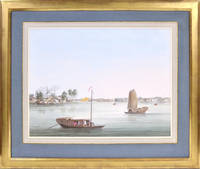
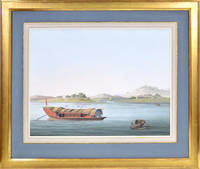
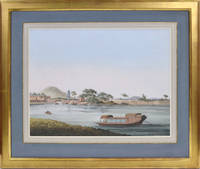
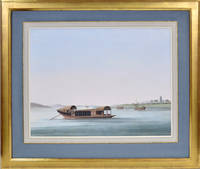
101456Canton circa 1810. . Pencil water colour and body colour drawing of craft heightened with white on paper watermarked 'J Whatman 1804' and '1805'. Framed and glazed overall size: 67.8cm x 57.3cm.<br /> Well executed and highly atmospheric watercolours capturing the importance of the river for trade in early nineteenth century China.<br /><br />Typically with the river in the foreground with a finely executed drawing of a native boat the backgrounds showing landscape scenes interspersed with occasional architectural details.<br /><br />The Pearl River is so named because of the pearl-colored shells that lie at the bottom of the river in the section that flows through the city of Guangzhou. Formerly often known as the Canton River it is an extensive river system in southern China. The name 'Pearl River' is also often used as a catch-all for the watersheds of the Xi 'West' Bei 'North' and Dong 'East' rivers of Guangdong. These rivers are all considered tributaries of the Pearl River because they share a common delta the Pearl River Delta. Measured from the farthest reaches of the Xi River the Pearl River system is China's third-longest river 2400 kilometres after the Yangtze River and the Yellow River and second largest by volume after the Yangtze.<br /> Canton, circa 1810. unknown
101464Canton circa 1810. . Pencil water colour and body colour drawing of craft heightened with white on paper watermarked 'J Whatman 1804' and '1805'. Framed and glazed overall size: 67.8cm x 57.3cm.<br /> 91 mp22pic Well executed and highly atmospheric watercolours capturing the importance of the river for trade in early nineteenth century China<br /><br />Typically with the river in the foreground with a finely executed drawing of a native boat the backgrounds showing landscape scenes interspersed with occasional architectural details.<br /><br />The Pearl River is so named because of the pearl-colored shells that lie at the bottom of the river in the section that flows through the city of Guangzhou. Formerly often known as the Canton River it is an extensive river system in southern China. The name 'Pearl River' is also often used as a catch-all for the watersheds of the Xi 'West' Bei 'North' and Dong 'East' rivers of Guangdong. These rivers are all considered tributaries of the Pearl River because they share a common delta the Pearl River Delta. Measured from the farthest reaches of the Xi River the Pearl River system is China's third-longest river 2400 kilometres after the Yangtze River and the Yellow River and second largest by volume after the Yangtze.<br /> Canton, circa 1810]. unknown
101452Canton circa 1810. . Pencil water colour and body colour drawing of craft heightened with white on paper watermarked 'J Whatman 1804' and '1805'. Framed and glazed overall size: 67.8cm x 57.3cm x 2cm.<br /> 87 mp22pic Well executed and highly atmospheric watercolours capturing the importance of the river for trade in early nineteenth-century ChinA<br /><br />An unusual and very attractive depiction of river life. Typically with the river in the foreground with a finely executed drawing of a native boat the backgrounds showing landscape scenes interspersed with occasional architectural details.<br /><br />The Pearl River is so named because of the pearl-colored shells that lie at the bottom of the river in the section that flows through the city of Guangzhou. Formerly often known as the Canton River it is an extensive river system in southern China. The name 'Pearl River' is also often used as a catch-all for the watersheds of the Xi 'West' Bei 'North' and Dong 'East' rivers of Guangdong. These rivers are all considered tributaries of the Pearl River because they share a common delta the Pearl River Delta. Measured from the farthest reaches of the Xi River the Pearl River system is China's third-longest river 2400 kilometres after the Yangtze River and the Yellow River and second largest by volume after the Yangtze.A<br /> Canton, circa 1810]. unknown
101453Canton circa 1810. . Pencil water colour and body colour drawing of craft heightened with white on paper watermarked 'J Whatman 1804' and '1805'. Framed and glazed overall size: 67.8cm x 57.3cm.<br /> 88 mp22pic Well executed and highly atmospheric watercolours capturing the importance of the river for trade in early nineteenth century China.<br /><br /><br /><br />The Pearl River is so named because of the pearl-colored shells that lie at the bottom of the river in the section that flows through the city of Guangzhou. Formerly often known as the Canton River it is an extensive river system in southern China. The name 'Pearl River' is also often used as a catch-all for the watersheds of the Xi 'West' Bei 'North' and Dong 'East' rivers of Guangdong. These rivers are all considered tributaries of the Pearl River because they share a common delta the Pearl River Delta. Measured from the farthest reaches of the Xi River the Pearl River system is China's third-longest river 2400 kilometres after the Yangtze River and the Yellow River and second largest by volume after the Yangtze.<br /> Canton, circa 1810]. unknown
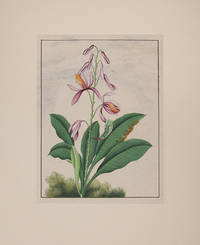
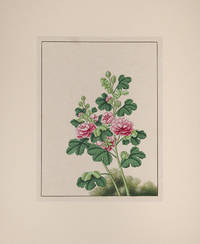
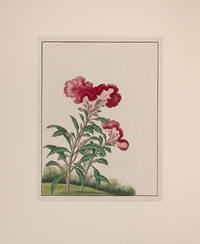
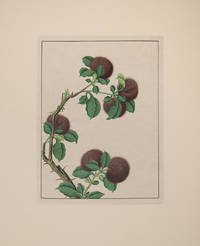
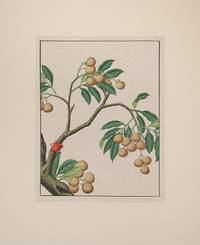
109660China mid nineteenth century. . Ink and gouache on paper mounted. Image size: 356 mm x 300 mm; mounted: 465 mm x 380 mm.<br /> Fine well executed decorative Chinese export watercolour. Light and easily transportable these watercolours mostly produced in the Canton region found a ready market in the West. Natural history studies were and continue to be amongst the most sought-after subjects.<br /> China, mid nineteenth century. unknown
109658China mid 19th century. . Ink and gouache on paper mounted. Image size: 356 mm x 300 mm; mounted: 465 mm x 380 mm.<br /> Fine well executed decorative Chinese export watercolour. Light and easily transportable these watercolours mostly produced in the Canton region found a ready market in the West. Natural history studies were and continue to be amongst the most sought-after subjects.<br /> China, mid 19th century. unknown
109659China mid nineteenth century. . Ink and gouache on paper mounted. Image size: 356 mm x 300 mm; mounted: 465 mm x 380 mm.<br /> Fine well executed decorative Chinese export watercolour. Light and easily transportable these watercolours mostly produced in the Canton region found a ready market in the West. Natural history studies were and continue to be amongst the most sought-after subjects.<br /> China, mid nineteenth century. unknown
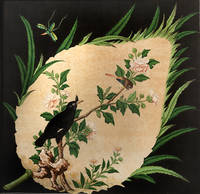
9333419th century. . Four Chinese Export paintings each finely painted in ink and gouache on paper with bird and flower scenes enclosed with floral cartouches on a dark ground.<br />Framed and glazed overall size: 52.3cm x 50.4cm x 3cm. <br /> <br /> 19th century]. unknown
109663China mid nineteenth century. . Ink and gouache on paper mounted. Image size: 356 mm x 300 mm; mounted: 465 mm x 380 mm.<br /> Fine well executed decorative Chinese export watercolour. Light and easily transportable these watercolours mostly produced in the Canton region found a ready market in the West. Natural history studies were and continue to be amongst the most sought-after subjects.<br /> China, mid nineteenth century. unknown
109662China mid nineteenth century. . Ink and gouache on paper mounted. Image size: 356 mm x 300 mm; mounted: 465 mm x 380 mm.<br /> Fine well executed decorative Chinese export watercolour. Light and easily transportable these watercolours mostly produced in the Canton region found a ready market in the West. Natural history studies were and continue to be amongst the most sought-after subjects.<br /> China, mid nineteenth century. unknown
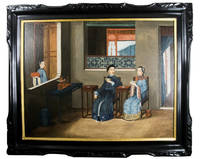
1820ABC_45805China 1820. 47 x 61 cm. picture; 61 x 74.5 cm. frame. Oil painting on canvas in a black lacquered Chinese export frame. An elegant interior scene from a Chinese Mandarins home in the early nineteenth century: a Manchu Mandarin and his consort taking tea in a domestic setting. He wears non-official semi-formal winter attire including rank badge sitting beside ahis beautiful Chinese lady surrounded by fine furniture and fittings. The whole scene reflects his good taste and social standing.Whilst tea had been the driving force of the China Trade since the early eighteenth century giving rise to export paintings illustrating its cultivation and production process the style and subject of the early export paintings was firmly rooted in traditional Chinese art and culture as in this delightful painting.l Cf. Choi Kee Il Tea and design in Chinese export painting in: The Magazine Antiques vol. 154 no. 4 October 1998. unknown
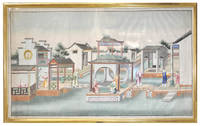
86803Possibly Canton ca.1820. . Two watercolours on paper 95 x 166 cm each; marginal tears some minor restoration light occasional marginal waterstains. Framed and glazed. Overall dimensions: 101 x 171 cm x 5cm.<br /> Very impressive large scale watercolours of Chinese scenes presumably executed for the Western market by an anonymous master and depicting internal and external views of a house. This type of export watercolours is usually found in a much smaller format; due to their very delicate nature it is very uncommon to find examples of such size as the present group and with the colouring still very fresh.<br /> Possibly Canton ca.1820]. unknown
239121916 to 1919 each a ‘Charles Letts School-Boy’s Diary’. At front of diaries for 1916 and 1917 he writes: ‘C L. Harris / 120 Gladstone St / Bedford’. See Fry’s entry by Michael Billington in the Dictonary of National Biography. His brother survives as a rather shadowy figure: he was certainly alive in 1978 when Fry referred to him in the account of his family background ‘Can You Find Me / A Family History’ OUP. In that volume Fry describes his ‘brother Leslie’ as a baby ‘growing sturdily’ noting that ‘though he was later called by his first name Charles he was Leslie for many years to come’. The four years of diary entries that are present here are short and factual and rather uneventful but they have a double interest: at once casting light on the family background of one of England’s finest twentieth-century playwrights and giving a picture of the development of an average English middle-class schoolboy around the period of the First World War as he rises to position of ‘Head of School’ at Bedford. The four volumes are in fair condition aged and worn with the 1916 diary sprung from its covers at the gutter of the rear endpapers. The four volumes are uniform in embossed brown cloth described by the publisher as ‘Art Linen’ each with back loop for pencil. Each volume provides space for four days’ entries per page with numerous preliminary printed pages with the customary useful information including endpapers and other matter reflective of the conflict with maps of the Europe theatre illustrations of medals and of a ‘soldier-’ and ‘sailor-boy hero of the Great War’ the last volume carrying a ‘Message from Admiral Sir John Jellicoe to the Readers of “The Schoolboys’ Diary’. In the first three volumes Harris writes in pencil filling in the diary assiduously from 1 January 1916. In the final volume by May of 1919 the entries become intermittent and on 15 August 1919 they cease entirely. In additional to the daily record Harris also provides details of ‘Pocket Money’ personal information including ‘Size in Hats’ and memoranda dates of significant events such as ‘Promoted to Lance-Corporal in the O.T.C.’ ‘Received 1st XV colours’ and on 24 July 1919 ‘Made HEAD OF SCHOOL.’. Loosely inserted are a few postal order counterfoils and Chatham bus tickets. The entries begin in 1916 with Harris on his school holidays doing errands for his widowed mother and reading to her and entertaining his brother ‘Arthur’ i.e. Christopher Fry for example by taking him on walks to town for a haircut and helping him with his stamp collection. The monotony of school begins repeated entries in early volumes start with ‘School as usual’ and the entries reflect the rounds of sport he is captain of the ‘Wasps’ cricket team in 1916 cadet corps bible classes exams trips to London 2 January 1919: ‘Went over St Dunstans in morning with Jack / Uncle Walter took Jack girl Madeleine & myself up to the “Old Vic†to see Shakespear’s “Macbeth†2.0-5.0. Jolly fine performance though a bit tragic / Left & returned by train took 1 hr each way.’ his health recurring toothache mumps etc the weather involvement for the war effort in agriculture 11 September 1918: ‘Another dismal day all by myself. Have quite made up my mind to chuck farming if this goes on especially as when I was happily walking home at 4.30 I ran into more work & had to load wheat till 7.9.’. By 1918 the entries begin to loosen up a little. On 19 March for example: ‘Rotten wet beastly muddy miserable day with a boil on my chin about the size of an egg & a Corps Inspection 2.30 by Lieut Col Pilkington on top of that. The rest may speak for itself. Also EII beat WII by 1/4 length.’ And on 10 September; ‘G his friend Gerald often referred to & I shocked barley all the morning & then ditched until 5.30. Shocking barley is qute a decent job.’ The signing of the armistice 11 November 1918 is greeted with ‘Flags all over the town bells etc. Bands in afternoon; town packed.’ And on the following day ‘Whole Holiday for Armistice / Thanksgiving Service in Hall instead of Prayers.’ Final entry 14 August 1919: ‘Went over St Mary Redcliffe Church in morn. More wonderful even than the Cathedral. Employed myself immensely. Went on to Downs by myself in even to hear band.’ 1916 to 1919, each a ‘Charles Letts School-Boy’s Diary’. At front of diaries for 1916 and 1917 he writes: ‘C L. Harris / hardcover
19882090502113709044Not Available 1988. Soft Cover. Fine. The book is in fine condition. Not Available paperback
18712437Charterhouse School 1871. Hardcover. Very good. Dates: 1871-1877 and 1910. Small 4to. 37 ff. mostly with newspaper clippings neatly pasted in on both sides 4 ff. in manuscript "Summary of Scores" from 1871-1877 and 1910. Several leaves excised; it is possible that the present album had been re-purposed. On a few of the stubs appear fragmentary MS notations suggesting that the notebook may have once been divided alphabetically. We find on certain stubs "Ai" followed immediately by "Ao" and then several leaves later: "Her. - Hes" followed by "Io." Binding rebacked with smooth calf. In very good condition. Highly interesting homemade album of Cricket Scores available nowhere else specifically documenting the triumphs of three young members of the Blomfield family namely: E.G. Edward George C.J. Charles James and R.T. Reginald Theodore. One wonders if the present album was created in order to promote friendly competition between the brothers two of whom went to Haileybury School and one went to Charterhouse; all three went up to Oxford. There are scores and game synopsis of matches were between Haileybury Charterhouse Marylebone Cricket Club MCC Westminster Trinity College Oxon. Exeter Oxon. and more. One of the more interesting features about the album is that it provides a fascinating record of one family's love of the game:<br /> <br /> ¶ Edward George 1853-1885 entered Charterhouse School London in 1865 and transfer upon the School's removal to Godalming in 1872; in 1873 he went to Trinity College Oxon. where he earned a B.A. in 1877 and M.A. in 1879; thereafter he served as Curate of St. Mary's Portsea until 1883 and then Vicar of St. Mark's Woolston until his death in London in 1885.<br /> <br /> ¶ Charles James 1855-1928 went to Haileybury School; he underwent military training at Sandhurst and served as an army officer in India Sudan and Natal. He attained the rank of Major General before his retirement in 1917. NB: this individual is not to be confused with a noted architect of the same name b. 1862 d. 1932. <br /> <br /> ¶ Reginald Theodore 1856-1942 also went to Haileybury School; he earned his B.A. from Exeter Oxon. in 1880 and M.A. in 1884. He became an architect and was knighted in 1919. He is remembered mainly for his work designing British war memorials. <br /> <br /> ¶ The parents of the three young men were Rev. George John and his first cousin Isabella Blomfield of Bow Devonshire whose own father Charles James Blomfield was Bishop of London. <br /> <br /> ¶ At the end is a "Summary of Scores" for the years 1871-1877. Following this in a different hand is the year 1910; although the initial of the last name "Blomfield" remains the same the other initials belong to Reginald Thomas and his two sons Henry George and Austin. <br /> <br /> ¶ See Stedman Charterhouse Register 1872-1900 passim. CATALOGUER'S NOTE: We are grateful to Catherine Smith Archivist of Charterhouse School for much useful information concerning the Blomfield Family. hardcover
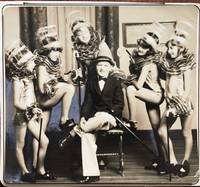
193058055Portland OR: Hollywood College of Music Dancing & Fine Arts Baker Studio Granada Studio La Vere Photo Shoppe Photo Craft Studios ca. 1930-1933. Oblong 4to. 24 original photographs all preserved in archival mylar sleeves sized 6.25 x 7 in. up to 8 x 10 in. some w/ photographer’s imprint w/in negative others w/ manuscript captions added a few w/ annotations and/or photographer’s instructions on versos all with bright strong contrast a few w/ offsetting from previous mounting on versos and one w/ very small pinholes at corners from prior mounting. Recent cloth binder stamping front cover excellent grouping. These photographs vividly document the dance and music studio operated by Annabelle Knowles reflecting the fast evolving costumes and aesthetics of the twilight of the Roaring 20’s as the U.S. descended into the Great Depression. These photos also clearly reflect the influence of Gus Edwards 1879-1945 vaudeville’s premier producer of kiddie acts and who had produced and released the shorts “Kiddie Revue†in 1930 and 1931. His influence was not only driven by his songs “By the Light of the Silvery Moon & “School Days†but also discovering such stars as Groucho Marx Eddie Cantor Mae Murray Sally Rand and many others. The images depict girls in two-piece outfits in front of Art Deco staging for “Body and Soulâ€; bare-backed girls in Flapper Era inspired costumes for chorus line “Kiddie Revueâ€; song and dance routines featuring Ronald Chetwood in top hat with Marcile Shillito Virginia Collins and chorus line in Jazz Age era costumes and canes; and several show Barbara Jane Wicks Shirley Jay Mulkey and Sunny Dentler in Spanish inspired costumes for “Baby Vanities.†Another shows adolescent boy and girl dance team in an “Apache†dance inspired costume number. The Hollywood College of Music Dance & Fine Arts offered classes and instruction in all ages with the last few photos showing teenage girls in chorus line with short hair coquettish expressions and teamwork or chorus line numbers. Annabelle Knowles 1900-1989 was a musician and dancer who founded the Hollywood College of Music Dancing & FIne Arts at 4112 NE Sandy Blvd. some time in the late 1920’s. Most of the street directory references focus on 1929-1932 and her British-America theatre-director husband at the time Vincent Knowles 1883-1944 worked at the studio as well. Baker 1882-1972 was a longtime commercial studio photographer in Portland OR who had initially begun as a photographer with noted tourist travel guide Howard Eaton photographing tours through National Pakrs. Beem 1892-1984 was founder and photographer at Granada Studio located in the 1930’s at 515 Swetland Building in Portland. Centlivere 1878-1964 owned and operated La Vere Photo Shoppe and Photo Craft Studios on Sandy Blvd. in Portland for nearly all of his career. We could find no similar collections or photographs or even references to Annabelle Knowles and very few examples of any of these three photography studios in institutional holdings. Hollywood College of Music, Dancing & Fine Arts, Baker Studio, Granada Studio, La Vere Photo Shoppe, Photo Craft Studios, hardcover
189741634Salt Lake City: Geo. Q. Cannon & Sons Company 1897. First edition. Hardcover. Tall thin octavo 25 cm Dark green cloth over boards with a gilt stamped title and decorative borders on the front cover. Very good. There is a 2" split in the cloth along the rear joint and a thin layer of glue has been applied to the spine from the head to the foot. The underlying boards are exposed occasionally along the edges. There are a handful of very minor stains on the covers. This copy once belonged to the Deseret Sunday School Union and has several library markings on the endpapers and title page and a handwritten notation at the foot of the spine. There is a small loss from the top fore edge corner of the front free endsheet. Flake 1551. Lessons include Jesus as a Boy Jesus and the Woman of Samaria The Parable of the Sower The Last Supper The Visit of Jesus to the Nephites Cain and Abel The Necessity of a Latter-day Prophet Joseph Smith's First Vision and more. Geo. Q. Cannon & Sons Company hardcover
2092902143300346Kiyu dojin N.A. Soft Cover. Fine. Number of pages: 1 47 Size: 25.7x18.1cm Kiyu dojin paperback
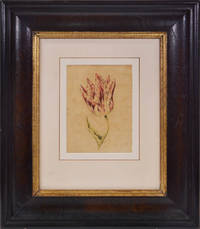
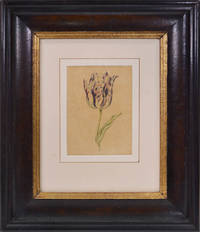
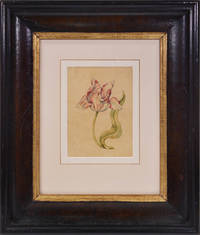
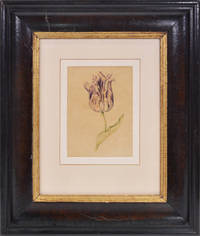
61952Holland 18th Century. . Water-colour on Dutch laid paper some light spotting and toning to paper. Framed and glazed overall size: 38.7cm x 45.7cm. Dimensions: 180 x 130mm. 7 x 5 inches.<br /> From a "Tulip Book" in the manner of Anthony Claesz who produced his own "Tulip Book" in c. 1641. These florilegia were commissioned to illustrate the differences between varieties of tulip bulb which at the time demanded such high prices. The beauty of these works ensured that their images would be copied for decades to come by amateur painters and gardeners alike. Claesz was a Dutch master in his own right with several highly accomplished works to his name. However as with most of the great Dutch masters of this period they happily supplemented their income by illustrating such books. It also allowed them to study in detail subjects that would later be incorporated in their great flower pieces.<br /><br />Provenance: Private Dutch collection.<br /> [Holland, 18th Century]. unknown
60722Holland 18th century. . Water-colour on Dutch laid paper some light toning. Framed and glazed overall size: 38.7cm by 45.7cm. Dimensions: 18 by 13cm. 7 by 5 inches.<br /> From a "Tulip Book" in the manner of Anthony Claesz who produced his own "Tulip Book" in c.1641. These florilegia were commissioned to illustrate the differences between varieties of tulip bulb which at the time demanded such high prices. The beauty of these works ensured that their images would be copied for decades to come by amateur painters and gardeners alike. Claesz was a Dutch master in his own right with several highly accomplished works to his name. However as with most of the great Dutch masters of this period they happily supplemented their income by illustrating such books. It also allowed them to study in detail subjects that would later be incorporated in their great flower pieces.<br /> [Holland, 18th century]. unknown
60952Holland 18th century. . Water-colour on Dutch laid paper light paper toning. Framed and glazed overall size: 38.7cm x 45.7cm. Dimensions: 180 x 130mm. 7 x 5 inches.<br /> From a "Tulip Book" in the manner of Anthony Claesz who produced his own "Tulip Book" in c. 1641. These florilegia were commissioned to illustrate the differences between varieties of tulip bulb which at the time demanded such high prices. The beauty of these works ensured that their images would be copied for decades to come by amateur painters and gardeners alike. Claesz was a Dutch master in his own right with several highly accomplished works to his name. However as with most of the great Dutch masters of this period they happily supplemented their income by illustrating such books. It also allowed them to study in detail subjects that would later be incorporated in their great flower pieces.<br /><br />Provenance: Private Dutch collection.<br /> [Holland, 18th century]. unknown
60719Holland 18th Century. . Water-colour on Dutch laid paper some light toning. Framed and glazed overall dimensions: 38.7cm by 45.7cm. Dimensions: 18 by 13cm. 7 by 5 inches.<br /> From a "Tulip Book" in the manner of Anthony Claesz who produced his own "Tulip Book" in c. 1641. These florilegia were commissioned to illustrate the differences between varieties of tulip bulb which at the time demanded such high prices. The beauty of these works ensured that their images would be copied for decades to come by amateur painters and gardeners alike. Claesz was a Dutch master in his own right with several highly accomplished works to his name. However as with most of the great Dutch masters of this period they happily supplemented their income by illustrating such books. It also allowed them to study in detail subjects that would later be incorporated in their great flower pieces. <br /><br />Provenance: Private Dutch collection.<br /> [Holland, 18th Century]. unknown
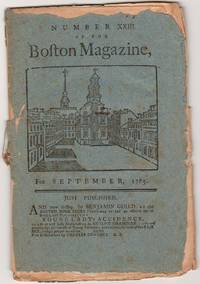
17853784<b><i>Founding of Harvard Medical School</i></b><br /><br /><i>The Boston Magazine</i> was published from October 1783 to December 1786 and was the first magazine to be published in Boston in the aftermath of the American Revolution. A major attraction of this issue is the presence of the front and rear printed wrappers although they are frayed and detached. The front wrapper features a large woodcut of the State House and surrounding buildings in Boston.The first 3 1/2 pages of the<i> Magazine</i> are Harvard's announcement from September 1783 of the creation of "the Medical Institution" now known as Harvard Medical School. This is followed by about two pages of an address "to the students in physic" i.e. the medical students reflecting upon the first two years of the medical school and outlining the requirements for a medical degree. About two pages are devoted to the sailing directions into and out of Plymouth Harbour. A brief news item in the "Monthly Chronology" reports a meeting to be held in October in Falmouth in the District of Maine on creating a "separate government" for the eastern counties -- a very early report on a separation that would not happen for another 35 years. Issues of <i>The Boston Magazine</i> in the original wrappers are extremely uncommon.<b>References</b>: Mott<i> A History of American Magazines 1741-1850</i>: Vol. I p. 28. Richardson <i>A History of Early American Magazines 1741-1789</i>: pp. 212-227. Lomazow <i>American Periodicals</i>: 15. <br /><br /><br /><b>Condition:</b> Signatures loose. Front and back wrappers present but frayed and detached; top 1/2" or so of front wrapper lacking. Occasional spotting. Interior pages very good. ICN 2933. Printed and published by Edmund Freeman
20082092902137601839Chunghwa Book Office Publishing 2008. Soft Cover. Fine. Number of pages: 972 pages Size: A5 Number of books: 2 Chunghwa Book Office Publishing paperback
15466Couverture rigide. Bon/1957. in-8. Milano Edizioni Stedar 1957 in-8 90 6pp cartonnage imprimé. Rel. de l'éd. Edition soignée tirée à petit nombre d'exemplaires. Envoi autographe signé du commentateur au docteur André Soubiran unknown