24 936 résultats
19602080202103705330Kagoshima Tadashi High School Alumni 1960. Soft Cover. Fine. Page number: 137p Size: 21cm A5 Kagoshima Tadashi High School Alumni paperback
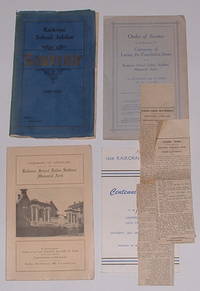
191917773Dunedin: Stone Son & Co. Good with no dust jacket. 1919. First Edition. Softcover. Wrappers worn and creased with small tears to margins. Owner's signature "Mary Helen Wardrop 28/11/19".; 44 pages. Blue printed wrappers. Page dimensions: 219 x 137mm. Illustrated. New Zealand regional history Kaikorai School Rosyln Dunedin. 3 others: 2 "Order of Service to be observed at the Ceremony of Laying the Foundation Stone of the Kaikorai School Fallen Soldiers' Memorial Arch. On Saturday 29th October A.D. 1921; A.L.5921 at 3 o'clock p.m." 4 pages. With two contemporary newspaper clippings. 3 "Ceremony of Unveiling - The Kaikorai School Fallen Soldiers' Memorial Arch - By His Excellency Admiral of the Fleet Viscount Jellicoe of Scapa . . . Sunday 12 February 1922 at 3 o'clock p.m." 4 pages. 4 "Centennial Dinner - Kaikorai School - 1868 - 1968". 4 pages. 22 autographs on "Autographs" page. . Stone, Son & Co. paperback
CORV-BBP-19672Kailua High School. Kailua HI. Plastic Comb. Very Good. Very good. Comb-bound 4to. This booklet is the product of work done by students in the 9th Grade GT English and Social Studies Classes. The stories are based on interviews the students did with older family members. 35pp. B/w photos illustrations. > Language: English > Size: 4to > Media/Binding: Comb Bound Kailua High School., Kailua, HI unknown
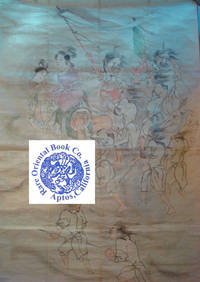
36023801Japan 1860 n.p. Large sheet 96 x 1m 44 cm. gouachevery clean work no worming or other condition issues painted on 16 joined sheets of Washi paper to make one large sheetfine water-color painting. THIS IS AN ORIGINAL PAINTED ART WORK . . . AM ORIGINAL COLOR PAINTING IN GRAND SIZE . . . FROM JAPAN'S OLDEST MYTHOLOGY: . . . THE KOJIKI & NIHON SHOKI PANTHEON . . . THE ORIGINS OF THE EMPEROR . . . OTOHIME GYO RETSU ZU: . . . THE PROCESSION OF OTOHIME DAUGHTER OF THE SEA GOD . . A stunning color painting by Kyosai. Probably done for a temple donation or as an expression of his faith to Japan's historic heroine. . OTOHIME is a goddess in Japanese mythology and is featured in the Kojiki as well as Nihon Shoki. Also known as "Luminous Jewel". A Japanese goddess the beautiful daughter of the sea-king Ryujin. She married Hoori and gave birth to a son after which she turned into a dragon. . Per the Japanese text brushed on the verso upper left corner: "239 ban dated Ansei 7th Kanoe-Saru-doshi 2 gatsu jojun end of February OTOHIME GYO RETSU ZU" . English: "#239 dated Ansei 7th monkey zodiac year end of Feb.: 1860 . PAINTING TITLE PER VERSO: "THE FIGURE OF PRINCESS OTOHIME'S PROCESSION THE DAUGHTER OF THE SEA GOD" . "Toyotama-hime" Japanese for "Lady Bountiful Soul" better known as Otohime is a goddess in Japanese mythology and is featured in the Kojiki as well as Nihon Shoki. She is the beautiful daughter of Ryujin the "God of the Sea." . A STUNNING ORIGINAL POLYCHROME GOUACHE PAINTING: . This original color watercolor painting shows the lively procession of OTOHIME and her hand maid. She is followed by a flag and umbrella bearer. Also following is a man with a pair of deer antlers good omen a man with a small red offering table with peaches the Wind God and his thunder-drum. Another flag bearer his helper followed by two others one holds a staff the other an offering of golden egg. . The items carries are symbolic good fortune and wealth in terms of deer antlers peaches and the golden egg represent ancient Chinese also used by the Japanese of omens of good fortune and good luck. . THE PAINTING: . Per the Japanese brushed text on the verso there is a number found meaning this panel of several was part of a larger work per the chronology found in Clark see below. . This panel of several paintings was part of a restoration of Zojo-ji temple in Shiba. In 1859 KANO Toei & Kyosai "participates in a repair project at the Zojo-ji temple." See Clark. . Although Kyosai had officially left the Kano school in 1854 by participating in the restoration of Tokugawa's family temple in Shiba he was showing loyalty to the Tokugawa family a good reason to volunteer his skills to the temple. It is also noteworthy that his mentor Kano Toei also participated in the restoration and in all likelihood Kyosai joined his master in a sign of respect and loyalty to him. . Based on this chronology it is clear Kyosai was one of the painters who worked at Zojo-ji temple along with his mentor and master teacher Kano Toei. It was not uncommon at this time for schools to volunteer teachers and students to do temple restoration and art work painting replacing or enhancing paintings and large murals. . This item's date matches the restoration dates for the Zojo-ji temple which began in 1859 and continued into 1860. . This panel was unused in the restoration it may have been a precursor to the final painting which was actually used in the restoration project. It matches the scenes found in Zojo-ji temple restoration. The work is the exact style of others painted by Kyosai and his genre. The caricatures of the people in this painting reflect Kyosai's style exactly the theme of his eccentric humor expressing his love for creativity and the joy of painting. . It is entirely within Kyosai's bizarre character to undertake and devote himself to such a project as illustrating the famous myth of OTOHIME in more than 200 deluxe extra-large-size format paintings. . This restoration project could also have been a 'paying job' for Kyosai as at that time he did not seem to be employed but in 1858 he began to design "Kyoga crazy pictures. It was in 1857 he married Okyo the daughter of a Rimpa painter Suzuki Kiitsu but Okyo died in 1859 and he remarried Tose who died in 1860. . It is more than likely Kyosai being a Buddhist he felt it was his religious obligation to do pennants by contributing to and drawing Buddhist or such traditional images as a way to placate the loss of his wife. . THE STORY OF OTOHIME DAUGHTER OF THE SEA GOD: . Because this work was part of the Zojo-ji temple restoration it cannot be considered a commercial painting one that was casually drawn and put on the market for sale. This was part of a commissioned restoration financed by some benefactor to the temple and most likely supported by the Tokugawa family. . ONE OF JAPAN'S EARLIEST AND MOST FAMOUS MYTHS: . The story of OTOHIME DAUGHTER OF THE SEA GOD is one of Japan's oldest and most famous myths known to all Japanese. Treasured as one of the most important in the ancient pantheon it is found in the earliest writing about the origin of Japan and the Emperor in the KOJIKI and the NIHON SHOKI. . This kind of larger paper illustrated story would take months to complete by It would also take devotion to the subject and focus with responsibility to produce a good number of paints daily. This was something Kyosai could and would do ! . THE ARTIST/PAINTER: This work is unsigned which is expected as part of a larger series of paintings. If this was the work of Kyosai it falls entirely within the dates during his period of work produced when he was 29 years old. . The caricature in the faces and fluid bodies in motion the "flowing" style are his. Although there is no signature and it is a true reflection of Kawanabe's work we are attributing it to him. . Another convincing point is that this kind of painting and meticulous style is also found in his famous instructional showing various 'schools' of painting in his KYOSAI GADEN. See below. . WHO WAS KAWANABE GYOSAI/KYOSAI: 1831-1889: Kawanabe Kyosai was a superb artist in the words of a critic "an individualist and an independent perhaps the last virtuoso in traditional Japanese painting". . Living through the Edo period to the Meiji period Kyosai witnessed Japan transform itself from a feudal country into a modern state. Born at Koga he was the son of a Samurai. His first aesthetic shock was at the age of nine when he picked up a human head apart from a corpse in the Kanda river. . After working for a short time as a boy with Utagawa Kuniyoshi he received his artistic training in the Kano school but soon abandoned the formal traditions for the greater freedom of the popular school. During the political ferment which produced and followed the revolution of 1867 Kyosai attained a reputation as a caricaturist. His very long painting on Makimono" scroll The battle of the farts" may be seen as a caricature of this ferment. . He was arrested three times and imprisoned by the authorities of the Shogunate. Soon after the assumption of effective power by the Emperor a great congress of painters and men of letters was held at which Kyosai was present. . He again expressed his opinion of the new movement in a caricature which had a great popular success but also brought him into the hands of the police this time of the opposite party. After this time he changed his name from Kyo crazy or wild to any one of 19 other "Go" studio names he used. However after the police jailed him he avoided use of "Kyo" but returned back to it with three other "GO" that used the same character "Kyo" crazy & wild such as #7 "Baiga Kyosha" #10 "Kyosai #12 Kyosha Gaishi #16 "Shosho Kyosai" Quoted from Roberts below see that reference for more details. . Kyosai is considered by many to be the greatest successor of Hokusai as well as the first political caricaturist of Japan. His work mirrored his life in its wild and undisciplined nature and occasionally reflected his love of drink. . Color photos are posted to our website. . REFERENCE: . More on OTO HIME: heon-org/articles/o/otohime-html KAWANABE Gyosai later known as Kyosai: Is well collected by world museums I GADAN: 1887 4 vol. set: In this work he outlines and exhibits a wide variety of "styles" of painting. In this work there are several examples of this kind or school of painting. Wikipedia stated about this book: "The most important work about Kyosai's art and life was written by himself: Kyosai Gadan or "Kyosai's Treatise on Painting" half autobiography and half painting manual. WESTERN APPRECIATORS: Many westerners came to visit Kyosai and their memoirs about the artist are valuable. The two important ones both rare were: Emile Etienne Guimet Promenades Japonaises Paris 1880. Josiah Conder: "Paintings and Studies by Kawanabe Kyosai" Tokyo 1911. Conder was a serious student of Japanese art; after some initial rejections he was accepted as Kyosai's pupil and accompanied him for ten years until the master's death. Timothy Clark Demon of painting: the art of Kawanabe Kyosai p.186 chronology and the drawing #21 p.58 is very similar to the pose found in our painting of OTOHIME Toyotama-hime both in pose facial quality hair style and the general perspective. ROBERTS Laurance P.: A DICTIONARY OF JAPANESE ARTISTS: PAINTING SCULPTURE CERAMICS PRINTS LACQUER p.100 stated of him: Kyosai ".was marked by a wild eccentric humor.caricatures of full of fantasy and invention." KAWANABE KYOSAI MEMORIAL MUSEUM. KAWANABE KYOSAI DOKU HON. OTOHIME: Nihon Jinmei Daijiten Toyotama-hime. Tokyo: Shogakukan. 2012. . . unknown
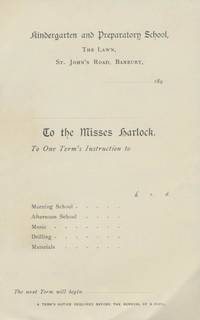
18903210273<p><em>8vo sheet 16 x 10 cm.</em></p><p>Maria and Frances Anne Harlock began their school at Banbury Oxfordshire about 1890. The Harlock's were natives of Banbury and the daughters of a local draper and former mayor who used part of the family home as a school until the death of their father in 1923 who was by then 101. As the Harlock's were Quakers good works by the family for the local area was something of a calling. Francis later served on the committee of management of the Friends' School at Sibford and it would appear that the sisters had run their own school on a break-even principle and saw education as a vocation rather than a money making enterprise.</p> The Lawn, St. John’s Road, Banbury.
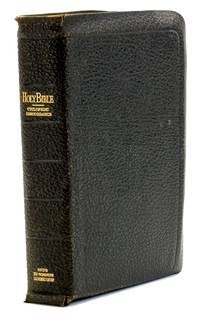
1945510236Oxford 1945. Leather. VERY GOOD. The scarce and coveted 'Long Primer' setting with center column references self-pronouncing black letter text in a very legible type in large-formate 8vo setting. Black genuine leather binding with pronounced grain in semi-yapp gilt spine lettering all edges art gilt. 'Sunday School' edition with concordance maps and other 'helps'. With owner's inscription and family history to front blanks as well as multiple obituaries inlaid. Front endpaper is torn at the front gutter but the leather and binding remain very strong; spine ends torn at corners as commonly seen with yapp some moderate rubbing to the textblock edges but still very clean and sound an attractive copy. Publication date of 1945 stamped to rear blank with the text of the bible itself stamped '43' at the end of Revelation. Oxford unknown
2080702109504758Editorial Committee for the 100th Anniversary of the 2nd Department of Internal Medicine Kyushu University School of Medicine N.A. Soft Cover. Fine. Pages: 284p Plate size: 30cm Number of books: 1 Editorial Committee for the 100th Anniversary of the 2nd Department of Internal Medicine, Kyushu University School of Medicine paperback
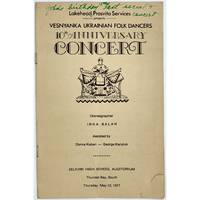
19777289Thunder Bay Ontario Canada: Lakehead Prosvita Services & The Vesnyanka Dance School 1977. First Edition First Printing. Stapled Wraps. Unpaginated pp. 4. 8vo. measuring 14x 22 cm. Illustrated twice-stapled card covers. Comprises of a detailed programme of events surrounding the tenth anniversary concert of the Vesnyanka Ukrainian Folk Dancers held in Thunder Bay short biographies of the choreorapher guest dancers and performers a short history of the dancing troupe a complete list of the names of all performers names of program sponsors individual and businesses the last page and rear cover features printed advertisements for a number of local sponsoring businesses. Neat unobtusive ink inscription to the upper-margin of the cover one very short closed tear to the edge of the front cover. Overall very good. Unrecorded programme booklet with no holdings found in OCLC. Not in Fisher UoT BAC/LAC etc. <br/><br/> Lakehead Prosvita Services & The Vesnyanka Dance School paperback
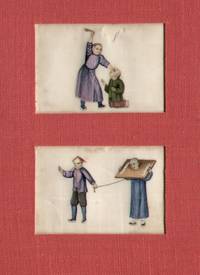
30018401Canton ca. 1800-1820 Lam-Qua. Red flax mat six goauche color paintings on pith paper each 10 x 7 cm two per mat very good clean two with marginal chipsimage not affected meticulously color drawn in much detail. R A R E . . . THE SUITE OF SIX COLOR GOUACHE PAINTINGS . . Begins with the a painting of Imperial police bringing the accused to where he will be punished. He wears a cangue or a large wooden collar clamped around his neck with his crime written on paper which is then glued to the wood. Image two shows the guilty on his knees being beaten with a leather strap by the punisher. Image three shows the policeman pulling a chain connected to a metal ring on the neck of the accused. The next shows the image of a large rock connected to a chain and the accused sitting on the rock with the chain fastened to his leg. The fifth shows the magistrate pointing his finger at the guilty as he while being admonished the guilty is forced to kneel on small rocks while a policeman holds ears. The last image shows the executioner with a long sword at the ready while the accused has a very sour look on his face his hands tied behind his back with his crime written on a long piece of wood at his side. It was common to parade the guilty through the streets for all to see the criminal as he was led to the execution grounds. . LAM-QUA TING-QUA SCHOOL: The works are done in the Canton style of Lam-Qua and his brother Ting-qua. See item #2 below for a link. . Ting-qua born ca. 1809; flourished 1840-70. He was the brother of Lam-Qua 1801-1860 and probably a close relation of Spoilum. Ting-qua's studio at 16 China Street Guangzhou was perhaps the most prolific source of Chinese export paintings of its time. Working in a manner influenced by Western artistic traditions Ting-qua and the painters of his studio restricted themselves to gouache and water-colors perhaps to avoid rivalry with Lam-qua's oil paintings. Their pictures which were often sold in sets." Quoted from item #2 below. . PITH PAPER: The paintings were done on pith paper. "Pith paper or rice paper" a misnomer as it is sometimes known is made from the inner pith of the plant Tetrapanex papyrifera which is a member of the Araliaceae family. The plant is a shrub native to Southern China and Taiwan. As well as a painting material pith paper was used to make artificial flowers and surgical dressings." Cited from item #1 below. . THE LEGAL SYSTEM OF CHINA IN EARLY 19TH CENTURY: Justice was swift and usually done to make an example of the accused. If the accused pleaded guilty and confessed his punishment was lessoned. If he persisted in innocence even though he was not guilty his punishment was more severe. Showing a cooperative attitude was of advantage. Nearly all people accused of a crime were assumed to be guilty. The punishment for various crimes were commonly known and justice was meted out by the magistrate. . RARITY: Gouache pith paintings are now rare most were damaged cracked and brittle rendering them useless. The few that survived are considered RARE and uncommon. The paintings were drawn with much skill and patience and were for the most part drawn for and sold to foreigners in the treaty ports of China in the early 19th century. Drawn with a fine brush in vivid colors the paintings depicted things that would fascinate foreigners and encourage them to bring home as souvenirs. The current examples often caught the eye of foreigners who may have actually seen some form of public punishment or execution. . CONDITION: The work is remarkable clean and solid. As usual when ever pith paper is fastened at the corners there is a reaction to moisture in the air and the paper will expand or contract and thus snap its connection. By and large these works are not damaged except for two corners where there was some loss. Please see link #1 below on how to mount and care for pith paintings. These can be re-matted per the link and preserved on acid-free paper and reframed for display. . Color photos are posted to our website. . BIBLIOGRAPHY: . C.L. Crossman: THE DECORATIVE ARTS OF THE CHINA TRADE p.173-203 and the associated color and b.w. photo examples. C.L. Crossman THE CHINA TRADE p.93-120 and the photos. A. Chu: ORIENTAL ANTIQUES AND COLLECTIBLES pp.62-67 photo #60. 1: see: artfacts dot org/artinfo/articals/pith_paper dot html 2. www dot answers dot com/topic/tingqua 3. Wikipedia: Lam_Qua C.L. Crossman: THE DECORATIVE ARTS OF THE CHINA TRADE p.173-203 and the associated color and b.w. photo examples. C.L. Crossman THE CHINA TRADE p.93-120 and the photos. A. Chu: ORIENTAL ANTIQUES AND COLLECTIBLES pp.62-67 photo #60. . unknown
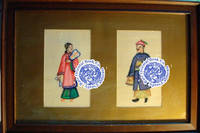
34040601Canton 1800-1820 Lam-Qua. Framed & glazed gold mat a pair of hand-painted "Pith" paintings 5.7 x 9.5 cm. matted size very clean bright excellent examples. ORIGINAL HAND-PAINT IN FULL COLOR. R A R E ! . . . A RARE PAIR OF 'PITH' PAINTINGS . . . IN EXCELLENT CONDITION . . A pair of lovely and delicately color painted Chinese couple. The woman on the left wears a long ping silk gown with emerald green under skirt. She hold a silk fan with a painted flower in her left hand and in her right a silken cloth. She wears jade earring and has a flower in her hair. She wears white shoes with orange tops. The man clearly a Mandarin wears a purple robe with his "Mandarin Square" silk embroidered rank on his chest. His undergarment is the typical Imperial green red and yellow colors. He wear the typical Mandarin's hat of red and pink with a green feather. His shoes are the typical black cloth top with white felt soles. The both look at each other. A typical Mandarin scene. . LAM-QUA & TING-QUA SCHOOLS: The works are done in the Canton style of Lam-Qua and his brother Ting-qua. See item #2 below for a link. . Ting-qua born ca. 1809; flourished 1840-70. He was the brother of Lam-Qua 1801-1860 and probably a close relation of Spoilum. Ting-qua's studio at 16 China Street Guangzhou was perhaps the most prolific source of Chinese export paintings of its time. Working in a manner influenced by Western artistic traditions Ting-qua and the painters of his studio restricted themselves to gouache and water-colors perhaps to avoid rivalry with Lam-qua's oil paintings. Their pictures which were often sold in sets." Quoted from item #2 below. . PITH PAPER: The paintings were done on pith paper. "Pith paper or rice paper a misnomer as it is sometimes known is made from the inner pith of the plant Tetrapanex papyrifera which is a member of the Araliaceae family. The plant is a shrub native to Southern China and Taiwan. As well as a painting material pith paper was used to make artificial flowers and surgical dressings." Cited from item #1 below. . THE LEGAL SYSTEM OF CHINA IN EARLY 19TH CENTURY: Justice was swift and usually done to make an example of the accused. If the accused pleaded guilty and confessed his punishment was lessoned. If he persisted in innocence even though he was not guilty his punishment was more severe. Showing a cooperative attitude was of advantage. Nearly all people accused of a crime were assumed to be guilty. The punishment for various crimes were commonly known and justice was meted out by the magistrate. . RARITY: Gouache pith paintings are now rare most were damaged cracked and brittle rendering them useless. The few that survived are considered RARE and uncommon. The paintings were drawn with much skill and patience and were for the most part drawn for and sold to foreigners in the treaty ports of China in the early 19th century. Drawn with a fine brush in vivid colors the paintings depicted things that would fascinate foreigners and encourage them to bring home as souvenirs. The current examples often caught the eye of foreigners who may have actually seen some form of public punishment or execution. . CONDITION: The work is remarkable clean and solid. There are no damage to the paintings visible from the glazed side the back has not been opened but the images look very clean solid with none of the usual cracking or other damage often found on these kinds of early paintings. The frame is clean solid and ready for library or display. . THE FRAMING AND MOUNTING: The pair of painting have been western-style gold-matted framed in brown wood and glazed. The over all size of the frame is 25.5 x 17.5 cm. The verso or back has brown paper glued to all edges and two tiny holes in the back where eyelets were probably screwed in to hold the hanging wire not present. . REFERENCES: . ease see this site for copious details on pith plant and its uses. -org/wiki/Lam_Qua C.L. Crossman.: THE DECORATIVE ARTS OF THE CHINA TRADE p.173-203 and the associated color and b.w. photo examples. . C.L. Crossman.: THE CHINA TRADE p.93-120 and the photos. Arthur Chu.: ORIENTAL ANTIQUES AND COLLECTIBLES pp.62-67 photo #60. . . unknown
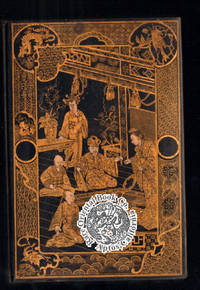
35006201Canton ca.1800-1820 Lam-Qua.Black lacquer gold painted 12 fine gouache hand-drawn & colored paintings 12.5 x 16.5 cm. very fine condition each mounted in an album with old gold paper corners on pith paperexcellent example. RARE ! . . . A SUPERB SUITE OF TWELVE STUNNING COLOR PITH PAINTINGS . . . ILLUSTRATING VARIOUS CHINESE IN ELABORATE COSTUME . This is a charming suite of 12 lovely portraits of Chinese men women and military men. . THE PAINTED SUBJECTS: . 1. An old sage holds a scroll of holy texts while he is seated behind him stands a guard with a pole sword. . 2. A young warrior holds a long axe ready for action. . 3. A young lady a white porcelain teacup. . 4. A warrior holds his halberd ready for action. . 5. A fierce older warrior holds a sword and his shield. . 6. A guard holds his long sword at the ready. . 7. An elderly man strokes his long beard. . 8. A young man takes a stroll holding a fan behind his back. . 9. An elderly an holds two Burmese-green jade bracelets. . 10. A man holds a feather fan. . 11. A very old man holds his long sword. . 12. A bearded man points with his hand toward the right. . The twelve paintings are gently mounted to stiff black album pages with the old style "NuAce" photo mounting corners. There is no damage to the paintings with this technique. . THE STUNNING GOLD OVER BLACK ILLUSTRATED LACQUER COVERS: This is a very unusual binding hand-painted in gold lacquer over black lacquer background on wooden boards. . The cover illustration shows five Chinese: The Lord & Master; his concubine; his son Prince; his retainer; and the maid. . The Lord & master is seen seated before a tea service with three golden cups and a golden ceramic tea pot. The Lord & Master reaches for the hand of his fair and very young concubine who holds a fan. The tea service is clearly for three people: The Lord & Master his son the Prince and the concubine. . The retainer is seated just behind the Lord & Master's right side showing proper respect by looking at the floor. The young Prince the son is seated before his father and looks at the concubine. At the rear is the maid waiting for order. She puts her right hand on the adjacent table holding a tray. . The work has an elaborate and stunning border. In the upper corners are two stunning illustrations: the upper left sows the Golden Dragon in the upper right is the Phoenix. At the left center margin is a golden Peacock. The margin-borders are elaborately done with differing traditional Chinese patterns and designs. A most stunning view inside of the . The back is plain black lacquer. . The spine is black leather with period Chinese swastika design white over black end papers. Some of the old glue is showing through the very thin tissue endpapers else very solid with heavy black pages. . CONDITION OF THE GOLD AND BLACK LACQUER COVERS: The covers are in exceptionally good condition. There are two minor spots: one ca. 1.5 cm spot at the son's midsection and another black spot .05 cm just below his robe. . There is the very small amount of occasional and barely visible usual and very minor mild scuffing with a minor discoloration of the face of the maid. There is a bit of 'crackle' to the black lacquer which is normal for a piece 200 years old. Else this is in very nice condition. . CONDITION OF THE PAINTINGS: These are exceptionally bright and clean drawings lightly mounted on a now browned backing paper with blue-glossy patterned paper borders. . Numbers: . 1 has a tiny 1.5 & .5 cm. small split at bottom left this does not affect the painting. . 2 has the lower portion folded in the process of paper-making which is normal variation and does not detract. . 5 has a tiny 1 cm. split at top in the margin this does not affect the painting. . 9 has a 7 cm. split from the elbow to the bottom of the work apparently restored from the verso minimal impact. . 11 has a small 1 cm. scuff in the right margin this does not affect the image. . 12 has a similar but less obvious 1 cm. scuff in the right margin at the same place as #11 this does not affect the image. . The balance i.e. numbers: 3467810 are without issues. . OVERLY CRITICAL: We are commonly obsessive and overly critical about pointing out any and all defects. Please view the scans posted to our website. All in all these look much better than the above description. Perfectly clean no blemishes. . NOTE: Typically "pith" paintings are prone to be very brittle and delicate. We are happy to state this suite is exceptionally very solid and intact. The colors are brilliant bright and stunningly fresh without any fading or issues. They appear to have been properly cared for protected. These are in excellent "Collector's Condition." . PAINTING QUALITY AND FRESH BRILLIANTLY COLORED: The paintings are meticulously executed with fine detail painted a steady skilled hand. . LAM-QUA TING-QUA SCHOOLS: The works are done in the Canton style of Lam-Qua and his brother Ting-qua. See link below. . Ting-qua born ca. 1809; flourished 1840-70. He was the brother of Lam-Qua 1801-1860 and probably a close relation of Spoilum. Ting-qua's studio at 16 China Street Guangzhou was perhaps the most prolific source of Chinese export paintings of its time. Working in a manner influenced by Western artistic traditions Ting-qua and the painters of his studio restricted themselves to gouache and water-colors perhaps to avoid rivalry with Lam-qua's oil paintings. Their pictures which were often sold in sets." . PITH PAPER: The paintings were done on pith paper. "Pith paper or rice paper" a misnomer as it is sometimes known is made from the inner pith of the plant Tetrapanex papyrifera which is a member of the Araliaceae family. The plant is a shrub native to Southern China and Taiwan. As well as a painting material pith paper was used to make artificial flowers and surgical dressings." . RARITY: Gouache pith paintings are now rare most were damaged cracked and brittle rendering them useless. The few that survived are considered RARE and uncommon. The paintings were drawn with much skill and patience and were for the most part drawn for and sold to foreigners in the treaty ports of China in the early 19th century. Drawn with a fine brush in vivid colors the paintings depicted things that would fascinate foreigners and encourage them to bring home as souvenirs. The current examples shows portraits of Chinese officials guards military men as well as upper class citizens. . Albums of pith paintings were typically issued in a suite of twelve. . BIBLIOGRAPHY: . -org/wiki/Lam_Qua C.L. Crossman.: THE DECORATIVE ARTS OF THE CHINA TRADE p.173-203 and the associated color and b.w. photo examples. . C.L. Crossman.: THE CHINA TRADE p.93-120 and the photos. Arthur Chu.: ORIENTAL ANTIQUES AND COLLECTIBLES pp.62-67 photo #60. . . unknown
1981093900Willowbrook: Look Out School Historical Society 1981. First Printing. Hardcover. pp. 159. 8vo. Light blue binding with black lettering to spine. Black and white photographic illustrations. Light shelfwear and some minor discoloured spotting; very good. [Look Out School Historical Society] hardcover
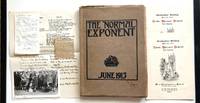
191312308Los Angeles: LASNS. Good. 1913. Softcover. Spotting to front cover in two places; half-inch closed split front cover bottom edge at fold near spine; 6 leaves p. 33-44 with quarter inch closed tear at foredge. Evidence of repair to rear hinge. Overall clean and solid. ; Brown wrappers with yapp edges lettered in black. Illustrated with two pages of portrait photographs of faculty twenty pages of portrait photographs of the Senior Class all but one page 16 photos each; group photographs of various clubs organizations sports teams. There are five holograph signatures on Faculty blank page two of which can be identified in the photos. On Senior Class blank there are 13 holograph signatures not including one Charlotte Newton who is pictured and underlined in ink. Also illustrated with drawings in the period style and many other ornaments and headpieces. Laid in are two folding Graduation Sunday State Normal School programs a scrap paper of holograph notes in pen notes from a sermon "1. Marriage 2. Raising Children 3. Building of a character 4. God's . As related to the family" etc. Plus a folded sheet with what appears to be a carbon manuscript of song lyrics for songs used in the graduation ceremony: "Tune Maryland My Maryland: Thou dost not falter in thy trust Normal School Old Normal School . . ." Finally: a 3.5 x 6" photograph titled in manuscript on the back" Roscoe Teachers' party - May 1945 my last year in L. A. Schools with a list of eleven names. Eleven names in pen also on the front top edge of the photo over the party attendees. Ohh! One more: 2.5" news clipping: "Provo Girl is Honored Miss Mayme Beesley . . . Of this city who has taken a course in education In the California State Normal School at Los Angeles . . ." There is a 'Mamie Beasly' next to Charlotte Newton with a pen correction of 'a' to 'e' on the last name. ; 4to 11" - 13" tall; 149 pages . LASNS paperback
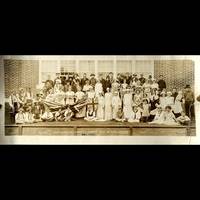
19277626Winnipeg Manitoba: Bauslaugh Photos 408 Main St. Winnipeg 1927. Original Photograph. Original silver gelatin photograph panoramic format measuring 16.75 x 7.5. Bears a white inscription in the negative: "CONFEDERATION JUBILEE GORDON BELL SCHOOL PAGEANT 1867-1927" to the bottom-centre and the name photographer's studio "Bauslaugh Photos 408 Main St. Winnipeg" to the right margin. <br /> <br />An utterly charming panoramic photograph capturing the full cast of a large-scale historical pageant held at Winnipeg's Gordon Bell School organized to celebrate Canada's 1927 Diamond Jubilee. The 60th anniversary of Confederation was a massive national event and patriotic school pageants such as the one pictured were a primary method of relating Canadian history civics and the era's concept of national identity. <br /> <br />The cast of students is arranged as a "living map" of Canada's diverse identities. Pictured at the centre are a row of young women in white dresses each personifying the provinces individually holding a shield with their respective coat of arms. The shields for Manitoba buffalo Saskatchewan wheat sheaves Alberta St. George's Cross over mountains and British Columbia Union Jack over a setting sun are clearly visible. Other central figures are dressed as "Britannia" or "Miss Canada" holding the Union Jack symbolizing the young nation's dual loyalties to both Canada and the British Empire. <br /> <br />Surrounding the central figures is a charming and diverse cast of students representing the many peoples comprising the nation. This includes students in Scottish kilts traditional Ukrainian and Polish embroidered shirts and floral headdresses and a young girl dressed in Indigenous regalia portrayed in a typical pageant-style. Other students are dressed as early settlers pioneers and historical figures creating a complete and idealized vision of the nation's multicultural identity. <br /> <br />The photograph was taken by Bauslaugh Photos of Winnipeg located at 408 Main Street very likely related to Bauslaugh & Taylor also of Winnipeg and active in the city between 1911-1915. An invaluable and lovely visual record of 1920's Winnipeg and Canada. Unrecorded in OCLC. Not found in Peel BAC/LAC UoM Archives & Special Collections et al. <br /> <br />Exceptionally well-preserved: the silver gelatin photograph retains strong detail and contrast. There is a short horizontal crease to the right margin extending slightly into the image area. Otherwise the photograph remains without flaws. The inscriptions in the negative remain equally clear and legible. Near fine. <br/><br/> Bauslaugh Photos (408 Main St.), Winnipeg unknown
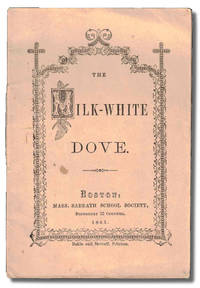
186550251Boston: Massachusetts Sabbath School Society 1865. Paperback. Good. Paperback. 5.5 by 3.75 inches. 14pp. Rubbed and darkened overall with some light foxing else a good example in publisher's stitched wraps. OCLC shows no holdings. <br/><br/> Massachusetts Sabbath School Society paperback
2512Rochester Kent: The School 1940. . 8vo tan cloth-covered boards spine orange cloth; printed paper spine label somewhat soiled COPAC and OCLC showing only one holding with this imprint--Cambridge University Library. Interesting piece produced by the students of the school. The whole was produced "in the clawses of the Typography Department of the Medway School.during the session 1939-40. Layout and arrangement in type by P. J. Reynolds .Set by students of the "Monotype Composition classes. Head of the Dpartment Charles L. Pickering under whose direction this book was made and finished in July 1940" Rochester, Kent: [The School], 1940. hardcover
20212081502111906298Chinese book office 2021. Soft Cover. Fine. The book is in fine condition. Chinese book office paperback
20112081502111901572Chinese book office 2011. Soft Cover. Fine. Number of pages: 1199p Size: A5 Soft Cover book Chinese book office paperback
20212081502111906726commercial stamp office 2021. Soft Cover. Fine. The book is in fine condition. commercial stamp office paperback
20192081502111905266Chinese Academy of Arts Publishing House 2019. Soft Cover. Fine. The book is in fine condition. Chinese Academy of Arts Publishing House paperback
20192081502111901318Chinese book office 2019. Soft Cover. Fine. The book is in fine condition. Chinese book office paperback
20162081502111904963Chinese book office 2016. Soft Cover. Fine. The book is in fine condition. Chinese book office paperback
20032081502111907367Chinese book office 2003. Soft Cover. Fine. Size: A5 Soft Cover Book Chinese book office paperback
20192081502111904156old books in shanghai 2019. Soft Cover. Fine. The book is in fine condition. old books in shanghai paperback
20202081502111900364Chinese book office 2020. Soft Cover. Fine. Size: A5 size Chinese book office paperback