24 936 résultats
19972081502111905602People's Literature 1997. Soft Cover. Fine. Number of pages: 1944p Size: A5 Soft Cover book People's Literature paperback
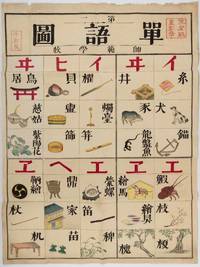
1873214113Japan. Meiji 6 1873. Four very attractive colour folded woodblock school posters 60 x 78cm each with accompanying woodblock printed textbook 32 double-folded leaves 22.5 x 15cm. Edges of posters worn with some minimal loss at margins the accompanying textbook is worn at edges with some thumb marks at lower corners but sound and generally clean. Overall good. Offers a fascinating glimpse into the beginnings of modern Japanese education. A wonderful collection of four primary school colour posters and a teacher's textbook dating to the very beginning of modern school education in Japan. The four posters contain sets of beautifully coloured and delicately printed pictures illustrating key words which children would be taught to read together with the corresponding kanji characters. The posters are divided by theme - one showing parts of the body and clothes; one showing crockery and cooking utensils; one with animals plants and tools; and one household items including a clock chair and abacus. They are particularly interesting for their combination of traditional Japanese and western items. The accompanying woodblock print text book 師範学校小学教授法 Shihan gakkō shōgaku kyōjuhō was published in Meiji 6 1873 and show how to explain each item in the classroom. <br> <br>The posters have the chops of Chikuma Prefecture current Nagano Prefecture and 1000 limited copies at the top. . hardcover
20222081502111907927Chinese book office 2022. Soft Cover. Fine. The book is in fine condition. Chinese book office paperback
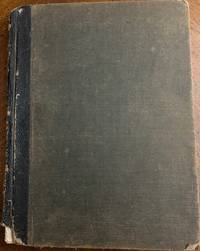
188230734Roanoke VA: Southern Methodist Publishing House 1882. First Edition. Ledger. Fair. Quarto. 134 pages. Black cloth covered boards with black leather spine. Most pages used for hand written accounts of attendance records. Form book published by the Southern Methodist Publishing House. Binding is edge worn shaken and falling apart. Hinges are broken but boards are still attached. Spine is chipped head and base. Last leave has the upper third portion torn off. Pencil notes on the end sheets. Fair only. <br /> <br /> Written on the front paste down are the two Superintendents of the school from 1883 to 1886: "J L Gresham Supt from April 1882 to Nov 16 1883 J C Hornsby Nov 16 1883 to fall of 1918." Contents contain several student names. Southern Methodist Publishing House unknown
18785956New York: Royal Baking Powder Co 1878. Stapled octavo-sized booklet 23.5 x 15cm. 32 pages. Illustrated. FIRST EDITION. Front wrapper verso with product reviews dated 1878. Includes a wood engraving showing twenty figures of diverse pans used in baking. “The recipes in this book are new and formulated by one of the most experienced Professors in the art of scientific and practical cookery especially adapted for the use of "Royal" Baking Powder and "Royal" flavoring Extracts. These preparations are incomparable in strength and purity. Substituting other articles will only end in disappointment." front wrapper blurb. Included are three hundred seventy seven recipes ranging from Bread & Rolls to Pies to Puddings to Fritters & Pancakes to Meat Pies to Icings. "The Royal Baking Powder Company was one of the largest producers of baking powder in the US. It was started by both Joseph Christoffel Hoagland & William Ziegler in 1866." Wiki. General wear & soiling to wrappers; foxing throughout; a bit musty. Good or a bit better in printed gray-green wrappers. OCLC locates four copies; Axford page 352; Bitting page 410 both for the 1882 and later editions; not in Cagle. Royal Baking Powder Co unknown
14455Chatham. 12 March 1839. A substantial letter 3pp. foolscap 8vo. 100 lines of text. Bifolium. In very good condition on aged paper with one closed along crease line neatly repaired with archival tape. Addressed on reverse of second leaf with Chatham postmark frank and black wax seal to 'Viscount Ingestrie M:P. 2 Wilton Crescent Belgrave Square London'. An interesting document in which a distinguished Victorian naval architect makes detailed criticisms of an innovation in his field. HMS Gorgon was designed by Sir William Symonds and launched in 1837. Her direct-acting engines in which the engine's cylinders are placed under the crankshaft built by Seaward and Company were the first to be fitted in any vessel. She was scrapped in 1864. Read begins his letter: 'My Lord Nothing could exceed my astonishment at the reply or rather <> which Sir C. Adam gave in citing the Gorgon as a specimen of the success of the personal conductor of our Naval Construction. In a lithographic account privately circulated but which the Hampshire Telegraph published; it was stated for what purposes this bad & wretched failure was designed. - She was to be able to carry 10 long 32 Pr. between decks - 4 32 Prs. and 2 10 inch Bomb Cannon on the weather deck - She was to take or be able to take a regiment on board with all its equipage for a colonial voyage across the Atlantic.' He proceeds to describe the 'falling off' from these specifications commenting that 'her constructor had so little knowledge of what he was about that he was deficient in displacement at least 400 tons corresponding to a too great immersion of 3 feet about . When she left Plymouth for her first trip to St. Sebastian she drew 17 ft 3 in aft instead of her intended draft 15.6 and the Ports abaft the Paddle Boxes were only from 3 ft 3 in to 3 ft 6 in above the water!! Of course the Ports were still caulked in.' At the end of this criticism he describes the Gorgon as 'a failure'. He proceeds to 'shew how experiments are got up' concluding 'is this the way that an experiment involving a cost of 40000£ should be conducted - The engines alone of the Gorgon cost 20000£.' He continues 'Would Sir C. Adam produce the lithographic circulars of which the Gorgon was intended for and would he venture to place in contrast with it the actual performance of the ship' He gives more specifications before stating: 'The Constructor of the Gorgon ought to be called upon to explain if he can the early discrepancy between his intentions & performances. He ends by apologising for 'this rough document'. Chatham. 12 March 1839. unknown
16078Devonport. 13 April 1839. HMS Gorgon was designed by Sir William Symonds and launched in 1837. Her direct-acting engines in which the engine's cylinders are placed under the crankshaft built by Seaward and Company were the first to be fitted in any vessel. She was scrapped in 1864. 4pp. 4to. Bifolium. In good condition lightly aged and worn but with the signature torn away. Addressed with seal in black wax to 'Benjamin Sharpe Esq 19 Fleet Street London' Sharpe's father had been resident partner at that address in the banking firm of Gosling & Sharpe. The first paragraph reads: 'Dear Sharpe I have just returned from the Gorgon and my visit to her has verified the substance of our Conversation on Thursday last. Her present armament consists of 4 32-pounder bored guns & 2 84-pounders 10-inch on the weather deck. if properly armed she would also carry 12 32-pounders on the main-deck but she is deficient in these. Her draft of water is about 15th. & 15 . 6 which I believe is what she ought to draw if her armament were complete with the full compliment of men water provisions munitions &c.' The letter continues with detailed criticism with reference to a trail 'in the river in July last with Ld Minto & other lords of the Admiralty on bd' the fact that 'her displacement had been sadly miscalculated'an incident on the coast of Spain her engines and paddle-boards. 'To judge of Gorgon whether she be a failure or otherwise she should be tried as an armed vessel carrying 16 32-pounders & 2 swivel guns . We have no more money that we know what to do with - no more workmen than we <> to keep pace with our wants in the shipwright department - & yet we are sacrificing both to the vain endeavours of adventurers in naval architecture while there are plenty of persons in the service who might be advantageously employed in preventing the occurrence of these & other discreditable blunders if it were not the fashion to prefer speculative notions to the plain & unerring principles of the <> of naval Construction'. Devonport. 13 April 1839. hardcover
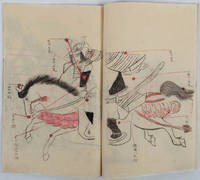
219848Japan. Later Edo. Colour manuscript illustrations presented in a handmade slim volume with paper ties. 14 double folded leaves 27 x 17.5cm. A prior owner's seal upper cover. A good copy of an attractive manuscript. This richly illustrated manuscript on shooting hand-copied in colour was most likely produced in the late Edo period probably in the 1850s. The original material was transmitted between 1703 and 1797 through several named individuals whose names appear on the final two pages. <br><br><br>The manuscript is chiefly concerned with where to aim a gun when hunting. A range of birds is shown both on the ground and in flight with the recommended points of aim marked by red circles. These markings shift according to whether the birds or animals are stationary or in motion. Three double-page illustrations depict fighting samurai and shooting targets. Particularly interesting is the final section which deals with shooting at stationary targets including a fan a branch and even a cloud. . unknown
111118Worcester Mass. The School Arts Magazine 1930. 36 plates loose in lightyl worn original folder including 4 in colour. Each plate hase previous owner's light name stamp not affecting image. A very good copy Worcester, Mass., The School Arts Magazine 1930. unknown
1831D19539Karlsruhe: Verlag Von Gottlieb Braun 1831. Neue Ausgabe. Hardcover. Good. Two volumes bound in one. Oblong with cloth spine and corners marbled paper boards printed label to upper board. 45 21 & 24 hand-colored lithographed maps some folding. Rubbing and wear to boards spotting throughout but hardly untypical. A rather scarce student atlas. <br/><br/> Verlag Von Gottlieb Braun hardcover
1974List923aBoston: Ad Hoc Committee for December 14 1974. Printed poster 17 x 11 inches folded. Somelight wear crease to center ownership marks to verso very good plus condition overall. With the ownership stamp of J. Wesley Miller with “J.W. Miller - duplicate†written in ink. Federal District Judge W. Arthur Garrity ruled in 1974 that Boston must integrate its school system. The group ROAR or Restore Our Alienated Rights led a broad effort against integration supported by the School Committee most members of the City Council and many teachers and police. Early efforts to block the desegregation efforts centered around South Boston High School where some parents of white students harassed and threw stones and bottles at arriving African-American students scenes repeated in some other white middle class neighborhoods. <br /> <br /> On December 14 over fifteen to twenty thousand people marched on Boston Common in support of the desegregation efforts. Offered here is a poster from the event published by the Ad Hoc Committee for Dec. 14. The poster shows an image from the Central High School desegregation efforts in 1957 above an image from Boston in 1974. No copies located though one is likely held at Miller’s unprocessed as of 2021 archive at UMass-Amherst. A note on the front reads “10-11x-1974†suggesting that he found the poster over a month before the planned event. Ad Hoc Committee for December 14 unknown
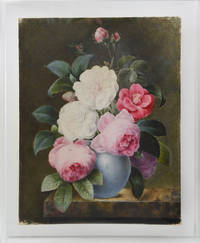
98959c.1830. . Watercolour and gouache on vellum.<br />39.2 x 31.2 cm<br />Framed in perspex boxes: 39.5cm x 47.5cm x 5.5cm.<br /> a beautiful example from the school of 'the Raphael of flowers' the most celebrated botanical artist of his day.<br /><br />Redoute's patrons included two Empresses and two Queens and his prodigious talents placed him at the centre of French court life both before and after the Revolution. He was appointed drawing master to Marie Antoinette yet despite his connections to the Royal family he survived the Terror and went on to become the court and flower painter to Empress Joséphine. It was because of her patronage that Redouté undertook Les Liliacées which together with Les Roses constitute the artist's greatest works. Although Joséphine had died three years before the publication of Les Roses it was the unequalled collection of roses on her estate at Malmaison that provided the artist with his inspiration.<br /> c.1830. hardcover
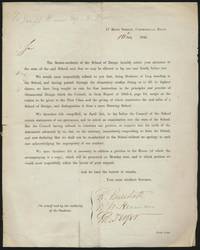
18453220094<p><em>4to printed bifolio sheet 24 x 19.5 cm some marks and folds. Addressed to Joseph Hume M.P and signed by Richard Burchet R.W. Herman and W.D. Telfer. </em></p><p>In 1845 Richard Burchett became the ringleader of students protesting to the Board of Trade about the teaching methods at the Government School of Design: this was the first attempt to improve the instruction in the principles and practice of ornamental design. The complaint became so serious that eventually a Parliamentary Committee of Enquiry was instituted in 1846 at which he and others gave evidence. Oddly by that time Burchett had already become a master at the school and so was giving evidence against his own employees to the committee.</p><p>This copy was addressed to the radical Joseph Hume M.P who was a close friend of William Williams another radical M.P. who led the charge of incompetence by the School of Design in the House of Commons. After eight committee meetings it was agreed that the School was not in good shape 'the principles of Ornaments and the practice of original design as applicable to manufactures are not efficiently taught' and 'That a knowledge of manufacturing processes so as to enable the students to unite fitness and practicability in Ornament is not communicated.' Reforms were instituted but not in time for some woefully bad designs to appear at the Great Exhibition of 1851 for all the world to see.</p> [London], 17 Bond Street, Commercial Road. 10th July
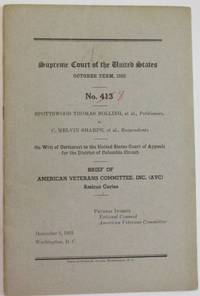
195233220Washington D.C.: Press of Byron S. Adams 1952. Original printed wrappers with wrapper title as issued and original staples. ii 13 1 pp. Near Fine.<br /> <br /> The Supreme Court heard argument in December 1952 but held the cases over for reargument in the following term. This is the Amicus Curiae brief submitted by the American Veterans Committee for the first argument. Supporting the District of Columbia children seeking to integrate the Washington public schools the Committee contends that the Fifth and Fourteenth Amendments guarantee the right to be free from racial discrimination that equality of education is impossible under a regime of racially segregated schools that equality can be achieved only by abolition of compulsory segregation by race and that "The people of Washington are ready for and will accept integration of their public schools."<br /> The brief is signed in type by the Committee's National Counsel Phineas Indritz who was a distinguished civil rights and constitutional lawyer. Press of Byron S. Adams unknown
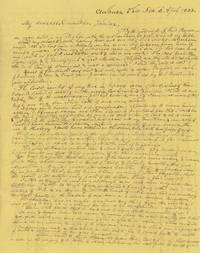
1832List3436Auburn New York 1832. Single four-page letter measuring 7 ¾ x 9 ¾ inches. Folded with very small tears at folds. Excellent to Near Fine. A letter written from the Auburn Theological Seminary in 1832 from the soon-to-be Reverend Thomas Reed Rawson 1803-1877 to his soon-to-be wife Louisa W. Dawes 1810–1849. Dawes who lived in Cummington Massachusetts was the older sister of Senator Henry Laurens Dawes best known for the 1887 Dawes Act.<br /> <br /> Rawson opens by commenting on the death of one of his students and his time spent in Oswego “visiting in the most fashionable familiesâ€; he felt this taught him a great deal about “human nature†which in Oswego is “peculiarâ€. He seems to have been particularly perplexed by the spiritual character he encountered in upstate New York a locus of the Christian revival movement now called the Second Great Awakening:<br /> <br /> “You know I expected that the spirit of the west was a more active . spirit than what was seen in the N.E. states & hoped by breathing this pure atmosphere to enjoy great spiritual health. How erroneous was the impression! How greatly have I been deceived! . I acted as though it was so – as though man was man only in certain latitudes. I acted as though face answered to face only when seen in the waters of N.E. & consequently that the heart of a N.E. man had no analogy to what beats in the bosom of one born in a more western longitude.â€<br /> <br /> Not only is Rawson nonplussed by New Yorkers’ religious qualities he is vehemently opposed to some of the new practices that arose from the religious revival there:<br /> <br /> “The state of things here I mean in all this country at the west is very peculiar. You have heard of ‘Old & New Measures’ I suppose. For myself I cannot approve of the latter. I find not a spirit in me to Fellowship them. Have been exceedingly tried by them as I have been in the midst of ‘new measures’ all winter. You can form but a faint idea of the excitement which is in this country in the religious community. In Oswego Co. the lay-men are going through the Co. holding meetings once a month in praying exhorting dispensing the duties of Clergymen &c. &c.; & it seems that the present state of things must result in a wide division in the churches. ‘A house divided against itself cannot stand.’ . As near as I can find out very sinister is the spirit that knows the new measures to that wild-pine which ran so extensively in the time of Edwards. The effects of it are seen in your town to this day.â€<br /> <br /> The “New Measures†were novel practices for American Christianity that came about during the Second Great Awakening mainly due to Presbyterian minister Charles Finney. These include very lengthy meetings public naming of sinners and public confessions of sin and were controversial with those who preferred a more orthodox and restrained service. Rawson accurately predicts that the new practices would lead to a schism; starting in 1837 the Old School-New School Controversy split the Presbyterian church along these lines. He later worries that such a division in the church would allow “Catholicism to take the advantage†and that “Satan is bringing this about as rapidly as possibleâ€. The appeal of a strong hierarchical Catholic church as opposed to a weak and divided Protestant one was a common worry among Protestants at the time.<br /> <br /> Rawson traces the “sinister spirit†of the new measures back to “the time of Edwardsâ€: Jonathan Edwards a key figure in the First Great Awakening of the 1730s and 40s. Given his reference to “your townâ€â€”Cummington Massachusetts—Rawson is probably referring to the so-called “New England theology†that arose from the First Great Awakening. Among other things New England theology proposed new views on man’s free will and responsibility; similar views would create controversy in Rawson’s time as he explains:<br /> <br /> “I see my own heart to be depraved & wicked beyond all observation but the fruits of the spirit I think I do love & hope they are sweeter & more sweet to my taste. I say taste the New measure-men are not taste-men but believe in the ‘motive scheme’ — By taste is meant the implantation of a new principle – love to God & is affected by the Holy Spirit. The ‘motive scheme’ implies that the sinner turns himself about in by motive merely.â€<br /> <br /> He is objecting to the idea that a sinner could redeem himself through an act of his own will—by his own ‘motives.’ Old School Presbyterianism holds a more orthodox Calvinist view wherein the redemption of the sinner is not up to the sinner’s will at all. Rawson makes an interesting comparison between New School views on the matter and states’ rights in the context of the then-ongoing nullification crisis:<br /> <br /> “The signs of the times declare most plainly to him who has wiped up his eyes that ‘the end has come upon the four corners of this earth’ i.e. the end of peaceful days for the present. Never was our Republic brought to a crisis like this. Nullification in the Political world is the same with Denunciation in the Religious world. This is my opinion; don’t know as have heard others say so.â€<br /> <br /> The nullification crisis arose when South Carolina declared that several import tariffs were unconstitutional and thus nullified them under the states’ rights doctrine of state nullification. Rawson seems to be drawing a parallel between the revivalists’ idea of the role of one’s motives in salvation and states’ rights advocates’ idea of the relationship between the states’ wills and the federal government’s. Of course the states’ rights issue would soon reach an apotheosis.<br /> Rawson closes with some affectionate lines for Dawes and advice about her own teaching job; the crossed text updates her on the Christian conversions within his family. Overall the letter provides detailed insights into the views of a more conservative theology student on the Presbyterian controversy that was soon to come to a head. unknown
18912092902143300143Mono fumei 1891. Soft Cover. Fine. Number of pages: 26 Size: 32cm Mono fumei paperback
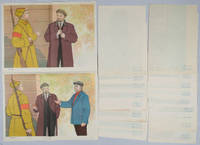
1988217269Shanghai.: 上海教育出版社. Shanghai Education Publishing House. 1988. Complete set of 18 coloured posters to accompany Volume 7 of the Chinese language course textbook for Year 6 students. Mostly 52.5 x 76.5cm some 38 x 52.5cm. All stamped with the name of a school "Jiading Town Second Central Primary School Materials Room" on reverse. Occasional foxing to reverse pin-tack holes and slight staining to some edges. Upper corners of Number 17 is chipped with some loss and previous cello-tape repairs. Colours in images of all posters are clear and bright and overall in good condition. Brief captions in simplified Chinese characters. The set of posters includes a wide variety of images from Lenin with soldiers to illustrations of animals and from illustrations of stories from the past to one of a modern high rise building. Of particular interest is picture 18 with a three-generation one-child family happily taking delivery of a new fridge in a high rise apartment with children's toys fresh flowers and a large TV all part of the scene. The father is wearing jeans. Overall they provide a picture of modern happy people living in a modern economy with plenty of consumer goods. . 上海教育出版社. [Shanghai Education Publishing House]. unknown
20202081502111903197Chinese book office 2020. Soft Cover. Fine. Size: A5 Soft Cover Chinese book office paperback
20022081502111904623Chinese book office 2002. Soft Cover. Fine. Size: A5 Soft Cover Chinese book office paperback
20112081502111904038Chinese book office 2011. Soft Cover. Fine. The book is in fine condition. Chinese book office paperback
20172081502111905269Chinese book office 2017. Soft Cover. Fine. The book is in fine condition. Chinese book office paperback
2081502111906829Chinese book office N.A. Soft Cover. Fine. The book is in fine condition. Chinese book office paperback
20002081502111907608Chinese book office 2000. Soft Cover. Fine. Size: A5 Soft Cover Number of books: 2 Chinese book office paperback
20162081502111905985East China Normal University 2016. Soft Cover. Fine. The book is in fine condition. East China Normal University paperback
20122081502111907785Chinese book office 2012. Soft Cover. Fine. The book is in fine condition. Chinese book office paperback