24 936 résultats
2082402113510812Not Available N.A. Soft Cover. Fine. Number of books: books Not Available paperback
19852082402113507106Not Available 1985. Soft Cover. Fine. Number of books: books Not Available paperback
19352092902137700564Girls' school 1935. Soft Cover. Fine. The book is in fine condition. Girls' school paperback
19572083002116206265Komatsushima City Sakano Junior High School Tokushima 1957. Soft Cover. Fine. The book is in fine condition. Komatsushima City Sakano Junior High School (Tokushima) paperback
19872082402113508121Not Available 1987. Soft Cover. Fine. Number of books: books Not Available paperback
20052080202102702393Shinchosha 2005. Soft Cover. Fine. Page size: 424 pages Size: 4-6 size Shinchosha paperback
2082402113510953Not Available N.A. Soft Cover. Fine. Number of books: books Not Available paperback
19372082402113504022Toyo tosho 1937. Soft Cover. Fine. Number of books: books Toyo tosho paperback
0364427019.Gpaperback. Good. Access codes and supplements are not guaranteed with used items. May be an ex-library book. paperback
036484325X.Ghardcover. Good. Access codes and supplements are not guaranteed with used items. May be an ex-library book. hardcover
2081502111906191Chinese book office N.A. Soft Cover. Fine. The book is in fine condition. Chinese book office paperback
19952080502106917298Not Available 1995. Soft Cover. Fine. The book is in fine condition. Not Available paperback
SB19C-02841Coyne Electrical School. Used - Good. Good condition. Acceptable dust jacket. technology circuits diagrams A copy that has been read but remains intact. May contain markings such as bookplates stamps limited notes and highlighting or a few light stains. Coyne Electrical School unknown
2092902141302350Kanki nashi N.A. Soft Cover. Fine. Number of books: 1 Kanki nashi paperback
Bunschoten, Raoul, edIn Pristine Condition. unknown
2090502113706103Not Available N.A. Soft Cover. Fine. The book is in fine condition. Not Available paperback
19532091502133800042Not Available 1953. Soft Cover. Fine. Number of pages: 88 pages 57 pages Not Available paperback
Arline M. FischOne in Pristine Condition one not in good condition very shelf worn. unknown
20001322216PN. New. 2000. Soft Cover. Date is original print. This is a reprint edition . PN paperback
20001321981PN. New. 2000. Soft Cover. Date is original print. This is a reprint edition . PN paperback
20082092902141206833Chinese Zodiac 2008. Soft Cover. Fine. Volume: 1 Chinese Zodiac paperback
19102111902153300774Tendai Buddhist School Academic Affairs Division 1910. Soft Cover. Fine. Number of books: 1 Tendai Buddhist School Academic Affairs Division paperback
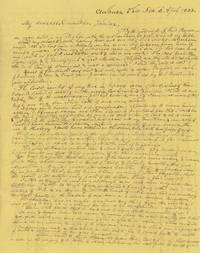
1832List3436Auburn New York 1832. Single four-page letter measuring 7 ¾ x 9 ¾ inches. Folded with very small tears at folds. Excellent to Near Fine. A letter written from the Auburn Theological Seminary in 1832 from the soon-to-be Reverend Thomas Reed Rawson 1803-1877 to his soon-to-be wife Louisa W. Dawes 1810–1849. Dawes who lived in Cummington Massachusetts was the older sister of Senator Henry Laurens Dawes best known for the 1887 Dawes Act.<br /> <br /> Rawson opens by commenting on the death of one of his students and his time spent in Oswego “visiting in the most fashionable familiesâ€; he felt this taught him a great deal about “human nature†which in Oswego is “peculiarâ€. He seems to have been particularly perplexed by the spiritual character he encountered in upstate New York a locus of the Christian revival movement now called the Second Great Awakening:<br /> <br /> “You know I expected that the spirit of the west was a more active . spirit than what was seen in the N.E. states & hoped by breathing this pure atmosphere to enjoy great spiritual health. How erroneous was the impression! How greatly have I been deceived! . I acted as though it was so – as though man was man only in certain latitudes. I acted as though face answered to face only when seen in the waters of N.E. & consequently that the heart of a N.E. man had no analogy to what beats in the bosom of one born in a more western longitude.â€<br /> <br /> Not only is Rawson nonplussed by New Yorkers’ religious qualities he is vehemently opposed to some of the new practices that arose from the religious revival there:<br /> <br /> “The state of things here I mean in all this country at the west is very peculiar. You have heard of ‘Old & New Measures’ I suppose. For myself I cannot approve of the latter. I find not a spirit in me to Fellowship them. Have been exceedingly tried by them as I have been in the midst of ‘new measures’ all winter. You can form but a faint idea of the excitement which is in this country in the religious community. In Oswego Co. the lay-men are going through the Co. holding meetings once a month in praying exhorting dispensing the duties of Clergymen &c. &c.; & it seems that the present state of things must result in a wide division in the churches. ‘A house divided against itself cannot stand.’ . As near as I can find out very sinister is the spirit that knows the new measures to that wild-pine which ran so extensively in the time of Edwards. The effects of it are seen in your town to this day.â€<br /> <br /> The “New Measures†were novel practices for American Christianity that came about during the Second Great Awakening mainly due to Presbyterian minister Charles Finney. These include very lengthy meetings public naming of sinners and public confessions of sin and were controversial with those who preferred a more orthodox and restrained service. Rawson accurately predicts that the new practices would lead to a schism; starting in 1837 the Old School-New School Controversy split the Presbyterian church along these lines. He later worries that such a division in the church would allow “Catholicism to take the advantage†and that “Satan is bringing this about as rapidly as possibleâ€. The appeal of a strong hierarchical Catholic church as opposed to a weak and divided Protestant one was a common worry among Protestants at the time.<br /> <br /> Rawson traces the “sinister spirit†of the new measures back to “the time of Edwardsâ€: Jonathan Edwards a key figure in the First Great Awakening of the 1730s and 40s. Given his reference to “your townâ€â€”Cummington Massachusetts—Rawson is probably referring to the so-called “New England theology†that arose from the First Great Awakening. Among other things New England theology proposed new views on man’s free will and responsibility; similar views would create controversy in Rawson’s time as he explains:<br /> <br /> “I see my own heart to be depraved & wicked beyond all observation but the fruits of the spirit I think I do love & hope they are sweeter & more sweet to my taste. I say taste the New measure-men are not taste-men but believe in the ‘motive scheme’ — By taste is meant the implantation of a new principle – love to God & is affected by the Holy Spirit. The ‘motive scheme’ implies that the sinner turns himself about in by motive merely.â€<br /> <br /> He is objecting to the idea that a sinner could redeem himself through an act of his own will—by his own ‘motives.’ Old School Presbyterianism holds a more orthodox Calvinist view wherein the redemption of the sinner is not up to the sinner’s will at all. Rawson makes an interesting comparison between New School views on the matter and states’ rights in the context of the then-ongoing nullification crisis:<br /> <br /> “The signs of the times declare most plainly to him who has wiped up his eyes that ‘the end has come upon the four corners of this earth’ i.e. the end of peaceful days for the present. Never was our Republic brought to a crisis like this. Nullification in the Political world is the same with Denunciation in the Religious world. This is my opinion; don’t know as have heard others say so.â€<br /> <br /> The nullification crisis arose when South Carolina declared that several import tariffs were unconstitutional and thus nullified them under the states’ rights doctrine of state nullification. Rawson seems to be drawing a parallel between the revivalists’ idea of the role of one’s motives in salvation and states’ rights advocates’ idea of the relationship between the states’ wills and the federal government’s. Of course the states’ rights issue would soon reach an apotheosis.<br /> Rawson closes with some affectionate lines for Dawes and advice about her own teaching job; the crossed text updates her on the Christian conversions within his family. Overall the letter provides detailed insights into the views of a more conservative theology student on the Presbyterian controversy that was soon to come to a head. unknown
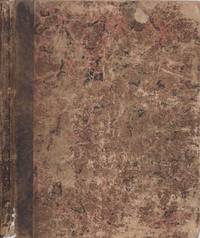
187934705Unknown 1879. Ledger. Good. Ledger. Approx. 7.5" x 6". Marbled paper covered boards with black leather spine. Boards are shelf and edge worn. Leather is rubbed and chipped at the head and base of spine. A few pages have been torn out and one sheet torn in half. Old library label of "Perseverance S.S. Library" on the front paste down.<br /> <br /> Ledger consists of 106 lined pages used for recording student names classes teachers questions treasurer reports minutes of school meetings etc. No location of this Sunday School was provided in the records. unknown
18780008008Orillia Ontario. Good. 1878. On offer is a book containing minutes of the Board of Trustees Meetings of School Section No 4 covering the period from January 1878 to January 1897 that gives an insight of what issues the school board dealt with in those years including financial support expenses school building operation and selection of teachers. The book has 64 pages and includes minutes of 69 meetings two pages documenting payments to a school teacher for the year of 1879. The school was built in 1876 a little more than a year before this book was started and 7 years after Ryerson proposed his 1871 Education Act requiring adequate accommodation for students in every school section. The Meeting agenda usually included election of trustees and chair adoption of annual reports and approval of various expenses: "it was proposed by Mr. Brailey seconded by D. M. Kaughan that the sum of six dollars be appropriated for Prize that the Section do also procure at same time a Daily Register.that the Section be empowered to procure a copy of the amended School Law of Copp Clark and Co." More serious matters concerned repairs construction and school house insurance: ".a Petition to be sent into the council legalize the Muskoka road passing the school house." "Section will be instructed to issue tenders for digging a well at the school and also see to the repairing of the plaster at the School House". In 1880 the routine was interrupted when School's first headmaster Mr. Gardiner left his wife and eloped with an eighteen-year-old to Detroit telegraphing his resignation which made the Trustee Board urgently look for a new teacher: "Several applications for the position of teacher in the room of W. G. Gardiner who has scandalously absconded from the neighbourhood and deserted his post as Teacher were considered by the Trustees but action in the matter was deferred to the future meeting". Finding a new teacher was not an easy task: "The Trustees proceeded to examine three applications made for the position of Teacher in the Sec-n. none of which met their entire approval.proposed that the school be kept vacant till the end of the year that the Sec. 4 do insert advertisements in the Toronto papers for a male teacher at a salary of 300$ per annum". Only a month and a half later in the end of December they hired a new Master of the School at a salary of 260$. In addition to teaching schoolmaster's duties included lighting the fires and sweeping the school and also planting trees: "Mr. Smith teacher be allowed to plant shade trees in front of the school premises within the fence adjoining the Muskoka road and that he receive 50 c. per tree for planting the same with the understanding that in the event of any of the said trees dying during the year that he agrees to replace the same with fresh trees and it is understood that said trees shall be maple and balsam alternately.". The meeting of December 1882 approved 2$ contribution to the Ryerson Memorial Fund. In 1885 the Public School Inspection gave instructions on improvements and repairs to be done including "wood shed construction replastering of the school house increasing blackboard accommodation and fixing privies". The book contains names of School Board Trustees and teachers and of some local residents performing work for the school. Condition: Good regular age-related wear several pages are torn out and missing.; Manuscript; 8vo - over 7¾" - 9¾" tall; KEYWORDS: HISTORY OF EARLY SCHOOL HISTORY ORILLIA HIGH SCHOOL LOCAL SCHOOLS ONTARIO SCHOOL EDUCATION SCHOOL TRUSTEES ORILLIA HISTORY 19TH CENTURY CANADIAN HISTORY HISTORY OF SCHOOL EDUCATION ONTARIO SIMCOE COUNTY SCHOOLS HANDWRITTEN MANUSCRIPT MANUSCRIPTS SCHOOL BOARD MEETINGS MINUTES PUBLIC SCHOOLS INSPECTION SIMCOE COUNTY SCHOOL SECTORS SCHOOL SECTOR 4 ORILLIA TEACHERS TEACHER SALARIES 19TH CENTURY 1880S 1870S CANADIANA . unknown