487 résultats
30678AMERICAN SUNDAY SCHOOL UNION. COLUMBUS AND HIS TIMES. Philadelphia: American Sunday-School Union n.d. 1849. Small 8vo. Quarter-morocco marbled boards. Frontispiece 193 pages. Scarce item originally published in 1842 by the Religions Tract Society. Cov rubbed. Early inscription on front blank leaf. unknown books
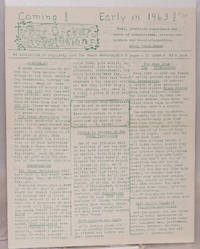
1962179985Brookville OH: The School of Living 1962. 8.5x11 inch handbill printed in green ink on both sides fold-creased 1/2 inch closed tear along crease else very good. Advertisement for an upcoming publication outlining its various features and the School's perspectives. Founded by Ralph Borsodi the School of Living was and remains a Gandhian decentralist ecologically conscious communitarian group. The School of Living unknown books
1938017447Chicago: DuSable. 1938. First Edition. Paperback. Wraps 4pp an invitation to the commencement is laid in. . DuSable paperback books
1908288258Washington Barracks D. C.: The Battalion Press Press of the Engineer School Government Printing Office 1908. Hard Cover. Very Good binding. Six pamphlets from the late 19th early 20th century primarily on military engineering bound together in one volume. Brown buckram with a black leather label. Spots of discoloration to the spine. Very Good binding. The Battalion Press | Press of the Engineer School | Government Printing Office unknown books
1973186924US Army Armor School 1973. Softcover. Good. Mild cover wear. Has a good binding no marks or notations. tnos US Army Armor School paperback books
1965176407New York: organization 1965. 4 3p. 8.5x11 inch mimeographed sheets plus 8.5x14 inch complaint form staple-bound in upper left corner very good condition not found in OCLC. From the collection of a CORE lawyer who was assigned to Mississippi during Freedom Summer this handout offers basic information on how to file a complaint under Title VI of the Civil Rights Act dealing with nondiscrimination in programs and services that receive federal financial assistance. Founded in 1963 the Law Students Civil Rights Council was the first inter-racial organization of law students and was one of the groups that provided volunteer lawyers to the Council of Federated Organizations during Freedom Summer. organization unknown books
181729558Philadelphia: Printed for the Institution by Anderson & Meehan 1817. 12mo. 12pp. Disbound without wraps else Very Good.<br/><br/> The Association sought to educate young men privately; its evening classes suggest that many of its students were in the work force. Evidently free public education was not introduced in Pennsylvania until 1818; and that was for the education of indigent children only.<br/> Officers and members of the Association are listed on page 2. Hugh De Haven Jun. was President. The Association's purpose was to instruct "adult males in reading writing and arithmetic; and to incite them to the study of the Holy Scriptures." Maximum number of Association members was thirty; expulsion was permitted "for unchristian behaviour by the concurrence of two-thirds of the Association." The Association would sponsor schools and hire teachers for classes on Monday Tuesday Wednesday and Friday evenings.<br/>AI 41336 1- DLC. Not in Sabin. OCLC records only facsimiles as of November 2012. Printed for the Institution, by Anderson & Meehan unknown books
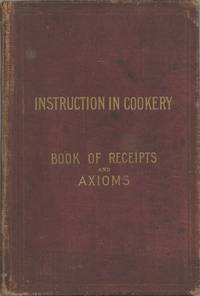
18906979London: School Board for London; Chas. Straker and Sons 1890. Small octavo 18.5 x 12.5 114 pages. Indexes. FIRST EDITION. A guide for cookery educators with syllabi and notes for instruction. Also included are instructions on using the cookbook itself in an educational setting ". but care is necessary as the girls destroy and disfigure the books sometimes. To obviate this difficulty and to help the teacher in finding out the culprits the receipts have been arranged consecutively according to the syllabuses so that the books can be strapped down with elastic bands on the pages for the lesson." Also included is the text of the author's General Axioms for Plain Cookery which had previously been printed separately as a "prize" for the girls who did not excel. Some light soiling and a few stains throughout undoubtedly those "culprits". In oxblood buckram titled in gilt on the front board. Cloth soiled and rubbed but still sound. Good. School Board for London; Chas. Straker and Sons hardcover books
196449591Berkeley and Los Angeles: University of California Press 1964. 1st Edition. Blue green cloth binding. Dust jacket. VG/VG. xvi 609 1 blank pp. Royal 8vo. <br/><br/> University of California Press hardcover books
81468bdThe Coral Gables Museum Corp. 2010. One of an edition limited to 100 hardbound copies. Oblong quarto hardcover slick full-color illus. boards 80 pp. Illustrated in full color. Fine As New in a Fine As New dust jacket. hardcover books
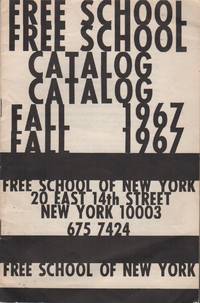
196717647New York: Free School of New York Fall 1967. First Edition. Wraps. Very good. 5.5" x 8.5" approx. saddle-stapled booklet. Touches of toning and wear at corners. Mailing information at rear wrap. Interior clean and bright. Very good. 12pp. <br/><br/>Catalog for the fall 1967 term at the Free School of New York also known as the Free University of New York. Established in 1965 as a reaction to traditional academia FUNY was in the tradition of 1960s protest movements run by committee with open enrollment and granting no degrees. This catalog which lists the school's 24 class offerings demonstrates a focus on the humanities with courses in filmmaking history fine arts and drama. Class offerings were predictably left-leaning with titles like "A Quest for Self" "The Thought of Mao Tse-Tung" and "Black Power and the "Ghetto Uprisings" and the faculty included counterculture figures such as Ed Sanders and Tuli Kupferberg. An ambitious and ephemeral offshoot of the 1960s counterculture movement FUNY closed after only a few years in operation. Free School of New York paperback books
018868Phoenix May 1918: Phoenix Union High School. Octavo. 231pp. The earliest recorded copies in the Arizona Newspaper Project and OCLC are in the 1930's. Much on this item dedicated to those classmates who had gone to fight in World War I. The opening poem is dedicated to the 28th. Besides giving accounts of the different departments there is a nice description of Jefferson Street when it was poorly lit in the first decade of the 20th Century. A later patriotic poem which notes that the Patriots of Phoenix High have "jacked old "Uncle Sammy" to bring justice "to the Hun". It goes on to say they did this by buying liberty bonds. It lists 185 of their older classmates who served in World War I four of whom died in the conflict. The school did not open in the Fall until December 16 because of the influenza crisis. Also there are large ads for some of the well-known Phoenix business some with a patriotic note such as Donofrios which suggests that while "you are thinking about that soldier Boy send him a box of their Cactus Candy." Bound in original pictorial wraps light finger soiling. Phoenix Union High School unknown books
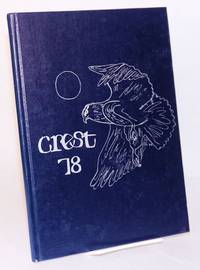
1978120790San Francisco: Herbert Hoover Junior High School 1978. 96 p. 11x8.5 inch hardback with inscriptions on endsheets and a few more in the text. A very good copy. Profusely illustrated by photographs the usual sort of yearbook production. The 1978 yearbook for Herbert HooverJunior High School San Francisco Unifed School District San Francisco CA. [Herbert Hoover Junior High School] unknown books
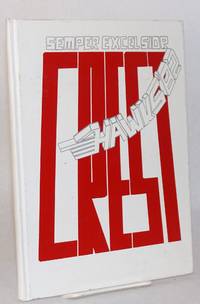
1982120794San Francisco: Herbert Hoover Middle School 1982. 62 p. hardback with slight soiling on covers otherwise in very good condition. Profusely illustrated by photographs. The 1982 yearbook for Herbert Hoover Middle School San Francisco Unifed School District San Francisco CA. [Herbert Hoover Middle School] unknown books
18712437Charterhouse School 1871. Hardcover. Very good. Dates: 1871-1877 and 1910. Small 4to. 37 ff. mostly with newspaper clippings neatly pasted in on both sides 4 ff. in manuscript "Summary of Scores" from 1871-1877 and 1910. Several leaves excised; it is possible that the present album had been re-purposed. On a few of the stubs appear fragmentary MS notations suggesting that the notebook may have once been divided alphabetically. We find on certain stubs "Ai" followed immediately by "Ao" and then several leaves later: "Her. - Hes" followed by "Io." Binding rebacked with smooth calf. In very good condition. Highly interesting homemade album of Cricket Scores available nowhere else specifically documenting the triumphs of three young members of the Blomfield family namely: E.G. Edward George C.J. Charles James and R.T. Reginald Theodore. One wonders if the present album was created in order to promote friendly competition between the brothers two of whom went to Haileybury School and one went to Charterhouse; all three went up to Oxford. There are scores and game synopsis of matches were between Haileybury Charterhouse Marylebone Cricket Club MCC Westminster Trinity College Oxon. Exeter Oxon. and more. One of the more interesting features about the album is that it provides a fascinating record of one family's love of the game:<br/><br/>¶ Edward George 1853-1885 entered Charterhouse School London in 1865 and transfer upon the School's removal to Godalming in 1872; in 1873 he went to Trinity College Oxon. where he earned a B.A. in 1877 and M.A. in 1879; thereafter he served as Curate of St. Mary's Portsea until 1883 and then Vicar of St. Mark's Woolston until his death in London in 1885.<br/><br/>¶ Charles James 1855-1928 went to Haileybury School; he underwent military training at Sandhurst and served as an army officer in India Sudan and Natal. He attained the rank of Major General before his retirement in 1917. NB: this individual is not to be confused with a noted architect of the same name b. 1862 d. 1932. <br/><br/>¶ Reginald Theodore 1856-1942 also went to Haileybury School; he earned his B.A. from Exeter Oxon. in 1880 and M.A. in 1884. He became an architect and was knighted in 1919. He is remembered mainly for his work designing British war memorials. <br/><br/>¶ The parents of the three young men were Rev. George John and his first cousin Isabella Blomfield of Bow Devonshire whose own father Charles James Blomfield was Bishop of London. <br/><br/>¶ At the end is a "Summary of Scores" for the years 1871-1877. Following this in a different hand is the year 1910; although the initial of the last name "Blomfield" remains the same the other initials belong to Reginald Thomas and his two sons Henry George and Austin. <br/><br/>¶ See Stedman Charterhouse Register 1872-1900 passim. CATALOGUER'S NOTE: We are grateful to Catherine Smith Archivist of Charterhouse School for much useful information concerning the Blomfield Family. hardcover books
19412304221941. hardcover. good. Many photo Illus. Thin 4to tan cloth cloth and some page margins dampstained head of spine worn edges of corners worn. N.p. 1941.<br/><br/> unknown books
2001235022001. Softcover. VG. White wraps. 107 pp. Numerous bw & color plates. unknown books
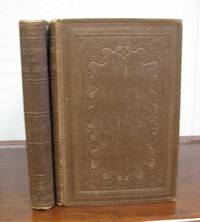
18568123Boston: Dutton & Wentworth / Ticknor & Fields 1856. 1st book edition. Original dark brown cloth with covers stamped in blind & gilt spine lettering. VG sp dull/minor extremity wear/tide line at top of text block in Vol II/owner sig on tps. 2 volumes. Engraved frontis & title page in Vol I. 8vo. <br/><br/>Collected commentary by Sargent a noted Antiquary & Temperance advocate on Boston society among other things as was initially published in a series of Boston Evening Transcript articles. Per the DAB "though he showed enthusiasm for the past his efforts were generally directed towards blasting something offensive to him out of existence". OCLC records just 4 copies of this work in institutional hands. Dutton & Wentworth / Ticknor & Fields hardcover books
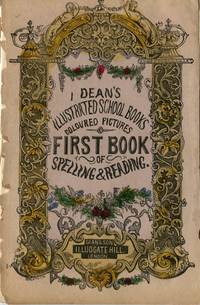
D6041London: Dean & Son n.d. likely late-19th century. Paperback. Fair. Original wraps with colored front cover ads on rear and inside covers. Illustrated in color throughout. Covers detached chipped along spine and a little dust-soiled. Text block is nice and bright with only the occasional dusty finger-smudge. Sold as is. <br/><br/> Dean & Son paperback books
1834547Millgrove Buschkill Taunship Northampton County Pennsylvania: Gedruckt von Samuel and Solomon Siegfried's 1834. 12mo. 189 x 105 mm. 7 x 4 ¼ inches. 360 pp. . Illustrated with woodcut title-page vignette and a woodcut image of a thermometer. Contemporary leather backed marbled paper boards; scuffed and rubbed at joints; paper toned with age and some foxing; good copy. First edition text entirely in German. Scarce Millgrove imprint written by Samuel Siegfried and printed by his brother Solomon both of Northampton County. The content of the geography text is well conceived beginning with a section of geographical terms followed by a grammar of place names and vital statistics for every state territory and country in North and South America Europe Africa the Near East and the Far East. This is followed by a more detailed study of each of the place names and includes information on population manufacturing farm production major cities literary and cultural centers and religious denominations. The book is fully indexed. "Samuel Siegfried 1797-1879 started his career as a printer after his move from Easton to Millgrove in 1834. In this he published at least two books Deutsche Georgraphie and Bewährter Ratgeber and his first broadside baptismal certificate together with his brother Solomon. At the end of this year and during 1835 Samuel Siegfried printed and published three further baptismal certificates under his own name." Solomon Siegfried is best known for the printing and decorating of birth and baptismal certificates which he produced for German speaking families in Northampton County. Shoemaker Checklist of American Imprints 26774. Stopp The Printed BBC's III p. 176. Earnest Flying Leaves and One-Sheets pp. 41-42 264. Gedruckt von Samuel and Solomon Siegfried's unknown books
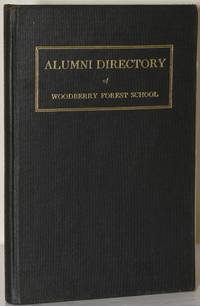
1935282353Woodberry Forest VA: The Alumni Association of Woodberry Forest School 1935. First Edition. Hard Cover. Fine binding. A clean copy with a Message from the Senior Prefect and a request for donations from the Alumni Association both laid in. Bound in black cloth with the titling stamped in gilt on the spine and front board. Slight rubbing to the rear board. Fine binding. The Alumni Association of Woodberry Forest School unknown books
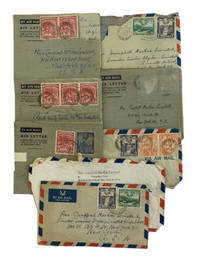
1951734561951. Paperback. Good. All appear to be written in 1951 and all were sent to Rev. Campbell MacRae Lewistall who is identified on a slip laid in one of the envelopes as Founder-teacher Blyden-Lewistall Private School at 314 West 133rd Street in New York City. Some letters are worn; all appear to be complete. Most envelopes present some with stamps. Three of the letters were from Philip Nathaniel King headmaster or head teacher of this Methodist-supported elementary school; one is from his wife; two are from his son; and two are from Mr. King's niece who was also a teacher at the school. All of the letters seem designed to establish contact with Rev. Lewistall who is addressed as Uncle. Some including the letters from King's son thank the New York Uncle for gifts such as an air rifle. It is clear from the letters that conditions at the school were far from ideal and that the Kings were hoping that their uncle in America would provide some financial support. <br/><br/> paperback books
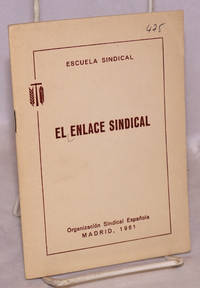
19617207Madrid: Organización Sindical Española 1961. 40p. stapled wraps lightly toned ownership stamp on front blank else very good condition. Text in Spanish. Organización Sindical Española unknown books
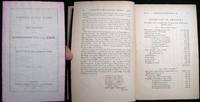
18713027Boston & London: Wright & Potter State Printer 1871. Public Document # 19 report for October 1870; reviews the state of the institution financial reports etc. number of people at the school statistics those who jumped ship; the officers and employees of the school; list of salaried officers on board the "Massachusetts" and their salaries - the ship had been sold that year as a measure of economy; also inventory of the property of the school contributions from the towns towards it's upkeep more; 31 pages original purple paper wraps; some spine ends edge tips wear to binding; a very good copy. First Edition. Soft Cover. Very Good. Wright & Potter, State Printer Paperback books
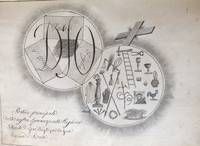
18242952Genoa 1824. <p>Manuscript on laid paper 4to 236 x 176 mm. 126 leaves foliated 3 1-3 1 4-42 1 43-51 1 52-61 1 62-103 1 104-118 complete. The numbered leaves containing one hundred and eighteen emblematic drawings all full-page explanations written on versos the unnumbered leaves containing the title 3 and 1/2-page introduction and section titles; most of the illustrations in landscape format. Calligraphic title text in brown ink in a neat cursive hand; the drawings in graphite pen-and-ink and gray wash a few with details in brown ink each within rule border with numbering at top gutter edge. Corner repairs to ff. 1-10 tears into ff. 9 and 104 a few other short marginal tears or fraying to edges ff. 100 and 101 with gutters reinforced on versos occasional minor offsetting or soiling. Late 19th-century half parchment and brown glazed paper manuscript title label on spine. <br /><br />An illustrated manuscript course of religious instruction for Deaf children by a pioneer of Deaf education in Italy using an original emblematic visual "language." <br /><br />By the early nineteenth century pre-modern misconceptions concerning the learning abilities of Deaf children had been largely exposed as false by such eighteenth-century pedagogues as the abbé Sicard and Charles-Michel de l'Epée in France each of whom founded schools for the Deaf and contributed to the development of a standardized sign language or Samuel Heinicke in Germany who implemented a different method of communication for the Deaf centered on oral speech. In Italy the most influential figure in the education of Deaf children was Ottavio Assarotti. As a young man Assarotti entered the order of the Piarists the Scuole pie. Founded in 1617 the Piarists' principal mission was and remains the provision of free education to poor and especially disabled children. After several years teaching theology and philosophy Assarotti set those disciplines aside to devote himself full-time to the development of an instructional program for Deaf children. Assarotti's method consisted in teaching the children not only reading writing and sign language but also a full range of humanist disciplines including science the arts and foreign languages. In 1805 he obtained financial support from Napoleon to found a school which after some delays was finally opened in 1811 in the former Bridgettine convent. After Napoleon's defeat the growing school received renewed support from King Vittorio Emmanuele I and its fame spread throughout Europe. <br /><br />"Assarotti made great use of sign language in his teaching . Directors of nearly all Italian institutes for deaf students flocked to learn from him and carried his method back with them. Pope Gregory XVI sent the new directors of the Rome Institute Padri Ralli and Gioazzini to study in Genoa with Assarotti. Upon their return to Rome they too used his techniques. How is it possible that a man so renowned and successful in his own time did not earn so much as one line of recognition in the historical accounts of other countries Perhaps the answer lies in the fact that Assarotti left no traces in written form of his philosophy and method. Had he done so not only would he have gained respect and notoriety outside Italy but perhaps the critical events soon to follow the subsequent dominance of "oralism" over sign language in Italy would have taken a different course ." Radutsky p. 245.<br /><br />In fact Assarotti wrote and may have published several texts for his pupils listed in DBI but not found in OCLC or ICCU. The present unpublished work was probably prepared for the use of instructors in the school. It contains a pictorial religious course of instruction using a complex but precise symbolic system to explain Christian doctrine and liturgy including the most abstract theological concepts. All the elements in the drawings are identified in captions of varying lengths and in various layouts. Names or words are often incorporated as visual elements of the emblems. While somewhat primitive the drawings' unique iconography is evocative and some have a powerful dreamlike quality.<br /><br />In the Middle Ages the Deaf were barred from the sacraments - and hence from marriage and any kind of normal life - because of the belief that they could not understand the word of God. While these strictures were loosened in 1571 thanks to Luther's influence prejudice against Deaf persons' abilities to achieve salvation subsisted partly because it was thought that they could not perform Confession. Hence the importance to early educators of the hearing-disabled of providing their pupils with comprehensive religious instruction as an essential foundation of their integration into society.<br /><br />The unnamed author of the introduction writing in the third person describes Assarotti's school and praises his religious zeal humanity and his understanding that Deaf people who had been previously "abandoned by society" are fully competent and indeed capable of the highest intellectual and spiritual attainment. The emblems the author explains will present to the Deaf student an easy transition from familiar material objects to those objects which are less material and from there to the most immaterial concepts of all. In doing so he or she will eventually absorb the entire Christian doctrine. The figures are described as Assarotti's own egli . ha inventato le figure che formano questo Libro . but whether the actual drawings are in his hand is uncertain. The introduction concludes with an explanation of the most frequently recurring emblematic figures. God is represented by a circle containing three rectangles which touch the circle and each other representing the Divine Trinity: flames emanate from the God the Father and Jesus rectangles toward the one representing the Holy Spirit a concept which is explained in the text as the reciprocal love between the two other Divine Persons. Jesus the man as opposed to his divine nature is shown by another circle helpfully inscribed "Uomo / Jesu' Cristo" and humans or human souls are represented by hearts although the meaning of the heart emblem varies throughout the manuscript. Further symbols introduced later are explained on the versos of the drawings.<br /><br />Contrasting with the approbation granted his pedagogical achievements Assarotti's religious views linked to the most mystical wing of the Ligurian Jansenists met with resistance from the church hierarchy and some of his theological writings were not approved for publication. The drawings of this manuscript provide a glimpse of an abstract mysticism which would certainly have been at odds with Catholic orthodoxy.<br /><br />The work is in five parts titled: Faith Fede ff. 4-42; Laws Legge 43-51; Prayer Preghiera 52-61; Sanctification Sanctificazione 62-103 and Virtue Vertù 104-118. The first part is a visual exposition of the Credo starting with God's attributes: his ubiquity is represented by the God and Jesus circles overlapping above a symbol of the world earth and heavens with the word DIO written repeatedly across the page; his omniscience by the God symbol at top sending down rays of light at center a man sitting under a tree and below that a well captioned "Abyss." Creation is a delightful drawing of fish in the seas flanking a mound representing the earth on top of which cavort animals under trees and within which are three large hearts linked to a central pole at the top and illustrating the three reasons that God created man: so that they might know love and enjoy him. The Church of Jesus Christ is an architectural drawing of a fortress. Heaven is a light emanating rays while Hell is a large vat whose opening is locked and barred. Virtuous souls are flaming hearts each with an open eye since they see God; sinful souls are spotted hearts with wilted stems instead of flames. These blemished hearts recur throughout the book for example behind bars in the vat of Hell; enchained by a similarly spotted Devil; in a genealogical tree descended from Adam and Eve; or clustered above Hell on Judgment Day opposite a crowd of pure haloed hearts trumpets sounding above and lightning striking the damned while divine light bathes the saved.<br /><br />The section on Laws contains various allegorical representations of the Ten Commandments. While some drawings amount to schematic tables demonstrating the relationships between theological concepts others are more pictorial. Reflecting no doubt Assarotti's personal mysticism all aspects of the divinity are abstract: there are no angels Madonnas or images of Christ. Crosses are shown but there are no Crucifixions and Christ's Passion appears as a circle containing the Arma Christi. The church hierarchy is represented by a papal tiara mitres and stoles. Human figures appear predominantly in the drawings of the sacraments and in representations of sin. In contrast with the invisibility of the divine Satin is personified as a grimacing devil and the seven deadly sins appear as animals and monsters poised above poisonous emissions from Hell's chimneys. <br /><br />That Assarotti's school used such manuscripts for teaching is supported by the existence of another manuscript very similar in content but lacking the title and two leaves offered by the Austrian antiquarian book firm Inlibris. Cf. Dizionario Biografico degli Italiani art. Antonella Dolci 4:433-4; E. Radutsky "The Education of Deaf People in Italy and the Use of Italian Sign Language" in Van Cleve ed. Deaf History Unveiled 1993 237-5; Rauthgundis Kurrer Gehörlose im Wandel der Zeit doctoral dissertation University of Munich 2013 available as a pdf online pp. 30-33.</p> unknown books