76 résultats
180063904Tokyo & Kyoto Japan: Kano School ca. 1800-1810. One 4to. art sample design portfolio sized 12.5 x 14 in. which folds out into giant montage of six large original late-Edo-Period Kano School screen designs on durable handmade Japanese rice paper measuring 110 x 75 in. carefully pasted as montage some titled as well as featuring ink manuscript painting instructions ordered counter-clockwise: “Bamboo scene†47 x 38.5 in.; King Tang of Shang court scene 36.5 x 39 in.; 2nd Court scene 38.75 x 38.75 in.; Pine tree landscape 38.75 x 38.75 in.; Crane 28.75 x 39 in.; and Island pagoda landscape & pine trees 31 x 41.75 in six w/ original colour painting some colour painting & material instructions in Japanese all arranged to compactly fold and bound with colour woodblock illustrated cloth and old bookseller labels mounted on verso some repairs to corners to reattach the boards thumbing & minor tears a fold creases w/ a few occasional paper repairs at the first most frequently used fold minor creasing & edgewear dustsoiling to fold creases interior offset toning from sizing & paint colours still an extraordinary exemplar. This exceptional late-Edo-period original Kano School painting montage incorporates many of the elements developed by the famed multi-generational painters whom over four centuries revived and shaped Chinese idealist traditions into a uniquely vigorous Japanese art style. The Kano school painters emphasized landscapes Imperial court interior & exterior architectural elements colours uses of gold animal and botanical subjects often creating crowded panoramic scenes typically used in wall & door screens as well as triptych folding wall screens. The repeated instructions on these designs in Japanese by Sasayama Tsutsumu -- one of several Sasayama painters who took that name from the 18th- to 19th-Centuries in the Kano School beginning with Sasayama Yoi d. 1743 student of Kano Sunnobu 1636-1713 and subsequently four more generations afterwards nearly all adopted and chiefly serving the Chofu domain -- specify these designs are each one of three pieces. In addition there are ink manuscript memos appearing with directions on pigments for the final design work such as adding mica flecks or other paints & dyes and these sketches captured key features of a design so that students or other Kano artists could sufficiently enlarge recreated and fully understand the steps required for the finished decorative artwork pieces. The upper right first image presents bamboo looming in the weather emphasizing their connections to architectural features; The second and third designs capture the golden age Curt of the King of Shang in 1600 B.C. memorialized later as the Xia Dynasty; the fourth presents a rugged hillside and trees shrouded in clouds; the fourth a wonderful large crane apparently intended as part of a much larger piece; and finally the sixth lower right features distant pagoda temple shrouded mountains flower-bedecked pine tree in foreground and with delicate colouring and shading. Naganobu Kano fl. 1775-1828 and his son Osanobu Seisenin Kano 1786-1846 were of the Kobikicho family which carried on the Kano School traditions from 1730 until the Meiji Period and were instrumental in producing designs and screens for the Nishinomaru and Honmaru palaces which burned down in 1838 and again in 1844. Even though the paintings no longer exist similar original design such as these do survive in the Tokyo National Museum. Seisenin Kano was especially well known for his art adapted from his studies from ancient paintings at the end of the Edo-period. See: Kano School After the Middle of the Edo Period Art Nomura 2026; Matthew P. McKelway Rediscovering the Kano School Artforum Vol. 53 No. 5 Jan. 2015; Brief Biographies of Scholars Painters and Haiku Poets of Chofu Records of the Sasayama Family Painters of the Chofu Domain 2026. Kano School, hardcover
175247661752 17,5x26 cm, pleine reliure toile, 336 pages, bon état, coiffes arasées et mors fendu sur un petit tiers, plat supérieur magnifiquement conservé, enluminé en creux, fleurons et volutes dorés rappelant l'Art Nouveau, plat inférieur un peu abîmé, éraflé, coins légèrement émoussés, 65 gravures en N&B de Paul Philippoteaux, la plupart in-texte, d'autres hors-texte, à pleine page, belle pièce de bibliophilie dite des écoles et des familles -
1796628240Halle, Waisenhaus, 1796. X, 660 S. Pappband d. Zeit mit neuem Rückenschild (berieben u. bestoßen, Rücken mit neuem Papier überklebt). [2 Warenabbildungen]
173028564Saint-André (des Eaux) 1730 un journal, broché (agraphé) ronéotypé en noir, de 9 pages bleue, rose ou crème imprimées d'un seul côté, format : 21 x 27 cm, illustré de 6 dessins in-texte en noir, MENSUEL N°1 OCTOBRE 1968 [ÉCOLE NOTRE-DAME DE L'ABBAYE (CHANTENAY)]
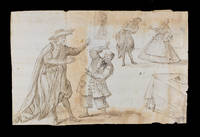
170198971701. 180x282mm. 7x11". España primer tercio dle siglo XVIII. Pluma tinta y aguada sepia sobre papel ocre agarbanzado verjurado. 180 x 282mm. Inscrito en el verso "64" "000.Pasteles" ". Cordón" y "P. de uno Camaron". Referencias: "Dibujo español del Renacimiento a Goya. La colección de la reina MarÃa Cristina de Borbón" Zaragoza 2008 nº 42 pp. 182 y 183 unknown
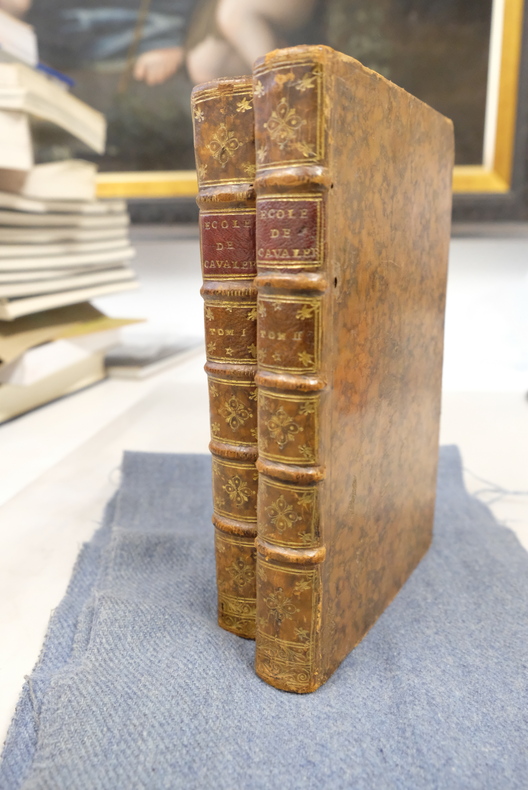
1736CHE2987MReliés, 319 et 298 pages, paru en 1736 à Paris, chez Jacques Guérin, libraire-imprimeur, 19,5x13,5cm. Très bon état général, très bien conservés, reliures légèrement usées, certaines pages légèrement brunies ou présentant des rousseurs.
17542110502151105707Ogawa Yokuro 1754. Soft Cover. Fine. Number of books: 1 Ogawa Yokuro paperback
180011952Paris, Imprimerie Nationale, an 8 ; in-8, broché ; 14 pp., (1) f. blanc.
17862092902141800516Osaka Bookstore Matabei 1786. Soft Cover. Fine. Number of books: 1 Osaka Bookstore Matabei paperback
176511568Hamburg, durch I. C. Piscator, ( 1765). 20 S. (mit Kopf- u. Schlußstücken). Geheftet.
176732270Paris Chez Vente 1767 in-12° 316-81 pp, avec le Catalogue Raisonné de Porcelaines de qualités supérieures, tant ancienne, première sorte, qu'ancien Japon et la Chine : d'effets précieux d'anciens lacqs, riches meubles de Boule , & bijoux , faisant partie du Cabinet de feu de M. de Julienne (...) Par C.F. Julliot , marchand au coin rue S. Honoré, au coi de celle du four, au curieux des Indes . Il manque Le Frontispice - Des côtes Manuscrites marquant peut être des prix ? des estimations ? - Carte de visite d'un expert parisien du XX ème siècle jointe - Plein veau restauré d'époque
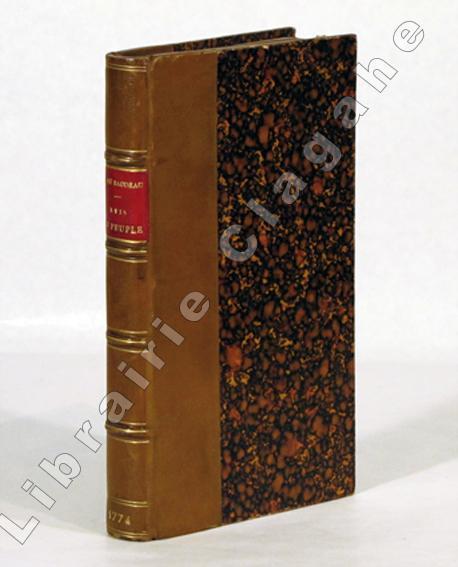
177418311Amsterdam et Paris, Fr. Ambr. Didot aîné, 1774 ; in-12 (178 mm), demi-veau caramel, dos à nerfs décorés de filets dorés, pièce de titre rouge, date en queue, non rogné (reliure du XIXe) ; 324 pp.
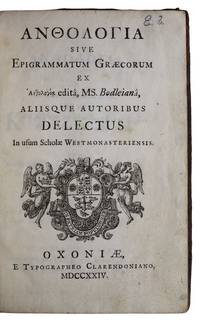
1724AQ24901Oxoniæ i.e. Oxford: E Typographeo Clarendoniano 1724. 2 99p 3. The first and sixth words of the title are transliterated from the Greek. Contemporary panelled sheep. Rubbed joints starting paper label with title in manuscript to head of spine. Contemporary inked ownership inscriptions of James Stuart to front endpapers scattered spotting. The sole recorded Oxford edition of an anthology of classical Greek satirical verse extracted from manuscripts held by the Bodleian for the use of students of Westminster School; including excerpts from the works of inter alia Anacreon Menander and Theocritus. The first London edition appeared in 1734. ESTC records copies at six locations in the British Isles BL NLS Nottingham Oxford Representative Church Body and St. Canice's Cathedral and six further worldwide California Chicago Illinois Kinder NYPL and Yale. ESTC T131082. First edition. 8vo. E Typographeo Clarendoniano unknown
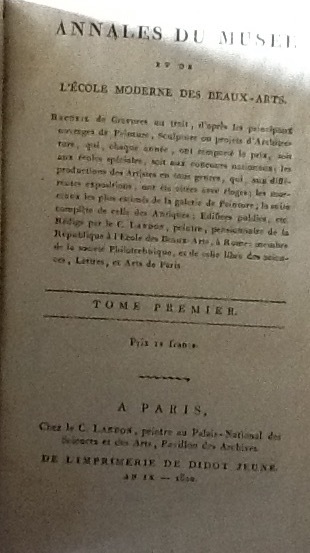
1800CCC-708apla1 edition didot jeune 1800 ( an IX ) , reliure plein cuir, tome 1 uniquement, 148 pages, 73 gravures pleine page noir/blanc, in-8 (13 cm X 20 cm), haut du dos rape, photos possible
1737262745London: E. Owen 1737. First edition. Double-page engraved frontispiece of Charterhouse engraved portrait of Sutton preceding Chapter I additional engraved plate of Sutton's tomb. xvi 275 1 pp. 8vo. Early 19th-century red straight-grained morocco a.e.g. Light rubbing to joints later gift inscription on ffep. First edition. Double-page engraved frontispiece of Charterhouse engraved portrait of Sutton preceding Chapter I additional engraved plate of Sutton's tomb. xvi 275 1 pp. 8vo. A life of Thomas Sutton 1532-1611 founder of the Charterhouse School in Smithfield London. E. Owen unknown books
1737262745London: E. Owen 1737. First edition. Double-page engraved frontispiece of Charterhouse engraved portrait of Sutton preceding Chapter I additional engraved plate of Sutton's tomb. xvi 275 1 pp. 8vo. Early 19th-century red straight-grained morocco a.e.g. Light rubbing to joints later gift inscription on ffep. First edition. Double-page engraved frontispiece of Charterhouse engraved portrait of Sutton preceding Chapter I additional engraved plate of Sutton's tomb. xvi 275 1 pp. 8vo. A life of Thomas Sutton 1532-1611 founder of the Charterhouse School in Smithfield London. E. Owen unknown
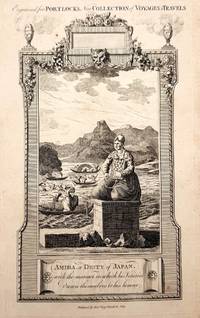
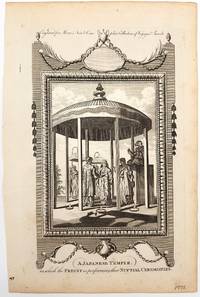
17781968London 1778. Engraving on cream laid paper 11 1/2 x 7 1/2 inches 290 x 190 mm sheet full margins. In good condition with minor age tone and an unevenly trimmed left sheet edge. Ink inscription in the left margin recto and pencil inscription in the right margin recto both well outside of the image area. unknown
180026715Canton 1800. Large 4to. 15 x 12 1/2 inches. 141 watercolours on thin paper nearly all captioned in ink in Chinese in the lower right corner each tipped to a sheet of wove paper. Mid-nineteenth century citron half morocco over marbled paper covered boards spine with raised bands in six compartments lettered in gilt in the second compartment the others with a repeat decoration in gilt marbled edges<br/> <br/> Provenance: Annie Pearson Viscountess Cowdray née Cass 1860-1932 Dunecht House Aberdeenshire.<br/> <br/> An extraordinary album of early Chinese export watercolours of the highest quality.<br/> <br/> Beginning in the late 18th century centred on the treaty port of Canton there existed a thriving trade in ethnographical watercolours executed by local Chinese artists and sold to the western merchants and travellers. The best known result of this trade is William Mason's Costume of China first published in London in 1800 which is illustrated with 60 hand-coloured aquatints adapted from a series of original watercolours by Pu-Qua of Canton. It was common for the local artists including Pu-Qua to work from a set series of models. The present album includes a number of compositions that are from the same set of models as those used by Pu-Qua but they include more detail and more of the trade-associated paraphernalia than are shown in the images as published in Mason's work. This suggests that they were not copied from Mason but were after another more detailed source or were unique compositions by the artist based on a similar series of models. Importantly these watercolours are of a uniformly higher quality than usually encountered and represent not only a wide array of occupations but also members of the highest echelon of Chinese society. The detailing on the costumes worn by these members of the royal court is breathtaking with copious use of gilt. Later collections of Chinese export watercolours were routinely executed on less expensive pith paper whereas the present watercolours are on high quality tissue and are larger in size than those typically encountered. The album represents an earlier more prestigious style of export watercolour paintings specifically meant for wealthy Europeans. These are Chinese watercolours of the highest quality designed and executed to the highest standards. The album was once owned by Annie Pearson Viscountess Cowdray Steward of Colchester and wife of Lord Weetman Dickinson Pearson 1st Viscount Cowdray.<br/> <br/> Cf. Crossman The China Trade Princeton: 1972; cf. Clunas Chinese Export Watercolours London: 1984. unknown
1738110705Toulouse, Par la Société 1738 In-16 relié plein veau d’époque 15,5 cm sur 10. Dos à nerfs orné des caissons et fleurons dorés. Tranches rouges. 436 pages. Page de titre et 72 pages de texte imprimées en rouge et noir. Bandeaux et culs-de-lampe. Mentions manuscrites sur deuxième contreplat. Reliure d’usage avec quelques petites taches, épidermures et frottements, 3 trous de vers au dos sans atteinte au texte. Rosace tracée au compas sur le premier plat, probablement par un écolier qui s’ennuyait ! Coins émoussés. Un cahier émergent légèrement de la gouttière aux tranches grises. Sans pages de garde. Assez bon état d’occasion.
179016081790. Engraving with hand coloring on laid paper 5 1/8 x 6 1/2 inches 130 x 160 mm the full sheet with unevenly trimmed margins. Multiple vertical creases and with the right margin having been fully reattached with clear tape on the verso. The top left corner has also been reattached with clear tape. There is some ghost text on the verso. Coloring is fresh yet delicate and extensive. One plate from an unknown English language publication. unknown
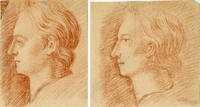
179014111790. Red crayon on cream laid paper 3 3/4 x 4 inches 95 x 102 mm ; 3 3/4 x 3 1/8 inches 95 x 80 mm. Each with scattered early repairs done with non-archival tape on the verso; the smaller of the two drawings has a repaired corner upper-right with in-drawing in red crayon. Condition issues are all consistent with age and the versos remain largely uneffected. A lovely duo. unknown
17781964London 1778. Engraving on cream laid paper 11 1/2 x 7 1/2 inches 290 x 190 mm full margins. In good condition with minor age tone and an unevenly trimmed left sheet edge. Ink inscription in the left margin recto and pencil inscription in the right margin recto both well outside of the image area. unknown
178022271780. Engraving on lightweight laid paper with an small indiscernible alphabetic watermark 9 x 7 1/2 230 x 188 mm; sheet 11 1/4 x 8 1/2 inches 284 x 215 mm wide margins. In very good condition with some light inscriptions in pencil in the lower margin outside of the image area. unknown
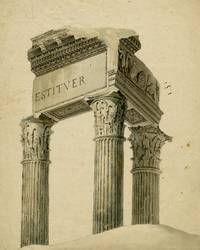
180010251800. Ink and wash in black ink with pen in black ink on watermarked C & I Honig cream laid paper 14 7/8 x 12 1/4 inches 378 x 311 mm the full sheet. In very good condition with some minor areas of light brown spotting in the right-center sheet margin. An excellent drawing with fine detail. The ruins of the Temple of Vespasian and Titus are located in the Roman Forum in Rome. The temple is a marble ruin that honors the deified emperors Vespasian and Titus. Located near the Temple of Saturn all that remain standing are three Corinthian columns that formed part of the colonnade. The temple was also dedicated to the son of Vespasiano Titus. Construction started on this temple in 79 AD. unknown
17462110502151103514Kara Bookstore Kichizaemon 1746. Soft Cover. Fine. Number of books: 2 Kara Bookstore Kichizaemon paperback