8 562 résultats
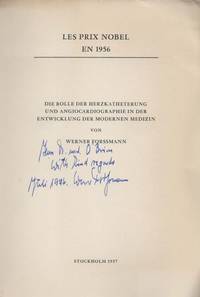
195631822AB1956. Germany 1956 - 1976. Octavo. Very good condition with only minor signs of wear. Signed and inscribed items by Forssmann are of great rarity. The Nobel Lecture alone is very scarce and very rarely available signed. Werner Theodor Otto Forßmann Forssmann in English; 29 August 1904 1 June 1979 was a German researcher and physician from Germany who shared the 1956 Nobel Prize in Medicine with Andre Frederic Cournand and Dickinson W. Richards for developing a procedure that allowed cardiac catheterization. In 1929 he put himself under local anesthesia and inserted a catheter into a vein of his arm. Not knowing if the catheter might pierce a vein he put his life at risk. Forssmann was nevertheless successful; he safely passed the catheter into his heart. Forssmann was born in Berlin on 29 August 1904. Upon graduating from Askanisches Gymnasium he entered the University of Berlin to study medicine passing the State Examination in 1929. He hypothesized that a catheter could be inserted directly into the heart for such applications as directly delivering drugs injecting radiopaque dyes or measuring blood pressure. The fear at the time was that such an intrusion into the heart would be fatal. To prove his point he decided to try the experiment on himself. In 1929 while working in Eberswalde he performed the first human cardiac catheterization. He ignored his department chief and persuaded the operating-room nurse in charge of the sterile supplies Gerda Ditzen to assist him. She agreed but only on the promise that he would do it on her rather than on himself. However Forssmann tricked her by restraining her to the operating table and pretending to locally anaesthetise and cut her arm whilst actually doing it on himself. He anesthetized his own lower arm in the cubital region and inserted a urinary catheter into his antecubital vein threading it partly along before releasing Ditzen who at this point realised the catheter was not in her arm and telling her to call the X-ray department. They walked some distance to the X-ray department on the floor below where under the guidance of a fluoroscope he advanced the catheter the full 60 cm into his right ventricular cavity. This was then recorded on X-Ray film showing the catheter lying in his right atrium. The head clinician at Eberswalde although initially very annoyed recognized Werner's discovery when shown the X-rays; he allowed Forssmann to carry out another catheterization on a terminally ill woman whose condition improved after being given drugs in this way. An unpaid position was created for Forssmann at the Berliner Charité Hospital working under Ferdinand Sauerbruch although once Sauerbruch saw his paper he was dismissed for continuing without his approval. Sauerbruch commented "You certainly can't begin surgery in that manner". Facing such disciplinary action for self-experimentation he was initially forced to leave the Charité but was later re-instated until again being forced to leave in 1932 for not meeting scientific expectations. His surgical skills were noted however and he was recommended to another hospital where he worked for a while before leaving in 1933 after marrying Dr. Elsbet Engel a specialist in urology there. Finding it difficult to get a job with his reputation he quit cardiology and took up urology. He then went on to study urology under Karl Heusch at the Rudolf Virchow Hospital in Berlin. Later he was appointed Chief of the Surgical Clinic at both the City Hospital at Dresden-Friedrichstadt and the Robert Koch Hospital in Berlin. From 1932 to 1945 he was a member of the Nazi Party. At the start of World War II he became a medical officer. In the course of his service he rose to the rank of Major until he was captured and put into a U.S. POW camp. Upon his release in 1945 he worked as a lumberjack and then as a country medic in the Black Forest with his wife. In 1950 he began practice as a urologist in Bad Kreuznach. During the time of his imprisonment his paper was read by André Frédéric Cournand and Dickinson W. Richards. They developed ways of applying his technique to heart disease diagnosis and research. In 1954 he was given the Leibniz Medal of the German Academy of Sciences. In 1956 the Nobel Prize in Physiology or Medicine was awarded to Cournand Richards and Forßmann. After winning the Nobel Prize he was given the position of Honorary Professor of Surgery and Urology at the University of Mainz. In 1961 he became an honorary professor at the National University of Córdoba. In 1962 he became a member of the Executive Board of the German Society of Surgery. He also became a member of the American College of Chest Physicians honorary member of the Swedish Society of Cardiology the German Society of Urology and the German Child Welfare Association. Wikipedia unknown
1834002750Paris, Vimont, 1834
185411115München, C. Wolf, [1854?]. Gr.-8° (22,5-25 cm). 1192 S. Halbleder der Zeit mit montiertem Rückenschild
18972092902144000583Bunji-do 1897. Soft Cover. Fine. Number of books: 20 Bunji-do paperback
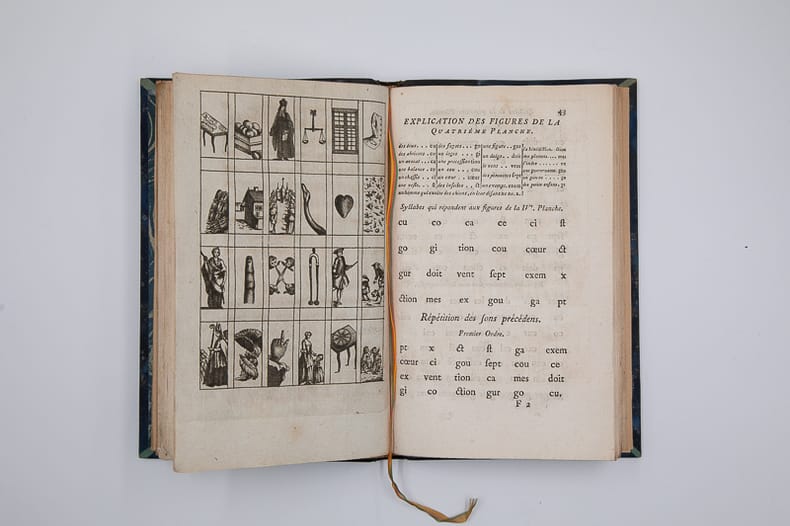
1777zy564Chez Couturier père, aux Galleries du Louvre Relié 1777 "TRÈS RARE ÉDITION DE 1777. RECHERCHÉE. CONTENANT LES 7 PAGES D'INSTRUCTION SUR LA FAÇON DE SERVIR DES FICHES...Le Quadrille des enfants. Ou système nouveau de lecture. Avec lequel tout enfant de quatre à cinq ans peut, par le moyen de quatre-vingt-huit figures, être mis en état de lire sans faute à l'ouverture de toutes sortes de livres en trois ou quatre mois, & même beaucoup plutôt, selon les dispositions de l'enfant. Quatrième édition, revue, abrégée & perfectionnée à l'usage des jeunes élèves de la pension académique du Faubourg S. Honoré, n°42. Chez Couturier père, aux Galleries du Louvre. Paris. 1777. avec Approbation & Privilège du Roi. In-8 (21,5x14 cm), 7 pages d'""Instruction sur la façon de se servir des fiches et du livre du Quadrille des Enfants"", 142, (2 : Approbation et Privilège) pp., (4) planches gravées, demi basane bleu nuit, dos lisse, titre et date dorés (reliure moderne). Rare quatrième édition du Quadrille des enfants publié en 1744 par Claude-Louis Berthaud. Les quatre planches gravées correspondent aux 88 figures de la méthode. Ces figures étaient également appliquées sur des planches en os avec le phonème correspondant au verso. La méthode reposant sur l'association de sons et d'images familières aux enfants. L'auteur dans son discours préliminaire incite à ""ne pas craindre à faire la dépense des fiches"", le précis des instructions imprimé à part ne devrait être livré qu'à ceux qui les achetaient. Il est ici relié en tête. Le Discours préliminaire se termine par la liste des enfants qui ont appris à lire par la méthode (avec le nom de leurs parents et leur adresse). Le Journal Encyclopédique ou Universel de l'année 1778 mentionne ""l'extrême utilité de cet ouvrage, dont on est redevable à feu M. Berthaud, est suffisamment connue"". L'édition de 1777 est très rare. Livraison a domicile (La Poste) ou en Mondial Relay sur simple demande."
50592Histoire naturelle de la parole.Court de Gebelin. Paris.1776.400 p.1 frontispice gravé par Marillier.1 planche rempliée d'Alphabet.(2 figs.).1 planche rempliée en couleurs par Gauthier Dagoty père.(5 figs.).Nouvelle Mnémonique. Demangeon.Paris.1841.156 p.La lecture perfectionnée par la déclamation.Fables et poésies.Wik Potel. Paris.Lyon.1858.64 p.Format in-8 pour ces 3 textes dans une demi-reliure au dos orné d'une couronne comtale dans 3 caissons dorés.Titres et auteurs en caractères dorés.Tranches peigne.Jolie reliure.Intérieurs avec rousseurs surtout pour les textes XIXème.
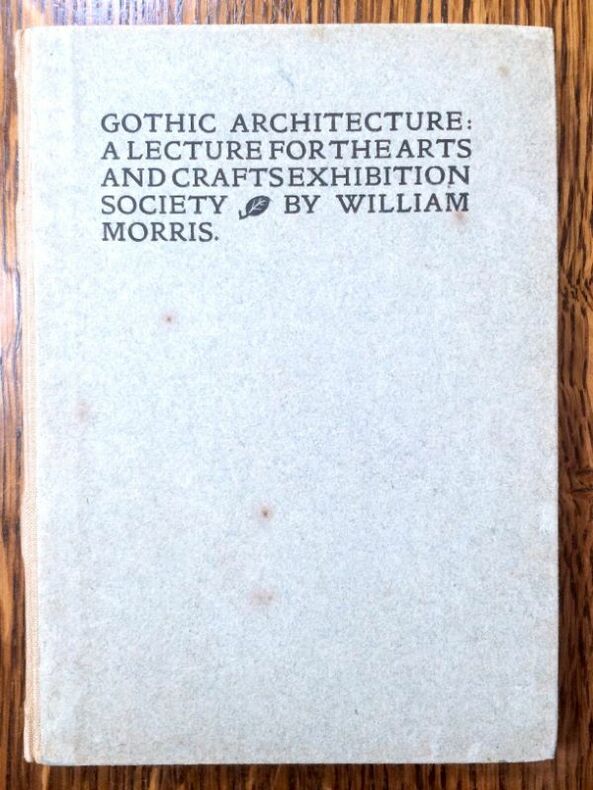
4531 Relié, cartonnage gris impr. et dos toilé d'édition. In-16°, 14,5 x 10,5 cm, [2]-68pp-[6]. Upper Mall / Hammersmith, Kelmscott Press, 1893. Edition originale
4531 Relié, cartonnage gris impr. et dos toilé d'édition. In-16°, 14,5 x 10,5 cm, [2]-68pp-[6]. Upper Mall / Hammersmith, Kelmscott Press, 1893. Edition originale
19852090202120412687Doho-sha 1985. Soft Cover. Fine. Number of books: 1 Doho-sha paperback
1833zy578coup de coeur de Bernard broché 1833 TRES RARE LIVRET PEDAGOGIQUE. Le Mot Et La Chose; ou Elémens figures de La Lecture, Ouvrage orne de 800 Figures. (14x23,2 cm), 10, (2) pp., XXXII planches gravées : couvertures de papier vergé ocre gravées. Méthode rare et innovante, premier essai de méthode globale. 12 pages de livret explicatif de la méthode, 32 planches de mots illustrés d'une gravure, la plupart coloriées à l'époque. Les illustrations et le choix des mots sont absolument ravissants, tout comme la mise en page, le soin apporté à la typographie et la conception des petites scènes. Le kangourou, pris par erreur pour une gazelle, est particulièrement charmant. Un seul exemplaire dans les bibliothèques mondiales, celui de la BnF. Livraison a domicile (La Poste) ou en Mondial Relay sur simple demande.
19562080502106602035Not Available 1956. Soft Cover. Fine. Volume: 1 Not Available paperback
1837wq669Paris, au bureau central, rue des filles-Saint-Thomas, n° 5 Relié 1837 Première édition in-4 (28 x 19,5 cm). Faux-titre, titre, 112 pages : demi-veau brun, filets dorés sur le dos, plats de papier marbré. (Reliure de l’époque). Issue du premier dictionnaire illustré d’iconophores, lettrines ornées à mi-page avec des représentations débutant par la même initiale. Une pour chaque lettre de l’alphabet, y compris le W, et conçu par le lexicographe et grammairien Napoléon Landais (1804-1852). L’auteur tira de son Dictionnaire général et grammatical (1834) ce manuel dont les gravures aideront à l’apprentissage. L’alphabet gravé est précédé de “Principes de lecture” composés d’alphabets, de syllabaires, d’exercices, de chiffres et de premières lectures sur 8 pages, 12 exercices. L’initiale ornée est soulignée de la lettre en différentes typographies, légendées, et d’un lexique de mots choisis propres à l’étude — faune, flore, peuples, etc. Le N fait la part belle à Napoléon Bonaparte avec plus de six pages historiques. Les riches ornements portent les signatures de Wattier et Tellier et sont gravés sur bois par V. Duplat et Andrew Best & Leloir, atelier de gravure parisien. Première garde volante manquante, angles inférieurs de certains feuillet pliés, quelques-uns avec petits manques sans atteinte du texte. Pâles rousseurs éparses. Provenance : Bibliothèque du Château de Laplagne, avec ex-libris ; Livraison a domicile (La Poste) ou en Mondial Relay sur simple demande.
2091502135400875Not Available N.A. Soft Cover. Fine. Number of books: 1 Not Available paperback
19202081502111806513Hirofumi-do shoten 1920. Soft Cover. Fine. Volume: 1 Hirofumi-do shoten paperback
19122080502106912287Not Available 1912. Soft Cover. Fine. The book is in fine condition. Not Available paperback
17811099761781 Un volume In-16 (9,5 x 16cm environ), reliure pleine peau, filets, et fleurons dorés au dos, tranche marbrées en couleurs, reprenant le motif des gardes - Cinq ouvrages reliés en un volume intitulé "Recueil II" à l'aide d'une pièce de titre au dos, répartis comme suit : (1) A Amsterdam; et se trouve à Paris, Chez Méquignon l'aîné, Librairie, rue des Cordeliers - M. DCC. LXXIX. 1779 - 46 pages - (2) A Berlin, et se trouve, à Paris, Chez l'Auteur , Barrière de Reuilly; Fauxbourg Saint-Antoine. Et Chez Belin, Librairie, rue Saint-Jacques - M DCC LXXIX. 1779 - 35 pages - (3) A Paris, Chez l'Auteur, rue Croix des Petits-Champs, Maison de M. Bourdet, Chirurgien-Dentiste du Roi. et Chez Blaizot, Librire du Roi, rue Satory, à Versailles - Avec Approbation et Permission - M. DCC. LXXXI. 1781- 139 pages - Cul-de-lampe - (4) A Amsterdam; et se trouve à Paris, Chez Bastien, Libraire, rue du Petit-Lion, Fauxbourg Saint-Germain - M. DCC. LXXIV. 1774 - 56 pages - (5) A Paris, Chez Saugrain, Libraire, Quai des Augustins, près de la rue Pavée - M. DCC. LXXXI. 1781 - 116 pages
vd1297Stoutgard, Ch. Thienemann. Libraire. Cartonnage d'éditeur Rare abécédaire orné de sept planches gravées et coloriées et publié en Allemagne vers 1860 (19 * 13 cm), un frontispice, 24 pages non paginées, 6 planches gravées et coloriées au pochoir. Cartonnage de l'éditeur, dos toile lie de vin, plats de papier, gravure coloriée et contre collée au premier plat, cinq planches de quatre gravures et une de cinq, toutes numérotées. Onze leçons précèdent les historiettes édifiantes : lettres, voyelles, accents, diphtongues et ponctuation. Les historiettes illustrées correspondent chacune à une lettre de l'alphabet (pas de W). De la bibliothèque des princes de Furstenberg à Donauschingen avec la tampon humide sur la première et la dernière page ; manque la page de faux-titre, quelques rousseurs sur les tranches et le premier plat. Bel état pour ce rare abécédaire. Livraison a domicile (La Poste) ou en Mondial Relay sur simple demande.
19732110502150908638Kuretake Gakuen Tokyo High School of Acupuncture and Moxibustion Research Department 1973. Soft Cover. Fine. Number of books: 13 Kuretake Gakuen Tokyo High School of Acupuncture and Moxibustion Research Department paperback
20112091502135703982Hojodo 2011. Soft Cover. Fine. The book is in fine condition. Hojodo paperback
1623100144875Cothenis Anhaltinorum 1623 in8. 1623. Relié. Le Lexicon Syriacum de Martino Trostio est un dictionnaire syriaque-latin-allemand publié en 1623 à Cothenis Anhaltinorum basé sur l'induction de tous les exemples du Nouveau Testament syriaque. L'ouvrage comprend des notes de variantes de lecture collectées à partir de cinq éditions imprimées et représente le lexique syriaque le plus complet publié à cette époque
14174Volumes in 8 reliure demi cuir, titre et filets dorés Textes de Alexandre DUMAS. Paul FEVAL, Jules VERNE, Théophile GAUTIER, Eugène SUE, Victor HUGO, Alphonse de LAMARTINE etc. Nombreuses illustrations de GAVARNI, GRANDVILLE, Tony JOHANNOT, DAUMIER etc. 44 volumes 1833- 1883 Première série 1) 1833-1834- Première année 2) 1834 1835 3) 1835 1836 4) ………… 5) 1837 1838 6) 1838 1839 7) 1839 1840 8) 1840 1841 9) 1841 1842 (légères épidermures) 10) 1842 1843 Deuxième série 11) 1843 1844 12) 1844 1845 13) 1845 1846 14) 18461847 15) 1847 1848 16) 1848 1849(charnière coupée en tête 17) 1848 1850 18) 1850 1851 19) 1851 1852 20)1852 1853 21) 1854 1855 (état moyen) 22) 1855 1856 broché 23) 1856 1857 24)………… 25)………… 26)………… 27)………… 28) 1860 0861 29) 1861 1862 broché 30) 1862 1863 31) 1863 1864 32)1864 1865 (2 déchirures) 33) 1865 1866 34) 1866 1867 35) 1867 1868 (pas de page de titre) 36) 1868 1869 37) 1869 1870 38) 1871 39) 1872 40) 1873 41)……….. 42) 1875 (épidermures) 43) 1876 44) 1877 45) 1878 46) 1879 47) 1880 48) 1881 49) 1882
1755000755Paris Desaint & Saillant, Vincent 1755
td323Hachette et Cie Revue relié "Dix-huit volumes in-8 (18 x 25 cm), reliure demi-basane, dos lisse orné de filets dorés, tête de série de la revue ""Lectures pour tous, revue universelle et populaire illustrée"", de 1898 à 1914, illustrations en noir, certaines couvertures ont été conservée in fine ; dos insolés, quelques épidermures sur le cuir, coins frottés, éraflures aux plats de certains volumes, par ailleurs bon état général. Livraison a domicile (La Poste) ou en Mondial Relay sur simple demande."
19012082402113510902Not Available 1901. Soft Cover. Fine. Number of books: books Not Available paperback
18812090202122801560Not Available 1881. Soft Cover. Fine. Number of pages: 78.88.95 pages Size: B5 Not Available paperback