Françoise Hélene - Reinert - Gollanès - MauvieuxLivre Rare Book

4 550 résultats
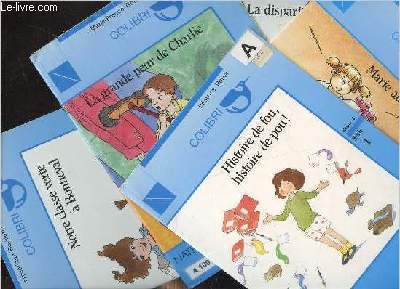
1993R160208140Nathan. 1993. In-8. Broché. Etat d'usage, Couv. convenable, Dos satisfaisant, Intérieur frais. 21 pages par numéros. Nombreuses illustrations en couleurs dans le texte. Etiquette de code collée sur le 1er plat. Tampon sur la page de titre.. . . . Classification Dewey : 372.4-Livre scolaire : lecture
1961RO60045187OPHRYS - GAP. 1961. In-8. Broché. Bon état, Couv. convenable, Dos abîmé, Intérieur acceptable. 57 pages.. . . . Classification Dewey : 372.4-Livre scolaire : lecture
1997cv2497Le Promeneur Broché 1997 In-12 (16.5 x 12.5 cm.), dos broché, couverture rempliée illustrée d'une vignette en couleurs, 162 pages ; couverture légèrement salie, bon état. Livraison a domicile (La Poste) ou en Mondial Relay sur simple demande.
1993R160208142Nathan. 1993. In-8. Broché. Etat d'usage, Couv. convenable, Dos satisfaisant, Intérieur frais. 21 pages par numéros. Nombreuses illustrations en couleurs dans le texte. Etiquette de code collée sur le 1er plat. Tampon sur la page de titre. . . . Classification Dewey : 372.4-Livre scolaire : lecture
1993R160208141Nathan. 1993. In-8. Broché. Etat d'usage, Couv. convenable, Dos satisfaisant, Intérieur frais. 21 pages par numéros. Nombreuses illustrations en couleurs dans le texte. Etiquette de code collée sur le 1er plat. Tampon sur la page de titre. . . . Classification Dewey : 372.4-Livre scolaire : lecture
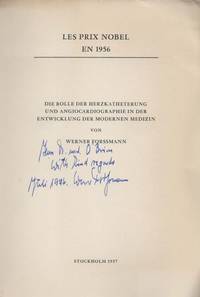
195631822AB1956. Germany 1956 - 1976. Octavo. Very good condition with only minor signs of wear. Signed and inscribed items by Forssmann are of great rarity. The Nobel Lecture alone is very scarce and very rarely available signed. Werner Theodor Otto Forßmann Forssmann in English; 29 August 1904 1 June 1979 was a German researcher and physician from Germany who shared the 1956 Nobel Prize in Medicine with Andre Frederic Cournand and Dickinson W. Richards for developing a procedure that allowed cardiac catheterization. In 1929 he put himself under local anesthesia and inserted a catheter into a vein of his arm. Not knowing if the catheter might pierce a vein he put his life at risk. Forssmann was nevertheless successful; he safely passed the catheter into his heart. Forssmann was born in Berlin on 29 August 1904. Upon graduating from Askanisches Gymnasium he entered the University of Berlin to study medicine passing the State Examination in 1929. He hypothesized that a catheter could be inserted directly into the heart for such applications as directly delivering drugs injecting radiopaque dyes or measuring blood pressure. The fear at the time was that such an intrusion into the heart would be fatal. To prove his point he decided to try the experiment on himself. In 1929 while working in Eberswalde he performed the first human cardiac catheterization. He ignored his department chief and persuaded the operating-room nurse in charge of the sterile supplies Gerda Ditzen to assist him. She agreed but only on the promise that he would do it on her rather than on himself. However Forssmann tricked her by restraining her to the operating table and pretending to locally anaesthetise and cut her arm whilst actually doing it on himself. He anesthetized his own lower arm in the cubital region and inserted a urinary catheter into his antecubital vein threading it partly along before releasing Ditzen who at this point realised the catheter was not in her arm and telling her to call the X-ray department. They walked some distance to the X-ray department on the floor below where under the guidance of a fluoroscope he advanced the catheter the full 60 cm into his right ventricular cavity. This was then recorded on X-Ray film showing the catheter lying in his right atrium. The head clinician at Eberswalde although initially very annoyed recognized Werner's discovery when shown the X-rays; he allowed Forssmann to carry out another catheterization on a terminally ill woman whose condition improved after being given drugs in this way. An unpaid position was created for Forssmann at the Berliner Charité Hospital working under Ferdinand Sauerbruch although once Sauerbruch saw his paper he was dismissed for continuing without his approval. Sauerbruch commented "You certainly can't begin surgery in that manner". Facing such disciplinary action for self-experimentation he was initially forced to leave the Charité but was later re-instated until again being forced to leave in 1932 for not meeting scientific expectations. His surgical skills were noted however and he was recommended to another hospital where he worked for a while before leaving in 1933 after marrying Dr. Elsbet Engel a specialist in urology there. Finding it difficult to get a job with his reputation he quit cardiology and took up urology. He then went on to study urology under Karl Heusch at the Rudolf Virchow Hospital in Berlin. Later he was appointed Chief of the Surgical Clinic at both the City Hospital at Dresden-Friedrichstadt and the Robert Koch Hospital in Berlin. From 1932 to 1945 he was a member of the Nazi Party. At the start of World War II he became a medical officer. In the course of his service he rose to the rank of Major until he was captured and put into a U.S. POW camp. Upon his release in 1945 he worked as a lumberjack and then as a country medic in the Black Forest with his wife. In 1950 he began practice as a urologist in Bad Kreuznach. During the time of his imprisonment his paper was read by André Frédéric Cournand and Dickinson W. Richards. They developed ways of applying his technique to heart disease diagnosis and research. In 1954 he was given the Leibniz Medal of the German Academy of Sciences. In 1956 the Nobel Prize in Physiology or Medicine was awarded to Cournand Richards and Forßmann. After winning the Nobel Prize he was given the position of Honorary Professor of Surgery and Urology at the University of Mainz. In 1961 he became an honorary professor at the National University of Córdoba. In 1962 he became a member of the Executive Board of the German Society of Surgery. He also became a member of the American College of Chest Physicians honorary member of the Swedish Society of Cardiology the German Society of Urology and the German Child Welfare Association. Wikipedia unknown
19392080502106917702Not Available 1939. Soft Cover. Fine. The book is in fine condition. Not Available paperback
19392092902140314550Koa Cultural Association 1939. Soft Cover. Fine. Number of books: 1 Koa Cultural Association paperback
19132110502151005348Kenkodo physical education store 1913. Soft Cover. Fine. Volume: 1 Kenkodo physical education store paperback
19992092902138201088Tanka kenkyu-sha 1999. Soft Cover. Fine. Number of pages: 121 pages Size: A5 size Number of books: 1 volume Tanka kenkyu-sha paperback
19262080502106509994Ryubunkan 1926. Soft Cover. Fine. Volume: 1 Ryubunkan paperback
19302082502113904246Dobun-kan-kan 1930. Soft Cover. Fine. Number of books: 1 Dobun-kan-kan paperback
19302082502113904152Published by Ryubunkan 1930. Soft Cover. Fine. Number of books: 1 Published by Ryubunkan paperback
1991RO60043654NATHAN. 1991. In-8. Cartonnage d'éditeurs. Etat d'usage, Couv. convenable, Dos satisfaisant, Quelques rousseurs. Non paginé. 7 pages. Nombreuses illustrations en couleurs dans le texte.. . . . Classification Dewey : 372.4-Livre scolaire : lecture
1988RO60043656NATHAN. 1988. In-8. Cartonnage d'éditeurs. Etat d'usage, Couv. convenable, Dos satisfaisant, Quelques rousseurs. Non pagine. Environ 10 pages. Nombreuses illustrations en couleurs dans le texte. Ecritures sur la 1er de couverture.. . . . Classification Dewey : 372.4-Livre scolaire : lecture
1988RO60043657NATHAN. 1988. In-8. Cartonnage d'éditeurs. Etat d'usage, Couv. convenable, Dos satisfaisant, Intérieur acceptable. Non pagine. Environ 10 pages. Nombreuses illustrations en couleurs dans le texte.. . . . Classification Dewey : 372.4-Livre scolaire : lecture
1984500212969Editions Gallimard 1984 17x0 6x10 8cm. 1984. Broché.
1974RO30120586DE L ECOLE. 1974. In-8. Broché. Bon état, Couv. convenable, Dos satisfaisant, Intérieur frais. 217 pages- quelques illustrations en noir et blanc dans et hors texte. . . . Classification Dewey : 372.4-Livre scolaire : lecture
1974RO40057854DE L ECOLE. 1974. In-8. Broché. Bon état, Couv. convenable, Dos satisfaisant, Quelques rousseurs. 217 pages- quelques illustrations en noir et blanc dans et hors texte. Quelques rares annotations au crayon à papier sans conséquence sur la lecture- traces d'adhésif sur les contreplats + annotation sur le 1er contreplat.. . . . Classification Dewey : 372.4-Livre scolaire : lecture
1921R150165298RIEDER.. 1921. In-12. Cartonnage d'éditeurs. Etat d'usage, Couv. légèrement passée, Coiffe en tête abîmée, Intérieur acceptable. 320 pages. Tampon et note au stylo sur la page de faux titre.. . . . Classification Dewey : 372.4-Livre scolaire : lecture
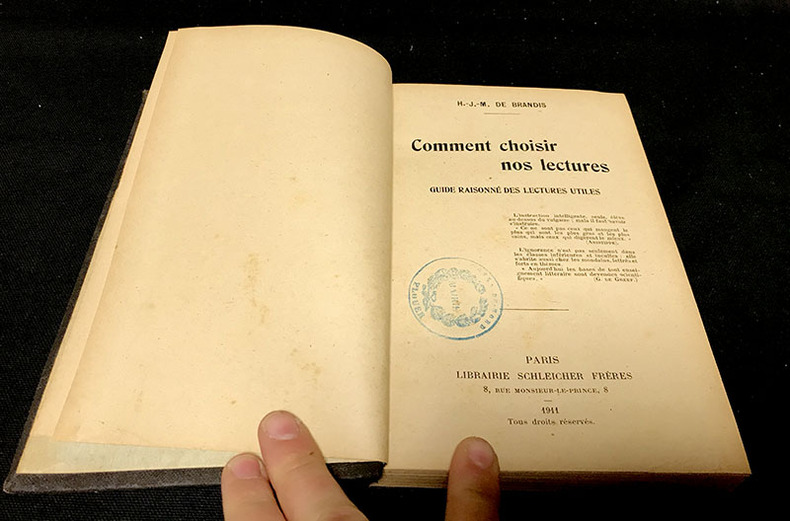
1911np1235Librairie Schleicher frères Relié 1911 In-12 (13 x 30 cm), relié pleine toile noire, dos lisse avec titre et auteur dorés, 208 pages ; coiffes et coins frottés, mors marqués, petites rousseurs, tampons à la page de titre et dernière page, par ailleurs bon état général. Livraison a domicile (La Poste) ou en Mondial Relay sur simple demande.
1983RO60043601FERNAND NATHAN. 1983. In-12. Broché. Bon état, Couv. convenable, Dos satisfaisant, Intérieur frais. Non paginé. Environ 10 pages. Illustrations en couleurs dans le texte. Livre Pop Up.. . . . Classification Dewey : 372.4-Livre scolaire : lecture
1973R320081572FERNAND NATHAN. 1973. In-8. Broché. Bon état, Couv. convenable, Dos satisfaisant, Intérieur frais. 63 pages - Nombreuses figures en noir et blanc hors texte - Plats tres legerement frottés.. . . . Classification Dewey : 372.4-Livre scolaire : lecture
1955R320061040FERNDAND NATHAN. 1955. In-8. Broché. Etat d'usage, Couv. défraîchie, Coiffe en pied abîmée, Intérieur frais. 64 pages - Nombreuses illustrations bicolores in texte - 1er plat illustré en couleurs.. . . . Classification Dewey : 372.4-Livre scolaire : lecture
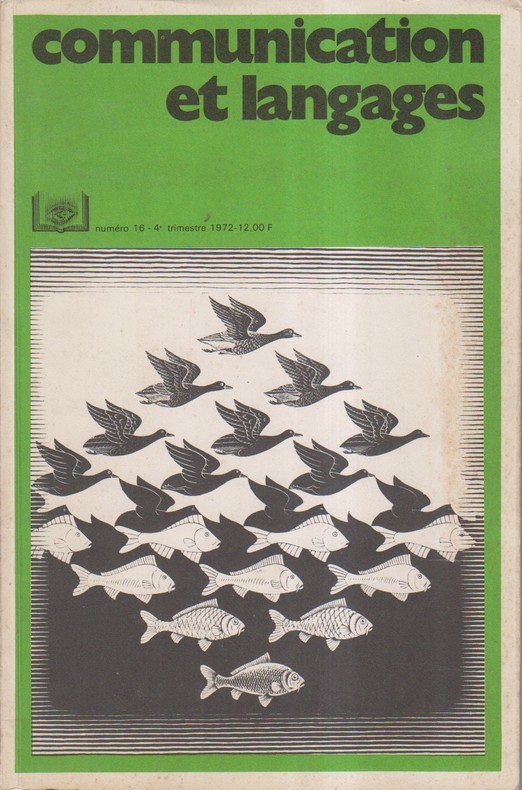
1972125321Couverture souple. Revue 16 x 24 cm. 120 pages.