12 555 résultats
13101Vals les Bains, organe officiel du Syndicat d'Initiative du Vivarais, 15 juin 1913, 1 br., couverture illustrée. in-8 de 20 pages, paginées 113 à 132, illustrations, clichés Aurenche, Audigier ;
1903470037Berlin, Druck u. Verlag der "Post", (1903). 70, 212 S. Originalumschlag (lädiert, Rücken überklebt u. mit Bibliotheksschild).
71274aafMünchen, Heraldische Gesellschaft, 1997, gr. in-8vo, 388 S., Original-Pappband.
B9781905124251Paperback. New. paperback
2091202133001945Fumikura Shobo N.A. Soft Cover. Fine. Number of books: 1 Fumikura Shobo paperback
19102080302106801751Shimazu Family Temporary Editing Office 1910. Soft Cover. Fine. Number of pages: 244 Number of books: 2 Shimazu Family Temporary Editing Office paperback
196812549Editions One World Family / Berkeley, California 1972. Grand magazine, in-4 agrafé de 32 pages au format 42,5 x 29,5 cm. Belles couvertures illustrées. Dos avec petit accroc central, du à la pliure du magazine. Plats et intérieur frais, malgré de minuscules tassement et frottis aux coins. Articlers et nombreus dessins en noir et blanc pour promouvoir les idées de cette communauté. Cette dernière fut fondée par Allen Noonan en 1967 à San Francisco, propriétaire d’un café et passionné d’ovnis. Elle fut très active à Berkeley, en Californie, où elle gérait le " One World Family Natural Foods and Entertainment Center " un restaurant mais aussi un magasin de vêtements et une salle de spectacle. L’OWFC a toujours été politiquement active, prenant part au mouvement contre la guerre du Vietnam, promouvant le pacifisme et le rejet du capitalisme. L’OWFC pratiquait l’Évangile éternel, une combinaison de croyances sur les ovnis, de thèmes basés sur le christianisme du bien et du mal, exprimés par l’utilisation d’une force vitale, ainsi que de croyances basé sur la spiritualité et les états d’être supérieurs. Comme d’autres communautés New Age et hippies, elle était en grande partie composée de jeunes, motivés par le rejet du capitalisme, de la religion occidentale, de la recherche d’une connexion plus étroite avec la nature par le biais d’un régime macrobiotique et de psychédéliques, de l’adoption de la vie communautaire et des relations non monogames. Rare édition originale américaine en bel état général et en micro-tirage, dont je n'ai trouvé aucune indication et dont j'ignore si il eut d'autres numéros publiés.
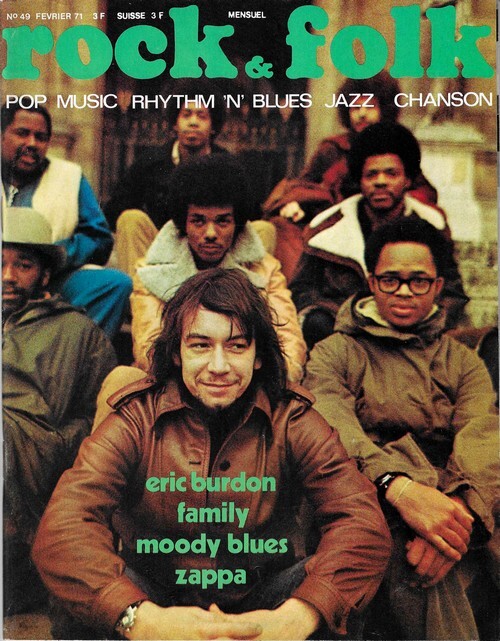
151932642Revue Rock & Folk n° 49 de février 1971. In-4 agrafé de 98 pages, au format 27 x 21,5 cm. Couvertures photographiques avec Léo Ferré. Couvertures avec d'infimes frottis aux coins. Intérieur frais. Mensuel musical français consacré à la musique rock et pop, fondé en 1966 par Robert Baudelet, Jean Tronchot, Philippe Adler, Jean-Pierre Leloir et Philippe Koechlin. La revue connut la participation de nombreux photographes dont : Jean-Pierre Leloir, Claude Gassian, Pierre Terrasson, Gaëlle Ghesquière, Bruno Ducourant,Patrice Guino, Jean-Louis Rancurel, Dominique Tarlé, Bertrand Alary et Saddri Derradji. Nombreux articles sur le Rock, le blues, la soul, la pop dont : Eric Burdon & War, Family, Jimi Hendrix, Les Moody Blues, Frank Zappa, Léon Russell, etc. Nombreuses chroniques avec de très nombreuses photographies en noir et blanc. Rare édition originale, en très bel état de fraicheur.
151932656Revue Rock & Folk n° 61 de février 1972. In-4 agrafé de 98 pages, au format 27 x 21,5 cm. Couvertures photographiques avec Keith Richard. Couvertures avec d'infimes frottis aux coins. Intérieur frais. Mensuel musical français consacré à la musique rock et pop, fondé en 1966 par Robert Baudelet, Jean Tronchot, Philippe Adler, Jean-Pierre Leloir et Philippe Koechlin. La revue connut la participation de nombreux photographes dont : Jean-Pierre Leloir, Claude Gassian, Pierre Terrasson, Gaëlle Ghesquière, Bruno Ducourant,Patrice Guino, Jean-Louis Rancurel, Dominique Tarlé, Bertrand Alary et Saddri Derradji. Nombreux articles sur le Rock, le blues, la soul, la pop dont : Keith Richard, Redbone, Hawkwind, Rory Gallagher, Paul Simon, Sly and the Family Stone, Dick Rivers, C.S.N. & Y, Nico, Lou Reed, Les Rolling Stones, etc. Nombreuses chroniques avec de très nombreuses photographies en noir et blanc. Planche de " Hamster Jovial " par Marcel Gotlib. Rare édition originale, en très bel état de fraicheur.
151932655Revue Rock & Folk n° 62 de mars 1972. In-4 agrafé de 98 pages, au format 27 x 21,5 cm. Couvertures photographiques avec Roger Waters. Couvertures avec d'infimes frottis aux coins. Intérieur frais. Mensuel musical français consacré à la musique rock et pop, fondé en 1966 par Robert Baudelet, Jean Tronchot, Philippe Adler, Jean-Pierre Leloir et Philippe Koechlin. La revue connut la participation de nombreux photographes dont : Jean-Pierre Leloir, Claude Gassian, Pierre Terrasson, Gaëlle Ghesquière, Bruno Ducourant,Patrice Guino, Jean-Louis Rancurel, Dominique Tarlé, Bertrand Alary et Saddri Derradji. Nombreux articles sur le Rock, le blues, la soul, la pop dont : T.Rex, Pink Floyd, Les Doors, Family, Les Byrds, Chuck Berry, Lou Reed, Gato Barbieri, Jefferson Airplane, Joni Mitchell, etc. Nombreuses chroniques avec de très nombreuses photographies en noir et blanc. Planche de " Hamster Jovial " par Marcel Gotlib. Rare édition originale, en très bel état de fraicheur.
19972091502135419552Miyoshimachi 1997. Soft Cover. Fine. Number of books: 2 Miyoshimachi paperback
18822Privas, Imprimerie Ardéchoise, 1898, 1 broché, première de couverture détachée, 4ème de couverture manquante, dos fragile, exemplaire à relier. in-8 de 319-(2) pages non coupées, petits manques dans la marge du dernier feuillet ;
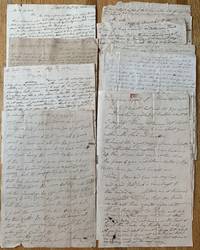
30844<p>Large archive of 1507 letters 6631 manuscript pp. dated 31 October 1884 to 19 May 1964; plus over 300 pieces of ephemera related to the Babb and Conant families.</p><p>Note: A complete inventory of the collection and biographical sketches of its main correspondents can be emailed upon request.</p><p><b>Persis Loring Conant 1887-1964 and Hugh Webster Babb 1887-1971</b></p><p>Persis Loring Conant was born on 29 May 1887. She was the daughter of merchant Frederick "Pardi" Odell Conant 1857-1928 and his wife Eva "Mardi" Merrill 1852-1936of Portland Maine. Persis' father prepared for college in the public schools of Portland and under private instructors and entered Bowdoin College where he received the degree of Bachelor of Science in 1880 and Master of Arts in 1883. A distant cousin of the Conant family was James Bryant Conant 1893-1978 an American chemist a transformative President of Harvard University and the first U.S. Ambassador to West Germany.</p><p>Earlier in 1874 Frederick went to California by way of Panama stopping in Kingston Jamaica and various Mexican and Central American ports and returning overland from San Francisco. In 1879 he went to Cuba visited the important cities and returned home by way of Key West Cedar Keys Jacksonville Florida Savannah Georgia Charleston South Carolina and Washington D.C.</p><p>In 1880 Frederick entered his father's store as a clerk and engaged in business in his native city; and became a partner in 1882. He became president of the wholesale portion their grocery firm of Conant Patrick & Company as well as the president of the Conant Corporation the Atlantic Shore Railroad York Utilities Company vice president of the Fidelity Trust Company and a director of the Bath & Brunswick Light & Power Company. Mr. Conant had been a member of the Portland Common Council and Board of Aldermen and was also a director of the Maine General Hospital and a trustee of the Portland Public Library and the North Yarmouth Me. Academy; he also served as a member of the Board of Overseers of Bowdoin College from 1909 to 1928.</p><p>Persis' paternal grandparents were merchant Richard Odell Conant 1828-1894 and Emma Loring 1829-1904 of Portland Maine her maternal grandparents were Capt. Reuben Merrill 1818-1875 and Hannah Elizabeth Blanchard 1822-1876 of Yarmouth Maine.</p><p>Persis was one of at least four children the others were: Elizabeth "Bess" Merrill Conant 1886-1973; Richard Odell Conant 1888-1950 a graduate of Bowdoin College 1912; and Reginald Odell Conant 1889-1965 who married Marion Drew. </p><p>Persis and her elder sister Elizbeth attended Wellesley College. Elizabeth attended from 1905-1909 graduating with a B.A. and was the president 1915-1917 of the Western Maine Wellesley Club. Persis attended Wellesley from 1906-1910 and graduated with a B.A. A roommate of Persis at Wellesley and a correspondent in this collection was Eva Marguerite Miller of Scranton Pennsylvania. Miller attended Wellesley from 1906 to 1910 graduating with a B.A. She was a member of the Scranton College Club.</p><p>Before Persis married she vacationed at Cumberland Maine in the summer when not at school. Her family lived in Portland. </p><p>Persis married Hugh W. Babb on 19 June 1915 in Bridgeport Connecticut. Persis' correspondence with Babb begins in the summer of 1912. Hugh Webster Babb was born on 3 March 1887 in Yarmouth Maine the son of Howard Seldon Babb 1849-1909 and his wife Margaret Loring 1852-1932 of Westbrook Cumberland County Maine. A second son Paul died as an infant. Hugh's father was a farmer and also worked at a paper mill and later insurance agent. Hugh's mother was born in Yarmouth Maine. She and her elder sister were both employed in the paper mill of S.D. Warren father of the famed art collector James P. Warren.</p><p>Babb attended Westbrook Maine public schools until his last two years of high school when he transferred to Highgate School in England. It was the support of Edward Perry Warren that allowed Babb to study and live in England. While in England he appears to have been baptized at the Parish of St. Thomas Oxford in 1906. While in England Babb's father died. His mother had been living in England with Babb. After earning a B.A. degree at Oxford in 1911 he spent two years at Cambridge and later took law degrees from Cambridge and Harvard 1916. He joined the firm of Brandeis Dunbar and Nutter for two years. This firm was founded by Supreme Court Justice Louis D. Brandeis and his partner Samuel D. Warren in 1879. Brandeis left the firm then known as Brandeis Dunbar & Nutter to take his seat on the United States Supreme Court in 1916 just before Babb joined the firm or perhaps the reason the firm took on Babb due to Brandeis' departure. On his 1917 WWI registration card he was listed as an attorney living at Boston and working for Dunbar Nutter & McClennen. Paving the way for equality and diversity in the industry the firm welcomes its first three women attorneys to practice law in 1918. After a couple of years with Brandeis Dunbar and Nutter Babb became a partner in Perrin Babb and Heavens. </p><p>In 1920 Babb joined the faculty of Boston University he taught law at Boston University for 37. He became the chairman of the law department of its College of Business Administration. He left the university in 1958 and taught for five years at the University of Maine law school.</p><p>Fluent in Russian Babb translated both "The Law of the Soviet State" Andrey Yanuaryevich Vyshinsky and "Soviet Legal Philosophy" V.I. Lenin & others. He also authored five commercial law textbooks.</p><p>Persis died on 19 April 1964. Prof. Hugh W. Babb died on 1 January 1971 at Portland Maine. He was 83 years old and was buried with his wife at the Riverside Cemetery Yarmouth Cumberland County Maine.</p><p> Persis and her husband had four sons: </p><p>Richard "Dicko" Conant Babb 1918-1943 attended Harvard University where he had plans to become a writer. He was active in track and cross country. On the outbreak of World War Two he joined the Royal Canadian Air Force. He died in flying accident in England while serving as a flight sergeant pilot. One of Dicko's letters mention that he was waiting in England to be transferred to the U.S. Air Force. While in England Dicko met a British woman by the name of Priscilla Barrett. They became close. After Richard's death and after the war Pricilla wrote to Richard's mother. These letters are included in the collection.</p><p>Prof. Warren Babb 1916-1987 of the School of Music University of Seattle Washington; he was involved in the founding of the International Webern Society of which he served as treasurer in its early years. The society promoted the study of Anton Webern 1883-1945. The International Webern Society was founded in 1962. The purpose of the organization was to encourage study and performance of the music of Anton Webern an Austrian composer and conductor. Along with his mentor Arnold Schoenberg and his colleague Alban Berg Webern was in the core of those in the circle of the Second Viennese School including Ernst Krenek and Theodor W. Adorno. Webern's music was among the most radical of its milieu both in its concision and in its rigorous and resolute apprehension of twelve-tone technique. He is likely named for Edward Perry Warren a family friend see below.</p><p>Hugh W. Babb Jr. 1919-1988 of Cumberland Maine. He attended the College of Business Administration at Boston University where he was active in crew and tennis. He graduated in 1941 in Business Management. He married Janet Bornhofft and raised a family in Cumberland.</p><p>Prof. Howard Babb 1924-1978. He was Professor of English of the University of California at Irvine chair of the Department of English and Comparative Literature and charter member of the UCI faculty. One of the generation whose education was interrupted by the second World War Howard attended Bard College and Cornell University in the V-12 Program before going on active service as a naval officer. He took his B.A. at Kenyon College in 1948 and earned his M.A. 1949 and Ph.D. 1955 at Harvard University. Before coming to UCI he taught at Kenyon and The Ohio State University where he progressed from assistant instructor to associate professor and vice-chair of the English department. He published articles on such different figures as Christopher Marlowe Ben Jonson F. Scott Fitzgerald and Sherwood Anderson. However his main concern was with the novel and especially with style in the novel a topic he also published on.</p><p>One of the collection's notable correspondents is:</p><p><b>Edward Perry Warren</b> 1860-1928 known as Ned Warren was an American art collector and the author of works proposing an idealized view of homosexual relationships. He wrote 9 letters in this collection 5 to Hugh W. Babb and 4 to Babb's mother. The letters to Mrs. Babb concern an illness Hugh was suffering from when he was attending Oxford Warren was caring for him. The letters Warren wrote to Hugh concern the state of the Classics at Oxford and proposals to change them being mandatory. Warren is now best known as the former owner of the "Warren Cup" in the British Museum. Warren was born in Waltham Massachusetts one of five children born into a wealthy Boston Massachusetts family. He was the son of Samuel Denis Warren 1817-1888 who founded the Cumberland Paper Mills in Maine and Susan Cornelia Clarke 1825-1901 the daughter of Dorus Clarke. He had four siblings: Samuel Dennis Warren II 1852-1910 lawyer and businessman; Henry Clarke Warren 1854-1899 scholar of Sanskrit and Pali; Cornelia Lyman Warren 1857-1921 philanthropist; Fredrick Fiske Warren 1862-1938 political radical and utopist. Warren graduated Harvard with a B.A. in 1883. At Oxford he met archeologist John Marshall 1860–1928 with whom he formed a close and long-lasting relationship though Marshall married in 1907 much to Warren's dismay. Beginning in 1888 Warren made England his primary home. He and Marshall lived together at Lewes House a large residence in Lewes East Sussex where they became the center of a circle of like-minded men interested in art and antiquities who ate together in a dining room overlooked by Lucas Cranach's Adam and Eve—a gift of Harold W. Parsons – now in the Courtauld Institute of Art. One account said that "Warren's attempts to produce a supposedly Greek and virile way of living into his Sussex home" produced "a comic mixture of apparently monastic severity no tea or soft chairs allowed and lavish living. Warren spent much of his time in Continental Europe collecting art works many of which he donated to the Museum of Fine Arts Boston assembling for that institution the "largest collection of erotic Greek vase paintings "in the U.S. He has been described as having "a taste for pornography" and was a "pioneer" in collecting it. His published works include <i>A Defence of Uranian Love</i> in three volumes which proposes a type of same-sex relationship similar to that prevalent in Classical Greece in which an older man would act as guide and lover to a younger man. Warren's oldest brother Samuel D. Warren had left law to work managing the family's paper mills. He managed the family trust established in May 1889 with the legal assistance of Louis D. Brandeis to benefit his father's widow and five children. Edward Warren challenged the family trust in 1906 claiming that Brandeis had structured it to benefit his law partner Samuel to the detriment of the other family members. The dispute ended with Samuel's suicide in 1910. The Warren Trust case became a point of contention during the 1916 Senate hearings on the confirmation of Brandeis to the Supreme Court and it remains important for its explication of legal ethics and professional responsibility. In a printed piece of ephemera published at the death of Margaret Loring Babb Hugh W. Babb's mother she is shown working at the Warren Paper Mill with her sister. It's probable that Hugh's father also worked there as well census records state he worked in a paper mill. This same piece of ephemera states that Hugh W. Babb was able to attend school in England due to the benefit of Edward Perry Warren.</p><p>Warren's family business was the S.D. Warren Paper Mill Cumberland Paper Mills a paper mill on the Presumpscot River in Westbrook Maine. It is now owned by SAPPI Limited a South African paper concern. It is one of Westbrook's major employers. A paper mill was established on this site in the 1730s when it was a rural and fairly unpopulated area. In 1854 that small paper mill in the soon-to-be established town of Westbrook was purchased for $28000 by Samuel Dennis Warren known as S.D. Warren. The mill was named Grant Warren and Company. In that year the mill was only running two paper machines and had a production output of about 3000 pounds of paper per day. Nine years later in 1863 an additional machine was added to the mill and the production increased to 11000 pounds per day. In 1854 paper was made by beating down rags and using the pulp from the rags. In 1867 after the mill changed its name to S.D. Warren Paper Mill Company Warren decided to add wood fibers with rags fibers for paper. It was the first mill in the United States to do so. The mill became the largest in the world. By 1880 the mill produced 35000 pounds of paper per day. Warren died in 1888 and was succeeded by his son also Samuel Dennis Warren who managed the business until his death in 1910. The mill continued to grow through the 20th century employing close to 3000 Westbrook residents.</p><p> The majority of the correspondence in this collection is either written by or to Persis Loring Conant Babb her husband Hugh Webster Babb Persis' parents Mr. and Mrs. Frederick Odell Conant Persis' sister Elizabeth "Bess" Conant as well as Persis and Hugh's children Howard Hugh Jr. Richard & Warren and Hugh W. Babb's parents Mr. and Mrs. Howard S. Babb. </p><p> There are also letters by friends of Persis including her college roommate Eva M. Miller a friend Ethelynde Sylvester Smith the well-known singer other friends and relatives. There are many letters during the time when Persis and her sister and girlfriends were all attending Wellesley College and soon after graduating. There are letters of Hugh W. Babb when he was in college And letters by Robert Hale another suitor of Persis when he was in college. There are also letters of Hugh and Persis' son Richard written when he was serving in the Canadian Air Force during World War Two.</p><p><b>Sample Quotations:</b></p><p><i>"Sunday Oct 1 '05</i></p><p><i>My dear Persis</i></p><p><i>'Sadie' Sally we are going to call her is in here writing on our one table so I am sitting on my couch.</i></p><p><i>Hattie went off to call with her mother on some one in Cambridge right after chapel this morning so I have been alone…</i></p><p><i>I went to chapel this morning or rather the regular Sunday Service with two girls at our table. One is from Somerville Mass. another 120 miles west of Chicago. The choir composed of about 30 girls marched in the first thing singing sort of Episcopal like just like choir boys and marched out after it. A Mr. hall preached the sermon 'God is Love.' Today is Flower Sunday. Always the 1st Sun is…</i></p><p><i>The chapel was jammed all the college girls and some Dana hall and parents. I saw Jennie Milliken when I was coming out of church. She is in Dana Hall.</i></p><p><i>Last night was Christian Association reception and of course we all went. Mabel Waldron took me. Hattie Louise & myself went up to Stone for our girls. I met Mabel's roommate Clara Williams the leader of the Glee Club…</i></p><p><i>…Then I was introduced to Gertrude Owen and I think she is about the most beautiful girl I ever saw. I noticed it at once and afterwards Hattie said she was considered the prettiest girl in college. She is in the choir walks with Miss Williams…</i></p><p><i>After we had been introduced to about a thousand people I was introduced to Pres. Hazard and she asked if I was any relation of Miss Conant at Walnut Hill School. I said I supposed we were descended from the same ancestor and then she said she was much loved here. I also met three people in the Christian Ass. Or something secretary & pres. Or somebody like that who were standing in line with her. Then we had punch and then Pres. Hazard addressed everybody from the stairs in the hall then the man who preached today most of the girls though he made them feel homesick. Then the Pres. Of Christian Ass. & Pres of student government and then the girls sang and gave the Wellesley cheer and cheered the Pres. And all those who spoke. It sounded great. They did it all together so well. The singing of 'Where oh where are the grand old seniors' etc. in a slow sort of way made me feel sort of weepy in fact all the singing but I didn't. Hat wept a few tears after she got home and her mother was here too. Then we came home…</i></p><p><i>Well I must say good night…Love to all of you…Bess"</i></p><p><i>"2 Oct 1905 629 Washington St. Sunday</i></p><p><i>My dearest Schwester</i></p><p><i>I thought I would write you today and tell you my doings the past week or what I didn't tell in my last letter.</i></p><p><i>Thursday Friday and Sat. morning there was cheering in College Hall after chapel. We all hustled up to the third floor as fast as we could go and waited our turn to cheer. Thurs. it was the Senior Officers Fri the Junior Officers and Sat. Sophomore Officers which had been elected the afternoon before. Gladys Doton is Vice Pres of the Junior Class. Isn't that fine Each class gives its own cheer and then says what they are cheering for 3 times as 'Senior Class Officers' or the girl's name.</i></p><p><i>Friday afternoon Miss Hill gave all the Freshmen a talk in the barn on the gymnastics and sports. It was great fun to hear her talk. There are so many things I want to do and you can only do one.</i></p><p><i>Yesterday was a pretty busy day. I went to chapel at 8:30 A.M. and then hustled up to College Hall and up on the 3rd floor and cheered. At nine o'clock I had a recitation in Math on the 3rd floor. Then my class work was done for the morning. I came home with Hattie made my bed and fixed up my things and then plugged German out of Sarah's book. Lunch was at 12:30 then I hustled back with Alice Gager who had a class at 1:30 and I bought a German book or rather 3 two for myself and one for Hattie. It was the last time the place was to be open from 1 – 1:30 so we could buy books. I had to climb to the 4th floor to go to the German Office. I went over to Katherine's room & asked them to supper. Then I went out under the trees facing the lake and sat on a bench and studied my German some more till 2:15 and then I went back and went to my German class up one flight. Then Hattie & I went down to the bookstore just below the German room and I bought a little blue note book…</i></p><p><i>…Mae Lowdon and myself went back up to College Hall to an 'At Home" to meet Miss Dudley who was something to do with the College Settlement Work in Boston. It was from 4 to 6 but we didn't get there till 4:30 probably…</i></p><p><i>Just as the bell rang for dinner Katherine and Fuzzy came and we hustled over to dinner. They had been to a tea and so couldn't get here any sooner. They and Hattie sat at my table. One of the girls there Julia Pease also had an upper-class girl so it was quite jolly. Betsy Eskay had her Senior to supper also a Miss Frickel who seemed very nice. I met her after supper. She did not sit at my table.</i></p><p><i>We sat over there in the parlors for a while and talked and then I had to come home and get dressed. At eight we went down to the Wellesley Inn. Some of the girls live there and they had asked all the Freshmen from A to M to a dance from 8 to 9:30. We had a great time. The Inn dinning room and waiting room are finished off very prettily. The tables were cleared away and we dance in there…I met the girl Amy Brown who Mrs. Smith wanted me to meet this summer…I had a dance with Miss Finlay a girl at my table and she took me up and introduced me to her. She seems real nice…</i></p><p><i>You know one of the girls here in the house is from Louisville Kentucky. Do you remember the name of that girl on the steamer who was from Louisville the real pretty girl who wore her hair parted and rolled at the sides and looked so very pretty I wanted to tell Aph her name and see if she knew her. Aph is the dearest thing. She isn't at all pretty but so nice and warm hearted. She said the people at first seemed dreadful to her we are so cold and abrupt in our manners I suppose to her but now she liked them. This morning at breakfast she was the last one to finish and we waited for her and she said in time she would make us all true Southerners. Sunday morning breakfast and noons other days we can sit any where we like that is we fill up the tables as we come in. A dear friend of Aph's Martha Cecil from Louisville also is a perfect dear. She is very pretty and attractive and has lots of life. I think I'd fall in love with her if I was a boy. I have met her but I don't know her well at all yet. Aph has an awfully dear room at least she has everything to fix it up0. Probably she is rich…</i></p><p><i>With much love Bessie"</i></p><p><i>"629 Washington Street Wellesley Mass. Dec 10 1905</i></p><p><i>Dearest sister</i></p><p><i>Guess it is time for me to be answering my own sister's letter don't you I was just reading over yours and your account of the A.D.S. dance. In it you call him Bobby of course Mr. Hale. Is that what you call him It sounded funny someway. You also said Dr. Bolton had gone. Guess I will go to Dr. Race now as long as I know him and I would like him to have the trade.</i></p><p><i>Mardi said you were having a red voile dress made. I am glad of it. You will need all the dresses you can get up here next year. Dresses to wear over to dinner medium dresses like my violet muslin and pongee are what you need the most. You will have your white silk and your graduating dresses for best and that white dotted muslin and your others for second best. Another thing if you buy any white waists get pretty thin ones embroidered or with lace insertion and have white slips to wear underneath. A pretty white waist and skirt looks dressed up and if you have a slip you can wear thin ones and be warm enough and also cover up your under flannels. We might embroider a waist for ourselves next summer. Slips are much worn by the girls red green pink blue yellow and every color. I like white ones as well as any for myself…</i></p><p><i>I thought of trying for Tree Day Dancing when I heard they needed more girls but I asked my gym teacher about it and she said that and corrective gym were too much. It wasn't wise to do both so I shall not try for it. I like Miss Louis ever so much. The things we have to do are good for us. I shall show them to you when I get home. They are hard work all right. I am so tired when I come out from the class I can hardly walk home. It tires your muscles at least if you do it right it does. I guess I do it right for my muscles are surely tired enough.</i></p><p><i>Last night we all went to the Vaudeville Performance at the barn. It was great fun and well done by the girls. Nina and Fuzzy were in one of the numbers. Nina was the animal trainer had a fierce black mustache white jacket and white baggy trousers with black shiny gaiters and she carried a black whip like the circus ring masters. There were three elephants and two monkeys. Fuzzy was one of the monkeys. She had on a red jacket and pants and little cap and the other girl had on green just like the suits the monkeys have on that the hand organ men carry around. They hopped around and danced together and then climbed up on stools and sat during the rest of the performance…</i></p><p><i>Lyman Abbott spoke at church this morning but I didn't go. I decided to stay home…</i></p><p><i>I must close…With heaps of love to you all Bess"</i></p><p><i>"6 Nov 1906</i></p><p><i>Dear Teddy</i></p><p><i>Your long looked for letter came this morning. I knew you were with Mrs. Curtis so supposed that was why you did not write.</i></p><p><i>You asked about foot-ball. There haven't been but 3 games I think and something has happened every time so I couldn't go but I did want to go when Malden came…</i></p><p><i>Last Thursday at 4 P.M. was the first 'Rossini Club' program. It was splendid. Miss Hawes sang beautifully.</i></p><p><i>…Last night Dad and I went to hear Ossip Gabrilowitsch the greatest Russian pianist at City Hall. I never heard anything like it not even Paderewski. I never dreamt that such music could be brought from a piano. He was a whole orchestra in himself. Such different shades of color nimbleness of fingers and marvelous technique! A musical friend of ours who has heard all the greatest pianists including Rubenstein says none of them can equal Gabrilowitsch. He is to be in Boston on Sat Nov 17th. Do go if possibly can. You will always be glad you had heard him for he has a great reputation already and can't possibly be over 25 yrs. Old. He played 'Theme and Variations' one of his own compositions for the first time in America. It is wonderful and certainly ranked well up with the Bach Chopin etc. that he performed. When I say that the audience recalled him five times for an encore and got it and at the end of 1 ¾ hours of playing they recalled him twice and insisted on an encore at the end of the program you may know that calm Portland went fairly crazy over him for they generally cannot get on their hats and out of the door quickly enough after a concert. Do go and hear him. Then the French Saint-Saens the greatest living composer is to be in Boston soon also…</i></p><p><i>Mama sends her love…Yours lovingly Ethelynde"</i></p><p><i>"14 Dec 1906 Thursday night</i></p><p><i>Dearest Teddy</i></p><p><i>I was awfully glad to hear that you are int eh Mandolin Club. Congratulations!</i></p><p><i>Last Friday I took my last German lesson until after the holidays. I simply could not keep up on it with all my extra work. I've been doing quite a little Christmas shopping for you see I won't have those last few days before Xmas in which to shop…</i></p><p><i>This afternoon I went to the Rossini Club. It was the best program yet. Mrs. Whitchouse was the only one I didn't care for. The quality of her voice was different on about every note she sang and she slid around from one note to another terribly instead of hitting them fairly and squarely.</i></p><p><i>Tuesday noon we entertained Gypsy Smith the evangelist his wife and daughter Zillah 22 yrs. Old at lunch. They are all charming to know. His daughter is as handsome as a picture looks very much like a gypsy. She has black hair and eyes beautiful teeth and does her hair in a coronation braid. Her mother is very English but lovely and I never met such a lovable man as Mr. Smith. They are all very highly culture. To say that of him would seem impossible when I tell you that he didn't know one letter from another until he was 17 yrs. Old and is now but 46. They have one son married and another in Cambridge University England. Never heard anybody like him in the pulpit. The hall is packed jam full every night and Sunday night there were 2700 people there the biggest crowd that ever came inside the doors…</i></p><p><i>Lovingly Ethelynde"</i></p><p><i>"Psi Upsilon Brunswick May 9 1907</i></p><p><i>Dear Persis</i></p><p><i>The spring fever possesses every one up here. Tennis baseball track work and long walks into the country consume the time and even my athletic ability is great enough for the last. The country here abouts is wild and heavily wooded with great old pine trees and though the flat plains extend for many miles on all sides the scenery is to me fascinating.</i></p><p><i>The air now begins to be fragrant with spring odors and when the wind blows from off the sea down through the plains and the pine trees it has a wonderful quality stimulating and at the same time restful. So you can hardly wonder that our daily walks mean much and that disinclination to study affects us all alike.</i></p><p><i>Lately too I have been trying to learn to play tennis but I do not know enough about the game to enjoy it as yet.</i></p><p><i>Last night we celebrated in a wild sort of a way the victory over Colby. We found some old fireworks and ransacked the neighborhood for fences and wood piles. Being fairly successful we soon had a good fire going in front of the chapel. As the clapper had fallen out of the bell Paul Blanchard one of our seniors and Rodney Ross in my delegation went hand over hand up the bell rope a hundred feet got through the trap door at the top and finally put it in again. After the returning victors were escorted from the train to the campus excitement subsided. Saturday we play Maine and we will & hope beat them…</i></p><p><i>I feel sorry that you cannot come here for the Psi Upsilon house party and the Ivy Day celebration. Ivy Day is the great day of the year here & certainly hope that in you Sophomore year you will attain to such perfect independence that you can come.</i></p><p><i>How did your friend enjoy her visit to Portland I wish that you could have stayed longer and that my new sailing machine had been in use. Had such been the case I believe that even the delights of study here would not have kept me away from my native town. But still study here is a necessity even it if is what old Horace calls a 'dirus necessitas' … Sincerely yours Robert Hale"</i></p><p><i>"Monday March 9 1908</i></p><p><i>Oxburgh Rectory</i></p><p><i>Stoke Ferry</i></p><p><i>Norfolk</i></p><p><i><br />My dear Mrs. Babb</i></p><p><i>After all I did get as far as London on the day when I wrote to you and it turned out that nothing had been lost by my delay such as it was. On Sunday morning I hauled a specialist out of bed and arranged with him to come to Stoke Ferry with me in the afternoon. We got here about even. There was a consultation with the local doctor and all was so clear that the London doctor left at ten P.M. I am staying merely because Hugh will be ready by Thursday or so to come with me to Lewes and it is not worth while to go there and back in the meantime.</i></p><p><i>Mr. Coombe in my opinion should have written you and should not have wired. He would not if he had known my address but would have left the question of wiring to me. He could have got my address from Lewes.</i></p><p><i>I mention this not for the sake of criticizing him but that you may clearly understand all sides of the case.</i></p><p><i>Hugh had been worrying himself about his examinations had been working too hard and had been sleepless in spite of some sleeping doses. The doctor at Oxford advised him to go away. He did not like to write to Lewes wherein he was wrong and he came here without getting much good. He had fainted at Oxford; and when he got to the Stoke Ferry Station to go up for his examinations he fainted again and struck his head. He had to be brought back to Mr. Coombes was put to bed wandering in mind. His fall was on Wednesday. I got the news Saturday morning and am writing on Monday. He is to all appearance perfectly well. He is dressed and has been downstairs to play on the piano and remarked 'Fancy my being thought ill.' The appearance will not be deceitful for the London doctor assured me that in such cases recovery is speedy and complete. It wasn't indeed necessary for me to come or to bring a physician. But I couldn't divine from Mr. Coombe's letters which were not supplemented by a letter form the doctor what was the matter. I had to provide against the unknown. The only result of my doings is that Hugh is got out of bed at once and given as much to eat as he wants. The only result at Oxford is that he misses honour mods which loss as I have written to you. Does not preclude his final success. My idea that he would come home with out returning to Oxford for the summer term is subject to revision. It may be better in every way for him to go back to Oxford. We will see how he gets on at Lewes during the vacation which begins almost on the day when he reaches Lewes. He is allowed to ride and to lay games – indeed 'that would be the best thing for him.' He may read but is not to take up hard reading at once. He shows no sign whatever of depression. It is all over.</i></p><p><i>If you have a clever son he will lead you a dance and you must pay the piper. Yours faithfully E.P. Warren"</i></p><p><i>"27 Feb 1917</i></p><p><i>Royal Societies Club</i></p><p><i>St. James's Street S.W.</i></p><p><i>My dear Hugh</i></p><p><i>You have been good not to remind me – too good: it would have been better to remind me. I did not put the pipes down on my list the list of things to do which I keep to as not to trust to memory but so I have fallen into the mistake of trusting to the list. I remembered this morning but had not your letter. You may have said something about shapes. I bought those which seemed to suit your size or age but not with the biggest bowls such as my brother used to like. I had to hunt for bowls for him. Either I know nothing of wood or else it is 'topping' & the price also. There is no amber: I conjectured pocket use. So these things are to go though books may not. There seems to be an article in the Round Table on Education I will get it & tear it out for you. The notion I believe is: for the pass schools English history & literature one other language ancient or modern science or mathematics and civics =political philosophy. I do not understand that Oxford is to change its name.</i></p><p><i><br />I am here & Marshall is to be here for the Deepdene sale three or four good statues which I have seen and vases which I have not seen. I wanted to buy a statue fairly complete for Boston when my brother & I were in Rome. It was cheap; but the museum wasn't buying and we couldn't. At present the museum is not buying; and the second statue which I could recommend turns up. I shall try to waken the body; and may succeed; but here is the case in general. Lane saw the futility of a certain policy. I was to come home; and he and I were to start another policy; but he died. I enquired what the post Lane policy was to be and found that it was to be the old futile policy. The great thing my dear is to be respectable and not believe in anything but business and of course women. They should say what is to be done & we should do it.</i></p><p><i>Yours E.P. Warren</i></p><p><i>July 17 1917</i></p><p><i>I have examined the Deepden statues since I wrote and find that there is not one which I wish the Museum to try to buy."</i></p><p><i>"1663 Fourth Street</i></p><p><i>San Diego California</i></p><p><i>July 21 1910</i></p><p><i>Dear Old Persis</i></p><p><i>Home two days and not a letter off to you. If I were not so busy visiting with mother I should accuse myself of being very neglectful of you but you will understand Persis dear and forgive me won't you</i></p><p><i>…By the way speaking of college did you hear that Pres. Hazard has resigned I wonder who will be president of Wellesley. I certainly hope Dean Pendleton will not. Isn't it too bad for Pres. Hazard – ill health was the cause. I think myself that it will be many a day before they get a woman for the head of the college that will come up to our President.</i></p><p><i>California is wonderfully cool – ideally so but dreadfully dusty and dirty. The trees are all gray with the sand and the hills are sore and brown – anything but an attractive place now. I am afraid that I have lived too long in the east to ever be very contended with San Diego. It is so stupid and dead here that I almost go to sleep on a street corner when I walk down to do a little shopping. I expect to sit home on the porch and do a little reading and little sewing. Mother says it is the greatest relief of her life not to have to get us ready to start back to college again…</i></p><p><i>I hear Marie Biddle is getting a divorce. Is that true and what is the difficulty</i></p><p><i>Have your books etc. arrived some yet I want mine so badly for without my Cambridge I really feel lost. You have gotten far ahead of me in reading…I have so many books to read…</i></p><p><i>Write me soon…As always Bernice"</i></p><p><i>"23 July 1910</i></p><p><i>1663 Fourth Street</i></p><p><i>San Diego California</i></p><p><i><br />My dear dear Persis</i></p><p><i>The postman has just come with your adorable pictures. I love them so and shall always be so glad that I have them…</i></p><p><i>I just received a letter from Katherine with on from Miss Fisher. She said they had been making many new plans for the Geology Department among which was converting the Fifth floor Library into a geology laboratory and work room and the old gym into a geology lecture room. You see already they are beginning to change the old place and I dare say that in a year's time we shall find the place much altered. Miss Fisher has been ill with the heat and the work which she has had to do and so has given up all plans for her summer work at College and has gone to the mountains. So she really must be a very delicate little woman – hardly able to stand I should think the strenuous work of a Wellesley professorship.</i></p><p><i>There is absolutely nothing to write you of here – San Diego is deader than it ever was and I hate the place more every day. Please write me soon. Give my love to your family but keep most of it for yourself…Lovingly Bernice"</i></p><p><i>"Ansbach EES Depot</i></p><p><i>APO 231</i></p><p><i>C/O U.S. Army</i></p><p><i>9.8.47</i></p><p><i>Dear Mrs. Babb</i></p><p><i>I was delighted to get your letter this morning and was very interested to hear all the news. I too have been very lax about writing to you I enjoy it so much too but Ansbach seems to have had a dulling effect on both my physical and mental processes…</i></p><p><i>I am very sorry to hear that you have to move again. I know what an ordeal it is Mother has done it so many times and now she tells me she has sold the farm & is going to live in 'Oakthorpe' a house we have near Newbury. In sheer desperation she sold hundreds of my books. They are so heavy to pack and carry. I know when I get back there is going to be much weeping & wailing on my behalf when I suddenly want something I haven't needed for years – that has just been sold. Luckily since I've been over here I have almost lost the terrible habit I had of hoarding. So many things of value have been stolen & it is so difficult to be constantly packing up what most people would consider rubbish that I just do not worry any more.</i></p><p><i>I hope there will only be a few more letters and then I will be with you. I'm getting to be an old lady and have been out here long enough. I want more to think about. I realize the average girl of my age is busy with husband and children and I'm not stupid in that I carry a torch for Richard I've tried with other people but I'm just not interested. I think Richard had everything I wanted when I look back and remember those completely happy evenings when all he and I had for entertainment was a long walk over the hills or a still longer bicycle ride to the movies I wonder why I've never met anyone since that could be happy with so little. Over here it is not considered having a good time unless one gets drunk or has hectic entertainment all the time. So down here I've had a lonely but quite pleasant time all on my own. My boss wanted me to renew my contract and offered me a very tempting raise in grade & pay but I turned it down and am definitely going home in September. Ansbach is beautiful rolling hills and miles of pine forests all the boys on the depot are staying over for one thing – fräulein. The place is full of them. Florence an American girl & myself are the only two allied women here and perhaps you can get a rough idea of the situation when I tell you that neither of us have had a date for three months. Luckily I am used to the country and am becoming an ardent photographer with terrible results but Florence hails from New York and is beginning to get a violent inferiority complex. She amuses me greatly. She's really funny gazes at herself in the evenings sends for new revolutionary make-ups and all to no avail. She can't understand what she lacks that the fräuleins have but from what I can make out the fundamental reason is that there are a great many obstacles to overcome before marrying a fräulein – dozens of papers to fill in etc. and I suppose the boys feel that what is difficult to obtain will be more worthwhile. I think I am right don't you…</i></p><p><i>The sun is shining and I feel very happy. I am working with nice people & the Germans are very fond of me. I shall be sorry to leave them. My love and best wishes to you Pricilla."</i></p>
188643657New York 1886. Each one page. 1 vols. 4to letter from Harry on his Studio stationery; 8vo 12mo. Tipped and mounted to larger sheet of stiff blue paper. Each one page. 1 vols. 4to letter from Harry on his Studio stationery; 8vo 12mo. A very interesting letter from Harry Beard regarding his distinguished family of artists and illustrators in response to his election as honorary member of the Northwestern Literary & Historical Society:<br /> <br /> " . There are so many of our family all artists in New York some of whom devote their talents almost exclusively to Natural History Subjects. James H. - my father an animal painter James C. and Daniel C. my brothers the former has illustrated several articles on natural history in the Harpers and Century Magazines and the latter both writes and illustrates the same subjects that I really hesitate in taking to myself the great honor you would confer for fear of appropriating what may have been intended for another . "<br /> <br /> A brief letter to "Dear Bro Shermain " inviting him to a meeting of the "S.S. Teachers of Williamsburg;" finally there is a charming signed sketch by Frank Beard of a boy and a girl smiling cheek to cheek with the autograph sentiment penned below by Beard: "If we were all innocent all would be glad - Frank Beard. unknown
03008094 letters 219 manuscript pages with 52 retained mailing envelopes plus 3 telegrams and 1 receipt all dated from 1882 to 1893 as follows: 41 letters 60 pages with 10 mailing envelopes written by Charles Emerson Benton to his son Everett plus 3 telegrams and 1 receipt all dated 1882-1888 all of the letters are posted from Guildhall Vermont to Everett in Boston or Waverly Massachusetts. One of the letters by Charles is actually a copy written to his nephew J. H. Benton Esq. 13 letters 33 pages with 10 mailing envelopes written by Adda Chamberlin Benton to her son Everett dated 1884-1893 these letters are posted from Guildhall Vermont to Everett either in Boston or Waverly Massachusetts. 40 letters 126 pages with 32 mailing envelopes written by Jay Bayard Benton to his brother Everett dated between the years 1882-1889 Jay Bayard Benton writes from Guildhall Vermont and from Northumberland New Hampshire. The later correspondence to his brother Everett was sent from St. Johnsbury Vermont where Jay was attending St. Johnsbury Academy. The bulk of Jay's letters are addressed to Everett in Boston Massachusetts. <br /><p><b>Everett Chamberlin Benton 1862 - 1924 </b> </p><p> Everett C. Benton of Belmont Middlesex County Massachusetts was born 25 September 1862 at Guildhall Essex County Vermont son of Judge Charles E. and Adda C. Benton. His father was one of the prominent men of Essex County and for many years held the office of county clerk and was at the time of his death judge of probate. The Benton family came from old revolutionary stock Benton's paternal great grandfather was a captain in the Continental Army under Gen. Washington at Valley Forge and his maternal great grandfather was a member of Capt. Johnson's Minute Men and was present at the capture of Fort Ticonderoga. </p><p> In early youth Everett C. Benton attended the public schools of his native town and the Colbrook and Lancaster Academies in New Hampshire. At the age of fourteen he was appointed a page in the Vermont senate and his political career began at that time. He was next clerk to the secretary of state for two years and was then deputy county clerk of Essex County for four years. Moving to Boston in 1882 he entered the insurance business connected with the firm of John C. Paige. At the death of the founder of the firm he became a part of its organization. In 1910 Benton organized the Massachusetts Fire and Marine Insurance Company of Boston Massachusetts becoming its first president. He was also the author of "The History of Guildhall Vermont" a valuable and authentic authority supplying much of the early history of the county as well as the town. </p><p> Benton took an active interest in politics during his time in Massachusetts and held various political offices. For a number of years he was a member of the town Republican committee of Belmont; in 1890 he was elected a member of the Republican congressional district committee in 1891 a member of the Republican state committee in 1892 chairman of committee on towns in the state committee and in 1893-1895 he was chairman of the executive committee of the Republican state committee. Benton was a delegate to three national conventions and in the Republican National Convention of 1904 was a delegate at large from Massachusetts. He was the Republican candidate for Massachusetts governor in 1912. </p><p> During the state campaign of 1893 Benton distinguished himself as one of the hardest workers on the Republican state committee and when Governor Greenhalge selected his military staff he recognized Benton's excellent work for the party by appointing him an aide-de-camp on his staff with the title of colonel. Benton remained on the staff of Gov. Greenhalge from 1895-1897. He also served in Company I Third Regiment New Hampshire National Guard and was a member of the Ancient and Honorable Artillery Company of Boston and was its commander in 1911-1912. </p><p> Col. Benton was a member of the Republican Club of Massachusetts and of the Norfolk Club. He was also a member of the Masonic fraternity serving as Grand Master of the Grand Lodge of Masons in Massachusetts in 1912 and 1913. Under his administration as Grand Master Massachusetts chartered its first lodges in the Canal Zone. He was also a member of the Metropolitan Park Commission. </p><p> On 24 January 1885 Benton was married to Willena Rogers and of the six children born to them at least four lived to adulthood: Jay R. Charles E. Blanche A. and Dorothy D. Everett was a Universalist and chairman of the board of trustees of the Second Society Universalists of Boston and was a member of other social beneficial and charitable organizations. </p><p><b>Charles Emerson Benton 1825-1892 and Adda Chamberlin 1835-1901</b> </p><p> Charles Emerson Benton was born in Waterford Caledonia County Vermont the son of farmer Samuel Slade Benton 1777-1857 and Esther Prouty Benton 1772-1860. He was county clerk and judge of probate. Charles married Adda Chamberlin in the year 1856. She was born at Newbury Orange County Vermont the daughter of Abner Chamberlin 1804-1884 and Mary Hazeltine 1808-1877. Charles E. Benton died at the age of 66 and was buried at Nellie Smart Cemetery at Guildhall Vermont. Adda Chamberlin died at Winchester Massachusetts on 10 September 1901. </p><p><b>Jay Bayard Benton 1870- </b> </p><p>Jay B. Benton of Winchester Middlesex County Massachusetts was born 10 April 1870 in Guildhall Vermont the son of Judge Charles E. and Adda C. Benton of Guildhall. He was educated in Lancaster New Hampshire and at the St. Johnsbury Academy St. Johnsbury Vermont from which he graduated with high honors in 1885 the youngest member of the class. After leaving St. Johnsbury Jay taught school for a term or two at Maidstone Vermont and then went to New York City where for a year he filled the office of librarian in the Young Men's Institute. In 1886 he entered Dartmouth College graduating with honors four years later. While in college Jay was editor of "The Dartmouth" for two years president of the Handel Society chorister in his senior year and assistant librarian of the college for three years. He also became a member of the Theta Delta Chi fraternity and of the Phi Beta Kappa society. </p><p> From Dartmouth he went to Boston and in the fall of 1890 joined the staff of the "Evening Transcript" he had represented the paper as Dartmouth correspondent. For a while he did reportorial work and was then promoted to the office of assistant city editor where he distinguished himself as an untiring worker and a man of ideas and originality. He remained with the "Transcript" until June 1894 when he accepted the position of assistant managing editor of the "Boston Journal." In this capacity he was largely responsible for the Sunday edition. He was the Boston correspondent of the "New York Dramatic Mirror" a popular member of the Press Club the Newspaper Club and the Papyrus Club an organization of literary men. Jay does not appear to have married and resided in his mother's home in Winchester Middlesex County Massachusetts. </p><p><b>Description and Samples of Letters:</b> </p><p>The letters were written by Benton family members from Guildhall Vermont while Everett C. Benton was living in Boston Massachusetts and active in Republican Party politics. The mother Adda writes about family and domestic matters and local gossip. The father Charles writes about business personal economy and family matters the earlier letters deal in large part with Charles' thoughts on his son's future his possibilities and prospects on entering the insurance business etc. The letters from Everett's brother Jay concern Jay's studies while studying at St. Johnsbury Academy as well as social family and home matters. The letters offered here were written during the period of 1882-1893 when Everett C. Benton first left home to live in Boston to pursue a career in politics and the insurance industry. </p><p>"Guildhall Sept 18 1882 </p><p>Dear son Everett </p><p>I did not send your watch charm as the valise came and your mother will have it ready to send back soon and I thought I would send it in the valise. We are all well and hope you are - Court sits tomorrow and I expect a very short term as usual for the reason that the lawyers are mad with Hartshorn and won't stay to hold a Court. </p><p>Yours in Haste Truly </p><p>Charles E. Benton </p><p>P.S. Your mother is the owner of the James B. Brown store on the other side of the River and wants $300.00 Insurance on it. It is used for a country store and Post Office. You know how it is situated and if you can get it insured at a reasonable rate I want it done otherwise let it go." </p><p>"Guildhall January 15 1883 </p><p>My dear son Everett </p><p>Your long letter and also other came duly and I should have answered the first one before only that I was up at the Brown Mill on Paul Stream four days last week for you uncle Jacob he has rented the mill to T. G. Beattie for 5 years and sold him the personal property and I was up there attending to the appraisal for him and for a wonder he has up to this time found no fault with what I did - Now to your case. My advice is now what it has been for you to stay your year out and perform your duties faithfully then if the business of Mr. Paige is not lucrative enough so that he can afford to pay you such wages as you can live on my advice my advice in that case would be to quit and if there is no other chance I can when you are of age give up the Clerk's Office to you and I will step out and try my luck. If Mr. Paige and Mr. Halt like you they will want to keep you if not then they will make you such terms as will be quite likely to be a notice to you that they can get along without your services. </p><p>Jacob Benton and Chase are expecting you to come to Lancaster and the last time I saw them I told them I thought it was a little doubtful. </p><p>Enclose I send you a check for $15.00 so that you may not be obliged to borrow of any body which is one of the meanest habits in my judgment a young man can get into and in the end will be likely to make a dishonest scamp of whoever practices it.With Love Charles E. Benton" </p><p>"Winter 1882 </p><p>Dear Everett </p><p>There is not a single bit of news but I will try and write you a short letter. I am well and am attending to my school like a good fellow. You would think that I was by the good lessons that I have. There is one more week of school and then a week's vacation. The examinations come a week from today and tomorrow Wednesday and Thursday. I am to be examined in Latin Arithmetic Physics and English History. I shall rank high in all. Those from the Graded School are to be examined Saturday. We have finished our Arithmetic. I don't think that I shall take anything its place next term unless it is Geometry. </p><p>There has been just one case tried at the Colebrook Court and that is not finished yet. It is Harlan Cross vs "Dr" Grant. I don't think that the "Dr" explained the "Philosophy of Dreams" to the jury. It is for seducing and alienating the affections of Mrs. Cross. "De faces de case am" as I understand. Mrs. Cross went to Lancaster to be doctored by Grant. While there he did as the above says and tried to get her to elope with him. She wouldn't but said that she would get a divorce and marry him. Before she could this case was started. All Lancaster have been up to testify. </p><p>There is a great nuisance in jail in the person of Charles Morrison. He is in for rape and he had ought to be sent to state prison right away without a trial. He calls to every person that passes. The most of his time is spent in chewing and smoking borrowed tobacco.J.B.B." </p><p>"23 May 1883 </p><p>Dear Everett </p><p>.School has finished. We had an exhibition the last day and it was quite a success. I sang the duet "What are the Wild Waves Saying" with Hattie Johnson and everyone said we did it splendidly. I played the accompaniment for tow other pieces. I also read a piece. Miss Johnson is engaged to teach the summer school I'm not going. I am taking music lessons at Lancaster of Prof. C. M. Kumlan. You remember that he is the one that played so long at Island Pond at the convention. He is an elegant player and is a very thorough teacher. Flora Johnson and I go to Lancaster and take a lesson twice a week.Prof. Kumlan has engaged the room that Fred William's barber shop was in for a music room and I take my lessons there.Small Boy" Jay B. Benton </p><p>"Guildhall Nov 25 1888 </p><p>My dear Everett </p><p>When I sent off the package to you I wrote only a little line in my haste - I wanted to tell you that I knit and colored the stockings myself and was afraid they might crock your feet at first - I washed and rewashed them over and over again hoping to get them clear but if they do crock a little do not cut your feet off but take heart that time and good washing will cure the trouble in both cases - feet and hose. </p><p>Your kind letter more than paid for all the work. You must not blame me if I am selfish and often wish I had you back in your own room at home - Caring for you and your clothes the few years that I had you makes me miss the work. I remember well how clean you always kept your bed - and often when I put your shirt in the wash the crease ironed into the back was there as if it had not been worn - I think you can tell how much a woman loves you by the care she takes of your clothes. </p><p>Another Thanksgiving is almost here again. Jay is coming just for a day or two. He has not been home since he went to Hanover directly after his return from Europe. I feel as if I had almost lost him. He stays so long away.Take good care of the babies. One thing I wanted to speak to you about when you was here but did not see to it that their heads are kept clean. I mean of the scuz on the scalp. It will be notice by your neighbors if you in you busy work days do not think of it. With much love Mother" </p>
030081Hardcover. Very Good. The archive includes: 16 letters 45 manuscript pages dated 1824-1838 with 11 manuscript pages of documents and papers dated 1827-1836 plus 162 manuscript page genealogy book of the Bradford family dated 1825; and a 76 page manuscript "Friendship Book" of Mary Ann Rodgers Bradford c. 1828-1838. Daniel Dunscomb Bradford 1808-1837 Daniel Dunscomb Bradford was born on 14 May 1808 the son of Jacob Bradford 1771-1816 and Elisa Dunscomb of New York City. He was baptized at Trinity Church New York City. Daniel was the second great grandson of William Bradford 1658-1752 the first printer in Pennsylvania and also the printer of the first book and newspaper in New York City. Daniel's father was first cousin to William Bradford 1755-1795 the second Attorney General of the United States 1794-1795. His grandfather Cornelius Bradford was the brother of the Revolutionary War printer William Bradford 1791-1791 the printer for the first Continental Congress. Daniel was one of five children the other four being: Margaret D. Cornelius died young Cornelius second of this name and David Dickson. At the age of 19 Daniel or "Dunscomb" as he was called commenced studying law and was admitted to the practice of law in 1831. He sailed for Europe after visiting England and proceeded to France where he was appointed the American Vice-Consul at Paris which office he held until his death in Paris on 5 December 1837 at the age of thirty years old. While in Paris as Consul Dunscomb was one of two non-family members present during the burial of General Lafayette in 1834. Bradford was also appointed the secretary of a committee of Americans in Paris who organized an appropriate expression of sorrow by the American people for Lafayette's death. David Dickson Bradford 1806- brother of Daniel Dunscomb married Mary Ann Rogers daughter of Dr. George Rogers of New York City by whom he had at least three children: Margaret Gage George Rogers and Mary Elizabeth. David Dickson Bradford became a seaman and eventually captain of his own vessel. Correspondence: 11 letters 34 pp. of Daniel Dunscomb Bradford written to his brother sea captain David Dickson Bradford and his sister-in-law Mary Ann Bradford dated New York and Paris 29 October 1828 - 6 April 1836. One of the letters is incomplete and two others are torn with loss of text with general browning and wear. These letters mainly concern family matters though bigger issues do intrude. In one letter 2 Jan. 1830 Dunscomb breaks the news of Cornelius Bradford's death in Jerusalem a later letter congratulates Dickson on his forthcoming marriage another discusses the welfare of their mother another writes of the family fortune or rather the lack thereof and their careers and aspirations such as sea-captain employment possibilities for Dickson etc. Dunscomb Bradford enjoyed writing on such subjects as how to behave as a gentleman and how to be happy in love and marriage. Dunscomb Bradford took his brother Cornelius Bradford's place as Consul in Paris on the latter's death in August 1830. Dunscomb too died young on 5 December 1837 and was buried in Pére Lachaise. 5 miscellaneous letters 11 pp. include: 1 letter of Capt. E.M. Donaldson to David Dickson Bradford dated Philadelphia 22 May 1824 discussing travel plans for "Mrs. Hall" and "the children." 1 letter copy of David Dickson Bradford to his brother Dunscomb Bradford dated New York 24 February 1833; 1 letter of David Dickson Bradford to his wife Mary dated 5 March 1834. 2 letters of Robert Dumont to David Dickson Bradford dated New York 3 Sept. 1836 and 16 Jan. 1838 the latter written at the request of Bradford's mother informing Dickson of the death of his brother Dunscomb in Paris. The correspondence generally soiled browned and worn. Some sheets torn at wax seals etc. But it is in generally good legible con <br /><br /> hardcover
150455721Valladolid 1504. Modern Boards. Near fine. Folio 30.5 by 21.4 cm. 1: 18th-century title leaf 25 1: docket leaves. Manuscript on paper ca. 30-35 lines per page. Text in Spanish. Modern cloth-backed marbled boards; title label mounted at front cover. Slightest hint of horizontal fold throughout mild toning to text light soiling and two small perforations at final docket leaf else a fine fresh copy.<br /> <br /> Early sixteenth-century Spanish manuscript recording the significant legal and religous act in which Doña María de Sarabia d. 1521 a member of the influential converso Cartagena family formally renounces her inheritance rights legítima in favor of the Convent of Santa María la Real de las Huelgas in Valladolid Spain. This act was part of her acceptance into the convent as a nun reflecting both her personal devotion and her family's ongoing engagement with religious institutions in Castile. Joining the convent could be seen as part of a broader family strategy to maintain their status and protect their legacy within Christian society. As very little is otherwise known about María de Sarabia's life the document is a rare and valuable source for understanding not only her personal history but the role she played within the broader context of the Cartagena family. The renunciation of inheritance rights to gain admission to a powerful religious institution reflects the intersection of faith identity and social survival in a period marked by profound social and religious transformations.<br /> <br /> The Spanish term 'converso' refers to those Jews who converted to Roman Catholicism in the 14th and 15th centuries as well as their descendents. The Cartagenas were one of the most well-known and powerful converso families in Castile during the late 15th and early 16th centuries. They rose to prominence through strategic marriages political alliances and service to the Crown. María's father Pedro de Cartagena 1387-1478 was the son of Pablo de Santa María formerly Shlomo ha-Levi; 1352-1435 a former chief rabbi who converted to Roman Catholicism and rose to become the Bishop of Burgos papal advisor and tutor to the future King Juan II of Castile. Her uncle Alvar García de Santa María 1370-1460 was a prominent chronicler and historian at the court of Castile further solidifying the family's influence in religious and intellectual circles. María married García Franco de Toledo d. 1487 a royal accountant and alderman regidor of Valladolid thereby linking her to another influential converso family. Her son Antonio Franco de Cartagena ca. 1455-ca. 1507 served as Chief Accountant to the Catholic Monarchs Ferdinand and Isabella a position that underscores the family's prominence within the royal administration. Another of her sons Pedro de Cartagena 1456-1486 was a poet and knight who became involved in the political and military affairs of the period futher reflecting the family's diverse roles in Castilian society. María's deaf sister the mystic Teresa de Cartagena ca. 1425-1478 was a nun at the Royal Monastery of Santa María la Real de las Huelgas in Burgos another powerful Cistercian convent closely associated with the Castilian aristocracy and a significant center of spiritual and secular power. Many consider her to be the first Spanish-language female author and the first defender of women's intellectual rights. While Teresa was at the convent in Burgos her sister María joined the Cistercian order in Valladolid. Affiliations with these powerful monasteries likely elevated their family's social standing and provided a form of protection especially for converso families seeking to demonstrate their Christian orthodoxy and commitment.<br /> <br /> While many conversos in 16th-century Spain faced challenges particularly from "Old Christians" who doubted the sincerity of their conversions the period also saw substantial integrations of conversos into Christian society. Families like the Cartagenas leveraged their educations connections and positions to contribute significantly to the governance and culture of Spain. This integration was achieved through active participation in the Church royal administration and intellectual life blending their Jewish heritage with their new Christian identities. References: Boase R. Secrets of Pinar's Game: Court Ladies and Courtly Verse in Fifteenth-Century Spain Leiden: Brill 2017 pp. 457-460; Cantera Burgos F. Alvar García de Santa María y su familia de conversos: historia de la judería de Burgos y de sus conversos más egregios. Madrid: Instituto Arias Montano 1952; Piera M. "Debunking the 'Self' in Self-fashioning: Communal Fashioning in the Cartagena Clan" in: Self-Fashioning and Assumptions of Identity in Medieval and Early Modern Iberia ed. L. Delbrugge Leiden: Brill 2015; Robalino G. "Teresa de Cartagena's Feminist Rhetoric and Theology" in: Negotiating Feminism and Faith in the Lives and Works of Late Medieval and Early Modern Women Amsterdam Univ. Press 2024 pp. 43-56; Roth N. Conversos Inquisition and the Expulsion of the Jews from Spain Univ. of Wisconsin Press 2002; Seidenspinner-Núñez D. & Kim Y. "Historicizing Teresa: Reflections on New Documents Regarding Sor Teresa de Cartagena" in: La corónica: A Journal of Medieval Hispanic Languages Literatures and Cultures 2004: 322 pp. 121-150. unknown
20783sans lieu, sans nom, sans date (fin XIXème). Carte de visite sur bristol de 10 x 6 cm.
30815<p>19 letters 39 pages plus 10 manuscripts totaling 76 pages as well as related ephemeral material.</p><p>The collection consists of the following items:</p><p>19 letters 39 pp. dated 4 September 1809 to 11 December 1821; 8 letters are not dated but are from the same period early 19th century as the rest of the letters in the collection which includes:</p><p>- John Casey to Joshua Casey Ferrisburgh 1809.</p><p>- Charles Smith to Edward Casey 1815.</p><p>- Beloved Mother to Beloved Friend and Respected Husband Lanesborough 1816.</p><p>- Alexander Ely to Eli Garlish dated Pittsfield 1816.</p><p>- Edward Casey to Mary Casey New York 1816.</p><p>- J. Bissup to Edward Casey Pittsfield 1817.</p><p>- to Edward Casey Mr. Stanneys 1817.</p><p>- Gideon Norton to Edward & Mary Casey Pittsfield 1817.</p><p>- Lucy Norton to Edward & Mary Casey Lanesborough 1818.</p><p>- Sally Norton to Mary N. Casey Lanesborough 1819.</p><p>- Edward Casey to Pittsfield 1821.</p><p>- Remaining letters are not dated they were written by: J and A. Casey to C. and M. Casey; Sally Norton to Mary Casey; to Edward Casey; Eliza Phelps to Edward Casey; others incomplete.</p><p> 10 manuscript papers totaling 77 pages dated 12 April 1806 to 1 May 1829 as follows:</p><p>- 44-page manuscript dated 12 Apr 1806 to 26 July 1807 which is a religious reflective diary of sorts by an unknown author but the author does tell us he was 18 years old on 12 April 1806 giving the author a birth year of 1788 which suggests Joshua Casey Mary Norton Casey as prospective authors.</p><p>- 16-page manuscript dated 1 May 1829 "Town Clerk's Office Whiting VT" distribution of estate of Ezra Allen Esq.</p><p>- 2-page manuscript dated 1 October 1818 estate distribution of Charles Norton Lanesborough Massachusetts.</p><p>- 1-page manuscript dated 10 February 1818 for 25 acres in Whiting Vermont for the poor.</p><p>- 1-page manuscript not dated includes 3 epitaphs for gravestones of Timothy S. Norton Daniel C. Norton and Charles Norton.</p><p>- 1-page manuscript dated January 1813 concerns part of a quarry being sold by J. Elijah Phelps of Lanesboro to Edward Casey also of Lanesboro.</p><p>- 12 pages of miscellaneous manuscript writings some with religious content.</p><p>15 manuscript ephemeral items including receipts invoices memoranda notes etc. dated 26 February 1810 to 23 February 1817.</p><p> Some of the manuscript material and correspondence in the collection consists of correspondence between family members and friends. Much of the material has highly religious content which specifically references and deals with the Second Great Awakening a period of strong religious revival that took place in America during the first several decades of the 19th Century. </p><p> While it occurred in all parts of the United States the Second Great Awakening was especially strong in the Northeast and the Midwest. This religious awakening was unique in that it moved beyond the educated elite of New England to those who were less wealthy and less educated. The center of revivalism was the so-called Burned-over district in western New York the region produced dozens of new denominations communal societies and reform. The correspondents in this collection lived in towns in Massachusetts and Vermont that straddled the border of New York State. Closely related to the Second Great Awakening were other reform movements such as Temperance which is touched on in one letter.</p><p><b>Sample Quotes:</b></p><p><i>"Pittsfield Augt 29 1816</i></p><p><i>Mr. Eli Garlish</i></p><p><i>Sir</i></p><p><i>Mr. Casey informs me that you refuse to let him quarry on your land either as agent for Elisha Ely or myself. That you are abusive & threaten to use all legal & illegal methods in your power to prevent his working the Quarry.</i></p><p><i>A man possessing a Lordship of six or eight hundred acres of land ought in order to command respect to be a gentleman. At least he ought to be above pocketing $500 for a lease of part of his estate and then refuse the lease the right of occupying the premises agreeable to the tenor of the lease. And he further ought to be ashamed of pocketing a large sum for work done on the quarry & then in the face of & contrary to the tenor of his own instrument appropriate the Quarry to his own use and when called on for a settlement break out into a passion – go to a tavern quarrel with the hostler & swear that he 'will whip Ely like an honest man' – Believe me Mr. Garlish a man possessing a Lordship ought to hold such conduct in the utmost abhorrence for if such abuses were tolerated in the community the vilest wretch would have the same right to fall on & give you a bruising that you would have to assault another man – be assured that I lay no claims to the character of a bully or blackguard neither am I to be intimidated.</i></p><p><i>Get yourself cool my good friend. Lay your hand upon your heart call on your conscience follow the dictates of your better judgement & my head for it you will at once see the folly of your present proceedings and the necessity of a speedy adjustment with Casey who has full powers to act for Elisha Ely and also a settlement with me for you may rest assured that you are entangled in a web of your own manufacture & unless by honorable means you extricate yourself it will eventually prove very detrimental to your interest. I am &c. Alexander Ely"</i></p><p><i>"Lanesborough Jan the 11 1818</i></p><p><i>Dear Brother & Sister</i></p><p><i>I have been informed this evening that Mr. Stone is in the neighborhood tho it a late hour I will not fail of writing a few lines to inform you of the health of our friends. Father Norton's family are much as they were when brother left here except Sally who for five days was very feeble and I think rather lower that when you left here since that time she has been on the gaining hand but is not able to sit up much now. Isaac Smith fails very fast and today I have been informed that his mouth is very sore.</i></p><p><i>It has been a xxxxxx time amongst professors of Religion this fall and fore part of winter but for a few days past I am informed their attention has been called conferences have been very full and some that have been very careless and stupid are now enquiring to know what shall I do to be saved. Otis Smith came forward in conference a few evenings ago and made a very humble acknowledgement for his treatment of professors and asked their forgiveness and is wondering if Christians saw such a beauty in the character of xxxxxxx he now discovers why they never told him and I hope that he will be a bold soldier of the cross as was Paul the persecutor. And my dear Sister while I am informing you of the prosperity of Zion in Lanesborough me thinks I hear you anxiously enquiring after the little branch of Zion in Pittsfield it has been a dark and trying day amongst us in general since you left as but some seem to be more engaged of late and feel as tho God was about to visit us by his spirit. Today I have been to meeting and five of the sisters spoke and some if I am a judge really possessed the spirit of the meek and lowly Jesus. It reminded me of the milk's kin carrying the ark to its place. Affectionately yours Lucy Norton"</i></p><p><i>"Thursday April 3</i></p><p><i>Dear Sister</i></p><p><i>With acclamations of joy and songs of praise I would inform you the Lord is in this place and I think we may adopt the language of the Prophet great is the Holy one of Israel in the midst of thee. Mr. Ebenezer Squire came here yesterday to inform us they had such a meeting to Mr. L. Clarkes the night before as had not been in town for twenty years about forty or fifty people were assembled and no appearance of an idle spectator some were speaking forth the wonders of redeeming love others inquiring to know what they should do to be save not scarcely one but what had some thing to say. They have meetings every evening and Mr. S says there is not a family on the street but what there is more or less awakened in it this awaking has not appeared very visible until about a fortnight or three weeks and now Sister I suppose you may well think that by this time I am ready to ask the question why I should be confined when the day has come that I have so many years prayed for desired to have and at times believed would come yet I think I am truly say I rejoice in the government of that God that orders my trials and changes in life and believe will be my object of love and adoration in a boundless eternity.</i></p><p><i>Saturday April 5 Doctor Roberts came here yesterday to proclaim the acceptable year of the Lord he said from Mr. Collins down to Pittsfield line there is fifteen or twenty hopefully converted within a week. The Doct. observed it and the Lord's doings and marvelous in his eyes and so marvelous that he scarcely could believe when he sees amongst those that have attend a hope Mr. Morrell Squire Rust Long and Betsey Smith Otis' wife and some three of Mr. L. Clarkes children Sully Squire in our neighborhood.</i></p><p><i>Sister you will at once discover from my different dates it is some time since I began to write and from my many pieces I know not when or where to stop I think I am some better but not able to be about</i></p><p><i>Adieu my much love Sister Sally Norton"</i></p><p><i>"Having had it on my mind time after time to sit down the texts of scripture which I have preached from it had my mind to set down the following which I began in the 18 years of my age the 12th day of April 1806.</i></p><p><i>I at this time attempt to set down some of my life passing through God's grace it may be for the honor of his cause and praying if it should ever fall into the hands of those that know not God they would consider as no man knows the things of a man but by the spirit of a man so no man knows the things of God but by the spirit of God and feeling myself a dying creature and believing when I quit this earthly tabernacle I shall praise God in nobler strains than here we can conceive of. I wish to do this is the fear of God hoping that it might be the means of doing good to his cause. I hope that I shall strive to not build up pride and paint it over to such the natural ear. But wishing to do it not knowing but it might fall into the hands of tempted lambs of Christ which are in the same way that God by his almighty grace has commanded me to go…"</i></p>
1982WorldHistory0002174Tamking University 1982. First Edition. Very Good. 3 4to vols. in wraps enclosed in a handsome folding case with 2 possible ivory clips inserted in leatherette ties. Tamking University paperback
1839101827<p>Different papers different sizes but all from the Engelmann family archives.</p><p>Includes:</p><p>1839. One plate for the year sheet size 31 x 24 cm.</p><p>1840. One plate for the year sheet size 555 x 36 cm.</p><p>1841. Two plates each depicting 6 months on a sheet sheet size 32 x 49 cm.</p><p>1842. One plate for the year sheet size 49 x 325 cm.</p><p>1842. a different calendar Two plates each depicting 6 months on a sheet sheet size 32 x 49 cm.</p><p>1843. Two plates each depicting 6 months on a sheet sheet size 575 x 215 cm.</p><p>1844. Two plates each depicting 6 months on a sheet sheet size 275 x 41 cm.</p><p>1844. a different calendar Two plates each depicting 6 months on a sheet sheet size 32 x 485 cm.</p><p>1848. Two plates each depicting 6 months on a sheet sheet size 47 x 17 cm.</p><p>Fine examples of early chromolithography a technique invented in France by Godefroy Engelmann who received his patent in 1837 only three years before the present calendar was printed. The patent was given to him for printing colour lithographs from four stones using just black blue yellow and red in a version of the technique perfected by French intaglio colour printers in the eighteenth century. Engelmann who had been a leading pioneer of monochrome lithography in France was now poised for showing the way forward for commercial colour printing. The success of chromolithography depends on the immensely skilful process of separating each image into its four constituent colours. These calendars clearly show the style of this new technique.</p>
030029No Binding. Very Good. Large archival collection consisting of: 2273 letters 5636 pages plus 16 diaries and 9 banker's boxes approximately 11 linear feet of ephemeral materials all dated 1898-1990 the bulk from 1920s-1960s. The correspondence centers on Phyllis Hart Clark and her family. There are 623 letters written by Phyllis mostly retained copies and 647 incoming letters. Her husband Raymond G. Clark writes and receives 201 letters. As a couple Phyllis and Raymond receive 450 letters and their son Philip writes and receives 293 letters. The ephemera includes several thousand pieces including folders of typed and manuscript notes brochures circulars handouts pamphlets postcards telegrams etc. all dated 1930s to 1980s for further description see below. <br/> <br/> unknown
1971LFA00e5a18 volumes totalisant 3 600 pages, format in-4, illustrés, reliés simili-cuir, Editions Hachette
1971LFA00e5b22 volumes, format in-4, illustrés, reliés simili-cuir
2015LFA-126728272Un ouvrage de 324 pages, format 145 x 190 mm, broché, publié en 2015, Bayard, bon état