1 910 résultats
1834151220097Stereotyped and published by C. Alexander & Co 1834-01-01. Hardcover. Acceptable. Stereotyped and published by C. Alexander & Co hardcover
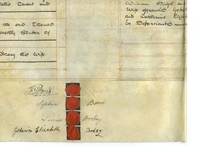
18025001018Exeter 1802. Group of 20 legal documents on paper and vellum relating to a property in Exeter including as the centrepiece a vellum manuscript indenture 630 x 790 mm. with the signatures of William and Elizabeth Bligh and many other members of his family Bligh himself having signed the indenture a second time in relation to a coda to the indenture; all in fine condition with original wax and paper seals present. <p><p>A remarkable group of manuscripts regarding the ownership of a property in Exeter over a period of a century and involving William Bligh and numerous close family members. The collection includes a rare example of the signatures of both William Bligh and his wife Elizabeth on the same manuscript document together with the signatures of Bligh's nephews Thomas and Francis Godolphin Bond both of whom had long careers in the Royal Navy and the latter of whom went on Bligh's second breadfruit voyage and kept up an important and revealing correspondence with his uncle. </p> <p>The group of documents relates to a family-owned house at 13 St. Martin's Lane Exeter a narrow street between Exeter High Street and the Cathedral Yard which is incidentally also the location of the historic Ship Inn said to have been frequented by Sir Francis Drake. The earliest material present here dates from 1702 while the other manuscripts trace the later history of the property throughout the eighteenth century.</p> <p>The signatures are attached to a legal indenture which is the last in a substantial group of documents relating to this property a group which also includes a detailed abstract of ownership prepared for the Blighs and the Bonds. </p> <p>The series of manuscripts culminates in an indenture dated 27 July 1802 conveying for a fee of £50 the rights of the Bligh family to one-sixth of a dwelling in St. Martin's Lane to one William Floyde. The property was evidently owned by Bligh in conjunction with his nephews and nieces in the Bond family: Bligh's half-sister Catherine married John Bond and Bligh and his wife were very close to the whole family in particular Francis Godolphin Bond 1765-1839 a distinguished sailor and First Lieutenant under Bligh on the second breadfruit voyage on HMS Providence. Attractively the present document includes the signatures of the entire Bond family notably that of Francis Godolphin Bond but also those of his brothers and sisters: Thomas Bond Rebecca Bond Sophia Bond Samuel Hookey husband of Catharine Elizabeth Hookey née Bond and Jenny C. Bond. A coda to the indenture is a receipt for payment of fifty pounds sterling which is also witnessed by all of the key signatories meaning that William Bligh's signature is actually present here twice.</p> <p>Equally interesting is the August 1801 "Abstract of the Title of Messrs. William Bligh et al" prepared for the transaction which records their interest in the property. This abstract notes that 'William Bligh is a Captain in the Navy and lives at Durham Place Lambeth but is now on board the Irresistable in the North Sea Fleet.' Of the other signatories it is also noted that at the time Thomas Bond was serving on the Raisonable while Francis Godolphin Bond was residing in London.</p> </p> . unknown
186028338LA HAYE 1860 une photographie originale albuminée en noir, Animée, format : 11,4 x 8 cm pour la photo, notée à l'encre violette sous la photo : LE MANS - LA MAISON DE RAYMOND DUCREST DE VILLENEUVE- 1897 -,
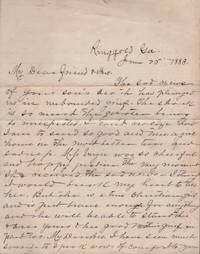
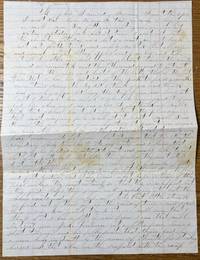
188335413Georgia 1883. Archive. Good. Small archive of 3 handwritten condolence letters written to the Buice family in Ringgold Georgia. Also included is the month of June calendar with a note written at bottom not legible and notes written on the blank side. The calendar sheet has some light stains and edge tears. Light fading and wear to the letters. Good condition. . <br /> <br /> All three letters begin with sorrow and condolences to the Buice family after their son Albert died. Written on the back of the June calendar is the note: "Our darling Baby girl was Born June 12th 1883. Our Darling Son was drowned June 24th 1883 aged 20 years lacking one month. Sadest day of our life." <br /> <br /> The first letter from Ringgold dated June 25 1883 is 4 pages long and addressed to "Dear Friend & Bro." It is signed W. L. Laice sp. <br /> <br /> The second letter written form Augusta Georgia is dated June 29 1883 and addressed "Dear Bro & Sister Buice. It is 3 pages long and signed by Cadesman Pope. <br /> <br /> The third letter from Dadeville Alabama is dated July 2nd 1883. It is addressed to "Mrs. Buice and family." This letter is 8 pages long and makes references to LaGrange Georgia. This letter also mentions the murder of the Dr. Carter editor of the People's Advocate: "Just two weeks ago my door neighbor was shot dead in tracks uptown. He was one of the nicest men I ever knew except that he was not a Christian he was a Physician here - was with Tillie and I both when we were sick not long ago. Was so refined well educated a polished gentleman. Political disturbances was the origin of his death. He was editor of the People's Advocate published weekly at this place and had said something in the editorials that offended a young man 22 years old who walked up to him in the square and demanded a private interview which Dr. Carter refused. Told him he had no business with him which could not be transacted there. Then young Sturdivant or Sturdevant drew out his pistol and shot him through the head." The letter is signed Mrs. Dansby. <br /> <br /> An article appearing in the Hazleton Sentinel and sourced from Columbus Georgia June 18th states "Dr. John F. Carter of Dadeville Alabama was shot and killed in that place by B. B. Sturdivant son of ex-Probate Judge Sturdivant Saturday night. Carter had been making some severe strictures on Judge Sturdivant in his paper about which young Sturdevant called to see him yesterday. unknown
1840105031<p>Small family archive of letters 10 pieces in all some folio size other basic letter sheet size over 20 pages of text some docketed on reverse. Most pages are aged and browned some chips and tears a few holes at center folds a little staining but otherwise about very good. This family archive begins with a letter dated June 14 1840 and provides a glimpse of life in still early America during the pioneer period. In the first letter which is. from near Danville Missouri daughter Emily Lee and Adam Lee to father Ely Butcher in Randolph Virginia asking for money. Emily complains about poor health but tells him to consider moving out there where good land could be had. Another letter dated September 24 1840 is from Rock Island County Illinois from John H. Butcher to his father Ely in Randolph Virginia. John Butcher a farmer tells his father he is in "tolerable good health" but talks about some hard times where he lives. He comments on the rivers being very low and it appears his shipping costs were double what they should be. He stays he finds times very hard in this country harder than expected and adds he couldn't get $1000 for his home at that time. He even makes a comment about a split in government but that the Whigs may feel they won writing not totally clear on this comment. On January 2 1842 from Danville Missouri we see another letter from Emily Lee to her father Ely Butcher in Randolph Virginia. This letter has a sad tone as Emily complains she hasn't gotten a letter from her father in almost two years despite writing to him a few times. She says she feels neglected by her father and brothers and times are very hard. She mentions store credit is not available and they lost a horse. According to Emily her in-laws are no help and she has eight children to take care of. She tells her father she will see him in the spring and she expects him to do something about her situation. Seems like Ely's kids are often in need and asking dad for help. On August 20 1844 John Butcher In Rock Island Illinois to Ely Butcher in Beverly Randolph County Virginia appears to be visited by his sister and his brother-in-law and sister Adam Lee and Emily lee. The farm is doing well and he indicates that oat and corn prices are "tolerable" and he expects to produce 800 bushes of corn and wheat. It appears his sister wants a divorce and it also appears John asks his father to intercede with his uncle Peyton about the land he uses. He seems to be tired of being a renter. He asks his father to negotiate a deal and help him pay for it. He apologizes for the tone of the letter but sounds a little desperate. There are also what appears to be some detailed receipts for the goods of Ely Butcher the dates appear to be 1842 and 1843. In fourth receipt the date is unclear but could be as late as 1866. A final document is a marriage certificate for Hannah Hart Butcher and the date is November 22 1911.</p>
186335352Memphis: n.p. 1863. Letter. Good. Letter. Approx. 11.5" x 8.5". 2 pages written on lined paper. Folded creased with light toning. "Hutton & Co. Prs" located in small print top left corner of the front page. <br /> <br /> Soldier writes; "At Present our armies are lying still or nearly so for the weather is too hot to make any heavy movements just now but it seems that the Southern Confederacy fairly trembles to its very center and I know that many of her soldiers are satisfied to quit and would like to get out of it pretty well but like the Yankees they must stick to it until their officers become convinced of a similar fact.they must certainly see they are whipped but their pride keeps them from acknowledging it." He also writes about a man hanged back home for stealing horses. He mentions the loss of a steamboat named "Alice Dean." This steamboat operated on the Mississippi and was captured and burned by the Confederates. n.p. unknown
18712437Charterhouse School 1871. Hardcover. Very good. Dates: 1871-1877 and 1910. Small 4to. 37 ff. mostly with newspaper clippings neatly pasted in on both sides 4 ff. in manuscript "Summary of Scores" from 1871-1877 and 1910. Several leaves excised; it is possible that the present album had been re-purposed. On a few of the stubs appear fragmentary MS notations suggesting that the notebook may have once been divided alphabetically. We find on certain stubs "Ai" followed immediately by "Ao" and then several leaves later: "Her. - Hes" followed by "Io." Binding rebacked with smooth calf. In very good condition. Highly interesting homemade album of Cricket Scores available nowhere else specifically documenting the triumphs of three young members of the Blomfield family namely: E.G. Edward George C.J. Charles James and R.T. Reginald Theodore. One wonders if the present album was created in order to promote friendly competition between the brothers two of whom went to Haileybury School and one went to Charterhouse; all three went up to Oxford. There are scores and game synopsis of matches were between Haileybury Charterhouse Marylebone Cricket Club MCC Westminster Trinity College Oxon. Exeter Oxon. and more. One of the more interesting features about the album is that it provides a fascinating record of one family's love of the game:<br /> <br /> ¶ Edward George 1853-1885 entered Charterhouse School London in 1865 and transfer upon the School's removal to Godalming in 1872; in 1873 he went to Trinity College Oxon. where he earned a B.A. in 1877 and M.A. in 1879; thereafter he served as Curate of St. Mary's Portsea until 1883 and then Vicar of St. Mark's Woolston until his death in London in 1885.<br /> <br /> ¶ Charles James 1855-1928 went to Haileybury School; he underwent military training at Sandhurst and served as an army officer in India Sudan and Natal. He attained the rank of Major General before his retirement in 1917. NB: this individual is not to be confused with a noted architect of the same name b. 1862 d. 1932. <br /> <br /> ¶ Reginald Theodore 1856-1942 also went to Haileybury School; he earned his B.A. from Exeter Oxon. in 1880 and M.A. in 1884. He became an architect and was knighted in 1919. He is remembered mainly for his work designing British war memorials. <br /> <br /> ¶ The parents of the three young men were Rev. George John and his first cousin Isabella Blomfield of Bow Devonshire whose own father Charles James Blomfield was Bishop of London. <br /> <br /> ¶ At the end is a "Summary of Scores" for the years 1871-1877. Following this in a different hand is the year 1910; although the initial of the last name "Blomfield" remains the same the other initials belong to Reginald Thomas and his two sons Henry George and Austin. <br /> <br /> ¶ See Stedman Charterhouse Register 1872-1900 passim. CATALOGUER'S NOTE: We are grateful to Catherine Smith Archivist of Charterhouse School for much useful information concerning the Blomfield Family. hardcover
187519929LONDRES 1875 Un acte Notarié Manuscrit à l'encre noire, sur velin, traduit du français en Anglais, format : 50 x 62 cm, avec en bas 1 trés gros cachet sec gauffré "Sceau de la Cour de Londres" "aux armes", avec un autre velin à l'intérieur de format plus petit : 26,5 x 34 cm, signatures, cachet sec bleu et argent five Pounds, cachet encre noir de la couronne Chief Office 8-1-75 22, daté du 9 Mars 1873, enregistré par Golsmith chief Clerk , le 11 Mars 1875,
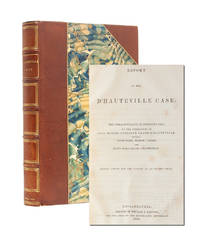
18404910Philadelphia: W. S. Martien 1840. First edition. bound with The Petition of Henry C. De Rham to the General Assembly of Rhode Island To Except Paul Daniel Gonsalve Grand d'Hauteville From the Operation of the Law 'To Secure the Fulfillment of Certain Contracts and for the Relief of Married Women in Certain Cases.' Together with a Remonstrance of Ellen S. d'Hauteville.Providence: Knowles & Vose 1841. First edition. <br /> <br /> bound with Review of the d'Hauteville Case: Recently Argued and Determined in the Court of General Sessions.Boston: Weeks Jordan and Co. 1841. First edition.<br /> <br /> Three volumes bound in one. Finely bound by Bradstreet's in half morocco over marbled boards with gilt to spine. Top edge gilt. Marbled endpapers. Armorial bookplate of Samuel F. Barger to front pastedown. Measuring 225 x 135mm and collating complete including titles: 295 1 blank; 124 2 errata; 2 44. A just about Fine copy with some inoffensive pencil annotations and corrections to volume I and occasional faint foxing; overall a pleasing copy of three scarce legal works related to women's custody rights according to international and interstate law. <br /> <br /> Three scarce tracts documenting the international custody battle that became highly publicized and debated in its time. In 1837 American citizen Ellen Sears married Daniel Gonsalve d'Hauteville a member of the Swiss nobility. During their brief union Ellen survived emotional neglect and mental cruelty from her husband whose "self-image as paterfamilias conflicted with Ellen's growing sense of herself as a mother tormented by an unfeeling spouse" DiFonzo. Pregnant and unhappy she left her husband for the U.S. giving birth to her son after her arrival. Under Common law doctrine d'Hauteville demanded that his wife and child return to his household in Switzerland. "But Sears and her Philadelphia lawyers devised a strategy that would challenge the accepted legal formulation along its emerging cultural fault line.leveraging mental cruelty into an accusation that d'Hauteville had violated the standards of the changing American family" DiFonzo. This strategy combined with gains that the women's movement had made in the U.S. and Europe marital property laws within the century helped bolster her position and win her custodial rights.<br /> <br /> "The d'Hauteville case was not a single event in a courtroom but a set of multiple legal experiences that exposed timebound and timeless realities of American legal culture. The case began in an insular way as a domestic drama must with the rapid rise and equally rapid fall of the d'Hauteville marriage. But as the fight for the son Frederick displaced their marriage as the central focus of Ellen and Gonsalve's relationship the law assumed a greater and greater presence in their lives. The pair not only confronted contradictions between their own ideas about justice and the legal rules they had to learn they also experienced the transformation of their domestic tragedy into a legal event with innumberable participants from lawyers judges and legislators to courtroom spectators newspaper reporters and diarists" Grossberg. <br /> <br /> The present tracts trace d'Hauteville's initial petition for Habeas Corpus followed by his petition to be exempted from a Rhode Island law protecting the rights of mothers. The final title tracks the case's conclusion providing a review. W. S. Martien unknown
1861808931861 Saint-Etienne, Imprimerie de Montagny, 1861, plaquette in 8° brochée, 56 pages ; une planche en frontispice (armes de la famille) ; couverture imprimée.
1875770221875 Lyon, Brun, 1875, plaquette in 8° brochée, VIII-31 pages ; couverture illustrée (Saffroy, III, 45285).
185535931Columbus Ohio: L. P. Rayl & Co 1855. Hardcover. Good. Octavo. 3 64 pages 1 page explanation 63 pages of blank lined pages used for recording births deaths marriages etc. Green cloth hardcover ruled in blind with blind stamped decorations on the covers. Gilt decorations on the cover and gilt title on the spine. Cloth spine is chipped at top and worn at the bottom. Corners are edge worn. Light to moderate foxing to the end papers and text. Occasional brown spots to the blank pages. Blind embossed bookseller stamp on the right front flyleaf from Columbus Ohio. 1857 previous owner inscription in another language written on the right front flyleaf reads - Johann Charls Herpilsheimer den 13 Aprill 1856." A cut section of lined paper with old hand writing in a different language is laid inside the front cover. This copy has no family history written on the blank pages. L. P. Rayl & Co hardcover
1862BOOKS288658FR/No Dustjacket. ca. 1862. Letters. This is an unsigned letter that was found in the John J. Taylor papers and looks like his handwriting. It is addressed to the The Honorable Legislature of the State of New York . the advantages of transporting lime salt plaster coal etc. would add incalculable revenues to the Chenango Canal. We the undersigned inhabitants of Tioga County . not used and with cross outs. Pen and Ink 12" x 8" . 4to. 1 page Slight tears at former folds . unknown
189781340Troy N.Y.:: Harvey James King 1897. First edition; No. 23 of 50 copies. publisher's cloth-backed gilt lettered boards. Ink owner's name stamp on pastedown and title page; some light soiling to the boards and edges of the Addendum; tight and sound. Folio. Two original photographic illustrations. . Separate 6 pp. Addenda laid in at rear. Harvey James King, hardcover
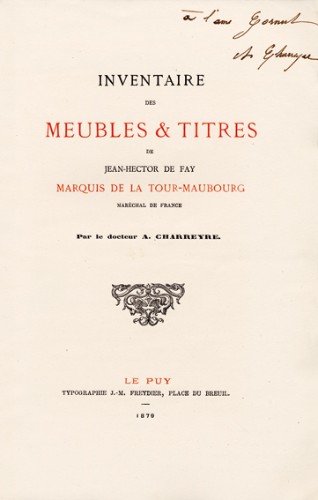
187911116Le Puy, Typographie J.M. Freydier, 1879 ; in-8, broché ; 47 pp., (1 bl.), couverture verte décorée, imprimée en rouge et noir ; imprimé sur beau vélin fort.
186658Lyon, Bibliothèque de la ville, 1866, in-8 ; demi-chagrin maroquiné cerise, dos à nerfs décoré de fleurons dorés, couverture conservée (ce qui est rare) ; 391 pp. et 8 gravures h.t. dont une en couleurs.
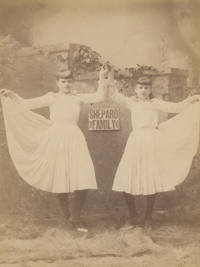
1890List1620Mostly New England: Various Photographers 1890. Cabinet cards measuring 6 ½ x 4 ¼ inches. Various settings showing the band members posed with their instruments including banjos violins trumpets drum and tubas. Varying wear but generally very good with some normal age-related fading. Very Good. Originally from Lawrenceville New York the Shepard Family Band toured throughout the Northeast in the 1880s and 1890s eventually settling in South Royalton Vermont. All members of the family were apparently musically inclined: “In addition to Minnie mother and matriarch Mary “Minnie†Shepard and her husband patriarch James Monroe Shepard all of the children were pressed into service. Daughter Laura Belle the ‘violiniste’ was getting better all the time under the instruction of a ‘competent master.’ Her fans “will be astonished at the improvement in style tone and expression.†It was said of little Lessie that ‘Among lady cornetists she has no equal.’ The darling little son of the family Master Burtie could not help but please for he was well-known to be ‘The youngest Tuba soloist in the world; only nine years of age; scarcely larger than the instrument he plays.’ He was also a ‘clever comedian singer and character artist.†The baby little Flossie “a sweet little miss of four summers’ was said to be a “wonderful mimic and impersonator…a veritable little fairy.’ Daughters Kittie and Georgia were also part of the troupe.†- Henry Sheldon Museum. A very nice collection. Various Photographers unknown
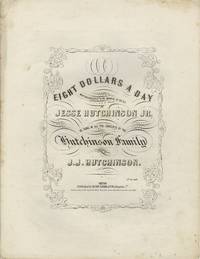
1848List3669Boston Massachusetts: Olivery Ditson 1848. Folio 14 x 10 ½ inches 5 pp. Slight splitting to covers contents fine very good plus overall. The sheet for the anti-politician polemic “Eight Dollars a Day" which was apparently a crowd favorite at the Hutchinson Family’s performances. The song lambastes the political class and its waste insinuating among other things that the politicians were spending their bloated salary on alcohol: “A flaming speech is made by one when the call is yea or nay But all are agreed with the question comes of Eight dollars a day.†The song was written in 1848 early in the Hutchinson Family’s period moving toward social activism and four years after their most famous abolition-themed compositions.1 Judging by the twelve copies held at libraries this was probably one of the better selling titles in their repertoire from the time period. <br /> <br /> 1 Philip D. Jordan “The Hutchinson Family in the Story of American Music†Minnesota History 22 no. 2 1941: 113–32. Olivery Ditson unknown
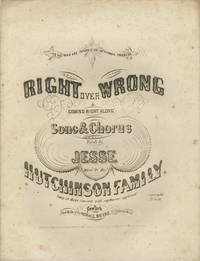
1855List3668New York: Horace Waters 1855. Sheet music measuring 10 ¾ x 14 ¼ inches 6 pp. Foxed with wear to edges; very good to excellent. A scarce Hutchinson Family sheet published in 1855 with an abolition theme. The song goes in part:<br /> <br /> “The captive now begins to rise and burst his chains asunder While Politicians stand aghast in anxious fear and wonder. No longer shall the bondman sigh beneath the galling fetters He sees the Dan of Freedom nigh and reads the golden letters…†<br /> <br /> It also discusses alcohol within a larger theme of good triumphing over evil. The song is included in some songsters but this standalone version is quite uncommon with one copy held at Dartmouth. In 1855 the Hutchinson Family Singers continued extensive touring across the northeastern United States presenting concert programs that combined abolitionist songs temperance material and political commentary aligned with reform movements. They had embraced abolitionism as a cause about a decade earlier with a string of compositions including “Get Off the Track†and “The Bereaved Slave Mother.â€. Horace Waters unknown
188561062Salem OR: n.p. ca. 1885. One oblong albumen boudoir photo sized 7.75 x 4.75 in. mounted on 8 x 5 in. studio board manuscript annotations on verso in pencil & ink incorrect speculative dating of 1869 in quotation marks minor edgewear rubbing still VG exemplar. A splendid boudoir image capturing generations of William Campbell’s 1822-1920 family at the Salem Marion County Oregon farm sometime in the 1880’s. Bert Robert 1869-1858 and his sister May Mary 1871-1960 stayed and worked in Oregon before later moving to Portland OR. Pets were apparently important to the family as they have included 3 in their image and interestingly the photographer has also included a bowl of large ripe apples in the foreground before the group. n.p., unknown
188514696Lyon, Henri Georg, 1885 ; in-4, broché ; 48 pp., couverture crème rempliée, imprimée en rouge et noir, comme la page de titre.
188022695SAINT MARTIN DU BOIS 1880 une photographie originale réalisée vers 1880 environ, Format de la photo : 27,3 x 19,3 cm - photographie collée sur carton de format : 33 x 26 cm, Tirage argentique, Couleur: Noir et blanc, UN MATCH DE CANNE DE COMBAT DANS LE PARC DU LOGIS DU COUDRAY - MARSAIS-SAINTE-RADEGONDE (VENDEE), 1880 Luçon Garnier-Francès Photographe,
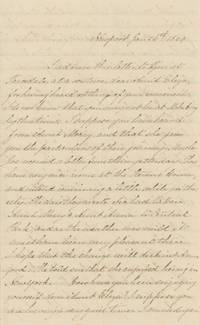
1871List3241Rhode Island Massachusetts and New York 1871. Thirty-two letters two apparently missing final pages; with fifteen pages of incomplete letter material. Excellent to Near Fine. Letters from some of the young ladies of the Hazard family primarily Gertrude Minturn 1843–1877 Anna Peace 1845–1868 and Esther Robinson 1848–d. Hazard with some from other family and friends. The family was descended from Thomas Hazard one of the founding settlers of Newport Rhode Island.1<br /> <br /> The girls were educated and often write from school; Anna and Esther attend the ‘Friends School’ in Providence which is probably the Moses Brown School and Gertrude attends Dr. Dio Lewis’s School for Young Ladies in Lexington Massachusetts. Founded by Diocletian Lewis a temperance and physical culture advocate the school incorporated his exercise system developed to condition weaker individuals. Gertrude describes a regimen of thirty minutes of walking plus an hour and a half of exercise and discusses Dr. Lewis:<br /> <br /> “Dr Lewis gives familiar lectures on any subject which the scholars propose. He is a very pleasant genial man and takes part in the games & dancing with the greatest spirit. There are about 20 scholars. Some of them board in the village but are subject to the rules of the school. This building is very large and is mostly occupied by the patients of Dr Lewis’ ‘Movement Cures’ to whom most of his time is devoted. The scholars and patients associate together. Indeed we are under very little constraint the teachers leaving our actions to be regulated by our own sense of propriety; and they seldom find occasion to reprove the scholars for misdemeanors.†November 23 1864<br /> <br /> Meanwhile Anna and Esther’s education is more on the religious side; Esther writes:<br /> <br /> “We have not been to meeting very often since we returned from our lovely visit to Newport but the first Sunday morning I did think all the time of it as I said I was going to. We were edified this morning by a sermon from Elizabeth Meader or rather a torrent of noise so that I am nearly deafened now. I don’t think I ever heard a more horrible combination of sounds from the mouth of any human being.†January 8 1865<br /> <br /> Though speaking in tongues is most strongly associated with Pentecostalism it is not unheard of in Quakerism. In his book of genealogy and reflections the girls’ father Thomas Hazard 1797–1886 connects the family’s “strong religious tendencies†to his own interest in spiritualism.2 This interest in mediumship comes up several times in the letters first in 1864 when one of the girls reports that “Pa writes us that at a circle which he attended a few days ago a clairvoyant medium described our house at Vaucluse perfectly†February 24 1864 and later when one of the girls attends a circle with their father in Philadelphia:<br /> <br /> “Yesterday morning Pa & I had a sitting with a Mrs. Robinson a trance speaking medium. The communication from mother was the most beautiful I ever heard. She spoke to us just as she used to on earth using the same expressions. It seemed as if I could almost see her – we are going again on Monday.†February 8 1867<br /> <br /> That is the pair spoke to Frances Minturn Hazard who had died in 1854.<br /> <br /> Of interest to researchers of the Hazard family and Rhode Island Quakers.<br /> <br /> 1 Caroline Elizabeth Robinson The Hazard Family of Rhode Island 1635–1894 Printed for the Author 1896.<br /> 2 Thomas R. Hazard Recollections of Olden Times Sanborn 1879 228. unknown
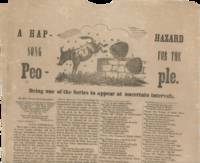
1855List3242Newport Rhode Island: N.p. 1855. Broadside measuring 21 ¾ x 10 inches folded with some damage to edges with two holes in the center intersecting with text. Very good to excellent. A HAP-HAZARD SONG was written around 1855 by an author using the pseudonym “Miss Terious Devil-up-mentsâ€. It concerns the legal cases of Ives vs. Hazard and Ives vs. Armstrong which involved a dispute over the sale of a farm belonging to Charles T. Hazard a less well-off cousin in the prominent Hazard family. Hazard assisted by his better-known cousin Thomas R. Hazard wanted to back out of the sale of his farm to wealthy Providence merchant Robert H. Ives claiming that his wife had not agreed to it. In 1855 the court decided against Hazard. The broadside mocks the Hazards’ efforts; it opens by telling the story of an “insane jackass†later “Assard†i.e. Hazard who is stung to death by bees and has its hide used to bind Thomas Hazard’s 1857 book concerning the case An Appeal to the People of the State of Rhode Island in Behalf of the Constitution and Laws. It then launches into a parodical song which seems to allege that it was Thomas Hazard not Mrs. Charles Hazard who wanted to keep the farm and that Hazard’s book accused Ives of greed when it was really the Hazards who were greedy; and mocks the opposition to farmland being sold off to the wealthy merchant class:<br /> <br /> “Then they made tremendous speeches / All about ‘the rights of man’ / Which literally translated means / ‘Each one get all you can!’â€<br /> <br /> The chorus which is “to be sung ironically†reads:<br /> <br /> “Ho! Yeomen of Rhode Island / Wherever you may stand / The farms belong to all of us / It is our Native Land.â€<br /> <br /> We find nine copies of A HAP-HAZARD SONG on OCLC. N.p. unknown
1830100955<p>Circa 1830's. 1830's. Fine. - An original 19 inch high by 24 inch wide broadside printed in Cyrillic on watermarked laid paper. Two columns printed within ruled frames and titled at the top left of the broadside loosely translated as "TABLE Of the highly solemn Birthdays and Name-days of His Imperial Majesty and Her Imperial Majesty the Accession of His Imperial Majesty to the All-Russian Imperial Throne and Their most joyful Imperial Majesties' Coronation; the Birthdays and Name-days of Their Imperial Highnesses as well as victory days; with an indication of which months and dates and with what church ceremony in the sacred services it is appropriate to observe them."</p><p>The title is followed by dates printed within the left column with descriptions of the events to be celebrated on that day. Starting with January 1st with celebration of the New Year and of the birthday of Her Imperial Highness the Right-Believing Lady Grand Duchess Elena Pavlova. The birthday of Her Imperial Highness the Right-Believing Lady Grand Duchess Anna Pavlova is to be celebrated on January 7th and so on.</p><p>On April 21st is to be celebrated the Name-days of Her Imperial Majesty the Most Pious Lady Empress Alexandra Feodorovna and the Right-Believing Lady Grand Princess Alexandra Nikolaevna. These name-days Imeniny were feast days of the person's patron saint. The list goes on and includes the celebration of the accession to the All-Russian Imperial Throne of His Imperial Majesty the Most Pious Great Sovereign Emperor Nicholas Pavlovich Autocrat of All Russia on November 20th.</p><p>Under the heading VICTORY is a list of celebrations commemorating Russian military victories. Celebrated on July 10 is the solemn commemoration of the peace between the Russian Empire and the Ottoman Porte concluded at Kaynardzha and the annexation of the Tauric Kingdom to the Russian State which occurred on July 10th 1783. On August 13 and 17 are celebrations of the 1788 capture of the frigates at Anapa and at Sudzhuk-Kale and the subsequent capture of Narva. September 28 commemorates the victory over the Prussian army and so on. A lengthy paragraph at the end describes the religious ceremonies which are to be held on several of these dates.</p><p>Folded several times horizontally and vertically else near fine.</p><p>It is worth noting that name days known as Imeniny or Angel's Days were often more significant than birthdays as they honored and celebrated the saint in whose name a member of the royal family was baptized.</p><p>N.B. The text is in Russian.</p> Circa [1830's].