[Caumartin]Livre Rare Book
12 556 résultats
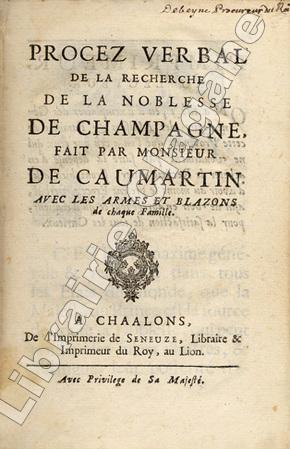
167310661À Chaalons, Imprimerie de Seneuze, s.d. (achevé d'imprimer le 1er septembre 1673) ; in-8 ; plein veau marbré, dos à nerfs décoré et doré, pièce de titre grenat, tranches rouges (reliure de l'époque) ; 160 pp.
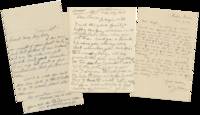
1935List2835California Texas Illinois and others 1935. 369 pieces: fourteen empty envelopes 108 pieces of unsorted ephemera and 247 letters. Of the letters twenty-one are undated; three date from 1851–1909; nineteen from 1910–11; thirty-five from 1912; thirteen from 1913–17; forty-two from 1921; thirteen from 1922–24; sixty-eight from 1934; and thirty-three from 1935. Overall very good to near fine. The Beaumans were a family from southern Texas who relocated to East St. Louis Illinois some time before 1908 and some of whom would later live in California. Captain Loui Beauman 1868–1921 was a military engineer Mason and member of the Society of American Military Engineers. He and his wife Kittie Woodruff 1867–1959 had three children survive to adulthood: Carrie Beauman 1893–1982 Second Lieutenant Loui Beauman 1894–1918—a Marine killed at 23 in a seaplane accident—and Julia Frances “Gally†Beauman 1908–1974. <br /> <br /> Offered here is a large correspondence archive belonging to the Beaumans; mainly addressed to Gally 119 letters the younger Loui seventy letters and Kitty fifty-two letters; and written by a wide variety of friends and family including Kitty fifty-one letters Carrie eighteen letters Katharyn Owen of San Antonio sixteen letters and Gally’s future husband Edwin J. Regan of Weaverville California twenty-three letters. Regan 1906–1996 was at the time running for District Attorney of Trinity County and would go on to hold that position before resigning in 1948 in favor of a State Senatorship followed by a judgeship on the Third Appellate Court of Appeal.<br /> <br /> Most of the early letters in the group are addressed to the younger Loui Beauman and their concerns include his friends’ jobs constructing railroads hiding their controversial “ragging†dancing from chaperones and which fraternity Beauman should join at the University of California. The fraternity issue is particularly contentious within the family; the elder Beauman tells his son that “I will not be pleased to hear that you have joined any of the fraternities†September 20 1912. The younger Beauman settled on Zeta Psi.<br /> <br /> After the passing of both father and son most of the letters are addressed to Kitty and Gally Beauman. Edwin Regan writes to Gally about his campaign for District Attorney which made him “worried and discouraged and down on the world†August 3 1934; Regan felt that “ability means nothing to the voters the sole issue is whether or not I am a ‘city guy’ or not†July 30 1934. Another common topic is the family’s concern for Carrie Beauman whose marriage to Arthur Levefre Jr. was becoming increasingly abusive. The couple lived in Houston far from the remaining family who were now in Berkeley and Weaverville.<br /> <br /> Though the family very rarely commented on politics—even including the Great Depression which was in full swing during the writing of nearly half of these letters—there is one event that enthused Carrie Beauman too much for her not to mention. This was the suppression by the KKK of alleged brewing race riots in Houston:<br /> <br /> “We came near a bad race riot last week. All the militia residents Light Guards ex-soldiers were called out. There were over 5000 armed white men on the main streets negro sections. Arthur slept with his clothes on 4 loaded guns. We all piled in one room. Believe me the Ku Klux Klan is doing efficient work. That’s twice in the last 10 days that they’ve ‘operated on’ the beasts. I’m tickled to death to know that there are a few fearless just honorable men left to meet sic out justice to these criminals. By the time this happens half a dozen times some of this crime wave will subside. If the paid officers of the law wont meet the emergency – then it’s time for the upright citizens to take a hand. I am tickled to death over this!†May 1 1921<br /> <br /> Overall an intimate look at the lives and affairs of an ordinary American family in the early twentieth century. unknown
1901List2832Santa Cruz and Stanford California 1901. Approximately forty-nine 7 x 10 inch pages with ninety-four 3 ½ x 3 ½ inch photos; five 1 ½ x 2 inch photos; one 1 ½ x 4 ½ inch photo; and one 5 x 6 ½ inch photo. Binding broken with staining on cover. Photographs generally very good to excellent contrast with a portion at the end significantly faded. Overall very good. Scrapbook of photographs mainly showing home life and recreation of a family with young children in central California in the early 1900s. The family spend time playing with their children in the yard going to the beach and hiking in the woods. There are also several snaps of buildings at Stanford University shortly after their construction. Of interest as a depiction of everyday life in turn-of-the-century California. unknown
1965L025943Comunita Eur/Arte/Cultura 1965. First Edition. Trade Paperback. Very Good/No Jacket. 8vo - over 7¾" - 9¾" square 8vo 702ppplates Text in Italian. Catalogue prepared for the exhibition in the Calcografia Nazionale Rome April-May 1965 sponsored by the Comunita Europea dell'Arte e della Cultura; coverage of Agostino Annibale and Lodovico Carracci's engraved works. Introduction by Calvesi; catalogue proper by Calvesi and Casale. Scarce; not located in Freitag. A very good copy in wrappers slight rubbing and browning to wrappers; slight internal browning.Over 200 b/w Illustrations. Comunita Eur/Arte/Cultura paperback
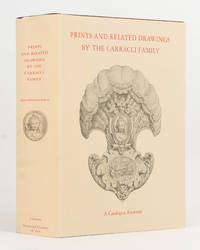
1979122519Bloomington: Indiana University Press in association with the National Gallery of Art Washington 1979. First Edition. Hardcover. Very Good/Dust Jacket Included. Bloomington Indiana University Press in association with the National Gallery of Art Washington 1979. Large quarto 533 pages with over 500 illustrations from 'photographs of prints and related material'. Quarter contrasting cloth; top edge slightly foxed bottom edge slightly marked; a few small tape-stains to the decorated front endpaper; an excellent copy with the lightly marked and cockled dustwrapper. Indiana University Press, in association with the National Gallery of Art, Washington hardcover
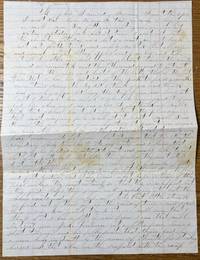
13417Carter Hall Millwood Clarke County Virginia. 21 February 1876. 4pp. 12mo. 210 lines. The first bifolium of a letter only and hence lacking a signature. In fair condition on lightly-aged paper with closed tears along fold lines. George Burwell who had inherited Carter Hall in 1814 see below had died three years before the writing of this letter and the identity of its author is unknown although he does claim to be a 'Scotchman'. The letter begins: 'Dear Sir Your letter of Jany 31 is received. I am glad to answer any questions but I must not be supposed to advise you in any thing regarding a change of residence. No man can think for another and <> I can only give true replies to any questions upon you must lie the onus of exhaustive questioning. - Again do not forget that I can speak only of the district - circumstances alter much in various places.' He asks him to bring out 'a parcel or two from England when you come'. There follow six numbered sections discussing various elements of life in Virginia beginning with the climate: 'July & August are our hottest months. Your families should arrive in Baltimore at about Sept 15. The temperature at Baltimore will probably be about 75o or 80o all the time from Aug 15 to Sept 15'. The second section discusses 'habitation' and employment. In section 3 he describes 'grass land' as 'much inferior to England '. Section 4: 'I mean to imply that a good farmer in a fair farm here will do as well as a tenant at home who pays rent - & I take into consideration that in capital of 5/ in so calculating.' Section 5 is on 'Sheep'. Section 6 begins: 'Men & boys were strong hollands in summer - poor people wear vests except on Sunday - as a rule you get these things better & cheaper here - than in England'. A long discussion of dress for both men and women follows 'Summer prints for ladies are good & cheap here - no use to bring them - they are called calicoes here But muslines grenadines too are dearer here and should be brought out'. Other topics include 'household stores': 'We find it quite expedient to get out the following articles - as their representatives here are either bad or too dear English mustard Worcester sauce Scotch marmalade Tea - oatmeal for my boys breakfast - I am a Scotchman sago tapioca curry powder canary seed if you have a bird'. Also 'Medicines' 'Seeds'. 'Bring no harness or carriages - There is nothing in Gt. Britain to equal the carriages in this country . I may advise you to go to Phipps Saddlers Holborn London who will give you saddles exactly like mine - cheaper & equal in leather to any in England - his bridles are first class also.' The letter ends with advice on 'hunting spurs' and 'thong'. Carter Hall is listed on the National Register of Historic Places. A grand house and plantation located in the lower Shenandoah River valley it was the estate of the family of Lieut-Col. Nathaniel Burwell 1750-1814. It was also a home for Burwell's cousin Edmund Randolph who had been United States Attorney General and later Secretary of State under George Washington. George Burwell 1799-1873 inherited the estate in 1814 and added a large portico. It served as headquarters for Stonewall Jackson during part of the American Civil War and was raided and sacked by Union troops during the war. Carter Hall, Millwood, Clarke County, Virginia. 21 February 1876. hardcover
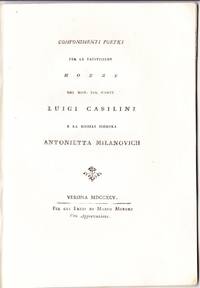
17956409Verona: per gli eredi di Marco Moroni 1795. Original edition. Fine. Octavo 20 cm; 231 blank pages. In woodblock-printed polychrome wraps in Remondini style. <br /><br />Occasional verses written and one assumes recited for the wedding of members of two of the leading political and legal families of the city of Rovigo in the province of Venice. The Casalini family effectively held political power in Rovigo from the 1400s through the nineteenth century. No copies inventoried in OCLC or in ICCU. per gli eredi di Marco Moroni paperback
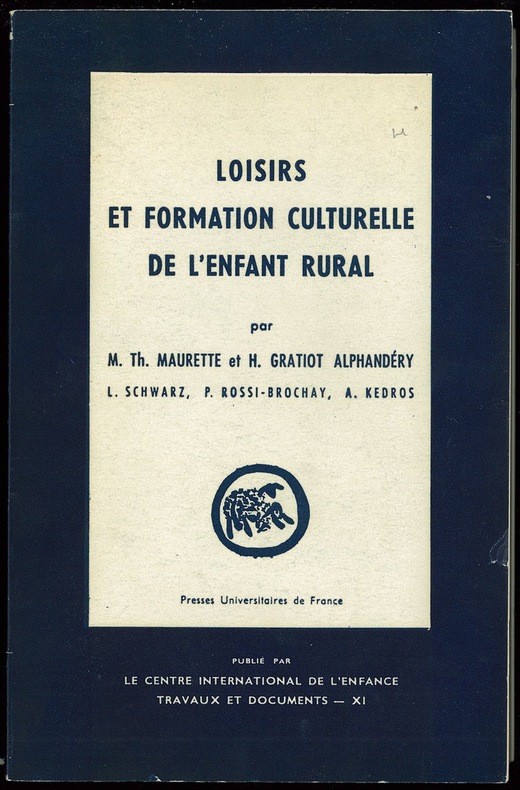
28998, Paris, P.U.F. 1956, in-8, br., bon état, nombreuses statistiques et illustrations (XXIV planches photographiques), 345-XXIVp.
br., bon état, nombreuses statistiques et illustrations (XXIV planches photographiques)
199849128Firenze: Leo S. Olschki Editore 1998. First Edition. Octavo 24cm.; publisher's cream card wrappers printed in brown and black; xxx6533pp.; illus. Light shelf wear spine a shade sunned else Very Good or better. Publisher's compliments card laid in. At head of title: Accademia Toscana di Scienze e Lettere "La Colombaria" "Studi" CLXVIII. Volume I only of this genealogical history and correspondence of the Chaplin acting family text chiefly in French. Leo S. Olschki Editore unknown
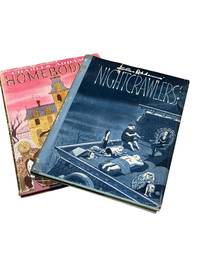
19579366New York: Simon and Schuster 1957. Fourth and fifth printings. 4to. 90 and 96pp. Hardcover copies with colorful illustrated endpapers and black and white illustrations by Addams throughout some foxing and toning very good. Both in original illustrated jackets that have tears chipping and tape repairs good only. Simon and Schuster hardcover
1st edition, original cloth, 4to. Viii + 36 + iv pages, illustrations throughout. In Yiddish. The beginning of the Second World War is simultaneously the beginning of suffering, pain, death, martyrdom and heroism of the Jews of Czestochowa. In the early morning hours of Friday, the first of September, 1939, Nazi Germany attacked Poland. And already on the third day, at nine o'clock in the morning on Sunday, the third of September, the Nazi motorized units began to penetrate Czestochowa and, one day later, there began the first slaughter which received the name Bloody Monday. Monday, the fourth of September, under the false accusation that Jews had shot at Germans, a horrible pogrom took place that lasted three days. The first victim was Naftali Tenenboym, owner of a button factory at 7 Pilsudskego Street. The second victim was Luzer Prafart, who was known under the nickname Po Pientsh ([Polish for] five each). The third, Katz, a carpenter by occupation, was known as a leader in the artisans unions. Among the numerous victims in the three day pogrom was the son of the Rosh-Hayeshiva [Head of the Talmudic academy], Yakubovitsh. The first three days of Nazi rule over Czestochowa were marked by bloody murder and looting. Jewish economic life was completely paralyzed. Cultural, social, and political life, including the entire school system, was completely dissolved. Falling like hail, there were repressions and decrees aimed at psychologically choking Jewish life, the theft of Jewish property, the exploitation of the Jewish labor force for free, and the placing of Jewish life into a lawless situation." (translated from book, Jewishgen 2018) SUBJECT(S): Jews -- Poland -- Czestochowa. Holocaust, Jewish (1939-1945). OCLC: 19303642. Wear and small piece missing from spine. Very good condition. (YIZ-4-4)xx
49927Auckland New Zealand : s.n. 1860. Handmade album. Octavo 190 x 120 mm the covers taken from a copy of The poetical works of Sir Walter Scott Edinburgh : A. & C. Black 1857 of limp tan cloth with decoration in blind and gilt device to front and rear; the book's original pastedowns and endpapers intentionally preserved the front free-endpaper with a mounted presentation label inscribed in ink in a neat hand: 'New Zealand ferns collected for Miss Grahame by her friends at Hazelbank Auckland 1860' followed by 28 loose sheets with pressed native fern specimens mounted recto only each accompanied by a handwritten caption identifying the specimen by its correct botanical name; the skilfully mounted and knowledgeably labelled specimens with very occasional minor loss the paper mounts with a minimal amount of foxing but overall the contents remarkable well preserved. This charming ""do-it-yourself"" Auckland album represents by far the earliest collection of New Zealand ferns we have handled. Although pteridomania - or fern fever - was undeniably already a phenomenon in the colony in the 1860s the album pre-dates by at least a decade for example the appearance of the first commercial souvenir albums by such specialist preparators as Eric Craig and Thomas Cranwell. The specimens in this album were clearly selected for their aesthetic appeal the majority being particularly delicate and skeletal-like. We believe that the young woman to whom the album was presented by her friends identified only as Miss Grahame is likely to have been a daughter of Auckland merchant Walter Grahame. Walter's brother the wealthy and influential William Smellie Grahame had already returned to England with his own family by 1858. ""Hazelbank"" was the name of a property in Wynyard Street Auckland which was later owned by MÄori businesswoman and philanthropist Mary Geddes. It is now the home of the Elam School of Fine Arts University of Auckland. hardcover
186335352Memphis: n.p. 1863. Letter. Good. Letter. Approx. 11.5" x 8.5". 2 pages written on lined paper. Folded creased with light toning. "Hutton & Co. Prs" located in small print top left corner of the front page. <br /> <br /> Soldier writes; "At Present our armies are lying still or nearly so for the weather is too hot to make any heavy movements just now but it seems that the Southern Confederacy fairly trembles to its very center and I know that many of her soldiers are satisfied to quit and would like to get out of it pretty well but like the Yankees they must stick to it until their officers become convinced of a similar fact.they must certainly see they are whipped but their pride keeps them from acknowledging it." He also writes about a man hanged back home for stealing horses. He mentions the loss of a steamboat named "Alice Dean." This steamboat operated on the Mississippi and was captured and burned by the Confederates. n.p. unknown
3676Le Puy, imp. La Haute-Loire, 1936, 1 br., couverture illustrée. in-8 de 112-(2) pp., portrait en frontispice ;
2006LFA0118bUn calendrier mural recto-verso, format 225 x 280 mm, cartonné, illustré de dessins anciens, édité en 2006 (Comptoir de Famille)
2007LFA0118cUn calendrier mural recto-verso, format 225 x 280 mm, cartonné, illustré de dessins anciens, édité en 2007 (Comptoir de Famille)
24455, Paris, Chronique Sociale de France 1949, in-8, br., (jauni), 77p.
50891, Varsovie, Wydawnictwo Prawnicze 1966, in-8, br., bon état, 79p.
1986LFA-126732316Revue catholique internationale : 132 pages, format 150 x 220 mm, brochée couverture couleurs, bon état
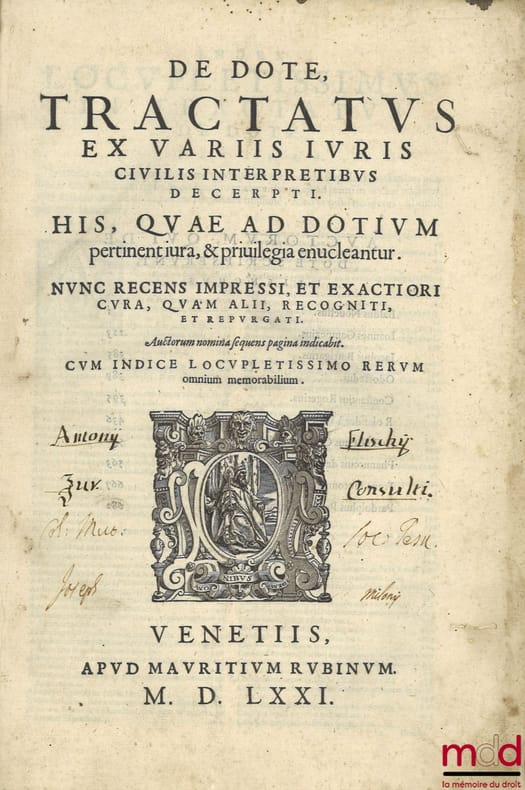
52674, Venetiis [Venise], Mauritium Rubinum 1571, in-folio, demi-vélin à coins beige, tit. manuscrit sur dos lisse et sur les tr., lettrines ornées, impression en double colonne, (qq. épidermures et tâches sur les plats, coupes inf. frottées, rares trous de vers non traversants, rares et légères mouillures à l’int., une annotation à l’encre), int. très frais , [Index]-685p.
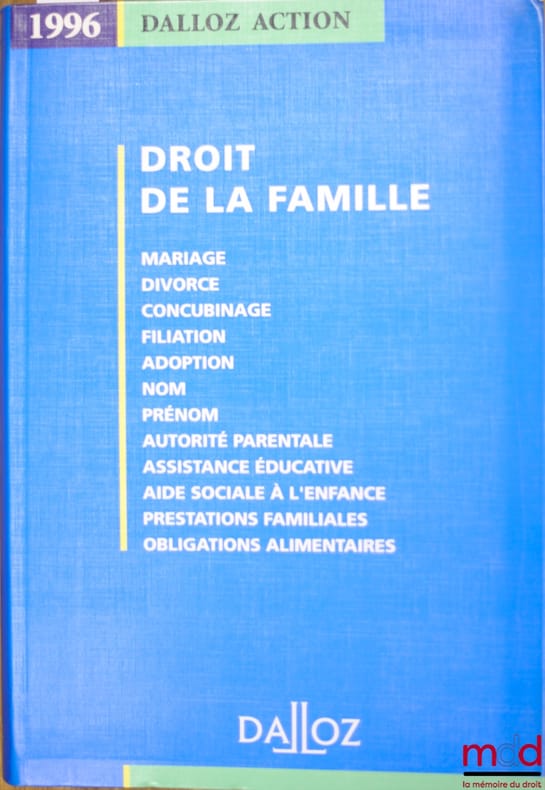
16410, Paris, Dalloz 1996, br..
26618, Bruxelles, Bruylant 2004, in-8, br., neuf, 256p.
48670, Paris, Defrénois - Lextenso éditions 2013, in-8, br., (couv. lég. passée), intérieur très frais, VI-[1ff.]-240p.
197213992Paris, Esprit, 1972 1 volume 14 x 22,5cm Broché. Paginé de 193 à 383, 8 pages gris bleu. Très bon état.