69 résultats
1799009635This one-page stampless folded letter measures approximately 12" x 7.5". It is datelined "Boston Feby March 6. 1799." It bears a straight-line "Boston" handstamp circled "7 / MR" Boston postmark and a manuscript "10" rate mark. Small sealing wax tear from when the letter was opened. In nice shape. A transcript will be provided. <br /><br />In this letter Abbot describes Dr. John Warren's surgery to remove a precancerous tumor from his daughter. The letter reads in part: <br /><p><p style="margin-left:5%; margin-right:10%;">"My dear brother & Sister Betty . . . you will leap for joy when I inform you that this moment Dr. Warren has closed the operation upon Phebe's unfortunate swelling. The time of her suffering was as follows. 9 min'ts in cutting 14 in taking up the blood vessels & 22 in Sponging airing & dressing the wound. Her conduct her fortitude & composure were astonishing & unequaled says the Doctr. It proves to have been a serious tumor wh would certainly have become a cancer. Every thing is well & promising. She Stays here at Cap Weld's 4 or 5 days when the Dr. Supposes she can safely be removed to Andover.". </p><p><p>Dr. John Warren was an American patriot and a surgeon in the Continental Army. His brother Joseph was a leader of the Sons of Liberty and is most famous for having recruited Paul Revere and William Dawes to spread the alarm when British troops departed Boston for Concord and Lexington. He was killed during the Battle of Bunker Hill and John was bayoneted by a British soldier when he attempted to retrieve Joseph's remains. After John recovered he served in army hospitals at Concord and Long Island and fought in the Battles of Trenton and Princeton. After the war he became a very successful Boston surgeon and performed the first abdominal operation in the United States. He founded Harvard Medical School in 1782. See "Warren John" in <i>American Medical Biographie</i>s online and entries including "John Warren" in Garrison's <i>History of Medicine</i>. </p><p>Warren performed a similar operation a mastectomy on President John Adams's daughter in 1812 and a letter describing it in the same manner was written by Adams to Dr. Benjamin Rush. <br /><br />While the location of Phebe's precancerous growth is not identified Abbot's elated letter nonetheless describes an early successful tumor removal by Warren and is a firsthand testament to the doctor's skill as well as to Phebe's fortitude while calmly suffering through such a serious and painful 45-minute operation without the benefit of anesthesia. <br /><br />Online genealogical records suggest that Phebe was born in 1799 if so she would have been about 11 years old at the time of the operation. <br /><br /> Adams's letter describing Warren's surgery sold in 1984 for the equivalent of $20000 in today's money. Granted Abbot's Revolutionary War service as a Major does not carry the same cachet as Adams's service as President however his letter describes a similar perilous surgery performed by Warren twelve years earlier. <br /><br /> Exceptionally scarce. At the time of this listing nothing similar is for sale in the trade and no similar descriptions of Warren's surgeries are held by institutions per OCLC. As previously noted there is one similar letter the Adams letter describing an operation by Warren.</p> books
1774WB16372Paris: Typis Barbou via Mathurinensium 1774. Hardcover. Very Good. 12mo 155 x 94mm. Pagination: xxxvj 346pp. 2 the Catalogus. Signatures: a12 b6 A-O12 P6. Three full-page plates engraved by Étienne Fessard 17141777 after Charles Nicolas Cochin 17151790 one is the frontispiece depicting a neoclassical scene of cherubs presenting the bust of Crispus Sallust to muses. Woodcut printers device of the brothers Barbou on title page two flying storks feeding each other a worm in foliated ouroboros: symbolizing fraternity typographic and engraved head- and tail pieces. Near contemporary French mottled tan calf gilt-ruled border spine gilt in six compartments one with red morocco lettering label and title SALLUS/TIUS marbled endpapers silk bookmark all edges gilt; some light edgewear and minor scuffs; few minor marginal stains throughout; overall a very good and sound copy of this scarce edition. The signature Tho. Walpole on a front flyleaf verso and the armorial bookplate with heraldry of Thomas Walpole the younger 17551840 Eton and Cambridge-educated British ambassador to Bavaria from 1783 to 1788 and the son of the British financier Thomas Walpole 17271803 also the nephew of Sir Robert Walpole 16761745 and cousin to Horace Walpole 17171797 whom he succeeded in the barony on front pastedown. Armorial crest as the bookplate of Spencer Horatio Walpole 18061898 Home Secretary and second son to that Thomas d. 1840 affixed to front marbled endpaper and his signature under that of his fathers as Spencer H. Walpole with a note written in his hand about a Roman history fragment by Granus Licinianus presented to the British Museum in Dec. 1859. Thomas Walpole the younger was 19 years old when this new edition was issued from Barbous press and he likely acquired it early on for his studies. This copy remained in the Walpole family for over 120 years. Later ex-libris of the American Arthurian scholar Nathan Comfort Starr 18961981 affixed to a front flyleaf. <br/><br/>New duodecimo edition of Roman historian Sallusts Roman history covering the Jugurthine War the Conspiracy of Catiline and with the Vita of Sallust by Stephan A. Phillippe. It was first published by Joseph Gérard Barbou fl. 17521788 in Paris in 1744 with the imprint Sumptibus Mich. Steph. David filii. Another edition was produced by Barbou in 1761 followed by this nova edition expurgate of 1774 as the new cleansed version of the text. The reading of Roman histories was incredibly important to the law-abiding and enlightened audiences of Western Europe. This copy is significant for its distinguished provenance from a branch of the Walpole family who were likely the original owners. The Walpole family were deeply entrenched in 18th century British government; it would have been crucial for Thomas and Spencer Horatio to be well-read and maintain erudite political discourse with their contemporaries. Thomass cousin the better-known Horace established the famed Strawberry Hill library and press also contributing to the learned position of the family. The year 1774 the same year of this edition saw the death of King Louis XV of France and much social and political tension in the decade prior to the French Revolution. Sallusts works became particularly popular during the Enlightenment as they encouraged a deeper reading of the mind and manners of men. The preliminary note by Spencer Horatio proves that he had great depth of knowledge about social history and scholarly works. He was a lawyer by profession but was appointed to the rank Home Secretary in 1852 before the government fell and reappointed in 1858 only to resign in 1859 interestingly the same year as this copys dated note. The Barbou press was known for their fine and ample editions of classic history works and the French engraver Charles Nicolas Cochin the Younger was well-received in his time enjoying the court patronage of Louis XV. The famous portrait engraving of Thomas Walpole the elder was made by Cochin and it is likely these history engravings appealed to the family who might have regarded him as a favorite. This copy has a wonderful Walpole ownership history and is an important Sallustian Enlightenment-era work that is rarely found. OCLC locates two institutional copies in the US at NYU and BYU. Brunet V: 87. Typis Barbou, via Mathurinensium hardcover books
1774WB16372Paris: Typis Barbou via Mathurinensium 1774. Hardcover. Very Good. 12mo 155 x 94mm. Pagination: xxxvj 346pp. 2 the Catalogus. Signatures: a12 b6 A-O12 P6. Three full-page plates engraved by Étienne Fessard 17141777 after Charles Nicolas Cochin 17151790 one is the frontispiece depicting a neoclassical scene of cherubs presenting the bust of Crispus Sallust to muses. Woodcut printers device of the brothers Barbou on title page two flying storks feeding each other a worm in foliated ouroboros: symbolizing fraternity typographic and engraved head- and tail pieces. Near contemporary French mottled tan calf gilt-ruled border spine gilt in six compartments one with red morocco lettering label and title SALLUS/TIUS marbled endpapers silk bookmark all edges gilt; some light edgewear and minor scuffs; few minor marginal stains throughout; overall a very good and sound copy of this scarce edition. The signature Tho. Walpole on a front flyleaf verso and the armorial bookplate with heraldry of Thomas Walpole the younger 17551840 Eton and Cambridge-educated British ambassador to Bavaria from 1783 to 1788 and the son of the British financier Thomas Walpole 17271803 also the nephew of Sir Robert Walpole 16761745 and cousin to Horace Walpole 17171797 whom he succeeded in the barony on front pastedown. Armorial crest as the bookplate of Spencer Horatio Walpole 18061898 Home Secretary and second son to that Thomas d. 1840 affixed to front marbled endpaper and his signature under that of his fathers as Spencer H. Walpole with a note written in his hand about a Roman history fragment by Granus Licinianus presented to the British Museum in Dec. 1859. Thomas Walpole the younger was 19 years old when this new edition was issued from Barbous press and he likely acquired it early on for his studies. This copy remained in the Walpole family for over 120 years. Later ex-libris of the American Arthurian scholar Nathan Comfort Starr 18961981 affixed to a front flyleaf. <br/><br/>New duodecimo edition of Roman historian Sallusts Roman history covering the Jugurthine War the Conspiracy of Catiline and with the Vita of Sallust by Stephan A. Phillippe. It was first published by Joseph Gérard Barbou fl. 17521788 in Paris in 1744 with the imprint Sumptibus Mich. Steph. David filii. Another edition was produced by Barbou in 1761 followed by this nova edition expurgate of 1774 as the new cleansed version of the text. The reading of Roman histories was incredibly important to the law-abiding and enlightened audiences of Western Europe. This copy is significant for its distinguished provenance from a branch of the Walpole family who were likely the original owners. The Walpole family were deeply entrenched in 18th century British government; it would have been crucial for Thomas and Spencer Horatio to be well-read and maintain erudite political discourse with their contemporaries. Thomass cousin the better-known Horace established the famed Strawberry Hill library and press also contributing to the learned position of the family. The year 1774 the same year of this edition saw the death of King Louis XV of France and much social and political tension in the decade prior to the French Revolution. Sallusts works became particularly popular during the Enlightenment as they encouraged a deeper reading of the mind and manners of men. The preliminary note by Spencer Horatio proves that he had great depth of knowledge about social history and scholarly works. He was a lawyer by profession but was appointed to the rank Home Secretary in 1852 before the government fell and reappointed in 1858 only to resign in 1859 interestingly the same year as this copys dated note. The Barbou press was known for their fine and ample editions of classic history works and the French engraver Charles Nicolas Cochin the Younger was well-received in his time enjoying the court patronage of Louis XV. The famous portrait engraving of Thomas Walpole the elder was made by Cochin and it is likely these history engravings appealed to the family who might have regarded him as a favorite. This copy has a wonderful Walpole ownership history and is an important Sallustian Enlightenment-era work that is rarely found. OCLC locates two institutional copies in the US at NYU and BYU. Brunet V: 87. Typis Barbou, via Mathurinensium hardcover
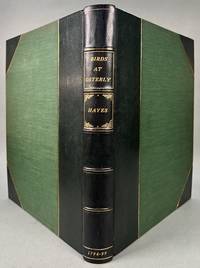
17948725<p>Two volumes in one. Bound in early twentieth century half green morocco over green cloth boards. Five raised bands with gilt particulars to spine. Top edge gilt. Marbled endpapers. From the library of H. Bradley Martin with his modest bookplate to front pastedown. Includes Sotheby's lot-bookmark from the famous sale. As is common this volume lacks the title preliminaries to volume two. Complete with 101 attractive hand colored full-page plates. Plate 19-26 35-36 and 83-86 are bound out of order. Other than Bradley's plate no previous owners' names or other defacements.</p> Printed by W. Bulmer and Co. and Published for the Authority by R. Faulder hardcover
176821255guérande 1768 un acte, broché de 4 pages (une grande feuille pliée en deux), sur papier vergé ligné et filigrané (forget) et manuscrit à l'encre brune, format :19 x 25 cm, avec cachet fiscal en noir en haut de la 1ère page : "ETATS DE BRETAGNE" , Deux Sols, cachet rouge "scel de la sénéchaussée de Guerrande" en haut à gauche de la 4ème page, fait à Nantes, le 26 mars1705 , signatures des Notaires "Buard" et "Bongrain" et demande accordée signée "Vrignaud" à l'encre brune ,
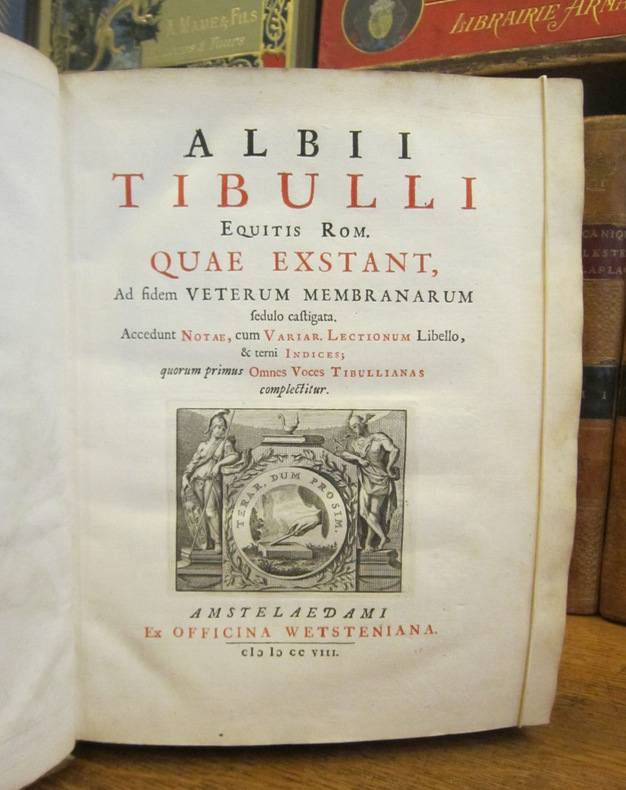
1708000312Amstelaedami (Amsterdam) Ex Officina Wetsteniana (Wetstein) 1708
1776CBRB638<p>This book is in good condition. Cover near the edges and spine is creased and frayed in some places. Page tanning. Some spots and marks throughout the pages. Two small tears on the cover page. No inscriptions.</p> J. Dodsley London hardcover
171820000417Utica NY 1817-1832. General wear. Some separation at letter folds and along edges. A collection of six letters between the mother and children of the Angier family originally of Southborough MA. The most consistent part of the letters is opening with an apology from the children for failing to write their mother Elizabeth Angier and how this failure means that they have neglected her in some way. The letters date were generally send from upstate New York from towns near Utica NY such as Whitestone and Frankfort where several of the siblings namely Mary Elizabeth and Sabrina had relocated to. It appears as though one of the older daughters after marrying Augustus Baldwin 1794-1880 in 1815 moved to Whitestone NY to start a family. As the years continued several of Mary's siblings such as Elizabeth and Sabrina who never married moved to the area to for better marriage and job prospects. Two of the six letters are between a pair of the siblings. The letters generally consist of updates on their lives family and friends as well as numerous religious missives and some mention of their jobs mostly teaching that the sisters were engaged in. Additionally in some of the letters the siblings have written missives addressed to their siblings still living in Southborough. All of the letters are folded stampless posts. Measures 5" x 3 1/2" folded. Below are excerpts from some of the letters: "We were presented with a daughter 14th Nov but alas! She is not that joy or comfort we so much hope for we have been called to a bitter trial God in his infinite goodness has seen fit to afflict us in taking our child by death our afflictions are sent to try us and oh that they mite sic prove a blessing to us that we mite sic feel reconciled under all the alotments sic of divine providence in submission to his will and that we might in full submission say the Lord giveth and the Lord taketh away and blessed be the name of the Lord." - February 2 1817 Whitestone NY from Augustus and Mary Baldwin to Mary's mother Elizabeth Angier "Aunt Haven has been sick since she returned from Boston with the nervous tooth ache. She had her tooth pulled and it broke a nerve and it had such an effect on her that it obliterated the whole of the nervous system so that she was not able to do her work for six weeks but she has got to be quite well now. Mr. Laban Nicholas wife Mr. Lees sister the one that was down when Mary went up the first time is deranged. She tries every way to kill herself. She once took her husbands razor and attempted to cut throat but was caught before she had completed the fatal deed. Twice her husband has found her with a rope around her neck and once got to her only soon enough to catch her in his arms as she leap sic from the scaffold one half minute longer and she would have been an eternity." - June 13 1818 Whitestone NY from Eliza Angier to her mother Elizabeth Angier. "I hope that he who has upheld you thus far in life will still hold you in the hollow of his hand lest at any time your feet should stray from the path of virtue and rectitude. And may he find your heart fast to him that when in health you may be an able to render to him according to his benefit. I am rejoiced to hear that there is any attention to the one thing needful with you. Oh that there may be many praying souls in that place and may we realize that we have an interest in your prayers. It would give a pang to any Christian to realize the state of this church and society. Religion is trampled upon like hearts cast before swine. we have reason to fear that wrath of an offended God is kindled against us and that he will come upon us with great judgment if we continue in this stupid state. Afflictions in themselves are courteous and I am not as an able to bear them as anyone. Yet they are sent for our good to restore are wandering feet. I would choose to be afflicted rather than remain in this Im feeling state. More the treacherous calm I dread then tempest bursting over my head. - August 3 1825 Frankfort NY Eliza Angier Warriner to her siblings Roland Angier and his wife Mary Marsh 1803-1866 "Eliza has become the mother of twins both daughters one we call Cordelia Eliza the other Frances Beattie they were born 20 April the life of the mother was disposed for sometime. We had two of the best nurses one was Sabrina besides all the assistance that I could render. Eliza is now so that she is just about taking care of the babes but not able to do much she is afflicted with the canker in her throat and stomach which keeps her and the babes in continual afflictions." - June 25 1830 Frankfort Alford and Eliza Angier Warriner to Eliza's mother Elizabeth Angier "The anniversary of my birthday which is tomorrow reminds me of my obligations to you the kindest and best of mothers who under God have been instrumental in preserving my life that I am so far from you as not to visit you often when I think that six years have rolled away since I saw you I am really astonished! And now that I have left my brothers and sisters is misterous sic To myself but for not writing to you I can offer no reasonable excuse I must played guilty this pleasant evening the moon with her bright Waze conveys my thoughts to my native home . I find many pleasant people here but in my dreams I visit Southborough inhabitants could I but you know where my mother is and what her enjoyment is in the decline of life it would relieve my anxiety. we had a very pleasant journey here we started from Utica July 30 in a canal boat in the front cabin 13 and number moving at the rate of 5 miles an hour able to read right net and sell. Mr. Simmons spent his time writing and reading his sermons which was very interesting to us when we got to Troy Thursday we had to lay up a few hours on account of the water for a kind a machine called the mud turtle which was scraping the mud from the river before we could cross the way to Albany then went on board a steamboat to New York saw a great many of the works of nature and a part then a coach convey the family to the New York shore then in a steamboat to Newark." - October 3 1832 Newark NJ Sabrina Angier to her mother Elizabeth Angier To view images click: https://photos.app.goo.gl/8yiDE57vHQQXnc7R7 <br/><br/>Elizabeth Newton was born on April 30 1763 to Solomon Newton 1734-1830 and Elizabeth Howe 1733-1818 in Southborough MA. She had eight siblings: Catherine Newton Ball 1759-1834 Lucreita Newton 1761-1813 Larkin Newton 1765-1788 Dolly Newton 1767-1855 Jeremiah Newton 1769-1837 Willard Newton 1771-863 Anna Newton Sherman 1773-1863. She married Charles Angier 1752-1816 on December 23 1784 in Southborough MA and had eleven children together: Betsy Angier 1785-1793 Anna Agier Fay 1787-1861 Converse Angier 1789- Mary Angier Baldwin 1791-1875 Roland Angier 1793-1872 Austin As the letters date from after the death of their father Charles Angier in 1816 even though the letters are to their mother Elizabeth they are addressed to her son Roland Angier whom she was living with at the time. Angier 1795-1865 Elizabeth "Eliza" Angier Warrienr 1795-1882 Lydia Angier 1800-1820 Sabrina 1802- and Charles Angier 1806-1881. She died on February 11 1845 in Southborough MA of lung fever. unknown books
1800LD4931c. 1800. Hardcover. Very Good. Half brown cloth and morocco gilt-stamped lettering on spine; oblong Folio; with 15 signed pencil drawings on paper about 315x485 mm each mounted on heavy cardstock with caption handwritten in French in ink in lower margin of mount. Circa 1800 with hand-lettered title-page indicating that this collection was mounted and bound in 1930. Cloth blistered; drawing paper a bit toned with some faint foxing here and there. <br/><br/>These extraordinary historical scenes by Chatillon trace the births deaths marriages and battles of the Earls of Shrewsbury from the First Earl John Talbot 1390-1453 an important English military commander during the Hundred Years War to Francis Talbot 1623-1667 the 11th Earl who met his more scandalous end in a duel with the Second Duke of Buckingham. John Talbot distinguished himself for his bravery in battle and is believed to have fought alongside Henry IV in the famous Battle of Shrewsbury 1403 in which King Henry IV defeated a rebel army led by Henry "Hotspur" Percy from Northumberland. The battle serves as the climax for William Shakespeare's "Henry IV Part One" and John Talbot appears with speaking lines in "Henry VI Part One." The Countess of Auvergne remarks of him "Is this the scourge of France / Is this the Talbot so much feared abroad / That with his name the mothers still their babes" The Battle of Shrewsbury is also the first in which English archers fought each other on English soil and archers are featured in the battle scenes illustrated here -- alongside armored horses waving flags the stern expressions of the valiant and the agonized faces of the wounded. The scope and intricacy of these drawings is difficult to capture with language -- no detail is left unrecorded from the coat of arms on a shield to the embroidery on a wedding dress the vaulted arches of a church the sinews of dog the teeth of horse gnashing its bit. A must-see please inquire for images or a complete list of captions. hardcover books
176421699London: Engraved and Printed for the Author and sold by Messrs. Fletcher and Co. 1764. First edition. Ephemera. Very good condition. The coat of arms of the Hastings family published in a sumptuous format in 1764 in the "Baronagium Genealogicum; or the Pedigrees of the English Peers." The print includes the associated three text sheets of the genealogical table with vignettes also colored. Copper engraving with handsome later hand color the platemark measuring approximately 24 x 42 cm 9 1/4 x 16 1/2" on paper 30 x 48.5 cm 12 x 19 1/4". Very good condition. Plate numbers 91 92 93 94. Beautifully colored. Two small marks above shield pp 91 chip in margin of pp 94 otherwise very clean. Engraved and Printed for the Author and sold by Messrs. Fletcher and Co. unknown
176421718London: Engraved and Printed for the Author and sold by Messrs. Fletcher and Co. 1764. First edition. Ephemera. Very good condition. The coat of arms of the Augustus family published in a sumptuous format in 1764 in the "Baronagium Genealogicum; or the Pedigrees of the English Peers." Copper engraving with handsome later hand color the platemark measuring approximately 24 x 42 cm 9 1/4 x 16 1/2" on paper 30 x 48.5 cm 12 x 19 1/4". Plate number 5. Beautifully colored and very clean. Engraved and Printed for the Author and sold by Messrs. Fletcher and Co. unknown
176421689London: Engraved and Printed for the Author and sold by Messrs. Fletcher and Co. 1764. First edition. Ephemera. Very good condition. The coat of arms of the Campbell family published in a sumptuous format in 1764 in the "Baronagium Genealogicum; or the Pedigrees of the English Peers." The print includes the two associated text sheets of the genealogical table with vignettes also colored. Copper engraving with handsome later hand color the platemark measuring approximately 24 x 42 cm 9 1/4 x 16 1/2" on paper 30 x 48.5 cm 12 x 19 1/4". Plate numbers 79 80 81. Beautifully colored slt dusty at bottom margin. Engraved and Printed for the Author and sold by Messrs. Fletcher and Co. unknown
1743604664Tübingen, J. J. Eisfeld, 1743. 4to. 40 S. Unaufgeschnittene Rohbögen.
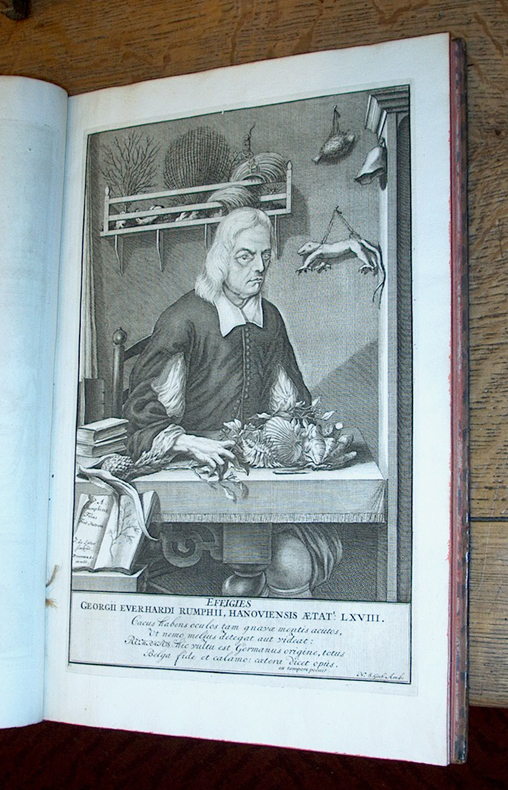
1711002657Lugduni Batavorum (Leide, Leyde), Apud Petrum Van der Aa, Bibliopolam, 1711 In-folio (41 x 27 cm), (1) ff., 15 pp., (8) pp., veau marbré, dos à six nerfs orné, pièce de titre de maroquin rouge, triple filet à froid entourant les plats, double filet doré sur les coupes, tranches rouges (reliure d'époque). Illustré d'un frontispice, un portrait de l'auteur, 1 vignette de titre, 4 vignettes dans le texte, et 60 planches gravées. Première édition en latin du "Cabinet des raretés de l'île d'Amboine" (Amboinsche Rariteitkamer), publié en hollandais en 1705 ; l'auteur, atteint de cécité, est ici représenté dans son cabinet. Précieux exemplaire provenant de la famille de Charles de MONTESQUIEU, de la bibliothèque du Château de la Brède, avec l'ex-libris des Secondat, barons de la Brède et de Montesquieu, "Virtutem Fortuna Secondat, Ex Bibliotheca Bredanense", et les initiales C. M. à l'encre. Bel exemplaire. // Folio (41 x 27 cm), (1) ff., 15 pp., (8) pp., marbled calf, spine tooled raised on six bands, red morocco title label, triple blind fillet borders on covers, double gilt fillet on turns-in, red edges (contemporary binding). Illustrated with a frontispiece, a portrait of the author, 1 vignette on title, 4 vignettes in the text, and 60 engraved plates. First edition in latin of the "Ambonese Curiosity Cabinet" (Amboinsche Rariteitkamer), first published in german in 1705 ; the author, blind, is here depicted in his office. Precious copy from Charles de MONTESQUIEU family, from the "Château de la Brède" library, with the book-plate of the Secondat, barons de la Brède et de Montesquieu "Virtutem Fortuna Secondat , Ex Bibliotheca Bredanense", and initials C. M. hand-written. Fine copy (Nissen ZBI 3520)
1702219892NP 1702-1848 1702. First Edition. Hardback. All items are in a good to very good condition loosely gathered in a folder of vellum-covered boards probably removed from a 19th century book. The older documents are slightly edge-nicked and tanned as with age but still legible. The later documents are quite clean and bright with just some dulling around the edges. Overall this unique and rare collection of documents remains particularly well-preserved overall. Further scans images etc. and additional bibliographical material available on request.; 8vo 8"" - 9"" tall; 0 pages; A small archive of original documents relating to the Quilter family. There appears to be a connection between a number of the families mentioned in these documents and 'The Kings Candlesticks' that relate to George IV and the Julius family. Three handwritten sheets of family trees late 16th century to 1931 that feature the names of Quilter of Staple in Kent 16th century Rumball 18th-19th century Julius Quilter Palmes or Palmer Rowland and others. The original documents range from 1702 to 1848 and include ordination certificates landlord-tenant agreements articles of clerkship and wills some with their original seals. Contents include: Deacon ordination certificate awarded to George Quilter signed by the Bishop of Ely 27th September 1816. With original seal. -- Chaplain certificate: ""George Quilter to be licensed to perform the office of Chaplain of the workhouse of the Lincoln Union in the county of Lincoln"" May 29th 1837. -- Canon certificate awarded to George Quilter signed by the Bishop of Lincoln 16th Dec. 1870. -- ""Inventory of furniture and effects in the house in Malbrook belonging to Mr. Quilter 1st Jan. 1702."" -- ""Inventory and appraisemet of furniture and effects in Walbrook from Mr. Quilter to Mr. Keating 24 January 1702."" -- ""Schedule of fixtures to be appraised to Mr. Quilter from Mr. Keating 23 June 1703."" -- ""Valuation of fixtures taken in the house of Mr. Dyson by Mr. Quilter Dec. 6th 1777."" -- ""Schedule of fixtures to be appraised from Mr. Quilter to Mr. Cameron 1st October 1783."" -- Articles of clerkship between William Lee and John Rumball. 1770. With original seals. -- Articles of clerkship between James Rumball Quilter and Robert Gatty. 1st May 1779. With original seals. This document states: ""James Rumball Quilter of Walbrook in the City of London."" -- Copy of the last will and testament of Francis Russell Nixon 1803-1879 the first Bishop of Tasmania. -- Last will and testament of Julius Quilter 2nd Sept 1848. The collection also includes a 19th century handwritten personal booklet/diary of religious verse and French poetry transcribed from various works. Place names mentioned and repeated in the listed documents include: Ely Canterbury Walbrook in the City of London and Lincoln. Also included is a typed letter from C. Cary Gilson addressed to the Quilters West Chiltington Common Sussex regarding the Quilter family connections to Lord Horatio Nelson's wife. Gilson quotes Aunt Nona: ""my great grandfather owned St. Kitts. The widow Mrs. Nesbitt was a relation of his and married Lord Nelson."" Nelson and Nisbet were married at Montpelier Estate on the island of Nevis on 11 March 1787 shortly before the end of his tour of duty in the Caribbean. The marriage was registered at Fig Tree Church St John's Parish Nevis. Nelson returned to England in July with Fanny following later Sugden John 2004. Nelson: A Dream of Glory. NP, 1702-1848 hardcover
17811601300210xbvkRoma, per Benedetto Francesi, 1781. Titlepage with large copperengraved coat-of-arms; XII, 300; [4, incl. titlep. with woodcut-decoration], 264 pages; few illustrated architectural initials and woodcut head- and endpieces. - Modern lightblue-and-black-on-yellow-ground marbled hardcover bindings with gilt-titled green leather-spinelabels, all edges sparkled in red; 8vo.(ca. 18,5 x 11 x 4 cm).
1759488404Lissabon, Monteiro, 1759. 4to. 8 Bl., 180, 50, 141 S. Leder d. Zeit mit Rückenvergoldung (gering berieben, Ecken bestoßen, 1 Kante u. 1 Gelenk mit Wurmspuren). [2 Warenabbildungen]
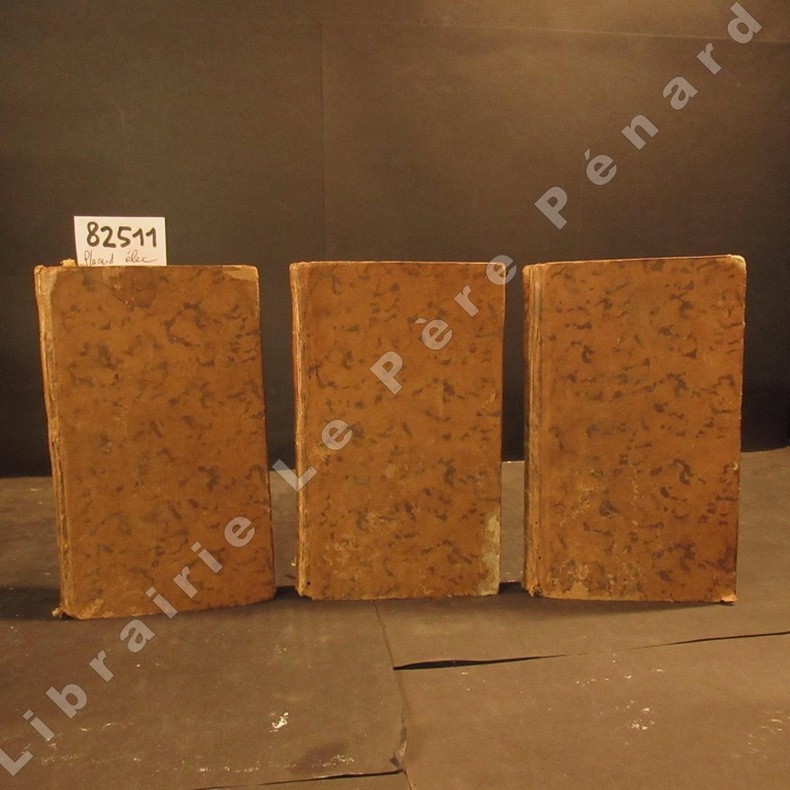
1782825111782 A Paris, & se vend à Liège, chez J. F. Bassompierre, Imprimeur de SON ALTESSE, & Libraire. 1782. 3 vol in-12. Plein vaux brun marbrée de l'époque, filets et fleurons dorés, pièces de titre et de tomaison, tranches rouges. Vol 1 : Tome 1 et 2 : xij+183 + 172 pages, Vol 2 : Tome 3 : 227 pages, Vol 3 : Tome 4 : 336 pages ( complet en trois volumes ) . PHOTOGRAPHIE SUR DEMANDE
1791488327Osnabrück, Kißling, 1791. 4 Bl., 293 S. Pappband d. Zeit (stark beschabt u. bestoßen). [2 Warenabbildungen]
17933003Cape Cod MA 1793. Folio paper stock ca. 300 x 200 mm. 24 pp. on laid paper MS entries covering every page. In contemporary "home-made" rough canvas wrappers worn some damage with loss of text and inherent soiling to text. At least 8 ff. have been excised at the end and elsewhere. Fair condition but an extraordinary survival. Preserved in a mylar L-sleeve backed with lig-free board. This crude manuscript graphically exhibits the extraordinary lengths to which colonial American students had to go in order to teach themselves. Provincial home-made textbooks such as this one almost never survive; we are unable to explain how -- or why -- this relic survived at all especially considering its lamentable condition. The manuscript was certainly owned by the Higgins family of Cape Cod who had descended from the Mayflower and who fought during the Revolutionary War see below. <br/><br/>The present ciphering book solves often complex math and word problems generally in the service of commerce. Currency is almost exclusively in British coinage but there is one reference to the conversion of British pounds into DOLLARS fol. 7v. The present manuscript bears the date "April the 17th year 1793" in a later hand! on the final page: thus the MS features a very early reference to U.S. dollars by an American student NB: on April 2 1792 the U.S. Congress created the United States dollar as the standard unit of currency. <br/><br/>Lessons herein include the Numeration Table; Addition of Money; Addition of Troy Weight; Addition of Dry Measure; Subtraction; Multiplication Table; the Golden Rule or Rule of Three and more. <br/><br/>PROVENANCE: Higgins family of Eastham / Granville / Orleans MA. Several hands have contributed to the creation of the MS. On the verso of the penultimate leaf are written the first names of several members of the Higgins family including Solomon Anna Elisa etc. These names were written below an exercise concerning the application of the Golden Rule to calculate the division of a bequest in this instance the Higgins family itself. On the recto of the final leaf is the repeated inscription of a member of the Higgins family who has resisted identification. The text on the verso of the final leaf is dated 1793 but this was clearly written by a later hand. On this page are written the names of several debtors to an unidentified individual including "Timothy Doane of Eastman" and "Solomon Higgins of Granville." More provenance research on this MS will no doubt prove rewarding. unknown books
175040358Ohne Ort, um 1750. Blatt ca. 17 x 9 cm. 1 Blatt, verso weiß. Am oberen Rand auf Karton montiert.
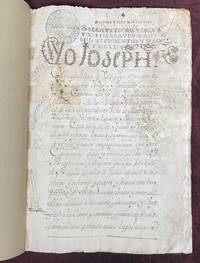
17283474Madrid 1728. Good. Manuscript on paper. Folio. 38 ff. tears and wear along fore-edges smaller tears along top and bottom of leaves persistant waterstains fol. 1 damaged with loss. Top portion of final leaf excised but the text is continuous see below. Recent sympathetic wrappers. With faults and priced correctly. EXCELLENT SPANISH GOLDEN-AGE MANUSCRIPT WHICH DOCUMENTS AN ATTEMPT TO "CERTIFY" THE NOBILITY OF A NOBLEMAN IN PROVINCIAL SPAIN WHOSE FAMILY WAS ASSOCIATED WITH THE FOUNDER OF SAN ANTONIO TEXAS.<br /> <br /> The purpose of the document is to demonstrate the nobility of Don Manuel Silbestre Joseph de Herrera y Tassis. There had been a reorganizing of the government of the town Bañares in the province of Burgos now Logroño and Herrera believed that he should be the "acalde" similar to the post of "mayor" though with greater authority than the modern mayor. However to claim the position it was necessary for some unstated reason for Herrera to prove that he was of noble birth.<br /> <br /> TEXT: The first leaves are copied from a "Book of Baptisms" the original is described as a large folio made of parchment from the Parish of San Andres in Madrid from June 5 1684 to May 23 1691 beginning at page 165. These leaves show that Manuel Herrera was born on the 31st of December 1686 making him 26 years old at the time of the events in question along with the names of his parents padrino etc. <br /> <br /> The next leaves are copied from a book titled "Twenty Three Baptisms" from the Parish of San Fines and San Luis in Madrid begun in September 12 1629 ended January 18 1630 page 109 and document the birth and baptism of Henrrique Herrera Manuel's father. Next is evidence of the fact that Manuel's older half brother Don Gregorio de Herrera y Varacaldo was granted entrance into the Orden de Santiago The Order of Saint James a military/religious order. This is a copy of a document by Don Gregorio de Tapia the king's secretary and a member of the royal cabinet.<br /> <br /> The next section lays out Manuel de Herrera's genealogy showing the claim to nobility through certain aspects of his family's history. His Grandfather Captain Don Matheo Andres de Herrera was granted membership in the Orden de Santiago by King Philip III. It is also shown that a number of Manuel's ancestors were born in Flanders obviously related to the Spanish occupation during the Eighty Years' War.<br /> <br /> Following are certifications showing that Manuel's grandfather and other ancestors had held the position of Acalde de Mesta. This means that they were in charge of the Spanish livestock sheep herders' association. Although that does not sound particularly impressive it was a position of immense power and prestige monetarily and politically and was only held at this time by members of the higher nobility. The family held this position under the authority of the Duke of Béjar the first mention in this document would have been under the 9th Duke. <br /> <br /> THE DUKES OF BÉJAR AND THE CONNECTION WITH SAN ANTONIO BEXAR COUNTY TEXAS: As we learn herein for several generations the Herrera family served under the Dukes of Béjar. Indeed Don Henrique de Herrera the father of Manuel Herrera for whom the present manuscript was written was the Governor of Sanabiza under the Duke of Béjar and a member of the Royal Council although the author claims that these records were "unavailable" as the city of Sanabiza had been taken over by the "enemy" Portuguese. The bespoke Manuel Herrera served as "Gentleman of the Chamber" under Juan Manuel López de Zúñiga y Castro later the 11th Duke of Béjar and the 10th Count of Bañares. Manuel López's uncle Baltazar de Zúñiga y Guzmánde 1658-1727 surely knew the family. He is of particular interest in the history of the Americas as he became Viceroy Governor and General Captain of New Spain President of the Royal Audience of Mexico High Majordomo of King Philip V and President of the Royal and Supreme Council of the Indies. In 1718 he established the Presidio San Antonio de Béjar; this was to become the city of San Antonio in Bexar County Texas. <br /> <br /> OTHER NOBLE FAMILY MEMBERS: Several pages describe the nobility of Manuel's older brother Gregorio who belonged to the Orden de Santiago; was a well-known noble of the Royal Court; and had been elected Acalde de Mesta over several other candidates including the Secretary of New Spain and the King's own son. Manuel's grandfather was also in the Orden de Santiago and was a member of the king's cabinet; and finally his father enjoyed noble privilege in the castle of Sanabiza. <br /> <br /> CONCLUSION: Manuel argues that he deserves to enjoy the same privileges in Bañares and he provices testimony from respected witnesses so that his "quality blood and nobility" can never again be challenged. The final section shows that the Bañares Deputation received the prepared documentation investigated its veracity confirmed the nobility of Don Manuel de Herrera y Tassis and granted him the position of Acalde de Bañares. <br /> <br /> The final leaf contains the hastily written attestation of the secretary Joseph Marttines de Vallabanes including a description of the document itself: "38 folios hand-rubricated and on the last leaf of the sello tercero paper . separated !" -- presumably referring to the missing section at the top of the last leaf. NB: the text is continuous; perhaps a decorative flourish was excised in order to validate the text of the document with another copy. <br /> <br /> SECRETARY: Written by Joseph Marttinez de Vallabanes regularly "MartÃnez"; this scribe has a habit of doubling the letters "t" and "r" a scribe in Valladolid and is "rubricado" meaning that each leaf on the recto lower interior margin has the scribe's "rúbrica"; an artistic signature that serves as a sort of notarized seal. The document was written at the order of Don Manuel Herrera y Tassis on the 10th of December 1727 as a copy of the original document written by the scribe Thomas de Silba and others in 1712.<br /> <br /> PAPER: Initial stamps at the head show the seal of King Phillip V of Spain and show that this paper is the "tercero" grade of "papel sellado" costing 68 maravidÃs approximately $7.30 today and stating the year: 1727. Papel sellado was first authorized in Spain by a decree from Felipe IV in 1636. This stamped paper primarily functioned to gather revenue for the royal treasury; documents without the official stamp were regarded as non-legal and the transactions they documented subsequently negated. Papel sellado was extended to Spain's colonies in the New World following another law in 1638 where it was mainly sold to individuals who executed legal documents such as lawyers scribes and merchants. The necessary stamps were available in four sellos the use of each dependent upon the transaction and descending in cost: Primero Segundo Tercero and Quarto with two additional categories under Sello Quarto "de oficio" for government use and "pobres" for indigents. The more prominent seals thus signaled documents of greater importance and value. Papel sellado was distributed in annual issues in Spain.<br /> <br /> WATERMARKS: <br /> 1. Filigrana Hispanicas 0023459A Ãguila bicéfala con alas abiertas y coronada. Escudo en el pecho con iniciales "MGC" en el interior = Valencia 1742. <br /> 2a. Not reproduced in Filigrana Hispanicas but possibly 0020929A Tres cÃrculos rematados en una cruz latina trebolada. En el primero una media luna en el segundo las letras PP y en el tercero un corazón.<br /> 2b. Countermark of the above Una cruz de Malta. <br /> 3. Filigrana Hispanicas 0022203A Tres cÃrculos rematados con una cruz latina trebolada. En el primero una media luna en el segundo las letras S/P/D/A y en el tercero las letras P/ GG. Debajo el número 2 = Oviedo 1738. <br /> <br /> CATALOGUER'S NOTE: We are grateful to Joseph Adams for his detailed analysis of this manuscript. unknown
1800138420Couverture rigide. Reliure plein cuir. Manques au 1er plat. 408 pages. Rousseurs.
1768138416Couverture rigide. Reliure demi-basane. Coiffes usées. 250 pages environ.