10 résultats
1552144501552 Broché - 15,5 x 21 - 288 pp - année 1970 - éditions Arthaud - illustrations
1518144821518 Broché - 15 x 18 - 70 pp - année 1952 - Imprimerie marcel Bon à Vesoul -
151932642Revue Rock & Folk n° 49 de février 1971. In-4 agrafé de 98 pages, au format 27 x 21,5 cm. Couvertures photographiques avec Léo Ferré. Couvertures avec d'infimes frottis aux coins. Intérieur frais. Mensuel musical français consacré à la musique rock et pop, fondé en 1966 par Robert Baudelet, Jean Tronchot, Philippe Adler, Jean-Pierre Leloir et Philippe Koechlin. La revue connut la participation de nombreux photographes dont : Jean-Pierre Leloir, Claude Gassian, Pierre Terrasson, Gaëlle Ghesquière, Bruno Ducourant,Patrice Guino, Jean-Louis Rancurel, Dominique Tarlé, Bertrand Alary et Saddri Derradji. Nombreux articles sur le Rock, le blues, la soul, la pop dont : Eric Burdon & War, Family, Jimi Hendrix, Les Moody Blues, Frank Zappa, Léon Russell, etc. Nombreuses chroniques avec de très nombreuses photographies en noir et blanc. Rare édition originale, en très bel état de fraicheur.
151932656Revue Rock & Folk n° 61 de février 1972. In-4 agrafé de 98 pages, au format 27 x 21,5 cm. Couvertures photographiques avec Keith Richard. Couvertures avec d'infimes frottis aux coins. Intérieur frais. Mensuel musical français consacré à la musique rock et pop, fondé en 1966 par Robert Baudelet, Jean Tronchot, Philippe Adler, Jean-Pierre Leloir et Philippe Koechlin. La revue connut la participation de nombreux photographes dont : Jean-Pierre Leloir, Claude Gassian, Pierre Terrasson, Gaëlle Ghesquière, Bruno Ducourant,Patrice Guino, Jean-Louis Rancurel, Dominique Tarlé, Bertrand Alary et Saddri Derradji. Nombreux articles sur le Rock, le blues, la soul, la pop dont : Keith Richard, Redbone, Hawkwind, Rory Gallagher, Paul Simon, Sly and the Family Stone, Dick Rivers, C.S.N. & Y, Nico, Lou Reed, Les Rolling Stones, etc. Nombreuses chroniques avec de très nombreuses photographies en noir et blanc. Planche de " Hamster Jovial " par Marcel Gotlib. Rare édition originale, en très bel état de fraicheur.
151932655Revue Rock & Folk n° 62 de mars 1972. In-4 agrafé de 98 pages, au format 27 x 21,5 cm. Couvertures photographiques avec Roger Waters. Couvertures avec d'infimes frottis aux coins. Intérieur frais. Mensuel musical français consacré à la musique rock et pop, fondé en 1966 par Robert Baudelet, Jean Tronchot, Philippe Adler, Jean-Pierre Leloir et Philippe Koechlin. La revue connut la participation de nombreux photographes dont : Jean-Pierre Leloir, Claude Gassian, Pierre Terrasson, Gaëlle Ghesquière, Bruno Ducourant,Patrice Guino, Jean-Louis Rancurel, Dominique Tarlé, Bertrand Alary et Saddri Derradji. Nombreux articles sur le Rock, le blues, la soul, la pop dont : T.Rex, Pink Floyd, Les Doors, Family, Les Byrds, Chuck Berry, Lou Reed, Gato Barbieri, Jefferson Airplane, Joni Mitchell, etc. Nombreuses chroniques avec de très nombreuses photographies en noir et blanc. Planche de " Hamster Jovial " par Marcel Gotlib. Rare édition originale, en très bel état de fraicheur.
1521144411521 Broché - 15 x 21 - 228 pp - année 1996 - imprimer sur les presses de Caracter's Besançon - illustrations
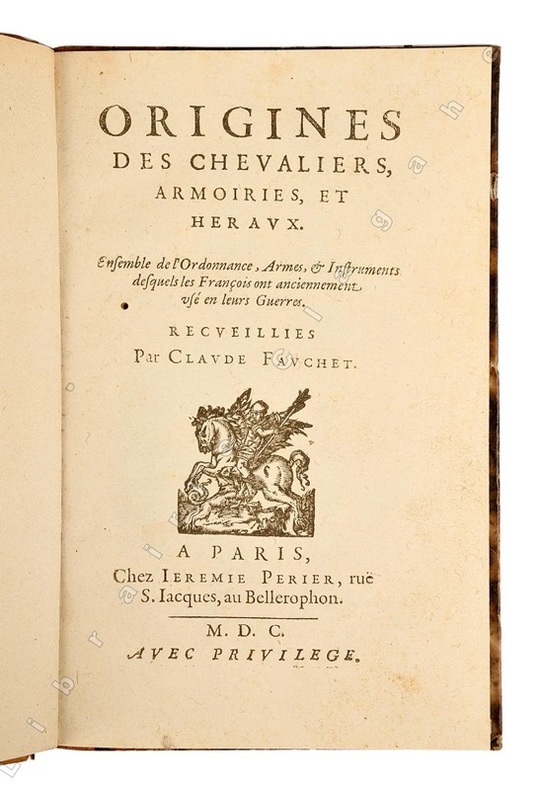
160021332Paris, Jérémie Perrier, 1600 ; in-8 (166 mm), demi veau havane, dos lisse à faux nerfs de filets dorés, fleurons à froid, titre en long (reliure ancienne postérieure); [4], 60 ff. Fleuron au titre, gravé sur bois montrant un chevalier qui pique un chien sauvage qui l’attaque, lettrines et bandeaux gravés sur bois ; l’Achevé d’imprimer est du 15 janvier 1600.
1571486271571 (Lyon) Lugduni, Apud Ioan. Tornaesivm (Jean de Tournes), Typogr. Regium (Typographe royal). MDLXXI - 1571 - In-16, 12 x 8,5 x 3,8 cm - Edition Originale - Reliure vélin de récupération avec manque -Collationné complet des 110 gravures sur bois- 637 pagers + Index (3) manque pages d'index- fortes mouillures - Envoi rapide et soigné - Réf. 48627
1599elala425cMantua: c1599. 1599. folio. pp. 405 22 blank leaf 12 35 40. woodcut ornaments & initials. old vellum some damage to lower front cover & upper spine a few leaves discoloured some staining to inner margins towards end. occasional marginal notes & markings some cut into when text rebound. bookplate of the Prince of Liechtenstein. The volume contains the documentary material of a law suit concerning a feudal estate in northern Italy which at the end of the sixteenth century was still under the sovereign jurisdiction of the Holy Roman Empire. In connection with two scandalous murder cases in the Gonzaga family the possession of the territory of Castelgiuffredo between Mantua and Brescia was claimed by the Duke of Mantua as head of the House of Gonzaga the Gonzaga family were masters of Mantua from 1329 to 1708. However the Emperor Rudolf had adjudged Castelgiuffredo to Francesco Gonzaga of Castiglione in 1599. This book was apparently published by order of the Duke of Mantua as a protest against the decision of the Emperor Rudolf. Included are the texts of hearings before the criminal court in the cases of the assassinations of Alfonso and Rodolfo Gonzaga during the years 1592-1597 and legal opinions on the validity of the claims of the parties concerned. A specified catalogue of the dowry of Caterina Gonzaga including every piece of her wardrobe jewellery household goods etc. is an interesting historical document illustrating the life of late Renaissance Italian privileged society. Presumably privately printed in a limited number of copies. Not found in the Italian National Library service or in the British Library Catalogue. [cMantua: c1599]. hardcover
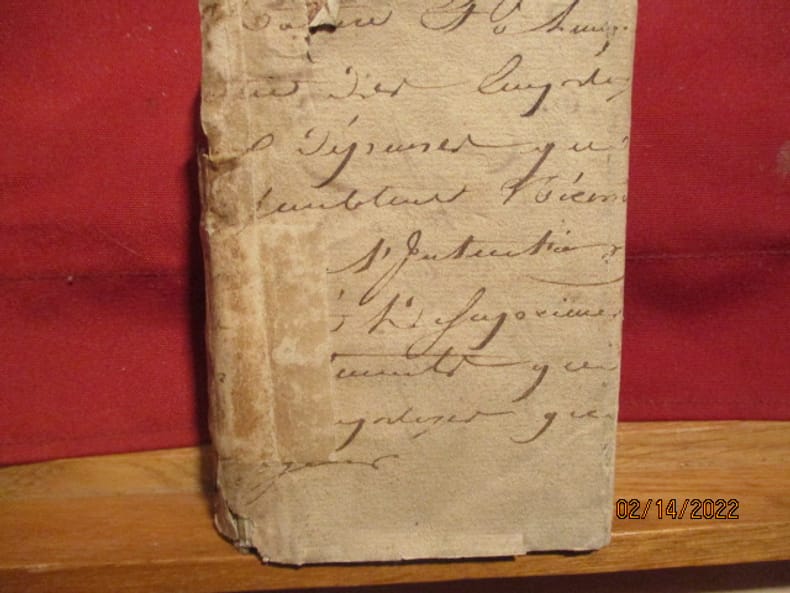
150455721Valladolid 1504. Modern Boards. Near fine. Folio 30.5 by 21.4 cm. 1: 18th-century title leaf 25 1: docket leaves. Manuscript on paper ca. 30-35 lines per page. Text in Spanish. Modern cloth-backed marbled boards; title label mounted at front cover. Slightest hint of horizontal fold throughout mild toning to text light soiling and two small perforations at final docket leaf else a fine fresh copy.<br /> <br /> Early sixteenth-century Spanish manuscript recording the significant legal and religous act in which Doña María de Sarabia d. 1521 a member of the influential converso Cartagena family formally renounces her inheritance rights legítima in favor of the Convent of Santa María la Real de las Huelgas in Valladolid Spain. This act was part of her acceptance into the convent as a nun reflecting both her personal devotion and her family's ongoing engagement with religious institutions in Castile. Joining the convent could be seen as part of a broader family strategy to maintain their status and protect their legacy within Christian society. As very little is otherwise known about María de Sarabia's life the document is a rare and valuable source for understanding not only her personal history but the role she played within the broader context of the Cartagena family. The renunciation of inheritance rights to gain admission to a powerful religious institution reflects the intersection of faith identity and social survival in a period marked by profound social and religious transformations.<br /> <br /> The Spanish term 'converso' refers to those Jews who converted to Roman Catholicism in the 14th and 15th centuries as well as their descendents. The Cartagenas were one of the most well-known and powerful converso families in Castile during the late 15th and early 16th centuries. They rose to prominence through strategic marriages political alliances and service to the Crown. María's father Pedro de Cartagena 1387-1478 was the son of Pablo de Santa María formerly Shlomo ha-Levi; 1352-1435 a former chief rabbi who converted to Roman Catholicism and rose to become the Bishop of Burgos papal advisor and tutor to the future King Juan II of Castile. Her uncle Alvar García de Santa María 1370-1460 was a prominent chronicler and historian at the court of Castile further solidifying the family's influence in religious and intellectual circles. María married García Franco de Toledo d. 1487 a royal accountant and alderman regidor of Valladolid thereby linking her to another influential converso family. Her son Antonio Franco de Cartagena ca. 1455-ca. 1507 served as Chief Accountant to the Catholic Monarchs Ferdinand and Isabella a position that underscores the family's prominence within the royal administration. Another of her sons Pedro de Cartagena 1456-1486 was a poet and knight who became involved in the political and military affairs of the period futher reflecting the family's diverse roles in Castilian society. María's deaf sister the mystic Teresa de Cartagena ca. 1425-1478 was a nun at the Royal Monastery of Santa María la Real de las Huelgas in Burgos another powerful Cistercian convent closely associated with the Castilian aristocracy and a significant center of spiritual and secular power. Many consider her to be the first Spanish-language female author and the first defender of women's intellectual rights. While Teresa was at the convent in Burgos her sister María joined the Cistercian order in Valladolid. Affiliations with these powerful monasteries likely elevated their family's social standing and provided a form of protection especially for converso families seeking to demonstrate their Christian orthodoxy and commitment.<br /> <br /> While many conversos in 16th-century Spain faced challenges particularly from "Old Christians" who doubted the sincerity of their conversions the period also saw substantial integrations of conversos into Christian society. Families like the Cartagenas leveraged their educations connections and positions to contribute significantly to the governance and culture of Spain. This integration was achieved through active participation in the Church royal administration and intellectual life blending their Jewish heritage with their new Christian identities. References: Boase R. Secrets of Pinar's Game: Court Ladies and Courtly Verse in Fifteenth-Century Spain Leiden: Brill 2017 pp. 457-460; Cantera Burgos F. Alvar García de Santa María y su familia de conversos: historia de la judería de Burgos y de sus conversos más egregios. Madrid: Instituto Arias Montano 1952; Piera M. "Debunking the 'Self' in Self-fashioning: Communal Fashioning in the Cartagena Clan" in: Self-Fashioning and Assumptions of Identity in Medieval and Early Modern Iberia ed. L. Delbrugge Leiden: Brill 2015; Robalino G. "Teresa de Cartagena's Feminist Rhetoric and Theology" in: Negotiating Feminism and Faith in the Lives and Works of Late Medieval and Early Modern Women Amsterdam Univ. Press 2024 pp. 43-56; Roth N. Conversos Inquisition and the Expulsion of the Jews from Spain Univ. of Wisconsin Press 2002; Seidenspinner-Núñez D. & Kim Y. "Historicizing Teresa: Reflections on New Documents Regarding Sor Teresa de Cartagena" in: La corónica: A Journal of Medieval Hispanic Languages Literatures and Cultures 2004: 322 pp. 121-150. unknown