[ABU DHABI ROYAL FAMILY].Biblio.com
3 060 résultats
1969L2QDFYEGE99FPakistan 1969. An archive of 807 loose photographs 541 in colour including several duplicates some printed in a different format including 65 photos depicting falcons 3 duplicates 36 in colour and 14 photographs of camels 1 in colour. A large collection of 807 photographs providing a unique view into the private life of Sheikh Zayed bin Sultan Al Nahyan 1918-2004 ruler of Abu Dhabi and founding father of the United Arab Emirates. The photographs depict Sheikh Zayed and his family including Sheikh Khalifa bin Zayed Al Nahyan b. 1948 relatives and friends partaking in various leisure activities. Also included are some photographs of children probably including Sheikh Zayed's sons possibly Sheikh Mohammed bin Zayed Al Nahyan b. 1961. The pictures date from a significant period in the history of Abu Dhabi the years leading up to the foundation of the United Arab Emirates in 1971 and from the earliest years of the new federation.A group of pictures is possibly taken in Pakistan many depicting a large manor where a party arrives by helicopter. Sheikh Zayed enjoyed visiting the country to go horse riding and hunting with his falcons. Many photographs depict casual dinner parties gatherings and meetings in the open air. Other photographs show a large party setting off on horseback falcons cPhotograph archive of Sheikh Zayed bin Sultan Al Nahyan's private life.Some photos slightly curled along the edges some slightly discoloured. Overall in very good condition. unknown
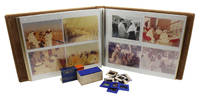
1970L7VBA667WXTVPakistan 1970. Stored in large six-leaf self-adhesive tan leather album oblong folio 43 x 34 cm. 40 photographs 29 in colour and 11 black-and-white. Various sizes 300 x 207 mm to 125 x 125 mm. Includes 51 original colour slides. A privately assembled photo album showing the ruling family of Dubai during a state visit to Pakistan apparently in the early 1970s. Pakistan was the first country to accord formal recognition to the United Arab Emirates after the state's emergence in 1971.Nearly half of the images show HH Sheikh Rashid bin Saeed Al Maktoum 1912-90 the father of the modern Emirate of Dubai in conversation at dinners and relaxing in the garden. Other photos show his sons the crown prince and later ruler HH Sheikh Maktoum bin Rashid Al Maktoum 1943-2006 the present ruler HH Sheikh Mohammed bin Rashid Al Maktoum and HH Sheikh Ahmed bin Rashid Al Maktoum. The collection was assembled by Azhar Abbas Hashmi a high-ranking officer of the Pakistani UBL bank United Bank Limited founded in 1959 by Agha Hasan Abedi 1922-95 who is seen in seven photographs with HH Sheikh Rashid as well as with his two older sons. While several pictures show the members of the royal family in negotiations with the Karachi banking officials there are also fascinating images of a falconry tour to the Pakistani countryside including a fine portrait of HH Sheikh Ahmed with a falcon perched on his arm. The more than fifty original colour slides show other scenes of the same visit; only four of the images are among the prints included in the album. Some occasional creases and even the odd tear but in general finely preserved. Three photos printed by Karachi's "Eveready Studio" some inscribed in ballpoint with identification on the reverse "Mr. S. L. Anwar HH Mr. Masood Naqvi Mr. Iqbal Khateeb / Mr. Hashmi showing the prospect drawings" one in Arabic another with ownership stamp: "Azhar Abbas Hashmi Vice President Gulf Operations International Division UBL HO Karachi". An unpublished set entirely unknown and without counterparts in the online Keystone or Hulton/Getty press photo archives from the estate of Azhar Abbas Hashmi 1940-2016 Pakistani financial manager and eminent literary patron with close ties to Karachi University. Long with UBL Hashmi would serve as the bank's vice-president before founding several important cultural organisations and becoming known as a man of letters in his own right. It was because of Hashmi's close connections to the Gulf states that Abu Dhabi provided funds to build the Karachi University's faculty of Islamic studies along with Sheikh Zayed Islamic Centre and Jamiya Masjid Ibrahi. hardcover
150455721Valladolid 1504. Modern Boards. Near fine. Folio 30.5 by 21.4 cm. 1: 18th-century title leaf 25 1: docket leaves. Manuscript on paper ca. 30-35 lines per page. Text in Spanish. Modern cloth-backed marbled boards; title label mounted at front cover. Slightest hint of horizontal fold throughout mild toning to text light soiling and two small perforations at final docket leaf else a fine fresh copy.<br /> <br /> Early sixteenth-century Spanish manuscript recording the significant legal and religous act in which Doña María de Sarabia d. 1521 a member of the influential converso Cartagena family formally renounces her inheritance rights legítima in favor of the Convent of Santa María la Real de las Huelgas in Valladolid Spain. This act was part of her acceptance into the convent as a nun reflecting both her personal devotion and her family's ongoing engagement with religious institutions in Castile. Joining the convent could be seen as part of a broader family strategy to maintain their status and protect their legacy within Christian society. As very little is otherwise known about María de Sarabia's life the document is a rare and valuable source for understanding not only her personal history but the role she played within the broader context of the Cartagena family. The renunciation of inheritance rights to gain admission to a powerful religious institution reflects the intersection of faith identity and social survival in a period marked by profound social and religious transformations.<br /> <br /> The Spanish term 'converso' refers to those Jews who converted to Roman Catholicism in the 14th and 15th centuries as well as their descendents. The Cartagenas were one of the most well-known and powerful converso families in Castile during the late 15th and early 16th centuries. They rose to prominence through strategic marriages political alliances and service to the Crown. María's father Pedro de Cartagena 1387-1478 was the son of Pablo de Santa María formerly Shlomo ha-Levi; 1352-1435 a former chief rabbi who converted to Roman Catholicism and rose to become the Bishop of Burgos papal advisor and tutor to the future King Juan II of Castile. Her uncle Alvar García de Santa María 1370-1460 was a prominent chronicler and historian at the court of Castile further solidifying the family's influence in religious and intellectual circles. María married García Franco de Toledo d. 1487 a royal accountant and alderman regidor of Valladolid thereby linking her to another influential converso family. Her son Antonio Franco de Cartagena ca. 1455-ca. 1507 served as Chief Accountant to the Catholic Monarchs Ferdinand and Isabella a position that underscores the family's prominence within the royal administration. Another of her sons Pedro de Cartagena 1456-1486 was a poet and knight who became involved in the political and military affairs of the period futher reflecting the family's diverse roles in Castilian society. María's deaf sister the mystic Teresa de Cartagena ca. 1425-1478 was a nun at the Royal Monastery of Santa María la Real de las Huelgas in Burgos another powerful Cistercian convent closely associated with the Castilian aristocracy and a significant center of spiritual and secular power. Many consider her to be the first Spanish-language female author and the first defender of women's intellectual rights. While Teresa was at the convent in Burgos her sister María joined the Cistercian order in Valladolid. Affiliations with these powerful monasteries likely elevated their family's social standing and provided a form of protection especially for converso families seeking to demonstrate their Christian orthodoxy and commitment.<br /> <br /> While many conversos in 16th-century Spain faced challenges particularly from "Old Christians" who doubted the sincerity of their conversions the period also saw substantial integrations of conversos into Christian society. Families like the Cartagenas leveraged their educations connections and positions to contribute significantly to the governance and culture of Spain. This integration was achieved through active participation in the Church royal administration and intellectual life blending their Jewish heritage with their new Christian identities. References: Boase R. Secrets of Pinar's Game: Court Ladies and Courtly Verse in Fifteenth-Century Spain Leiden: Brill 2017 pp. 457-460; Cantera Burgos F. Alvar García de Santa María y su familia de conversos: historia de la judería de Burgos y de sus conversos más egregios. Madrid: Instituto Arias Montano 1952; Piera M. "Debunking the 'Self' in Self-fashioning: Communal Fashioning in the Cartagena Clan" in: Self-Fashioning and Assumptions of Identity in Medieval and Early Modern Iberia ed. L. Delbrugge Leiden: Brill 2015; Robalino G. "Teresa de Cartagena's Feminist Rhetoric and Theology" in: Negotiating Feminism and Faith in the Lives and Works of Late Medieval and Early Modern Women Amsterdam Univ. Press 2024 pp. 43-56; Roth N. Conversos Inquisition and the Expulsion of the Jews from Spain Univ. of Wisconsin Press 2002; Seidenspinner-Núñez D. & Kim Y. "Historicizing Teresa: Reflections on New Documents Regarding Sor Teresa de Cartagena" in: La corónica: A Journal of Medieval Hispanic Languages Literatures and Cultures 2004: 322 pp. 121-150. unknown
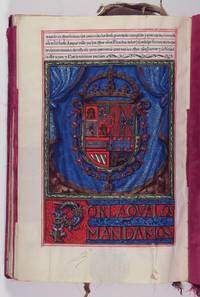
172155346Spain: Chancellary Court of Granada 1721. Original manuscript. Hardcover. Fine. Small folio 33 by 22 cm / 11-7/8 by 7-7/8 in. Illuminated manuscript on vellum. Main text in black ink masterfully penned in fine clear Gothic style ruled and bordered in red. 82 unnumbered leaves 4 blank comprising 6 full-page miniatures and 144 pages of text generally 32 lines per page. 36 richly illuminated bands with initials appear throughout the text with occasional ornate initials in black ink. The finely detailed miniatures are painted in rich colors and decorated with metallic gold and silver. The royal seal of Philip V of Spain is stamped in black ink at the bottom margin on the recto of all text leaves as well as the final three blanks; the initials of a royal notary appear at the bottom margin of each page of text. Bound in contemporary crimson velvet lightly rubbed with decorative brocade ribbon ties worn and frayed. All edges gilt; crimson silk guards bound-in to protect the miniatures and illuminated bands. Text in Spanish. Manuscript on vellum fine and clean throughout. Overall a very well-preserved bound document.<br /> <br /> Sumptuously illustrated 18th-century manuscript nobility patent carta ejecutoria de hidalguia commissioned by the De la Barra family of Castile to memorialize the recognition of its noble status in the reign of Philip V King of Spain. As depicted in the illustrated family tree and noted at the opening of the text the family traces their noble ancestry back through five generations to Don Bartholome de la Barra y Zuñiga. "During the late medieval era many individuals received the honor of hidalgo status the lowest rank of nobility but with the passage of time this noble status was not always locally recognized. If a person or family was willing to submit a documented family history to local officials of the Chamber of Hijosdalgo of the Chancellery Court of either Valladolid of Granada they could sue for formal recognition" Neary. While few succeeded in these suits those who did would often commission luxury copies of the paperwork bound with the royal seal.<br /> <br /> While customized for each family the text and images of these nobility patents follow a standardized template which must elaborate on three key themes: religious devotion; service to the crown; and purity of blood limpieza de sangre. The latter required that the family demonstrate the absence of Jewish Muslim or "heretical" ancestry. As is commonly the case the present example opens with an image of the Virgin Mary here receiving the devotion of four members of the De la Barra family depicted on their knees before a sumptuously appointed church altar. The facing image depicts the Father the Son and the Holy Spirit in the form of a dove looking down upon the infant Jesus. The other full-page miniatures depict the De la Barra family tree; their coat of arms King Philip V; and the royal coat of arms. The richly illuminated bands contain the names of De la Barra family members or introduce key sequences in the presentation and disposition of the suit. The final four pages of text comprise an official copy of the court's final decision. Penned in an ordinary scribal hand this concluding document was usually written on paper; in the present case the declaration appears on parchment at the special request of the family. The document is signed by Santiago Alcalde y Linares royal notary escribano and dated 3 July 1721.<br /> <br /> Provenance: The engraved bookplates of C. L. F. Robinson Newport Rhode Island and Mary MacMillin Norton appear on the opening blank leaf. Charles L. F. Robinson 1874-1916 described in the auction sale catalogue of his library as "a liberal and discriminating collector of rare books" who acquired many volumes from the Hoe and Huth collections was best known as a collector of rare Americana. A clipping from the auction catalogue lot 595 describing the present manuscript is laid in; a typescript of the description is tipped in at the inner margin along with another printed catalogue description possibly from another sale. Robinson served at one time as president of the Colt Patent Firearms Manufacturing Company of Hartford Connecticut. The Anderson Galleries Catalogue of Rare Books Comprising the Valuable Library of the Late Col. Charles L. F. Robinson of Hartford Conn. lot 595 p. 136; E. A. Neary "Spanish Golden Age Nobility Documents" in: Digital Collections for the Classroom. Online via Newberry Library April 13 2023. [Chancellary Court of Granada] hardcover
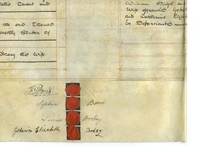
18025001018Exeter 1802. Group of 20 legal documents on paper and vellum relating to a property in Exeter including as the centrepiece a vellum manuscript indenture 630 x 790 mm. with the signatures of William and Elizabeth Bligh and many other members of his family Bligh himself having signed the indenture a second time in relation to a coda to the indenture; all in fine condition with original wax and paper seals present. <p><p>A remarkable group of manuscripts regarding the ownership of a property in Exeter over a period of a century and involving William Bligh and numerous close family members. The collection includes a rare example of the signatures of both William Bligh and his wife Elizabeth on the same manuscript document together with the signatures of Bligh's nephews Thomas and Francis Godolphin Bond both of whom had long careers in the Royal Navy and the latter of whom went on Bligh's second breadfruit voyage and kept up an important and revealing correspondence with his uncle. </p> <p>The group of documents relates to a family-owned house at 13 St. Martin's Lane Exeter a narrow street between Exeter High Street and the Cathedral Yard which is incidentally also the location of the historic Ship Inn said to have been frequented by Sir Francis Drake. The earliest material present here dates from 1702 while the other manuscripts trace the later history of the property throughout the eighteenth century.</p> <p>The signatures are attached to a legal indenture which is the last in a substantial group of documents relating to this property a group which also includes a detailed abstract of ownership prepared for the Blighs and the Bonds. </p> <p>The series of manuscripts culminates in an indenture dated 27 July 1802 conveying for a fee of £50 the rights of the Bligh family to one-sixth of a dwelling in St. Martin's Lane to one William Floyde. The property was evidently owned by Bligh in conjunction with his nephews and nieces in the Bond family: Bligh's half-sister Catherine married John Bond and Bligh and his wife were very close to the whole family in particular Francis Godolphin Bond 1765-1839 a distinguished sailor and First Lieutenant under Bligh on the second breadfruit voyage on HMS Providence. Attractively the present document includes the signatures of the entire Bond family notably that of Francis Godolphin Bond but also those of his brothers and sisters: Thomas Bond Rebecca Bond Sophia Bond Samuel Hookey husband of Catharine Elizabeth Hookey née Bond and Jenny C. Bond. A coda to the indenture is a receipt for payment of fifty pounds sterling which is also witnessed by all of the key signatories meaning that William Bligh's signature is actually present here twice.</p> <p>Equally interesting is the August 1801 "Abstract of the Title of Messrs. William Bligh et al" prepared for the transaction which records their interest in the property. This abstract notes that 'William Bligh is a Captain in the Navy and lives at Durham Place Lambeth but is now on board the Irresistable in the North Sea Fleet.' Of the other signatories it is also noted that at the time Thomas Bond was serving on the Raisonable while Francis Godolphin Bond was residing in London.</p> </p> . unknown
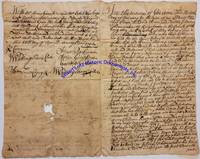
6344SCHOONMAKER FAMILY ARCHIVE. The Schoonmakers were a multi-generational Dutch family who lived in Ulster County New York mostly around Kingston. The first family arrived in New York in the mid-1600s and settled up the Hudson River around Kingston.Archive. 60 manuscripts. Dates range from 1712 to 1836. Places are generally in and around Ulster County New York. This Schoonmaker family archive consists of approximately sixty documents related to several generations of the clan of the Kingston Ulster County region of New York. Some of the highlights include an estate document about a Negro boy meaning the family-owned slaves legal documents signed by women unusual for the time a couple of documents in Dutch etc. There are signatures of many early settlers with Dutch names such as Oosterhout Heermans Van Gaasbeck Tremper Yeoman Van Vliet and Hooghteeling.Some of the highlights include:A four-page document dated April 12 1712 for the estate of Hendrick Schoonmaker. The most interesting line is the mention of a Negro Boy bequeathed.An oversized document dated June 28 1721 related to the DeMayer family. It is signed by Nicholas & Elsie DeMayer as well as Hendrik Oosterhout.An oversized document dated February 18 1729 related to real estate and signed by Johannis Schoonmaker.An oversized document dated May 25 1730 related to property for the estate of Hendrick Schoonmaker. It is signed by Cornelius & Sarah MacLeen and Andries Heermans.A document dated September 11 1733 for real estate. It is signed by Abraham Person & Hendrik Oosterhout; there is a Persen House museum in Kingston.A document dated February 19 1770 signed by numerous figures including Trintje Schoonmaker Ezekiel Masten Abraham Masten and Cornelius Beekman.A letter dated December 9 1811 about Reverend Ostrander performing services in the Dutch language & a call for a Dutch minister.A document dated June 7 1814 about a Kingston church & William Osterhoudt.A receipt dated August 20 1817 for the Columbian newspaper subscription to Henry Schoonmaker.A document dated July 28 1816 signed by Cornelius Tappan to Schoonmaker regarding military regiments.A printed broadside dated October 22 1826 regarding political support for Governor DeWitt Clinton. unknown
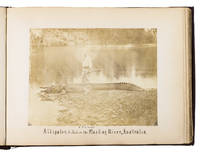
1870ABC_47579Australia and England and India 1870. Contemporary maroon cloth embroidered with yellow flowers. Comes in a custom-made black-cloth clamshell box internally covered in burgundy cloth with a black morocco title-label on the spine lettered in gold and a folding liner of the same burgundy cloth. Oblong album ca. 23 x 30 cm. With 36 albumen prints including 14 photographs of Australia. These include houses churches buildings in Springsure Queensland around 1870 photos of Charles with his horse a wonderful picture of an "Alligator killed in the Mackay River" and "bottle trees near Taroon" 5 photographs of India: Bengal Camp Delhi multiple group photos in Darjeeling a group photo in front of the government house in Calcutta and the crew of the H.M.S. Narcissus 17 photographs of Gibraltar America Switserland art pieces and the Dicken family. Further with 24 watercolour paintings of flowers landscapes and people including two of the Taj Mahal and 17 coloured pencil and ink drawings of people. The drawings and paintings are almost all signed S. P. D. or F. E. D. who were likely members of the Dicken family. Most photographs and art pieces are captioned in pencil or brown ink several leaves are decorated with additional drawings or dried plants. Album amicorum of a settler in Australia and his family with rare photographs of Queensland Australia and India in the 1870s.The photographs in the album are extraordinary especially those of the small town of Springsure. In 1841 the first photograph was taken in Australia of Bridge Street in Sydney. While explorers and early colonists quickly became a subject of interest for Australian photographers photographs of early settlements are quite rare. The photographs of the government house in Calcutta and the crew of the H.M.S. Narcissus in the album are also of historical interest. Together with the numerous drawings paintings and poems the album offers a fascinating insight into life in Queensland in the late 19th century.Charles Shortt Dicken 1841-1902 was born in India. He was a lieutenant for the Royal Irish Fusiliers before he settled in Queensland in 1864. He entered the mounted police in 1866 and worked as a police magistrate until he was appointed secretary in the office of the Agent-General for Queensland in London in 1880. When he retired from this position in 1891 he received the title C.M.G Companion in the Order of Saint Michael and Saint George. This is awarded to those who render extraordinary or important non-military service to the United Kingdom in a foreign or Commonwealth country. In the final years of his life he contributed to The British Empire series a series of four volumes which aimed to offer trusthworthy information about the colonies and settlement of the British Empire. Dicken was a co-author of volume IV - Australasia published in 1900.The cloth is worn at the head of the spine and shows a few small holes on the boards revealing the leather album beneath. The illustration of the "execution of Mary Queen of Scots" is missing on leaf 12. Some of the dried plants are falling off. The edges and corners of the leaves show some signs of wear the leaves slightly browned. Overall in good condition the photographs artworks and other decorations are very well preserved.l Mennel P. Dictionary of Australasian biography p. 132; The Daily Telegraph november 15 1902 p. 4. hardcover
40260London : John Newton 1st January 1817. Terrestrial pocket globe 3 inches in diameter engraved gores with original hand colour over papier-mâché and plaster sphere the surface in fine order with a recent wax applied for protection two metal pins resting the globe in the original publisher's shagreen case titled Newton's improved pocket celestial globe with engraved diagrams of the constellations the lips coloured red original metal hinge and two hook and eye clasps. A fine example of a rare pocket globe sitting perfectly within its case. A rare and attractive miniature pocket globe showing Cook's third voyage. John Newton 1759-1844 was the founder of a firm of globe makers in London established in the 1780s and continuing on with the involvement of Newton's sons throughout the nineteenth century. This small terrestrial globe in its original case shows the track of Cook's third voyage of 1776-80 with its return to England under the commands of Clerke and Gore. New Holland is shown separated from Van Diemen's Land Port Jackson and Botany Bay are marked and interestingly 'French Discoveries' are captioned along the South Australian coastline a reference to the Baudin expedition. An analemma is drawn over the Pacific Ocean and the 'Antipodes of London' are marked south of New Zealand. References: Dekker Elly et al. Globes at Greenwich: A Catalogue of the Globes and Armillary Spheres in the National Maritime Museum Greenwich. London: Oxford University Press and the National Maritime Museum 1999 pp. 424 - 425 GLBO58 Sumira Sylvia. The art and history of globes. London : The British Library 2014 p. 189 the 1831 edition illustrated. unknown
0301781433 letters 4409 pages 647 retained mailing envelopes dated 1845 to 1944.The collection consists of five cartons of material. The collection includes letters of five generations of the McCulloch family written over the course of one hundred years starting with Major Alexander McCulloch 1779-1886 to his 3rd great grandson Ashby McCulloch Sutherland 1921-1998 with the bulk of the letters covering the families of Henry Ashby McCulloch his wife Lola Gaylord their daughter Lolita McCulloch and her husband William Alexander Sutherland and Lolita and William's son Ashby McCulloch Sutherland. The collection also includes 3 diaries 3 address books 2 notebooks 1 expense account book plus 942 photographs and approximately 1400 pieces of printed and manuscript ephemeral items with the bulk being from 1900s-1940s.<br /><br /><p><b>History of the McCulloch - Sutherland Families of San Antonio Texas</b></p><p>Major Alexander McCulloch and wife Francis Le Noir 1779-1866</p><p>Major Alexander McCulloch was born in Virginia and raised in North Carolina. He was a graduate of Yale and an aide-de-camp to General James Coffee under General Andrew Jackson in the Creek Indian War and the War of 1812 from 1812-1815 in Alabama Georgia and New Orleans. He died in Dyer County Tennessee in August 1846.</p><p>The McCulloch family had been wealthy politically influential and socially prominent in North Carolina before the American Revolution but Alexander McCulloch had wasted much of his inheritance and was unable even to educate his sons. Two of his older sons briefly attended a school in Tennessee taught by their neighbor Sam Houston. After several moves the family settled at Dyersburg where one of their closest neighbors was David Crockett who became a great influence on Alexander's sons Henry Eustace McCulloch and his older brother Ben McCulloch who both would later become Confederate brigadier generals during the American Civil War.</p><p>Major Alexander McCulloch married Francis F. Le Noir who was born 11 April 1779 in Virginia. She was the daughter of a planter and slaveholder. Her only brother John Peterson Le Noir died in New Orleans of a wound received in a skirmish the night of 21 December 1814 while serving in the U.S. Army in the War of 1812. She came to Texas after 1846 and lived at the home of her son Captain John S. McCulloch in Ellis County until her death on 10 May 1866. She and her husband had 12 children together.</p><p>One son of Alexander and Francis was Alexander McCulloch who served in the army of Texas in 1836-37 and was an officer in the U.S. Army in the Mexican War. Another son was Benjamin McCulloch who participated in the Battle of San Jacinto as a private served in the Mexican War as a captain and was killed in the Battle of Pea Ridge Arkansas 7 March 1862 while serving as a Brigadier General in the Confederate Army. A third son was John S. McCulloch a captain in the Confederate Army who Francis went to Texas to live with. A fourth son and the line of McCullochs that this archive offered here descended from was General Henry Eustace McCulloch. This archive contains one letter written by Major Alexander McCulloch to his wife dated 1845.</p><p><b>General Henry Eustace McCulloch 1816-1895 and wife Jane Isabella Ashby 1822-1896</b></p><p>General Henry Eustace McCulloch was an early pioneer Texas Ranger and Confederate officer. He was born in Rutherford County Tennessee on December 6 1816. Although he played an important role in military affairs in early Texas he received fewer accolades than his more famous cohorts John S. Rip Ford John C. Jack Hays and his older brother Benjamin McCulloch. In the 1830s Ben and Henry McCulloch carried on several economic enterprises. They traveled the Mississippi River on log rafts to various markets and by the end of the decade they had moved to Gonzales to survey and locate lands. In 1839 in the political struggles at Gonzales Henry McCulloch shot and killed Reuben Ross after the latter intoxicated and obnoxious drew his pistols. The angular-featured gentle-looking McCulloch joined the Texas Rangers in the heyday of their role as citizen soldiers against Native Americans and Mexican troops. In the battle of Plum Creek in 1840 against the Comanches he scouted fought with distinction and was wounded. In addition he served as a lieutenant in Hays's rangers in their military operations against the Comanches and Mexican nationals. In 1842 in the attack on San Antonio and retreat by Mexican troops McCulloch scouted infiltrated enemy lines seeking information and participated in the battle of Salado Creek.</p><p>For the next two decades he mixed his military career with other ventures. In 1843 he was elected sheriff of Gonzales and began a merchandising career there. The following year he moved his business to Seguin. During the Mexican War and afterward he served as a captain of a volunteer company guarding the Indian frontier. He became especially adept at organizing regular ranger patrols in intervals from different camps to cover a designated area. In the early 1850s McCulloch served in the state legislature both houses from Guadalupe County and at the end of the decade he accepted an appointment as United States marshal for the Eastern District of Texas. He served as a high-ranking Confederate officer during the Civil War. As Texas left the Union he assumed command of the posts on the northwestern frontier from Camp Colorado to the Red River and used Texas secessionist troops to accept the surrender of federal forces. Given the rank of colonel by the Confederate Congress McCulloch organized the First Regiment Texas Mounted Riflemen in 1861. This body of troops slowed down penetration of the western frontier by Native Americans through a system of patrols and small-scale engagements. After promotion to brigadier general McCulloch commanded the Northern Sub-District of Texas from 1863 to the end of the war. In this role he faced the threats of Indian raids and the movement of Union forces. He also had to deal with the activities of draft dodgers deserters and bushwhackers. At one time he tried unsuccessfully to arrest William Quantrill for robbery and murder. With the war ended McCulloch went home to Seguin with an armed escort for protection against deserters who swore to take his life.</p><p>After the Civil War he remained in the limelight. In 1874 he assisted the newly elected governor Richard Coke in removing Edmund J. Davis from the executive offices. Early in 1876 as a reward for his years of service McCulloch was appointed superintendent of the Deaf and Dumb Asylum later the Texas School for the Deaf. Here his lax and inept administration brought about a legislative investigation that made him resign his position in 1879.</p><p>Henry married to Jane Isabella Ashby on 20 August 1840. She was born 17 September 1822 at Shelby Co Kentucky. She was the daughter of John Miller Ashby and Mary Harris Garnett of Kentucky who had been early settlers in the DeWitt Colony which was centered on Gonzales Texas. The couple had a number of children most of who remained in Texas.</p><p>General Henry Eustace McCulloch died on March 12 1895 at Seguin Texas and was buried in San Geronimo Cemetery. He received a full Masonic funeral having been an active freemason after the War in the Guadalupe County Lodge. His wife died the following year on 18 July 1896 at Seguin Guadalupe Co. Texas. There are 4 letters in this collection related to Henry Eustace McCulloch. Two letters are written by Henry Eustace McCulloch to his son in November 1882 and February 1895 with 2 letters written to him.</p><p><b>Henry Ashby McCulloch 1866-1913 and wife Lola Beatrice Gaylord 1871-1944</b></p><p>One of General McCulloch's sons his namesake was Henry Ashby McCulloch who was born 23 July 1866 at Rangers Horn Geronimo Guadalupe Co. Texas. He married on 18 April 1893 and died 22 January 1913 at Buenos Aires Argentina. The present collection is mainly concentrated on Henry his wife Lola Beatrice Gaylord their daughter Lolita "Lola" Beatrice McCulloch as well as Lolita's second husband William Alexander Sutherland and Lolita's son from her first marriage Ashby McCulloch Howard Sutherland who was adopted by Sutherland and took his stepfather's name.</p><p>Henry A. McCulloch left college in 1884 on account of a shortage of funds and thus did not graduate. From November 1884 to May 1887 he was a surveyor for state lands for Texas and the railways of the western part of the state being headquartered at El Paso. He did some work at this time in the State of Chihuahua Mexico for Davis Brothers of El Paso in 1885. For the last half of 1887 he was transit man and division engineer in charge of estimates for Mexican International Railway for Sabinas to Torreon and on preliminary survey from Torreon to Durango.</p><p>At the beginning of 1889 he was in the panhandle of Texas with William Walter Phelps Co. surveying 5000000 acre land grant in charge of two parties. He went to Mexico in 1890 for the purpose of working for the Wells-Fargo Company who he had been working with previously as a messenger at Eagle Pass Texas being responsible for communications between El Paso and Eagle Pass. In July of 1891 he was appointed "acting" route agent for Wells Fargo at Irapuato Guanajuato and later appointed as the route agent. In 1892 he was transferred to Monterrey and put in charge of all of Northern Mexico.</p><p>During 1892 he married Lola Beatrice Gaylord. And in 1895 he was appointed general route agent with headquarters in the City of Mexico and put in charge of all outside transportation business. While living in Mexico his daughter Lola Beatrice McCulloch was born in Mexico City on 16 August 1896. In 1898 he entered the service of American Surety Company as inspector and served in that capacity and as acting general manager until mid-July 1899 when he resigned because of differences between him and the company. He was immediately given a position as the general superintendent of San Marcos and Tecolutla Railway SM&T RR placed in charge of construction and operation. He stayed in this position a short time again having differences of opinions with his superiors and resigned to take a job in November 1900 with the Mexicana Railway as commercial agent staying only a brief time before taking a job again with the SM&T RR. SM&T RR was bought out by Mexican Eastern Railway. The SM&T was then leased to a corporation called Interoceanic Railway which was owned by stockholders of the Mexican Eastern Railway. McCulloch then became the General Train Master of the Interoceanic and the General Agent of the Mexican Eastern.</p><p>By 1904 he was appointed division superintendent of the Interoceanic Railway and later the same year appointed terminal superintendent for the company. Staying in Mexico he moved over to the Pan American Railroad where he was appointed the assistant general manager and became general superintendent of that company's railways in Mexico. In 1907 he was appointed general manager of Southern Railways of Peru and Dependencies under W. L. Morkill where he remained for several years before taking a position with a group of Argentine railroads. McCulloch died in Buenos Aires in 1913. </p><p>There are a 338 letters and telegrams written both to and from Henry concerning his work in Central and South America with the various railroad companies he was employed by. A number of these telegrams are multiple pages written in code then translated and sent back and forth at great expense in an attempt to keep prying eyes from what the companies were doing in the way of railroads in South America.</p><p>Henry A. McCulloch's wife Lola Beatrice Gaylord was born in October 1871 at Anderson Texas. She outlived her husband by nearly thirty years dying on 12 June 1944 at San Antonio Texas. She was buried at San Antonio's City Cemetery #1. She was the daughter of Edward Gaylord d. 1873 and Cornelia Bernice Milton 1849-1924. She is shown in the 1920 Census as living with her daughter Lolita and Lolita's first husband John Dewees Howard as well as her mother Cornelia Gaylord. Besides her grandson Ashby McCulloch Sutherland and her nephew William Leigh Morrow she was survived by two nieces Mrs. Sara Capers of San Antonio daughter of Eleanor Stribling Capers and Mrs. D. R. Dance of West Point New York. This archive includes 564 letters written to and from Lola Gaylord McCulloch.</p><p><b>Lolita "Lola" McCulloch 1896-1929 and William Alexander Sutherland 1895-1929</b></p><p>Lolita "Lola" McCulloch was born on 16 August 1896 at Mexico City Mexico. After the death of her father in 1913 the family moved back to San Antonio Texas. She was first married to John Dewees Howard 1895-1982 on 4 October 1916 at St. Mark's Episcopal Church in San Antonio Texas. Howard was the son of M. L. Howard. Her cousins Eleanor and Beatrice Stribling led the bridal party. One of the matrons was the young Mrs. Dwight D. Eisenhower herself recently married to the future president in July of 1916. However Lolita's marriage ended in divorce. Howard a salesman remarried and shows up in the 1930 Census as being married. He registered for the WWII draft but it is not clear if he served.</p><p>The first marriage of Lolita produced a son Ashby McCulloch Howard. After her divorce Lolita received custody of the child and then married a second time to William Alexander Sutherland on 2 June 1926. Sutherland legally adopted the boy and the boy was given his surname and was Sutherland's heir when he died unexpectedly in 1929. Lolita's second husband William Alexander Sutherland was born in 1895. He was the manager of the Monterrey Mexico branch of the Bank of Montreal and the couple's son Ashby spent his early years living at San Antonio Texas under the care of his grandmother Lola Gaylord McCulloch.</p><p>Lolita "Lola" McCulloch died on 25 March 1929 at her mother's home. She was 32 years old. She was survived by her husband William who would die in a car accident several months later her son mother an Aunt Mrs. Ben Stribling Celeste Gaylord 1874-1939 and cousins Eleanor Stribling; 1903-1985 and Mrs. D. R. Dance Beatrice Stribling 1902-1974 and William Leigh Morrow all of San Antonio. Celeste Gaylord married first Frank Morrow and second to Benjamin A. Stribling 1863-1950.</p><p>Lolita's husband William Alexander Sutherland died 23 November 1929 in a car accident at Monterrey Mexico. He had remained in Mexico after the death of his wife several months earlier. His body was taken back to San Antonio where he was buried. He was survived by a sister Mrs. Russell Cruikshank of Newcastle Canada and a brother Gordon Sutherland of Monckton Canada. There are a number of letters in the archive between Gordon Sutherland and Mrs. Lola Gaylord McCulloch concerning the estate of Gordon's brother William Alexander. William Alexander Sutherland adopted Ashby Henry Howard as his son which is evidenced by documents in the archive. Ashby became the legitimate heir of Sutherland and took his surname. This archive includes 82 letters to and from Lolita McCulloch Howard Sutherland and 10 letters to and from William Alexander Sutherland.</p><p><b>Ashby McCulloch Howard Sutherland 1921-1998</b></p><p>Ashby McCulloch Howard Sutherland was born on 16 March 1921 at San Antonio Texas. His father was John Dewees Howard 1895-1982 the first husband of Lolita "Lola" McCulloch. After the divorce and Lolita's marriage to William Alexander Sutherland Ashby was adopted by Sutherland as his son and given his surname. Since his parents were living in Mexico when his father was working for the Bank of Montreal's Mexico City branch Ashby stayed in San Antonio and lived with his grandmother Lola Gaylord McCulloch. He continued to live with his grandmother after the premature death of both of his parents in 1929.</p><p>Ashby graduated college in 1942 as the valedictorian from the University of the South Sewanee Tennessee and from Harvard Law School class of 1949. After wartime service in Europe as a U.S. Army officer he practiced at Sullivan & Cromwell before joining the International Nickel Co. New York INCO Ltd in 1954. He was an assistant to the general solicitor of the INCO Ltd. at the time of his marriage on 13 April 1956 to Marion Adair Ramsey.</p><p>Marion Adair Ramsey was the daughter of Mr. and Mrs. Robert Howard Ramsey of Goliad Texas. She attended Sophie Newcomb College in New Orleans and graduated from University of Texas where she was a member of Kappa Alpha Theta. For three years before her marriage to Sutherland she was associated with the Museum of Modern Art in New York.</p><p>The couple was married on 13 April 1956 at the Central Presbyterian Church in New York. After their marriage they made their home for some time in New York City. Ashby was with INCO until 1983 in New York Paris and Toronto serving in a variety of legal and management positions before retiring as a senior vice president and executive director.</p><p>After Ashby retired he and his family moved back to San Antonio but spent parts of his later years in Venice and San Miguel de Allende. Ashby was a member of the Knickerbocker Club and the Harvard Club of New York City. Ashby was married from 1956 to 1972 to Marion and although they divorced in 1972 they remained close friends. Ashby McCulloch Howard Sutherland died on 5 February 1998 after suffering for about a year with Leukemia and was buried on 9 February at City Cemetery in San Antonio. Together the couple had at least two children Howard Ramsey Sutherland of London and Ramsey Sutherland Farber of Buffalo. This archive includes 226 letters to and from Ashby McCulloch Sutherland mostly written during the time he was in undergraduate school law school or in military service.</p><p><b>Description of Collection</b></p><p>Correspondence of Alexander McCulloch his son Henry Eustace McCulloch and grandson Henry Ashby McCulloch</p><p>343 letters 743 pages 8 envelopes dated 1845-1913 as follows:</p><p>Alexander McCulloch Sr. 1 letter 2 pp. folding letter-sheet dated Huntsville 1845 written to his wife Francis.</p><p>Henry Eustace McCulloch 4 letters 10 pp. no envelopes dated 1859-1896. Of these 4 letters two were written by him to his son the other two are incoming letters. The letters to his son are dated Seguin Texas 1882 and Rockport 1896 just before he died. One of the letters addressed to him was written by his son S. L. McCulloch and dated Martindale Texas 1883 with the other incoming letter dated 6 May 1859 written by his nephew Rush McCulloch of Wilfred Texas.</p><p>Henry Ashby McCulloch approximately 338 letters 731 pp. 7 envelopes dated 1876-1913. Of these letters 174 are outgoing and 164 incoming. A number of these letters are telegrams or cablegrams some long some fairly short. They include coded cablegrams with transcriptions. These letters are almost all business related and deal with McCulloch's work in Central and South America with various railroads from 1876 up to the year that he died. About half of the letters are from 1912.</p><p><b>Correspondence of Lola Gaylord McCulloch wife of Henry Ashby McCulloch</b></p><p>564 letters 2066 pages 309 envelopes dated 1879-1944 bulk 1920s-1940s as follows:</p><p>Outgoing - 162 letters 534 pages 42 envelopes as follows:</p><p>Lola G. McCulloch to her daughter Lolita 17 letters 86 pp. 6 envelopes dated 1908-1928. Some of these letters were written by Lola to her daughter Lolita when Lolita was in Montreal Canada or Corpus Christi Texas.</p><p>Lola G. McCulloch to her grandson Ashby McCulloch Sutherland 27 letters 87 pp. 23 envelopes dated mostly San Antonio Texas 1921-1943 with most letters being from 1939-1943 when he was away at college in Sewanee Tennessee at the University of the South and then later at Soldier's Field Boston Massachusetts when he was in military service.</p><p>Lola G. McCulloch to her sister Celeste Gaylord 4 letters 35 pp. 2 envelopes dated 1907-1913 written by McCulloch to her sister while McCulloch was either onboard a ship or in Mexico or Peru.</p><p>Lola G. McCulloch to Hilyer-Deutsch-Jarrett & Co. 8 letters 18 pp. 1 envelope dated 1924-1930. Hilyer et al was a lumber company in San Antonio who McCulloch had business with concerning financial instruments between the parties. McCulloch writes from her home in San Antonio as well as from Mexico.</p><p>Lola G. McCulloch to several insurance companies 13 letters 17 pp. dated 1930. Copies of letters written to several Canadian insurance companies by McCulloch concerning policies of her late son-in-law William Alexander Sutherland for her grandson Ashby McC. Sutherland.</p><p>Lola G. McCulloch to Gordon Sutherland 8 letters 11 pp. 1 envelope dated 1930-1932. Copies of letters of McCulloch concerning the estate of her late son-in-law William Alexander Sutherland. Gordon Sutherland is William's brother whose estate was divided between Gordon his sister and William's son Ashby McC Sutherland.</p><p>Lola G. McCulloch outgoing letters to miscellaneous correspondents 85 letters 280 pp. 9 envelopes dated 1886-1941. Mostly copies of letters sent to various individuals or companies.</p><p>Incoming - 402 letters 1532 pages 267 envelopes as follows:</p><p>61 letters 301 pp. 43 envelopes of family letters mother cousins nieces and nephews to Lola G. McCulloch dated 1879-1944 mostly 1920s-1940s.</p><p>27 letters 43 pp. 17 envelopes of the Bank of Montreal the Union National Bank and the San Antonio Loan & Trust Co. to Lola G. McCulloch dated 1929-1940 dealing with McCulloch's finances as well as her grandson Ashby McC Sutherland who inherited half of the estate of his father William Alexander Sutherland.</p><p>6 letters 22 pp. 4 envelopes of T. A. Corry of Los Gatos California to Lola G. McCulloch dated 1936-1940. Corry appears to have been a friend of McCulloch possibly a relative also on the LeNoir branch of the family. Corry appears to have been friends with the McCulloch family through his work on Peruvian Railroads.</p><p>19 letters 198 pp. 18 envelopes of Dorothy Cruikshank of Newcastle New Brunswick Canada dated 1929-1940 to Lola G. McCulloch. Cruikshank was the sister of William Alexander Sutherland McCulloch's late son-in-law.</p><p>11 letters 37 pp. 9 envelopes of Ariana Graves Dennison wife of James Edward Dennison. Originally born in Texas she moved to Mexico City Mexico where she writes to Lola G. McCulloch dated 1929-1943. Ariana appears to have been a friend of McCulloch. James Edward Dennison was the treasurer of the American Book & Printing Company of Mexico City.</p><p>13 letters 72 pp. 10 envelopes of Charlotte St. John Elliot of Sewanee Tennessee to Lola G. McCulloch dated 1939-1943. Charlotte St. John Elliot 1870-1958 was born 24 June 1870 at Savannah Georgia to Robert W.B. and Caroline Elliott of South Carolina. Her father was a clergyman at San Antonio on the 1880 Census and this may be how Elliott came to know Lola Gaylord McCulloch. Elliott lived at Sewanee Tennessee with her lifelong companion Marie Truslow a sculptor. Charlotte was described as a "tall dignified and benevolent woman" and Truslow as "stumpy bucktoothed and vivacious." They were said to wear "long dresses black or dazzling white and heavy amber beads and pearls pendant over very ample bosoms." Elliott was friends with the southern writers Walker Percy and his cousin William Alexander Percy and her name shows up in a book about Percy Walker page 285 "<i>The House of Percy: Honor Melancholy and Imagination in a Southern Family</i>" by Bertram Wyatt-Brown New York & Oxford: Oxford University Press 1994 Marie Jermaine Truslow 1871-1958 Elliott's partner was a resident of Sewanee from 1924 until she died at the age of 86 in 1958. Her death came 11 days after the death of her partner Elliott on 17 February 1958. She was listed as a friend of many years to Charlotte Elliott with whom she shared a home at Sewanee.</p><p>Truslow was born in Brooklyn New York 6 August 1871 the daughter of James Linklater Truslow and his wife the former Amelia Louise Adams both later of Summit New Jersey. Truslow became a sculptor of note and had studied in Florence Italy and Dresden Germany. She and Charlotte had been classmates at St. Catherine's School in Brooklyn before both went abroad to study. At the beginning of WWI they were both back in New York City and met again and together opened the Home Studio for young ladies interested in studying music and art. Elliot was a dramatic soprano and once was a member of the Metropolitan Opera Chorus. Elliott is found advertising in the <i>New York Tribune</i> 3 Nov 1918 and the <i>Brooklyn Daily Eagle</i> 23 Feb 1919 as a singing instructor. In 1924 the two women closed their school and moved to Sewanee where they purchased a home and were active in the cultural affairs of the community for many years. Elliott was the granddaughter of Bishop Elliot a principal founder of the University of the South at Sewanee the university where Ashby McCulloch Sutherland attended. After the death of the two women they were buried next to each other at the University Cemetery. The 1940 Census taken for Sewanee lists Truslow as "head" of the household and Charlotte's relationship to her as "friend." An earlier census in 1930 listed Charlotte as "partner" to the head of house which was Truslow.</p><p>16 letters 19 pp. 6 envelopes dated 1924-1934 of Hilyer-Deutsch-Jarrett & Co. Hilyer et al was a lumber company in San Antonio who McCulloch had business with concerning financial instruments between the parties.</p><p>14 letters 17 pp. dated 1913- 1930 mostly 1930 of several insurance companies concerning mainly the estate/policy of William Alexander Sutherland McCulloch's late son-in-law and the inheritance of her grandson Ashby McC Sutherland.</p><p>17 letters 87 pp. 12 envelopes dated 1929-1944 of Alice Caruthers Reed of Charlotte and Durham North Carolina to Lola G. McCulloch. Alice appears to be a friend of McCulloch. She was born in Mexico the daughter of a physician. Her father lived at San Antonio as did Alice before she married George L. Reed an accountant with a chemical company and moved to Virginia and then later to North Carolina.</p><p>18 letters 34 pp. 10 envelopes dated 1930-1934 of Gordon Sutherland to Lola G. McCulloch. Sutherland is the brother of McCulloch's late son-in-law William Alexander Sutherland. The letters mostly concern the estate of Sutherland and the inheritance of McCulloch's grandson Ashby McC Sutherland.</p><p>16 letters 66 pp. 11 envelopes dated 1929-1943 of "Suzie" of Mexico City Mexico to Lola G. McCulloch. Suzie lives in Mexico City. She appears to be a friend of the McCulloch family.</p><p>184 letters 636 pp. 127 envelopes dated 1884-1943 incoming letters from various individuals to Lola G. McCulloch. The letters consist of correspondence from many friends and associates business or otherwise.</p><p><b>Correspondence of Lolita McCulloch Howard Sutherland daughter of Lola Gaylord McCulloch and Henry Ashby McCulloch</b></p><p>82 letters 388 pp. 60 envelopes dated 1906-1928 as follows:</p><p>Outgoing - 52 letters 221 pp. 31 envelopes as follows:</p><p>22 letters 115 pp. 15 envelopes dated 1906-1918 the bulk from 1914-1915. Letters written by Lolita to her parents from Mexico Washington D.C. New York NY and elsewhere.</p><p>26 letters 98 pp. 14 envelopes dated 1924-1928. Letters written by Lolita to her son Ashby McCulloch Sutherland when she was living in Mexico or visiting Canada and her son was living with Lolita's mother Lola Gaylord McCulloch in San Antonio Texas. Lolita's husband William Alexander Sutherland was working for a branch of the Bank of Montreal located in Mexico City Mexico.</p><p>4 letters 8 pp. 2 envelopes dated 1909-1910. Letters written by Lolita to others.</p><p>Incoming - 30 letters 167 pp. 29 envelopes as follows:</p><p>30 incoming letters 167 pp. written by various individuals to Lolita McCulloch Howard Sutherland dated 1913-1924. The bulk of the letters were written to Lolita in 1915 when she was living at San Antonio Texas. The letters are written by friends cousins and male romantic interests.</p><p><b>Correspondence of William Alexander Sutherland husband of Lolita McCulloch Howard Sutherland father of Ashby McCulloch Sutherland</b></p><p>10 letters 39 pp. 2 envelopes dated 1928-1929. Of these 11 letters there are 3 outgoing by Sutherland dated 1928-1929 and 7 incoming to him dated 1928-1929. One of the outgoing letters is to his son Ashby the other 2 are business related. The 7 incoming letters appear to be both family and business.</p><p><b>Correspondence of Ashby McCulloch Sutherland son of Lolita McCulloch and William Alexander Sutherland</b></p><p>226 letters 689 pp. 227 envelopes dated 1928-1944 as follows:</p><p>Outgoing - 177 letters 520 pp. 152 envelopes as follows:</p><p>165 letters 496 pp. 144 envelopes dated 1930-1944 written by Sutherland to his grandmother Lola G. McCulloch who became his legal guardian after the death of his parents in 1929 when he was 8 years old. Most of the letters were written by Sutherland when he was away at college at Sewanee Tennessee attending the University of the South 1938-1942 or when he was at Harvard Law 1942-1943 at Cambridge Massachusetts or in military service 1943-1944 at Soldier's Field Boston West Springfield Massachusetts or at Camp Lee Virginia and Camp Ellis Illinois.</p><p>12 letters 24 pp. 8 envelopes dated 1928-1929 written by Sutherland to his parents William Alexander Sutherland and Lolita McCulloch Sutherland. These letters were written by Sutherland when he was a child living at his grandmother's in San Antonio Texas and his parent were living in Mexico or visiting Canada.</p><p>5 letters 10 pp. 2 envelopes dated 1938-1941 written to friends or family.</p><p>Incoming - 89 letters 169 pp. 75 envelopes as follows:</p><p>89 letters 169 pp. 75 envelopes dated 1932-1944 some undated. All of these 89 letters are written to Ashby when he was either away at college or in military service or when he was on break at home in San Antonio. These letters were written classmates friends in military service college administrators as well as family aunts cousins etc. and women who were perhaps romantic interests before he finally married in the 1950s.</p><p><b>Correspondence of Celeste Gaylord Morrow Stribling</b></p><p>39 letters 173 pp. 26 envelopes dated 1908-1937 as follows:</p><p>26 letters 120 pp. 17 envelopes dated 1908-1937 written by Stribling to her sister Lola G. McCulloch.</p><p>13 letters 53 pp. 9 envelopes dated 1913-1937 written by Stribling to her mother and family members.</p><p><b>Correspondence of John Dewees Howard 1st husband of Lolita McCulloch Sutherland</b></p><p>3 letters 8 pp. 3 envelopes dated 1917-1930. Two of these letters are written to Howard; the other one is written by him to his wife Lolita McCulloch Howard later Lolita McCulloch Sutherland after she divorced Howard and remarried Sutherland.</p><p><b>Miscellaneous Letters of the McCulloch and Sutherland families</b></p><p>166 letters 363 pp. 12 envelopes dated 1867-1943. These letters are written to and from various individuals some correspondents are relatives of the McCulloch and Sutherland families others not. Some are apparent copies but not signed thus not knowing who wrote them. A number are from the 19th Century and deal with the Milton family relatives of Lola Gaylord McCulloch's mother Cornelia Bernice Milton Gaylord.</p><p><b>Address Books Diaries Expense Accounts Memorandum and Notebooks:</b></p><p>3 address books 33 42 29 pp. one measures 3 ¼" x 5 ¼" bound in black leather dated 1909 another</p><p>measures 2 ¾" x 5" flip top binding bound in calf not dated c. 1910 and the third states it belonged to "Lola B. Gaylord McCulloch San Antonio TX" and measures 4" x 6 ¼" bound in stiff black cloth.</p><p>1 diary 117 pp. measures 4 ¾" x 6" bound in crumbling leatherette dated 1926 five year diary only one year used diary mostly written in the first half of year. Diary appears to be kept by a female with a boyfriend or fiancé named "Bill."</p><p>1 diary of Ashby McCulloch Sutherland measures 5 ½" x 7" bound in puffy cheap leather dated 1 July to 2 Sep. 1935. Diary is a five year diary but our diarist only kept a couple of months in 1935.</p><p>1 diary 5 pp measures 4" x 6 ½" bound in cloth dated 1-11 Jan. 1921 possibly written by John Dewees Howard or a relative of Lolita McCulloch as it mentions Lolita and she would have been married to Howard in Jan 1921.</p><p>1 expense account book 53 pp. measures 4" x 6 ½" bound in red flexible leather dated 1910-1911 documents monthly expenses servants wages foodstuffs washing governess shoe repairs school expenses etc. Presumably the accounts of Lola Beatrice Gaylord McCulloch or her husband H. A. McCulloch.</p><p>1 notebook 12 pp. measures 4" x 6 ¾" bound in paper used by someone to keep music lesson notes not dated.</p><p>1 notebook 2 pp measures 4 ¼" x 6 ¾" bound in flexible cloth front wrapper states "H.A. McCulloch Register Silver" and contains two page lists of the "silver" owned by McCulloch silverware pots cups plates etc and the values.</p><p><b>Photographs:</b></p><p>Approximately 942 photographs various sizes from small snapshots measuring 2" x 3" to large portraits at 10" x 12" some photos from Mexico Texas California many of family members some of industry or businesses some are labeled many not some dated many not all are black and white good condition dated circa 1890-1940s but undated photos could be older. Counted within this photograph total are 20 cabinet card photos 14 cdv's 2 tin types 1 negative and two small photograph albums.</p><p><b>Ephemera:</b></p><p>Approximately 1400 pieces of printed and manuscript ephemera dated 1836-1944 with bulk being from 1910s -1940s as follows</p><p>Postcards: 129 postcards used mostly incoming postcards to Mrs. H. A. McCulloch from her grandson Ashby McCulloch Howard Sutherland with several to her daughter Lolita son-in-law John Dewees Howard and to Ashby McCulloch Howard Sutherland from others dated c.1910-1943.</p><p>47 real photo postcards some used some not of the used cards they are dated c. 1909-1939 unused cards possibly dated earlier.</p><p>Telegrams: 49 telegrams dated c1900-1940 mostly written to H.A. McCulloch or his grandson Ashby McCulloch Howard Sutherland most written to H.A. McCulloch in 1911 some were written to Sutherland when he was in college at the University of the South.</p><p><b>Manuscript & Printed Ephemera:</b></p><p>5 Certificates: National Honor Society Secondary Schools San Antonio Texas 1935; Junior High School Diploma San Antonio Texas 1937; Diploma Senior High School San Antonio Texas 1938; Membership Phi Gamma Mu Tennessee Beta Chapter University of the South 1941; Diploma from University of the South. 1942.</p><p>47 legal documents including: wills estate papers property deeds insurance policies contracts etc. of the McCulloch family dated circa 1836-1942 with most being from 1908-1942 with 9 of the documents being in Spanish and dated 1895-1929.</p><p>102 manuscript pp. various miscellaneous notes jottings recipes verse etc.</p><p>103 calling cards business cards or invitations.</p><p>80 manuscript documents related to schooling such as exams tests essays report cards circulars appearing to be of Henry Ashby McCulloch and his grandson Ashby McCulloch Howard Sutherland dated circa 1880s-1940s.</p><p>22 medical receipts from doctors for service on Mrs. John D. Howard Lolita McCulloch Sutherland; Ashby Howard Sutherland; William A. Sutherland; Mrs. H.A. McCulloch.</p><p>84 pieces of manuscript receipts and accounts dated 1830s-1930s for McCulloch and allied families.</p><p>51 printed pieces of ephemera such as circulars advertisements brochures etc.</p><p>123 pieces of banking ephemera such as bank statements cancelled checks bank receipts etc. mostly of Mrs. H.A. Lola Gaylord McCulloch and her son Ashby McCulloch Howard Sutherland.</p><p>61 general receipts for clothing hotels food books Quaritch funeral taxes etc. a number of them on letterhead dated 1909-1941</p><p>75 newspaper/magazine clippings some concern McCulloch/Sutherland family such as the auto accident in Mexico that killed Alexander Sutherland.</p><p>35 typed pages various items verse translations of coded telegrams family history etc.</p><p>204 greeting cards mostly written to Mrs. H. A. McCulloch and her grandson Ashby McCulloch Howard Sutherland dated circa 1924-1944.</p><p>168 used envelopes likely separated from letters within this collection.</p><p>Miscellaneous Ephemera: 2 pairs of Masonic white gloves; 1 Masonic apron; 1 used worn black leather wallet inscribed "E.H. Gaylord."</p>
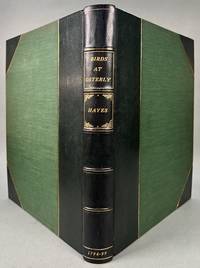
17948725<p>Two volumes in one. Bound in early twentieth century half green morocco over green cloth boards. Five raised bands with gilt particulars to spine. Top edge gilt. Marbled endpapers. From the library of H. Bradley Martin with his modest bookplate to front pastedown. Includes Sotheby's lot-bookmark from the famous sale. As is common this volume lacks the title preliminaries to volume two. Complete with 101 attractive hand colored full-page plates. Plate 19-26 35-36 and 83-86 are bound out of order. Other than Bradley's plate no previous owners' names or other defacements.</p> Printed by W. Bulmer and Co. and Published for the Authority by R. Faulder hardcover
1867000060Colebrook Connecticut CT 1867. On offer is a superb archive of 59 original manuscript multi-generational family of diaries spanning the civil war era through the early 20th century. The Carrington Family Diaries 1867 - 1913. All 59 diaries from members of the Carrington Family of Colebrook Connecticut. The patriarch Edward Sr. wife Sarah Ann Terry Carrington sons Edward C. Jr. died in the Civil War and Edwin T. and daughters Sarah and Kate. Edward Sr. died in 1878 and Sarah Ann Terry Carrington died in 1881. Both are buried in the Colebrook Center Cemetery in Colebrook Connecticut. Sarah Ann Terry Carrington mother was the daughter of Eliphalet Terry of New York. The group breaks down as follows: Sarah Terry matriarch wife of Edwin: 11 diaries: 1867 1868 1869 1870 1871 1872 1873 1874 1875 1876 1877. typical diary entries; Edward Carrington Snr father of Edwin: 8 diaries: 1857 1867 1868 1869 1870 1872 1873 1874. sporadic point form entries for the most part business like records of day to day business and some personal content.; Edward Carrington Jnr: 4 diaries: 1855 1855 1857 1860. typical diary entries of an obviously young man.; Katherine Carrington a daughter: 2 diaries: 1868 1872. typical diary entries. Edwin Carrington patriarch after Edward Snr: 34 diaries: 1875 1876 1878 1879 1880 1881 1883 1884 1885 1887 1888 1889 1890 1891 1892 1893 1894 1895 1896 1897 1898 1899 1900 1901 1903 1904 1906 1907 1908 1909 1910 1911 1912 1913. like the father sporadic at tmes point form entries for the most part business like records of day to day business interspersed with personal content. ADDITIONAL BACKGROUND: Lieut. Edward Carrington son was killed in the Civil War in St. Marks Florida in the Natural Bridge Conflict on March 6 1865 but the family did not get the news until March 22 1865. In 1871 the son Edwin was married to Charlotte nicknamed Lottie born April 9. 1847 and the couple moved to Scio NY. Edwin then moved to Bay City Michigan it appears in 1875. His wife and son Winny born in 1873 did not move with him to Michigan but rather stayed in Scio NY. Edwin traveled extensively on business by train and then in the later years by automobile and visited his family about every two months coupled with his business trips. Edwin was Secretary and Treasurer of the Bay City Building Company Rifle Room Company and Ausable Lumber Company in Michigan. Edwin and Lottie's son Winny died at the age of two years and eights months on 2/15/1876 and father did not make it home in time. A daughter Sarah was born in 1876; a son Eddy was born in 1877 and a daughter Gracie in 1882. Some of the earlier years have diaries from more than one member of the family. Edwin's diaries of 1875 - 1913 are both diaries as well as his business day planners. All have notations at the back of expenses and costs. As a hobby he enjoyed duck hunting. In 1901 Edwin and Lottie became grandparents by Sarah. The diaries mention both the deaths of Lincoln and McKinley. Several diaries have newspaper articles tucked at the back. One is an article about Mrs. Abraham Lincoln. There are two articles about how the Edward Carrington Sr. family made their "fortune" in 1874. THIS IS A SENSATIONAL AND UNIQUE MULTI GENERATIONAL FAMILY HISTORY THAT WOULD BE THE PRIDE AND CENTERPIECE OF ANY SERIOUS DIARY COLLECTOR. Good. 32mo - over 4" - 5" tall. Manuscript. unknown
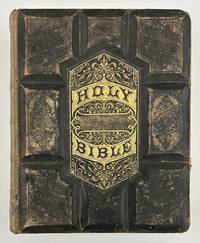
190512728Various locations in Maryland and Delaware 1905. Autobiography: 11a341pp. typescript carbon on yellow paper marked "COPY" at head of first page. Two pages with long corrected sections stapled to original leaves occasional emendations in type. Minor edge wear. Very good. Family Bible: various paginations plus numerous plates and with seven 19th-century photographs at rear in the "Family Portraits" section. Square folio. Original black leather and gutta percha stamped in gilt and blind. Some scuffing edge wear and soiling to boards. Occasional soiling and wear internally with some portions of text and portrait pages at rear chipped and/or detached. Rear hinge separated. Good condition. An amazing collection consisting of a carbon typescript of a previously unknown and unpublished autobiography a family Bible with manuscript notations and original photographs memorializing Howard Talbot Jason and his family. The Jasons were a prominent African American family in Maryland and Delaware in the 19th and 20th centuries whose members included prominent ministers physicians and educators. Howard Talbot Jason 1867-1955 was educated at the oldest HBCU in the country Pennsylvania's Lincoln University and worked as an educator Presbyterian missionary and minister.<br /> <br /> Much more will now be known about Howard Talbot Jason due to the present typescript autobiography. From contextual clues the work was evidently transcribed by his daughter Grace Jason Perry likely from Howard's handwritten original which may still reside within the Jason family or more likely has been lost to history. Howard's autobiography begins with his birth in Easton Maryland and some background information on his slave-born father William. Sadly Howard had "no particular remembrance" of his mother who died when he was six. He then details some events of his childhood his early working life as a waiter fisherman laborer and barber his education at "a school for colored boys not far from my town of Hockessin Delaware" and Lincoln University and his time serving as a missionary in Puerto Rico where among other things he experiences "Jim Crowism". In fact Howard's autobiography is mostly concerned with his time at Lincoln and his missionary work in Puerto Rico when his account concludes unfinished and in mid-sentence on page 34. A few notes from his daughter Grace are typed out on the last page as she has "not been able to figure out just where this belongs in Dad's autobiography." The work covers Howard Talbot Jason's life from birth to about 1905 constituting roughly the first half of his life. We know of no other extant copies of this autobiography though we cannot count out the possibility that other examples may reside with Jason family descendants. In any case the emergence of this work provides a phenomenal new understanding of an important African American figure in Maryland and Delaware.<br /> <br /> The autobiography is accompanied by an informative family Bible kept by various members of the prominent Jason family namely Howard Talbot Jason. The Bible was gifted to Howard Talbot Jason in 1894 by his father William Jason evidenced by the gift inscription on the front flyleaf. Three pages between the Old and New Testaments listing details of marriages births and deaths provide critical information on the Jason family beginning with the marriage of William Jason 1831-1929 and Mary E. Wing 1839-1873 on December 16 1858. Three other marriages are recorded between 1883 and 1894. The "Births" page records the birthdays of nine members of the Jason family between 1831 and 1872. The next page records the deaths of ten Jason family members between 1866 and 1955 the latter being the death of the aforementioned Howard Talbot Jason. The Jasons lived around Easton and Trappe Maryland and later in other locations in Delaware and Pennsylvania.<br /> <br /> In addition to the life details of the various Jason family members the Bible also houses seven 19th-century photographs in the rear. This includes six CDVs and one tintype featuring five men and two women almost certainly picturing Jason family members. Most are housed securely inside oval windows but two display photographic studio information both from Philadelphia photographers. One of the photographs seems to picture William C. Jason Sr. 1859-1943. He appears to be the most notable among the family members here. William C. Jason Sr. was a barber and printer in his youth then later a Methodist minister educator and second president of Delaware's State College for Colored Students now known as Delaware State University. He is also the namesake of Jason Beach a formerly-segregated stretch of recreational shoreline for African Americans located in Trap Pond State Park outside Laurel Delaware where there is a historical marker about him.<br /> <br /> The Bible was apparently retained by a member of the family after Howard Talbot Jason who provides an additional notation in more modern blue ballpoint ink beneath the original gift inscription stating that "Howard Talbot Jason also had three brothers named William Ernest and Alonzo." This same family member also laid in a note about various siblings of Lena Bertha Wright Jason dated in 1989 a substantial collection of her personal papers reside at Harvard. Family Bibles retained by African-American families in the 19th and 20th centuries are rarely encountered in the marketplace. And though marked as a copy it is possible even likely that the typescript of Howard Talbot Jason's life is a unique survival of an as-yet-unknown African American autobiography. unknown
1883Original with family inscriptions. Wooden Case. Very Good. Original wooden case for a brass set of scales used by Dr. David Townsend during the battle of Bunker Hill and other events requiring medical attention during and after the American Revolutionary War. unknown
16192607n.p. 1619. Early 17th-century account ledger of Giulio Cesare and Luco Spinola two brothers of the Genoese patrician family recording debts and credits over a period beginning in 1619 and ending in 1631. Information about individual debts is registered at the top of each page with ample blank space underneath for successive transactions relating to the debt. Other pages are filled with tables recording transactions in a given period of time pertaining to different debtors and creditors. Although the book was evidently begun in 1619 some of the entries record transactions dating back to 1599. The entries are written in a single neat hand which only occasionally turns into a hasty scrawl. Six loose leaves inserted into the pages contain records of transactions from 1599 to 1630. The brothers were evidently responsible for the finances of their mother Lamilla whose name appears frequently as well as their sisters. One of them Luiggia born Livia was in a convent while the other Benedetta had her dowry managed by her brother until her marriage to her cousin Paris Salvago. Reflecting the Spinola familys twin spheres of influence in Genoa and Naples both places appear in the transactions with somewhat more mentions of Naplesprobably an indication of the focus of Giulio Cesare and Lucos business interests and a plausible explanation for why their accounting ledger should be bound in such a splendid Spanish-Neapolitan binding. Folio manuscript 25 x 35 cm consisting of 119 numbered leaves and 70 blank leaves; 6 loose folded leaves. Contemporary black morocco wallet binding most likely Neapolitan or Spanish elaborately and densely tooled with original morocco reinforcements with decorative red stitching on lower edge i.e. spine; some minor worming and abrasion. Vellum title shows minor soiling and so do extremities of scattered leaves but generally in an excellent state of preservation. hardcover
141846N.p.: N.p. 1970. Archive of 16 photographs seven double weight and ten single weight of rock performers circa the late 1960s and early 1970s. Struck by photographer Jim Marshall circa 1990s most with his stamp and manuscript identification number on the verso. <br /> <br /> Artists represented include Bob Dylan The Rolling Stones The Who Bob Dylan Joni Mitchell Sly and the Family Stone Santana Jim Morrison Tina Turner The Allman Brothers Band including standalone shots of Duane Allman and others. The Santana photos are especially notable as the band already a live sensation is performing at Woodstock just ahead of the release their first album. <br /> <br /> As a photographer for both record labels and magazines such as "Rolling Stone" Jim Marshall was one of the most prolific and influential chronicles of rock music during the 1960s and 1970s. Among his most iconic photographs are images of Jimi Hendrix setting his guitar on fire at Monterey Pop Johnny Cash performing at San Quentin and The Beatles backstage at their final live concert at Candlestick Park. In 2014 he was posthumously awarded a Lifetime Achievement Grammy the only photographer to be so honored. <br /> <br /> Photographs variously 5 x 7 inches and 8 x 10 inches. Fine overall. <br /> <br /> For details please inquire. N.p. unknown
1800LD4931c. 1800. Hardcover. Very Good. Half brown cloth and morocco gilt-stamped lettering on spine; oblong Folio; with 15 signed pencil drawings on paper about 315x485 mm each mounted on heavy cardstock with caption handwritten in French in ink in lower margin of mount. Circa 1800 with hand-lettered title-page indicating that this collection was mounted and bound in 1930. Cloth blistered; drawing paper a bit toned with some faint foxing here and there. <br/><br/>These extraordinary historical scenes by Chatillon trace the births deaths marriages and battles of the Earls of Shrewsbury from the First Earl John Talbot 1390-1453 an important English military commander during the Hundred Years War to Francis Talbot 1623-1667 the 11th Earl who met his more scandalous end in a duel with the Second Duke of Buckingham. John Talbot distinguished himself for his bravery in battle and is believed to have fought alongside Henry IV in the famous Battle of Shrewsbury 1403 in which King Henry IV defeated a rebel army led by Henry "Hotspur" Percy from Northumberland. The battle serves as the climax for William Shakespeare's "Henry IV Part One" and John Talbot appears with speaking lines in "Henry VI Part One." The Countess of Auvergne remarks of him "Is this the scourge of France / Is this the Talbot so much feared abroad / That with his name the mothers still their babes" The Battle of Shrewsbury is also the first in which English archers fought each other on English soil and archers are featured in the battle scenes illustrated here -- alongside armored horses waving flags the stern expressions of the valiant and the agonized faces of the wounded. The scope and intricacy of these drawings is difficult to capture with language -- no detail is left unrecorded from the coat of arms on a shield to the embroidery on a wedding dress the vaulted arches of a church the sinews of dog the teeth of horse gnashing its bit. A must-see please inquire for images or a complete list of captions. hardcover
030029No Binding. Very Good. Large archival collection consisting of: 2273 letters 5636 pages plus 16 diaries and 9 banker's boxes approximately 11 linear feet of ephemeral materials all dated 1898-1990 the bulk from 1920s-1960s. The correspondence centers on Phyllis Hart Clark and her family. There are 623 letters written by Phyllis mostly retained copies and 647 incoming letters. Her husband Raymond G. Clark writes and receives 201 letters. As a couple Phyllis and Raymond receive 450 letters and their son Philip writes and receives 293 letters. The ephemera includes several thousand pieces including folders of typed and manuscript notes brochures circulars handouts pamphlets postcards telegrams etc. all dated 1930s to 1980s for further description see below. <br/> <br/> unknown
31017Six photograph albums with 894 photographs with several related ephemeral items documenting the lives and travels of this Philadelphia family in the first quarter of the 20th century. The Firth family was a prominent Philadelphia family which had married into another one the Livezey's whose seat was their estate Glen Fern in Germantown. Thomas Livezey was a miller and friend of Benjamin Franklin and large property owner. The Livezey family sold much of their estate in the 19th century to the city of Philadelphia and it became Fairmount Park. The Firth Family lived in a palatial mansion on Allen's Lane before moving to the Eastern Shore of Maryland in the 1930s.1. Album documenting a month-long Hunting Trip on the Upper Yellowstone and in the mountains of Wyoming September – October 1908 by Thomas T. FirthOblong small quarto 62 photographs measuring 3 â… x 5 â…ž inches mounted on 49 black paper leaves binding worn and scuffed else very good. Photographs identified in white ink and include views of the mountains encampments game views of Cody Wyoming Cody Dam under construction party members etc.2. Photograph Album Documenting Hunting Trip to New Brunswick Canada 1913 including Images of Native American GuidesOblong quarto 55 photographs measuring 3 â… x 5 â…ž inches mounted on 49 black paper leaves bound in original flexible embossed binding images identified and dated in white ink in very good condition. Includes images of hunting camps and cabins in the woods of northern New Brunswick north of Newcastle and Miramichi game caribou moose Native American Guides etc.3. Photograph Album Documenting Motoring Trips to Maryland Virginia New Jersey Pennsylvania and Life in Germantown and the Wissahickon Valley Philadelphia 1918-1919Oblong small quarto containing 200 small snapshots mounted on 50 black paper leaves most subjects identified in white ink bound in original flexible embossed wraps string tie some chipping to edges of leaves else very good. 4. Photograph Album Documenting Family Motoring Trips to Florida New Jersey The Pocono Mountains and the Adirondacks 1919-1920Oblong small quarto containing 329 snapshots mounted on 48 black paper leaves most images identified and dated in white ink bound in original flexible paper wraps string tie missing binding worn some chipping to edges and extremities of several leaves else very good.5. Photograph Album Documenting a Hunting Trip in Northern Ontario Canada north of Opasatika Ontario and South of James Bay 1921Oblong quarto 87 photographs measuring between 2 â…› x 5 â…œ inches and 9 x 7 â… inches on 41 black paper leaves identified in white ink several related ephemeral items mounted and laid in bound in original cloth covered flexible wrappers string tie several leaves detached and chipped at edges and extremities else in very good condition.Trip taken by Thomas Firth and C. R. Firth images document the party views of Cochrane Ontario the woods Native American Guides the game shot etc. 6. Album Documenting a Trip to Florida in their boat the "Osprey" 1922 and 1923Oblong quarto containing 161 photographs mounted on 47 black paper leaves bound in original flexible embossed boards string tie missing some related ephemera laid in some chipping to edges and extremities of leaves else very good. The route to Florida went via the Dismal Swamp Canal from Norfolk to Albemarle Sound with stops in Beaufort North Carolina Cleveland Florida Captiva Boca Grande Useppa Island Sanibel Fort Myers Marco etc. and the album includes views of all these locations
1962419856Frankenforst Regensburg Lindenhof Freiburg Munster Lübberstedt Germany / Rigi-Kulma Rigi-Kaltbad Switzerland 1962. Hardcover. Very Good. Five albums ranging from quarto to folio photo albums measuring between 10.5†x 8†and 15†x 8â€. Tan flexible paper boards black leather boards with gilt page edges string tied red patterned cloth boards orange leather boards with gilt decorations and one foldout album with green three quarter cloth and marbled paper boards. Contains a total of 490 black and white sepia cyanotype or color photographs measuring between 2†x 1†and 10†x 7†with some captions written in German. Other ephemera includes newspaper clippings and 22 postcards. All albums have lightly bumped corners and spine ends with small tears thus very good with near fine or better photographs.<br /> <br /> An archive of a German family’s photo albums from 1913 to 1962 with each album focused on a different decade or theme. Most of the albums are focused on different parts of the family traveling to places around Germany and one album is specifically dedicated to a young woman’s equestrian tournaments.<br /> <br /> One of the albums is centered on a couple traveling in and around Germany from 1929 through 1932. Each picture is labeled with their destinations including Frankenforst Regensburg Lindenhof Freiburg Munster and among others. Included are pictures of landscapes rivers bridges parks churches and cemeteries with several pictures of the couple standing together smiling or embracing each other. A couple photographs feature a zeppelin flying above them out in the countryside. There are also pictures of the couple at the beach and in a garden with their children including a daughter named “Lore.†<br /> <br /> Another album is filled with photographs handwritten entries and newspaper clippings surrounding Uschi Schaemann and her horse Mario competing in various tournaments from 1958 through 1962. Uschi’s riding name was “Madness.†The album opens up with the date “Christmas Saturday December 24th by Mario and Uschi.†The newspaper clippings are often of Uschi riding Mario and sometimes include the place they won at the tournaments often coming in first through fifth place. Uschi’s written entries in the album are meant to be read as if Mario wrote it “Prayer of a horse! Always take care of me even if I am now more old. Give me always a clean camp and a wide box. Treat and care me well! Say a lot to me - and I will love you more and more.†She fills the first several pages with how grateful her horse is to be with her “Let me beg of you and God will be worth thee for beside me was created also and I am grateful that I could live a part of my horse life with you. And my last and only wish is that it always remains so and that I may be allowed up to my last breath with you.†<br /> <br /> Two of the older albums circa late 19th century and early 20th century show a family living in the country often visiting the beach with large wicker chairs. One of the two older albums contains more postcards from Rigi-Kulma and Rigi-Kaltbad in Switzerland with some pictures from the family’s vacation there. The pictures show the snowy landscape with large mountains and small settlements. There are also several pictures placed together to show a panoramic view of the countryside in both Germany and Switzerland. <br /> <br /> There is a foldable album cover with photographs affixed to loose thick papers inside. The album is titled “Lübberstedt†after a town located in Germany. The album contains photographs of the village featuring one of the larger homes the family lived in the forests around Lübberstedt and of certain family members wearing military uniforms from World War I. <br /> <br /> An extensive collection of photo albums with carefully taken and chosen images detailing five decades of a German family’s adventures and home life. hardcover
1224171992. Stockton: 1992. <br /> <br /> Two boxes large 4to 12 1/2 x 11 ins. containing 51 reproductions from original daguerreotypes ambrotypes tintypes and other formats mounted and preserved in mylar sleeves. In perfect condition contained in red cloth boxes. <br /> <br /> § Only edition of these fine reproductions of some of the rarest early material about Stockton and its founding families. This set is one of five sets made for the Cole family and copy #3 of 22 sets in all; Geraldine Cole was a direct descendant of Capt. Weber. The other four sets have been retained by the family. Loosely inserted are descriptive text leaves by Prof. Daniel Kasser and others about the importance of the collection. "It represents a rare nearly unique vision of facets from a family album. To the City of Stockton and the State of California they represent a regional treasure. Unique in and to their time many of these images qualify as national treasures." Kasser. In all a complete set of the material including the 6 supplementary leaves of text errata etc. unknown
1750ABC_46340The Netherlands 1750. Oblong 8vo ca. 10.5 x 16 cm. 18th-century gold-tooled calf gold-tooled spine each board with a double-fillet frame a centrepiece and four cornerpieces gilt edges green cloth ties. Manuscript on paper written in brown and black ink in several - 17th- 18th- and 19th-century hands. With a full-page unidentified coat-of-arms showing three salamanders drawn in brown ink and a page containing 6 smaller crests of branches of the Roorda family in black ink. 1 blank 5 3 blank 20 1 blank 1 78 blank ll. Manuscript family chronicle incorporating multiple chronicles from the 17th and 18th century. The manuscript chronicles the births and deaths of four generations of the Bos Werdolen or Verdole and Roda family in Amersfoort Groningen The Hague Scheveningen IJsselstijn Tiel Deventer Kampen Zuilen and Edam. The book was probably compiled by Dirk Daniel Roda 1726-1898 a lieutenant in the infantry and later beer brewer shortly after the death of his father in 1747. It incorporates chronicles by his father Michiel Roda 1686-1747 his maternal grandfather Jacob Werdolen chronicling 1668-1686 Jacob Werdolen's father Hendrik van Werdolen a note from 1639 and a copy by Hendrik's wife Barbera Bos born 1596 of the chronicle written by her father chronicling 1577-1601.The different chronicles are interleaved with notes by Dirk Daniel Roda which supply additional biographical information. In several pages he describes the his own Roorda ancestors in the 17th century and the process by which they changed their name to Roda. Other notes chronicle the origins of the Roorda family crest of which he has drawn the known six versions. A full-page coat-of-arms containing three salamanders was possibly drawn by Barbera Bos. Although this specific crest could not be identified it probably refers to a branch other than "Bos" meaning forest or wood in her family.With the bookplate of Eltjo Aldegondus van Beresteyn 1876-1948 on the front paste-down. Also with his library label on the front board. Van Beresteyn was very interested in genealogy explaining his possession of the present family chronicle and founded the Centraal Bureau voor Genealogie CBG. A pencil inscription on the second to last leaf notes that the book was bought from H. Coffrie in 1938.Binding somewhat worn and rubbed leather on the spine somewhat cracked and with a few minor gaps paste-downs slightly browned some occasional spotting browning and soiling but overall in good condition. A fascinating family chronicle with a very interesting provenance.l For Van Beresteyn: J.A.A. Bervoets 'Beresteijn jhr. Eltjo Aldegondus van 1876-1948' in: Biografisch Woordenboek van Nederland online source. hardcover
1776168426Paris : Chez la veuve Ballard & Fils Imprimeurs-Libraires du Roi 1776. First Edition. Hardback. Full contemporary tree calf very good. Professionally and period sympathetically re-backed with raised bands and the title blocked direct in gilt; very impressively finished. Generalized wear to the board extremities. Armorial motif in gilt to the frontpanel. Remains particularly well-preserved overall; tight bright clean and strong.; 8vo 8"" - 9"" tall; 472 pages; Series; Supplement de L'Histoire Genealogique et chronologique des grands officiers de la Couronne v.2. Notes: Title vignette head and tail pieces. Subjects; France - Genealogy - Military affairs - 18th century. Large folio. Paris : Chez la veuve Ballard & Fils, Imprimeurs-Libraires du Roi hardcover
1593UC BerkeleyLick Observatory Massive Archive of the Family of Edward Singleton Holden Including Letters Photographs Family Memoir and Printed Material 1880’s-1960’s<br /> <br /> Collection includes over 800 photographs over 330 manuscript letters plus a variety of printed material and family ephemera. The letters generally are in very good condition with the exception of maybe 10% of them which apparently were nibbled on by critters with some loss of content. Despite this the majority are intact and fully legible. The photos and albums range from very good to poor condition. Perhaps 50% of the photo material received ill-suited non-archival taping which is now brittle and yellow. Many of the photos and albums are annotated. The photo albums are mostly 20th century and appear to be from Edward Holden's daughters Mabel and Mildred. <br /> <br /> Edward Singleton Holden 1846-1914 was an American astronomer fifth president of the University of California and first director of the Lick Observatory. In 1901 he became the librarian of the United States Military Academy at West Point where he remained until his death.<br /> <br /> In 1873 he became professor of mathematics at the US Naval Observatory where he made a favorable impression on Simon Newcomb. On August 28 1877 a few days after Asaph Hall discovered the moons of Mars Deimos and Phobos he claimed to have found a third satellite of Mars. Further analysis showed large mistakes in his observations. He was director of Washburn Observatory at the University of Wisconsin–Madison from 1881 to 1885. He was elected a member of the American National Academy of Sciences in 1885. He discovered a total of 22 NGC objects New General Catalogue of Nebulae and Clusters of Stars abbreviated NGC during his work at Washburn Observatory.<br /> <br /> He was the fifth president of the University of California from 1885 until 1888 and the first director of the Lick Observatory from 1888 until the end of 1897. He resigned as a result of internal dissent over his management among his subordinates. While at the Lick Observatory he was the founder of the Astronomical Society of the Pacific and its first president 1889–1891.<br /> <br /> Edward Singleton Holden was the son of Jeremiah Fenno and Sarah F Singleton Holden of St. Louis. Missouri. Edward would marry Mary Chauvenet in 1871. Mary was the daughter of William Chauvenet a professor of mathematics astronomy navigation and surveying who was instrumental in the establishment of the U.S. Naval Academy at Annapolis Maryland and later the second chancellor of Washington University in St. Louis. Together Edward and Mary would have four children including William who died at birth Mabel 1873-1961 Mildred 1875-1932 and Edward Ned 1877-1956.<br /> <br /> In 1880 Edward and Mary would separate leaving Mary to raise the three children living with her mother and their grandmother Catherine in St. Louis. Mary's father passed away in 1870. This separation unusual for the time colors many of the letters in this archive and is highlighted in Mabel's typed memoir. "Between utter loyalty to my mother whom I adored and my father whose brilliant intellect and fascination and great scholarship drew me to him while at the same time he deserted me and never asked me to be his all again.I was aghast at the life of agony in my mother's heart for she never ceased to love my father." Later prior to one of Edward's business trips to the east Mabel requests he visit "No I will not come! I am convinced that I do not ever want to see your mother again and so I cannot come to see you."<br /> <br /> This tension between Mabel and her father manifests itself in the many letters he wrote Mabel's sister Mildred. Many times Edward would ask Mildred about Mabel or request Mildred pass letters on to Mabel likely indicating an estrangement. Similarly Mildred was a conduit for her father to her little brother Ned whom Edward felt was lazy and unmotivated. <br /> <br /> Throughout the several hundred letters from Edward Singleton to Mildred we sense the sternness of a parent with parental pride of her accomplishments. He rarely lets us with fatherly advice and suggestions on how she live her life. "at any rate you will make a mistake if you run counter to what I ask you in this masterful fashion." <br /> <br /> The archive includes a number of genealogical documents with Holden emphasizing how important good social standing is. He insists in a series of letters that both Mabel and Mildred join the Massachusetts Society of Colonial Dames "recollect that membership in this society makes you at once accepted by the very people in America." 'I find Mabel is much too lax about this indispensable mark of good breeding & you must not be." The archive also contains Holden's application for membership into the California Society of the Sons of the American Revolution.<br /> <br /> Money or the lack thereof is a constant refrain in Edward's letters. He often apologizes for not providing better for his children. Holden was a prolific author and held appointments as UC Berkeley President and Director of Lick Observatory but was always complaining about money. In a February 1899 letter "I have not been idle a moment--but the pay waits until the publication. I want you to understand this--& to know that it is not my fault I have not been appointed to two good places with salaries & shall not try for any more such places. I am tired of fighting slanders 20 years old. It's a pity that the effect of them has to be felt by your girls--but so it is."<br /> <br /> In a note dated October 1901 Holden writes to Mildred "I've been appointed at West Point in chg. of library & have accepted." Holden's career was filled with controversy and disappointment. For more on his career see "Rise and Fall of Edward S. Holden" by Donald Osterbrock published in 1984 in the Journal of Astronomy.<br /> <br /> We find relatively little about Edward Singleton Holden's private life with few mentions of friends and no romantic clues. One curiosity arises from January 7 1895 when Holden writes "I shall soon go to spend a while with my old friend Mrs. Jessie Benton Fremont in Los Angeles. I'm not very well & this change is good for me." Fremont 22 years his senior was living on a widow's pension granted by Congress after her husband John C. Fremont died in 1890. <br /> <br /> Archive Includes the following:<br /> <br /> --Photo albums with 800 pictures in range from the 1880s to 1960s.<br /> --A typed manuscript 88 pages from Edward Singleton Holden's daughter Mabel detailing their relationship and his estrangement from his family the loss of her daughter and the end of her life.<br /> --18 letters and other documents all from the astronomer Edward Singleton Holden dealing with his time as a member of several committees at the US Naval Academy in the 1890s. There are several handwritten documents from him and a number of documents signed by various Naval officers and more. There is interesting content throughout.<br /> --128 handwritten and signed letters from Edward Singleton Holden to his daughter Mildred. They are from the 1890s and are all written from Mount Hamilton at the Lick Observatory at the University of California. They have good personal content and are in mostly good condition. Many of the letters are quite long.<br /> --140 letters to Edward Singleton Holden and his family. These letters are from family and some well-known people to him and his daughters from the 1890s into the 1910s. Some of the authors of the letters include:<br /> <br /> Alfred Elliott Bates<br /> Arthur Twining Hadley<br /> Carl William Ackerman<br /> Charles Doolittle Walcott<br /> Clarence Cary<br /> Fitzroy Carrington 2<br /> George Brinton McClellan Jr<br /> George Lewis Gillespie Jr<br /> George Platt Brett Sr<br /> John Shaw Billings<br /> Joseph Roswell Hawley<br /> Nicholas Murray Butler 2<br /> Peter Smith Michie USMA<br /> Rossiter Johnson 2<br /> Talcott Williams 3<br /> --Antique address book. There are many entries as well as blank pages included inside.<br /> --Signed handwritten letters to Edward Singleton Holden including sympathy cards received after his death from various people in politics and military.<br /> --Mabel Randall-MacIver Mabel Holden Autobiographical Collection: Diary notes 10 pages on legal size paper Autobiographical notes 24 pages on legal size paper Autobiographical notes 8 pages dated July 12th 1946 Autobiographical notes 111 pages dated from November 5th 1949 to July 8th 1951 Autobiographical notes 10 pages dated April 1952.<br /> --Fontainebleau Alumni Bulletin April 1952 Complete issue with an article and picture of Mabel Randall-MacIver on the front page. Partial text from the article reads: "This is only a very small part of the story of Mrs. David Randall-MacIver. Her life filled with so many interesting events from childhood to this very day would fill volumes. It is hoped that she will find some time to devote to her autobiography."<br /> --Records of Mabel Randall-MacIver: History of Edward Singleton Holden letter 11 Pages dated October 7th 1952 sent from the War Department Library U.S. Military Academy West Point N.Y. - Details of his professional educational and personal accomplishments.<br /> --Letter 1 page dated December 22nd 1958. Correspondence sent from Bryn Mawr College President's Office regarding that there are no pictures available of the memorial to Story Kirkbride given by the class of 1922.<br /> --Letter 2 pages dated May 17th 1961: Holden family genealogy details.<br /> --34 manuscript letters from Catherine Chauvenet mostly to granddaughter Mildred <br /> --Handwritten obituary of David Randell Maclver the British-born archaeologist. He is most famous for his excavations at Great Zimbabwe which provided the first solid evidence that the site as built by the Shona people. Also he was an intelligence officer for the American military during WWI and during WWII assisted the US army to preserve historical monuments in Europe.<br /> --Letters to Maclver's wife expressing condolences for her loss.<br /> --Sympathy letters written to Natalie Tuttle Martin expressing condolences for loss of Mabel/ Mildred Holden-Maclvers<br /> --Letter 2 pages dated November 1946 with 97 signatures: National Conservatory of Music and Declamation November 1946 Paris. 'The students of the Conservatory would like to thank the American Mutual Aid to Artists for all the good that has been done to them. They are deeply touched and grateful and will never forget what Americans do for them in hard times.'<br /> --3 Vintage Andrea Del Sarto Drawings #8 #58 #63<br /> --1 Vintage Michelangelo Drawing #32<br /> --1 Vintage Sandro Botticelli Drawing #52<br /> <br /> A deep dive into the family of influential scientist and writer Edward Singleton Holden. This archive has been privately held by heirs of Edward Singleton Holden and none to our knowledge have been available for scholarship. unknown
31319<p>The collection contains 126 letters 377 manuscript pages 7 manuscript essays 19 pages and one Christmas card sent to his Westall cousins by Thomas Wolfe manuscript sentiment in his hand. The collection also includes over 165 Westall – Justice family photographs from the 1880's – 1940s including carte-de-visite cabinet cards boudoir cards snapshots large format studio portraits as well as press photographs. The bulk of the images have been identified by a Westall family member in ink on the verso of the images identifying the sitters. The collection includes 60 related ephemeral items.</p><p>The correspondence comprises the courtship letters of William Harrison Westall and Emily I. "Pink" Justice. The collection also includes letters to Emily from family members and other suitors. Westall and Justice were both born in Swannanoa North Carolina but at the time of their courtship were both living in Asheville. Westall was working and Justice was a student at Asheville Female College. Westall would become the maternal uncle of the novelist Thomas Wolfe and like his older sister Julia Wolfe's mother displayed similar traits of character. He was confident assertive determined persistent and a bit obsessive. Westall faced opposition from Emily's parents in his courtship in part due to some of these traits. Emily's parents at one point sent her away to visit relatives in Tennessee and effectively banned Westall from their home shortly before their marriage. All of this only served to increase Westall's determination to succeed in his suit. Another source of friction between the young couple was the number of additional "sweethearts" and suitors interested in Emily's attentions.</p><p>William Harrison Westall was born May 16 1863 in Swannanoa Buncombe County North Carolina. He was the sixth of eleven children Henry Addison Sam Sally Julia Elizabeth Westall Wolfe1 – the mother of Thomas Wolfe American author William Harrison Lee Mary Crockett Elmer and Greely born to Martha Anne Penland and Thomas Casey Westall a farmer and builder. On both sides he was descended from pioneer families of western North Carolina. He married Emily I. Justice 1863-1942 of Buncombe County North Carolina. The couple had at least two sons. William Harrison Westall ran a successful building supply and lumber company and helped supply the raw materials during Asheville North Carolina's growth from the early 1880's through the early 20th century after the arrival of the Western North Carolina Railroad. William H. Westall even supplied materials to Biltmore in Asheville. Westall's older brother James Manassas Westall 1861-1943 was a prominent building contractor in Asheville during this period.</p><p>1. Julia Elizabeth Westall Wolfe 1860-1945 the mother of Thomas Wolfe was born on a farm in Swannanoa nine miles east of Asheville. The fourth of eleven children of Martha Anne Penland and Thomas Casey Westall a farmer and builder. She was educated at Judson College in Hendersonville she taught school for a time but stopped when she married William Oliver Wolfe on January 14 1885.</p><p>The couple resided in Asheville where their eight children were born: Leslie 1885-86; Effie Nelson Gambrell 1887-1950; Frank C. 188-1956; Mabel Wheaton 1890-1958; twins Grover Cleveland 1892-1904 and Benjamin Cleveland 1892 -1918; Frederick William 1894-1980; and Thomas Clayton 1900-1938.</p><p>In 1906 Mrs. Wolfe bought for $ 6500 a boardinghouse at 48 Spruce Street which she operated until her death. The house was called the Old Kentucky Home by its former owner it was the Dixieland of <em>Look Homeward Angel</em> and <em>Of Time and the River</em>. The house was purchased by the State of North Carolina in 1975 as a historic site it was then opened to the public as the Thomas Wolfe Memorial.</p><p>In his novels Wolfe provided a largely autobiographical account of his family's life from the turn of the century on. Julia Wolfe became the fictional Eliza Gant a small compact and persevering woman determined to keep her family together and manage fer boarding house in spite of marital discord and tragedies such as the deaths of her sons Grover and Ben. An able talker with a remarkable memory she provided her son with much raw material for his novels and short stories Her talents in business not only in running the boardinghouse but also in real estate purchases and sales eld to the family's relative affluence; thus Thomas was able to attend a private preparatory school and the University of North Carolina.</p><p>After her husband's death Mrs. Wolfe continued her business interests and was able to provide financial aid for her son then teaching at New York University and traveling in Europe. When she lost much of her capital in the Florida real estate crash of the 1920s which was followed by the great depression in Asheville she had to depend mainly on her boardinghouse for income. As he son's books became famous she in turn became noted as the real-life matriarch of the fictional Gants. From the early 1930s onward her boardinghouse drew literary pilgrims to Asheville.</p><p>A close bond existed between Julia Wolfe and her son Thomas from childhood until his death and some commentators have traced similar traits of character such as a prodigious memory ambition verbal power and determination. Their correspondence which spanned thirty years illumines one of the most moving mother-son relationships in American literary history. Always a champion of her son's writing Mrs. Wolfe became ever more so after his death. She often traveled to various parts of the country giving informal talks on his early life and influences. She was buried in the family plot at Asheville's Riverside Cemetery.</p><p>https://www.ncpedia.org/biography/wolfe-julia-elizabeth</p><p>Sample Quotes:</p><p>"Swannanoa N.C. Aug. 9th 1881 to Emily I. Justice Asheville NC</p><p>"Miss Pink</p><p>… I thought I would write you a few lines this morning … Miss Adina has been up for a week she is going home in the morning we had preaching last night at the Depot I would like to know if you ar still in the notion of going to Flatcreek campmeeting. There were a party talking of going to Black mountain this week but they gave out the idea we will all go in September I want you to go I enjoyed the picnic very much I think that I will come to Beaver dam church before very long I want you to let me know when there will be preaching Herre … T.E.W."</p><p>"Oct. 12th 1882 Asheville</p><p>Dearest Emily</p><p>It is with feelings of real pleasure that I take up my pen to write you a few lines. It is a privilege for which I feel very much under obligations to you for being so kind as to grant me. I shall take much pleasure in being able to communicate to you my secret thoughts & desires hopes & joys pleasures & expectations and in short I shall burden you with all that I could wish a <u>very dear friend</u> to know. I anticipate much pleasure from our correspondence & shall do my best to make it agreeable to you. I have long felt a deeper interest in you than you have any idea of. I anticipate with pleasure the day when I can feel assured that you <u>do</u> hold an interest in my future welfare & happiness. How much regard I have for you you do not know. It is not in my nature to express much of my real feelings. I may entertain a <u>very</u> high opinion of an individual but I am not the one to express it unequivocally. It is contrary to my nature temperament and disposition and I can no more rebel against these than swim against the cataract of Niagara. Emily you and I have long been friends in the common acceptance of the term "friend" but may I express the fond hope that our friendship may be placed on a higher nobler plane than it ever was before. May I always hope <u>we</u> may be friends in the most aesthetic sense of the term and not simply what the vulgar unthinking world terms friends. <u>We</u> will know each other; <u>We</u> will understand each other even if the outside world considers us as merely acquaintances. I have my faith in life to carve out myself' I have to attain success by my own efforts; My bark drifts lonely on the the turbid waters of life's rapid deeprolling currents with only me to send up heartfelt wishes for its success in the perilous voyage of life with only me to shed a silent heart rendering tear should it meet its destruction amidst the shoals & breakers which ever surround weak mortals in this voyage. I say "only me" because in the seeming friends of earth can be placed but little reliance. May I hope that in this ocean of life I may have one in whom I can place the utmost confidence in whose faith I can have the most unbounded reliance to whom I can turn when clouds overcast my path & all seems dark & dreary when the world casts a frowning glance upon me and hear her sympathizing voice in accents gentle and sweet bid me look upward and onward … Darling I love you! Why need I seek to hide it longer … Remember our promise to each other not to show our letters to any one. Be sure & keep it I will. . H"</p><p>"Bakersville N.C. Dec. 27th 82</p><p>Dearest Pink</p><p>I don't know that you care much about hearing from me but I want to hear from you and although I may be in Asheville before very long don't want you to forget me entirely while I am away… I left A Thursday morning took dinner with my sister in Marion and started home that afternoon. Something was going on nearly every night – when I was here before but have not enjoyed it much this time. Skated a little one or two days ago and went to a party last night and had the exquisite pleasure once more of running against a sewing machine agent – "It was said" as the legends go that those awful fellows were so thick here once that a tree fell on a windy day and killed <u>fourteen</u>. That thinned them out a good deal but enough are left to be in the way of <u>organ agents</u>. I sold one organ the day before leaving Asheville and Prof Folk who is working with me sold one …</p><p>Father is going to build a printing office soon and has made arrangements to publish a Free Will Baptist paper for the Free Will Baptist association in connection with the one he already publishes … Bradley S. Worthen"</p><p>'Asheville N.C. March 16thm 1883</p><p>Miss Pink</p><p>There will be an entertainment or a show in the Opera Hall at the Court House to night and if the weather is favorably sic and you would like to go; I would be pleased to accompany you there. And if you can go I will call by for you at seven o'clock … Wm. H. Westall"</p><p>"Asheville N.C. Aug. 1st 1883</p><p>Miss Pink</p><p>Dearest One you may be <u>greatly</u> surprised by getting this letter and it <u>will not</u> be anything <u>very</u> strange if you <u>should</u> be surprised. Your refusing to kiss me good night has <u>caused me</u> to <u>suffer greatly</u>.</p><p>Oh! I am feeling so <u>badly</u> I <u>can not</u> sleep a <u>wink</u> to night and as the clock strikes one my mind is like a ship on a stormy sea tossing reeling and blown about by a wind of disappointment; I <u>say</u> disappointment because it was a <u>great</u> disappointment to me in bidding you good-night <u>without</u> <u>a kiss</u> as I have had a kiss nearly <u>every time</u> of late when parting with Miss Pink.</p><p>I am one <u>who honestly truthfully</u> and <u>candidly</u> love you and you have said that you <u>loved me</u>; told me <u>not once nor twice but a great many times</u> that you<u> surely</u> loved me and <u>no one else</u> and that I was the <u>only</u> one that you <u>ever did</u> love well I believed that you did think and do think yet a great deal of me and perhaps did about <u>half-way</u> love me but <u>refusing</u> to <u>kiss me</u> when there was no excuse at all: twelve o'clock at night; when there was no one about; is very plain proof <u>that you do not think so much of me</u>.</p><p>I do not know why it is that I have fallen so <u>deeply</u> in love with you when you as it seems to me <u>can not</u> love me. You are waring a ring as an "engagement ring" and <u>then</u> you refuse to kiss me; one who you claim to be engaged to and one who you say that you love <u>what is the matter</u></p><p>Now Miss Pink: I <u>truly</u> and <u>honestly</u> love you God being my judge and it makes me feel very bad to think that you do not care so much for me.</p><p>May you prove to me that you do think a great-deal of me and I hope you will <u>never</u> refuse to kiss me again on an occasion like tonight when there was no excuse <u>only that you did not want to</u>. Wy did you <u>ever </u>kiss me Was it because I <u>asked</u> and <u>insisted</u> on it Or was it because you was kissing one who you loved</p><p>People sometimes kiss others who they <u>do not love</u> but I do not believe that <u>any</u> young lady ought <u>ever</u> to kiss a young man who she <u>does not love</u> but a young lady kissing a young man who she <u>truly loves</u> I don't think there is <u>anything</u> wrong in it.</p><p>I never heard of a young lady <u>refusing</u> to kiss one she loves when there was no excuse for not doing so and you refusing to kiss me under the circumstances tonight <u>puzzles</u> me <u>very much</u> and I would like to have the <u>puzzle</u> unraveled.</p><p>I am sure there would not be any<u> harm</u> in you kissing me; even if you <u>do not</u> love me for I can assure you that <u>no one</u> will ever know it by me telling them and as far as <u>anything</u> else is concerned you need <u>never </u>have any fear if I <u>know</u> myself.</p><p>I of course will come again tomorrow night as I agreed and if you should not get this letter before then perhaps I will not mention this subject or anything in regard to you refusing to kiss me but whenever you do get this letter answer me either by letter or personal conversation. For I want a reconing sic soon in regard to your manners towards me for the last two or three weeks you <u>never</u> refused to kiss me since you first kiss me until of late so there seems to be <u>something</u> rong sic <u>somewhere</u> and I would like to <u>know</u> where it is and <u>what it is</u>.</p><p>Please excuse this letter for I am feeling so very badly that it is <u>nearly utterly</u> impossible for me to write anything in a systematic or in a grammatical style.</p><p>I will still add a few more lines; saying I <u>can not</u> believe that you know how <u>much</u> I <u>love you</u> or you would not treat me as you have. If it was possible for me to <u>express</u> <u>by words</u> <u>how much</u> I love you I would <u>gladly</u> do so but there is not <u>words in the</u> English language by which I could express my love for you.</p><p>Ever since I had the <u>pleasure</u> of meeting you there has been a <u>fire</u> of <u>love</u> kindled in my <u>heart</u> and it has been burning <u>slowly continuously</u> and <u>warmly</u> <u>ever</u> since and all that is lacking to make it an <u>unceasing</u> and <u>everlasting</u> <u>flame</u> to burn <u>forever</u> is a little breeze of love from your heart; and may you <u>soon</u> send<u> that</u> breeze of <u>true love</u> so that it may ease my <u>aching heart</u>.</p><p>Hoping that you may explain how you feel in regard to what I have said I will close by saying be careful to never let any one get their fingers on this letter. The clock has struck two in the morning and I to bed must go. … W. H. Westall"</p><p>"Asheville N.C. Sept. 29th 1883</p><p><u>Dearest One </u>-</p><p>I thought I would write you a few lines as I am going to Morganton this evening and perhaps will not get back until Tuesday next. I would so much like to have you go with me but I suppose you would not like to go so far alone with me; as you are so much afraid of people talking about you going trips with me alone; and as we would be gone three or four days. But I <u>certainly</u> would like to have you go with me as I shall not enjoy the trip without your company.</p><p>I hope you will enjoy yourself Sunday if I am so far away from you.</p><p>It is like pulling eye teeth to me to be absent from you <u>just one</u> Sunday if I am with you <u>so much</u> during the week.</p><p>I don't wish you any harm but I do wish it would go as hard with you to spend one Sunday without being with me. as it <u>dose</u> sic go hard with me; In other words I wish you <u>loved</u> me as I do you and then you would take it very hard to spend one Sunday without being with me.</p><p>You may think you do love me as much or more than I do you but I think you are mistaken though it may be so but I think it hardly possible. If I should not get back Tuesday I will write you and let you know about it … W. H.W."</p><p>"Asheville N.C. January 3d 1884</p><p><u>Loved One</u>:-</p><p>May I ask you to neither get offended nor vexed at the insanity shown in my frequent letters. I have a <u>reason</u> for writing <u>this</u> one as well as for <u>all </u>I have written you.</p><p>The object of this letter is to tell you my dream of last night. It was about you of course; and as all of my daily thoughts are of you so are my dreams. I will just state the particulars of the dream for if I should try to teel it all it would take a great deal of paper and sometime to tell it …</p><p>First; I thought you came to see me purposely to explain to me for the way you had treated me while I was sick; I thought you explained everything satisfactory; but I told you that in all our court-ship I never had been led to believe you truly loved me I doubted your sincerity; I thought you then looked me in the face tears came into your eyes rolled down your sweet cheeks and that you throwed your arms around my neck kissed me and said: "God being my judge I love you truly and I am yours until death shall part us; love me else I die."</p><p>O! darling; though it was a dream you cannot imagine the inexpressible ease of mind and of heart there was when in that dream I saw the tears gushing from your eyes something I never saw since I have known you and when I thought you whispered in my ear "I love thee truly; love me else I die. O Dear; I can see your lovely form in my imagination before me now just as I saw you in the dream. The sadest thing of the dream is it has added greatly to my misery and suffering; The dream was to me: "Misery of Hell changed to the Happiness of Heaven" When I woke and found it all a dream the happiness of the moment vanished.</p><p>O if I could only be convinced in reality that you loved me in truth as strongly as I was in the dream then I would be more satisfied than I am.</p><p>I am always saying that I am rendered so unhappy by my unbelief of your love. You say you love me and I believe you do but what I am crying about is you do not love me as I do you; your love affections for me is not strong enough. I have no doubt but what you think you could not love me more; you have said so any way; I think you are just mistaken. You know people sometimes are mistaken in some things. I hope I am in thinking that you do not love me as you ought to.</p><p>Dear! It has been nearly a long week since I saw you you think if I care any thing at all for you I would come to see you at any time I want to without an invitation that is a mistake I have two or three reasons for demanding an invitation; I have already given you my reasons for not "calling" in so long a time – you are going to school; you say you have to study your lessons; how do I know whether you have any time apart from your books I am not much to impose on any one if I know it and especially on the one I love.</p><p>Darling we have been engaged for some time and there should not be any doubts in either of us of our love and sincerity if we ever expect to march up to the matrimonial altar together. … Wm. H. W."</p><p>"Asheville N. C. February 29th 1884</p><p>Miss Pink Dear:</p><p>I am not dead but liveth and don't expect to die while I see others living. I imagine I see you to night mourning and weeping because I am not by your side; Then again I imagine I see you sitting around the fireside in the family room or upstairs singing songs of praises enjoying yourself just as well or better than if I were with thee. You asked me the other night "if I would come again Friday night" and I answered "I would"; this is Friday night and I have just returned from your house did not get disappointed seeing you but I imagine you are ready to dispute me when I say I have seen you tonight nevertheless it is so I did not get disappointed in seeing you I saw you at a short distance in a lighted room in the second story of a house' now the reason why I had the great pleasure of seeing you and you not me was there was no light in the window for me.</p><p>You remember I have said to you that when you were expecting me at any rate when I thought you were if there should be no light in the window for me if when I get in sight of your house and do not see a light in the south window I then suppose you are either not expecting me or you don't care whether I come or not it always makes me feel as if my presents are not desirous on your part: can you blame me I guess you do but Oh Dear do not if you please. You know my nature very well and instead of blaming me for my faults you should try to improve them that is if you truly love me and expect to some day be joined in matrimony with me. You of course did not expect me to night or you would have had a "light in the window" or you did not want me; you know it is very hard for me to think you don't enjoy my company but still I am forced to think some thing what do you suppose it is It is this I have been going to see you too often; staying too long when I do go; nearly every time I have been at your house at night you have at a very late hour begged me to go home as you are not allowed to stay up very late bed time.</p><p>I hope you will excuse one who loves you dearly and I will try to do better in the future. I cannot blame you for telling me your bed time I cannot blame you for asking me to go home when I am imposing on you when you are wanting to close your eyes in sleep. Why I did not come tonight was I did not think you were expecting me; and I do not want to go any where not being expected; though I can not see why you did not expect me … Wm. H. Westall …"</p><p>"Asheville N.C. March 26th 1884</p><p>Dear Pink</p><p>I feel tonight as if I could write you a long letter and it is my duty to do so yet I can not write very much <u>not in the right mood</u>.</p><p>I feel very mean for acting as I did last night <u>being so provoking</u> as I was you said you hoped I would not always be so I hope so too and I promis you <u>now</u> that I will never do anything in the future which would cause you any unpleasant feelings.</p><p>I fear you are feeling badly over the way I acted and treated you last night so I write these few lines to let you know that I have repented making a resolution to <u>never</u> do so again; never to do say or act in any way which would not please you.</p><p>I know I am a perfect fool some times and you must not get any ways offended at me I would feel a great deal better to night if I thought everything was right.</p><p>Some day I hope you will understand me <u>to know my heart</u> then I know you will love me as I do you. Fearing that I left you last night feeling very unpleasant I make the promis never to do so again knowing that I am a sinful wretch I will close. … W. H. Westall …"</p><p>"Grafton N.M. 6/7 1884</p><p>Miss Justice</p><p>… As you say fishing and hunting are very pleasant but I prefer to take mine with out the broken arm… If you could have seen me coming into town. I fear you would not have felt proud of your correspondent. I had a young deer tied behind my saddle and two big turkeys in front of me my clothing was considerably the worse for acquaintance with rocks and bushes blood and deer hair. A very dusty face covered with a months growth of beard was shaded by a wide slouch hat. I carried a ten pound repeating rifle large six shooters and butcher knife and wore two cartridge belts one for the rifle the other for the revolvers. In fact I presented so disreputable an appearance that when I caught the first glimpse of myself in a mirror I instinctively reached for my revolver to defend myself.</p><p>We planted our first man in Grafton today a cowboy who undertook to <u>lay out</u> one of our Grafton boys who is only about 20 years old and got left. The fight occurred in a horse corral after dark so the shooting was all guess work both emptied their six shooters one bullet grazed Charlie's temple and another passed through his shirt burning the skin a little. Mr. Cowboy got two through the body and one horse was killed. The fellow said before he died that Charlie was a "<u>good one</u>" and not at all to blame. Charlie has not been arrested and I don't suppose he will be he is known to be quiet and peaceable while the other fellow styled himself a <u>bad man</u> from Texas and refused to give his name even after he knew he was dying. The men he was with called him <u>yaller</u> because he had very light hair and rode a yellow horse. They went off and left him for the boys in town to care for and when told he was dead sent back word to bury him in a blanket. We buried him without ceremony in a rough pine box but I suppose he will sleep as soundly as if laid in a silver mounted casket and a two hours sermon preached over him he was well cared for while he lived but Charlie who followed him to the grave wore the only solemn face I saw there… Jas B. Taylor"</p><p>Asheville N.C. Sept. 27 1884</p><p>"Miss Pink</p><p>I am compelled to go this evening to the city of Hickory N.C. will start in about an hour; Will return next Monday or Tuesday Very sorry to go and be absent from you even so short a time. Would be glad to have you go with me but circumstances won't allow it this time. Please don't forget me until I return and thine shall be the prases world without end. William Harrison W"</p><p>Asheville N.C. March 18th 1885</p><p>Miss Pink Justice Dear Friend</p><p>Your long looked for letter just to hand; I had just about come to the conclusion that you did not care enough to write to me I have been <u>weeping</u> <u>wailing</u> and <u>pawing</u> the earth since you left after hearing what I have of your departure from the Asheville Depot; I have been made to understand that you caught a <u>beau</u> the morning you left A – and that your <u>beau</u> laughed at you being so badly struck with him. The beau was a Mr. Tom Ray whom you met at the Depot introduced to you by your brother It was said that before the train left Mr. Ray had forgotten your name and spoke of you as "<u>that fast girl</u>" he told a friend of his that you had told your brother to ask him to sit with you in the train to Parrottsville said you was badly <u>mashed</u>; I think if all this is so you were badly <u>mashed</u>; it seems very strange that as soon as you get out of my eyesight you will act in any such manner. I can hardly believe this; still at some times I cannot help from thinking but what it must be so I am feeling very badly over it still I am not going to die and you must not think so I am compelled to believe you love me a little if you give me entirely up. I am both sorry and glad that you are not contented with your new home and if you want to come back I will come after you ar any time you will meet me at Parrottsville; could I come down some Sunday leaving Asheville Sunday morning and come backwith you in the evening the same day if so I would rather do that than visiting your Aunts as it is so far from the Depot If I could go and return the same day it would be much better then I would not loose any time please let me know how it is; I will be so glad to see you back in Asheville once again if you don't think so very much of me I have not been contented at any time since you left I walked all over Asheville Sunday had no where to go no place to lay my head I was a miserable boy; I would not spend another such Sunday for the whole world. I wish you could love me so that you would be perfectly contented with me so that you would be perfectly contented with me so that you would never think of traying to catch another beau it seems as though you wanted to travel the world over to see if you could find some one who is better handsomer and more of a "big bug" than I it may be when you travel over the world more you will come to the conclusion that I am about as good a boy as you could ever find. I have become a little wreckless since you left me still I will never cease to love you it matters not where you go or how long you stay. Suppose I should go away for my health to be gone six months and should ask a young lady to sit with me in the train and make her think I was badly mashed on her how would you like it I don't get guess you would like it very much so it is with me but I can't help myself; I have had two teeth filled and I still love you. … Wm. H. Westall …"</p><p>"Asheville N.C. March 26th 1885</p><p>Miss Pink Justice My Dearest One</p><p>Yours just to hand conveying to me the sad and shiking sic fact that you had not as yet received a line from me since you left Asheville. Dear after waiting a long weary and toilsome week I received a long and interesting letter from you which I answered by return mail. I have now been looking for an answer and instead I get a letter giving me a raking for not writing to you… I cannot blame you for feeling sad and lonesome if you think very much of me but I am surprised at you not coming home if you are so lonesome and sad.</p><p>I wrote you in my other letter that if you were not pleased and home sick and wished to return home I would come after you anytime. It hurts me to think you are not enjoying yourself… I will not advise you to come home if you don't want to; as badly as I want to see you for if you could gain your health as you once had it it would be the best thing you could do and you and I would be the more happier. If the place is such as you describe I don't think you will improve very much … William H. Westall"</p><p>"Asheville N.C. April 3d 1885</p><p>Dear Pink</p><p>Yours just to hand and I cannot tell you how very glad I am to hear from you after waiting so long for a letter I had just about come to the conclusion that you had met with someone who you could think more of than I and had given up the idea of writing again.</p><p>I was very much surprised at you putting off coming home so long; as you seemed to be so anxious and home sick; I expected that you would write me to come at once for you instead of putting it off three long weeks but I suppose you are very well contented now; judging from the way you write; you say for me not to tell your people about you coming home that they don't want you to come; and that you are not pleasing them now that it is I that you are trying to please; well; I am very glad to hear you say that; but I have one thing to say it is this; If you are contented in Tenn and you think by you staying there is summer it will be the meanes of you regaining your health I would advise you to stay Don't come back to A – just to please me I would rather you would stay if it is your pleasure to do so and you get well by so doing still I will be glad when you by so doing; still I will be glad when you are in A again where I can see you when ever I want to you did not say whether or not you were or not you were getting better; I suppose you are or you would have been complaining. I don't want you to come back and then say it was I that brought you otherwise you would have remained in Tenn and improved your health. If you think it best for you to stay I would advise you to stay. I have stood your absence one long month and have to stand it three week longer …</p><p>I have gotten so I can view every thing in a reasonable manner and I don't my feelings to cause me to advise you any other way than what would be best for you. … It occurred to me that I would not like to spend any time in Tenn if it is such a lonesome place as you say it is; therefore I thought when you got ready to come home. I would arrange it so that I could start on the train here in the morning and return with you in the afternoon the same day getting to Asheville at sun down; so I selected Sunday for the day so it would not interfere with my business. I suppose I can go to Bridge Port and back in the same day making the connections with trains you know more about that than I as you have gone over it.</p><p>You seem to think that I surely have by this time caught another sweet heart … it seems to me if you cared very much for me and thought I would likely get another sweet heart after you left A you would not have gone and after having gone it seems to me as though you would not put off coming home but would take up the cross and come at once. … W. H. W."</p><p>"Asheville N.C. July 21st 1885</p><p>Miss Pink Justice Dear Friend</p><p>I have just returned home from the Div. room and read your letter of inquiry. I am surprised at you not knowing why I have not been down.</p><p>As you know last Wednesday night when I was at your house your Mother ordered you to bed at half past nine o'clock which was only to let me understand that I was not welcome there; <u>so where I am not welcome I shall not go</u>.</p><p>I suppose your mother is mad with me on account of me telling what I did about your uncle; If I should have<u> made</u> and told what I did and could not prove it there would be some reason in her getting mad but all of what I told came from a <u>true source</u> and can be proved besides other smutty things.</p><p>If your Mother or any one else gets mad with me for telling what I have told will just have to get mad I can not help it and I don't care while I can not blame you with anything I can and will say that I have been at your present home for the last time unless it be under circumstances which I don't expect to look for now.</p><p>I am grieved to think of how things terminated and am very sorry but it can not be helped now.</p><p>I would be very glad to see you and have a long talk with you but if I can not see you without coming to your present home I will never see you; while now tears flow down my cheeks I have made up my mind not to place my self in a position where I would likely be insulted.</p><p>I can not find fault with you you can not help your surroundings or responsible for what your kind people do I once enjoyed life but I can not say that I do now for about two months I have not been satisfied with things in general there will have to be a great change.</p><p>If you can not meet me somewhere else than at your present home I don't know when you will get to see me surrounding circumstances are such.</p><p>I heard of your thinking of going off and am glad you did not go; There are a great many things I want to ask you but I will wait until I see you … Wm. H. W. …"</p><p>"Asheville N.C. November 18th 1885</p><p>Miss Pink Dearest One</p><p>I write you a few lines to night but have nothing strange or special to say only that I am feeling so blue and lonesome that I can not content myself anywhere or at anything. I have tried to read but am so blue I can not interest myself reading any thing; so I concluded I would spend a few minutes writing you a short letter.</p><p>You have of late several times complained of me not writing "good" letters as I once did. <u>Now</u>: if I could always feel as I do to night when writing to you you never again would complain of me not writing you "good" letters for if I should be lost to final words with which to do it. If I were now by your side I could show you better than I could tell you any way.</p><p>I have been as you know very unsettled in my mind and feelings for some little time but to night I feel as though "<u>all is well</u>" and settled as <u>far as I know or am concerned</u>.</p><p>For the last year we have had troubles and differences of many kinds: my hopes tonight are that all <u>such</u> is past and gone to come no more and for the future I hope that our troubles if any will be "<u>little ones</u>"</p><p>It has not been very long ago since when troubled I looked forward and hoped for the day to arrive when I would have forgotten you: when all feelings of love would have gone and vanquished my troubled and unsettled mind <u>but O now</u> <u>what a wide difference what a almost sudden change has come</u> I now look forward to the day when we will be happy with each other I hope you and I will never again do anything or act so as to offend the other.</p><p>I wish I could have seen you to night I would not be feeling so <u>blue</u> I am going the "<u>appointed time sure</u>" sure <u>Friday night</u> look for me and try to be glad to see the one you <u>so much</u> -------- </p><p>Don't <u>mourn</u> or <u>grieve</u> but be <u>merry over all things smile brightly</u> smile on me as you never did before and the praises shall be yours forever.</p><p>I would write more but for the lack of time will have to close <u>excuse pencil writing</u> and believe me I beg you to be the same <u>True Will</u>"</p><p>'Asheville N.C. January 15th 1886</p><p>Darling Pink</p><p>In obedience to your command and my desire I write you a few lines. While I write the south wind is<u> hissing</u> and <u>howling furiously</u> and threatening stormy weather; I am afraid we will have very disagreeable weather for quite a while yet. I will not be very surprised to see a deep snow on the ground tomorrow morning when I awake from my slumbering.</p><p>I had quite a nice time last evening at the party I enjoyed myself as much as I could have<u> you not being there with me</u>. I am very sorry circumstances were such that you could not go for I am sure you too would have had a good time. If you did miss this time you shall not miss all we will have a "<u>good time</u>" "one of these days" if nothing happens and you don't lose all hopes and confidence in me. While we have had so many "<u>ups</u>" and "<u>downs</u>" I can not help but think that things will be adjusted some day soon and all then will be peace and happiness <u>I hope so any way.</u></p><p>While I know you are talked to by your parents about me which tends to make you mistrust me and after <u>so long a time</u> try to separate us I can not help but think it will take more than <u>human influence</u> to part us Those who have tried to separate us <u>shall repent</u>. I can not help but believe you have a feeling t''ward me that will <u>never never die</u>. Our <u>court-ship</u> has been quite a long one. We have had a hard time we have a great many times come near unto separating but now I don't believe there is anything that will separate us but death.</p><p>The best we make of this life it is a hard one let us try and do better in the future – trying to make each other more happier and then we will be as inseparable as the <u>Trinity</u>. I will not get to see you before Sunday after noon at which time I am going to see you if I am run out of Doubleday Town … W. H. Westall"</p><p>'Asheville N.C. January 26th 1886</p><p>Darling Pink</p><p>… I am nearly <u>dead</u> to see you and it is nearly death to me to wait until Sunday next before seeing you again. One week from you seems as a year to me. I heard that one of your old <u>sweet-hearts"</u> has been down to see you but hope there is no truth in the report still I can not help being a little uneasy.</p><p>Can't you come up town one evening this week so that I may get one "<u>peep</u>" at you before Sunday</p><p>Do come and come around to see me I will be <u>more</u> than glad to see you. Dear Do try and make me think that you Love me; if you do don't be afraid to let people know it. Don't you think I am crazy If you do you are not much mistaken. I am so busy this evening and so tired that I can not think of any thing to write. … W.H.W."</p><p>"Asheville N.C. Jan. 30th 1886</p><p>Dear Pink</p><p>Your letter received this morning was very glad to hear from you but very sorry to have you accuse me of Lieing sic you may get mad with me and abuse me in any way you can but to accuse me of "<u>bare face</u>" <u>Lieing</u> sic is a death blow to me; I would rather have you accuse me of anything else than <u>Lieing </u>sic I wrote you that I had heard that one of your old <u>Sweet-hearts</u> had been down to see you; I <u>did hear it</u> and I told you nothing else but the truth when I told you about but had I known that you would "<u>give me the Lie</u>" about it I would not have mentioned it at all I don't believe I ever wrote you a letter without having something to quarrel about and should I live one hundred years I don't think it would be any better; you or I one always mad; <u>Hell on earth and Hell hereafter.</u> I would have come down last night but did not get your letter until this morning. I am feeling very badly this morning but can not help iyt. I will go down tomorrow after non and we will fight it out satisfactory no doubt.</p><p>I did not go to see Rush last night or any one else I am not "bad off" enough to go to see any one. Your abused Darling W.H.W."</p>
19301207Great Britain 1930. <p>8vo. 230 x 180 mm. 9 x 7 ¼ inches. 70 pp. poems & lyrics. Illustrated with 35 original drawings 9 of which are in full color. Album bound in red cloth spine over red boards with the drawing in black in of a Bride & Groom set within a frame of tall leafy trees. </p> <br /> <p>The opening dialogue sets the tone for the entire album the story of loving family wishing there daughter and sister a very happy wedding day. The text of "A Dialogue on an Important Subject Between Two Members of the Pryke Family" reads in part:</p> <br /> <p>Joan. Mummy what is this I hear</p> <br /> <p>M. Collie's to be married dear!</p> <br /> <p>J. Goodness gracious merry me!</p> <br /> <p> When is the Event to be</p> <br /> <p>M. On the tenth of August Joan.</p> <br /> <p> She and he will be made one</p> <br /> <p>J. What's fellow want her for</p> <br /> <p>M. To darn his socks and scrub the floor;</p> <br /> <p> And Dust the room and make the bed</p> <br /> <p> And see that his is amply fed.</p> <br /> <p>Thus the album of a loving family begins with this coming of age poem with a colored drawing on the opposite page of Mother and three sisters presenting the book set on a purple pillow being held by the youngest girl. This is followed by a series of 34 other poems all by family members celebrating Collie the family and some poems of pure whimsy and folly. Each is illustrated with a pen & ink drawing rendered in pure amateur fashion fit for the nature of the album. <br /> One of the untitled poems signed by O. P. suggests that the family relished word games. The first few lines read;</p> <br /> <p>When I was at kcowledge</p> <br /> <p>It came to my nollege</p> <br /> <p>That if could scrough</p> <br /> <p>Out the time to go threw</p> <br /> <p>With my uttermost fourse</p> <br /> <p>A Very long corce</p> <br /> <p>Of spelling . . </p> <br /> <p>The page opposite shows a table with eight books including a dictionary a speller a book with the title "How to use a Vowel" and copy of "Principles of Etymology". </p> <br /> <p>A remarkable gift from Mother and sisters to the daughter getting married.</p> . unknown