[FASHION -- JAZZ AGE TEXTILES].Biblio.com
807 résultats
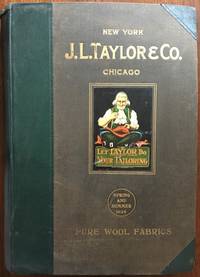
192658100New York & Chicago: J.L. Taylor & Co. 1926. Thick elephant folio 17 x 23.25 x 2.5 ins. 75 3 pp. printed on thick card stock each mounted on linen hinge. With 17 colour fashion plates illustrating Taylor styles of the period verso of almost all pages with 364 of 375 mounted textile samples in wool wool-rayon blends some felt backed silk moleskin corduroy cashmere waistband sample and more -- all samples clearly marked with prices and availability some of the 12 missing samples are indicated in pencil as being “Out†as well as a few present 1 additional pinned-in numerous illustrations throughout in blue-green colour tinting including Chicago & New York factories some diagrams charts and graphs. Original half-green cloth over gray green cloth corners gilt lettering on front cover colour plate w/ J.L. Taylor tailor mounted front cover some wear & minor bumping to fore-edges corners some minor soiling & occasional foxing to interior leaves -- some of it dust from the wool samples 10-15 samples with minor deterioration and evidence of old predation still a very good unsophisticated and remarkably complete example w/ original 9 x 21 in. double-sided stock list in red & black laid-in. First edition of this scarce and unusually complete salesman sample catalogue for Jazz era men’s suits in 1928-1929. J.L. Taylor maintained a huge tailoring operation in both Chicago and New York until after World War II employing hundreds of tailors and seamstresses to fill orders. The catalogues were very expensive to produce and so were most often found in department stores mercantiles and men’s stores which would have these catalogues on the sales floor for two years or more. The catalogue offers invaluable illustrated historical reference for the colours styles and fabrics during the era of F. Scott Fitzgerald and the Flappers. Most of the colour fashion plates illustrating the available styles have elegantly dressed women and settings in the background including with an emphasis on sporting in summer so golf tennis croquet canoeing boating and swimming all make an appearance. Of particular interest is the wonderful dress chart indicating styles needed clothes accessories and shoes which one would need for Day Wedding Matinee Reception Evening Dress and many others offering an excellent marketing opportunity for the store to sell the customer items to compliment his suits overcoats and other fashion wear ordered from J.L. Taylor. The final plate focuses on the lightweight “Palm Beach†& “Mohair†suits at the height of the 1920’s boom in Florida featuring snappily dressed models in Panama straw hats and a lightweight fedora. Worldcat locates 1 partial copy Preserved at the Library of Congress stripped of samples and used as scrapbook for Wilbur’s Drug Store prescriptions of Portland ME -- not an unusual occurrence. J.L. Taylor & Co., hardcover
19279883New York 1927. 4.5x3.5" photograph slightly trimmed down affecting the studio stamp on the bottom edge. Signed by Florence Mills in 1927. Mounted on an autograph album page with a signature card from Betty Blythe to verso. Few spots to photo some soiling to edges. Signature bright and clear. Very good. <br /> <br /> Rare signed photograph from one of the most celebrated Black performers of the 1920s Florence Mills 1896-1927 who died at the age of 31 from complications from tuberculosis and an appendectomy. <br /> <br /> Mills was a child performer in travelling Black stage productions with her sisters as well as "The Tennessee Ten." One of her early major roles was in the Broadway musical Shuffle Along in 1921 one of the defining productions marking the beginning of the Harlem Renaissance. She was a regular performer at the Plantation Club and later headlined the Palace Theatre before becoming internationally known starring in Lew Leslie's Blackbirds of 1926. While performing some 300 shows in London of that year she became ill with tuberculosis her death the following year shocking the entertainment world.<br /> <br /> A naturally scarce signed photo from the year of her death depicting one of the defining performers of the Harlem Renaissance. unknown
192661473New York: Grosset & Dunlap 1926. 8vo. 350 pp. plus 2 pp. publisher’s ads. Dark-blue publisher’s cloth red lettering & ruling embossed News Service ownership stamp at lower right corner title w/ d.j. vivid cover art of flapper “Joanna†in red by Charles Wrenn minor chip & closed tear to lower fore-edge minor chipping head of spine VG/VG- copy. First Grosset edition this novel was released along with the First National flapper silent film now lost and directed by Edwin Carewe co-wrote screenplay with Lois Zellner and starred Dorothy Mackaill Jack Muluall and Paul Nicholson. Grosset & Dunlap, hardcover
199926915<p>Jazz Age Paris Blake Jody. Le Tumulte Noir: Modernist Art and Popular Entertainment in Jazz-Age Paris 1900-1930. University Park: Penn State Press 1999. First Printing of the First Edition. ISBN: 0271017538. A Fine tight copy in a Very Good plus dust jacket with light sunning to the spine that is common wtih this title. In Le Tumulte noir Jody Blake focuses on the impacts of African sculpture and African-American music and dance on Parisian popular entertainment and modernist art literature and performance. Blake discusses the reception of ragtime-era and jazz-age entertainment as well as other African visual and performing art forms to provide new ways of understanding the development of modernist primitivism from Matisse and Picasso to Futurism Dada Surrealism and Purism. But the influence of art nÈgre went well beyond the avant-garde art world. Starting with the cakewalk of the 1900s and culminating with the Charleston of the 1920s the book studies the African-American idioms that were involved in larger cultural social and political developments. As an illustration Blake argues that performers such as Josephine Baker and Sidney Bechet of Revue nÈgre fame were thought to affect the political balance between Africa and Europe during the colonial period. Le Tumulte noir is divided into six chronological chapters each a well-researched well-conceived and well-written synthesis of the histories of art literature music and dance.</p> Penn State Press, hardcover
192253307Beaver Dam WI: Malleable Iron Range Co. 1922-23. Three works in one. Oblong 4to. 38; 3-24; 34 pp. 35-39A leaves 39-66 i.e. 68 pp. 1st -- Colour-illustrated title in gray black orange & light blue printed and illustrated throughout with each black & white illustration of stove w/ orange & gray border; 2nd -- numerous plates in black & white black printed borders text illustrations diagrams; 3rd -- illustrated title numerous plates 5 linen-backed colour-tinted photographs w/ linen hinges text illustrations. Tan softcovers bound w/ two brass screw-posts at upper margin w/ Monarch Malleable range instructions cooking times and thermometer instructions preserved in original printed envelope laid-in minor shelfwear very minor thumbing rubbing still VG copy w/ ownership stamp of J.ohn Y. Hicks b. 1881 Malleable Iron Range sales rep who worked as railroad messenger and then machinist and salesman following World War I. First edition thus of these nicely illustrated salesman sample catalogues of Jazz Age electric stove appliances with electric cook tops insulating blocks an electric appliance plug-in on the side as well as automatic timer and temperature controls. These beautiful stoves could be purchased with enamel finish and as one oven cabinet ranges two oven cabinet ranges one oven square ranges one oven H type cabinet range with built-in kitchen heaters and more. The nicely executed colour-tinted linen-backed photographs showing Malleable stoves provide excellent contemporary visual documentation of the actual colours of the popular stoves folloowing World War I. Malleable Iron Range Company existed from 1896-1985 and at its height after World War I employed over 1200 employees producing a variety of stove and oven appliances which were coal & wood burning electric and gas. No copies located in Worldcat. Malleable Iron Range Co., paperback
192251291Chicago: Olson Rug Company 1922. 8vo. 32 pp. Colour-illustrated throughout numerous black & white text illustrations. Colour-illustrated softcovers slight shelfwear NF copy. First edition of this lavishly illustrated and scarce Jazz Age flooring catalogue for the famed Chicago rug manufactuer. Found in 1874 by Walter E. Olson this beautiful catalogue includes a number of interior designs showing the rugs fitted into Arts & Crafts homes and Flapper Era homes with decor window treatments and furnishings. The Olson Rug Company was a pioneering recycling firm detailing how they used old carpets rugs and old clothing to produce velvety rugs which would rival in appearance and wearing high grade Wiltons and Axminsters. The Olson Company is perhaps best remembered for the Olson Park and Waterfall which was a popular local tourist attraction located outside the factory until sold to Marshall Field in 1965 which subsequently plowed the gardens under and created a parking lot. Olson Rug Company, paperback
192554342Philadelphia PA: Otto F. Schumann Philadelphia Textile School ca. 1925. Small 4to. 8.25 x 9.2 in. 75 leaves unnumbered including 32 leaves with detailed colour charts on weave formations producing various kinds of cloth 3 tipped-in textile samples together w/ weaving instructions in manuscript. Original limp leather 3-ring binder gilt lettering stamped on front cover ink lettering & association of Otto F. Schumann on front cover some soiling dustsoiling edgewear still VG exemplar. This Jazz Age weaving manuscript notebook complete with weave formation design plates fabric samples and instructions offer a remarkable and invaluable artifact of how a young American textile designer and weaver received training at the famed Philadelphia Textile School now Philadelphia University during the 1920s. These course books were judged on completeness and the aspiring weaver’s skill in presenting the details about the instruction as well as their abilities in running the machinery required to produce the cloth. This manuscript notebook includes Schumann’s detailed plates and notes on producing color effect on the plain weave creating Broken Twills Crowfoot Satins Checked & Figured Broken Twills Entwining Twills Basket Weaves and Broken Satins. The extensive manuscript notes detail the loom instructions how many lines are required composition and more in producing the assorted effects. Because of the poor quality of United States textiles exhibited at the Centennial Exhibition in 1876 the Philadelphia Textile Manufacturers pushed for a formalized vocational school to train weavers designers and textile workers. In 1884 it became part of the Pennsylvania Museum and School of Industrial Art with 81 students enrolled by 1885 and by 1894 the School of Textiles added a Department of Wool Carding & Spinning and a Department of Cloth Finishing and Design. By the 1920s the Philadelphia Textile School was offering extensive three-year textile courses chemistry and dyeing courses as well as design courses in cottons woolens worsteds silks Jacquard design and more. Schumann 1906-1967 was the son of Hugo Schumann founder and owner of the Maid Hosiery Mills in Reading PA through the opening decades of the 20th century for whom he worked with until after World War II as designer and sales executive. Otto F. Schumann, Philadelphia Textile School, hardcover
192548049Chicago: Rothschild Brothers 1925. Tall 8vo. 100 pp. Over 100 colour illustrations 100s of black & white text illustrations & photos. Blue & silver printed softcovers elegant design on front cover w/ blue border and simulated silver mirror very minor soiling some shelfwear still VG copy w/ original order form & price change notice tipped-in. First edition of this beautifully illustrated catalogue of Flapper Era toiletry ware including dresser sets in beautiful Bakelite and celluloid cases men’s military sets with varieties of brushes perfume bottles manicure instruments shoe horns jewelry boxes clocks and much more. Rothschild Brothers, paperback
192559963Chicago: Olson Rug Company 1925. Oblong 4to. 9.75 x 7.8 in. 2 48 2 pp. Colour-illustrated throughout numerous black & white decorative border illustrations. Colour-illustrated softcovers vivid wraparound Orientalist cover art of scene depicting bedouin camels & tents in the desert seated upon Oriental rugs minor shelfwear slight bumping to couple corners still VG bright copy including order blank in red & black w/ pictorial map on verso of Olson Rug railroad time deliveries. First edition of this lavishly illustrated and scarce Jazz Age flooring catalogue for the famed Chicago rug manufacturer filled with striking Orientalist inspired Persian carpets Middle Eastern Central Asian and East Asian patterns intended to brighten any Craftsman home. Found in 1874 by Walter E. Olson this beautiful catalogue includes a number of interior designs showing the rugs fitted into Arts & Crafts homes and Flapper Era homes with decor window treatments and furnishings. The Olson Rug Company was a pioneering recycling firm detailing how they used old carpets rugs and old clothing to produce velvety rugs which would rival in appearance and wearing high grade Wiltons and Axminsters. The Olson Company is perhaps best remembered for the Olson Park and Waterfall which was a popular local tourist attraction located outside the factory until sold to Marshall Field in 1965 which subsequently plowed the gardens under and created a parking lot. Worldcat locates 1 copy Winterthur. Olson Rug Company, paperback
193058329New York: Jacobsen Publishing Co. Inc. 1930. 8vo. 335 5 pp. Tan cloth black Art Deco lettering black ruling uniform interior toning as usual w/ d.j. Art Deco fadeaway cover art of woman in print dress on red background artist initial “H†minor edgewear creasing still VG/VG copy. First American edition of this Flapper Era romance novel set against the backdrop of contrived marriages land swindles and more in the new British suburbs. Wilson 1878-1965 wrote over 30 romance novels following World War I through World War II most under the name “Diana Patrick†and is perhaps best remembered as mother of Romilly Cavan Isabel Wilson who published her debut novel Heron at 21 years old. Jacobsen Publishing Co., Inc., hardcover
192453221New York: The Charles William Stores Inc. 1924-1925. Two vols. 4to. 548 8; 518 8 pp. With numerous colour plates colour-tinted text illustrations over 1000 black & white text illustrations diagrams. Colour-illustrated softcovers minor soiling wear slight sunning front cover of vol. 1 creasing to spine; minor creasing shelfwear vol. 2 light uniform interior toning as usual still VG- set. First edition of the complete year of Jazz Age catalogues from the Charles William Stores which offered a treasure trove of everyday fashions work clothes and household and consumer goods during the Roaring 20s offering the glamour and style of New York to the rest of the country. Their fashions were intended for the average American with emphasis on the more “endowed†woman and “stout†man during the Jazz Age emphasizing chic styles and well-woven fabrics. These catalogues detail the high grade work pants riding breeches denim jeans corduroy work pants along with triple-sewed work denim overalls and coats which could be purchased as well as those made out of Wabash Stripe Stifel denim cloth noted for its durability. No copies located in Worldcat of Spring & Summer 1925; 3 copies located of Fall & Winter 1925 Henry Ford Harvard American Textile History Museum. The Charles William Stores, Inc., paperback
1925589771925. Two black & white photo images 8" x 10" on glossy stock mounted in Crown Studio mats 11 1/4" x 13 1/4". Images are night shots of windows depicting surroundings full of architectural details. Very minimal soiling to lower fore-edge. 1 image with a bit longer exposure time still a very good pair of photos. These two commercial photos of 1920s window displays provide an invaluable historical glimpse into the marketing of men's fashions at the height of the Jazz Age. The photos include unique period elements with breathtaking flower arrangements positioned amongst the displayed clothing. The men's suits range in tints and style primarily including double-breasted and single-breasted suits with trousers carefully draped over surrounding decorative tables and stands cravats at the neck and each with a dapper cane displayed above it. Rich draperies of men's suit fabrics have been arranged below and around the displays. Frank Jacoby's store was a thriving business in Bridgeport CT. at 1083 Broad Street until the throes of the Great Depression when they were forced to close in 1933. unknown
192839300New York: Rae D. Henkle 1928. 8vo. viii 182 pp. Yellow boards orange lettrng w/ d.j. NF/NF. First edition of this scarce and riotous anthology of essays and humor on the Jazz era including Flappers are safeguards Men are the vainer sex Parents are snobs Stupid men marry early and much more. Rae D. Henkle, hardcover
193560373New York: Grosset & Dunlap c. 1935 1941. 8vo. 310 pp. Beige publisher’s cloth blue lettering on spine minor shelwear soiling w/ d.j. moody Art Deco cover art by Arthur Hawkins representing Manhattan’s Upper Eastside minor chipping head of spine couple closed tears creasing edgewear still VG/G copy w/ original Newport OR drugstore stamp on front pastedown. First Grosset Edition reprinting the 1935 Harcourt Brace original of this novel set against the backdrop of the waning years of the Jazz Age and the promiscuous experiences of Gloria Wondrous including her affair with Weston Liggett and assorted friends. In 1960 25 years after its first publication the novel was adapted into the film starring Elizabeth Taylor for which she won the Academy Award for Best Actress. Grosset & Dunlap, hardcover
201728274<p>Jazz Age Riley II Charles A. Free as Gods: How the Jazz Age Reinvented Modernism. Lebanon: ForeEdge 2017. First Printing of the First US Edition. A Fine tight copy in a Fine unclipped dust jacket. Among many art music and literature lovers particularly devotees of modernism the expatriate community in France during the Jazz Age represents a remarkable convergence of genius in one place and period-one of the most glorious in history. The outpouring of boundary-pushing novels paintings ballets music and design was so profuse that it belies the brevity of the era 1918–1929. Drawing on unpublished albums drawings paintings and manuscripts Charles A. Riley offers a fresh examination of both canonic and overlooked writers and artists and their works by revealing them in conversation with one another. </p> ForeEdge, hardcover
193039980New York: Sears Publishing Co. Inc. 1930. 8vo. 6 299 1 pp. Beige cloth purple lettrng mnr dustsoilng w/ d.j. mnr chppng hd & ft of spine tape repairs to tears chppng VG-/Fair w/ frmr ownrshp signature on ffep. First edition of this amusing Jazz era story of a beautiful girl who persuades a millionaire to torn over $ 25000 to her without asking for a quid pro quo so she can break into society. Sears Publishing Co., Inc., hardcover
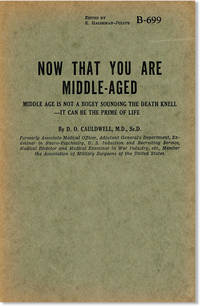
194846590Girard KS: Haldeman-Julius Publications 1948. First Edition. Octavo 21cm.; publisher's green printed staplebound card wrappers; 32pp. Wrapper extremities toned else Ner Fine. Big Blue Book no. B-699. From the introduction: "Middle age is not heralded by an increasing waistline a few gray hairs a double chin a spot of baldness lines in the face or crowsfeet under the eyes." p. 3. The author a former Associate Medical Officer for the U.S. Induction and Recruiting Service goes on to cover such topics as "Men at 40 and the Prostate Myth" "Fallacies About the Menopause" and the age-old question "Are Middle-Aged Women Less Attractive Than Men" The latter seventeen pages reprint letters seeking advice from Cauldwell with headings like "A Failure at 35" and "Unwanted Wife." OCLC locates four separately catalogued copies as of November 2019 at UC Davis the Smithsonian Northwestern and Kansas with an additional copy at the Huntington catalogued as part of a larger collection. Haldeman-Julius Publications unknown
192550606New York: A. Koenigsberg 648 Broadway ca. 1925. 8vo. 12 pp. Photo illustrated throughout colour-tinted centerfold. Colour-illustrated softcovers model wearing a stylish hat printed in red & black stapled as issued sewn through punch hole at head of spine w/ gold silk braid slight shelfwear 1 very small closed tear at fore-edge front cover still VG copy. First edition of this very scarce and beautiful catalogue of hat frames and hat bases for millinery shops during the 1920s. The company could supply for hat designers Zibeline hatters plush hats Lyons Velvet Brims Satins Velours Ribbon bound fur and felt hats as well as millinery supplies and hat boxes. Koenigsberg b. 1889 emigrated from England in 1889 to New York where he worked as a furrier for many years with his father Wolf before setting up his own successful millinery supply shop and 4200 square foot factory which successfully operated until the Great Depression. After his shop closed Koenigsberg moved into selling pin ball machines. No copies located in Worldcat; See: New York State Industrial Bulletin of the Department of Labor 1921 Vol. 1 p. 171. A. Koenigsberg, 648 Broadway, paperback
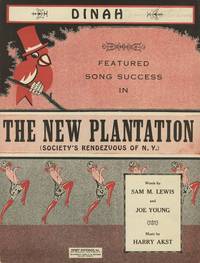
1925List3672New York City: Henry Waterson Inc 1925. Folio illustrated wraps. 5 pp. Fine condition. A striking Jazz Age sheet music issue and likely first edition for “Dinah†the widely popular song composed by Harry Akst with lyrics by Sam M. Lewis and Joe Young here promoted as a “Featured Song Success†from The New Plantation Society’s Rendezvous of N.Y. a Harlem revue-style theatrical production. The revue was advertised as an all-Black production reopening the Plantation Cabaret at 50th Street and Broadway featuring prominent performers including blues singer Ethel Waters alongside Will Vodery’s Parisian Orchestra Josephine Baker Bessie Allison Leonard Harper Jimmy Ferguson and the Plantation beauty chorus.1 “Dinah†would go on to become one of the most enduring standards of the decade. Multiple versions were published in 1925 this one in June and though we are not able to establish definitive priority we guess that this is the first edition. Very scarce with three copies found institutionally at the Francis G. Spencer collection at Baylor University BYU and the British Library reference collection. <br /> <br /> 1 “Ethel Waters Is Featured In New Plantation Revue†The New York Age June 20 1925 6. Henry Waterson, Inc unknown
19619262Altadena CA: Dane Rudhyar 1961. First editions. 5 pamphlets each reproduced from typescript bound with single staple along spine in printed self wrappers and unfolded. Generally very good or better with toning and a few dog-eared corners. <br /> <br /> Scarce set of five self published pamphlets by the American composer/astrologer Dane Rudhyar 1895-1985. This is a mixed set from his Seed For Greater Living series each is continuously paginated by series and between 12-36pp in length. Includes:<br /> <br /> Toward the Life of Plentitude Part IV; and The Way "Through: Twelve Basic Challenges and Tests of Individual Existence Parts 4 6 8 and 9.<br /> <br /> OCLC lists these pamphlets as being published between 1957-1962 with the "Way Through" booklets all dated 1961. Two Universities in California hold any from the series as do two in Switzerland. <br /> <br /> <br /> . Dane Rudhyar unknown
1926List3141Quincy Massachusetts: unpublished 1926. 201 pp cardstock wraps. Normal wear to wraps; overall Near Fine. Alice Brackett White Coolidge 1864–1927 was a Boston socialite of the prominent Richardson family; her grandfather was merchant and Massachusetts State Legislator Jeffrey Richardson. Coolidge was also the author of three children’s books: The Bunnies of Evergreen Village 1917 The Refugees in Evergreen Village 1918 and Evergreen Village to the Rescue 1922. Offered here is Coolidge’s unpublished memoir of her early life written in 1926 titled My Early Reminiscences.<br /> <br /> The memoir recalls Coolidge’s childhood and teen years spent mainly in Massachusetts New Hampshire and Maine. Her recollections typically involve extensive descriptions of the houses at which her family stayed the scenery around them and the various families they met and visited with. Given her position in society her acquaintances are sometimes quite influential people: Princeton president John Grier Hibben enjoys Coolidge’s fishcakes; Trinity Church rector Phillips Brooks gives her grandfather an “excellent pew†in the newly-finished church; pioneering doctor Alfred Worcester mistakes red pepper for mercury in a scientific demonstration at her school; and she recalls brief correspondences with John Greenleaf Whittier and William James.<br /> <br /> Coolidge also took dance lessons from Augustus Papanti whom she describes as “one of the thinnest men I ever saw†who was “very melancholy. I hardly remember his ever smilingâ€; and remembers Judge Charles Devens for “his great stature his charming face his courtliness of manner and his really boyish simplicity in entering into our evening games†including a game of “mind reading†which Devens played “with zest.â€<br /> <br /> One of her longtime friends was Rear Admiral John E. Pillsbury. She recalls:<br /> <br /> “Mr. Pillsbury as a young naval man a brother-in-law of my uncle Dr. Richardson used to take me out in the swan-boats on the Public Garden Pond. Later he went through all the ranks up to being retired as a Rear Admiral but time and circumstances never changed him. We always met at Thanksgiving and Christmas dinners and always talked at great length. . He was a wonderfully interesting lovable man and very modest and unassuming and shy. I always considered him one of my best friends though older by many years than I.â€<br /> <br /> Another interesting New England figure Coolidge encountered was Joseph Lee. She describes Lee’s hotel in Newton:<br /> <br /> “The house where we stayed was kept by a remarkable man named Joseph Lee. He was a mulatto much above many of his kind and his wife was a handsome woman partly Indian. They did the cooking and he waited on table with a colored maid to help him. In fact there were no white women in the house. The cooking was delicious.â€<br /> <br /> Lee was born enslaved in South Carolina freed in 1865 and went on to invent the automatic bread kneading and bread crumbing machines.<br /> <br /> Though nearly all of her childhood was spent in New England she also remembers being invited to visit Charles Joseph Bonaparte in Baltimore:<br /> <br /> “We had never been so far south except to Washington and I felt a curious feeling of being in a different atmosphere from any I had known. . We were met at the station by Mrs. Bonaparte in a large roomy covered vehicle with two horses. The coachman and footman were in the Bonaparte colors -- a deep wine color. The footman I well remember. He was a light-colored young negro very handsome and smiling and excited over having young ladies from the North. . All the servants were colored and lived in cabins near the house. . I never knew Mr. Bonaparte in public life so my memories of him are quite intimate and I fancy I saw much of his real self. . His mind was very active. He used to talk or listen as he walked and he moved his head in a curious way from one side to the other with a slightly rolling motion which was distinctly individual. . I never saw him irritated or excited and he was always very simple. In the group picture we had taken at the Maplewood he sat down cross-legged on the piazza floor like a boy. That was in about 1887. I suppose in public life or in law he was different but he was very equable and charming as we met him in his home and at the mountains. Most of all I admired his sweet tender ways with his flower-like wife.â€<br /> <br /> This was not too long after the end of Reconstruction and Coolidge remarks on the tense atmosphere:<br /> <br /> “Mrs. Bonaparte had warned me to be careful about questions regarding the North and South as the ‘feeling’ had not yet died away. I was so glad she had warned me. A gentleman slipped in and sat down beside me to watch a parade and whispered in my ear as the bands had been playing ‘Dixie’ how glad he was to meet a Northerner. I was glad to meet him too although I remember neither his name nor face but I felt I breathed freer in his sympathetic locality. . I had no idea that this feeling still remained as far North as Baltimore and of course I remembered how our Massachusetts troops had been fired upon in Baltimore at the outset of the war but I was admonished and very wise and only returned my unremembered neighbor’s greeting with a sympathetic word and look.â€<br /> <br /> Besides individuals Coolidge does cover a few historical events including the Great Boston Fire of 1872:<br /> <br /> “Oh! a horrible sight met our eyes. Back of the opposite houses in Park Square was a background of sheets of red flames and heavy black smoke rising high into the air. . On the Parade Ground all was in confusion and the sight was very sad and never-to-be-forgotten. It was literally covered with boxes and bales of furniture and sad forlorn desperate looking people crouching or sitting or standing amidst what they had saved from their homes . At night . the whole city was in darkness as there was no gas.â€<br /> <br /> The family also frequently stayed at hotels in the White Mountains of New Hampshire and Coolidge recalls the “overwhelmingly tragic†effects of the 1867 sale of this land to logging companies; she writes that looking out from the Flume House in Franconia “all about were brown scarred places marking the woodchoppers’ work which was cutting away our beautiful trees for lumberâ€.<br /> <br /> In this memoir Coolidge supplies detailed remembrances of the private personalities of influential figures of Gilded Age New England. We find two copies of My Early Reminiscences on OCLC. Of interest to historians of the era especially as told through the perspective of a young woman. unpublished unknown
1940LIST0210New York 1940. Watercolors on paper affixed to later illustration board 14 x 26 inches each. Very Good. An attractive set of images from the Robert Moses era in an unknown hand. The images show proposed intersections including two that were never built. The images include "Proposed Parkway Passing over Entrance to Fort Totten" which shows an overpass on the Cross-Island Parkway in Northeast Queens dated October 1937; "Linden Boulevard Overpass at Southern Parkway" showing an unbuilt intersection at North Conduit Avenue and Dumont Avenue perhaps in the Ozone Park neighborhood undated; "Woodbine Street Passing over Long Island RR to Metropolitan Ave & 67th St." which shows a non-existent intersection near the Middle Village stop on the M line dated August 1940. <br /> <br /> Interesting relics from the Robert Moses era which shaped the infrastructure landscape of New York City. A very good group overall though the Woodbine Street illustrations shows marginal dampstaining and all three show evidence of label removals and wear. unknown
1333927029.Gpaperback. Good. Access codes and supplements are not guaranteed with used items. May be an ex-library book. paperback
1331326915.Gpaperback. Good. Access codes and supplements are not guaranteed with used items. May be an ex-library book. paperback
0844231657New. hardcover. New. Satisfaction Guaranteed or your money back. hardcover