807 résultats
193476696Nevada. Missouri: Weltmer Institute of Suggestive Therapeutics 1934-35. Edited by Ernest Weltmer. Vol. 15. No.1 1933 2 3 4 5 6 7 1934. Seven issues with an unexplained jump of 6 months. Tall octavos. 32 pp. each. Numerous ads unlike the preceding magazine. Publisher’s printed wrappers. Some minor issues but very good overall. None located by OCLC.Weltmer was an early advocate of Prosperity as a core issue in his teachings & considered it the result of successful mind-body integration. The title of this magazine reflects that. Prosperity soon became a mainstay in almost all New Age schools. This magazine is much like his Magazine of Practical Psychology with lessons and articles by notables in the field. Weltmer Institute of Suggestive Therapeutics unknown
1976biblio556<p>MGNA 1976 1977. The complete series: First Year Sets 1 - 6; Second Year Sets 1 - 6; Third Year Sets 1 - 6; Fourth Year Sets 1 - 3; Fifth Year Set 1 final set published. 22 staplebound pamphlets in very-good to fine condition. An outgrowth of the Alice Bailey teachings MGNA was founded by the eminent Italian psychotherapist Roberto Assagioli.</p> MGNA paperback
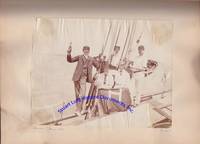
6174LONG ISLAND. This scrapbook displays photographs taken between 1887-1889 that capture a wealthy familys life on Long Island during the Gilded Age. The term The Gilded Age created by Mark Twain refers to the period of the late nineteenth century typically the 1870s through the turn of the 20th century during which rapid economic growth rapid industrialization and widespread European immigration primarily unskilled labor transformed the economies of the Northern and Western United States. According to the United States Census the era saw a real wage growth of 40% from 1860 to 1890 with the average annual wage per industrial worker including men women and children rising from $380 in 1880 $11523 in 2022 dollars to $584 in 1890 $18370 in 2022 dollars a gain of 59%. This rise in wealth resulted in the rise of a New Money elite those who made their money not through generational wealth and family connections but rather through oil the railroads and other rising industries. They are best exemplified by John D. Rockefeller Jay Gould Henry Clay Frick Andrew Mellon Andrew Carnegie Henry Flagler J. P. Morgan Leland Stanford and Cornelius Vanderbilt. New York was often at the center of the Gilded Age as the worlds dominant financial market and the nations leader in economic investment immigration political corruption and culture. This scrapbook contains 59 black-and-white photographs. They are affixed or mounted to 43 of 70 pages in the album. 29 of the photographs are 3.5 x 4.5 19 are 6.5 x 4.5 and 11 are 5.5 x 7.5. Two of these images are cyanotypes. Though the family is not named in the album and photographs with names underneath lead to nothing online there is a photograph in front of a house labeled Westbrook. The Westbrook estate on Long Island was designed in 1886 for William Bayard Cutting 18501912 by the architect Charles C. Haight in the Tudor Revival style. It contained the first private golf course in the United States and is now a part of a state park called the Bayard-Cutting Arboretum. Cutting started the sugar beet industry in the United States in 1888 was a builder of railroads operated the ferries of New York City his maternal grandfather was a partner of Robert Fulton and developed part of the south Brooklyn waterfront Red Hook. Images include a large extended family repeatedly and leisurely photographed the Harvard-Yale sailing race in 1887 at New London young men likely Yale students yachting and relaxing on a boat named the Princess and beautiful images of the scenery and waters of Long Island. Overall the album is in good shape. One photograph is damaged and several others have minor tears or chips. The scrapbook is half-leather and half-cloth so the spine is worn and the corners are rubbed and bumped. Regardless the scrapbook is a prize for anyone interested in this fascinating and relevant era in American history. It provides fantastic insight into the life of a wealthy Long Island family including what they did what they wore and how they presented themselves to each other and their neighbors. hardcover
1935141672ca 1935. paperback. Oversize 9-1/2 X 12-1/4 double-weight gelatin silver photograph inscribed in blue ink fountain pen by Montgomery to Hollywood photographer George Watson. The inscription is undated but most likely dates from the mid to late 1930's. Damage to lower left corner else VG Montgomery 1904-1981 began his acting career in 1929 and has the distinction of having played both Lord Peter Wimsey in 1940 "Haunted Honeymoon" based on BUSMAN'S HONEYMOON and Philp Marlowe in 1947 "Lady in the Lake". He also directed and starred in one of the great film noirs of the forties "Ride the Pink Horse" 1947 based on the Dorothy B. Hughes novel. Watson was a member of the notable Watson family of photographers that has flourished in Los Angeles for nearly a century. He was one of the first staff photographers at the Los Angeles Times and covered notable stories throughout the twenties paperback
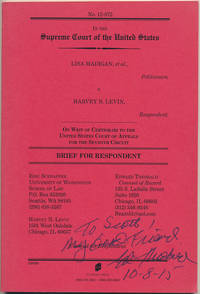
47419N.p.: Counsel Press n.y. Paperback. Small 4to. Stiff red wrappers. xii 54pp. Near fine. Rear wrappers and last leaf only mildly warped. Bright tight copy of this legal pamphlet No. 12-872 part of an age discrimination suit filed by an Illinois state's attorney who argued he was dismissed because of his age 61 to make room for a younger female attorney. Remarked one commentator "He won a major victory in the Seventh Circuit Court allowing him to go forward with a claim that his constitutional right not to be discriminated against because of his age had been violated. The state took the case on to the Supreme Court claiming that his right to sue under the Fourteenth Amendment had been displaced by the federal Age Discrimination in Employment Act. The problem in brief was that the Seventh Circuit decided the case before it was due to go to trial and the professors had questioned its authority to do that. If that was right Justices Samuel A. Alito Jr. and Anthony M. Kennedy commented why did the Supreme Court have any business stepping in" The Illinois Solicitor General got spanked by the justices during his questioning. Then "Levin's lawyer Edward R. Theobald III took to the podium. His appearance began on an unfortunate note as Justice Alito tried unsuccessfully to get him to take a firm position on whether or not Levin was an employee under the ADEA. For reasons that were not clear Theobald contented himself with simply reciting what the Seventh Circuit had said in ruling for his client." It goes on: "Chief Justice Roberts promptly took on Theobald saying that he had gotten what he had sought from the court of appeals and now was trying to insulate that result from any review. The Chief Justice was referring mainly to Theobald's merits brief in which he had put heavy emphasis on whether the ADEA issue was involved at all in the case since Levin he said got no protection under that law. The argument it was clear was getting far out of Theobald's opportunity to control it in his client's favor. Finally Justice Scalia had had enough. He noted that many of Theobald's arguments had not been made in his brief opposing the Court's review. 'We don't like to dismiss a case as improvidently granted' the Justice said impatiently. 'We depend upon counsel' to make arguments in a way that puts them before the Court. 'You should have told us' earlier Scalia said." This pamphlet is the aforementioned brief opposing the Court's review -- and the front wrapper is inscribed and signed large and bold by Levin's attorney: "To -- / My Good Friend / Ed Theobald / 10-8-15." These briefs are produced in small quantities for distrbution to those parties involved and are therefore rather scarce. This unusual item is accompanied by five large glossy Christmas cards each imprinted with Theobald's full name and each signed on inside panel with a holiday greeting. For good measure also included is a copy of Lyle Denniston's 2013 legal analysis of Levin v. Madigan "Argument recap: A bad way to open a Term" which includes a court artist's rendering showing Theobald presenting the case before Ruth Bader Ginsburg. Counsel Press paperback
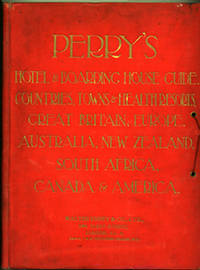
19315466London. Walter Perry and Co. Ltd. 1931. Gilt titled crimson cloth. 4to. Edition for 1931. Profusely illustrated with photographs drawings and period advertisements. An absolute treasure depicting the grand and elegant days of travel. A complete guide to Hotels and boarding houses in Great Britain Europe Australia New Zealand South Africa Canada and the USA. Charming period advertising allows one to travel back to the heady romantic days of Somerset Maugham and the Orient Express. Indexed and tabbed this is a true gem of nostalgia. A Very Good copy Walter Perry and Co. Ltd. hardcover
19852091202133001921New Science 1985. Soft Cover. Fine. Number of books: 1 New Science paperback