Weldon, Walter; Moulin, EtBiblio.com
34 résultats
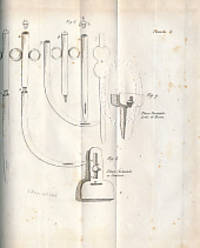
1793e4899London; Paris: The Medicinal Laboratory; J B Baillière. G : in Good condition. Cover rubbed and scuffed. Some light marking to paragraphs. Scattered browning and dust soiling tp page ends. Ex Royal College of Surgeons Ireland Library. 1793. Second Edition. Brown hardback half-leather cover with marbled boards. 210mm x 130mm 8" x 5". 171pp xiv 184pp plates 40pp catalogue. 10 engraved plates in book 2. Pointing Out the Advantages and Disadvantages of Each Mode of Operating Under Different Circumstancrs and Diseases Which Obtained the Annual premium of A Medical Society.' To which is added an appendix containing observations on some of the causes of retention of urine and on the use of catheters.' Book 2 'Nouveau Traitement' published in 1834 in French. . The Medicinal Laboratory; J B Baillière hardcover
17676181767, Francisci Grasset, Lausanne, in-8 plein cuir de VIII+607 pages, fleurons dorés, pages de garde marbrées, 4 planches noir et blanc dont 2 dépliantes. Pars prima ad generationem. Texte en latin. | Etat : Etat d'usage, coins et dos usés, manques sur le dos et près des mors, rousseurs ne nuisant pas à la lecture (Ref.: MA22)
178097828452233431780, Desprez, in-8 plein cuir, titrage et décors dorés sur dos à 5 nerfs, Médecine domestique, ou traité complet des moyens de se conserver en santé, de guérir & de prévenir les maladies, par le régime & les remèdes simples: ouvrage utile aux personnes de tous états & mis à la portée de tout le monde. Traduit de l'anglais par J. Duplanil, docteur en médecine de la Faculté de Montpellier et médecin ordinaire de son altesse royale Monseigneur le Comte d'Artois. Seconde édition | Etat : assez bon état, coins et coiffes frottés, trous de ver, intérieur frais (Ref.: ref96104)
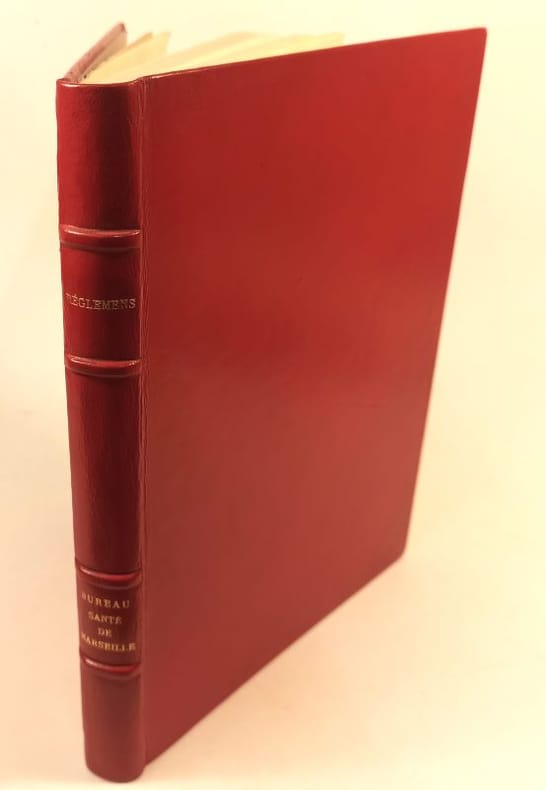
179723926Marseille, Mossy, An V (1797). Petit in-4 (19 x 25 cm) basane rouge, dos à nerfs. 215 + (4) pp. (Reliure du XXe siècle).
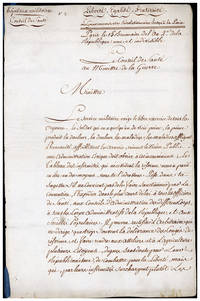
179346096Paris 1793. <p>France. Conseil de Santé. Tableau des infirmités qui nécessitent la réforme et doivent empêcher l'admission au service militaire title on leaf 2. Manuscript document addressed to the Minister of War signed by nine members of the Conseil de Santé including Antoine-Auguste Parmentier 1737-1813 Antoine Dubois 1756-1837 Guillaume Daignan 1732-1812 Nicolas Heurteloup 1750-1812 Pierre Bayen 1725-98 and Vincent Jean Paul Biron 1758-1817. 4ff. 2 bifolia the last leaf blank fastened along central fold with silk ties. Paris 15 brumaire de l'an 2 de la République 5 November 1793. 318 x 206 mm. Light soiling and spotting first bifolium partially split along central fold but very good. </p> <p>Elegantly written official document from the French revolutionary government's Conseil de Santé to the Minister of War Jean Baptiste Noël Bouchotte 1754-1840 calling for the need to reform the French army's medical regulations and providing a tabulated list of infirmities disqualifying soldiers and prospective recruits from serving in the military. "The list will be able to rectify the arbitrariness that too often governs the issuance of sick leave and will restore to workplaces and farms the many citizens who are no doubt worthy by virtue of their Republicanism to fight for liberty but who because of their infirmities overload the armies rather than increase their strength" f. 1; our translation. The "Tableau des infirmités" includes blindness in one or both eyes deafness goiter pulmonary disease hernia hemorrhoids sciatica loss or paralysis of a limb lameness leprosy scurvy epilepsy and bad incisor or canine teeth-this last because soldiers used their front teeth to tear open gunpowder cartridges. </p> <p> Among the signers of this document were Antoine-Auguste Parmentier best known for promoting the potato as a food source in France; Nicolas Heurteloup chief surgeon of the Grande Armée under Napoleon; Guillaume Daignan author of one of the earliest studies of puberty among Europeans see Garrison-Morton.com 7806; Antoine Dubois head of maternity services to Napoleon and his wife Marie Louise; Pierre Bayen chemist and member of the Académie des Sciences; and Vincent Jean Paul Biron secretary of the Commission de Santé. </p> . unknown
179346096Paris 1793. <p>France. Conseil de Santé. Tableau des infirmités qui nécessitent la réforme et doivent empêcher l'admission au service militaire title on leaf 2. Manuscript document addressed to the Minister of War signed by nine members of the Conseil de Santé including Antoine-Auguste Parmentier 1737-1813 Antoine Dubois 1756-1837 Guillaume Daignan 1732-1812 Nicolas Heurteloup 1750-1812 Pierre Bayen 1725-98 and Vincent Jean Paul Biron 1758-1817. 4ff. 2 bifolia the last leaf blank fastened along central fold with silk ties. Paris 15 brumaire de l'an 2 de la République 5 November 1793. 318 x 206 mm. Light soiling and spotting first bifolium partially split along central fold but very good. </p> <p>Elegantly written official document from the French revolutionary government's Conseil de Santé to the Minister of War Jean Baptiste Noël Bouchotte 1754-1840 calling for the need to reform the French army's medical regulations and providing a tabulated list of infirmities disqualifying soldiers and prospective recruits from serving in the military. "The list will be able to rectify the arbitrariness that too often governs the issuance of sick leave and will restore to workplaces and farms the many citizens who are no doubt worthy by virtue of their Republicanism to fight for liberty but who because of their infirmities overload the armies rather than increase their strength" f. 1; our translation. The "Tableau des infirmités" includes blindness in one or both eyes deafness goiter pulmonary disease hernia hemorrhoids sciatica loss or paralysis of a limb lameness leprosy scurvy epilepsy and bad incisor or canine teeth—this last because soldiers used their front teeth to tear open gunpowder cartridges. </p> <p> Among the signers of this document were Antoine-Auguste Parmentier best known for promoting the potato as a food source in France; Nicolas Heurteloup chief surgeon of the Grande Armée under Napoleon; Guillaume Daignan author of one of the earliest studies of puberty among Europeans see Garrison-Morton.com 7806; Antoine Dubois head of maternity services to Napoleon and his wife Marie Louise; Pierre Bayen chemist and member of the Académie des Sciences; and Vincent Jean Paul Biron secretary of the Commission de Santé. </p> . unknown books
1784354191784, Etienne Charpentier, in-folio demi-cuir de 57 planches noir et blanc gravées et commentées, « ouvrage contenant environ soixante planches recueillies d'après les meilleurs auteurs dans ce genre, et enrichi de plusieurs nouvelles, figures très curieuses, et fort utiles concernant les accouchements, les Hernies, et autres cas particuliers, rendues aussi exactes qu'il a été possible, par les soins de François-Michel Disdier, maître es arts, et en chirurgie, démonstrateur en anatomie et autres matières chirurgicales. » | Etat : Etat général moyen, plats un peu écorchés, quelques piqûres et traces d'humidité (Ref.: G4490)
175318827Zaandam 1753. 8vo. for the author by Jan Broekhuysen Contemporary decorated paper wrappers preserved in half cloth chemise and matching slipcase. 28 96 pp. Extremely rare first edition of a list of Dutch data concerning the whaling trade in and around Greenland compiled by Gerrit van Sante 1728-1779. The book was designed with blank spance to add new data in the years following 1753. The present copy has been updated probably by the first owner till the year 1761. Besides the names of the commanders for every Dutch voyage to Greenland and the Davis Strait and the names of the directors for whom they sailed it also includes an annual record of the number of whales caught tonnes of blubber and barrels of whale oil both for each commander individually and for the industry as a whole. "Van Sante understood completely the enormous economic importance of whaling for the Netherlands and mentions the results of every voyage of every ship" Catalogue library of G.J. Honig. "Greenland" is broadly interpreted to include the waters around Spitsbergen and Jan Mayen Island and the Davis Strait fleets fishing between Greenland and America are not separately recorded until 1719. With manuscript owner's inscription the warrant signature of the author on the back of the title-page and manuscript additions throughout. Otherwise in very good condition and wholly untrimmed.l Bookauction catalogue The library of G.J. Honig Utrecht 1969 item 375 this copy; JBC III p. 1766; Sabin 76854; STCN 1 copy; WorldCat 2 other copies. ABE CAT Alaska Canada & Greenland hardcover
1774ABC_501841774. Loosely inserted in contemporary wrappers with the manuscript title on the front. The work is kept in a brown cloth folder with a red morocco title label on the front lettered in gold. Folio. Three manuscript reports concerning sickness scurvy hospital conditions and mortality aboard ships of the VOC Dutch East India Company specifically on voyages between the Cape of Good Hope and Batavia and in connection with the Bengal trade.The first document is from 1783 written by the doctor C. J. de Jamars and addressed to the VOC Chamber at Amsterdam this report discusses the uncommon sicknesses and deaths occurring on outward-bound ships between the Cape and Batavia. It refers to earlier resolutions and records that mortality up to the Cape had decreased following improved regulations.Particular emphasis is laid upon scurvy and putrid fevers and upon the inadequacy of medical stores supplied at the Cape. De Jamars argues for a substantial increase in China cinchona bark the principal febrifuge of the period recommending as much as 50 lb for a complement of 300 men. The document reflects the increasing institutional awareness within the VOC of shipboard hygiene provisioning and preventative medicine.The second document is an extract of a report submitted to Mr Willem Arnold Alting 1724-1800 Governor-General of the VOC by several medical officers including B. S. Engelbert. It offers a detailed investigation into the heavy mortality on ships sailing from the Cape to Batavia.The Cape hospital is identified as a principal source of contagion described as dilapidated foul and lacking segregation of patients. Criticism is levelled at the premature discharge of convalescents who were allegedly forced into heavy labour under harsh conditions before full recovery thereby spreading infection aboard ship. Other causes listed include: the embarkation of inexperienced sailors elderly men and boys climatic factors humid oppressive air near the tropics insufficient medicines especially cinchona bark and spirits of vitriol severe restrictions on fresh water for both sick and healthy men.The report makes extensive practical recommendations: improved hospital hygiene provision of clean clothing and bedding prohibition on the sale of sailors garments better victualling including sauerkraut dried fruits barley beans butter and raisins increased water rations and the preparation of restorative drinks in extreme heat.There are vivid observations of men reduced to destitution lacking shoes or bedding when transferred from hospital to ship and of theft and neglect among the lower ranks. The text provides valuable insight into 18th-century naval medicine dietetics and the administrative challenges of long-distance maritime empire.The third document is a memorandum concerning the prevention of scurvy during prolonged stays in Texel prior to departure. Again written by De Famard he observes that idleness lack of exercise and exposure to damp sea air predispose crews to scorbutic disease even before sailing.The wrappers have been reinforced with gauze on the outside. Otherwise in very good condition. hardcover