233 résultats
196857041San Francisco: Frank Reynolds / Hells Angels Motorcycle Club 1968. First Edition. Quarto 26.75cm; twelve 12 five-color broadsides measuring 20cm X 26cm printed on rectos only and housed in an illustrated portfolio on glossy cardstock. A few stress creases and some subtle toning along the spine-fold of the portfolio else Fine. <br /> <br /> An off-the-wall collection of free-form poems written by Freewheelin' Frank Reynolds former Secretary of the San Francisco chapter of the Hells Angels Motorcycle Club. The broadsides reproduce hand-lettered illustrated poems written by Reynolds in the mid-1960's printed by the Diggers and issued the year after his 1967 memoir written with Michael McClure. Content ranges from personal history and camaraderie within the club to things of a more mystical and metaphysical nature - references to Satan astrological signs alternately written in an optimistic tone or with a pervading sense of doom. The mystical and metaphysical realm would continue to hold Reynolds's attention through his later life. After leaving the Angels Reynolds spent 5 years in Soldedad Prison on an arson charge; while doing time McClure sent him a book by Zen master Shunryu Suzuki Roshi to help him clear his head which Reynolds credited with saving his life. He spent the remaining years of his life living in the mountains next to a waterfall where he spent his days meditating in isolation. One of the most interesting documents created by any Hells Angels club members one that epitomizes the spirit of the 1960's and outsider art. OCLC notes 18 holdings in US institutions. Frank Reynolds / Hells Angels Motorcycle Club unknown
1963106408BBTokyo, Inoue Shobo, (1963). 4° (26,5 x 19,2 cm.). 157, (2) S. mit teils ganzs. Abb. OPbd. mit illustr. OU. in Orig.-Versandkarton. [24 Warenabbildungen]
1966CAT0204New York: UPI Roto Service 1966. First Edition. Photocopy of a typed manuscript 8-½ x 11 in. 12 pp. printed recto only sl. chipping and toning at edges; together with an additional copy of the typed manuscript; a License to Use Your Head order form for Leary’s Future History book series no date; and seven of eight “Man of Visions†silver gelatin prints 8 x 10 in. each dated May 28 1966 with caption leaves and UPI Press stamps verso. Near Fine. Journalist Joe O’Sullivan visited Timothy Leary’s community in Millbrook New York twice in 1966. Following these visits he released two interviews with Leary on the UPI Roto Service. This interview unpublished and unrecorded in Leary’s bibliography is the second of the two interviews. The interview offers detailed descriptions of Leary’s daily life and providing an ordinary context for his controversial work. Leary gives laconic answers to O’Sullivan’s questions about drugs the counterculture free love Viet Nam sic and the communal life at Millbrook occasionally proffering a bit of unasked for advice including on the author’s children. “Let them turn you on … Treat them as little gods and goddesses.â€<br /> <br /> The photos taken to accompany the first interview similarly reflect O’Sullivan’s interest in the mundane: e.g. poignant detailed vignettes of a shrine to Rosemary Woodruff soon to be Leary’s wife while she was doing jail time for marijuana possession. We find no evidence that either interview was ever published. The first article “Man of Visions†is referenced in our typescript’s caption and was “serviced to UPI Roto Service clients in the package of May 28 1966†the same date as the present photo-series which presumably accompanied it.<br /> <br /> Both articles would have appeared before Leary’s landmark Playboy interview was published in September 1966 which the annotated Leary bibliography lists as his first published interview Horowitz Walls & Smith D1 . Surprisingly there is no reference in Horowitz to either of the earlier O’Sullivan UPI articles though a short third article “God and Timothy Leary†was published in Dec. 1966 Howoritz et al. D3. Some of the photographs from “Man of Visions†are known from other sources a few seemingly unpublished. Materials are in excellent condition with minimal wear. UPI Roto Service unknown
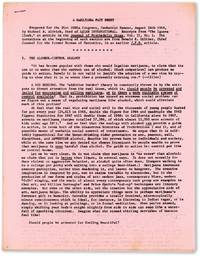
196882020Buffalo NY: SUNYAB LeMar 1968. First Edition. Quarto 28cm; pink sheets with text mimeographed in black on recto and verso and stapled at upper left corner; 8pp. Mild handling some very subtle toning to text edges; Near Fine. A substantial document prepared by Michael Aldrich head of LeMar International for the 21st Congress of the United States National Student Association USNSA which from 1947-1978 functioned as the dominant national union of students in the U.S. responsible for an extensive variety of student organizing throughout its history. The contents clearly aimed to educate covered such topics as psychological dependence the physical effects of marijuana whether marijuana contributes to insanity the commission of crimes or leads to heroin usage with discussion of the drugs' positive properties in comparison to alcohol usage. The document concludes with 34-point list of notes and sources and a plug for both the LeMar Information Kit $2.50 and back issues of The Marijuana Review. An uncommon survival not separately listed in OCLC. 82020. SUNYAB LeMar] unknown
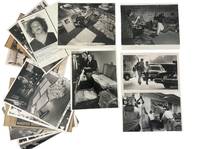
1970231661970. Narcotics raids arrests rehabilitation scenes and evidence displays across Florida in press photographs and magazine pages. Photograph archive spanning Miami Fort Lauderdale Pasco County and related Florida sites from 1970 to the early 1990s establishing how drug control operated through police action newspaper circulation and treatment institutions during the War on Drugs. Produced for press use by newspaper staff photographers wire services and law enforcement publicity channels the group shows the public face of narcotics enforcement at the point when South Florida had become a major corridor in the national drug economy and anti drug policy was being made newly visible through staged photographs official briefings and widely circulated arrest imagery. Named figures included such as Bob Gladden Larry Csonka Jim Kiick Admiral Rickover Carl Mingo and several rehab subjects identified by hand on the versos. The photographs depict suspects detained searched paraded identified displayed beside seized contraband and in other cases shown within rehabilitation settings revealing how law enforcement courts newsrooms and treatment programs handled the same crisis through different institutional forms.<br /> <br /> Photo archive of 18 press photographs including 16 silver gelatin press photographs and 2 wire photos approximately 8 x 10 inches Florida 1970 to early 1990s. The core images show narcotics policing in action: a helmeted officer beside a paddy wagon crowded with detainees; a bench filled with young men under detention in an interior holding space; two handcuffed men led from a courthouse or station entrance; a police-released mugshot with typed caption identifying former New England Patriots running back Bob Gladden after arrest in Fort Lauderdale on a marijuana charge; and a street arrest with an armed officer escorting a suspect between parked cars. Several photographs center on the staged display of evidence including tables covered with packets of drugs stacked currency pistols taped "cookie sheets" and open suitcases packed with bricks or cutting materials. One image shows a narcotics dog inspecting rows of luggage; another shows officials at microphones before a sign for the Vice President's National Narcotics Border Interdiction System; another records cocaine seized from a concealed boat compartment. The group also includes rehabilitation scenes with young adults identified en verso in cursive extending the archive beyond arrest photography into treatment culture. Versos carry a dense record of press handling and editorial use including Miami Herald staff photo stamps dated Dec. 15 1970 and Jan. 5 1971 a St. Petersburg Times credit and clipping backing for a Pasco County drug ring case dated May 29 1974 typed bureau captions circled editorial notations such as "cocaine" "marijuana" "drug raid" and "Operation Crackdown" plus handwritten shot descriptions and date-used stamps.<br /> <br /> The earliest prints fall at the threshold of the modern War on Drugs while later additions carry the record forward into the crack era and the more theatrical seizure photography of the 1980s and early 1990s. Florida is central to that story not only as a site of smuggling and interdiction but as a place where narcotics enforcement became highly visual with press conferences celebrity linked arrests tactical raids canine inspections and rehabilitation coverage all translated into newspaper images for public consumption. The present grouping combines an earlier core of related press photographs with later additions and it preserves a strong visual record of how narcotics control was communicated to the public through local papers wire distribution and agency captioning. Light surface wear minor edge and corner handling editorial markings and stamps to versos scattered adhesive residue and toning; overall very good condition. A concentrated Florida press record of the machinery publicity and human management of drug enforcement across two decades. unknown
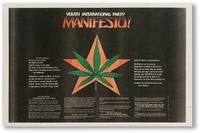
196882927New York: Youth International Party 1968. First Edition. Original illustrated poster offset printed in black red and green on white stock measuring 89.5cm x 58cm 35.25" x 22.75". Clean and fresh; professionally conserved to remove old tape adhesions; a few small repairs at margins; Near Fine. Professionally mounted too archival canvas.<br /> <br /> Manifesto of the Youth International Party founded by Abbie and Anita Hoffman Jerry Rubin Paul Krassner and Nancy Kurshan in the Hoffman's New York apartment on December 31 1967. The poster is largely comprised of the Yippie flag - a pot leaf superimposed on a red star in a sea of black - with text printed in red and white. The "New Nation" statement in the manifesto was meant to embody the group's ethos for an entire generation. OCLC notes a single holding UC Davis; we note one other held at OMCA. Youth International Party unknown
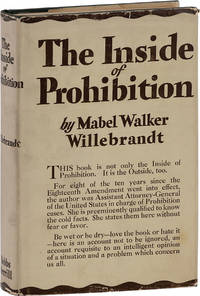
192963853Indianapolis: The Bobbs-Merrill Company 1929. First Edition. First Printing. Octavo 20.5cm; evergreen cloth with titles stamped in gilt on spine and front cover; dustjacket; iv89-3471pp. Small faint dampstain to upper left corner of rear cover else a fresh very Near Fine copy. Dustjacket is price-clipped showing light wear mild dust-soil a few small tears and creases and a corresponding faint dampstain to upper rear flap fold; Very Good. Lengthy volume by the former assistant attorney general for the Justice Department responsible for enforcing the Volstead Act from 1921-1929. "She worked closely with both the Woman's Christian Temperance Union and the Anti-Saloon League to build public support for the federal efforts. She also used liquor prosecutions to generate headlines. A number of times Willebrandt sat in the courtroom while one of her assistants pressed a case. Since women government lawyers were quite a novelty in the 1920s her actions generated press coverage. Similarly she focused much of her action on corruption cases that grew out of the violation of prohibition again headline grabbers. She did not seek press notice gratuitously but as a part of a Justice Department campaign to showcase prohibition enforcement activity and to make a case to the public for cleaner government. Willebrandt published first in syndicated newspaper column form and then as a book The Inside of Prohibition her vision for effective prohibition law enforcement. She called for clean government greater coordination between national and local officials and especially for common people to take responsibility for seeing the laws enforced" Badr Jehad and Mark Weir. "Prohibition's Portia: Mabel Walker Willebrandt." online resource. An attractive copy uncommon in commerce. The Bobbs-Merrill Company unknown
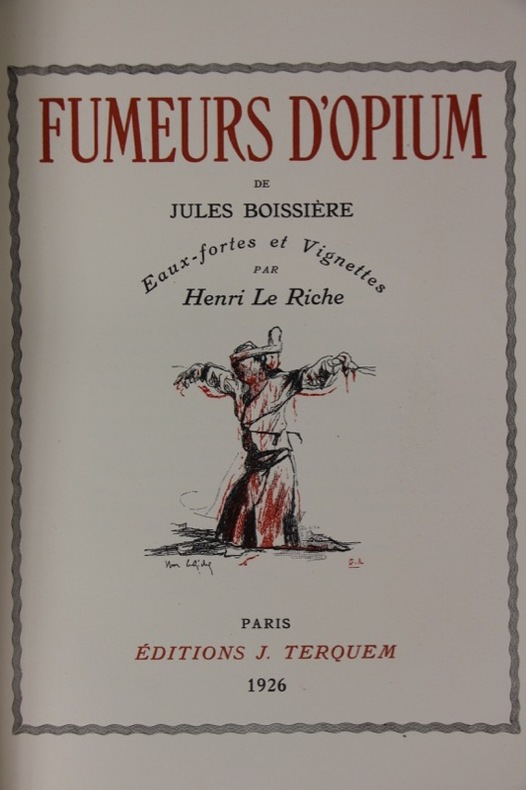
192637144Paris, Terquem 1926 Grand in-4, demi-maroquin brun a coins, dos a nerfs richement orne, couv. conservees. Vignette de titre, frontispice coul., 18 eaux-fortes en noir dont 9 hors-texte et 7 culs-de-lampe, le tout augmente d’une suite en sanguine de toutes les illustrations avec des remarques par Henri Le Riche la suite des culs-de-lampe et de la vignette de titre sont en fin de volume.