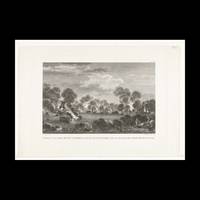
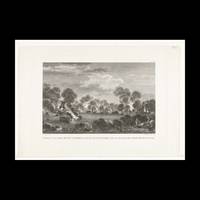
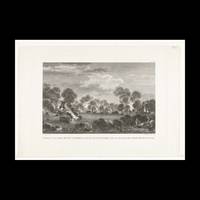
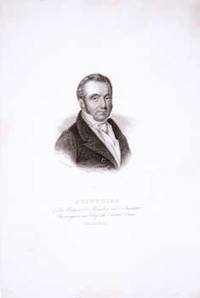
Zurlauben. - DEQUEVAUVILLER, sc. d’après Le BARBIER Lainé:Livre Rare Book

49 résultats
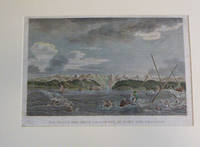
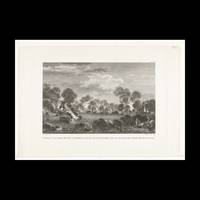
111518aaf(Paris, Clousier & Lamy), s.d., (1780-1786), 35x21.6 cm. Tirée de l’ouvrage de Laborde et Zurlauben «Tableaux topographiques de la Suisse, planche n° 65. En exceptionnel état de fraîcheur des couleurs. 1 feuille / 1 Blatt 29.4x41 cm.
230595s.d. à vue : 28 x 39.5 cm - cadre : 39 x 50 cm, encadrée sous verre, cadre postérieur à baguettes dorées. Très légers manques au cadre.
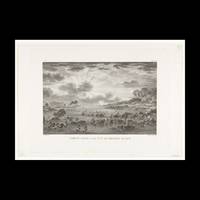
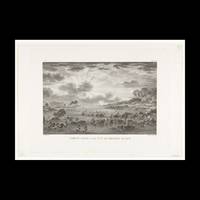
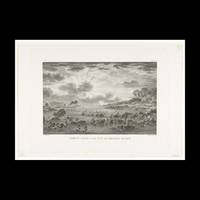
51-7165Paris: L'Imprimerie de la Republique 1797. Engraving. Handcolored and matted. The work titled "Naufrage des deux chaloupes au Port des Francais" was created by Nicolas Marie Ozanne and engraved by Dequevauviller with script by L. Aubert. It is Plage 25 in the "Atlas du Voyage de la Perouse" published in 1797 by L'Imprimerie de la Republique. The engraving measures 41 cm in width and 28 cm in height.This composition is an engraved drawing depicting a dramatic maritime scene at Lituya Bay Alaska. The setting is a tumultuous sea where two longboats chaloupes are shown shipwrecked. The foreground is dominated by the chaotic struggle of sailors clinging to debris amidst towering waves. The figures are rendered with dynamic expressions and gestures emphasizing the peril and urgency of the situation.In the middle ground the remaining parts of the vessels are visible and some crew members attempt to navigate the wreckage. The background features a serene landscape of rugged mountains and dense forests offering a stark contrast to the tumultuous scene in the foreground. The sky is filled with dramatic clouds enhancing the overall tension and atmosphere of the artwork.The engraving's style reflects the precision and attention to detail typical of late 18th-century maritime art. The lines are finely etched capturing both the ferocity of the sea and the tranquility of the surrounding landscape.This work is historically significant as it is part of the narrative of Jean-Francois de Galaup comte de La Perouse's voyage. La Perouse embarked on an expedition from France in 1785 to further the discoveries initiated by Captain Cook. Unfortunately he was shipwrecked in 1788 but his documented experiences including maps and views were preserved and published in this atlas.The cultural context reflects the Age of Enlightenment's spirit of exploration and scientific inquiry as European powers sought to chart unknown territories. This particular scene set in Alaska underscores the dangers faced by explorers during these expeditions.The engraving is part of a larger atlas "La Perouse's Voyages" which contains 34 maps and views. This specific piece is listed under List No 3355.025 and Page No 25 in the Rumsey Collection. The work is an exceptional example of 18th-century cartographic art issued to accompany La Perouse's global voyages with particular emphasis on the hazards and discoveries encountered during these explorations. Paris: L'Imprimerie de la Republique, 1797 unknown
2169aafs.d., (1780-86), 35 x 22 cm l'image, gravure sur cuivre originale tirée de Zurlauben, Tableaux topographiques de la Suisse, planche n° 48. au verso Ex Libris James Whishaw, 1 feuille.
83957aaf1780-86». 35 x 22 cm. gravure sur cuivre orignale, Dessinée par le Barbier gravée par Dequevauvillier. Tirée de: «Zurlauben, Tableaux topographiques de la Suisse. Blatt n°30 au verso Ex Libris James Whishaw, 1 feuille
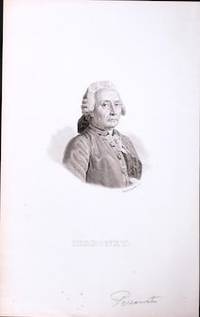
70-1219Paris : 19th Century European Publisher 1800s. Original B&W gravure. 9.25 x 6 inches. Very Good. Minor spots of foxing at bottom edge not affecting image. Penciled notation at bottom edge. Paris : [19th Century European Publisher], [1800s?]. unknown
180925355Paris: Imprimerie Impériale 1809. Fine. Imprimerie Impériale Paris 1809-1829 53.50 x 70.50 cm une feuille Original unshaved full-page etching from the Imperial edition of the Description de l'Égypte or Recueil des observations et recherches faites en Égypte pendant l'expédition française publié par les ordres de Sa Majesté l'Empereur Napoléon le Grand A Collection of the observations and research carried out in Egypt during the French expedition published on the orders of his Majesty the Emperor Napoleon the Great'.Produced between February 1802 and 1830 on the orders of Naopleon Bonaparte and published between 1809 and 1828 1000 copies were printed and distributed to institutions on vergé paper with an 'Égypte ancienne et moderne' watermark visible when held up to the light. Light marginal spotting not touching image otherwise in very fresh fine condition. An engraving from the Description de l'Egypte one of the masterpieces of French printing and the birth of a new field: Egyptology. A gigantic survey of Egypt at the time of Bonaparte's conquests in 1798 and 1799 the work is divided into 13 volumes of engravings making up 892 plates of which 72 colored as well as presenting the splendors of the Egypt of the Pharaohs in 9 volumes. The other volumes discuss natural history and present a fascinating portrait of Coptic and Islamic Egypt as it was seen by Bonaparte's Eastern Armies. The Egyptian campaign' militarily a disaster demonstrates through the engravings of the Description d'Egypte the scientific success it nonetheless became thanks to the 167 expert members of the Commission of the Sciences and Arts of the Institut d'Egypte Egyptian Institute who followed Napoleon's army. The Institut gathered together in Egypt the mathematician Monge the chemist Berthollet the naturalist Geoffroy Saint-Hilaire as well as numerous artists engineers architects and doctors. They were tasked with re-discovering modern and ancient Egypt and displaying its natural treasures as well as the know-how of its inhabitants.This edition the so-called Imperial edition of the plates for the Description de l'Egypte was printed in four large formats two of which were specially created for it and christened Moyen-Egypte and Grand-Egypte. A special press was built to print it the process extending over 20 years from 1809 to 1829. The Imperial edition proved so popular that a second edition this time in black and white and without the Egypte ancienne et moderne watermark known as the Royal Edition was published during the Restoration by the printing house of C.-L.-F. Panckoucke Paris.The engravings of the Description d'Egypte owe a great deal to Baron Dominique-Vivant Denon illustrator diplomat collector and later Director of the Musée Napoléon the Louvre. His exploration of the South of Egypt gave Bonaparte the idea of sending the experts of the Institut there thus creating a faithful and complete portrait of the area. This was the research gathered together from 1802 in the mammoth Description de L'Egypte.Denon embarked on this story of archeological exploration at the age of 51 reaching first Alexandria and then Cairo before exploring Upper Egypt. Along with the members of the Institut d'Egypte the Natural History Museum's painter H.J. Redouté brother of Pierre-Joseph Redouté author of Roses the mineralogist Dolomiue and the draughtsman Joly Denon then explored the Nile Delta and Lower Egypt. When however he joined the 21st Light Infantry Regiment as it marched across Upper Egypt in pursuit of the retreating Mameluks in November 1798 he found himself the only civilian. In the very midst of the battle itself he reeled off sketches of the works of art that peppered his path right up to the threshold of the Sudan. He said that he had crossed a country that is apart from its name entirely unknown to Europeans and therefore everything was worth describing Voyages dans la Basse et la Haute Egypte pendant les campag Imprimerie Impériale unknown
180925336Paris: Imprimerie Impériale 1809. Fine. Imprimerie Impériale Paris 1809-1829 70.50 x 53.50 cm une feuille Original unshaved full-page etching from the Imperial edition of the Description de l'Égypte or Recueil des observations et recherches faites en Égypte pendant l'expédition française publié par les ordres de Sa Majesté l'Empereur Napoléon le Grand A Collection of the observations and research carried out in Egypt during the French expedition published on the orders of his Majesty the Emperor Napoleon the Great'.Produced between February 1802 and 1830 on the orders of Naopleon Bonaparte and published between 1809 and 1828 1000 copies were printed and distributed to institutions on vergé paper with an 'Égypte ancienne et moderne' watermark visible when held up to the light. Light marginal spotting not touching image otherwise in very fresh fine condition. An engraving from the Description de l'Egypte one of the masterpieces of French printing and the birth of a new field: Egyptology. A gigantic survey of Egypt at the time of Bonaparte's conquests in 1798 and 1799 the work is divided into 13 volumes of engravings making up 892 plates of which 72 colored as well as presenting the splendors of the Egypt of the Pharaohs in 9 volumes. The other volumes discuss natural history and present a fascinating portrait of Coptic and Islamic Egypt as it was seen by Bonaparte's Eastern Armies. The Egyptian campaign' militarily a disaster demonstrates through the engravings of the Description d'Egypte the scientific success it nonetheless became thanks to the 167 expert members of the Commission of the Sciences and Arts of the Institut d'Egypte Egyptian Institute who followed Napoleon's army. The Institut gathered together in Egypt the mathematician Monge the chemist Berthollet the naturalist Geoffroy Saint-Hilaire as well as numerous artists engineers architects and doctors. They were tasked with re-discovering modern and ancient Egypt and displaying its natural treasures as well as the know-how of its inhabitants.This edition the so-called Imperial edition of the plates for the Description de l'Egypte was printed in four large formats two of which were specially created for it and christened Moyen-Egypte and Grand-Egypte. A special press was built to print it the process extending over 20 years from 1809 to 1829. The Imperial edition proved so popular that a second edition this time in black and white and without the Egypte ancienne et moderne watermark known as the Royal Edition was published during the Restoration by the printing house of C.-L.-F. Panckoucke Paris.The engravings of the Description d'Egypte owe a great deal to Baron Dominique-Vivant Denon illustrator diplomat collector and later Director of the Musée Napoléon the Louvre. His exploration of the South of Egypt gave Bonaparte the idea of sending the experts of the Institut there thus creating a faithful and complete portrait of the area. This was the research gathered together from 1802 in the mammoth Description de L'Egypte.Denon embarked on this story of archeological exploration at the age of 51 reaching first Alexandria and then Cairo before exploring Upper Egypt. Along with the members of the Institut d'Egypte the Natural History Museum's painter H.J. Redouté brother of Pierre-Joseph Redouté author of Roses the mineralogist Dolomiue and the draughtsman Joly Denon then explored the Nile Delta and Lower Egypt. When however he joined the 21st Light Infantry Regiment as it marched across Upper Egypt in pursuit of the retreating Mameluks in November 1798 he found himself the only civilian. In the very midst of the battle itself he reeled off sketches of the works of art that peppered his path right up to the threshold of the Sudan. He said that he had crossed a country that is apart from its name entirely unknown to Europeans and therefore everything was worth describing Voyages dans la Basse et la Haute Egypte pendant les campag Imprimerie Impériale unknown
180925336Imprimerie Impériale | Paris 1809-1829 | 70.50 x 53.50 cm | une feuille
180925355Imprimerie Impériale | Paris 1809-1829 | 53.50 x 70.50 cm | une feuille
86218s.l.n.n, [circa 1800], , , , Gravure en taille-douce par Dequevauviller et Duchemin d'après le portrait de Kratzer d'Hans Holbein le jeune en 1528. Dimensions de la planche : 22 x 16.5 cm. Couverture rigide
186140312Paris, Jerusalem u. Beirut, 1857-1861. Zus. 64 S., 8° bis 4°.
1432681Contentum Ltd. Loose sheet. New. High-quality art print based on an original work from the Rijksmuseum. Created in the 18th century 1755. Professionally printed on premium fine-art paper Photo Rag Bright White premium quality in size A2. The artwork is printed with a white border museum-style presentation. Contentum Ltd. unknown
1432682Contentum Ltd. Loose sheet. New. High-quality art print based on an original work from the Rijksmuseum. Created in the 18th century 1755. Professionally printed on premium fine-art paper Museum Etching museum quality in size A2. The artwork is printed with a white border museum-style presentation. Contentum Ltd. unknown
1432679Contentum Ltd. Loose sheet. New. High-quality art print based on an original work from the Rijksmuseum. Created in the 18th century 1755. Professionally printed on premium fine-art paper Museum Etching museum quality in size A3. The artwork is printed with a white border museum-style presentation. Contentum Ltd. unknown
1432680Contentum Ltd. Loose sheet. New. High-quality art print based on an original work from the Rijksmuseum. Created in the 18th century 1755. Professionally printed on premium fine-art paper Photo Matt Fibre in size A2. The artwork is printed with a white border museum-style presentation. Contentum Ltd. unknown
68-6294Paris France: Blaisot circa 1825 - 1830. Engraving on laid deckled rag paper. 21.5 x 29 cm. sheet size; 7 x 10.5 cm. engraved portion. Good with minor tears at edge well away from image & damp-staining; else Very Good. En Francais.Portrait engraving published by Antoine Bara Blaisot 1794 - 1876. He was a nineteenth cenutry publisher of fine art prints as well as an editor of literary works. Paris: circa 1825 - 1830. Paris, France: Blaisot, circa 1825 - 1830. unknown
68-6287Paris France: Blaisot circa 1825 - 1830. Engraving on laid deckled rag paper. 21.5 x 29 cm. sheet size; 7 x 10.5 cm. engraved portion. Good with minor tears at edge well away from image & damp-staining; else Very Good. En Francais.Portrait engraving published by Antoine Bara Blaisot 1794 - 1876. He was a nineteenth cenutry publisher of fine art prints as well as an editor of literary works. Paris: circa 1825 - 1830. Paris, France: Blaisot, circa 1825 - 1830. unknown
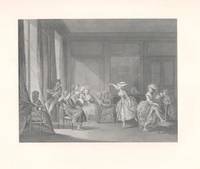
76-0135Paris: French Publisher circa 1788. Engraving on wove paper. 25.5 x 32.5 cm sheet. Very Good toning along sheet edges. [Paris: French Publisher, circa 1788]. unknown
68-6284Paris France: Blaisot circa 1825 - 1830. Engraving on laid deckled rag paper. 21.5 x 29 cm. sheet size; 7 x 10.5 cm. engraved portion. Good with minor tears at edge well away from image & damp-staining; else Very Good. En Francais.Portrait engraving published by Antoine Bara Blaisot 1794 - 1876. He was a nineteenth cenutry publisher of fine art prints as well as an editor of literary works. Paris: circa 1825 - 1830. Paris, France: Blaisot, circa 1825 - 1830. unknown
1432653Contentum Ltd. Loose sheet. New. High-quality art print based on an original work from the Rijksmuseum. Created in the 18th century 1794. Professionally printed on premium fine-art paper Museum Etching museum quality in size A3. The artwork is printed with a white border museum-style presentation. Contentum Ltd. unknown
1432656Contentum Ltd. Loose sheet. New. High-quality art print based on an original work from the Rijksmuseum. Created in the 18th century 1794. Professionally printed on premium fine-art paper Museum Etching museum quality in size A2. The artwork is printed with a white border museum-style presentation. Contentum Ltd. unknown
1432654Contentum Ltd. Loose sheet. New. High-quality art print based on an original work from the Rijksmuseum. Created in the 18th century 1794. Professionally printed on premium fine-art paper Photo Matt Fibre in size A2. The artwork is printed with a white border museum-style presentation. Contentum Ltd. unknown
1432655Contentum Ltd. Loose sheet. New. High-quality art print based on an original work from the Rijksmuseum. Created in the 18th century 1794. Professionally printed on premium fine-art paper Photo Rag Bright White premium quality in size A2. The artwork is printed with a white border museum-style presentation. Contentum Ltd. unknown
70-1202Paris : Blaisot 1800s. Original B&W gravure. 5.25 x 7.75 inches. Very Good. Very light smudging. Penciled notation at bottom edge. Paris : [Blaisot], [1800s?]. unknown