COLLIN D HARLEVILLE Jean-FrançoisLivre Rare Book
9 résultats
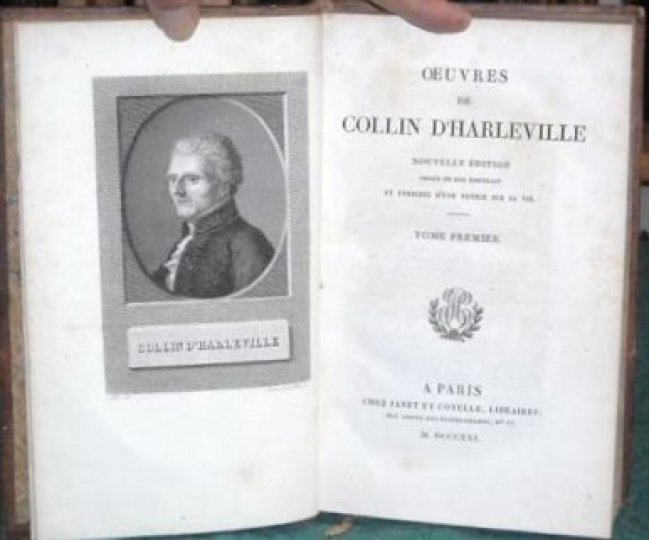
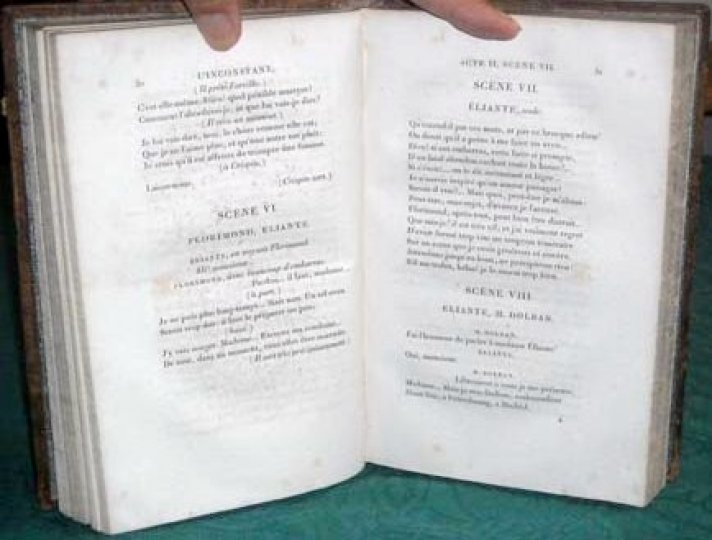
182110716Nouvelle édition ornée de son portrait (Méhü-Dequevauviller) et enrichie d'une Notice sur sa Vie.Tome 1. L'inconstant - L'optimiste - Les Châteaux en Espagne.Tome 2. Le vieux Célibataire - Monsieur de Crac - Les Artistes - Les Moeurs du jour.Tome 3. Le Vieillard et les jeunes Gens - Malice pour Malice - Il veut tout faire - Les Riches.Tome 4. Poésies fugitives - Les querelles des deux frères.A Paris, chez Janet et Cotelle 1821.Reliure plein veau raciné de l'époque. Dos lisse orné et doré avec pièces de titre et de tomaison rouges. Tranches marbrées. Accident au dos du T1. Dos des T1 et T4 frottés. Quelques rousseurs. Bon état intérieur. Format in-8° (21x13).
182116074Nouvelle édition ornée de son portrait (de Méhü et Dequevauviller) et enrichie d'une Notice sur sa Vie (par Andrieux).L'Inconstant - L'Optimiste - Les Châteaux en Espagne - Variantes - Poésies fugitives - Les Querelles des deux Frères - Le Vieux Célibataire - Malice pour Malice - etc. etc.A Paris, chez Janet et Cotelle - 1821 - cxviij et 321 pages, 408, 402 et 297 pages.Suivi de "Les Querelles des deux Frères ou La Famille bretonne, comédie en trois actes et en vers, ouvrage posthume de Collin d'Harleville. Précédée d'un Prologue de M. Andrieux. Représentée pour la première fois sur le théâtre de l'Impératrice, le 17 novembre 1808. 120 pages.Reliure plein veau raciné de l'époque. Dos lisse orné et doré avec pièces de titre rouges et de tomaison vertes. Tranches marbrées. Roulette dorée encadrant les plats, filet sur les coupes. Quelques légers frottements. Quelques rousseurs. Bon état. Format in-8°(21x13).
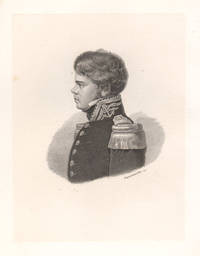
184014291840. Steel-engraving. 150mm by 110mm india-laid paper. India-laid.<br /> Jules Poret de Blosseville 1802-1833 was a French navigator explorer and geographer. He spent nearly a month in New South Wales in January 1824 using his ability in English and his training in astronomy to work with Governor Sir Thomas Brisbane in the latter's new observatory.One small foxing spot on left edge. A few marks in outer margins. unknown
180925355Imprimerie Impériale | Paris 1809-1829 | 53.50 x 70.50 cm | une feuille
180925355Paris: Imprimerie Impériale 1809. Fine. Imprimerie Impériale Paris 1809-1829 53.50 x 70.50 cm une feuille Original unshaved full-page etching from the Imperial edition of the Description de l'Égypte or Recueil des observations et recherches faites en Égypte pendant l'expédition française publié par les ordres de Sa Majesté l'Empereur Napoléon le Grand A Collection of the observations and research carried out in Egypt during the French expedition published on the orders of his Majesty the Emperor Napoleon the Great'.Produced between February 1802 and 1830 on the orders of Naopleon Bonaparte and published between 1809 and 1828 1000 copies were printed and distributed to institutions on vergé paper with an 'Égypte ancienne et moderne' watermark visible when held up to the light. Light marginal spotting not touching image otherwise in very fresh fine condition. An engraving from the Description de l'Egypte one of the masterpieces of French printing and the birth of a new field: Egyptology. A gigantic survey of Egypt at the time of Bonaparte's conquests in 1798 and 1799 the work is divided into 13 volumes of engravings making up 892 plates of which 72 colored as well as presenting the splendors of the Egypt of the Pharaohs in 9 volumes. The other volumes discuss natural history and present a fascinating portrait of Coptic and Islamic Egypt as it was seen by Bonaparte's Eastern Armies. The Egyptian campaign' militarily a disaster demonstrates through the engravings of the Description d'Egypte the scientific success it nonetheless became thanks to the 167 expert members of the Commission of the Sciences and Arts of the Institut d'Egypte Egyptian Institute who followed Napoleon's army. The Institut gathered together in Egypt the mathematician Monge the chemist Berthollet the naturalist Geoffroy Saint-Hilaire as well as numerous artists engineers architects and doctors. They were tasked with re-discovering modern and ancient Egypt and displaying its natural treasures as well as the know-how of its inhabitants.This edition the so-called Imperial edition of the plates for the Description de l'Egypte was printed in four large formats two of which were specially created for it and christened Moyen-Egypte and Grand-Egypte. A special press was built to print it the process extending over 20 years from 1809 to 1829. The Imperial edition proved so popular that a second edition this time in black and white and without the Egypte ancienne et moderne watermark known as the Royal Edition was published during the Restoration by the printing house of C.-L.-F. Panckoucke Paris.The engravings of the Description d'Egypte owe a great deal to Baron Dominique-Vivant Denon illustrator diplomat collector and later Director of the Musée Napoléon the Louvre. His exploration of the South of Egypt gave Bonaparte the idea of sending the experts of the Institut there thus creating a faithful and complete portrait of the area. This was the research gathered together from 1802 in the mammoth Description de L'Egypte.Denon embarked on this story of archeological exploration at the age of 51 reaching first Alexandria and then Cairo before exploring Upper Egypt. Along with the members of the Institut d'Egypte the Natural History Museum's painter H.J. Redouté brother of Pierre-Joseph Redouté author of Roses the mineralogist Dolomiue and the draughtsman Joly Denon then explored the Nile Delta and Lower Egypt. When however he joined the 21st Light Infantry Regiment as it marched across Upper Egypt in pursuit of the retreating Mameluks in November 1798 he found himself the only civilian. In the very midst of the battle itself he reeled off sketches of the works of art that peppered his path right up to the threshold of the Sudan. He said that he had crossed a country that is apart from its name entirely unknown to Europeans and therefore everything was worth describing Voyages dans la Basse et la Haute Egypte pendant les campag Imprimerie Impériale unknown
183521011Paris: Remond 1835. Very good overall. Exquisite stipple engraving of fish discovered on Dumont D'Urville's "Voyage de l'Astrolabe -- Zoologie". The French voyages in this period benefited from the French expansive world view that saw artists & scientists accompanying the sailors on French voyages of exploration recording scientific detail and assembling natural history collections. Jules Dumont D'Urville visited Australia twice 1826-29 & 1837-40. His account of the second voyage was published in 1842 text volumes; 1846 atlas and 1853 natural history plates. <br /> <br /> Folio Image 16 x 10.5 in with large margins. Plate 1 from the "Poissons" section. Clean copy. Tide mark in margin not near printed surface. Remond unknown
180925336Imprimerie Impériale | Paris 1809-1829 | 70.50 x 53.50 cm | une feuille
180925336Paris: Imprimerie Impériale 1809. Fine. Imprimerie Impériale Paris 1809-1829 70.50 x 53.50 cm une feuille Original unshaved full-page etching from the Imperial edition of the Description de l'Égypte or Recueil des observations et recherches faites en Égypte pendant l'expédition française publié par les ordres de Sa Majesté l'Empereur Napoléon le Grand A Collection of the observations and research carried out in Egypt during the French expedition published on the orders of his Majesty the Emperor Napoleon the Great'.Produced between February 1802 and 1830 on the orders of Naopleon Bonaparte and published between 1809 and 1828 1000 copies were printed and distributed to institutions on vergé paper with an 'Égypte ancienne et moderne' watermark visible when held up to the light. Light marginal spotting not touching image otherwise in very fresh fine condition. An engraving from the Description de l'Egypte one of the masterpieces of French printing and the birth of a new field: Egyptology. A gigantic survey of Egypt at the time of Bonaparte's conquests in 1798 and 1799 the work is divided into 13 volumes of engravings making up 892 plates of which 72 colored as well as presenting the splendors of the Egypt of the Pharaohs in 9 volumes. The other volumes discuss natural history and present a fascinating portrait of Coptic and Islamic Egypt as it was seen by Bonaparte's Eastern Armies. The Egyptian campaign' militarily a disaster demonstrates through the engravings of the Description d'Egypte the scientific success it nonetheless became thanks to the 167 expert members of the Commission of the Sciences and Arts of the Institut d'Egypte Egyptian Institute who followed Napoleon's army. The Institut gathered together in Egypt the mathematician Monge the chemist Berthollet the naturalist Geoffroy Saint-Hilaire as well as numerous artists engineers architects and doctors. They were tasked with re-discovering modern and ancient Egypt and displaying its natural treasures as well as the know-how of its inhabitants.This edition the so-called Imperial edition of the plates for the Description de l'Egypte was printed in four large formats two of which were specially created for it and christened Moyen-Egypte and Grand-Egypte. A special press was built to print it the process extending over 20 years from 1809 to 1829. The Imperial edition proved so popular that a second edition this time in black and white and without the Egypte ancienne et moderne watermark known as the Royal Edition was published during the Restoration by the printing house of C.-L.-F. Panckoucke Paris.The engravings of the Description d'Egypte owe a great deal to Baron Dominique-Vivant Denon illustrator diplomat collector and later Director of the Musée Napoléon the Louvre. His exploration of the South of Egypt gave Bonaparte the idea of sending the experts of the Institut there thus creating a faithful and complete portrait of the area. This was the research gathered together from 1802 in the mammoth Description de L'Egypte.Denon embarked on this story of archeological exploration at the age of 51 reaching first Alexandria and then Cairo before exploring Upper Egypt. Along with the members of the Institut d'Egypte the Natural History Museum's painter H.J. Redouté brother of Pierre-Joseph Redouté author of Roses the mineralogist Dolomiue and the draughtsman Joly Denon then explored the Nile Delta and Lower Egypt. When however he joined the 21st Light Infantry Regiment as it marched across Upper Egypt in pursuit of the retreating Mameluks in November 1798 he found himself the only civilian. In the very midst of the battle itself he reeled off sketches of the works of art that peppered his path right up to the threshold of the Sudan. He said that he had crossed a country that is apart from its name entirely unknown to Europeans and therefore everything was worth describing Voyages dans la Basse et la Haute Egypte pendant les campag Imprimerie Impériale unknown
186140312Paris, Jerusalem u. Beirut, 1857-1861. Zus. 64 S., 8° bis 4°.