Bede the VenerableBiblio.com
10 résultats
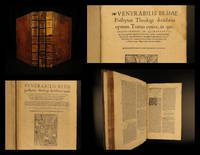
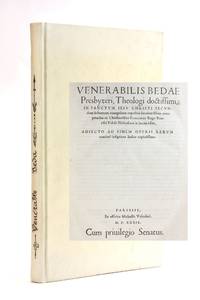
1539505317Michaelis Vascosani Michel Vascosan 1539. Leather. NEAR FINE. 4 218pp. 9 Index. Folio in 6's collation complete: 2 A3-T6 2. Vulgate text printed in larger font with woodcut drop caps marginal references. Nicely bound in recent vellum with hand-written spine title in a convincing antiquarian hand. Some light staining to the edges small wormhole to top margin toward the gutter not affecting text; else FINE internally; a nice fresh copy. Bede the Venerable was one of the greatest minds of the Middle Ages and his immense learning is on full display in this commentary on the Fourth Gospel drawing on the church fathers as well as interlocating Old Testament and intertextual references. Bede had a particular devotion to the Johnannine gospel; his translation of the Vulgate into Old English is held as the first vernacular translation. The value of this particular edition is due to its significance in the history of printing. Vascosan set up his press 1530 under the banner of his father in law the famed printer Badius and adorned his title pages with the Badius printer's device through the decade. For reasons unclear possibly a dispute with relatives sharing an interest in the firm in 1539 Vascosan stopped using the Badius device. Rather than cut his own device Vascosan simply printed his title pages without one remarkably becoming the first printer to forego this branding tool that was so essential to printer differentiation in an age when books were sold without bindings. While his motivations at the outset are unclear it may have been simply needing to sell some books before a proper device could be cut he took a liking to it and maintained this style throughout his career. Today he is remembered as a pioneer of this 'unadorned elegance of his editions' Oxford Companion to the Book p. 1238. His text-only title pages were 'a harbinger of a new approach to title pages. Vascosan’s decision flew in the face of the Parisian and more generally European book-trade where printers’ devices had played a vital role in the identification and marketing of printers’ and booksellers’ output. He was trail-blazing a new method of promoting his works – a minimalist style which would challenge the use of ornate devices so popular among the first generation of Parisian printers and booksellers. Coupled with his rejection of a printer’s device was what one might call his ‘purification’ of the title page for his title pages are incredibly simple in style the whiteness of the paper dominating. Henri-Jean Martin wittily calls this ‘the graphic mode’ of ‘solemnization of the title page’ as opposed to the second ‘monumental mode’ which by the end of the sixteenth century became saturated with symbols and architectural motifs.' Exhibition Catalog 'Printing in Sixteenth-Century France at the Edward Worth Library.' While we cannot speculate on the priority of printings within the year 1539 we can say that no other copies of a 1539 Vascosan imprint are available in trade at this time and only one appears in auction records. OCLC 60698411 listes 8 copies. Michaelis Vascosani [Michel Vascosan] unknown
154511735<p><b>1545 Saint Venerable BEDE Bible & Commentary English Monk Church Cosmology </b></p><p>Saint Venerable Bede was an English monk during the 7th- and 8th-centuries. He is most remembered for his ecclesiastical work on the history of English people in which he discusses the establishment and growth of the church throughout the known world. He also wrote important commentaries on the books of the Bible. This work explains relevant Biblical passages as well as describes the allegorical notes of Church Fathers. However he did not write exclusively of church theology. He also wrote on the development of time and ideas of cosmology. </p><p>This 16th-century Latin edition was published in Paris by Roigny. An impressive three-volume folio set!</p><p>Item number: #11735</p><p>Price: $3500</p><p>BEDE Saint Venerable</p><p><b><i>Venerabilis Bedae presbyteri theologi doctissimi juxta ac sanctissimi commentationum in Sacras Literas tomus primus : in quo ea maximè quae Veteris Testamenti sunt ita perspicuè ac dilucidè enarrantur ut inter celeberrimos ejus argumenti tractatores…</i></b></p><p>Parisiis : Apud Joannem Roigny 1545/44. 1st editions</p><p><br /></p><p><u>Details</u>: </p><p>· Collation: Complete with all pages; 3 volumes</p><p>o Vol I – 16 272</p><p>o Vol II – 16 264</p><p>o Vol III – 12 260</p><p>· References: USTC 149316</p><p>· Language: Latin</p><p>· Binding: Leather; tight & secure</p><p>· Size: ~13in X 9in 33.5cm x 23cm</p><p>· Exceedingly rare and desirable set</p><p>Our Guarantee:</p><p>Very Fast. Very Safe. Free Shipping Worldwide.</p><p>Customer satisfaction is our priority! Notify us with 7 days of receiving and we will offer a full refund without reservation!</p><p>11735</p><p>Photos available upon request. </p> Joannem Roigny hardcover
154421323Paris: Petrum Regnault 1544. First Edition. . Hardcover. Good. Folio. Vignette title not in British library 261pp Vellum <br/> <br/> Petrum Regnault hardcover
156532099Antwerp: John Laet 1565. Five books in one volume. A VERY RARE COMPLETE COPY the First Edition of Historia ecclesiastica gentis Anglorum translated into English. Provenance: Montanus 1602 -- Sir Roger Twysden 1648 and Sir John Saunders Sebright armorial bookplate. With woodcut device on titlepage woodcut armorial dedication to Queen Elizabeth woodcut plate of St. Augustin with Elbert King of Kent in anno 596 woodcut plate of King Oswald uniting the Umbrian kingdoms halfpage woodcut of Elbert building St. Paul's and with many large and handsome woodcut initials all throughout. The woodcuts are possibly by Arnaud Nicolai. Small 4to 188 x 140 mm in antique three-quarter russia over marbled boards the spine with raised bands ruled in gilt one compartment gilt lettered gilt dating at the tail gilt lined back and cornerpieces. 1-6 >1-4 #1-4 192 9 pp. A truly excellent survival of a book rarely found complete. The text-block is especially fresh and well preserved crisp and very clean. The blanks date from the time of the binding but the text is otherwise wholly complete and original the binding is handsome though its age is evident and there was restoration some time ago to the hinges the front of which is also strengthened from within. VERY RARE FIRST EDITION IN ENGLISH OF THE FIRST AND GREATEST WORK OF ENGLISH HISTORY BY THE FATHER OF ENGLISH HISTORY. RARE IN COMPLETE STATE when one reads the catalogue entries of copies in even some of the worlds most prestigious institutions one finds descriptions of missing signatures facsimile titles or entire sections excised to be quite the norm. This copy but for its probable early 19th century blank flies and endpapers is wholly intact and in a truly exceptional state of preservation.<br> The Venerable Bede's title of "The Father of English History" is well deserved. He was England’s greatest historian in the Middle Ages. His greatest work is the Historia Ecclesiastica here in its first English edition. It is an ecclesiastical history of the English people. Bede begins with Caesar’s invasion in 55 BCE and St. Alban’s martyrdom in Roman Britain tracks the spread of Christianity following St. Augustine’s mission to England in 597 and provides an account of critical events such as the Council of Whitby which decided that Roman rather than Celtic Christian customs would be followed in Britain.<br> Bede drew on the many manuscripts in the Jarrow monastery’s outstanding library and correspondents provided him materials. He was a diligent scholar and properly credited his sources. To the benefit of historical scholarship Historia Ecclesiastica spread widely throughout Europe in the Middle Ages with some 160 manuscripts still surviving. Not long after his death he became known as the Venerable Bede. His was one of the first printed history books published in Latin in Strasbourg about 1475. Highly popular on the Continent and in Britain it was reprinted in 1500 1506 and 1514.<br> Due to its strong association with Catholicism this first translation into the English tongue was published in Antwerp as the book was then prohibited in England as traitorous. Stapleton was educated in Oxford where he became a fellow in 1553. On Queen Elizabeth’s accession he left England to study theology in Louvain and Paris. His translation of Bede was his first of many fine works. Stapleton used Bede’s history to remind the reader that “we Englishmen also these many hundred of years kept and preserved sound and whole the precious perle of right faith and belefe†and he admonished that “after we forsooke the first paterne off the Christen faith delievered to us we have fallen in to plenty of heresies.†He added that the Venerable Bede a most reliable source describes many miracles that occurred in Britain under the true faith. Stapleton's translation has been called an "enduring contribution to this sparkling collection of recusant prose" -DNB <br> This is also a copy of fine and established provenience. It was formerly owned by the renown historian and antiquary Roger Twysden whose ownership signature is dated 1648. Having been caught up in civil war strife Twysden retired to his seat Roydon Hall and devoted himself to his study and writings particularly on early English histories and monasticism. His collection passed to Sir John Sebright who sold the main portion at auction in 1807. Much of Twysden's collection later passed to Sir John Sebright whose fine engraved armorial plate is afixed to the front paste-down. The present binding was likely made while the book was in Sebright's possession. <br> Contrary to the implications of Stapleton's edition of Bede Twysden's Historical vindication of the Church of England 1657 argued that it was the Church of England rather than Rome which had held fast to the true faith and that the pope's powers over England gained gradually over the centuries had been submitted to voluntarily out of love not duty for the archbishop of Canterbury had no mediate superior but only Christ and God see Jessup Sir Roger Twysden pp. 192-5. Completed in 731 Bede's Historia ecclesiastica gentis Anglorum is 'probably one of the most popular history books in any language and has certainly retained it popularity longer than any rival. The enthusiasm shown for his writings in the eighth century by English missionaries on the Continent such as Boniface Lul and others led to the spread of knowledge of his works not only in England but also in western Europe . . . . From then on as the spread of his manuscripts shows the History became popular all over western Europe and 160 of them survive today in spite of all the wars and other dangers to which manuscripts are always subject' Colgrave & Mynors p. xvii. It was first printed c. 1475 at Strasbourg PMM 16. 'Bede provided for over a thousand years and to a large extent still provides nearly all the knowledge available of the early history of England. His Historia is the only work other than parts of the Bible which has been read by every English generation from his own day to the present. It has the power to move and to convey something of the personality of its author to a degree which has called forth not only admiration but a kind of affection' Oxford DNB. John Laet hardcover
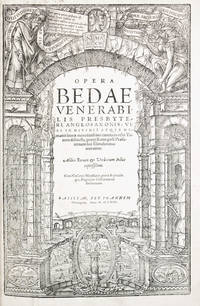
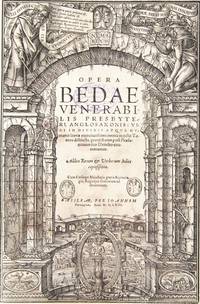
1563254015Basileae i.e. Basle: Per Joannem Hervagium 1563. First collected edition. Title within architectural border with device of Johann Herwagen. Profusely illustrated with iwoodcut maps music tables diagrams. Text in two columns; with Index. 4 vols. Folio. Contemporary calf rebacked new leather spine labels labels misnumbered later endpapers; covers worn but sound one joint starting but firm. Text show various degrees of slight worming and scattered light foxing but overall a very good sound set of this massive collected edition complete except for the final blank leaf of Volume VI. First collected edition. Title within architectural border with device of Johann Herwagen. Profusely illustrated with iwoodcut maps music tables diagrams. Text in two columns; with Index. 4 vols. Folio. The Father of English History. This is the first of three continental editions of the works of Bede the others being from Cologne in 1612 and 1688. Johann Herwage  a printer originally from Strassburg  married  the widow of the great Basel printer Johann Froben and for a while collaborated with his stepson Hieronymus Froben. From 1532 however he again started printing under his own name.<br/><br/>RARE ON THE MARKET. Adams B-477 Per Joannem Hervagium unknown books
15636955Basilae Per Ioannem Heruagium Anno M.D.LXIII. 1563. 1563 Folio. 8 volumes. Later vellum bindings each volume with two labels. New labels and vellum spine to Vol. I. Stamp of an English monastic library on the title pages and also an earlier small stamp from a continental library. Engraved architectural title page to Vol. I. some illustrations music and historiated initials in the text. Old dampstains at the front of Vol. I. A good sound set of the first collected edition of Bede's works. In the autobiographical account appended to his Historia Ecclesiastica Gentis Anglorum Bede lists over thirty of his written works. It omits some of Bede's writings and includes a Commentary on St. Paul which is not by Bede. PBFA Basilae, Per Ioannem Heruagium, Anno M.D.LXIII. hardcover
1563254015Basileae i.e. Basle: Per Joannem Hervagium 1563. First collected edition. Title within architectural border with device of Johann Herwagen. Profusely illustrated with iwoodcut maps music tables diagrams. Text in two columns; with Index. 4 vols. Folio. Contemporary calf rebacked new leather spine labels labels misnumbered later endpapers; covers worn but sound one joint starting but firm. Text show various degrees of slight worming and scattered light foxing but overall a very good sound set of this massive collected edition complete except for the final blank leaf of Volume VI. First collected edition. Title within architectural border with device of Johann Herwagen. Profusely illustrated with iwoodcut maps music tables diagrams. Text in two columns; with Index. 4 vols. Folio. This is the first of three continental editions of the works of Bede the others being from Cologne in 1612 and 1688. Johann Herwage a printer originally from Strassburg married the widow of the great Basel printer Johann Froben and for a while collaborated with his stepson Hieronymus Froben. From 1532 however he again started printing under his own name.<br /> <br /> RARE ON THE MARKET. Adams B-477 Per Joannem Hervagium unknown
152053259Paris, 1520 15X20 cm. Très bon état
152542822Venice: in aedibus Ioannis Tacuini Tridinensis 1525. <p>Bede the Venerable 672/73 - 735. De computo vel loquela per gestum digitorum and De ratione unciarum. In Hoc in volumine haec continentur M. Val. Probus de notis Roma. ex codice manuscript castigatior . . . ed. Giovanni Tacuino Venice: G. Tacuino 1525 ff. LV - LVII. Whole volume 4to. 4 LXXIX i.e. LXXXI 1ff. Title in red and black. Full-page woodcut of a sibyl within an architectural setting signed "b. M." in the block probably Benedetto Montagna a few woodcut initials. 211 x 153 mm. Modern vellum. Fine. </p> <p>Probably the Earliest Printings of Bede's accounts of finger-reckoning and duodecimal fractions. Bede's "De computo vel loquela per gestum digitorum" On calculating and speaking with the fingers and "De ratione unciarum" On calculating duodecimal fractions form part of the introduction to his treatise De temporum ratione On the reckoning of time written around 725 A.D. The editio princeps of De temporum ratione was published by Sichardus in 1529 four years after the present work. Portions of De temporum ratione appeared in print as early as 1505 but these do not appear to have included the section on finger-reckoning. Smith in his Rara arithmetica states that the 1522 edition of Johannes Aventinus's Abacus atque vetustissima veterum latinorum per digitos manusque numerandi contains a description of Bede's finger-reckoning; however we think this may be an error since we have not been able to find any record of this edition in OCLC or the Karlsruhe Virtual Catalogue. Smith himself described only the 1532 edition of Aventinus's work see Rara arithmetica pp. 136-138. </p> <p>Bede's two disquisitions are contained in a collection of works on Latin abbreviations symbols weights measures and inscriptions edited by Giovanni Tacuino. The collection is devoted primarily to works on deciphering the abbreviations used in classical-era stone or bronze inscriptions a subject of great interest to humanistic scholars eager to discover more about the ancient world. Included in the collection is the editio princeps of Petrus Diaconus' De notus literarum more Romano liber which Tacuino had discovered along with a new edition of M. Valerius Probus' De notus Romanorum and several transcriptions of Roman inscriptions in quasi-facsimile. The typographic design of the title is reminiscent of an ancient text in stone. </p> <p>Finger-reckoning a method of computation in which numbers are represented by finger and hand gestures had been practiced since ancient times and was commonly used during the Middle Ages; however there are very few written accounts of the technique dating from these times probably because it was used primarily by "common or illiterate people" Menninger p. 201 who passed its methods on orally. Bede's account of the practice although not the first was the best and most influential. His purpose was to provide a useful method for calculating the Christian calendar most importantly the date of Easter and other movable feasts. </p> <p>Bede listed finger- and hand symbols for the numerals 1 through 9999; these </p> <p>"roughly work like a placement system. The middle ring and little fingers of the left hand denote the digits; the thumb and index fingers on the left hand express the tens; the thumb and index finger on the right hand the hundreds; and the middle ring and little fingers the thousands . . . The informal manner in which Bede explains how to flex the fingers and form gestures seems to retain traces of oral instruction" Kusukawa pp. 28-29. </p> <p>Prior to Europe's adoption of Arabic numerals finger-reckoning provided a rudimentary method of place-value calculation. "Neither Bede nor any of his contemporaries in Western Europe knew about place value or zero but finger reckoning enabled them to proceed as if they did. Finger joints supplied place value-one joint 10s another 100s and so on-and zero was indicated by the normal relaxed position of the fingers-by nothing so to speak. The system was even capable of simple computation" Crosby The Measure of Reality: Quantification in Western Europe 1250-1600 p. 42. </p> <p>Bede's explanation of the Roman system of duodecimal fractions which follows the description of finger-reckoning clarifies the terminology and provides a list of synonyms for different types of fractions. Kusukawa "A manual computer for reckoning time" in Sherman Writing on Hands: Memory and Knowledge in Early Modern Europe pp. 28-34. Menninger Number Words and Number Symbols: A Cultural History of Numbers pp. 201-8.</p> . in aedibus Ioannis Tacuini Tridinensis unknown
158361666Graz, Akademische Druck- u. Verlagsanstalt, 1971 (Nachdruck der Ausgabe Lauingen, 1583). 8°. Mit Textillustrationen. XXXIII S., 8 Bll., 487 S., 27 Bll., OKunstldr.