American Institute of HomeopathyBiblio.com
110 résultats
45286444like new. unknown
1841108608Boston: Daniel L. Hale 1841 Book. Fair. Leather. First Edition. Volume I of this two volume mid-19th century work on healthy living and medicine. Includes a view of the human body old school practice of physic vegetable materia medica compounds practice of medicine and a guide for women. 592 pages plus glossary and index; illustrated. Leather binding is worn and rubbed; rear free endpaper is torn; text is in very good condition; the two pages of illustrations of the human skeleton is worn on the edges. Daniel L. Hale hardcover
M-9-7654309Fine. unknown
1922041133Lima Peru: Imprenta Torres Aguirre 1922 Book. Very Good -. Hardcover. INSCRIBED AND SIGNED BY AUTHOR. First Edition. Cover has minor rubmarks; top of title page has minor wear on top right corner. INSCRIBED and SIGNED by AUTHOR Maldonado on the top of the title page. Very rare copy of this early twentieth century work on medical folklore in Peru illustrated with black-and-white text illustrations and color plates. "Sumario del Primer Volumen" includes "Los mitos medicos - Divinidades y fantasmas"; "Los mitos medicos - El susto"; "Los mitos medicos - El aire. El chocaque La irijua El Ojeo"; "Los mitos medicos - Las yaguas. La urijua. La ticradura"; "La brujeria"; "Las curas misticas"; "La medicina interna"; "Las enfermedades de la piel"; "La vida sexual"; "La Obstetricia"; "La pediatria"; "Las enfermedades mentales y nerviousas" "La cirujia" "La oftalmologia. La venereologia"; and "El hombre manatial terapeutico". Imprenta Torres Aguirre hardcover
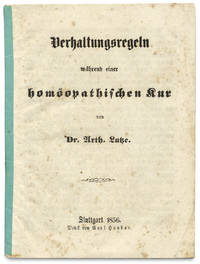
3728751<p>Stuttgart Germany: Druck von Carl Hauber 1856. 16 pages. 5½ x 4¼ inches. Self wrappers; stitched; with blue/green paper spine reinforcement. Brief foxing; creasing at one corner; very good.</p> <p>Unrecorded homeopathic medical tract—whose title roughly translates as “Rules of Conduct during a Homeopathic Course of Treatment.â€</p> <p>It was written by Dr. Arthur Lutze 1813–1870 an important homeopathic physician and contemporary of Dr. Samuel Hahnemann 1755–1843 the founder of this pseudo-scientific system of alternative medicine that used very particular animal vegetable and mineral preparations to cure various diseases.</p> <p>A year before this tract was published in 1855 Dr. Lutze opened a homeopathic clinic and spa in Köthen Saxony-Anhalt complete with large wards and private rooms spas and other amenities. Present here are 25 dietary and health rules to be followed during a homeopathic treatment.</p> <p>Strictly forbidden foods include coffee tea strong Bavarian beer wine schnaps rum etc. and “everything strong and spicy.†One could eat pork conditionally; beef and mutton were allowed. Many other dietary regulations and advisories follow.</p> <p>No copies in OCLC or KVK.</p> unknown
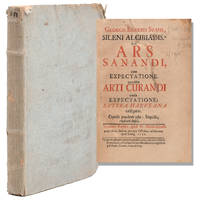
173035811Paris: apud Fr. Horth-hemels 1730. Frontispiece. 8 246 pp. 1 vols. 8vo. Plain drab blue wrappers uncut Fine copy. Frontispiece. 8 246 pp. 1 vols. 8vo. "Stahl German chemist and physician.received his medical degree at Jena.he was the personal physician to Frederick I of Prussia.he was among those who bridged the gap between alchemy and medecine.The present work is Stahl's commentary on Gideon Harvey's "the art of curing diseases by expectation".Stahl's work is biting and satirical commentary on Harvey." Heirs to Hippocrates. Heirs to Hippocrates 701; Cushing S383; Osler 2907; Waller 4082; Blake 430; Wellcome III p. 219 apud Fr. Horth-hemels unknown
187331209Boston 1873. Original printed wrappers stitched. 60 1 3 blanks pp. Front wrapper spotted and detached but present; some light spotting to lower blank margins of first several leaves. Good.<br /> <br /> The Massachusetts Medical Society preferred charges against Bushnell Fuller and six other physician members of the Society for "Conduct unbecoming and unworthy an honorable physician and member of this Society" i.e. practicing homeopathy. The Society's Board of Trial conducted the proceedings "at the Society's Rooms." The alleged miscreants purportedly sought to "disorganize and destroy" the Massachusetts Medical Society and to become members of the Massachusetts Homoeopathic Medical Society. A By-Law of the Massachusetts Medical Society prohibited any Member from professing "to cure diseases by Spiritualism Homoeopathy or Thompsonianism."<br /> With defendants protesting what they regarded as a kangaroo-court the trial proceeded. The detailed closing arguments for "the Accused" are printed here as well as summaries of the testimony. In what was a foregone conclusion they were all found guilty and expelled from the Massachusetts Medical Society. <br /> II Harv. Law Cat. 1031. unknown
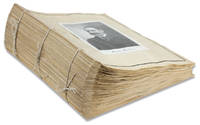
3725344<p>New York 1902–1904. 158ff. 12½ x 9½ inches. Album filled with tipped on or pasted in letters ephemera calling cards. Disbound lacking covers secured with recent cord tie; original black bordered leaves reinforced on left edge with cloth lining. Overall Very Good.</p> <p>A useful and packed album providing fine insight into the life of the German-American homeopathic physician Martin Deschere 1848–1902 of New York City. </p> <p>Deschere’s widow Olga Deschere assembled this archive after Martin Deschere’s passing. It reveals a constellation of physicians and medical institutions who were in his orbit. The bulk of the matter comprises: 200 pages of handwritten letters of condolences and tributes —from New York City medical organizations leading homeopaths and other physicians; 70 obituaries from newspapers and medical journals; and over 150 mourning calling cards almost all with a brief autograph sentiment. Some letters refer to Deschere’s homeopathic practice to Dr. Samuel Hahnemann 1755–1843 the founder of homeopathy and even to the “peculiar system†of homeopathy.</p> <p>Martin Deschere was a native of Hamburg Germany. Homeopath Dr. Samuel Lilienthal 1815–1891 also a German-American guided his early career. In 1875 he graduated from the New York Homoeopathic Medical College and Hospital. In 1881 Deschere was appointed Professor of Pediatrics at his alma mater holding this position for many years. Deschere served as a staff physician at New York’s Flower Hospital and the Laura Franklin Free Hospital for Children. He was an editor of the North American Journal of Homoeopathy a member and president of the Homoeopathic Medical Society of the State of New York the founder of the Materia Medica Society and a founder of a pediatric medical society.</p> <p>Colleagues offering tribute to Dr. Deschere were Willard Ide Pierce of the New York Medical Club and author of Plain Talks on Materia Medica with Comparisons Philadelphia 1911; Henry M. Dearborn 1846–1904 professor at the New York College and Hospital for Women and New York Homœopathic Medical College and Hospital; Frederick M. Dearborn b.1876 lecturer at the New York Homœopathic Medical College and Hospital and the New York College and Hospital for Women; Willis A. Dewey b.1858 an anatomy professor at Hahnemann Medical College of the Pacific and editor of the California Homoeopath and The Medical Century; and Loomis L. Danforth b.1849 professor of obstetrics New York Homœopathic Medical College and Hospital and chief of maternity staff at Hahnemann Hospital.</p> <p>Other memorialists included George W. Roberts b.1866 professor of surgery at the New York Medical College and Hospital for Women; John W. Dowling b.1837 Registrar of the New York Homœopathic Medical College and a founder of its surgical hospital; H. Everett Russell b.1863 graduate of the New York Homœopathic Medical College and Hospital and member of American Institute of Homœopathy and the National Society of Electro-Therapeutists; Walter Sands Mills b.1865 physician to the department of the heart and lungs New York Homœopathic Medical College Dispensary; and C.A. Weirick of Chicago co-editor of the Journal of Orificial Surgery and official of the the American Institute of Homœopathy.</p> <p>Dr. William Francis Honan recalled Deschere as a professor:</p> <p>"It was my good fortune to come under his personal instruction in 1889 & subsequently to enjoy a continued acquaintanceship with him. I’ve soon learned to admire the steadfast character of the man and appreciate his very unusual scientific attainments. Your loss will be that of the entire medical profession and suffering humanity an earnest self sacrificing worker. f59 July 23 1902"</p> <p>Byron George Clark b.1847 a member of the American Institute of Homœopathy wrote:</p> <p>"I have not called upon the Doctor for some time chiefly because he always wanted I should go carefully over his case and seemed disappointed at my not offering suggestions when I felt he was under better care than I could give him. … I feel I have lost a friend that will be hard to replace. We were in close sympathy in our ideas of homeopathy and our faith in its work that we felt an honesty that was healthful in each others work and as I have been expecting to move downtown further for some time…I have anticipated quite some pleasure in being near him that we could work together more; but a greater power has decided otherwise and we must bow to his will however hard. f60 July 24 1902"</p> <p>Two manuscript resolutions within honored Dr. Deschere. For example:</p> <p>"At the regular Annual Meeting of the Staff of the Laura Franklin Free Hospital for Children held October 29th 1902 the following resolution was read and unanimously adopted — Whereas: — From the time of its foundation and until his ill-health and death prevented this Hospital has enjoyed the devoted labors of Dr. Martin Deschere and Whereas: — The bountiful store of his professional learning keen observation and innate genius has been freely imparted to the ailing young in this Hospital and elsewhere… be it Resolved: — That the Medical Staff of the Laura Franklin Free Hospital for Children feels deeply the loss of an associate whom we loved; a consultant whose advice we valued; and a consistent and steadfast Homoeopath whose example we would emulate."</p> <p>A retained copy of Dr. Deschere’s letter —to the Alumni Association of the New York Homoeopathic Medical College and Hospital— written on the occasion of the twenty-fifth anniversary of his graduation remarks</p> <p>"It is a sore disappointment to me that I am prevented by illness from appearing before you to-night and addressing you as my pleasant duty demands. … Although unable to address you personally I am with you heart and soul and in this spirit of congeniality I desire to express to you my ideas of how our Association may work to the best interests of our College. …Let us always remember that as graduates of the N. Y. Hom. Med. Coll. & Hosp. we remain thoroughly homoeopathic in our professional work no matter what special field this may cover. The more thoroughly we understand the philosophy of the Law of Similars the closer we adhere to it in our professional duties the more logically we practice according to it at the bedside the more satisfactory will be our results and consequently the higher will be our standard is homoeopathic physicians and the higher will that school be valued that has educated such men. … All our pioneers from Samuel Hahnemann down had added a knowledge of homoeopathic therapeutics to their general knowledge of medicine but only the utilization over this knowledge in their practice stamped them homoeopathic physicians. … Again I know of physicians who have made special studies of homoeopathic therapeutics partly out of curiosity and partly for their own instruction to a degree that they become well versed in that field of science but they never thought of becoming or being considered homoeopathic physicians even though they utilized some of this acquired knowledge in their practice. Therefore I herewith openly protest again the definition of a homoeopathic physician as accepted by the American Institute for if we shall be judged by our works we can only by be judged as homoeopathic physicians by working as such. May 1900"</p> <p>A useful archive. A dense concentration of biographical information reveals the life of a little-known nineteenth-century American homeopathist while contextualizing the relationships and connections he shared with like-minded colleagues.</p> <p>Ref. Cleave Biographical Cyclopaedia of Homeopathic Physicians and Surgeons Philadelphia 1873.</p> unknown
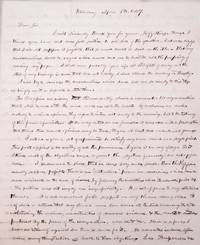
1847323890Waterbury CT 1847. 4pp. Folded 4to sheet. Usual folds. 4pp. Folded 4to sheet. ".The Profession are willing that Homeopathy should be examined but only on condition that it shall be done with the mind made up as to the result. If conclusions are reached contract to received opinions they refuse to listen not merely to the reasoning but to the testimony of their former associates . I entered upon a set of experiments to satisfy my own mind on a single point. This point appears to me worthy of all the prominence I gave it in my essay. To it I think most of the objections urged against the system generally are not applicable. I endeavored to show that in doses very much smaller than the Profession usually suppose possible there is an alternative power in medicines which can be made available in the cure of disease."<br /> <br /> Rodman would publish his paper on the subject in 1851 titled An Examination of the Evidence in Regard to Infinitesimal Doses. unknown
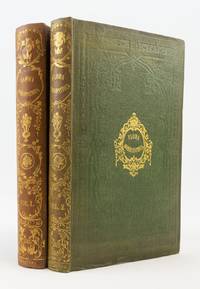
1852ST19516London: H. Baillière 1852-53. FIRST EDITION. 263 x 165 mm. 10 3/8 x 6 1/2". Two volumes. <br/> Publisher's olive green cloth covers decorated in gilt and blind spine attractively gilt the volumes very expertly recased with new appropriate endpapers. WITH 66 VERY ATTRACTIVE HAND-COLORED PLATES lithographed by H. Sowerby. Harvard Arnold Arboretium p. 314; Nissen BBI 778. ◆Spines faded to brown a few minor signs of use but the bindings solid and definitely appealing. Occasional minor foxing one plate with a small spray of black dots from printing process but a fine copy internally the text clean and fresh and the plates bright with pleasing colors.<br/> <br/> This work promotes the efficacy of homeopathic remedies through the use of detailed botanical illustrations and thorough descriptions of 66 plants--from benign specimens such as chamomile and coffee to hazardous species such as poison ivy and ergot. The descriptions of each plant include their botanical characteristics history means of identification geographical distribution physiological effects in humans and animals parts of the plant used and methods of preparation and their general use in homeopathy as well as numerous case studies and clinical observations that supposedly prove the effectiveness of homeopathic remedies in the treatment of various physical and mental diseases. Edward Hamilton 1815-1903 was a member of the British Homeopathic Society and a Physician to the London Homeopathic Hospital founded in 1849. In addition to providing a useful reference for practitioners of homeopathy Hamilton attempts in the present work to elevate and legitimize the practice in the eyes of the public and the larger medical community. The origins of homeopathy go back to the end of the 18th century but the approach became especially popular in the 19th century as an alternative to conventional Western medicine--often referred to by homeopaths as "allopathy"--whose methods at the time could be ineffectual or even dangerous to the health of the patient for example bloodletting and purging. Practitioners of homeopathy operate under the belief that "like cures like." In the words of the National Library of Medicine this means that "Practitioners select a drug that would if given to a healthy volunteer cause the presenting symptoms of the patient. For example the homoeopathic remedy Allium cepa is derived from the common onion. Contact with raw onions typically causes lacrimation stinging and irritation around the eyes and nose and clear nasal discharge. Allium cepa might be prescribed to patients with hay fever especially if both nose and eyes are affected." Crucially homeopathic remedies are harmless to the patient because they are diluted many times over--to the point that the active ingredient is an infinitesimal part of the solution. For example when taken this way the fatal Atropa Belladonna commonly known as Deadly Nightshade which "produces phenomena of inflammation in the peripheral tissues" is especially successful at treating ailments related to inflammation. The author notes that it was even administered as a prophylaxis against scarlet fever dubious studies of which are discussed here at length. Other surprising recommendations in the book include Henbane for nymphomania Bitter Cucumber for dysentery and Cannabis for a range of maladies that include tetanus acne and gonorrhea. Our copy is in remarkably good condition for a work that was intended to be referred to again and again with the hand-colored plates being unusually bright and especially well preserved. There are very few early homeopathic books with significant illustrations and none approaching the level of detail and artistry seen in the present work. H. Baillière unknown