(Homeopathy) Rodman, William WBiblio.com
17 résultats
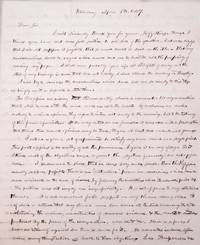
1847323890Waterbury CT 1847. 4pp. Folded 4to sheet. Usual folds. 4pp. Folded 4to sheet. ".The Profession are willing that Homeopathy should be examined but only on condition that it shall be done with the mind made up as to the result. If conclusions are reached contract to received opinions they refuse to listen not merely to the reasoning but to the testimony of their former associates . I entered upon a set of experiments to satisfy my own mind on a single point. This point appears to me worthy of all the prominence I gave it in my essay. To it I think most of the objections urged against the system generally are not applicable. I endeavored to show that in doses very much smaller than the Profession usually suppose possible there is an alternative power in medicines which can be made available in the cure of disease."<br /> <br /> Rodman would publish his paper on the subject in 1851 titled An Examination of the Evidence in Regard to Infinitesimal Doses. unknown
1832SB-20287Paris, J.-B. Baillière, 1832. X S., 1 Bl., 568; 681 S., 1 Bl. Grüne Halblederbände der Zeit mit goldgeprägten Rückentiteln und goldgeprägter Ornamentik; Buchdeckel mit schwarz-grünen Marmorbezügen; dreiseitiger, marmorierter Blauschnitt. Standardwerk des Begründers der Lehre der Homöopathie, Samuel Hahnemann (1755 - 1843), ins Französische übersetzt von A.-J.-L- Jourdan. Hahnemann verbrachte seine letzten Lebensjahre 1835 bis 1843 als praktizierender Arzt in Paris, wo er unter anderem den Geiger Niccolò Paganini und den Schriftsteller Eugène Sue zu seinen Patienten zählte. Ouvrage standard du fondateur de l'enseignement de l'homéopathie, Samuel Hahnemann (1755 - 1843), traduit en français par A.-J.-L-Jourdan. Hahnemann a passé les dernières années de sa vie de 1835 à 1843 en tant que médecin praticien à Paris, où il a traité le violoniste Niccolò Paganini et l'écrivain Eugène, entre autres.
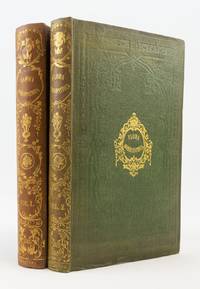
1852ST19516London: H. Baillière 1852-53. FIRST EDITION. 263 x 165 mm. 10 3/8 x 6 1/2". Two volumes. <br/> Publisher's olive green cloth covers decorated in gilt and blind spine attractively gilt the volumes very expertly recased with new appropriate endpapers. WITH 66 VERY ATTRACTIVE HAND-COLORED PLATES lithographed by H. Sowerby. Harvard Arnold Arboretium p. 314; Nissen BBI 778. ◆Spines faded to brown a few minor signs of use but the bindings solid and definitely appealing. Occasional minor foxing one plate with a small spray of black dots from printing process but a fine copy internally the text clean and fresh and the plates bright with pleasing colors.<br/> <br/> This work promotes the efficacy of homeopathic remedies through the use of detailed botanical illustrations and thorough descriptions of 66 plants--from benign specimens such as chamomile and coffee to hazardous species such as poison ivy and ergot. The descriptions of each plant include their botanical characteristics history means of identification geographical distribution physiological effects in humans and animals parts of the plant used and methods of preparation and their general use in homeopathy as well as numerous case studies and clinical observations that supposedly prove the effectiveness of homeopathic remedies in the treatment of various physical and mental diseases. Edward Hamilton 1815-1903 was a member of the British Homeopathic Society and a Physician to the London Homeopathic Hospital founded in 1849. In addition to providing a useful reference for practitioners of homeopathy Hamilton attempts in the present work to elevate and legitimize the practice in the eyes of the public and the larger medical community. The origins of homeopathy go back to the end of the 18th century but the approach became especially popular in the 19th century as an alternative to conventional Western medicine--often referred to by homeopaths as "allopathy"--whose methods at the time could be ineffectual or even dangerous to the health of the patient for example bloodletting and purging. Practitioners of homeopathy operate under the belief that "like cures like." In the words of the National Library of Medicine this means that "Practitioners select a drug that would if given to a healthy volunteer cause the presenting symptoms of the patient. For example the homoeopathic remedy Allium cepa is derived from the common onion. Contact with raw onions typically causes lacrimation stinging and irritation around the eyes and nose and clear nasal discharge. Allium cepa might be prescribed to patients with hay fever especially if both nose and eyes are affected." Crucially homeopathic remedies are harmless to the patient because they are diluted many times over--to the point that the active ingredient is an infinitesimal part of the solution. For example when taken this way the fatal Atropa Belladonna commonly known as Deadly Nightshade which "produces phenomena of inflammation in the peripheral tissues" is especially successful at treating ailments related to inflammation. The author notes that it was even administered as a prophylaxis against scarlet fever dubious studies of which are discussed here at length. Other surprising recommendations in the book include Henbane for nymphomania Bitter Cucumber for dysentery and Cannabis for a range of maladies that include tetanus acne and gonorrhea. Our copy is in remarkably good condition for a work that was intended to be referred to again and again with the hand-colored plates being unusually bright and especially well preserved. There are very few early homeopathic books with significant illustrations and none approaching the level of detail and artistry seen in the present work. H. Baillière unknown
1875106798New York: Charles P. Somerby 1875 Book. Good. Hardcover. Second Edition. Part First: "Embracing health digestion disease and the science of the reproductive organs" illustrated with one hundred and twenty-five illustrations by Kappes Spiegle and Treat. Part Second: "Embracing dress heredity child-training kitchen and dining room ethics". An illustrated popular medicine text from the late nineteenth century. Cover has moderate wear edgewear light rub marks 1 page of the contents is separated from the binding; light foxing. Charles P. Somerby hardcover
189819074Philadelphia: Boericke & Tafel 1898. First Edition. Hardcover. Near fine. 8vo xvii 903 pp with illustrations from photographs. Publisher's green cloth with gilt lettering on spine. Light rubbing to extremities minor stain to fore edge else fine. Bradford 1847-1918 was a homeopathic practitioner who did much to document the history of homeopathic medicine in the United States. This scarce work provides an exhaustive account of the Homeopathic Medical College of Pennsylvania founded in 1848 and the institutions that succeeded it. Today's Drexel University College of Medicine was formed from a merger of the Hahnemann Medical College and The Woman's Medical College the first medical school in the world for women. Boericke & Tafel hardcover books
18441252157Jena, Frommann, 1844. 6, 346 S. Ppbd d. Zeit (stärker beschabt u. bestoßen, oberes Kapital ausgerissen, innen meist stärker braun- u. fingerfleckig).
18873836<p>Madrid: Se vende en la Farmacia Homeopática…. De la Señora Viuda del doctor Somolinos Real Academia Nacional de Medicina 1873</p><p>Octavo: 13 x 8 cm. i-v vi-viii 9-328 p.</p><p>FIFTH EDITION of the booklet 1st ed. 1864. All editions are extremely rare.</p><p>Bound in a contemporary wallet binding modified to hold medicine. A rare complete set comprising a Spanish homeopathy handbook for families together with homeopathic remedies prepared by the Somolinos pharmacy of Madrid the first homeopathic pharmacy in Spain. </p><p>A fascinating witness to the diffusion and implementation of Hahnemann's theories. Inside the front board there is a carrier for 23 glass vials. A separate related box also issued by the Somolinos pharmacy with a wooden carrier for 45 additional vials is included. <i>Almost all of the small glass vials still contain homeopathic substances.</i></p><p>The inventor of homeopathic theory was the German doctor Samuel Hahnemann 1756-1843 who according to the principle of 'similia similibus curantur' held that the agent that <i>causes </i>an ailment should be administered in heavily diluted form to patients who suffered from that ailment.</p><p>Homeopathy did not take root on a large scale in Spain where there were very few homeopathic doctors or pharmacists. Among the pharmacists who did prepare homeopathic medicines was Cesáreo MartÃn Somolinos 1827-1878 who set up his shop at 26 Calle Infantas in Madrid. Somolinos also made up and sold pocket homeopathic kits of the kind offered here some of which are preserved in the Museo de La Farmacia Hispana in Madrid. The author of the manual Jaime Pizá Rosselló. was director and chief pharmacist of the Somolinos pharmacy.</p><p>See Alfonso Galán "Cesáreo MartÃn Somolinos: homeopathic pharmacist: his activities in the Hahnemann Society of Madrid" in Boletin de la Sociedad Espanola de Historia de la Farmacia 39 154-155</p> Se vende en la Farmacia Homeopática…. De la Señora Viuda del doctor Somolinos Real Academia Nacional de Medicina, books
18941253417Leipzig, W. Schwabe, 1894. Gr.-8vo. 10 (von 12), 374 S. Neuer Lwdbd m. altem, goldgeprägten Rückenschild (Papier etwas gebräunt, ohne den Vortitel).
1880109577Philadelphia: P. Blakiston Son & Co. 1880 Book. Good. Hardcover. First Edition. This Fourth Series includes Brain-Work and Over-Work by Prof. H. C. Wood MD; School and Industrial Hygiene by D. F. Lincoln MD; and Our Homes by Henry Hartshorne MD. 149 pages illustrated. Cover is faded/stained; interior is in very good condition. Bookplate inside front cover inked name on free endpaper. P. Blakiston, Son & Co. hardcover
1841108608Boston: Daniel L. Hale 1841 Book. Fair. Leather. First Edition. Volume I of this two volume mid-19th century work on healthy living and medicine. Includes a view of the human body old school practice of physic vegetable materia medica compounds practice of medicine and a guide for women. 592 pages plus glossary and index; illustrated. Leather binding is worn and rubbed; rear free endpaper is torn; text is in very good condition; the two pages of illustrations of the human skeleton is worn on the edges. Daniel L. Hale hardcover
187254533New York-San Francisco, Boericke & Tafel, 1872. 8°. 68 (recte 168) S., OLwd.
1860088425Boston: Bradley Dayton & Co. 1860 Book. Fair. Leather. First Edition. "Being a brief description in plain language of all the diseases of men women and children with the latest and most approved methods of curing them. illustrated by thirty-six figures on eight splendid colored lithograph plates and three hundred and thirty-six engravings". Leather binding is quite worn with the front board and endpaper removed but present; rear board is nearly detached; text is in very good condition. . Bradley, Dayton & Co. hardcover
187331209Boston 1873. Original printed wrappers stitched. 60 1 3 blanks pp. Front wrapper spotted and detached but present; some light spotting to lower blank margins of first several leaves. Good.<br /> <br /> The Massachusetts Medical Society preferred charges against Bushnell Fuller and six other physician members of the Society for "Conduct unbecoming and unworthy an honorable physician and member of this Society" i.e. practicing homeopathy. The Society's Board of Trial conducted the proceedings "at the Society's Rooms." The alleged miscreants purportedly sought to "disorganize and destroy" the Massachusetts Medical Society and to become members of the Massachusetts Homoeopathic Medical Society. A By-Law of the Massachusetts Medical Society prohibited any Member from professing "to cure diseases by Spiritualism Homoeopathy or Thompsonianism."<br /> With defendants protesting what they regarded as a kangaroo-court the trial proceeded. The detailed closing arguments for "the Accused" are printed here as well as summaries of the testimony. In what was a foregone conclusion they were all found guilty and expelled from the Massachusetts Medical Society. <br /> II Harv. Law Cat. 1031. unknown
187331209Boston 1873. Original printed wrappers stitched. 60 1 3 blanks pp. Front wrapper spotted and detached but present; some light spotting to lower blank margins of first several leaves. Good.<br/><br/> The Massachusetts Medical Society preferred charges against Bushnell Fuller and six other physician members of the Society for "Conduct unbecoming and unworthy an honorable physician and member of this Society" i.e. practicing homeopathy. The Society's Board of Trial conducted the proceedings "at the Society's Rooms." The alleged miscreants purportedly sought to "disorganize and destroy" the Massachusetts Medical Society and to become members of the Massachusetts Homoeopathic Medical Society. A By-Law of the Massachusetts Medical Society prohibited any Member from professing "to cure diseases by Spiritualism Homoeopathy or Thompsonianism."<br/> With defendants protesting what they regarded as a kangaroo-court the trial proceeded. The detailed closing arguments for "the Accused" are printed here as well as summaries of the testimony. In what was a foregone conclusion they were all found guilty and expelled from the Massachusetts Medical Society. <br/>II Harv. Law Cat. 1031. unknown books
187655685Berlin. Verlag Hermann Peters. 1876. 468 Seiten u. XII Seiten "Stimmen der Presse". Mit 2 Textholzschnitten. Kart.-Einband der Zeit mit Rückenschild (Einband an den Kanten berieben. Papier teils stockfleckig. 2 Seiten mit Tintenflecken) 20x14 cm
188954612Berlin, Otto Janke, 1889. Gr.-8°. XIV, 488 S., HLwd. d. Zt. m. goldgepr. Rückentitel.
188754613Berlin, Otto Janke, 1887. Gr.-8°. XVI, 506 S., HLwd. d. Zt. m. goldgepr. Rückentitel.