(Homeopathy) Rodman, William WBiblio.com
52 résultats
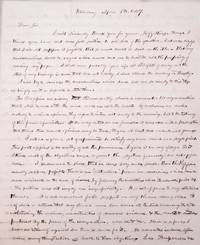
1847323890Waterbury CT 1847. 4pp. Folded 4to sheet. Usual folds. 4pp. Folded 4to sheet. ".The Profession are willing that Homeopathy should be examined but only on condition that it shall be done with the mind made up as to the result. If conclusions are reached contract to received opinions they refuse to listen not merely to the reasoning but to the testimony of their former associates . I entered upon a set of experiments to satisfy my own mind on a single point. This point appears to me worthy of all the prominence I gave it in my essay. To it I think most of the objections urged against the system generally are not applicable. I endeavored to show that in doses very much smaller than the Profession usually suppose possible there is an alternative power in medicines which can be made available in the cure of disease."<br /> <br /> Rodman would publish his paper on the subject in 1851 titled An Examination of the Evidence in Regard to Infinitesimal Doses. unknown
1838100388Remmelmann 1838 Paris, chez Gustave Remmelmann, 1838, 93 p., demi-basane, environ 20x13cm, premier plat d'origine conservé, dos et mors-peaux insolés, des frottements d'usage sur la reliure, des tampons sur la page de garde, quelques rousseurs.
1811GF322871811 Paris - Crouillebois et Crochard - 1811 - 1 volume in8 de XVI - 464 pages - Reliure d'époque demi basane brune - pièce de titre en maroquin rouge - filets dorés au dos - deux coins émoussés - quelques piqures - mouillures aniennes légéres au faux titre et au titre - Bon exemplaire cependant -
1840999473Castel Montpellier, Castel, 1840. In-8 relié demi-basane verte dos lisse orné de fleurons à motifs floraux, 270 pages. Bien complet des deux grandes planches dépliantes, l'une d'instruments médicaux, l'autre est un tableau des causes de la stérilité. Le chapitre III est consacré "aux substances que l'art emploie pour diriger les fluides et maintenir les propriétés vitales sur les organes de la génération des deux sexes" ainsi on trouvera , dans le régne végétal les menthes, l'asperge, la racine de Jean de Lopez, les truffes, la vanille, l'opium, le baume de la Mecque etc...dans le régne animal, l'ambre gris, la civette, le musc etc... suivent des recettes de diverse préparations employées extérieurement pour combattre la stérilité, entre autres le bain astérasique, les ceintures astérasiques, les liniments anti-anaphrodisiaque et diverses préparations employées à l'intérieur pour combattre la stérilité, entre autres l'essence orientale, des sirops, des pastilles, un vin tonique, une marmelade, le Wakaka des Indes etc...!!!Bel exemplaire dans une très jolie reliure.
1850102701850 demi-reliure en cuir rouge (red half binding in leather) grand in-octavo, dos long - décoré or avec des fers spéciaux et des filets gras - roulettes (spine without raised band -gilt decoration specials blocking stamps and broad gilt line - fillets), papier imitation chagrin aux plats (paper imitation shagreen on the cover) - premier plat insolé (front cover fading), coins émoussés (corners blunt), tranches lisses (smooth edges), texte 2 colonnes (text - 2 coloumns), sans illustration (no illustration), rousseurs (redness marks), XI+1160 pages, 1850 à Paris Victor Masson,
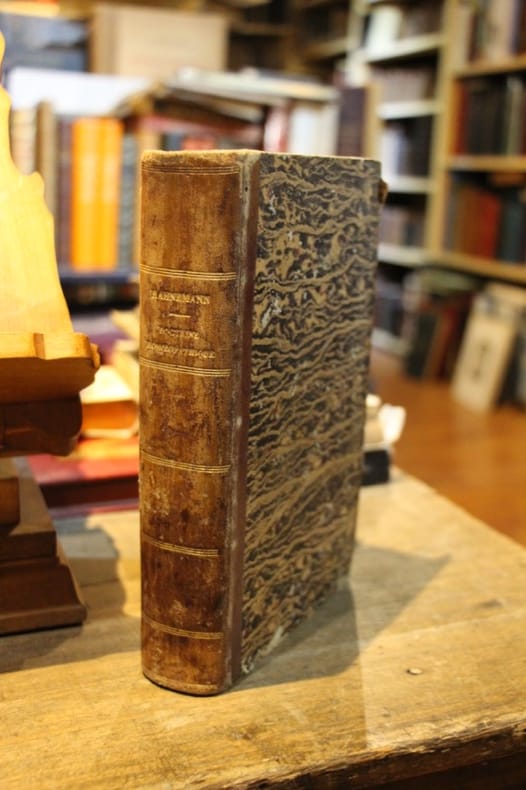
1832SB-20287Paris, J.-B. Baillière, 1832. X S., 1 Bl., 568; 681 S., 1 Bl. Grüne Halblederbände der Zeit mit goldgeprägten Rückentiteln und goldgeprägter Ornamentik; Buchdeckel mit schwarz-grünen Marmorbezügen; dreiseitiger, marmorierter Blauschnitt. Standardwerk des Begründers der Lehre der Homöopathie, Samuel Hahnemann (1755 - 1843), ins Französische übersetzt von A.-J.-L- Jourdan. Hahnemann verbrachte seine letzten Lebensjahre 1835 bis 1843 als praktizierender Arzt in Paris, wo er unter anderem den Geiger Niccolò Paganini und den Schriftsteller Eugène Sue zu seinen Patienten zählte. Ouvrage standard du fondateur de l'enseignement de l'homéopathie, Samuel Hahnemann (1755 - 1843), traduit en français par A.-J.-L-Jourdan. Hahnemann a passé les dernières années de sa vie de 1835 à 1843 en tant que médecin praticien à Paris, où il a traité le violoniste Niccolò Paganini et l'écrivain Eugène, entre autres.
1855GF322761855 Paris - Baillière - 1855 - 1 volume in8 de VIII - 410 pages - Reliure demi basane brune - dos plat orné de filets -
185577001855 P., Chez J.-B. Baillière, 1855, 2 vol. in-8 (223 x 140 mm) brochés, couvertures imprimées, de (1) f. (catalogue de l'éditeur) - (4) ff. (faux-titre, titre, avertissement et table) - 632 pp. ; VI - 516 pp. Dos légèrement insolés, rares rousseurs (concentrées sur quelques cahiers), exemplaire en très grande partie non coupé, rare dans cet état.
185618616A Paris / A Londres, chez J. B. et H. Baillière, 1856. Un vol. au format in-12 (188 x 123 mm) de 1 f. bl., vii - 380 pp. et 1 f. bl. Reliure de l'époque de demi-chagrin maroquiné tête-de-nègre, dos à nerfs orné de doubles filets gras à froid, filets gras dorés, titre doré, palette dorée en tête et queue, toutes tranches mouchetées.
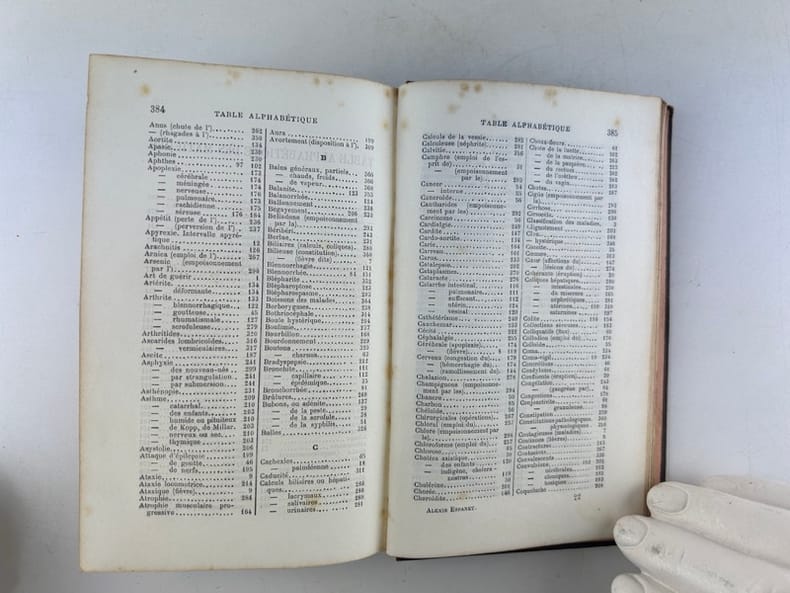
185643404Paris, J.-B. Baillière, 1856. 1 vol. Paris, J.-B. Baillière, 1856. In-8 de (4)-XLVIII-568 pp., demi-basane brune, dos lisse orné de filets dorés (reliure de l'époque).
1834GF322961834 Paris, Baillière - 1834- Un volume in8 de 8 - 666 pages - Reliure d'époque demi veau glacé - Dos plat orné de fleurons - quelques piqures - petites épidermures aux mors et en tête - bon exemplaire -
183952767J.-B. Baillière, 1832 ; Desforges et Cie 1839 2 titres en 1volume in-8, demi-basane marron, dos lisse orné de filets dorés, 524 - IV- 321 pp. Fortes mouillures marginales, quelques rousseurs. En l’état.
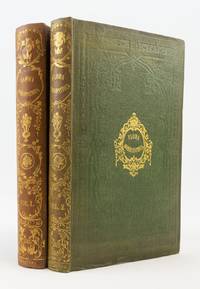
1852ST19516London: H. Baillière 1852-53. FIRST EDITION. 263 x 165 mm. 10 3/8 x 6 1/2". Two volumes. <br/> Publisher's olive green cloth covers decorated in gilt and blind spine attractively gilt the volumes very expertly recased with new appropriate endpapers. WITH 66 VERY ATTRACTIVE HAND-COLORED PLATES lithographed by H. Sowerby. Harvard Arnold Arboretium p. 314; Nissen BBI 778. ◆Spines faded to brown a few minor signs of use but the bindings solid and definitely appealing. Occasional minor foxing one plate with a small spray of black dots from printing process but a fine copy internally the text clean and fresh and the plates bright with pleasing colors.<br/> <br/> This work promotes the efficacy of homeopathic remedies through the use of detailed botanical illustrations and thorough descriptions of 66 plants--from benign specimens such as chamomile and coffee to hazardous species such as poison ivy and ergot. The descriptions of each plant include their botanical characteristics history means of identification geographical distribution physiological effects in humans and animals parts of the plant used and methods of preparation and their general use in homeopathy as well as numerous case studies and clinical observations that supposedly prove the effectiveness of homeopathic remedies in the treatment of various physical and mental diseases. Edward Hamilton 1815-1903 was a member of the British Homeopathic Society and a Physician to the London Homeopathic Hospital founded in 1849. In addition to providing a useful reference for practitioners of homeopathy Hamilton attempts in the present work to elevate and legitimize the practice in the eyes of the public and the larger medical community. The origins of homeopathy go back to the end of the 18th century but the approach became especially popular in the 19th century as an alternative to conventional Western medicine--often referred to by homeopaths as "allopathy"--whose methods at the time could be ineffectual or even dangerous to the health of the patient for example bloodletting and purging. Practitioners of homeopathy operate under the belief that "like cures like." In the words of the National Library of Medicine this means that "Practitioners select a drug that would if given to a healthy volunteer cause the presenting symptoms of the patient. For example the homoeopathic remedy Allium cepa is derived from the common onion. Contact with raw onions typically causes lacrimation stinging and irritation around the eyes and nose and clear nasal discharge. Allium cepa might be prescribed to patients with hay fever especially if both nose and eyes are affected." Crucially homeopathic remedies are harmless to the patient because they are diluted many times over--to the point that the active ingredient is an infinitesimal part of the solution. For example when taken this way the fatal Atropa Belladonna commonly known as Deadly Nightshade which "produces phenomena of inflammation in the peripheral tissues" is especially successful at treating ailments related to inflammation. The author notes that it was even administered as a prophylaxis against scarlet fever dubious studies of which are discussed here at length. Other surprising recommendations in the book include Henbane for nymphomania Bitter Cucumber for dysentery and Cannabis for a range of maladies that include tetanus acne and gonorrhea. Our copy is in remarkably good condition for a work that was intended to be referred to again and again with the hand-colored plates being unusually bright and especially well preserved. There are very few early homeopathic books with significant illustrations and none approaching the level of detail and artistry seen in the present work. H. Baillière unknown
1848gu1598Baillère Relié 1848 In-12 (8.5x14.5 cm), relié demi-veau, titre doré au dos orné de liserés dorés, (VIII)-460 pages, ouvrage divisé en deux partie : la première contient l'indication des Maladies sous les dénominations nosologiques de l'ancienne Ecole, les symptômes de ces maladies, et les remèdes qui leur ont été opposés avec succès ; la seconde renferme la liste des médicaments par ordre alphabétique, et à la suite du nom de chaque substance, les affections guéries par son emploi, etc. ; traduit de l'allemand sur la 2e édition par G.L. Strauss ; coiffes, coins et bords frottés, traces de frottement sur les plats, rousseurs à l'intérieur, état correct. Livraison a domicile (La Poste) ou en Mondial Relay sur simple demande.
1875106798New York: Charles P. Somerby 1875 Book. Good. Hardcover. Second Edition. Part First: "Embracing health digestion disease and the science of the reproductive organs" illustrated with one hundred and twenty-five illustrations by Kappes Spiegle and Treat. Part Second: "Embracing dress heredity child-training kitchen and dining room ethics". An illustrated popular medicine text from the late nineteenth century. Cover has moderate wear edgewear light rub marks 1 page of the contents is separated from the binding; light foxing. Charles P. Somerby hardcover
1847WOC-1092Application Pratique des principes et des moyens de cette Doctrine au Traitement des Maladies. Avec portrait de Samuel Hanneman en frontispice dans le tome 1er. Paris & Londres, J.-B.Baillière,1847.2 volumes in-8 (21x14cm)reliés demi basane d'époque, dos ornés de filets dorés, petites éraflures sur le morspeau du tome premier et petite fente dans une charnière. XV,ff,d'errata,643pp.+716pp.
1847784821847 Paris et Londres, Baillière, 1847, 2 volumes in 8° brochés, XV-643 et 716 pages ; quelques rousseurs éparses ; envoi autographe signé sur la couverture du tome premier.
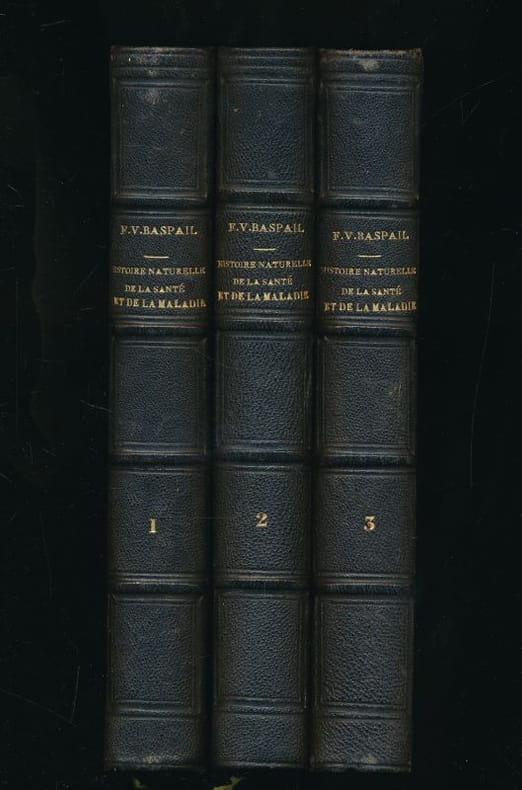
1860115305Bruxelles Paris, Bruxelles, 1860. 3 volumes In-8 reliés demi-chagrin noir, dos à caissons, plats de percaline noire estampée à froid. Portrait en frontispice CIV + 344 pages + XIX planches sous serpentes + VIII + 552 + VIII + 552 pages. Figures dans le texte. Contient de très nombreuses recettes thérapeutiques. Quelques rousseurs, bien relié. Bon exemplaire.
1860143658Bruxelles Paris, Bruxelles, 1860. 3 volumes In-8 reliés demi-basane verte, dos lisse, titre doré. Portrait en frontispice CIV + 344 pages + XIX planches sous serpentes + VIII + 552 + VIII + 552 pages. Suivi du Formulaire pour la nouvelle méthode de traitement hygiénique et curatif . Figures dans le texte. Contient de très nombreuses recettes thérapeutiques. Quelques rousseurs, bien relié. bon exemplaire.
18441252157Jena, Frommann, 1844. 6, 346 S. Ppbd d. Zeit (stärker beschabt u. bestoßen, oberes Kapital ausgerissen, innen meist stärker braun- u. fingerfleckig).
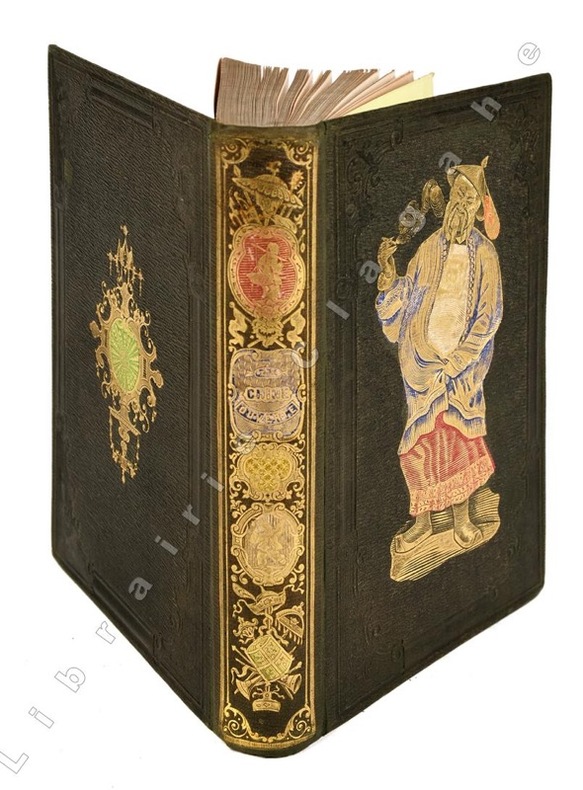
184511299Paris, H. Fournier, 1845 ; cartonnage polychrome à fond noir représentant un personnage chinois fumant, en habit traditionnel doré rehaussé de rouge, bleu et blanc, fond décoré de scènes et objets symboliques, second plat à grand décor doré et vert, tranches dorées ; VI, (2), 396 pp., 50 planches hors-texte, nombreuses illustrations in-texte de tous formats, dessins de Auguste Borget.
189382AuParis Bailliere et Fils 1893 In12 282 pages - cartonnage demi-toile rouge - bon etat
189382AuParis Bailliere et Fils 1893 In12 282 pages - cartonnage demi-toile rouge - bon etat
187484642Paris Baillière et Fils, 1874, in-12 (11x16cm), cartonnage éditeur, xxi, 396p. Quelques rousseurs sinon bel exemplaire.
1890175969Chez l'auteur Chez l'auteur, vers 1890. In-12 Broché de 96 pages illustrées d'une planche couleurs volante à divers sujet. Petit traité pratique de médecine et de pharmacie usuelle. Papier jauni néanmoins bon état