PICASSO, Pablo; HALASZ, Gyula; BRASSAIBiblio.com

279 résultats
1966112218Cannes 1966. Unpublished and heavily corrected manuscript of Brassai's account of his visit to Picasso A superb unpublished and heavily corrected manuscript in French in which Brassaï recounts his visit to Picasso a long-standing friend at his home near Cannes. Brassaï who photographed much of Picasso's work in the 1940s had published Conversations with Picasso in 1964 in which he created an intimate portrait of Picasso covering their friendship and artistic collaboration and recording each of their meetings with minute detail. Picasso said of the volume "Read this book if you want to understand me". This account is written in a similar style and during the course of the afternoon Picasso speaks about his nostalgia for his old studios his health his enthusiasm for the recently invented felt-tip pen his opinion of his own writings his relationship with his wife Jacqueline and his views on feminism. Though unmarked as such it is from the collection of Brassaï's close friend and colleague photographer Stefan Lorant who founded Picture Post the pioneering pictorial magazine. Quarto 285 x 233. 20 typed sheets in French rectos only legibly hand-corrected throughout by Brassai in black ink. Housed in a black cloth album with each sheet in a separate clear plastic file. In excellent condition the final page a little creased and with minor loss to right-hand side affecting one letter. Overall fresh and clean. hardcover
193348496Neuilly-sur-Seine. 1933. Original publisher's printed white glossy wrappers reproduction of a Man Ray photograph to front cover of each issue with titles and contributors in red against a white background taking the form of a lighthouse with revolving light later cream morocco-backed black card board chemise with title in red to spine and matching slipcase. 4 vols. in 3. Small 4to. 252 x 182 mm. 4to. 284 x 194 mm. Printed text in French with reproductions of monochrome photographs throughout nos. 1 & 2 with printed 'Bulletin d'Abonnement' sheets on orange paper tipped-in issue with advertisements on various coloured stock see below. An excellent complete set of Lise Deharme's very scarce 'Le Phare de Neuilly' with the final number in the even scarcer large paper édition de tête format.The third number i.e. 'Numéro 3 - 4' is a large paper copy one of 20 nominatif examples issued on papier couché mat spécial printed for 'Monsieur et Madame Raoul Fernandez'; only the third volume was issued in this format.Although each title page of 'Le Phare de Neuilly' suggests that ten issues were to be published 'Dix numéros par an' only these four were achieved. A mixture of the literary and artistic the illustration is of monochrome photographs throughout with Lee Miller contributing to each issue; Man Ray's work also features - the covers are his work - as well as Nadar Dora Maar Brassaï Pierre Keffer Eli Lotar Lloyd Sloane and others.The literary contributors - all listed on the covers of each issue - are extremely varied and include Georges Ribemont-Dessaignes who also wrote the record reviews in the first two numbers Robert Desnos two poems in no. 1 Céline Arnauld Jacques Baron Hans Arp as a poet translated from the German by Georges Hugnet Paul Dermée Lise Hertz i.e. Lise Deharme Nathalie Barney Stendhal the unpublished 'Le lac de Genève' writen under Stendhal's pseudonym 'Henri Martineau' James Joyce see below Thérèse Aubray Jacques Lacan the poem 'Hiatus Irrationalis' Marcel Jouhandeau Ilarie Voronca the poem 'Foules' translated from the Romanian by M. de Boully D. H. Lawrence a translation of 'The Man Who Died' Claire Goll Eugène Jolas 'Gyroscope' Raymond Queneau 'Fragments d'un Roman' and many others.Of particular note in terms of content not to mention innovation are the following: - Alejo Carpentier's 'Images et Prières Nègres' illustrated with a series of photographs - the negatives were burnt in the presence of the Cuban sorceror 'Taita José' - of ritualistic objects shrines and saints; - Le Phare de Neuilly's presumably Deharme herself writing under the eponymous psudonym 'Manifeste du Désarmement Psychique'; - James Joyce's poem 'Ecce Puer' written on the birth of his grandson Stephen in 1932 translated into French by Yvan Goll and printed on the right of a sheet of transparent crystal paper; beneath on a sheet of glossy paper is a photographic reproduction of Joyce's manuscript for the poem and at left is a portrait of both Joyce and his grandson by Robert H. Davis; - Lloyd Sloane's extraordinary 'Monsieur Sépulcre Agent d'Assurances Présente . ' a Surrealist photographic collage novella; - no. 1 with the advertisements at the front of the issue printed in black on monochrome sheets of burgundy blue and pink paper that on pink with text reproducing Deharme's manuscript those at rear on cream newsprint paper advertising Jose Corti''s publishing house 'Corti / 6 Rue de Clichy' and announcing Deharme's own 'Cahier de Curieuse Personne / Poèmes / par / Lise Hirtz' to be published by Corti as appearing 'dans trois mois' this advertisement also reproducing Deharme's manuscript and Roger Vitrac's 'Le Coup de Trafalgar'.Lise Deharme the editor of 'Le Phare de Neuilly' published in the Paris suburb of Neuilly was a salonnière a prolific poetess and a novelist. A muse and patron to the Surrealists - she encountered them as a group in the 1920s - her first published work was 'Images dans le Dos de Cocher' of 1922 although her collaboration with Miró 'Il était une petite pie' of 1928 is cited more usually as her first publication both were issued under her maiden name Ilse Hirtz. Deharme was immortalised by Breton in Nadja as 'la dame au gant' and she can be regarded in many ways as being 'Le Phare de Neuilly' herself.'Page de couverture identique pour les trois fascicules : photographie de Man Ray contient de nombreuses reproductions photographiques de Man Ray Lee Miller Nadar Brassaï Pierre Keffer Dora Maar'. Destribats. Le Fonds Paul Destribats 339; not in Ades. unknown
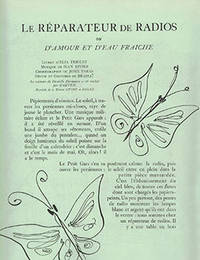
51-1017Paris: Théâtre des Champs-Elysées 1949. Seven original drawings by Brassaï who did the décor for the ballet together with the typescript with the author's manuscript annotations as well as the printed publication.Louis Aragon Elsa's husband described the performance in Les Lettres françaises n° 1096 915 septembre 1965.Ça me rappelle cette soirée aux Champs Elysées à la première d'un ballet d'Elsa musique de Jean Rivier chorégraphie de Boris Kochno décors de Brassaï le réparateur de radios avec le déchaînement de la salle les sifflets à roulettes parce que l'on voyait danser les gens du monde dans une boîte de nuit et qu'est-ce que vous voulez tout de suite tout Paris se sentait visé !Dessins originaux à l'encre de Chine sur 7 feuillets environ 246 x 159 mm représentant des bouquets de muguet 3 ou des papillons 4 destinés à illustrés le texte de présentation d'Elsa Triolet "Le Réparateur de radios" publié dans le programme du Théâtre des Champs-Elysées de 1949-1950.On joint :- Triolet Elsa. Le Réparateur de radios ou d'amour et d'eau fraîche. Tapuscrit corrigé 3 p. et épreuves corrigées 3 p. signées.Le livret du Réparateur de radios d'Elsa Triolet sera mis en musique par Jean Rivier avec une chorégraphie de John Taras au Théâtre des Champs-Elysées.- Programme du Théâtre des Champs-Elysées 1950 n° 10.In-4 324 x 346 mm en feuilles cordelette. Dirigé par Boris Kochno textes de Paul Eluard et Elsa Triolet dessins de Balthus Cecil Beaton Brassaï etc. Paris: Théâtre des Champs-Elysées, 1949. unknown
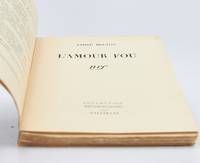
193787781Paris: Gallimard 1937. Fine. ""Convulsive beauty will be veiled-erotic fixed-explosive magic-circumstantial or it will not be"" Gallimard Paris 1937 14.50 x 19.50 cm Relié First edition one of 9 numbered copies on japon only deluxe issue aside from 35 copies on pur fil and a few on coloured paper. Full black morocco binding flat spine authors name palladium-stamped title stamped lengthwise in palladium and blind grey long-grain shagreen inlays to boards with author and title stamped lengthwise in palladium and in blind turn-ins framed in morocco light plum suede pastedowns and flyleaves three palladium decorated deckled edges outstanding custom binding by Thomas Boichot. Illustrated with 20 photographs including 7 photographs by Man Ray 4 by Brassaï one each by Dora Maar Henri Cartier-Bresson and Rogi André as well as artworks by Max Ernst and the statue of a female character by Giacometti in which the writer saw the very emanation of the desire to love and to be loved in search of its real human object in its painful ignorance. André Breton offers a meditation on love at first sight and passion drawn from his fateful first encounter in 1934 with his future wife Jacqueline Lamba this woman was scandalously beautiful. Recalling the beginnings of their romantic relationship he reflects on chance and embarks on a rereading of their love story detecting all sorts of phantasmagoric signs analysing his experiences and feelings. He concludes with an open letter to their daughter Aube born in December 1935 which ends with these words: I want you to be madly loved. A masterpiece of Surrealist literature both an extension and opposite of Nadja which was published nine years earlier also considered an objectbook in the classic surrealist style interleaved with photographs by Cartier-Bresson Brassaï and Man Ray . It proves its own startling kind of existence in the real world being not just a book not just the record of an extraordinary love that between André Breton and the artist with whom he shared his life but an object inserted madly and really now in our world Mary Ann Caws Translators note Mad Love University of Nebraska Press 1987. Gallimard hardcover