Pompadour, Marquise de (Jeanne-Antoinette Poisson)Antiquariat.de

150 résultats
1762307826AB1762. 13,4 x 18,5 cm. Auf Pergament. (leicht beschnitten, etw. fleckig, kleines Loch).
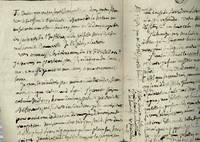
177625395versailles 1776 un Parchemin ORIGINAL de 32 pages, format : 32 x 24,5 cm, manuscrit à l'encre brune sur velin, signature manuscrite de AMELOT DE CHAILLOU, Antoine-Jean - Secrétaire d'État de la Maison du Roi LOUIS XVI + signature manuscrite (illisible) de Louis Jean BERTIER DE SAUVIGNY, Intendant de la Généralité de Paris, fait au Conseil d'Etat du Roy, sa Majesté y étant, à Versailles, le 21 Juillet 1776, [signature manuscrite à l'encre brune de Pierre Faron Benoît GUERRIER DE BEZANCE, Maitre des requêtes de lHôtel du Roi, Procureur général de la Commission des péages à Paris, en dernière page en bas à gauche] + Un Parchemin ORIGINAL de 4 pages, format : 32 x 24,5 cm, manuscrit à l'encre brune sur velin, signature manuscrite de AMELOT DE CHAILLOU, Antoine-Jean - Secrétaire d'État de la Maison du Roi LOUIS XVI + signature manuscrite (illisible) de Louis Jean BERTIER DE SAUVIGNY, Intendant de la Généralité de Paris, fait au Conseil d'Etat du Roy, sa Majesté y étant, à Versailles, le 17 Mars 1777,[signature manuscrite à l'encre brune de Pierre Faron Benoît GUERRIER DE BEZANCE, Maitre des requêtes de lHôtel du Roi, Procureur général de la Commission des péages à Paris, en dernière page en bas à gauche] + JOINT : LETTRE ORIGINALE DE LOUIS XVI, Roi de France, format : 19,5 x 38,5 cm, lettre manuscrite à l'encre brune du Roi au Conseiller d'Etat intendant et commissaire départi pour l'exécution de nos ordres en la Généralité de Paris lui en joignant de tenir la main à l'exécution de l'ARRET joint, lettre signée AMELOT DE CHAILLOU, Antoine-Jean (1732-1795), Secrétaire d'État de la Maison du Roi et signée par le ROI LOUIS XVI,[signature manuscrite au dos de la lettre à l'encre brune de Pierre Faron Benoît GUERRIER DE BEZANCE, Maitre des requêtes de lHôtel du Roi, Procureur général de la Commission des péages à Paris], fait à Versailles, le 17 Mars 1777,
173326449London, John Pine, 1733-37. Royal 8vo. Bound in 2 cont. uniform red full morocco. 5 raised bands on backs, backs richly gilt, boards richly gilt, inner gilt borders on boards, all edges of boards gilt, all edges gilt. Vol. 1 neatly rebacked, vol. 2 w. a bit worn hinges. Corners bumped. Internally mint condition. Front- and end-papers in silk, printed on fine, thick paper, broad margins. Copper-engr. throughout, plates and vignettes as well as text.
176352675(København, antageligt 1763). Folio. (37 x 24,5 cm.).Samtidigt hldrbd. med tidstypisk sidepapir. Øve kapitæl slidt. Ryg noget slidt. Permer med brugsspor. Ialt 140 pp. Manuskriptet er rigt illustreret og koncentreret omkring kanonernes brug, typer og indretning. 28 helsides (kanoner, lavetter etc), 13 halvisdes, 5 geometriske figurer, 10 tabeller og ca. 34 tekstfigurer, de fleste i delvis håndkolorereing. Et blad løst i 6. afdeling, og de sidste 3 plancher lettere skjoldede og opklæbede. Flere af delene er signeret ""O. Lütken"".
175859468Paris dimanche 2 avril 1758 | 13.40 x 19.20 cm | 2 feuillets
17700005130No place: Le chev de Berny 1770. Hardcover. Near Fine. 12mo 49pp. 3pp. of Table 3pp. with mss. borders inkspot and inked names on flyleaf flyleaf and title leaves nicked at top edge parchment-backed sprinkled boards <br/><br/>This is a UNIQUE MSS. executed by Chevalier de Berny who after a military career became the master of a writing academy in Brussels. Rather few of his works have survived. These love poems are addressed to Louise Madame Messiery M. Le Baron de H . It incoporates French masonic ideas including p. 3 "L'Amour recu Franc macon" and p. 48 in "Reflexion sur L'Amour". Le chev de Berny hardcover
1778919461778 - 1779 | 15.5 x 13.5 cm | Une feuille
175859468Paris 1758. Fine. Paris dimanche 2 avril 1758 13.40 x 19.20 cm 2 feuillets Will of Louise-Anne de Bourbon-Condé known as Mademoiselle de Charolais copied by the hand of Jean-Baptiste-François-Joseph Count de Sade and father of the Marquis in which the latter makes her nephew Louis-François Joseph de Bourbon Prince de Conti her universal legatee. A second part concerns bequests to livery servants to chambermaids and valets to the wardrobe keeper etc. Footnote in the hand of the Marquis de Sade: ""known as Mademoiselle de Charolais"". Attached is a note sheet written in Sade's hand with a view to publishing his father's correspondence. This will was written five days before the death of Mademoiselle de Charolais whose death occurred on Friday April 7 1758 following three months of illness. The second part of the will is dated Sunday April 2 1758 while the first bears the date of Sunday April 12 1758: this is obviously an erroneous date. The entirety of this copy was written by the hand of the Count de Sade who lived with Mademoiselle de Charolais at her château of Athis-Mons from 1750 until her death. The young Count de Sade sent by his father to Paris around 1720 had as protector Louis-Henri de Bourbon Prince de Condé known as Monsieur le Duc. Upon his arrival the young man appreciated court life and ""Rare thing he pleased women without making himself hated by men: hence the number of his friends at least as high as that of his mistresses. . M. de Sade was not content with easy conquests; bourgeois women left him indifferent. Those he sought - and most often conquered - were court women not only endowed with wit and beauty but also adorned with an illustrious name credit influence or fortune capable in a word of serving his interests and putting him in good standing at court."" Lever Sade. Among his conquests figured Mademoiselle de Charolais seven years his senior sister of his protector and then royal mistress. Little desirous of marrying she preferred all her life to remain unmarried and multiplied adventures and prestigious lovers. She was notably the favorite of the Duke de Richelieu but also of Louis XV for whom she recruited numerous mistresses thus earning the sobriquet of ""royal procuress"". The carnal encounter between Mademoiselle de Charolais and the Count de Sade took place on November 24 1725 while the latter was confined to bed because of a sprain. A letter from Louise-Anne attests to this nascent adventure: ""November 24 is the most beautiful day of my life if I have regained possession of my kingdom and my sovereignty by the rights of the bed where I swore you an oath of fidelity. I count on having received yours and I now live for the prettiest king in the world."" Papiers de famille p.20. The passion was not reciprocal however and the fickle Count de Sade soon met the Duchess de la Trémoïlle. Thus distancing himself from Mademoiselle de Charolais he wrote to her by way of breaking up: ""I regarded Madam the advances you made to me as provocation of your mind and not of your heart. I did not have the honor of knowing you I owed you nothing a sprain obliged me to keep to my room I was idle there your letters were pretty they amused me I flattered myself if it were true that I had made your conquest that you might cure me of an unfortunate passion which occupies me entirely."" op. cit. p.23. In 1752 the Count de Sade was ruined by his lifestyle he had sent young Donatien to Louis-le-Grand college and lodged with his good friend Mademoiselle de Charolais at the château of Athis-Mons: ""I have retired to Mademoiselle's although it is cruel at my age to depend on someone to reduce my expenses."" Letter from the Count de Sade to his uncle the provost of L'Isle-sur-Sorgue November 11 1752. He remained with his friend accompanying her in her numerous travels across Europe until her death. The correspondence between the Count de Sade and Mademoiselle de Charolais con unknown
1775307824AB1775. 22,3 x 17,5 cm. (durch Siegel Beschädigung mit Papierverlust).
177690973Versailles 31 janvier 1776 | 18.3 x 24.4 cm | Bifeuillet
175090724s. n. | s. l. s. d. [1750] | 20.5 x 31 cm | Relié
178590845s. n. | s. l. 1785 | 20.1 x 31.9 cm | Une feuille
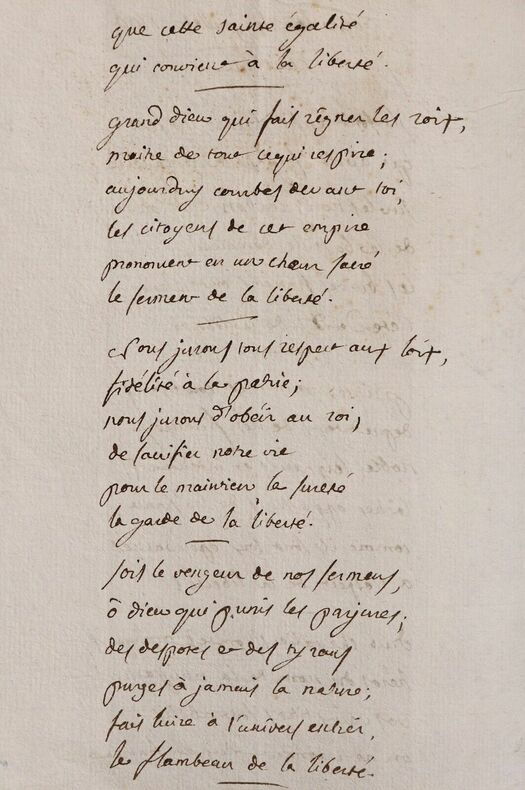
1790AMO-4529S.n., [14 juillet] 1790 Manuscrit autographe anonyme. 2 pages. 36 vers (6 strophes de 6 vers) 1 bi-feuillet 21,7 x 16,8 cm. parfait état. Belle écriture parfaitement lisible. Pièce autographe inédite non encore attribuée.
174581101745-1747 1 Un volume manuscrit in-4. 20 x 27 cm. 618 pp: 4 ff. n. ch., pp. 1-146 [Sur le mariage conclu], pp. 147-152 [blanc], pp. 153-611 [Negociation pour le mariage], 9 ff. n. chiffrés. Une planche dépliante dessinée et coloriée à la main est insérée entre les pp. 556 et 557. Ouvrage relié en veau marbré dépoque, dos à cinq nerfs orné de fleurons fleurdelisés, pièces de titre et de date en maroquin rouge et bordeaux, double filet sur les tranches, gardes en papier marbré, toutes tranches rouges. Ex-libris de la Bibliothèque de M. Laplagne Barris, au château de La Plagne, dans le Gers, et André Gutzwiller. Plats et coiffes un peu frottés, marques dusage aux coins, coiffe supérieure légèrement fissurée, sinon intérieur frais et en très bon état.
1772AMO-3535Georges-Louis Leclerc, comte de Buffon (1707-1788) 1 page feuillet 20,5 x 16 cm Bon état. Légères traces de plis. Deux trous d’épingle en dehors du texte. Voir photos. Lettre signée à son ami le botaniste André Thouin (1747-1824) alors âgé de 25 ans. Goerges-Louis Leclerc, comte de Buffon est âgé de 65 ans au moment de la rédaction de ce courrier. Son immense ouvrage intitulé "L'Histoire naturelle" est encore en cours de publication (cette somme unique en son genre fut publiée entre 1749 et sa mort - avec de nombreux suppléments parus ensuite par Lacépède – en 1772 les Oiseaux sont en cours de publication depuis 1770. La publication des Oiseaux ne s’achèvera qu’en 1783). Dans le présent courrier Buffon écrit à son jeune ami et collaborateur resté à Paris. Buffon écrit depuis son cabinet de travail de Montbard. C’est précisément en 1772, peu de temps après la rédaction de ce courrier que seront achevées les forges situées près du village de Buffon. Buffon écrit à Thouin en ces termes : [Transcription de la lettre / orthographe respectée :] "Lucas a dû vous remettre, mon cher Thouin, les deux certificats dont vous avez besoin et c'est à lui à qui je vous prie de remettre la partie qui me revient lorsque vous aurez touchée. Je vous envoye ci joint un second mandat pour prendre vingt voyes de bois chez le Sr Vaslin ; s'il fait aussi froid à Paris qu'ici on doit commencer à en brûler beaucoup. Ma santé souffre de cette rigueur de froid qui dure ici depuis quatre à cinq jours, le termomètre étoit cette nuit à 6 degrés 1/2 au dessous de la glace. Je vous remercie, mon cher Thouin, de vos bons souhaits au renouvellement de cette année. Je vous prie de faire mes amitiés à votre bonne mère et à votre famille. à Montbard ce 6 janvier 1772 [signé] Buffon." Les relations entre André Thouin (1747-1824) et Buffon sont importantes. C'est Buffon, alors intendant du jardin du roi depuis 1739, qui offre à André Thouin la place de son pèreJean- André Thouin (jardinier en chef du jardin du roi) décédé en 1764. André Thouin n'a alors que 17 ans. Les deux hommes collaboreront étroitement jusqu’à la mort de Buffon en 1788. Buffon gère Paris le plus souvent depuis son cabinet de Montbard tandis que Thouin se révèle être un parfait collaborateur au plus près des nombreux travaux à réaliser et à gérer le Jardin du Roi. Thouin aura une importante carrière et sera toujours très apprécié de Buffon. De nombreuses lettres de Buffon à Thouin ont été publiées dans la Correspondance Générale de Buffon ainsi que dans les volumes de correspondance inédite publiés ultérieurement. La lettre que nous proposons ici ne se trouve pas dans ces volumes de correspondance. Elle est inédite. Par ailleurs nous avons constaté que les échanges publiés entre Buffon et Thouin datent du début des années 1780 et années suivantes. Un tel courrier entre les deux hommes à la date de janvier 1772 montre la teneur des échanges durant les premières années après la nomination de Thouin jeune au Jardin du Roi depuis 1764. Très beau document signé par le grand naturaliste.
174660957(Unsigned, and no date, but penned between 1746 and 1751). 1 leaf 4to (25,5 x 19 cm), off-white paper in fine condition. Fully penned on both recto (24 lines) and verso (5 lines).
1793733941er avril 1793 | 15.60 x 20 cm | une page sur un feuillet
1793733941793. Fine. 1er avril 1793 15.60 x 20 cm une page sur un feuillet Unpublished autograph letter signed and dated written in black ink and addressed to a notary. On the verso probably in the hand of a secretary the inscription ""Sade du 1er avril 1793""; below this inscription a short sentence in the Marquis's hand: ""so that I may write to Gaufridy to send him money"". Some transverse folds from the original folding for posting. Lengthy letter addressed to a notary while the Marquis freed on April 2 1790 by the abolition of royal warrants is at liberty and attempting to put his affairs in order. After the Revolution his sons emigrated and he did not follow them. His name nevertheless appears on the list of persons who left France due to the revolutionary troubles: ""I hope that with all this I will manage to have my name erased from that fatal list of émigrés."" Anxious not to be considered a ci-devant Marquis in this period preceding the Terror he insists on the persecution of which he claims to be a victim despite his good will: ""It is an unparalleled atrocity that such a trick should have been played on me who have not left Paris since the revolution and who since that time have not ceased to give the most unequivocal proofs of my patriotism"". In this letter Sade also denounces the complexity of the workings of the French administration after the Revolution: ""I have just sent M. Lions the appropriate certificate of residence and I have attached a petition to the district which he tells me is . essential."" Impecunious he begs his lawyer ""to excite the zeal of those who owe him and to urge them to pay as much money as they collect immediately to M. Gauffridi sic"" and does not hesitate to show himself obliging in order to achieve his ends: ""spare no effort then I beseech you . always preserve for me your care and your friendship . I embrace and greet you with all my heart."" Sade's efforts would prove futile; in December 1793 he was imprisoned at the Madelonnettes before being admitted through the good offices of his friend Mme Quenet to the Coignard de Picpus establishment a nursing home sheltering wealthy suspects. Interesting unpublished letter showing the unfortunate Marquis at bay during one of his rare moments of freedom. unknown
1789307833AB1789. (Ränder gebräunt, knickfaltig).
17977617330 fructidor 1797 An V [16 septembre 1897] | 18.50 x 21.30 cm | 3 pages sur un double feuillet
1797761731797. Fine. An exceedingly rare letter from Restif: « Les événemens du 18 fructidor' m'ont rendu la vie . en affligeant mon cur » 30 fructidor 1797 An V 16 septembre 1897 18.50 x 21.30 cm 3 pages sur un double feuillet Extremely rare autograph letter signed « Restif Labretone » addressed to Citoyenne Fontaine. Three pages written in black ink on a double sheet of laid paper. Remains of a wax seal folds inherent to mailing. This letter was published with some inaccuracies in Lettres inédites de Restif de Labretone by V. Forest and É. Grimaud 1883. The Fontaine couple are merchants from Grenoble and Restif de la Bretonne began corresponding with them on March 15 1797. Important letter testifying to the completion of the publication of Restif's great autobiographical work: Monsieur Nicolas ou les Ressorts du Cur Humain dévoilé. « I will have completed the Cur humain Dévoilé within 15 days I will prepare your package immediately to have it ready. » The first eight volumes of this great autobiographical work printed by Restif himself a typesetter by trade in his residence at 11 rue de la Bûcherie were entrusted to the « dishonest » bookseller Nicolas Bonneville who did not honor his debts to the writer. Besides health issues « I exchange my illnesses and do not cure them » Restif also shares with his correspondent his literary setbacks: « The Author of Nature will preserve a sincere friend for me to compensate for the scoundrels of the Institute and the perfidious Mercier ». Indeed the previous year the author learned with bitterness that he was not admitted to the National Institute and Louis-Sébastien Mercier who had praised him in his Tableau de Paris and supported his candidacy then turned away from him. To this sum of misfortunes financial difficulties are added. Penniless and living on meager state pensions he maintains all his support for the Republic: « By what fatality do I never see the views of the rulers who welcome me; or how do they not see at once that I am attached to the Revolution to the point that I still love it even when it beats me. » Restif profoundly anti-royalist wrote several pamphlets to this effect and had just added to the end of Monsieur Nicolas an apology for the coup d'état of 18 Fructidor Year V. However this date marks the end of the allowance granted to him by Lazare Carnot after his failure at the Institute: « You know the events of 18 Fructidor; I will not speak to you about them. They have given me back my life; but by afflicting both my heart and my gratitude. » But Restif's great sorrow is the loss of his daughter Filette born from his adventure with Louise Allan whose paternity was revealed to him only late: « I am writing to you from bed weeping over my Filette who died 11 months and ten days ago . Filette was my daughter and Louise's whose soul and beauty she had. » Autograph letters signed by Restif de La Bretonne that have survived to this day are extremely rare. unknown
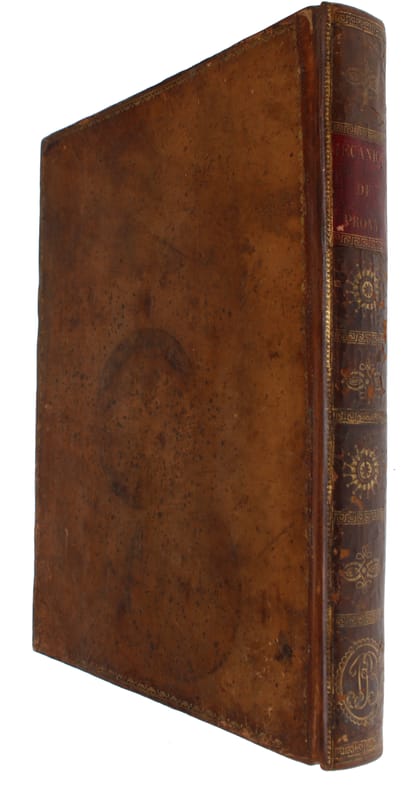
180060104Paris, Imprimerie de la République, an VIII [i.e. 1800]. 4to. Bound in a lovely full mottled calf binding with fine, gilt ornamental borders to boards, double gilt line-borders to all edges of boards and a richly gilt spine. Spine with gilt red leather title-label and with the gilt monogram of Joséphine and Napoléon - ""JB"" - to lower spine. Neatly rebacked. With a handwritten inscription for Napoleon to title-page ""Au Citoyen Bonaparte/ premier Consul de la République francaise/ De la part du Conseil [de]/ L'Ecole Polythechnique"", with a signature underneath and the stamp of the Ecole Polytechnique. The inscription is slighly cropped at the outer margin. A bit of brownspotting here and there. (4), VII, (1), 477, (3) pp.
179358186Königsberg, Friedrich Nicolovius, 1793. 8vo. In the original bluish cardboardbinding, with handwritten title to spine. Binding very neatly restored at spine and extremities. Previous owner's inscriptions to front free end-paper and title-page as well as pasted-down front end-paper. One leaf with a tiny closed tear to blank outer margin and some leaves with a single hole to the blank outer margin. Light pencil-underlinings and -markings to a few leaves. Internally clean and fresh. Printed on very heavy paper (about three times the thickness of the normal paper) and with wide margins. XX, (2), 296, (2, -errata) pp. Housed in a beautiful marbled half calf box in pastiche-style, with splendidly gilt spine and gilt morrocco title-label.
179167693s. l. (Londres, Paris, Toulon...) 1791-1832 | 12000 feuillets de divers formats | en feuilles
179167693s. l. Londres London Paris Toulon. 1791. Fine. s. l. Londres London Paris Toulon. 1791-1832 12 000 feuillets de divers formats en feuilles Unpublished political scientific and historical archives The complete manuscript unpublished papers of Louis Chevalier de Sade 1753-1832 author of the Lexicon politique and cousin of the famous Marquis. The important geopolitical historical and scientific archives of a learned aristocrat a privileged witness of the end of the Ancien Régime the French Revolution the Consulate Empire and Restoration. A unique fund of research on the implementation of a constitutional monarchy. Exceptional collection of the Chevalier Louis de Sade's personal archives the cousin of the Marquis de Sade representing 12000 handwritten pages including several thousand unpublished and written by his hand. The Chevalier shows a thought system that he describes as «holistic» including historical political and scientific reflections. Louis Chevalier de SADE If we take the French Revolution as the birth of an experiment both secular and political the Chevalier de Sade was without doubt one of its early critics. Not only of the Revolution which had many other detractors but of its political ideology which would go on profoundly to impact the two hundred years that followed. What he calls «positive politics» is «based on reasoning and experience». «The theory did have some attractions for me; I studied it with care I savored its principles. Now I see their value only in terms of the impact of their implementation what we've seen them produce in the peoples of which history has given me knowledge. This is my method; I know that it is all in all the opposite of the methods utilized by the men who have governed us and written our constitutions to this very day without deviation. This continuous divergence between what has been done and what should never have been done increased my confidence in the path to be followed and at the same time fortified my determination to keep to the views I had adopted of judging laws by the historic consequences they entail rather than by the lyrical supposedly conclusive metaphysical arguments with which these innovators continually and still to this day assault us.» The Chevalier de Sade who saw the world in terms of his own time and place could be nothing other than a Royalist. There were practically no examples of democracy in the history known to the Chevalier apart from the Classical democracies of Greece and Rome which had been experiments only in very elitist forms of democracy. These were very well known to this political scientist whose papers contain 7000 pages dedicated to the history of the Classical world. The republic ushered in by the Revolution was more than just a political system it was the realization of a philosophical political ideal. And while most of those opposed to the new regime saw in it above all a threat to their personal situations their religious beliefs or even more simply their habits the writings of the Chevalier de Sade show no such dogmatic influence; or at least he never uses dogma to justify his arguments. Louis de Sade a gentleman without a fortune and without significant ties was conservative through philosophical and historical conviction and not out of interest. It is with this perfect intellectual honesty that he studies the essays memoirs and political or theoretical works of his contemporaries. Running counter to Enlightenment thought the Chevalier's view of society owed very little to philosophy. Though he puts together a serious theoretical history of the development of Man from the condition of «savages» to the forging of various societies he does not posit Man's ideal nature as some of his contemporaries did. Rather the Chevalier examines the gap between nature and the civilized being without passing moral or philosophical judgment as was the fashion at the time. «The political error that damned Europe in the 18th unknown