Wilker, Johann Matthias [auch Wilcker], Buchbinder, Autor, pietist. Liederdichter (1734-1794)Antiquariat.de

151 résultats
178891019Magdeburg, 1788. den 15ten Jun. 1788. 13 S. auf 4 gefalt. Bögen leicht getönten Grove-Büttens (mit Wasserzeichen) in brauner Tinte. 4to. 25,5 x 19 cm.
178890974Magdeburg, 1788. 5 S. auf 2 gefalt. Bögen leicht getönten Grove-Büttens (mit Wasserzeichen) in brauner Tinte. 4to. 27 x 19 (37,5 x 26,5) cm.
178690998(Magdeburg), 1786. In zweierlei Handschriften in brauner Tinte. 3 lose Lagen: [1.] 4 Bögen = 8 Bätter; [2.] 4 1/2 Bgn. = 9 Bll.; [3.] 6 Bgn. = 12 Bll.; [davon 5 blanco]. 4to. 36,5 x 22 cm. In 3 losen Lagen.
178690978(Magdeburg), 1786. 65 S. in zweierlei Handschriften in brauner u. roter Tinte auf 37 Bll. (= 18 gefalt. Bögen, 1 Bl.). 4to. 36,5 x 22 cm. In 4 losen Lagen.
177291128Magdeburg, [nach 1772]. 5 S. auf 2 gefalt. Bögen leicht getönten Büttens (mit Wasserzeichen) in blass-brauner Tinte. 4to. 35 x 21 cm.
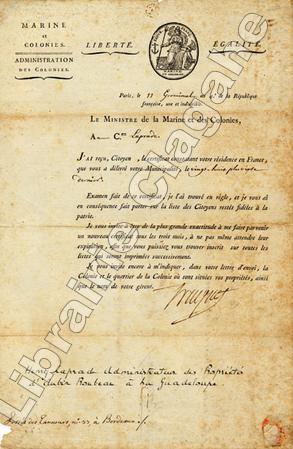
17968139au citoyen Laprade ; in-folio, 2 pp., en-tête Marine et Colonies : le Ministre de la Marine et des Colonies en date du 11 germinal an 4, pièce en partie imprimée accusant réception du certificat de résidence à Bordeaux, prescrit par le roi pour les non prévenus d'émigration. Marque postale rouge "Mte de la Marine et des Colonies" au verso, avec l'adresse de Laprade.
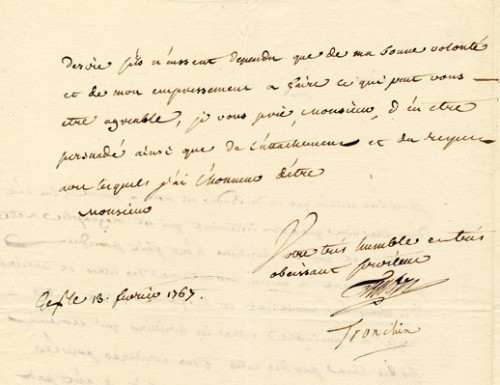
176711347in-4, 1 p. 1/2 ; Genève, 13 février 1767 ; il signale à son correspondant "que M. de Budé est mort à Genève, que c'est dans cette ville que son testament qui est olographe a été ouvert, et que ses héritiers n'ont fait procéder juridiquement à aucun inventaire des titres et terriers des terres de Montréal et de Ferney, tout a été réglé à l'amiable entre les héritiers qui étaient sur les lieux par des actes sous écritures privées dont, à quelque prix que ce soit, il n'est pas possible de se procurer un double sans leur participation. C'est la réponse que j'ai faite au mémoire que je vous renvois...", signé Tronchin.
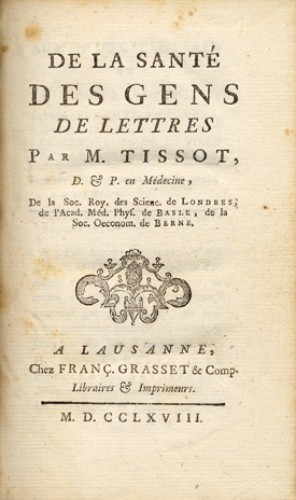
176811235Lausanne, chez François Grasset, 1768 ; in-8 ; plein veau havane marbré, dos à nerfs décoré et doré, filet sur les coupes, tranches rouges (reliure de l'époque) ; XVI, 246 pp., (1) f. blanc.
1762boz_003435Stanislas de Boufflers. Lettre autographe signée en date du 11 décembre 1762. Dimensions : 15.7 x 9.6 cm. Nombre de pages : 3 pages. Stanislas Jean de Boufflers Marquis de Remiencourt, plus souvent appelé le chevalier de Boufflers est un maréchal de camp et poète lorrain puis français.
17918128in-folio, 1 p. imprimée et complétée à la main, signature autographe de Sombreuil, en date du 28 août 1791 ; elle accompagnait le Brevet nominatif du bénéficiaire, invalide resté anonyme ; "ayant demandé à se retirer à Pont-à-Mousson et partant aujourd'hui de l'Hôtel...", l'intéressé a reçu quatre livres pour son trajet, à raison de huit sous par lieue pour dix lieues ; mention en dessous et au verso de divers versements qu'il a reçus à Meaux, Châlons, Château-Thierry, Saint-Dizier et Toul.
17542966En France, sans nom, 1754. 1 volume in-12 de [6-]112-56-41-68-36 pages. Plein veau fauve moucheté, dos à nerfs orné, tranches rouge. Petites galeries de vers au 1er plat, sans atteinte au papier, coins frottés, nom de possesseur et inscription sur garde, au faux-titre et au titre (à la plume, d'époque).
174719933LANCOSME 1747 une lettre (document authentique), manuscrite à l'encre brune sur papier velin ligné filigrané, format : 38,5 centimètres de large x 49 centimètres de haut, cachets rouge aux armes des Lancosme en bas à gauche, signature manuscrite de Louis François Alexandre de SAVARY , CHEVALIER DE L'ORDRE MILITAIRE DE SAINT LOUIS, SEIGNEUR MARQUIS DE LANCOSME, fait au château de Lancosme, le 1er Juillet 1747 ,
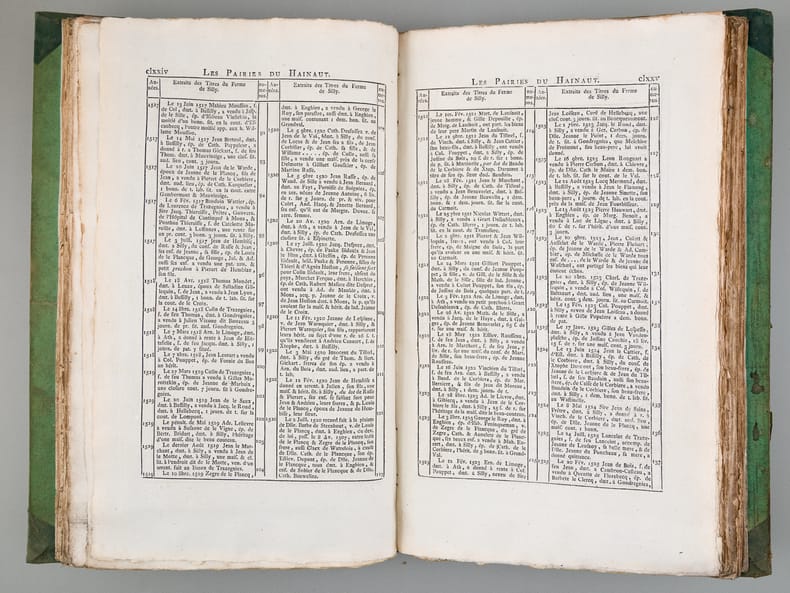
178266072Ouvrage par souscription annoncé en 1782, 3 vol. in-folio cartonnage bradel vert de l'époque, Première Partie : De l'Imprimerie de Saillant, Paris, s.d. [ 1782 , 2 ff., cccclxi pp. ; Deuxième Partire : De l'Imprimerie de Léonard Danel, A Lille, s.d., cccclxiij-mlxix pp. ; Table générale : De l'Imprimerie de Léonard Danel, A Lille, s.d. [circa septembre 1804 ], 1 f., 144 pp. avec 3 tableaux généalogiques dépliants et qq. gravures dans le texte
1771307827AB(1771). 19 x 13,5 cm. (starker brauner Fleck in den Text der letzten beiden Zeilen einfließend, kleine Ausbesserungen).
17984673Lausanne, Imprimé aux dépends de l'auteur, 1798. In-12 de XXIV, 406 pages, [1]ff. blanc, demi-basane à coins, dos lisse, étiquette de titre, petit accroc à la coiffe inférieure, coins un poil frottés.
1789GITf363Ensemble de 9 registres brochés (7 au format 26,5cm sur 19cm, 2 au format 22,5cm sur 17cm), totalisant 511 feuillets non chiffrés (415 rédigés, 116 restés vierges). La plupart des feuillets sont écrits recto verso, pratiquement sans marges, interlignes étroits, d'une petite écriture fine, serrée mais bien lisible. Brochures solides mais usées (plats du registre 1835 désolidarisées), traces de brûlure avec petit manque de papier en bordure du registre 1832-1858, auréole claire ancienne en tête du registre 1799-1812, en tête et dans les fonds de celui de 1816-1822 (avec légères adhérences par endroits), rousseurs par endroits n'altérant pas la lecture.
1762307826AB1762. 13,4 x 18,5 cm. Auf Pergament. (leicht beschnitten, etw. fleckig, kleines Loch).
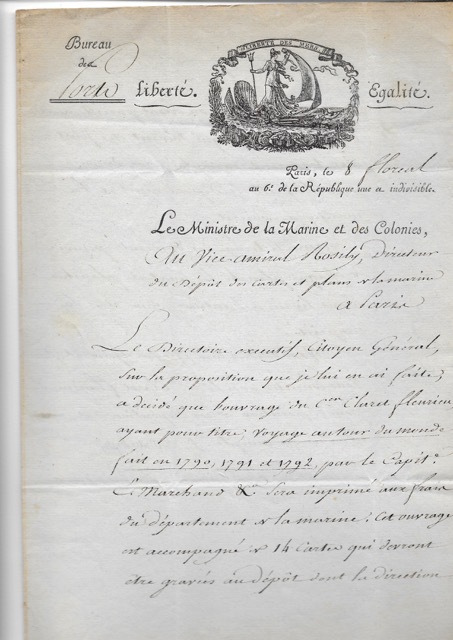
179811951Lettre signée par le ministre de la Marine et des Colonies Pleville Le Peley, datée 8 floréal an 6 (27 avril 1798). Il écrit au Vice-Amiral ROSILY à propos d'un livre de voyages. L'ouvrage (Voyage autour du monde de Claret de Fleurieu) a bien paru suite à cette lettre ... 2 pages 31,5 x 21,5 cm avec belle vignette. Très bon Paris 1798 2 pages in-folio
174719935Saint Cirang en Brenne 1747 une lettre (document authentique), manuscrite à l'encre brune sur velin , format : 33 centimètres de large x 24 centimètres de haut, cachet rouge aux armes de l'évèque de Nevers en bas à gauche, signature manuscrite : Piolle Chanoine de Nevers (par procuration spéciale de Guillaume Dhugues Evèque de NEVERS), fait à Saint Cyrang, le 17 Novembre 1750, rousseurs en marge mais trés lisible,
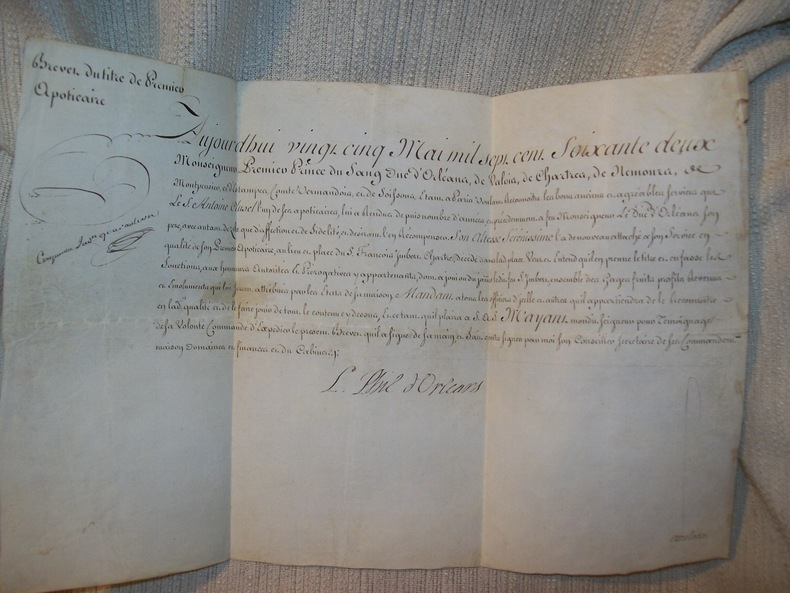
1762GITe802Document original in folio sur vélin (28cm sur 43cm) en langue française, signé "L. Phil d'Orléans" contresigné "Omelone", plié en 3 parties dans le sens de la hauteur. Texte bien complet, bel exemplaire d'une grande fraîcheur.
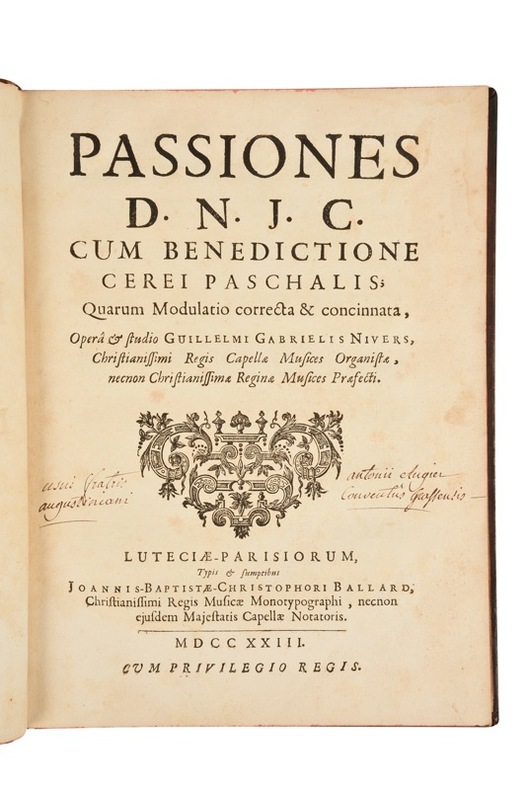
172321655Paris, Jean-Baptiste-Christophe Ballard, 1723 ; relié ensuite, du même auteur : Lamentationes Jeremiae prophetae, quarum modulatio correcta et concinnata. (même éditeur et même date).Soit deux ouvrages reliés en un volume in-quarto, reliure de deuil en veau brun, fer des instruments de la Passion poussés à froid au centre des plats, fer à la tête de mort et tibias croisés poussés à froid dans les coins et sur les caissons du dos (reliure de l’époque) ; [4], 122 pp., [1] f. de Privilège ; [2] Titre et Privilège, 22 pp.
1797761731797. Fine. An exceedingly rare letter from Restif: « Les événemens du 18 fructidor' m'ont rendu la vie . en affligeant mon cur » 30 fructidor 1797 An V 16 septembre 1897 18.50 x 21.30 cm 3 pages sur un double feuillet Extremely rare autograph letter signed « Restif Labretone » addressed to Citoyenne Fontaine. Three pages written in black ink on a double sheet of laid paper. Remains of a wax seal folds inherent to mailing. This letter was published with some inaccuracies in Lettres inédites de Restif de Labretone by V. Forest and É. Grimaud 1883. The Fontaine couple are merchants from Grenoble and Restif de la Bretonne began corresponding with them on March 15 1797. Important letter testifying to the completion of the publication of Restif's great autobiographical work: Monsieur Nicolas ou les Ressorts du Cur Humain dévoilé. « I will have completed the Cur humain Dévoilé within 15 days I will prepare your package immediately to have it ready. » The first eight volumes of this great autobiographical work printed by Restif himself a typesetter by trade in his residence at 11 rue de la Bûcherie were entrusted to the « dishonest » bookseller Nicolas Bonneville who did not honor his debts to the writer. Besides health issues « I exchange my illnesses and do not cure them » Restif also shares with his correspondent his literary setbacks: « The Author of Nature will preserve a sincere friend for me to compensate for the scoundrels of the Institute and the perfidious Mercier ». Indeed the previous year the author learned with bitterness that he was not admitted to the National Institute and Louis-Sébastien Mercier who had praised him in his Tableau de Paris and supported his candidacy then turned away from him. To this sum of misfortunes financial difficulties are added. Penniless and living on meager state pensions he maintains all his support for the Republic: « By what fatality do I never see the views of the rulers who welcome me; or how do they not see at once that I am attached to the Revolution to the point that I still love it even when it beats me. » Restif profoundly anti-royalist wrote several pamphlets to this effect and had just added to the end of Monsieur Nicolas an apology for the coup d'état of 18 Fructidor Year V. However this date marks the end of the allowance granted to him by Lazare Carnot after his failure at the Institute: « You know the events of 18 Fructidor; I will not speak to you about them. They have given me back my life; but by afflicting both my heart and my gratitude. » But Restif's great sorrow is the loss of his daughter Filette born from his adventure with Louise Allan whose paternity was revealed to him only late: « I am writing to you from bed weeping over my Filette who died 11 months and ten days ago . Filette was my daughter and Louise's whose soul and beauty she had. » Autograph letters signed by Restif de La Bretonne that have survived to this day are extremely rare. unknown
17977617330 fructidor 1797 An V [16 septembre 1897] | 18.50 x 21.30 cm | 3 pages sur un double feuillet
1781307656AB1781. 32x20 cm. (Oben lichtrandig, verso Papierstreifenreste, links und rechts beschnitten).
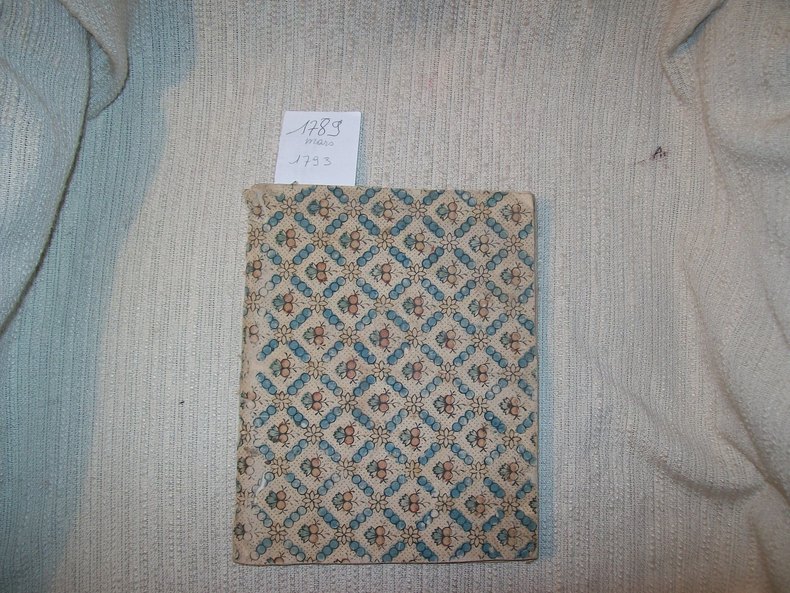
17890TP107Paris 1789. Four very warm letters from patients obviously post-operative all declaring the utmost respect and thanks to Professor Chopart. One letter is clearly signed Lalouette and the first of March 1789. Biographical Notes: SIR THOMAS PHILLIPPS 1792-1872. Born in 1792 Sir Thomas Phillipps from childhood was obsessed with the idea of obtaining virtually anything written or printed on paper including cartloads of documents from wastepaper merchants and the entire inventories of booksellers. "I wish to have one copy of every book in the world" he declared to a friend. He very nearly succeeded. His collection ultimately grew to more than 100000 books and at least 60000 manuscripts. As a result of his extravagant purchases Sir Thomas was permanently on the verge of bankruptcy and was constantly pursued by creditors. So many books arrived at his house that it was impossible to unpack his acquisitions much less keep pace with them. Visiting scholars driven to distraction would spend days hunting for an elusive text in the dusty heaps that filled every room. Because Sir Thomas has a morbid dread of fire most of his collection was housed in coffinlike boxes that could be carted away quickly. Visitors to Middle Hill were struck too by the presence of numerous logs a ploy he used to lure beetles away from his books. As Sir Thomas relentlessly pursued his passion the house itself began to crumble and its floors started to sag under the cast weight of hundreds of tons of paper. His neglect of Middle Hill was partly deliberate however. Sir Thomas's chief enemy in life James Halliwell had married his daughter against his wishes. It appears that Halliwell was in Sir Thomas' eyes the worst kind of criminal a book thief who had stolen valuable works from university libraries and even from his father-in-law. Having no sons Sir Thomas was unable to prevent Halliwell from inheriting his estate. To ensure that his detested heir would never receive anything of value Sir Thomas's solution was to allow Middle Hill to fall unto complete disrepair. He even went so far as to chop down and sell for lumber the centuries-old oak trees that lined the majestic mile-long drive to his home. In 1863 Sir Thomas decided to move - in order to accommodate his books. With the aid of 160 men 103 wagonloads of books and papers drawn by 230 horses the books were lumbered from Middle Hill top their new estate in nearby Cheltenham. It is said that for years afterwards the countryside was littered with the remains of carts that had collapsed under the sheer weight of the Phillipps collection. Sir Thomas continues to add to his library until his death in 1872. After Sir Thomas's death his immediate family had no room for his collection. So vast was the library that although individual items and large sections were sold privately or through numerous auction sales the Phillipps collection is still being sold more than a century after the death of its owner. In the course of its sales many treasures have come to light. As late as 1964 part of the long-lost and unique medieval manuscript of the Roman poet Ovid's Metamorphoses appeared and was subsequently reunited with its other half at Magdalen College Oxford. Once destined for destruction as worthless wastepaper this and many other priceless works were saved by the single-minded obsession of the greatest bibliomaniac of all time. Autograph. Manuscript. Very Fine. 8vo - over 7¾" - 9¾" tall. Paperback