Max JACOBBiblio.com
1 050 résultats
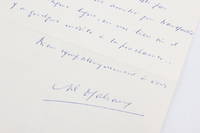
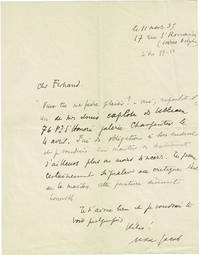
193575865Paris 1935. Fine. Paris 31 mars 1935 21 x 27 cm une page sur un feuillet Unpublished autograph letter signed by Max Jacob addressed to Fernand Pouey. One page written in black ink on a sheet. Two transverse folds inherent to mailing. Remarkable letter in which Max Jacob asks a strange favor of his friend: ""Un de nos amis explose sic des tableaux 76 Fg St Honoré galerie Charpentier le 4 avril. J'ai des obligations à son endroit et je voudrais lui montrer des sentiments d'ailleurs plus ou moins sincères. Tu peux certainement signaler au critique d'art de la maison cette peinture sûrement honorable."" ""One of our friends is exploding sic paintings 76 Fg St Honoré galerie Charpentier on April 4th. I have obligations toward him and I would like to show him feelings that are more or less sincere. You can certainly point out to the house art critic this surely honorable painting."" The mysterious ""friend"" mentioned in this letter could be the painter Balthus who exhibited at the Galerie Charpentier in early April 1935. unknown
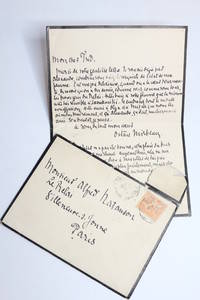
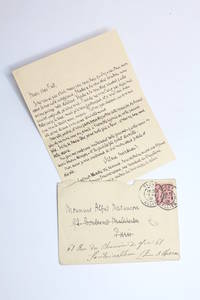
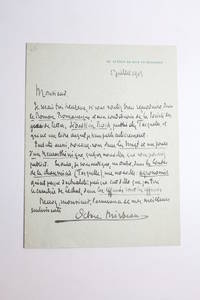
190173686s. l. cachet de Seine-et-Marne 1901. Fine. s. l. cachet de Seine-et-Marne 15 Septembre 1901 12.50 x 17.60 cm une feuille Moving autograph letter signed by Octave Mirbeau addressed to the playwright and founder of the Revue Blanche Alfred Natanson. 15 lines in black ink on a folded sheet mourning paper with black border watermarked ""JDL & cie"" envelope attached. ""Thank you for your kind letter. I already knew from Alexandre Natanson how worried you had been about my wife's condition. It is a delicious joy when one's heart is tormented to know that one has friends like you like all of you the good people of the Relai. Please tell your wife that mine was very touched by her friendship. And embrace everyone with effusion. Also tell Olga Alexandre Natanson's wife and Misia Thadée's wife that we love them tenderly and Alexandre that he is a charming friend."" Long postscript on the poor health of his wife the former actress Alice Régnault: ""Yesterday was not a good day and the wound on her arm presented a nasty appearance. Today it is a little better. But it is something to watch very closely. Movements are made a little more easily but she still suffers extremely at night at the slightest play of the muscles"". Mirbeau had been particularly close to the Revue Blanche group since its launch in Paris in 1891. But it was during the Dreyfus affair that his intimate and lasting friendship with the Natanson brothers Thadée Alexandre and Alfred was strengthened. After aesthetic disagreements over Art Nouveau and the Nabis Mirbeau finally reunited with Thadée around 1900 in a now shared inclination for the young Nabis painters of the Revue Blanche Bonnard Vallotton and Vuillard. The ""Relai"" corresponds to a former coaching inn in Villeneuve-sur-Yonne purchased by Thadée Natanson in 1897 which became a destination for all their writer and artist friends. One could encounter the Nabis painters Vuillard Vallotton Bonnard or Roussel as well as Toulouse-Lautrec. The Revue Blanche played an essential role in France as historian Paul-Henri Bourrelier confirms: ""Most of the most prominent writers painters musicians politicians intellectuals of the late nineteenth and early twentieth centuries collaborated with it or were associated with it. Created financed and directed by the three Natanson brothers young Polish Jews with the enthusiastic complicity of their fellow students from the Condorcet lycée La Revue blanche quickly became a place of debate on all the subjects that stirred France. It led political battles under the impetus of anarchists like Fénéon Mirbeau; socialists such as Blum G. Moch Péguy; Dreyfusards and founders of the League of Human Rights like Reinach and Pressensé."" unknown
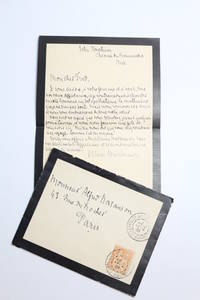
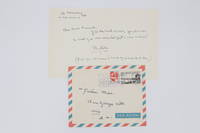
190673701Cormeilles-en-Vexin 1906. Fine. Cormeilles-en-Vexin 22 août 1906 ou 1908 12.60 x 17 cm une feuille Friendly autograph letter signed by Octave Mirbeau addressed to the playwright and founder of the Revue Blanche Alfred Natanson. 12 lines in black ink on a folded sheet letterhead paper ""Cormeilles-en-VexinS.&O."" envelope included. ""Cher ami J'avais bien pensé que cette vieille bonne femme qui tape si fort sur les matelas avait du écorcher mon nom. Mais dans l'incertitude car je pouvais penser aussi que vous étiez pris avec quelqu'un de très sérieux . Ceci mon cher Fred pour vous dire que je suis parti de chez vous triste de ne pas vous avoir vu voilà tout et sans le moindre sentiment mauvais. Vous savez que j'ai pour vous une affection solide et je vous connais assez gentil pour moi pour me permettre de supposer des sottises. ."" ""Dear friend I had indeed thought that this old good woman who beats the mattresses so hard must have mangled my name. But in uncertainty for I could also think that you were busy with someone very serious . This my dear Fred to tell you that I left your house sad not to have seen you that's all and without the slightest bad feeling. You know that I have a solid affection for you and I know you well enough to be kind to me to allow myself to suppose foolish things. ."" With an amusing postscript: ""Ne prêtez pas attention à ce gribouillage. L'auto a je ne sais pas quoi j'y travaille. et n'y fait rien de bon. d'ailleurs. Et mon mécanicien se prend la tête à deux mains noires d'huile grasse ."". ""Don't pay attention to this scribbling. The car has something wrong I don't know what I'm working on it. and it's not doing any good. anyway. And my mechanic is holding his head in his two hands black with greasy oil ."". Mirbeau was particularly close to the Revue Blanche group since its launch in Paris in 1891. But it was from the Dreyfus affair that his intimate and lasting friendship with the Natanson brothers Thadée Alexandre and Alfred was strengthened. After aesthetic disagreements about Art Nouveau and the Nabis Mirbeau finally reunited with Thadée around 1900 in a now common inclination for the young Nabis painters of the Revue Blanche Bonnard Vallotton and Vuillard. The Revue Blanche played an essential role in France as confirmed by historian Paul-Henri Bourrelier: ""Most of the most prominent writers painters musicians politicians intellectuals of the late 19th and early 20th centuries collaborated with it or were associated with it. Created financed and directed by the three Natanson brothers young Polish Jews with the enthusiastic complicity of their classmates from the Condorcet lycée La Revue blanche quickly became a place of debate on all subjects that stirred France. It led political battles under the impulse of anarchists like Fénéon Mirbeau; socialists such as Blum G. Moch Péguy; Dreyfusards and founders of the League of Human Rights like Reinach and Pressensé."" unknown
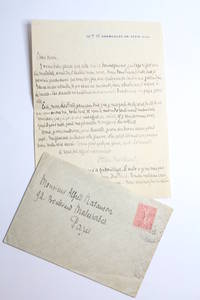
190173700Nice Villa Ibrahim chemin des Baumettes Nice 1901. Fine. Nice Villa Ibrahim chemin des Baumettes Nice 8 Février 1901 12.50 x 17.60 cm une feuille Friendly autograph letter signed by Octave Mirbeau addressed to the playwright and founder of the Revue Blanche Alfred Natanson some time after his marriage. 12 lines in black ink on a folded sheet mourning paper with black border watermarked ""JDL & cie"" envelope included. ""Je vous envoie à votre femme et à vous tous nos vux affectueux et je voudrais pouvoir chanter en votre honneur un bel épithalame. Le malheur est que je ne suis pas poète. Mais nous somme vos amis et nous vous embrassons de tout notre cur. Nous avions espéré que vous viendriez passer quelques jours à Cannes et nous nous faisions une fête de vous avoir ici. Misia nous dit que vous avez renoncé à ce voyage. Comme c'est ennuyeux ! ."". ""I send to your wife and to you all our affectionate wishes and I would like to be able to sing a beautiful epithalamium in your honor. The misfortune is that I am not a poet. But we are your friends and we embrace you with all our heart. We had hoped that you would come to spend a few days in Cannes and we were looking forward to having you here. Misia tells us that you have given up this trip. How annoying! ."". Mirbeau was particularly close to the Revue Blanche group since its launch in Paris in 1891. But it was from the Dreyfus affair that his intimate and lasting friendship with the Natanson brothers Thadée Alexandre and Alfred was strengthened. After aesthetic disagreements about Art Nouveau and the Nabis Mirbeau finally reunited with Thadée around 1900 in a now common inclination for the young Nabis painters of the Revue Blanche Bonnard Vallotton and Vuillard. The Revue Blanche played an essential role in France as confirmed by historian Paul-Henri Bourrelier: ""Most of the most prominent writers painters musicians politicians intellectuals of the late 19th and early 20th centuries collaborated with it or were associated with it. Created financed and directed by the three Natanson brothers young Polish Jews with the enthusiastic complicity of their classmates from the Condorcet lycée La Revue blanche quickly became a place of debate on all subjects that stirred France. It led political battles under the impulse of anarchists like Fénéon Mirbeau; socialists such as Blum G. Moch Péguy; Dreyfusards and founders of the League of Human Rights like Reinach and Pressensé."" unknown
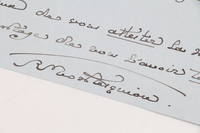
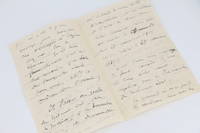
192083142s. l.: S. n. 1920. Fine. S. n. s. l. s. d. circa 1920 27 x 22 cm deux pages sur deux feuilles Autograph letter dated and signed by the dandy count 20 lines on 2 pages written in black ink about friendship and certain constraints that his correspondent seems to encounter probably his friend Henri Lapauze: ""Cher ami puisque vous souffrez c'est vous qu'il faut plaindre ; puisque je souris ce n'est pas moi qu'il faut blâmer. Votre souffrance vient de ne pas faire ce que vous voulez ; donc votre vindicte doit viser qui vous contraint. Ce que mes yeux ont vu aura comme suite conséquente ce que mes oreilles ont entendu on l'a écrit plaisamment. Il faut fournir à ces tomes là. Vous pensez bien que votre logique et votre justice ne visent qu'à établir les responsabilités. Car nous nous estimons au dessus de la louange mais pas au dessus de l'amitié. J'étais heureux de vous attester la mienne. Je le suis davantage de vous l'avoir témoignée. Votre Montesquiou."" ""Dear friend since you suffer it is you who must be pitied; since I smile it is not I who should be blamed. Your suffering comes from not doing what you want; therefore your vindication must target whoever constrains you. What my eyes have seen will have as a consequent sequel what my ears have heard it has been written pleasantly. We must provide for those volumes there. You well think that your logic and your justice aim only to establish responsibilities. For we consider ourselves above praise but not above friendship. I was happy to attest mine to you. I am even more so to have shown it to you. Yours Montesquiou."" S. n. unknown
192083358s. l.: S. n. 1920. Fine. S. n. s. l. s. d. circa 1920 25.50 x 20 cm une feuille Autograph letter signed by the dandy count 27 lines written in blue ink addressed to his friend and bibliographer the critic Henri Lapauze: ""Neuilly Dear friend thank you for your note. I am going to see Coppée again. When you speak again you of my book you will please me of course if this accords with your views first by recalling that it is dedicated to Barrès then by observing if not admiring what is rare in the spectacle shall we say the example given by an artist who has proven himself and publishes his eleventh volume books in which there are things without ever having cared about anything other than the esteem of those who please him; by a man who below this list of works which is requested of him by a recent questionnaire then encountering the word rewards followed by a question mark has the happiness and perhaps the honor of having to leave this useless line blank or at least to populate it with this word from Flaubert: ""One must be quite modest to be able to be honored"" Your proud friend RMontesquiou. 10 June."" Traces of folds inherent to the envelope. S. n. unknown
195762715s. l. 1957. Fine. s. l. 21 mai 1957 13.30 x 20.90 cm une page sur une feuille Autograph letter signed by Roland Barthes in Wintgen written in black ink. Date at the top of the letter and signature at the bottom of the letter. Central fold caused by mailing. Roland Barthes sends this letter to warn his addressee that he will not be able to come to a meeting of authors in Germany. He writes that he must absolutely be in Switzerland on the same date. unknown
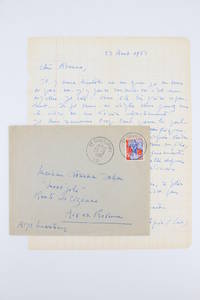
195679397Saint-Cirq-Lapopie 1956. Fine. Saint-Cirq-Lapopie 1956 13 x 21 cm une page sur un feuillet - enveloppe jointe Autograph letter signed by Violette Leduc addressed to Adriana Salem. One page written in blue ink on a school notebook sheet. Transverse folds inherent to mailing and small marginal losses due to removal of the sheet from the notebook. Charming letter sent from Saint-Cirq-Lapopie: ""Me voici à Saint Cirq La Popie sic depuis vendredi dernier et m'y voici seule. . L'été est revenu et il s'est installé depuis mon départ. C'est un site extraordinaire connaissez-vous "" ""Here I am at Saint Cirq La Popie sic since last Friday and here I am alone. . Summer has returned and it has settled in since my departure. It's an extraordinary site do you know it"" It was undoubtedly on the invitation of Thérèse Plantier her friend who was also a writer that Violette Leduc went to Saint-Cirq-Lapopie André Breton's stronghold. ""In the 1950s the department of Lot was chosen as a testing ground by the Citizens of the World movement: a globalist movement advocating for a planet without borders governed by world law. Cahors became the first city to sign a globalization charter followed by 248 municipalities in the department and declared itself 'Cahors mundi' a world city. Several personalities - politicians intellectuals artists - joined this movement initiated by Garry Davis a former pilot in the American army. Among them André Breton 1896-1966 but also Max Ernst Albert Camus and even Abbé Pierre. On June 24 1950 André Breton participated in the inauguration of the Route sans frontière n°1 symbolically linking Cahors to Figeac. The route was then supposed to cross the world and reach Berlin China Japan and the United States. On the occasion of this inauguration André Breton discovered the village of Saint-Cirq-Lapopie."" Archives du Lot Adriana Salem was the daughter of Frederic Gentili di Giuseppe representative of the Italian Minister of Finance in Paris and great collector of Italian Renaissance paintings. unknown
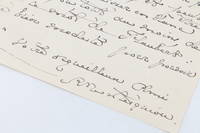
1906STLX0014Leipzig, Insel 1906. Schmutztit., Tit., 131(1) S., 1 Bl., OHPgt. Mit golgepr. Rückentitel auf mont. Papierschildchen, zweifarbig gemusterter Deckelbezug, Kopfgoldschnitt. Einband etw. berieben, Rückennähte stellenweise angeplatzt. Mit einer eh. Widmung des Verfassers ("Meinem lieben Hans. Rodaun 1907") auf dem flieg. Vorsatzblatt Zweite Auflage des Sammelbandes im Jahr der Erstveröffentlichung (Jacoby 78). Die drei Theaterstücke waren zuvor 1897 bzw. 1899 (Bergwerk) erstmals im Druck erschienen.
196343915Alexandria, 1855-1963. Zus. 91 S., 8°. u. 4°.
196788032Hamburg, 1967. Papierbogen 29,7 x 21 cm. Unter Feinkarton-Passepartout.
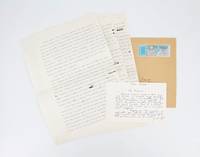
198583170Paris 1985. Fine. Paris 24 octobre 1985 14.50 x 10.50 cm quatre feuilles une enveloppe Autograph letter signed on a Bristol card by Julien Gracq 15 lines in black ink addressed to journalist Jean-Claude Lamy regarding the text of an article for which he gives his approval and an album of photographs concerning another writer. Apart from a few modifications he intends to make notably on the fact of not being photographed even by Robert Doisneau he authorizes the publication of this interview. We include the envelope addressed by Julien Gracq from his Parisian home. We also include the text of three pages of the article with corrections and crossings-out by Jean-Claude Lamy and four modifications and corrections in Julien Gracq's hand. A few letters have smudged without consequence a handsome copy. ""Paris 24 octobre Cher monsieur. Merci de m'avoir soumis le texte que je vous retourne : il correspond en gros aux propos tenus et je ne vois à vous soumettre que deux ou trois formulations un peu différentes. Je regarde avec plaisir les photos de l'album que vous l'aimable pensée de m'adresser : il s'agit là d'un écrivain qui ne m'a jamais laissé indifférent. Rappelez vous notre conversation : une seule photo pour illustrer votre texte j'aurais préféré"" aucune ! malgré le talent très grand de Robert Doisneau Avec mon bon souvenir. J. Gracq."" ""Paris 24 October Dear sir. Thank you for submitting the text which I return to you: it corresponds roughly to the remarks made and I see only two or three slightly different formulations to submit to you. I look with pleasure at the photos in the album which you had the kind thought to send me: this concerns a writer who has never left me indifferent. Remember our conversation: only one photo to illustrate your text I would have preferred none! despite Robert Doisneau's very great talent With my kind regards. J. Gracq."" unknown
190673674Vichy 1906. Fine. Vichy 10 août 1906 11.60 x 18 cm une feuille Moving autograph letter signed by Octave Mirbeau addressed to the playwright and founder of the Revue Blanche Alfred Natanson when he had just lost his father. 18 lines in black ink on a folded sheet envelope included. ""Mon cher Fred Je ne vous ai pas écrit ; mais vous savez bien qu'il n'y a pas dans mon cur la moindre indifférence. Thadée a dû vous dire combien nous avions partagé votre douleur. Thadée a dû vous dire souvent quelle amitié profonde j'ai pour vous. Peut-être ne vous l'ai-je pas exprimée telle que je la sens mais je la sens fortement et je voudrais bien que vous la sentiez aussi un peu. C'est un gros chagrin que de ne plus être aimé de ceux qu'on aime véritablement. Vous allez partir ; et vous faîtes bien de quitter cette maison où durant plus de six mois vous avez assisté à l'horrible agonie de votre pauvre père. Tâchez de travailler pour notre joie à tous. et revenez avec une belle uvre."" ""My dear Fred I have not written to you; but you know well that there is not the slightest indifference in my heart. Thadée must have told you how much we shared your grief. Thadée must have told you often what deep friendship I have for you. Perhaps I have not expressed it to you as I feel it but I feel it strongly and I would very much like you to feel it too a little. It is a great sorrow to no longer be loved by those one truly loves. You are going to leave; and you do well to quit this house where for more than six months you witnessed the horrible agony of your poor father. Try to work for all our joy. and return with a beautiful work."". Mirbeau was particularly close to the group of the Revue Blanche since its launch in Paris in 1891. But it was since the Dreyfus affair that his intimate and lasting friendship with the Natanson brothers Thadée Alexandre and Alfred was strengthened. After aesthetic disagreements about Art Nouveau and the Nabis Mirbeau finally reunited with Thadée around 1900 in a now common inclination for the young Nabis painters of the Revue Blanche Bonnard Vallotton and Vuillard. The Revue Blanche played an essential role in France as confirmed by historian Paul-Henri Bourrelier: ""Most of the most prominent writers painters musicians politicians and intellectuals of the late 19th and early 20th centuries collaborated with it or were associated with it. Created financed and directed by the three Natanson brothers young Polish Jews with the enthusiastic complicity of their classmates from the Condorcet lycée La Revue blanche quickly became a place of debate on all subjects that stirred France. It waged political battles under the impulse of anarchists like Fénéon Mirbeau; socialists such as Blum G. Moch Péguy; Dreyfusards and founders of the League of Human Rights like Reinach and Pressensé."" unknown
190373704s. l. Paris 1903. Fine. s. l. Paris 1er Juillet 1903 13.80 x 18.30 cm une feuille Autograph letter signed by Octave Mirbeau addressed presumably to Léon Tonnelle director of the review Le Roman Romanesque. 12 lines in black ink on a folded sheet grey paper with letterhead ""68 avenue du bois de Boulogne"". ""Monsieur je serais très heureux si vous vouliez bien reproduire dans Le Roman Romanesque et aux conditions de la Société des gens de lettres Sébastien Roch publié chez Fasquelle et qui est un livre auquel je tiens particulièrement. Peut-être aussi trouverez-vous dans Les vingt et un jours d'un neurasthénique quelques nouvelles que vous pourriez publier. En outre je vous indique en outre dans Les Contes de la Chaumière Fasquelle une nouvelle : Agronomie qui est presque d'actualité puisque c'est d'elle que j'ai tiré le caractère de Lechat dans Les Affaires sont les affaires. ."" ""Sir I would be very happy if you would kindly reproduce in Le Roman Romanesque and under the conditions of the Société des gens de lettres Sébastien Roch published by Fasquelle and which is a book to which I am particularly attached. Perhaps also you will find in Les vingt et un jours d'un neurasthénique some short stories that you could publish. Furthermore I also indicate to you in Les Contes de la Chaumière Fasquelle a short story: Agronomie which is almost topical since it is from this that I drew the character of Lechat in Les Affaires sont les affaires. ."". Octave Mirbeau published his novel Le Calvaire in issue 8 of the review le Roman Romanesque published in December 1903. The titles mentioned in the letter were ultimately not published. unknown
195484002Boulogne-sur-Seine Boulogne-Billancourt: S. n. 1954. Fine. S. n. Boulogne-sur-Seine Boulogne-Billancourt 28 Décembre 1954 13.50 x 21 cm une feuille Autograph letter signed and dated by André Malraux 20 lines in blue ballpoint pen from his Boulogne home on avenue Victor Hugo thanking him for his favorable review either of Des bas-reliefs aux grottes sacrées or of Le Monde chrétien both published in 1954. He apologizes for not being able to respond quickly to his laudatory article before thanking him: "". it is certain that by emphasizing both the technical aspect and the other underlined words you render the book a great service and take the animal by the right end."" he also acknowledges the clairvoyance and pertinence of his article despite the difficulty of properly apprehending the work: "". for these essays are not conceivable within traditional art criticism."" while praising the attachment that binds them: "". this attitude which is the only just one did it not necessarily imply a friendship that shows through each line in a place where there is some merit in proclaiming it."" Fold mark inherent to the mailing process. Resistance fighter and participant in Combat André Parinaud is a journalist columnist art critic and writer. From 1959 to 1967 he held the position of editor-in-chief of the important weekly Arts bringing together the elite of French creation in all artistic fields: literature painting theater cinema. He then conducted more than 1000 radio interviews with the greatest writers and artists including Salvador Dali Louis-Ferdinand Céline Colette Paul Léautaud André Breton Georges Simenon and André Malraux. While continuing to work at O.R.T.F. and radio he founded several festivals or artistic events such as The International Art Film Festival the National Academy of Street Arts. S. n. unknown
191675947s. l. 1916. Fine. s. l. s. d. vers 1916-1918 12.40 x 17 cm 2 pages sur un feuillet remplié Autograph letter signed by Georges Auric addressed to Bolette Natanson. Two pages written in black ink on a folded sheet. Folds inherent to mailing. Beautiful poetic letter with Rimbaldian influences: ""Alchimistes Rimbaud ! Eclair ouvre le ciel de mon adolescence ! Je me sens poète et c'est bien le moment de m'arrêter !"" ""Alchemists Rimbaud! Lightning opens the sky of my adolescence! I feel like a poet and this is the right moment to stop!"" Auric mentions a concert he must give at Mme Japy de Beaucourt's who held a salon in honor of the review directed by Ricciotto Canudo Montjoie ! : ""Je dois jouer - encore ! vendredi chez Mme J. de B. non point n'est ce pas Mme Jean de B mais Mme Canudo de Beaucourt"" ""I must play - again! Friday at Mme J. de B.'s not isn't it Mme Jean de B but Mme Canudo de Beaucourt"". He adds: ""Montjoie et Canudo gras et bête italboche."" ""Montjoie and Canudo fat and stupid Italian."" Having moved in artistic circles since her earliest childhood - she was the daughter of Alexandre and niece of Thadée Natanson creators of the famous Revue Blanche - Bolette Natanson 1892-1936 became friends with Jean Cocteau Raymond Radiguet Georges Auric Jean Hugo and Colette. Passionate about fashion she left Paris for the United States with Misia Sert close friend of Coco Chanel and was hired at Goodman. With her husband Jean-Charles Moreux they created the gallery Les Cadres on boulevard Saint-Honoré in 1929 and frequented numerous artists and intellectuals. Their success was immediate and they multiplied projects: creating the fireplace for Winnaretta de Polignac decorating the château de Maulny designing Baron de Rothschild's private mansion creating frames for industrialist Bernard Reichenbach and finally creating the storefront for Colette's beauty institute in 1932. Bolette Natanson also framed works by her prestigious painter friends: Bonnard Braque Picasso Vuillard Man Ray André Dunoyer de Segonzac etc. Despite this meteoric rise she took her own life in December 1936 a few months after her father's death. unknown
191675943s. l. 1916. Fine. s. l. s. d. vers 1916-1918 12.40 x 17 cm 2 pages sur un feuillet remplié Signed autograph letter from Georges Auric addressed to Bolette Natanson. Two pages written in black ink on a folded sheet. Deletions and underlinings. Fold marks inherent to mailing. Very fine letter in which the composer dissertates on friendship: ""I simply wanted to tell you this important thing. I recommend that you not invite Florent Schmitt nor any 'artist'. Otherwise I declare myself incapable of resisting the vision of these evil geniuses. For more than ever people disgust me except you naturally. I would like to press a button and destroy Humanity. Then we will be at peace and I will tell you the truth about Art and the truth about all the things in which you have faith."" Auric also evokes music in this letter: ""Only Ravel's waltzes are noble and sentimental."" Having evolved from her earliest childhood in artistic circles - she is the daughter of Alexandre and the niece of Thadée Natanson the creators of the famous Revue Blanche - Bolette Natanson 1892-1936 befriended Jean Cocteau Raymond Radiguet Georges Auric Jean Hugo and Colette. Passionate about couture she left Paris for the United States with Misia Sert great friend of Coco Chanel and was hired at Goodman. With her husband Jean-Charles Moreux they created in 1929 the gallery Les Cadres on boulevard Saint-Honoré and frequented numerous artists and intellectuals. Their success was immediate and they multiplied projects: the creation of Winnaretta de Polignac's fireplace the decoration of the château de Maulny the layout of baron de Rothschild's private mansion the creation of frames for industrialist Bernard Reichenbach and finally the realization of Colette's beauty institute storefront in 1932. Bolette Natanson also framed the works of her prestigious painter friends: Bonnard Braque Picasso Vuillard Man Ray André Dunoyer de Segonzac etc. Despite this meteoric rise she took her own life in December 1936 a few months after her father's death. unknown
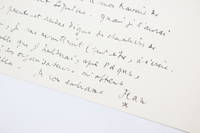
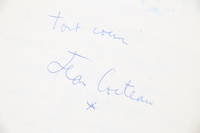
196386003Fréjus 1963. Fine. Fréjus 17 Avril 1963 21.50 x 27.50 cm une page Autograph letter dated and signed by Jean Cocteau 20 lines in black ink on letterhead of the committee for the edification of the chapel of Notre-Dame de Jérusalem de Fréjus. Fold marks inherent to postal dispatch one tear in left margin of the letter at the level of the fold. Jean Cocteau offers profuse apologies while acknowledging mitigating circumstances regarding the emotional burden overwhelming him: ""J'accepte vos reproches avec beaucoup de honte. Mais si je pouvais vous raconter la période que je traverse votre coeur me comprendrait et m'absoudrait."" ""I accept your reproaches with great shame. But if I could tell you about the period I am going through your heart would understand and absolve me."" due to a recently deceased friendship about which he does not wish to reveal more: ""N'en parlons plus et priez pour moi."" ""Let us speak no more of it and pray for me."" Jean Cocteau prefers to discuss his projects: ""Actuellement je me consacre à mon travail de la chapelle du Saint-Sépulcre. Quand je l'aurai construite peinte et rendue digne des chevaliers de Jérusalem je me remettrait sic peut-être à écrire."" ""Currently I am devoting myself to my work on the chapel of the Holy Sepulchre. When I have built it painted it and made it worthy of the knights of Jerusalem I will perhaps start writing again."" and the prospects that delight him: ""Il est probable que je resterais après Pâques à Fréjus où les organisateurs m'offrent une petite villa."" ""It is likely that I will remain after Easter in Fréjus where the organizers are offering me a small villa."" unknown
195885233Saint-Jean-Cap-Ferrat 1958. Fine. Saint-Jean-Cap-Ferrat 4 N ovembre 1958 13.50 x 21 cm trois pages et demi sur deux feuillets Autograph letter signed by Jean Cocteau 52 lines in blue ink to Olivier Quéant sent from the Villa Santo-Sospir in Saint Jean Cap-Ferrat which he decorated. Fold marks inherent to the mailing. Jean Cocteau waxes bucolically enthusiastic about the place where he resides and works: "". chaque jour je travaille à flanc de colline dans une sorte de ferme exquise où ne fleurisse que les grains qui tombent d'ailleurs."" "". each day I work on the hillside in a sort of exquisite farm where only the seeds that fall from elsewhere flourish."" and rhapsodizes about the local craftsmanship: "". des artisans véritables. travailler chez eux c'est le contraire de lire un journal. On aime voir ce miracle de l'équilibre entre le coeur et la main."" "". true artisans. working with them is the opposite of reading a newspaper. One loves to see this miracle of balance between heart and hand."" He informs Olivier Quéant of his upcoming exhibition: ""J'expose le 15 13 pour la première 6 rue Bonaparte. je ne te demande pas de venir voir mes oeuvres mais leur besogne ils le méritent."" ""I'm exhibiting on the 15th 13th for the opening 6 rue Bonaparte. I'm not asking you to come see my works but their labor they deserve it."" and also explains the aesthetic causes he intends to defend henceforth: "". nous menons la même croisade : celle de soutenir ces braves types qu'on dédaigne comme des aristocrates du milieu ouvrier. Le drame c'est que l'artiste qui tournait amoureusement un pied de fauteuil Louis 15 apporte la même application mais froide à forger la pièce d'une machine qui fabriquera le fauteuil."" "". we wage the same crusade: that of supporting these good fellows who are disdained as aristocrats of the working class. The tragedy is that the artist who lovingly turned a Louis XV chair leg applies the same care but cold to forging the part of a machine that will manufacture the chair."" while lamenting that artisanal traditions and know-how are sinking into oblivion: "". les jeunes refusent d'apprendre le métier par exemple des femmes de soixante ans qui firent ce prodige : ma tapisserie de Judith et Holopherne. disaient : c'est la dernière."" "". young people refuse to learn the trade for example women of sixty who performed this miracle: my tapestry of Judith and Holofernes. said: it's the last one."" He hopes to see his friend Olivier Quéant soon: ""Tu en verras une chez les Weill si tu me fais la grâce de venir et si le déluge parisien cesse et si tu ne dois pas atteindre la rue Bonaparte en arche ou gondole."" ""You'll see one at the Weills' if you do me the grace of coming and if the Parisian deluge ceases and if you don't have to reach rue Bonaparte by ark or gondola."" unknown
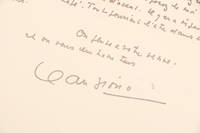
195284966s. l. 1952. Fine. s. l. ca 1952 21 x 27 cm une feuille Autograph letter signed by Jean Giono 14 lines in black ink addressed to Roland Laudenbach who jointly ran the magazine Opéra with his friend Roger Nimier. Fold marks inherent to the mailing. ""Cher Roland j'y pense : Voulez-vous quelque chose pour Opéra de qualité d'assez sensationnel et qui fuisse faire sept à huit numéros peut-être plus à votre gré Le Journal. Le Journal de 1936 à 1949. Si cela vous plait parlez en avec Nimier pensez à un chiffre proposez le moi ça ira sûrement et c'est d'accord. Il y en a déjà pas mal de tapé ! Tout le journal l'être dans un mois. On pense à votre venue et on vous embrasse tous. Jean Giono."" Dear Roland I'm thinking: Would you like something for Opéra Something quality rather sensational that could run for seven to eight issues perhaps more as you wish The Journal. The Journal from 1936 to 1949. If this appeals to you discuss it with Nimier think of a figure propose it to me it will surely work out and we're in agreement. Quite a bit of it is already typed! The entire journal will be ready in a month. We're thinking of your visit and we all embrace you. Jean Giono. A very visual letter bearing Jean Giono's handsome signature. unknown
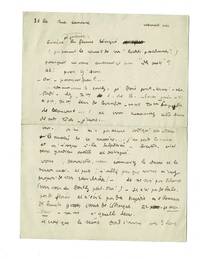
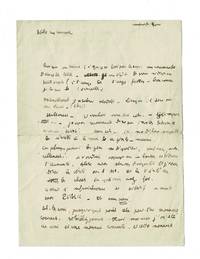
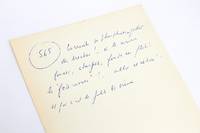
195484046Meudon 1954. Fine. Meudon 1954 20.70 x 26.80 cm une page sur un feuillet Autograph manuscript signed by Louis-Ferdinand Céline written in blue ballpoint pen on a sheet of white paper numbered 565 in the left corner. One transverse fold. Some pin holes in the upper margin evidence of the organization of Céline manuscripts in ""bundles"". « torrents de phosphore jaillir des brèches ! . et les avions foncer charger fendre ces flots ! les ""forteresses"" ! aller et retour ! et que c'est le Jules le crime » ""torrents of phosphorus gushing from the breaches! . and the planes rushing charging cleaving these waves! the ""fortresses""! back and forth! and that it's Jules who's the crime"" The passage on our sheet conforms to the published version. Published in 1954 Normance is a direct sequel to Féérie pour une autre fois which appeared two years earlier. Both parts were written during Céline's years of exile and imprisonment in Denmark. Upon his return to France in 1951 Céline undertook a work of ""polishing"" and published these two titanic texts independently originally conceived as one. ""Céline while working on it thought of this novel as a second Voyage au bout de la nuit capable twenty years later of astonishing the public as much as the 1932 novel."" Henri Godard unknown
190586168s. l. 1905. Fine. s. l. s. d. ca 1905 11.50 x 18 cm 5 pages sur un double feuillet Autograph letter signed by Maurice Leblanc to a friend from Rouen named Louis asking him to perform several services as he lacks the time to handle them himself. Maurice Leblanc entrusts his friend with two commissions: first to collect some furniture reserved by one of his friends at an antique dealer's: ""Go to a man named Chassaigne antique dealer 20 rue St Romain.He sold 6 chairs to the Prats two months ago. . apparently he refused to accept a deposit. No response. Let him say frankly that he has sold everything. The bench was for me 40 francs and I would very much like to have it."" the second concerning an administrative matter: ""Go to the registry of the civil court. and request an extract of my birth certificate and an extract of my parents' death certificates. It's for a marriage."" unknown
196678869Paris 1966. Fine. Paris 17 novembre 1966 20.70 x 13.50 cm une page sur un feuillet enveloppe jointe Handwritten signed letter addressed to Docteur Francis Mars: ""j'ai du mal à vous pardonner le mal que vous vous êtes fait à vous-même ! I find it difficult to forgive you for the harm you have done to yourself! Paris 17 November 1966 20.7 x 13.5 cm one page on a leaf envelope attached Handwritten letter signed by Natalie Clifford Barney addressed to Doctor Francis Mars a few lines written in black in on a leaf of headed paper from 20 rue Jacob Paris VIe envelope attached. Central fold from having been sent. ""Cher ami Francis j'ai du mal à vous pardonner le mal que vous vous êtes fait à vous-même ! Natalie PS: Je ne serai à Nice que vers le 5 déc. My dear friend Francis I find it difficult to forgive you for the harm you have done to yourself! Natalie PS: I will not be in Nice until around 5 Dec. Francis Mars from Nice was a mutual friend of Natalie Clifford Barney and her companion the artist-painter Romaine Brooks. The two women who had been in a relationship for almost fifty years did not live together: Natalie lived in Paris and only joined Romaine in Nice for the winter. unknown
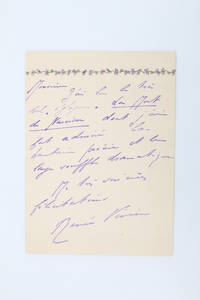
190479913s. l. Paris 1904. Fine. s. l. Paris s. d. ca 1904 11.50 x 16 cm une page sur un double feuillet Handwritten signed letter addressed to the poet Jean-Marc Bernard: I read the very beautiful eclogue La Mort de Narcisse whose haughty poetry and dramatic breath I admired very much. Paris ca 1904 11.5 x 16 cm one page on a double leafHandwritten signed letter from Renée Vivien addressed to Jean-Marc Bernard written in violet ink on a double leaf of paper decorated at the head with a border of violets. Transverse folds from having been sent. Monsieur J'ai lu le très bel ""églogue"" La Mort de Narcisse dont j'ai fort admiré la hautaine poésie et le large souffle dramatique. Mes très sincères félicitations. Renée Vivien. Monsieur I read the very beautiful eclogue La Mort de Narcisse whose haughty poetry and dramatic breath I admired very much. My very sincere congratulations. Renée Vivien. Jean-Marc Bernard was one of the founders of the poetic satirical and monarchist magazine Les Guêpes which welcomed contributions from Paul-Jean Toulet and Francis Carco among others. Together with the latter two he was part of the École fantaisiste a collective of young poets eager to break with the Parnassians and symbolists and whose ambitions were soon to be swept away by the arrival of the Great War. Jean-Marc Bernard lost his life on the front line destroyed by a shell at the age of thirty-three. unknown
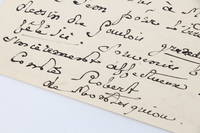
190783363New York: S. n. 1907. Fine. S. n. New York 4 février 1903 13.50 x 17.50 cm deux feuillets recto-verso Autograph letter signed by the dandy count 54 lines written in black ink on two leaves recto-verso addressed to his friend and bibliographer the critic Henri Lapauze: ""4 février Westminster hôtel New-York Cher monsieur et ami j'ai le plaisir de vous adresser ci-joint une copie manuscrite du salut d'ouverture qui servira de prélude de bienvenue à la première de mes conférences dont la date est fixée à demain. J'espère que vous ferez bon accueil à cet envoi de l'absent et le publierez en bonne place. Les documents ci-joints vous aideront à faire rédiger les lignes explicatives dont je vous demande d'accompagner l'article. Merci à vous à Mr Galdemar et à Sem pour son irrésistible dessin du Gaulois grandement fêté ici. Souvenir bien sincèrement affectueux. Comte Robert de Montesquiou. Je tiens à ajouter que je suis heureux de vous donner la primeur de ce document en témoignage et souvenir de nos bons rapports. J'ajoute que tout semble se disposer pour le succès de mon entreprise. Et vous connaissez assez les lois humaines mondaines et polémiques pour savoir que le tapage de presse accueillant ici les étrangers un peu notables ajoute à la curiosité de l'auditoire. J'espère ne pas trop la décevoir et ceci est le secret de demain. J'ai énuméré dans les pages que je vous adresse les raisons qui m'ont dicté le choix du sujet de ma première conférence. Je n'y reviens pas."" ""February 4th Westminster hotel New-York Dear Sir and friend I have the pleasure of sending you herewith a manuscript copy of the opening greeting which will serve as a welcome prelude to the first of my lectures the date of which is set for tomorrow. I hope you will give a good reception to this missive from the absent one and publish it in a prominent place. The enclosed documents will help you have written the explanatory lines I ask you to accompany the article with. Thank you to Mr Galdemar and to Sem for his irresistible drawing of the Gaulois greatly celebrated here. Most sincerely affectionate regards. Count Robert de Montesquiou. I want to add that I am happy to give you the exclusive rights to this document as testimony and remembrance of our good relations. I add that everything seems to be arranged for the success of my enterprise. And you know well enough the human worldly and polemical laws to know that the press commotion welcoming rather notable foreigners here adds to the audience's curiosity. I hope not to disappoint it too much and this is tomorrow's secret. I have enumerated in the pages I am sending you the reasons that dictated my choice of subject for my first lecture. I will not return to this."" Small pin holes that held the two leaves together. S. n. unknown