Louis-Ferdinand CELINEBiblio.com
1 050 résultats
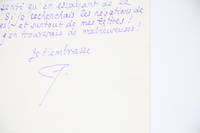
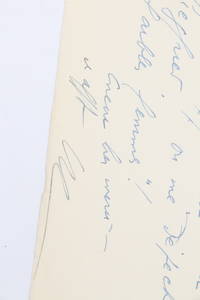
195080911s. l. Klarskovgaard 1950. Fine. s. l. Klarskovgaard 17 novembre 1950 21 x 34 cm 1 page sur un feuillet Autograph letter signed with the paraph of Louis-Ferdinand Céline addressed to his lawyer Master Thorvald Mikkelsen. One page written in blue ink on a large sheet of white paper; number ""566"" in Céline's hand in red pencil at the top left. Transversal folds inherent to mailing. This letter was very partially transcribed in Année Céline 2005. Early November 1950 Gaby Paul had come to visit Céline and Lucette at Klarskovgaard: ""Mme Gen Paul a repris la route de Montmartre toute ravie de votre accueil ! A moi de vous remercier chaleureusement car enfin j'espère que votre généreuse réception me sera comptée ""à indulgence""."" ""Mme Gen Paul has taken the road back to Montmartre delighted with your welcome! It is for me to thank you warmly because I finally hope that your generous reception will be counted in my favor as 'indulgence'."" Through her intermediary Céline evidently received news of his former Montmartre companions: ""Je ne sais pas quels crimes j'ai commis mais pour ces fourbes canailles du 18eme Arrt. ma légende de bistrot en bistrot est devenue un Super Niebelung d'horreurs ! C'est rigolo. Au point qu'aucun n'ose me venir voir ici !"" ""I don't know what crimes I committed but for these deceitful scoundrels of the 18th district my legend from bistro to bistro has become a Super Niebelung of horrors! It's amusing. To the point that none dare come to see me here!"" In 1947 Céline pursued by French justice for his collaborationist involvement was confined in Denmark. It was in May 1948 accompanied by Lucette and Bébert that he arrived at his lawyer Master Thorvald Mikkelsen's home at Klarskovgaard. The latter owned a large property by the Baltic Sea and invited the exile to stay there. On February 21 1950 as part of the épuration the writer was definitively sentenced in absentia by the civic chamber of the Paris Court of Justice for collaboration to one year of imprisonment which he had already served in Denmark. The Swedish Consul General in Paris Raoul Nordling intervened on his behalf with Gustav Rasmussen Danish Foreign Minister and managed to delay his extradition. On April 20 1951 Jean-Louis Tixier-Vignancour his lawyer since 1948 obtained Céline's amnesty under the title of ""severely disabled veteran of the Great War"" by presenting his file under the name Louis-Ferdinand Destouches without any magistrate making the connection. Céline would leave Denmark the following summer after three years spent at his lawyer's home. unknown
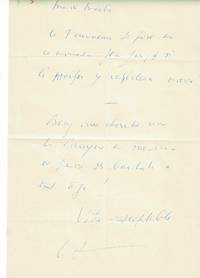
195076185s. l. Klarskovgaard 1950. Fine. s. l. Klarskovgaard 28 octobre 1950 21 x 34 cm 1 pages sur un feuillet Partly unpublished autograph letter signed by ""your touchy LF"" Louis-Ferdinand Céline addressed to his lawyer Maître Thorvald Mikkelsen. One page written in blue ink on a large sheet of white paper; number ""563"" in Céline's hand in the upper left corner in red pencil. Transverse folds inherent to the mailing. This letter was very partially transcribed in the Année Céline 2005. Céline after days of suffering from the cold is delighted to announce to his friend that he has received heating: ""Le fourneau se pose en ce moment. Je ne sais pas si la maison y résistera l'on verra !"" ""The stove is being installed right now. I don't know if the house will withstand it we shall see!"" This letter also mentions his Swedish friend Ernst Bendz like him a doctor and writer: ""Benz sic vous cherche un La Bruyère en suédois - on passe des bachots à tout âge !"" ""Bendz is looking for a La Bruyère in Swedish for you - one takes exams at any age!"" In 1947 Céline pursued by French justice for his collaborationist involvement was confined in Denmark. It was in May 1948 accompanied by Lucette and Bébert that he arrived at his lawyer Maître Thorvald Mikkelsen's home in Klarskovgaard. The latter owned a large property by the Baltic Sea and invited the exile to stay there. On February 21 1950 as part of the purge the writer was definitively condemned in absentia by the civic chamber of the Paris Court of Justice for collaboration to one year of imprisonment which he had already served in Denmark. The Swedish Consul General in Paris Raoul Nordling intervened on his behalf with Gustav Rasmussen the Danish Foreign Minister and managed to delay his extradition. On April 20 1951 Jean-Louis Tixier-Vignancour his lawyer since 1948 obtained Céline's amnesty as a ""severely disabled veteran of the Great War"" by presenting his file under the name of Louis-Ferdinand Destouches without any magistrate making the connection. Céline would leave Denmark the following summer after three years spent at his lawyer's home. unknown
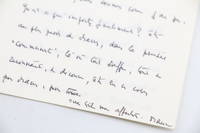
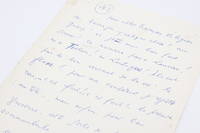
196987858s. l.: S. n. 1969. Fine. S. n. s. l. 11 Décembre 1969 10 x 7.50 cm une feuille une enveloppe Autograph card dated and signed by Maurice Blanchot to his sister Marguerite 12 lines in black ink. Manuscript envelope included. ""Cher marg voici donc des paroles comme testamentaires accueille-les non comme venant de moi mais d'une recherche qui a par hasard et sans mérite ni démérite passée par moi qui m'y suis soumis comme j'ai pu qu'est-ce qui importe finalement être au plus près de chacun dans la pensée ""communiste"" là où tout souffre tout se reconnait se découvre être en ce coeur pour chacun pour tous. Avec toute mon affection. Maurice."" Dear Marg here then are words like testamentary ones receive them not as coming from me but from a search which has by chance and without merit or demerit passed through me who submitted to it as I could what matters finally to be as close as possible to each one in ""communist"" thought where everything suffers everything recognizes itself discovers itself to be in this heart for each one for all. With all my affection. Maurice. S. n. unknown
1902613441902. Fine. 1902 18.10 x 22.90 cm 2 feuillets et un quart Autograph manuscript signed by Octave Mirbeau 99 lines in black ink on 3 leaves with manuscript corrections by the author and one correction in blue pencil by a typographer. Manuscript used for the composition and printing of the article ""Habitudes"" published on April 20 1902 in the Journal a daily newspaper launched in 1892 by Fernand Xau. The beginning of Mirbeau's career was essentially driven by journalism which allowed him to publish and earn a living despite his lack of inclination for the activity. Quickly feared for his pamphleteering activity Gustave Mirbeau distilling a biting irony stands here against injustice institutionalized by the State and society. Led by the dense and effective writing of Gustave Mirbeau this manuscript is probably a final draft as suggested by the conformity of the two texts and the rare corrections made to the original notably by the blue pencil of a typographer. On the verso of the last leaf is found an earlier version of the first lines of the article. unknown
191177520Paris 1911. Fine. Paris Lundi 11 septembre 1911 13.50 x 18 cm 5 pages sur un double feuillet et un feuillet libre Autograph letter signed by Pierre Louÿs addressed to Georges Louis. Five pages written in violet ink on a double leaf and a loose leaf. A press article pasted on the recto of the single leaf. Transverse creases inherent to posting. Fine letter addressed to his brother Georges Louis with whom Pierre Louÿs maintained a very intimate relationship and whom he considered as his own father. The question of the real identity of Pierre Louÿs's father still fascinates biographers today: ""His father Pierre Philippe Louis . had married in 1842 Jeanne Constance Blanchin who died ten years later after giving him two children Lucie and Georges. In 1855 he remarried Claire Céline Maldan and from this union was born in 1857 a son Paul; then in 1870 our writer who received the first names Pierre Félix. This late birth the differences in character between father and son the former's disaffection toward the latter the profound intimacy that always reigned between Louÿs and his brother Georges all this has led certain biographers and critics to suspect that the latter was in reality the writer's father. The exceptionally intimate and constant relationship that Pierre and Georges maintained between themselves all their lives could be an argument in this sense. Of course no irrefutable proof has been discovered and none will probably ever be discovered. Nevertheless certain letters . are quite disturbing. In 1895 for example Louÿs writes seriously to his brother that he knows the answer to ""the most poignant question"" he could ask him a question he has had ""on his lips for ten years."" The following year in the full triumph of Aphrodite he thanks Georges effusively and ends his letter with this sentence: ""Not one of my friends has a FATHER who is to him what you are to me."" Arguing from the close intimacy of Georges and Claire Céline during the year 1870 and the jealousy that the father never ceased to show toward his younger son Claude Farrère did not hesitate to conclude in favor of Georges Louis. And what to think of this dedication by Louÿs to his brother on a deluxe paper copy of the first edition of Pausole: For Georges his eldest son / Pierre."" Jean-Paul Goujon Pierre Louÿs Pierre Louÿs comments in this letter on Thomas Edison's visit to Paris: ""Edison is in France. Toward the end of last month a journalist questioned him. I regret not having kept the article."" The writer then launches into a true dialogue from his memories of said article paraphrasing the inventor in the manner of a witness who himself attended the interview: ""To the simple question ""Are you pleased with your trip"" Edison answered with amiable phrases and immediately on his own he brought the conversation to the subjects: Monoplane. War. He said I only repeat from memory the sense of what I read: He said in substance: ""You are not yet enthusiastic enough about the value of your new weapon: it is formidable. You take aeroplanes for scouts. Say first: combatants. From the heights where the monoplane evolves easily today there is an effective military power but especially an incalculable moral power."" He explained himself thus: ""Give grenades to an aviator who will drop them. Even if they are not very dangerous even if they rarely hit their target the entire enemy army will scatter like a flock of sheep under the flight of the eagle. Five six grenades falling from the sky will provoke panic terror. Nothing is frightening for a crowd like a peril that comes from above."" "" This ""remarkable interview"" related by the writer who finds that ""the theory is correct"" underlines the visionary character of Edison who seems here to relate the facts of the coming First World War. The erudite Pierre Louÿs illuminates this theory of ""Edison the prophet"" with his classical culture: ""It agrees with the old phrases about the limits of b unknown
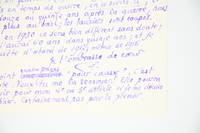
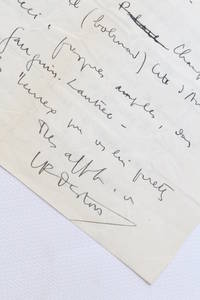
191677523Paris 1916. Fine. Paris Lundi 11 septembre 1916 13 x 20.50 cm 3 pages sur 2 feuillets Autograph letter signed with initial by Pierre Louÿs addressed to Georges Louis. Two pages written in purple ink on two sheets. Central folds inherent to posting. Fine letter addressed to his brother Georges Louis with whom Pierre Louÿs maintained a very intimate relationship and whom he considered as his own father. The question of Pierre Louÿs' real paternal identity still fascinates biographers today: ""His father Pierre Philippe Louis . had married in 1842 Jeanne Constance Blanchin who died ten years later after giving him two children Lucie and Georges. In 1855 he remarried Claire Céline Maldan and from this union was born in 1857 a son Paul; then in 1870 our writer who received the Christian names Pierre Félix. This late birth the differences in character between father and son the former's disaffection towards the latter the profound intimacy that always reigned between Louÿs and his brother Georges all this has led certain biographers and critics to suspect that the latter was in reality the writer's father. The exceptionally intimate and constant relationship that Pierre and Georges maintained between themselves throughout their lives could be an argument in this direction. Of course no irrefutable proof has been discovered and probably never will be. Nevertheless certain letters . are quite troubling. In 1895 for example Louÿs writes gravely to his brother that he knows the answer to 'the most poignant question' he could ask him a question he has had 'on his lips for ten years'. The following year at the height of Aphrodite's triumph he thanks Georges effusively and ends his letter with this sentence: 'Not one of my friends has a FATHER who is to him what you are to me.' Arguing from the close intimacy between Georges and Claire Céline during the year 1870 and from the jealousy that the father never ceased to show towards his younger son Claude Farrère did not hesitate to conclude in favor of Georges Louis. And what should we think of this dedication by Louÿs to his brother on a Japan paper copy of the first edition of Pausole: To Georges his eldest son / Pierre."" Jean-Paul Goujon Pierre Louÿs In this interesting letter Louÿs discusses at length the difficulty writers face in living by their pen. Titling his missive ""Continuation of our conversation about war and literature"" he first makes a very pessimistic observation: ""In the 16th century It was even worse! In the 16th the independent man of letters did not exist at all - to write one needed an office a benefice - or land and income rare fortune among writers. . It is only in the 19th century that we find a very small number of conscientious writers living by their pen. And even then. Do you want to count them Hugo almost alone succeeds. Lamartine fails and is obliged to beg pitifully at the end of his life. Gautier who had magnificent gifts only subsists by writing in newspapers . you see what I mean: Theatre and Journal."" He continues: ""That works well in peacetime. - In 1890 l'Echo de Paris inserted prose poems in the first column. - In ""date illegible because crossed out ""le Figaro had a literary supplement. . But in wartime in this century and ten twelve or fifteen years after the war we shall go to the woods no more; the laurels are cut down. Oh! In 1930 it will doubtless be very different; but I shall be 60 in fifteen years; and I worry first about 1917; even about 1916."" This very pessimistic letter was written at a period when Louÿs was at his worst ""The man who wrote these pages was a solitary man reclusive sick drugged surrounded by dubious creatures and having as confidant only this adored brother who would die less than a year later."" Ibid. unknown
1935A222O. O. [Porto Ronco (Tessin/Schweiz)] 18. XII. 1935 (Poststempel Umschlag). 4°. 1 S. An den befreundeten Verleger im Londoner Exil Lothar Mohrenwitz (1886-1960), dem er Reisepläne und Neuigkeiten mitteilt: ?Alter, guter Baron, ich bin auf dem Sprunge, - morgen oder übermorgen nach Paris, Hotel Raphael, Av. Kléber. Habe kurz entschlossen alles gemordet oder verheiratet in meinem Buch und werde es Huntington zu Weihnachten überreichen [1936 erschien bei Gyldendal in Kopenhagen die erste Buchausgabe von ?Drei Kameraden?]. Möglicherweise komme ich auf 2-3 Tage nach London [?] Es wäre großartig, wenn Sie nach Paris kämen; ich bleibe nicht allzulange [?] Inzwischen war Homolka hier; er ist jetzt in Nizza, und wir marschieren vereint nunmehr auf Paris, die alte Sehnsucht jedes deutschen Militärs. [?]Ihr Tyrann der westlichen Seehälfte. Reichsjägermeister zur See [Quer:] Haltet die alten Traditionen hoch, Baron!?. Der eigenhändig adressierte Briefumschlag beiliegend.
1932008529Croton Falls NY: Spiral Press. SIGNED first edition. Limitied to 300 copies. Hard cover in original cloth. Published Croton Falls NY: Spiral Press 1932. 4to. 8 1/4" x 11 1/4" unpaginated drawings by William Spratling illustrated with b/w plates and architectural plans and renderings. Bound in dark blue publisher's cloth with gilt embossed titles to cover and spine gilt cover design beveled edges pictorial map endpapers. Inscribed by Morrow to Mr. and Mrs. Reeve Schley: "For Mr. and Mrs. Reeve Schley who knew Casa Manana. with a Merry Christmas from Elizabeth Morrow. December 1932." A rare work and important resource on Mexican architecture and pottery by Elizabeth Cutter Morrow on Cuernavaca Mexico where she and her husband U.S. Senator Dwight Morrow who was Ambassador to Mexico from 1927 to 1930 bought adjoining plots to build a house inspired by the local historic architecture. The book is divided into three sections. Section one describes the town of Cuernavaca. Section two contains architectural plans and details for the home and gardens. Section three contains photo reproductions of the Mexican furnishings in the house including water jars jewelry boxes and woven garments. American-born expatriate artist and designer William Spratling created drawings for the new house and illustrated the text. Elizabeth Morrow was an American poet in the early 20th century who became the first female head of Smith College. Morrow was the mother of Anne Morrow Lindbergh distinguished American author and wife of aviation pioneer Charles Lindbergh. Near fine. Rare. . Near Fine. Hard. 1st. 1932. Spiral Press unknown
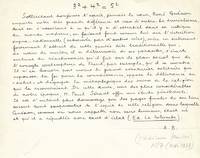
1953751691953. Fine. mai 1953 21 x 27 cm une feuille André Breton autograph manuscript signed ""A.B."" entitled ""3² 4² = 5²"" written for issue no. 7 of May 1953 of the review Médium. 18 lines written in black ink in careful handwriting on a white sheet. Two transverse folds of no significance. This is the final version of the text; an intermediate version of this article can be seen on the Breton Archives website. An interesting chronicle on Paul Sérant's work devoted to René Guénon and his work published by éditions La Colombe: ""Of this work one of the most considerable of our time M. Paul Sérant offers a penetrating study."" unknown
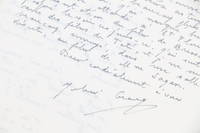
197884596Paris 1978. Fine. Paris s. d. 1978 14.50 x 20.50 cm une feuille Important autograph letter signed by Julien Gracq 53 lines in black ink addressed to his close friend and monographer Ariel Denis establishing him as his biographer. Julien Gracq expresses his regret that his friend Ariel Denis was not selected despite his intervention by the Berlin Academy to teach: ""Je vous avais recommandé de mon mieux mais je doute que cela ait été en Allemagne d'une grande efficacité. Je sais d'ailleurs que comme vous le pressentiez les concurents étaient en nombre."" ""I recommended you as best I could but I doubt that was very effective in Germany. I know moreover that as you suspected there were many competitors."" To help his friend the author of Rivage des Syrtes suggested to publisher Seghers who wanted to publish a work about him in his famous ""Poètes d'aujourd'hui"" collection the name of Ariel Denis having had no news from the first biographer considered for this publication: ""Ils me demandent de leur suggérer un nom. J'ai indiqué celui de Lautrat. Et j'ai indiqué le vôtre ne sachant bien sûr aucunement si un travail de ce genre pourrait vous plaire. Il va de soi que si Seghers s'adressait à vous vous devez être absolument libre d'accepter ou de refuser."" ""They ask me to suggest a name. I indicated Lautrat's. And I indicated yours not knowing of course at all whether work of this kind might please you. It goes without saying that if Seghers approached you you must be absolutely free to accept or refuse."" He also hopes to see his friend again soon before the summer holidays: "". si je ne vous revois pas avant juillet je vous souhiate des vacances à la fois paisibles et laborieuses en comptant vous revoir d'ici l'automne."" "".if I don't see you again before July I wish you holidays that are both peaceful and productive counting on seeing you again by autumn."" He concludes his letter with his judgments as an informed cinephile: ""J'ai surtout revu des films de Tati et je me suis beaucoup ennuyé dans une salle déserte au film de Mme Sagan."" ""I mainly rewatched Tati films and I was very bored in a deserted theater by Mme Sagan's film."" At Julien Gracq's instigation Ariel Denis would indeed accept Seghers' proposal to publish a volume in his ""Poètes d'aujourd'hui"" collection about the author of Au château d'Argol thereby becoming one of his best and most remarkable biographers. unknown
192487768Le Clos-Marie Roscoff 1924. Fine. Le Clos-Marie Roscoff 30 Août 1924 21 x 27.50 cm 1 page recto verso Autograph letter dated from Liane de Pougy addressed to the French archaeologist curator of the Saint-Germain museum and professor of art history at the École du Louvre Salomon Reinach 56 lines written in blue ink on a recto verso leaf written from her property Clos-Marie in Roscoff where the famous courtesan stayed until 1926. A small tear in the right margin of the letter and inherent to the folding of the missive. Liane de Pougy does not have time to be bored in her Roscoff property: ""J'écris beaucoup dans mes cahiers fleuris et je reçois des visites"" I write a lot in my flowered notebooks and I receive visits where her great friend Mathilde de Morny known as ""Missy"" famous Amazon of Tout-Paris comes to see her: ""Missy-Missou est revenue nous voir avec 2 amis. C'est bien elle-lui que vous avez vu à l'Opéra. Il ou elle eût été charmée de vous saluer mais ne vous as pas perçu. Il est reparti emmenant Max Jacob qui est déjà revenu."" Missy-Missou came back to see us with 2 friends. It is indeed she-he that you saw at the Opera. He or she would have been delighted to greet you but did not see you. He left taking Max Jacob who has already returned. Liane de Pougy receives many people: ""Nous attendons le jeune de Jacques de Maleisgne avec sa femme son nègre des animaux - des instruments banjo etc. Vous voyez qu'il y a de quoi s'occuper."" We are expecting young Jacques de Maleisgne with his wife his negro animals - instruments banjo etc. You see there is plenty to keep busy. complains about her health affected by weather conditions: ""En plus de mes occupations j'ai des douleurs alimentées par les pluies incessantes cependant ce matin ma fenêtre est ouverte sur un paysage riant."" In addition to my occupations I have pains fed by incessant rains however this morning my window is open on a smiling landscape. while appreciating with a certain melancholy the beauties of nature surrounding her: ""Les rosiers poussent drus leurs fleurs persistent les grenouilles et les limaces sont heureuses baveuses et ne demandent plus de roi ! Les guêpes bourdonnent tristement désenchantées de la saison ratée. et nous attendons l'hiver et ses feux ses lumières ses neiges ses fourrures et tous ses artifices."" The rose bushes grow thick their flowers persist the frogs and slugs are happy drooling and no longer ask for a king! The wasps buzz sadly disenchanted with the failed season. and we await winter and its fires its lights its snows its furs and all its artifices. Fine letter from the famous courtesan actress and author Liane de Pougy relating her friendships with the Tout-Paris of the Amazons. unknown
192386631Le Clos-Marie Roscoff Roscoff 1923. Fine. Le Clos-Marie Roscoff Roscoff 2 Septembre 1923 20.50 x 27 cm 1 page recto verso Autograph letter dated from Liane de Pougy to the French archaeologist curator of the Musée de Saint-Germain and professor of art history at the École du Louvre Salomon Reinach 56 lines written in blue ink on one double-sided sheet written from her property at Clos-Marie in Roscoff where the famous courtesan stayed until 1926. A small tear in the right-hand margin of the letter inherent in the enveloping of the missive; another slight tear at the foot without affecting the text. Liane de Pougy marvels at the youthful vigor of Reinach who had just turned 65: ' Many happy returns for your 65 years which find you so young so fresh so green with such playful studious feelings. My friend your youthful morals hold the secret of your physical youth—as Rosa Josepha said one sustains the other one preserves the other—and this seen head-on. ' while magnifying his radiant intelligence: 'To no longer produce but to sit atop the high throne of your trophies formed by all you have wrested from instinct to sacrifice to intellectuality. Why do people always say a well of knowledge instead of a luminous column a sky a sun a star etc.—in short something that makes us lift our heads' She is waiting for her friend and former lover the terrible and unfaithful Natalie Clifford-Barney:  'Natalie plans to come to Clos at the end of September. She has a wound to heal here—time fortunately has already done part of the work! I have sensitive feelings and like a musketeer a good heart but a bad temper. This is the 1st time the amazon has truly aimed at me. Let us speak of it no more'. Liane firmly expresses her wish not to be pitied or consoled for her romantic troubles:  'I have suffered in silence but without resignation. Do not speak of this to Nathanaël. Nathanaël means Philippe Max Jacob claims who lives and works near us in the most fascinating way. '. A beautiful letter by the celebrated courtesan actress and writer Liane de Pougy recounting with restrained candor her romantic disappointments with Natalie Clifford-Barney.  unknown
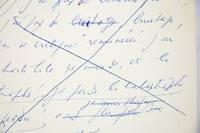
195484027Meudon 1954. Fine. Meudon 1954 20.70 x 26.80 cm une page sur un feuillet Autograph manuscript signed by Louis-Ferdinand Céline written in blue and pink ballpoint pens on a white paper sheet numbered 507 in the left corner. One transverse fold. Some pin holes in the upper margin stigmata of the organization of Céline manuscripts in ""bundles"". « j'ai pas de cinéma personnel j'ai pas de bruitage j'ai pas de critiques ""rémunérés"" j'ai que l'hostilité du monde et la catastrophe ! je perds la catastrophe je suis perdu ! . chienlit ! charlatan ! barbeau mou ! Comme ça vous m'intitulez si vous me trouvez pas dans la loge en plein enragement d'éléments ! je veux pas que vous. » The passage in our sheet presents some variations from the published version. Published in 1954 Normance is a direct sequel to Féérie pour une autre fois published two years earlier. Both parts were written during Céline's years of exile and imprisonment in Denmark. Upon his return to France in 1951 Céline undertook a work of ""polishing"" and published independently these two titanic texts originally envisioned as one. ""Céline while working on it thought of this novel as a second Voyage au bout de la nuit capable twenty years later of astonishing the public as much as the 1932 novel."" Henri Godard unknown
193463409Paris 1934. Fine. Paris 3 mai 1934 21 x 27 cm 2 pages sur un feuillet une enveloppe jointe Autograph letter signed ""LF Destouches"" addressed to the journalist Léon Deffoux. 24 lines written in black ink several underlines and erasures of Celine's hand. Envelope attached. Folds inherent to the enveloping of the mail as well as some very tiny pinholes in the right margin of the leaflet. unknown
195483969Meudon 1954. Fine. Meudon 1954 21.20 x 26.10 cm une page sur un feuillet Autograph manuscript signed by Louis-Ferdinand Céline written in blue ballpoint pen on a sheet of white paper numbered 243 in the left corner. Some stains as well as a central fold of no consequence. A tiny lack of paper at the lower right margin of the sheet. Some pinholes in the upper margin evidence of the organization of Céline's manuscripts in ""bundles"". ""pour aller traverser les lignes des barrages quelque chose !. au galop ! et je me suis bien fait sonner ! ça arrivera pas à Lauriac ! ni à Tartron ! ni Larengue !. Ils ont pris le bon versant de la vie : le flan !. pour ma concerne je regrette rien . c'est fait ! c'est fait ! la preuve ma tête. mais enfin pour la griserie cette sorte de bravoure somnambule j'admire les doués. je les respecte. j'arrive moi que par le stoïcisme le sang froid là ! hop !"" ""to go cross the lines barricades something!. at a gallop! and I really got myself beaten up! that won't happen to Lauriac! nor to Tartron! nor Larengue!. They took the right side of life: the flank!. as for me I regret nothing. it's done! it's done! the proof my head. but finally for the intoxication this sort of sleepwalking bravery I admire the gifted ones. I respect them. I only achieve it through stoicism cold blood there! hop!"" The passage from our sheet referring to Mauriac Sartre and Aragon conforms to the published version. Published in 1954 Normance is a direct sequel to Féérie pour une autre fois published two years earlier. The two parts were written during Céline's years of exile and imprisonment in Denmark. Upon his return to France in 1951 Céline undertook a work of ""polishing"" and published these two titanic texts independently originally conceived as one. ""Céline while working on it thought of this novel as a second Voyage au bout de la nuit capable twenty years later of astonishing the public as much as the 1932 novel."" Henri Godard unknown
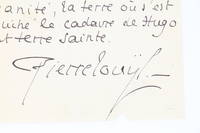
192078161Paris 1920. Fine. Paris s. d. novembre 1920 13.50 x 18 cm 4 pages sur 4 feuillets Autograph letter signed by Pierre Louÿs addressed to Georges Louis. Four pages written in blue ink on four sheets. Handsome letter addressed to his brother Georges Louis with whom Pierre Louÿs maintained a very intimate relationship and whom he considered as his own father. The question of Pierre Louÿs's real father's identity still fascinates biographers today: ""His father Pierre Philippe Louis . had married in 1842 Jeanne Constance Blanchin who died ten years later after having given him two children Lucie and Georges. In 1855 he remarried Claire Céline Maldan and from this union was born in 1857 a son Paul; then in 1870 our writer who received the first names Pierre Félix. This late birth the differences in character between father and son the former's disaffection toward the latter the profound intimacy that always reigned between Louÿs and his brother Georges all this has led certain biographers and critics to suspect that the latter was in reality the writer's father. The exceptionally intimate and constant relationship that Pierre and Georges maintained between them throughout their lives could be an argument in this sense. Of course no irrefutable proof has been discovered and probably never will be. Nevertheless certain letters . are quite troubling. In 1895 for example Louÿs writes gravely to his brother that he knows the answer to 'the most poignant question' he could ask him a question he has had 'on his lips for ten years.' The following year at the height of Aphrodite's triumph he thanks Georges effusively and ends his letter with this sentence: 'Not one of my friends has a FATHER who is to him what you are to me.' Arguing from the close intimacy between Georges and Claire Céline during the year 1870 and from the jealousy that the father never ceased to show toward his younger son Claude Farrère did not hesitate to conclude in favor of Georges Louis. And what to think of this dedication by Louÿs to his brother on a deluxe copy of the first edition of Pausole: To Georges his eldest son / Pierre."" Jean-Paul Goujon Pierre Louÿs This letter was written after the First World War: ""The project to open the Panthéon to heroes who offered everything to the Fatherland even losing their name for her is excellent. And it would be for the archbishopric of Paris an unhoped-for opportunity to spontaneously render to our great dead of the crypt the respects that it alone in the world denies them. It would thus repair an error that has lasted too long for its glory. Cemeteries are deconsecrated. No theological reason can attribute to them a more religious character than to the basement of a monument surmounted by a colossal cross and sanctified by ashes."" Indeed in November 1920 Charles Dumont the general budget reporter expressed his wish to bring the unknown soldier into the Panthéon. Finally only the ceremony took place there and the remains of the most famous of the combatants remained as everyone knows under the Arc de Triomphe. The only soldier to join the Panthéon Maurice Genevoix would not enter until a hundred years later on November 11 2020. Louÿs concludes his letter with a very handsome tribute to the writer he has always admired: ""One is ill-advised to forbid the faithful such a pilgrimage. They do it. For immense humanity the earth where Hugo's corpse lay down is holy ground."" unknown
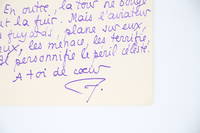
191677521Paris 1916. Fine. Paris 15 mai 1916 11 x 16 cm 6 pages sur un double feuillet et un feuillet simple Autograph letter from Pierre Louÿs signed with his initial addressed to Georges Louis. Six pages written in violet ink on a double leaf and a single leaf. Central creases inherent to posting. Very fine letter addressed to his brother Georges Louis with whom Pierre Louÿs maintained a very intimate relationship and whom he considered as his own father. The question of the real identity of Pierre Louÿs's father still fascinates biographers today: ""His father Pierre Philippe Louis . had married in 1842 Jeanne Constance Blanchin who died ten years later after giving him two children Lucie and Georges. In 1855 he remarried Claire Céline Maldan and from this union was born in 1857 a son Paul; then in 1870 our writer who received the first names Pierre Félix. This late birth the differences in character between father and son the former's disaffection toward the latter the profound intimacy that always reigned between Louÿs and his brother Georges all this has led certain biographers and critics to suspect that the latter was in reality the writer's father. The exceptionally intimate and constant relationship that Pierre and Georges maintained between themselves all their lives could be an argument in this sense. Of course no irrefutable proof has been discovered and none will probably ever be discovered. Nevertheless certain letters . are quite disturbing. In 1895 for example Louÿs writes seriously to his brother that he knows the answer to ""the most poignant question"" he could ask him a question he has had ""on his lips for ten years."" The following year in the full triumph of Aphrodite he thanks Georges effusively and ends his letter with this sentence: ""Not one of my friends has a FATHER who is to him what you are to me."" Arguing from the close intimacy of Georges and Claire Céline during the year 1870 and the jealousy that the father never ceased to show toward his younger son Claude Farrère did not hesitate to conclude in favor of Georges Louis. And what to think of this dedication by Louÿs to his brother on a deluxe paper copy of the first edition of Pausole: For Georges his eldest son / Pierre."" Jean-Paul Goujon Pierre Louÿs A true reflection on literature and the choice of words this letter was written while Pierre Louÿs was working on a work that would appear the following year: Poëtique. ""Louÿs decides . to write a Poëtique which will be like the testament of his work as well as a message to young writers. He had always reflected on poetic art and accumulated dozens of notes both on poets and on poetry itself."" Ibid. To reflect on poetic art is precisely what he does in this fine letter: ""Regarding negation I wondered why the principle I tried to establish nuance ruse or error was not classical. I believe the answer is: Chimène. - We take the word as a text to teach high school students that negation is an additional force. - Ex. ""Je ne te hais point"" ""I do not hate you"" more expressive than ""Je t'aime"" ""I love you"". But no. Rodrigue has just said: ""Votre haine"" ""Your hatred"". It is Rodrigue who imprints the image. The response ""Je ne te hais point"" ""I do not hate you"" is the passage from shadow to light: it is to speak the nuance. . It is terribly delicate to write ""ne pas"" ""not""."" Then in a period of great trouble and isolation the poet is touched by Paul Valéry's support: ""The other day I had written a long letter to Valéry about my ""Poëtique."" - He answered me immediately a letter where he began by thanking me for all that he had felt of affection for him in the very fact that I had spent part of my evening with him without his being there. I answer him in turn - as much as I remember - ""It is so rare friends who suspect affection beneath something. There are hardly more than two kinds of people: those who do not lift the stone because they are certain there is not unknown
194183134Paris: S. n. 1941. Fine. S. n. Paris 13 juin 1941 14 x 19.50 cm trois feuilles recto-verso Autograph letter dated June 13th Carlo Rim having specified in pencil at the head of the first leaf 1941 and signed by Raimu addressed to his great friend Carlo Rim 98 lines in black ink on three leaves recto-verso. Folds inherent to mailing. Raimu rails against the incapacity and indecision of those responsible for a film project entitled l'Arlésienne quite a symbol! of which Carlo Rim was part: ""L'arlésienne ne pourra pas se faire parce que monsieur gendre Prouvost et cie sont des couillons. Et des gens sans aucune descisions. Donc affaire morte."" ""l'Arlésienne cannot be made because monsieur son-in-law Prouvost and company are fools. And people without any decisions. So the matter is dead."" "". tous les mois il change d'idées et dieu sait s'il en a mais tout cela se termine par des idées. jamais il ne tournera pas plus le tien que celui des autres il a peut-être de l'argent mais il ne veut pas le sortir. Genre Prouvost."" "". every month he changes his mind and God knows he has ideas but all this ends with ideas. he will never shoot yours any more than those of others he may have money but he doesn't want to spend it. That's Prouvost for you."" Raimu ever so irascible does not calm down and drowns his friend's last hopes about the forthcoming realization of l'Arlésienne: ""Mon vieux Carlo à l'heure actuelle les deux pauvres studios de Nice sont pris jusqu'à fin septembre par des gens qui eux prennent les descisions et qui verse de l'argent. donc tu vois mon pauvre vieux ce sont tous des bonimenteurs Honnebelle - Prouvost. des gens plein aux as mais ils ne veulent pas les sortir."" ""My dear Carlo at present the two poor studios in Nice are booked until the end of September by people who do make decisions and who put up money. so you see my poor friend they are all smooth talkers Honnebelle - Prouvost. people loaded with money but they don't want to spend it."" "". il trouvera 100 excuses pour ne pas tourner et elles lui seront faciles."" "". he will find 100 excuses not to shoot and they will come easily to him.""and ends his epistolary diatribe with this glacial criticism:""Mon Carlo il n'y a plus rien à faire en province que de la barraque et à écarter les marchands de boniments. because que depuis la fille du puisatier je n'ai entendu que des bobards. En plus il faudrait faire des films à la noix."" ""My Carlo there is nothing left to do in the provinces but fairground shows and to ward off the peddlers of smooth talk. because since la fille du puisatier I have heard nothing but tall tales. Plus we would have to make trashy films."" Carlo Rim was a Provençal writer author notably of ""Ma belle Marseille"" a caricaturist a filmmaker: ""Justin de Marseille"" ""L'armoire volante"" ""La maison Bonnadieu"" and was notably the friend of Fernandel Raimu and Marcel Pagnol but also of Max Jacob and André Salmon whom he met in Sanary. S. n. unknown
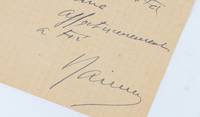
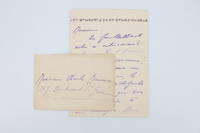
190679816s. l. Paris 1906. Fine. s. l. Paris s. d. ca. 1906 11.50 x 16 cm 1 page 1/2 sur un double feuillet Autograph letter signed by Renée Vivien addressed to Charles Maurras written in violet ink on a double leaf of headed paper adorned with a border of violets. Transverse folds inherent to mailing envelope included. Beautiful letter of thanks: ""Monsieur En feuillettant votre si intéressant volume : De l'Avenir de l'Intelligence j'ai relu avec un plaisir ému les pages - trop indulgentes vraiment ! - que vous avez consacré à mes ouvrages. Merci infiniment. Et veuillez agréer mes très reconnaissants sentiments de confraternité littéraire. Renée Vivien"" ""Sir While leafing through your most interesting volume: De l'Avenir de l'Intelligence I reread with moved pleasure the pages - too indulgent really! - that you dedicated to my works. Thank you infinitely. And please accept my most grateful sentiments of literary confraternity. Renée Vivien"" Charles Maurras had indeed devoted a dithyrambic chapter of his work to the Muse of violets whose verses he compared to those of Verlaine: ""Le vieux faune sentimental des Fêtes galantes et de Parallèlement reconnaîtrait chez Renée Vivien beaucoup plus qu'une élève certainement une des Surs une de ces Amies terribles qu'il a chantées. Quant à Baudelaire il lui dirait : ""Ma fille"" aux premiers regards échangés. Baudelairisme profond central générateur."" ""The old sentimental faun of Fêtes galantes and Parallèlement would recognize in Renée Vivien much more than a student certainly one of the Sisters one of those terrible Friends he sang of. As for Baudelaire he would say to her: 'My daughter' at first glance. Deep central generative Baudelairism."" unknown
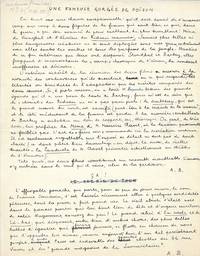
1953751681953. Fine. mai 1953 21 x 27 cm une feuille et un petit papillon André Breton autograph manuscript signed ""A.B."" of two chronicles entitled ""Une fameuse gorgée de poison"" and ""ça !"" written for issue no. 7 of May 1953 of the review Médium. One long page written in black ink in careful handwriting on a white sheet some corrections and additions sometimes in blue ink. Included is a small slip in Breton's hand concerning an article by René Alleau containing a small printed text annotated by him in red and blue ballpoint pens and bearing an explanatory note at the top. Two transverse folds of no significance. This is the final version of these two texts; an intermediate version of these articles more crossed out than ours can be seen on the Breton Archives website. ""Une fameuse gorgée de poison"" ""A famous gulp of poison"" is a critical text on two films: Le Rideau cramoisi by Alexandre Astruc drawn from a story by Barbey d'Aurevilly and La Canduela by Maurice Clavel drawn from a novel by Stendhal: ""As they stand these two films constitute an unforgettable ensemble. Love is kindled there in the wind it loves that of perdition."" ""ça !"" ""that!"" whose title we can clearly see was previously chosen by Breton ""Le gredin du jour"" ""The scoundrel of the day"" is a diatribe against ""The frightful fool who bears for so few days more the name of Francis Jourdain"" and who ""recently allowed himself some sordid senile drivel which the press made much of. The old idiot had got it into the rotten parsnip that serves him as head and excretory organ to soil Huysmans if you please!"" unknown
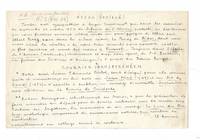
1952751671952. Fine. novembre 1952 20.90 x 13.40 cm une feuille André Breton autograph manuscript comprising two short texts titled ""Assez souillé !"" and ""Courrier transpyrénéen"" written for issue no. 1 of November 1952 of the journal Médium. 18 lines written in black ink in a careful hand on a white sheet. A tiny pinhole in the upper right margin of the sheet. ""Assez souillé !"" ""Enough soiled!"" recounts the reception given by the journal Médium to Céline's panegyric by Albert Paraz. The chronicle titled ""Courrier transpyrénéen"" ""Trans-Pyrenean Mail"" announces the publication of the latest work by critic Juan Eduardo Cirlot titled Surrealismo. Breton also mentions Robert Benayoun's work Le Livre du Non-Sens which would ultimately bear the title Anthologie du non-sens and appear in 1957 published by J.- J. Pauvert. unknown
1910008531NY: Thomas Y. Crowell & Co. Signed first edition limited to 525 numbered copies in England and America #137 signed by Pogany on limitation page. Full brown morocco with gilt cover design gilt spine titles top edge gilting pictorial end papers sewn in silk bookmark. Published NY: Thomas Y. Crowell & Co. 1910. Folio 9 1/2" x 13" printed on Japan vellum unpaginated Illustrated by Pogany with 20 tipped-in color plates calligraphic text decorative borders plus illustrations in color and line throughout the text. A stunning work. Some scuffing wear along the edges of boards small previous owner bookplate on front pastedown internally near fine pages clean no foxing or markings page block crisp all plates present binding tight. Rare. . Very Good. Hard. 1st. 1910. Thomas Y. Crowell & Co unknown
1999203370CBSchriesheim, Frank Albrecht, 1999. Fol. 125 S., 1 Bl. mit 18 Orig.-Radierungen von Inge Jastram. Rotbrauner Original-Halbleder, handgebunden von Thomas Zwang mit blindgeprägtem Einband (1. Seite des beigef. Briefes). (Neuwertig).
200012973Cos Cob CT: Alexander Autographs. New. 2000. Paperback. FREE UPGRADE to Courier/Priority Shipping Upon Request - IN STOCK AND IMMEDIATELY AVAILABLE FOR SHIPMENT - Flawless. Features an image of an original signed painting by U. S. Grant on the back cover. Includes autographed items of historical interest including from a number of public figures in politics and the arts. -- with a bonus offer-- . Alexander Autographs paperback
199727871Greenwich CT: Alexander Autographs. New. 1997. Paperback. FREE UPGRADE to Courier/Priority Shipping Upon Request - IN STOCK AND IMMEDIATELY AVAILABLE FOR SHIPMENT - FLAWLESS COPY BRAND NEW PRISTINE -- with a bonus offer-- . Alexander Autographs paperback