RAVACHOLBiblio.com
184 résultats
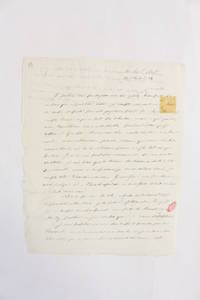
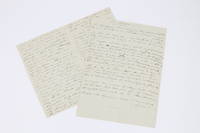
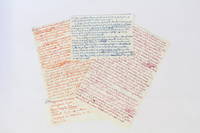
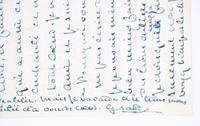
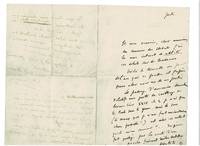
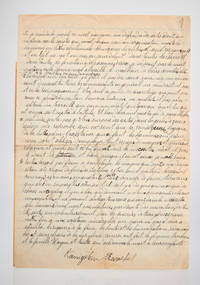
1892734381892. Fine. 1892 20 x 29.50 cm 4 pages sur un double feuillet Exceptional complete autograph manuscript of Ravachols true last testament largely unpublished unknown in this form preceding its rewriting by a third party for publication in the press. A unique testimony to the genuine thought of the anarchist icon. Four-page lined quarto manuscript entirely written in black ink and signed twice Konigstein Ravachol at the foot of each sheet. Pencil corrections within the text possibly in the hand of his lawyer. Some horizontal folds and very minor marginal tears without loss. Written in his prison cell during the second Montbrison trial that led to his death sentence this text hastily penned without punctuation or capital letters and in naïve spelling was meant to be delivered orally by Ravachol during the hearing. Ravachol was dead set on putting in his two cents for the defence not to defend himself but to explain. No luck dammit! Four words in and the judge cut him off. His statement isnt lost by Jove! Émile Pouget in Père Peinard July 310 1892. This self-styled Rocambole of anarchism was not allowed to read his statement aloud but he handed it to his lawyer Maître Lagasse and by June 23 the forbidden text appeared in the conservative newspaper Le Temps. This first publication was so faithful to the original that it preserved the author's eccentric spelling a fidelity that Émile Pouget would ironically criticise in the Père Peinard issue of July 3 1892 one week before Ravachols execution: Le Temps that opportunist bedsheet printed it as is. Like a true Jesuit it even printed it too true. Ravachol had written the thing for himself; he knew how to read it but there wasnt a word of correct spelling seeing as he knew about spelling as much as he knew about cabbage farming. Le Temps printed the thing without changing a line so its practically unreadable . Thats exactly what the bastards wanted dammit! . Im reprinting it below without changing a word just fixing the spelling. That same July 3 issue of Père Peinard included a corrected version orthographically of the statement initially published in Le Temps. This dual publication combined with Ravachols defiant bearing before the guillotine had a powerful effect on public opinion. Until then even anarchist publications had kept a certain distance from this provocative criminal suspected of using the anarchist cause for personal gain. But following his execution the testament was quickly reproduced in other newspapers and Ravachols final cry of revolt soon became a genuine anarchist anthem among libertarians worldwide. However the version circulated in the press the only known version until now the original manuscript having disappeared differs markedly from the manuscript in our possession. Indeed the style was lightly polished several turns of phrase refined and most significantly entire passages were excised including the conclusion paragraph which was fully replaced. Our manuscript with its crossings-out and revisions is likely the original version of this political testament. Written in a single burst in dense handwriting without punctuation or paragraph breaks it includes two lengthy sections expressing concerns for public health that are entirely absent from the published version. The first is a third of a page-long passage about the dangerous ingredients added to bread: no longer needing money to live thered be no fear of bakers adding dangerous ingredients to bread to make it look better or heavier since it wouldnt profit them and theyd have like everyone else and by the same means access to what they needed for their work and existence. Thered be no need to check whether the bread weighs right if the money is counterfeit or if the bill is correct. The second nearly a full page long concerns the silk-dyeing industry in which Ravachol had worked: If one reflects atten unknown
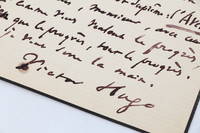
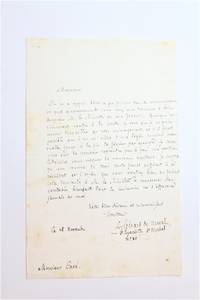
1871833181871. Fine. « So that justice finally be done for women » Mardi 7 novembre 1871 13.30 x 20.80 cm 2 pages sur un feuillet double Autograph letter signed by Victor Hugo to Léon Richer two pages in black ink on a double sheet framed in black. Crosswise folds inherent to envelope inserting. A central tear at the junction of the two sheets. Published in uvres complètes de Victor Hugo Ollendorff 1905. Manuscript housed in a blue half morocco chemise and slipcase marbled paper boards marbled paper slipcase signed Boichot. A magnificent and important letter to Léon Richer one of the first male feminist activists considered by Hubertine Auclert as the ""father of feminism"" and later regarded by Simone de Beauvoir as its ""true founder"". This deeply humanist text is a compendium of Victor Hugo's campaign for the abolition of capital punishment and the female attainment of social equality and civil rights. « Mardi 7 novembre 1871 Monsieur on m'a demandé d'urgence mon intervention pour les condamnés à mort. L'accomplissement de ce devoir a retardé ma réponse à votre excellente lettre. Vous avez raison de compter sur moi pour affirmer l'avenir de la femme. Dès 1849 dans l'Assemblée nationale je faisais éclater de rire la majorité réactionnaire en déclarant que le droit de l'homme avait pour corollaires le droit de la femme et le droit de l'enfant. En 1853 à Jersey dans l'exil j'ai fait la même déclaration sur la tombe d'une proscrite Louise Julien mais cette fois on n'a pas ri on a pleuré. Cet effort pour qu'enfin justice soit rendue à la femme je l'ai renouvelé dans les Misérables je l'ai renouvelé dans le Congrès de Lausanne et je viens de le renouveler encore dans ma lettre au Rappel que vous voulez bien me citer. J'ajoute que tout mon théâtre tend à la dignification de la femme. Mon plaidoyer pour la femme est vous le voyez ancien et persévérant et n'a pas eu de solution de continuité. L'équilibre entre le droit de l'homme et le droit de la femme est une des conditions de la stabilité sociale. Cet équilibre se fera. Vous avez donc bien fait de vous mettre sous la protection de ce mot suprême : l'Avenir. Je suis Monsieur avec ceux qui comme vous veulent le progrès rien que le progrès tout le progrès. Je vous serre la main. Victor Hugo » ""Tuesday november 7 1871 Sir I have been urgently asked to intervene on behalf of those sentenced to death. The fulfillment of this duty has delayed my reply to your excellent letter. You are right to count on me to defend the future of women. As early as 1849 in the National Assembly I made the reactionary majority burst into laughter by declaring the rights of man as natural counterparts to the rights of woman and the rights of children. In 1853 in my Jersey exile I made the same declaration on the grave of an outlaw Louise Julien but this time people didn't laugh they wept. I renewed this effort to finally do justice to women in Les Misérables I renewed it in the Congrès de Lausanne and I've just renewed it again in my letter to Le Rappel which you are kind enough to publish. I would add that every single one of my theatrical works aims to dignify women. As you can see my plea for women is long-standing and persevering and no other has ventured to continue with this endeavor. Balance between men's rights and women's rights is one of the conditions of social stability. This balance will be achieved. I commend you for placing yourself under the protection of this supreme word: the Future. I am Sir with those who like you want progress nothing but progress the whole of progress. I shake your hand. Victor H Although this letter focuses primarily on advocating for women's rights it begins with the death penalty: I have been urgently asked to intervene on behalf of those sentenced to death. The fulfillment of this duty has delayed my reply to your excellent letter. Shortly after the Paris Commune the October 1871 pages of Hugo's diary la hardcover
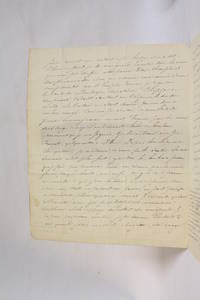
1808689671808. Fine. 26 mars 1808 20 x 24.80 cm 3 pages 1/2 sur un double feuillet Long autograph letter by Stendhal addressed to his sister Pauline written in fine handwriting with black ink. Address of Stendhal's father where his sister resides in Grenoble with the stamp ""n°51 Grande Armée."" Red wax seal bearing Stendhal's coat of arms. Several original folds inherent to postal delivery. A paper loss due to the unsealing of the letter has been skillfully restored. Published in his Correspondance ed. Henri Martineau Paris Le Divan 1933 vol. 3 no. 262 A pp. 26-29. A very beautiful letter filled with romantic passion blending childhood nostalgia with sentimental tales and foreshadowing The Red and the Black. This letter is part of the correspondence between twenty-five years old Henri Beyle and his sister Pauline three years his junior. This epistolary relationship which quickly took the form of a ""journal"" as Pauline's responses were rare. It is deemed a crucial milestone in the intellectual development of the future Stendhal: ""Here are my dreams my dear friend; I am almost ashamed of them; but after all you are the only person in the world to whom I dare confess them."" In this letter which attests to the strong bond between brother and sister Stendhal then in Germany expresses his deep nostalgia: ""I revisited in my memory all the time we spent together: how I did not love you in our childhood; how I once hit you at Claix in the kitchen. I hid in the little book cabinet; my father came back a moment later furious and said to me: 'Wicked child! I would eat you!' Then all the woes inflicted upon us by poor Aunt Séraphie; our walks along those paths surrounded by stagnant water towards Saint-Joseph."" These regrets about the past are accompanied by a typically Stendhalian melancholy: ""Alas! That delightful happiness I once imagined I glimpsed it once at Frascati and a few other times in Milan. Since then it has not returned; I marvel at my inability to feel it. The mere memory of it is more powerful than all the present joys I can procure."" This evocation of the Italy he longs for is intertwined with memories of the women he loved: ""I told you that while in Frascati at a charming fireworks display at the moment of the explosion Adèle leaned on my shoulder for an instant; I cannot express how happy I was. For two years whenever I was overwhelmed with sorrow this image gave me courage and made me forget all my troubles. I had long forgotten it; I tried to recall it today. Against my will I see Adèle as she is; but as I am now there is no longer the slightest joy in this memory."" This lengthy account of Adèle Rebuffet his cousin with whom he had a profound romantic relationship before forming a closer bond with her mother reflects Stendhal's sentimentality. He also mentions another of his great passions Angelina Pietragrua the ideal Italian woman and embodiment of his Milanese memories: ""Madame Pietragrua is different: her memory is linked to that of the Italian language; whenever something pleases me in a role for a woman in a work I involuntarily put it into her mouth."" This ""role for a woman"" that Stendhal refers to echoes the central theme of this letter the work Il Matrimonio segreto by composer Cimarosa: ""Do you sometimes play the Matrimonio Its the passage Cara sposa at the beginning between Carolina and Paolino. . But play the Matrimonio for my sake especially Signor deh permettette and the finale Io rival de mia sorella."" This opera by Cimarosa remained a constant throughout the writer's life and work. In his Memoirs of an Egotist 1832 he explains: ""In Milan in 1820 I wanted to have this written on my tomb . I wanted a marble tablet in the shape of a playing card: ""Errico Beyle - Milanese - Visse scrisse amò - Quest'anima adorava Cimarosa Mozart e Shakspeare - Morì di anni. il . 18."" ""Henri Beyle - Milanese - He lived wrote loved - This soul adored Cimarosa Mozar unknown
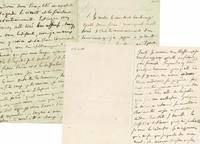
1823759401823. Fine. s. d. ca 1823 12 x 18.20 cm Six pages sur deux feuillets rempliés Almost entirely unpublished handwritten letter from the painter Eugène Delacroix to the love of his youth the mysterious Julie now identified as being Madame de Pron by her maiden name Louise du Bois des Cours de La Maisonfort wife of Louis-Jules Baron Rossignol de Pron and daughter of the Marquis de La Maisonfort Minister of France in Tuscany patron of Lamartine and friend of Chateaubriand. 90 lines 6 pages on two folded leaves. A few deletions and two bibliographical annotations in pencil on the upper part of the first page no114. This letter is one of the last to his lover in private ownership all of Delacroix's correspondence to Madame de Pron being kept at the Getty Research Institute Los Angeles. Only nine of the ninety lines of this unpublished letter were transcribed in the Burlington Magazine in September 2009 alongside the long article by Michèle Hanoosh Bertrand and Lorraine Servois whose research finally revealed the identity of the famous recipient. Sublime love letter from twenty-four-year-old Eugène Delacroix addressed to his lover Madame de Pron twelve years his senior who unleashed the liveliest passion in him. This episode of the painter's youth then considered the rising star of Romanticism for a long time remained a mystery in the biography of Delacroix who was careful to preserve the anonymity of his lover thanks to various pseudonyms: Cara the Lady of the Italians and even Julie as in this letter in reference to the famous epistolary novel Julie ou la Nouvelle Héloïse by Rousseau. For obvious reasons Delacroix did not sign his name on any of the letters in correspondence with the lady. A great figure of the legitimate aristocracy the recipient of this feverish letter is Madame de Pron daughter of the Marquis de La Maisonfort Minister of France in Tuscany patron of Lamartine friend of Chateaubriand. Her beauty was immortalized in 1818 by Élisabeth Vigée-Lebrun who painted her portrait in pastel with an oriental hairstyle. Delacroix and Madame de Pron met in April 1822 when the portrait of the latter's son Adrien was commissioned a pupil at the Lycée Impérial now Lycée Louis-le-Grand. Delacroix had been commissioned for the portrait by his close friend Charles Soulier Madame de Pron's lover who despite himself served as an intermediary for Delacroix. In the absence of Soulier who had gone to Italy the painter and the young women established an intense romantic relationship. The portrait commission became a pretext for their tender meetings in his studio on rue de Grès while no trace of the child's painting has been found to this day. Their adventure lasted a little over a year but it was one of the most intense passions of the artist's life. Our letter undoubtedly corresponds to the last throes of their relationship in the month of November 1823. After one of their visits at the end of a hiatus of several months Delacroix writes to her again under the influence of emotion: I come home with a shaken heart what a wonderful evening! . Sometimes I say to myself: why did I see her again In the calm sanctuary where I lived even in the middle of the invisible places that I had formed . I managed to silence my heart. Madame de Pron had indeed decided to bring an end to their intimate relationship see her letter from 10 November 1823: I want sweet friendship . I do not want to torment you Getty Research Institute. Losing all discernment and with blind devotion Delacroix attempts to revive their affair: Make me lie prove to me that your soul is indeed that of the Julie that I once knew since mine has regained its charming emotions and its worries. But the painter runs into Soulier and General de Coëtlosquet also lovers of Madame de Pron. Delacroix had narrowly avoided a final disagreement with Soulier who had almost seen a letter from Madame de Pron in h unknown
186562589Biponti Deux-Ponts 1865. Fine. Biponti Deux-Ponts Vendredi 12 mai 1865 13.20 x 20.80 cm 1 page sur un feuillet remplié Autograph letter signed by Charles Baudelaire written in ink and addressed to his mother. A few underlinings deletions and authorial corrections. This letter was first published in Charles Baudelaire Dernières lettres inédites à sa mère in 1926. Former collection of Armand Godoy no. 197. A precious letter from Baudelaire's Brussels period during the poet's voluntary exile at the end of his life. « Il est douteux que j'habite quelque part à Paris. Je crois que j'habiterai surtout une voiture dans laquelle je ferai si je peux toutes mes courses en un ou deux jours. » Haunted by Paris the city of vice and creditors he dreads this brief return. His exile in Brussels is in his eyes a sign of failure and ever since arriving in Belgium he has delayed his return to France. Yet weary of the flat country he despises he mocks its inhabitants: « On est lent ici. » The poet like the seventeen-year-old student who once promised his mother he would get back on track now vows: « Me voici en mesure d'accomplir tous mes plans. Je ne sais comment t'exprimer ma reconnaissance ; et je crois que la meilleure manière sera d'exécuter mes promesses. » Literally obsessed with this sacred mother « who haunts his heart and his mind » the « grateful son » sees himself as incapable of fulfilling his poetic destiny without her undivided attention. unknown
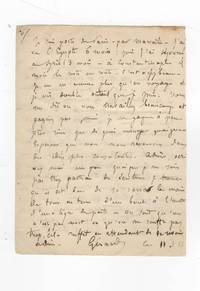
184475148Paris 1844. Fine. Paris 11 février 1844 10.40 x 13.60 cm quatre pages sur deux feuillets Three autograph letters signed by Gérard de Nerval 2 pages signed «Gérard» Théophile Gautier 1 page and a third unsigned letter 1 page penned by a certain «Robert» cf. Nerval's letter Louis Desessart Théophile Gautier's appointed publisher co-published Nervals play Léo Burckart with Barba in 1839. Following financial difficulties he was forced to take refuge «in that sad and charming city of Brussels». The three friends wrote this letter from Paris where they had reunited following Nervals long journey to the East: «I spent six months in Egypt; then three months in Syria four months in Constantinople and the rest en route. Its quite beautiful. I only enjoy myself while traveling and try to live twice as much as I can.» This journey deeply impressed Théophile Gautier who would only travel to Turkey and Egypt years later: «I am in Paris and wish I were in Cairo from where Gérard is returning.» The exoticism of distant lands starkly contrasts with the melancholy and severity of Europe: «How sad Paris is when one returns from sunlit countries.» Nerval And in Paris far from dreams of escape life means toil and melancholy: «We are like sick people who are never comfortable anywhere. I think the good times are gone and the golden hours of the past when we spoke such wise follies will never return. Whats the point of living if we must work and cannot see our friends or write to them or do anything we would like» Gautier The two writers express great compassion for their friends Belgian exile with Brussels appearing as the capital of spleen: «What! Youre still in that sad and charming city of Brussels! . Brussels is even darker poor fellow!» Nerval This joint letter was in fact initiated by «Robert»: «Isnt it true my dear friend that Im quite skilled at making you forget my faults . as a way of making it up to you Im sending you the autographs of two of your . comrades your fondest memories two men of fame who despite all their affection and friendship for you would never have written a word had I not trimmed their quills and handed them paper like sulky children and told them: write at once at once to the exile you love most.» unknown
183386496s. l. Neuchâtel 1833. Fine. Eve's first kiss: 'The gods grant no favours untainted.' s. l. Neuchâtel 29 septembre 1833 13.40 x 21.10 cm une page sur un double feuillet Autograph letter signed by Honoré de Balzac addressed to his friend the writer Charles de Bernard. One page written in black ink on a bifolium. On the verso of the second leaf appears the address of the recipient Charles de Bernard du Grail written in Balzacs hand along with postal stamps and the seal bearing the arms of the Balzac dEntraigues family which the author had appropriated. A few minor holes not affecting the text; fold marks as usual from mailing. Published in his correspondence Paris Calmann Lévy 1876 CXIV pp. 252253. Balzac wrote this letter four days after his very first meeting and first kiss with Madame Hanska in Neuchâtel following many months of epistolary correspondence. « Jai été très heureux ici. Je suis très content de ce que jai vu le pays est délicieux ; mais vous savez que Jupiter a deux tonneaux et que les dieux nont point de faveurs qui soient pures. » ""I have been very happy here. I am most pleased with what I have seen; the country is delightful. But you know that Jupiter has two jars and the gods grant no favours that are untainted."" Two years after receiving the first letter from the Stranger Éveline Rzewuska a lovestruck Balzac left Paris to join her in Switzerland. His brief stop in Besançon ostensibly a convenient detour served as a polite pretext for his departure from the capitalwhere he took the opportunity to visit his correspondent Charles de Bernard. « Il me semble que je vous ai bien peu remercié de la bonne journée que vous mavez donnée ; mais jespère vous prouver que je ne suis point un ingrat. À mercredi donc ; vous devez penser que jaurai bien du plaisir à vous revoir vous qui avez fait que mon voyage à Besançon na pas été inutile et que jy ai trouvé du plaisir ». I fear I thanked you all too little for the delightful day you gave me; but I hope to prove that I am not ungrateful. Until Wednesday then you must know how much I look forward to seeing you again you who ensured that my journey to Besançon was not in vain and even brought me joy. After a day in Besançon and a chaotic journey by mail coach Balzac finally met his beloved though regrettably in the company of her husband Count Hanski. Seizing upon the Counts absence the writer stole a long-awaited kiss with Madame Hanska on an ancient stone bench upon the hill of Crêt. In the rapture of their first encounter he could not help but invoke La Fontaines ominous fable in his letter: « mais vous savez que Jupiter a deux tonneaux et que les dieux nont point de faveurs qui soient pures ». but you know that Jupiter has two jars and the gods offer no favours untainted. His love affair with Madame Hanska would prove far from serene as Gonzague Saint Bris aptly summed it up: eighteen years of love sixteen of waiting two of happiness and six months of marriage. Neuchâtel would remain a powerful emblem of their union recurring in some sixty of their letters. Neuchâtel is like the white lily he wrote to her pure with a penetrating fragrance youth freshness brilliance hope happiness glimpsed. De Bernard who had previously arranged his journey to Switzerland was once again tasked with organising Balzacs return: « Jaurai le plaisir de vous revoir mercredi 2 octobre. Voulez-vous avoir lobligeance de me retenir une place à la malle pour Paris ». I shall have the pleasure of seeing you again on Wednesday 2 October. Would you be so kind as to reserve me a place in the mail coach to Paris The journey separating him once again from his beloved proved wretched: The mail coach was fully booked for six days so my friend from Besançon Charles de Bernard was unable to secure me a place. I was thus obliged to travel on the roof of a diligence in the company of five Swiss from the canton of Vaud unknown
1865767951865. Fine. 30 mai 1865 13.70 x 21.10 cm une page sur un feuillet Autograph letter signed by Charles Baudelaire to Narcisse Ancelle written in black ink on a sheet of blue paper. Folds from mailing three minute pinholes not affecting the text. This letter was transcribed in the Complete Works volume 11 published in 1949 by L. Conard. A moving letter from Brussels addressed to the celebrated family notary who became in 1844 Charles's legal guardian charged with managing his annuity and his exponential debts. A complex relationship developed between the poet and his guardian mingling necessity and mistrust yet nonetheless bearing witness to genuine mutual respect between the two men. This correspondence devoid of the emotional quality of his letters to his mother or the circumlocutions in his exchanges with creditors constitutes one of the most precious biographical sources on the poet. Indeed Baudelaire's financial dependence constrained him to great transparency with his guardian and each of his letters to Ancelle admirably summarizes his wanderings. Thus this letter evokes the terrible mire in which the poet found himself in Belgium and his constantly postponed return to Paris. When he writes Baudelaire is still in Brussels at the Hôtel du Grand Miroir ""28 rue de la Montagne"" but one must not write the hotel's name otherwise letters do not reach him directly where he is dying of boredom illness and resentment toward a country in which he innocently believed he would find glory. This announcement of imminent departure for Paris ""Two or three days after your reply I will leave"" echoes all the similar promises the poet has made for nearly a year to his correspondents. This one will be aborted like all the others for as he confesses to Ancelle a few months earlier Paris fills him with ""a dog's fear."" It is only in August 1865 that he will make a final and brief stay in France before his fatal stroke. His return ""I am eagerly awaited in Paris and in Honfleur"" was nevertheless motivated by a compelling reason: to negotiate with a publisher through Manet's intervention the publication of his collection of reflections on his contemporaries which he had already titled My Heart Laid Bare Mon cur mis à nu and whose manuscript is partly at his mother's house in Honfleur. Another failurethe work would not appear until 1897 thirty years after Baudelaire's death. But it is undoubtedly the reference to the ""two large paintings he wishes to send to Honfleur"" that gives this letter all its significance. Baudelaire evokes his wish to repatriate paintings from his collection that he left with various lenders or restorers of which he had already sent a list to Ancelle a few months earlier. Among these which ones did he want to bring back to his mother His father's portrait the Boilly the Manet a Constantin Guys There is no mention in other letters of this art shipment and of the ""remainder"" to which the paintings were to be joined. This desire to ""send to Honfleur"" his precious belongings nonetheless testifies to the weakened poet's wish to settle permanently in his mother's ""jewel-house"" in Honfleur an island of serenity where Baudelaire dreamed of a peaceful retreat where all would once again be ""order and beauty luxury calm and voluptuousness."" He would indeed return there paralyzed and mute but for a final year of agony after his syphilitic crisis. The Hôtel du Grand Miroir would remain his last true dwelling as noted on Tuesday April 3 1866 in the register of admissions at the Saint-Jean Clinic: ""Name and first names: Baudelaire Charles. Address: France and 28 rue de la Montagne. Profession: man of letters. Illness: apoplexy."" A fine letter to the man who was both Baudelaire's persecutor and protector. He accompanied the poet until his death before becoming executor of the family estate. unknown
185468690Paris 1854. Fine. Paris 25 Juin 1854 11.50 x 18.50 cm une page recto-verso Handwritten letter dated and signed by Charles Baudelaire to Philoxène Boyer concerning the intriguing Léontine B. Paris 25 Juin 1854 11.5 x 18.5 cm one page recto-verso Handwritten two-page letter dated 25 June 1854 and signed by Charles Baudelaire to Philoxène Boyer whom he calls «my dear Lyrique» in which he apologises for having missed a meeting with him he confesses his impecuniosity to him and reports to him on the efforts made by Léontine B. an intriguing person who will end up compromising Philoxène Boyer because of his debts to attend a party to which she is not invited and which holds a certain jealousy: «You surely assume my dear Lyrique that yesterday something serious happened for me to have missed this meeting. Here is what I would have told you: 1 my money has not come; but it will come. / 2 Léontine is obstinate. I am convinced that I have fulfilled my confidence mission very well. I came back three times. When I finally could explain to her carefully that this party was for family secret that Boyer himself was supposed to ignore it she replied: Well it's no longer a secret since I know.» Finally while recognising Léontine as «a very original turn of mind» and although the attitude of this troublesome scheme: «causes you worry and I understand.» Charles Baudelaire pleads for indulgence and leniency: «since she persists so proudly I would urge you to let the event run. It is after all only the homage of a dizzy mind.» unknown
1805669741805. Fine. 10 Floréal 13 30 avril 1805 18.50 x 23.10 cm une feuille Stendhal's autograph letter addressed to his sister Pauline. 28 lines written with a fine writing in black ink. First name ""Pauline"" from the hand of the sender at the bottom of the letter. Inventory number ""36"" in ink from another hand. Two small traces of stamp and stamp a small tear restored in the bottom margin of the page. A few tiny folds inherent in the enveloping of the letter. Rare and beautiful letter of Stendhal addressed to his sister Pauline in which all the sensitivity of the young man and his love for the dramatic art shows more than twenty years before his big romantic successes. This letter comes from the correspondence between Henri Bayle here twenty-two years with his sister Pauline three years younger. This true epistolary liaison which quickly took the form of a ""diary"" - Pauline's answers were rare - is an essential milestone in the constitution of the intellectual journey of the future Stendhal. Our letter of a great lyricism testifies to the strength of the bond uniting the young writer and his sister: ""Let's shake each other my good friend. We will never find anyone who loves Pauline as Henry nor will Henry ever find a more beautiful soul than Pauline. ""The use of the third person and a lover vocabulary erects the young woman to the rank of alter ego a sister-soul and even perfect mistress. The young Henri is then precisely under the yoke of a devouring passion for the actress Melanie Guilbert whom he met during his declamation classes at Dugazon: "" I'm going to be bored perhaps by my dark sadness. I know very well that the seriousness of ardent passions is not pleasant. "" Contrasting with this passionate relationship Pauline symbolizes reason and balance a figure that Henri like a pygmalion can fashion at leisure. In good tutor he advises: ""Learn by heart roles. About declamation I will teach you a thousand things. I'm bringing you a Gil Blas and a Tracy. ""We understand here worship Stendhal devoted to the theater from his earliest years both as a player as a playwright the fund of its archives to the Grenoble Library contains nearly 700 sheets of blanks:"" I am in despair at not being able to wear you Beanies. But wait maybe someday will come . as Ulino says. ""This passion for theater Henry intends to pass it to his sister:"" We will work like hell during the time that I stay in Grenoble. ""In total opposite view with the education of women in his time he put a point of honor that Pauline is an educated person; In several letters moreover we find injunctions from the brother ordering his sister to give up needlework in favor of the reading he recommends. Truly obsessed with theater and convinced that he will become an author of successful comedies he works tirelessly: ""I am told a room where I will not be free and where I can not just declaim. Try to disturb this arrangement. ""Years before writing great novels that make her famous Stendhal already understands that loneliness is for him a source of creation and says:"" A lonely is jealous of his freedom. It is his greatest good as that of all men. "" unknown
184183639s. l. Passy Paris 1841. Fine. s. l. Passy Paris « mardi matin » 28 décembre 1841 13.50 x 21.60 cm une page sur un double feuillet enveloppe jointe Autograph letter signed by Honoré de Balzac to Jean-Baptiste Violet d'Epagny director of the Odéon theater. One page in black ink on a double sheet. Enclosed and pasted on the second page is the envelope of this letter written in Balzac's hand.""My dear director under the terms of our agreements I am ready to read I have chosen tomorrow Wednesday and I have told your stage manager the names of the actors to whom I entrust our play. I've done a bit of your job I've conquered Madame Dorval who will make you rich I'll bring her myself. Find here my dear d'Épagny a thousand regards I have given you proof of our old acquaintance by choosing you for Les Ressources de Quinola I shall expect a return in our relations and I am entitled to a great deal of zeal."" Les Ressources de Quinola is both in the spirit Les Fourberies de Scapin and Les Noces de Figaro. From the 1840s until his death Balzac's ambition was to achieve a reputation comparable to his illustrious predecessors Molière and Beaumarchais. Although this proved to be a hope as vain as it was determined Balzac never doubted failure after failure that his success was imminent. On July 15 1841 d'Épagny was appointed director of the Odéon . as any theater director would have done in his place he spent summer vacations organizing his winter programme. He asked Balzac for a play and Balzac complied choosing Les Ressources de Quinola. . We all know what a fuss was made about Balzac's play and how childishly naive the author was in filling the room with the highest Parisian society and foreign elite in order to make snobs want to join such a brilliant assembly. . Madame Dorval more astute than the author refused the role intended for her as soon as Balzac read . She did well for one never saw a more complete failure"" L'Amateur d'autographes mai 1911 Interesting letter revealing the beginnings of the creation of Les Ressources de Quinola and the author's habit of reading his play for the actors who then voted to accept or reject it. Provenance: Arthur Meyer collection then ""AGR"" stamp on letter and envelope. unknown
1860640961860. Fine. s. d. circa 1860 20.60 x 27.60 cm un feuillet remplié DUMAS Alexandre Naïs et Chloé. Unpublished handwritten sapphic poem signed by Alexandre Dumas N. d. c. 1860 206 x 276 cm one folded leaf Autograph manuscript poem signed by Alexandre Dumas bearing the title Naïs et Chloé 84 verses in black ink on a blue folded leaf of paper. A few tiny tears without damage to the text invariably produced when a leaf of paper is folded. A very rare manuscript of a long unpublished poem depicting the love of Naïs and Chloé the writing of which is motivated by the admiration and tribute paid by Alexandre Dumas to one of the greatest figures of ancient poetry Sappho. A prolific novelist Dumas rarely tried his hand at poetry; Naïs et Chloé by its length constitutes a hapax in the literary production of this writer. The text remains unpublished to this day and is here enhanced by the elegant calligraphy of its author. The poem is made up of 21 quatrains among which stands a remarkable insertion of the most famous verse by Sappho to the beloved woman the title of which is preserved in the very body of the text. This embedding is part of the verve with which Dumas defends the poetic and evocative force of the writing of Sappho whom he elevates to the rank of the star of the world of Poetry: Il est au sein des mers s'appuyant à l'Asie Entre l'heureuse Smyrne et la sombre Lemnos Une île aux bois fleuris chers à la Poésie A qui Venus donna le doux nom de Lesbos. Quand du chantre divin la voix fut étouffée Que du nom d'Euridice elle eut frappé l'écho Le flot roula tête et la lyre d'Orphée Sur la rive où plus tard devait naître Sapho Sapho naquit la lyre en ses mains fut remise Les sons qu'elle en tira jusqu'à nous sont venus. Translated with conscientious care by the author the poem borrowed from Sappho in which that most famous verse emerges this one I say is equal to the gods is found in several places in Dumas' work particularly in the chapter entitled les vers saphiques of San Felice and in a collection of articles dedicated to the great female figures where she sits alongside Joan of Arc and Margaret of Anjou. For Dumas it is a matter of remaining faithful to the written verses and rendering their sensuality often blurred by previous translators: The translations of these two poets often appear to lack not only ancient color but are inadequate in their lesbian ardor Les étoiles du monde Galerie historique des femmes les plus célèbres de tous les temps et de tous les pays. Above and beyond this translation Dumas is imbued with the lyricism of Sappho without losing his own romantic vein and he paints the sapphic love of Naïs and Chloé in an erotic light: Oh seule palpitante échevelée et nue Une main sur ma gorge et l'autre. Oh ma Naïs Serre moi dans tes bras et sois la bien venue Car à force d'amour. tiens. tiens je te trahis Et l'on n'entendit plus alors dans la nuit sombre Que le bruit des baisers répétés par l'écho Car Nais et Cloé se taisaient et dans l'ombre Clinias s'enfuyait en maudissant Sapho. The poem testifies to the continuous interest that the authors of the late 19th century showed toward sapphism and to the personage of the reader-voyeur here embodied by Cleinias whose most famous occurrence remains Zola's Nana. Exceptional and long autograph sapphic poem by Alexandre Dumas. $ 10 000 unknown
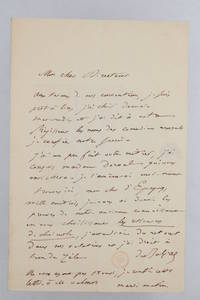
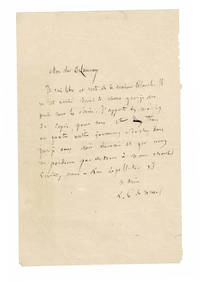
184172914Paris 1841. Fine. Paris 18 novembre 1841 13.90 x 20.80 cm une page sur un feuillet remplié Autograph letter signed by Gérard de Nerval addressed to Auguste Cavé written in careful handwriting in black ink on the first page of a double sheet. Minor traces of folds inherent to posting and some light foxing. This letter was transcribed in Nerval's Complete Works in the Pléiade edition. After two violent nervous breakdowns Gérard de Nerval was compelled to stay at Dr. Blanche's clinic between March and November 1841. Short of money he addressed this letter to his friend Auguste Cavé then director of the Fine Arts section at the Ministry of the Interior to solicit his support with ""M. le Ministre"": ""Quoi qu'entièrement rendu à la santé je sens que je ne puis encore travailler qu'avec ménagement et s'il était possible que l'on m'aidât d'une légère somme mensuelle . je serais plus sûr de pouvoir reprendre peu à peu ma position littéraire sans risquer de nouveaux accidens"" ""Though entirely restored to health I feel that I can only work with care and if it were possible to be helped with a small monthly sum . I would be more certain of being able to gradually resume my literary position without risking new accidents"". unknown
1839803451839. Fine. s. d. ca 1839 13 x 8 cm une feuille Signed handwritten letter to Louis Desnoyers ca 1839 13 x 8 cm one leaf Handwritten letter signed by Honoré de Balzac addressed to Louis Desnoyers written on a white piece of paper in black ink. My dear Mr Desnoyers extraordinarily today I attend a diplomatic dinner of good-natured folk who want to laugh and drink and as I am in a stupor at work I have not had the courage to refuse this debauchery; I will therefore not be at home. Come early Sunday morning. / Yours / de Balzac. Louis Desnoyers plays an important role in the foundation of the Société des gens de lettres which aims to protect literary and artistic property and to create a solidarity fund. Balzac supported the creation of this Society of which Desnoyers was vice-president. Amusing letter testimony of Balzac's love of good food. unknown
1861000615Chicago Illinois IL. Good. 1861. A wonderful archive of historically significant with detailed civil war content: 1 Two detailed Civil War diaries; 2 Ransom's first war letter home; 3 superb signed Ransom Civil War cartes des vistecdv; 4 Other photos: a tintype cdv gem photo and another hand colored cdv of his wife Louie Lucy Perham; 5 A book titled "Sacred Poems"; 6 Ransom's business card and property tag and lastly but of huge importance to genealogists; 7 Early name and address book of Dick Ransom mentioning many family members and Battery mates. Dick Ransom was from Chicago Illinois; enlisted on 8/7/1862 as a private. On 8/29/1862 he mustered into Chicago Mercantile Light Artillery. He was discharged for disability on 3/24/1863. Specifics: Diary #1 1861 2.5 x 3.5 inches full year January 1st through December 31st 1861 120 pages of which approx. 250 days with entries recorded dark brown period ink very legible. Great war content and a number of remarks made in great excitement; Lincoln as President; death of Col. Ellsworth and Steven Douglas. Battle excitement and the rout of the federal army at the first battle of Bull Run at Manassas. Diary #2 1862 : 3 x 5 inches entries from Aug. 7th 1862 through Mar. 6th 1863. 29 pages brown period ink very legible. Cover reads " Dick Ransom mercantile Battery Chicago Artillary 100 Washington Street Chicago". Signed in ink in Dick Ransom's hand on first page; "Dick Ransom 100 Washington Street Chicago Ill." Also included: 3 wonderful cdv/tintype of Lucy Ransom. Dick speaks of his proposal for marriage to Lucy in his 1861 diary. First is a tintype/cdv format of Lucy backmark Chicago dated Aug 19th 1866 and signed on reverse in Dick's handin brown ink "Louie Perham 1866 Dick Ransom". Secondly mounted Gem Albuman photo of Lucy on cdv mount ca. 1865. Cdv is handcolored image of Lucy dated Jan 23rd 1868. The address book includes all of Dick's friends and family and many of Mercantile Battery mates including Sinclair Willard Gunlock and Medal of Honor winner James Dunne. 3 x 5 inches many pages of entries mouse chew on cover edges. The date of 1883 can be found on the fep. Brown ink inscriptions this book is an important genealogy record and helps to identify all the people referred to in the diaries. Here are some snippets: " January 9th "my Birthday 19 years old born at South Woodstock Vermont""march 4th Abe Lincoln President of the United States"" Mar 19th " wrote a long letter to Lucy . with a proposal for marrige which I am sure will be accepted.I am in great anxiety for an answer". tintype of Lucy included "rec'd an answer alright = O.K."" April 25th -Intense excitement about . voluteers companies forming and drilling constantly all over the North"." May 2nd - douglas was received here by republicans and Democrates unanimously " May 3 - great war excitement for some time - volunteerism all over the country - great excitement". " May 5th - volunteers drilling in the streets "" May 8th - Lucy went for me to get a flag for the volunteers ."" May 9th - great war excitement companies guarding and driling". " May 24th - war message regarding the good and efficient commanders." " may 25th - Scott and President Lincoln col. Ellsworth the Zouave huro of Chicago killed in Alexandrea yesterday for tearing down a secsession flag. " June 3rd - Stephen A Douglas died at the tremont house this A.m. at 48. The city draped very very heavily mourning. col. Ellesworth funeral yeaterday at Bryan hall". " May 4th - Douglas laid in state at Bryan Hall all day." " May 5th - Douglas still in Bryan Hall ". " May 5th - Douglas still lies in state at Bryan hall is to be burried at Cottage Grove tomorrow ". "May 7th- Douglas funeral stores all shut up largest funeral ever in Chicago ". " June 10th - War excitement continues usual small battles and skirmishes but no large ones some expected soon". " June 20th - war and rumors of war some great battles expected soon in vicinity of Washington Sucession." " June 25th - Great riot in Milwakee yesterday - Dutch Mob attacks." " June 25 - all state banks in iowa Indiana and Eastern Missiouri counterfeits so plenty now". " June 30th - went out to Cottage Grove to see the camp" " July 8 - Telegraphs forbidden by the War department to transmit any war news of the intentions of the united states "." July 16 - the federal forces are beginning to move toward Richmond knowing where they will stop Gen. Scott don't tell everydody". " July 22 - At noon good news from the war high hopes night news the entire rout of the Federal army . and retreat back to Washington". referring to the first battle of Bull Run at Manassas " July 23 - News from war not encouraging - 600 killed ". " July 25- breacking accounts the battle and rout of the Union army though better than at first suspected ". " Sept. 25- think of joining T.E.G. Ransoms 11th regiment at Cairo had a letter from him wants me". referring to Gen. Ransom. " Oct 6th - another letter from T.E. G. Ransom still urges me. " " Aug 7th 1862 I enlisted in the Mercantile Battery of the Artillary of the U.S. for three years unless sooner discharges"" Aug 9th I was sworn in by capt. christopher U.S. mustering officer of Chicago". " Mr Sutter pastor presented each of the young men who had enlisted with a teatament". " Aug 11th - picked up duds to go to camp tomorrow- at 9 o'clock". "Aug 12th- at 9 o'clock at our headquarters at corner of Lake and State streets at the .Mercantile Association - marched to court house and examined by surgeon and then recieved our $ 60 ". " Aug 13th - arranged our camp as best we could not being organized . was on guard . skirmishing ." " Aug 14th -rec'd news that we were accepted by the government and were to have a full battery . powder smooth Bores . the Coffeemill . orders to fill up the company to 156 men. some photographs taken ". " Aug 25 - we elected our officers and then were visited by Adjutant General Fuller.Cooley Wilson Swan Bickford ". " Aug 29 - The Battery was mustered into service by lt. Knox ". "Sept. 1st- went to town to get more photographs". " Sept 23 - lient Wilson had a sword to be presented him ". " Oct. 3- went to camp and found that the Guns and all accoutrements and ammunition had come". . guns 2 .from riffle james cannon 2 to 8 ditto rebel guns -one made in Memphis and one in orleans which had been captured". " Oct 4th Seargents knights and Whitney Thomas and Throop drew cuts for the 4 bronze guns -knight & Thomas got the U.S. & Throop 7 Whit the rebels.". " Oct 5- had a great deal of company to look at the guns ." the Mercantile Association presented Crego with a sword . the accoutrements are being distributed and guns. today there was a sword Pistols presented to Capt. Cooley by the Mercantile Association." "Oct 15th " last evening the Asociation presented the Battery a splendid set of Colors. . to ft. Wayne.after the horses for the Battery ". " Oct 26th - we drill about 4 hours daily with our horses and guns on the prarie and five blank cartriges to break in the horses - we are almost ready mow for the field and fight". We are now likely to get our Captain Cooley to resign and have Morgan in his place. we have no guard around the camp now only on the horses guns ammunitionstores & officers tents and the boys go down town when they choose". " Dec. 25th - Vicksburg measels" "jan 2nd 1863. left Yazoo country- & Walnut Hills & c bluffs - Sherman's big retreat" . " Feb 14 - Arkansas Post- Sherman deserted - then back to Youngs Point". " Mar 6th Left Youngs Point for Hospital in Memphis on steame "City of Memphis". " April 1st 1863 - Mrs. Livermore brought me my discharge from the service- to Washington Hosptal Memphis.". " April 2 - left Memphis on Bostona -- homeward bound a free man". Remarkable archive.; Manuscript; 48mo - over 3" - 4" tall; KEYWORDS: HISTORY OF DICK RANSOM ALS CDV AMERICANA HANDWRITTEN MANUSCRIPT DOCUMENT LETTER AUTOGRAPH WRITER HAND WRITTEN DOCUMENTS SIGNED LETTERS MANUSCRIPTS HISTORICAL HOLOGRAPH WRITERS AUTOGRAPHS PERSONAL PERSONAL HISTORY MEMOIR MEMORIAL DIARY JOURNAL DIARIES JOURNALS LOG LOGS KEEPSAKE AMERICANA Civil War War Between the States VICKSBURG MANASSASS BULL RUN LINCOLN ILLINOIS MERCHANTILE ILLINOIS INFANTRY Zouave . unknown
188568398Dieppe 1885. Fine. Dieppe 1er septembre 1885 22.40 x 17.70 cm 4 pages sur un double feuillet Unpublished autograph letter signed Dieppe 1 September 1885 22.4 x 17.7 cm one folded sheet under custom slipcase Unpublished signed autograph letter from Edgar Degas to an unknown correspondent. 4 pages in black ink on one folded sheet. Central fold inherent to the way the letter was folded.his letter is presented in a chemise and case with paper boards decorated with abstract motifs the spine of the chemise in green morocco pastedowns and endpapers of green suede slipcase signed by Thomas Boichot. A handsome unpublished letter testimony to Degas' other great passion after dance: song.he Parisian premiere of Ernest Rayer's Wagnerian opera Sigurd took place on 12 June 1885 at the Opera de Paris. Degas overcome by the performance of the singer Rose Caron saw the piece thirty-seven times: «I still love Sigurd and I like it more and more. I have never seen Reyer except once in the street. And I made a point of telling him of the admiration it provoked in me far more immediately than in someone who being neither maid nor washerwoman was worthy of some consideration.» Degas paid homage to the beauty of Rose Caron in Sigurd by doing two drawings on fans today in private hands in the US.Properly obsessed by this «admirable work that did him so much good that he could not get over» the painter asked his famous neighbor to play him the score on the piano: «The young Jacques-Emile Blanche our neighbor plays it to me every day in place of your wife.»he letter closes with a lyrical description of Mont-Saint-Michel of which Degas had made several drawings: «Have you ever seen Mont-Saint-Michel Could we go and spend a few days there together sometime It's so pretty so charming. In one month I've been twice. The big tides at the end of September will take me back once more.» Degas' passion for opera is the subject of an exhibition for the 350th birthday of the Paris Opera open from 24 September 2019 to 19 January 2020 at the Musée d'Orsay. hardcover
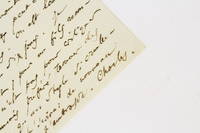
190078743s. l. Londres London 1900. Fine. s. l. Londres London 24 mars 1900 10 x 15.70 cm 6 pages sur 2 doubles feuillets Handwritten signed letter addressed to Natalie Clifford Barney and enriched with a poem entitled « Le Miroir » London 24 March 1900 10 x 157 cm 6 pages on 2 double leaves Handwritten manuscript letter by Renée Vivien signed Pauline and written in black ink on a double leaf headed 24 Hyde Park Street. This letter contains a handwritten alexandrine poem entitled Le Miroir; never published on the initiative of the poet but it has been transcribed in Renée Vivien et ses masques in à l'encart April 1980: Je t'admire et ne suis que ton miroir fidèle Car je m'abîme en toi pour t'aimer un peu mieux; Je rêve ta beauté je me confonds en elle Et j'ai fait de mes yeux le miroir de tes yeux Je t'adore et mon cur est le profond miroir Où ton humeur d'avril se reflète sans cesse Tout entier il s'éclaire à tes moments d'espoir Et se meurt lentement à ta moindre tristesse Ô toujours la plus douce ô blonde entre les blondes Je t'adore et mon corps est l'amoureux miroir Où tu verras tes seins et tes hanches profondes Ces seins pâles qui sont si lumineux le soir! Penche-toi tu verras ton miroir tour à tour Pâlir ou te sourire avec tes mêmes lèvres Où trembleront encore les mêmes mots d'amour Tu le verras frémir des mêmes longues fièvres Contemple ton miroir de chair tendre et nacrée Car il s'est fait très pur afin de recevoir Le reflet immortel de la beauté sacrée Penche-toi longuement sur l'amoureux miroir! The rest of this long missive has however remained unpublished. A very beautiful letter sent from London by the Muse aux Violettes who misses her little one: Despite its slowness time passes you see and brings the hour that I await feverishly the time to meet again Natalie! Two more sad evenings and the third you will be there to rock me in your arms! . Today I was still disproportionately bored. I so need to see you again that I count the hours as they pass. I only think of you obsessed haunted taken possessed by you and by our memories. I am a poor unhappy thing far from you. Weary of society life We had the queen's dressing room how chic my darling! Lady Augustus Fitz Clarence invited us. She descends from a bastard of the King and is therefore an illegitimate relative of the sovereign! Renée lingers on the contemplation of a present from her darling: Your ring I love it so much it is a bond of our love that never leaves me. I so regretted your dagger that at the last moment I forgot to carry. Your ring you see is your memory on my finger I look at it and part of our tenderness is embodied in it. It is at the end of 1899 and through Violette Shillito that Renée Vivien then Pauline Tarn met Natalie Clifford Barney ""this American woman softer than a scarf whose sparkling face shines with golden hair sea blue eyes never-ending teeth"" Colette Claudine à Paris. Natalie who had just experienced a summer romance with the scandalous Liane de Pougy who introduced her to sapphism paid little attention to this new acquaintance. Renée on the other hand was totally captivated by the young American woman and describes this love at first sight in her autobiographical novel Une femme m'apparut: ""I lived again the hour already well past when I saw her for the first time felt the shiver that ran through me when my eyes met the mortal steel of her look those eyes blue and piercing as a blade. I had a dim premonition that this woman would determine the pattern of my fate and that her face was the predestined face of my Future. Near her I felt the luminous dizziness which comes at the edge of an abyss or the attraction of a very deep water. She radiated the charm of danger which drew me to her inexorably."" ""Winter 1899-1900. Beginnings of the idyll. One evening Vivien is invited by her new friend to Mme Barney's studio Natalie's mother 153 avenue Victor-Hugo on unknown
184172928Paris 1841. Fine. Paris s. d. avril 1841 13.50 x 21 cm une page sur un feuillet Autograph letter signed by Gérard de Nerval addressed to Hippolyte Delaunay written in black ink. Recipient's name in Nerval's hand on the verso of the leaf. A central fold inherent to the mailing. This letter has been transcribed in Nerval's Complete Works in the Pléiade edition. Gérard de Nerval is finally ""free and released from the Maison Blanche"" after staying there following his crisis of early spring 1841. This is not however a definitive release but probably permission granted by Doctor Blanche to his patient the latter would not be definitively released until November 1841. The handwriting difficult to read in places shows Gérard de Nerval's feverishness as he seeks to reconnect with the literary milieu: ""I bring masses of copy for you and three or four other journals."" Hippolyte Delaunay was editor-in-chief of the review L'Artiste in which Nerval published on April 11th of the same year an article entitled ""Mémoires d'un Parisien Sainte-Pélagie 1832"". unknown
184173272Paris 1841. Fine. Paris s. d. circa mars 1841 10 x 13.10 cm un feuillet et son enveloppe dépliée Very rare autograph letter signed ""Gérard Labrunie"" addressed to ""his dear papa"" Dr. Labrunie. 13 lines written in small handwriting in black ink on one page. Unfolded envelope attached showing several postal stamps restored on the back with an adhesive piece. A few transverse creases as well as some very discrete holes not touching the text and inherent to the use of a pin to seal the letter. Fine letter from Gérard Labrunie to his ""dear papa"" about a ""very complicated affair"" relating to the ""capacity as surrogate guardian"" of the writer's father. Very rare signature of Gérard de Nerval under his real patronymic name: Gérard Labrunie. unknown
180185841Charenton 1801. Fine. ""I experience spasms a sort of shivering a lot of yawning disgust total despondency the blood rushes violently to my head then I feel dizzy spinning which makes me stumble and a thousand other things proving a great tension in the body and a great irritation in the nervous system."" Charenton 1801 15 x 22.80 cm un feuillet composé deux papiers encollés Original autograph letter by the Marquis de Sade consists of 27 lines of relatively tight handwriting. Most likely written to his wife as evidenced by the letter's origin from Sade's family. The letter is physically composed of two glued pieces of paper. On the verso the Marquis wrote 19 lines and scrupulously crossed them out - a few words and letters are still quite visible. Cited in Maurice Lever's biography 'Donatien Alphonse François marquis de Sade' Paris Fayard 1991 p. 631. On March 7 1801 Armand de Sade the Marquis's son received a letter from the Minister of Police Joseph Fouché notifying him that his father had been arrested yesterday and that handwritten pages from the novel 'La nouvelle Justine' Justine or the Misfortunes of Virtue had been found on his person: Nevertheless sensitive to your request for leniency and concerned to preserve the honor of your name I have decided to have your father transferred to the Charenton nursing home.. It should be noted that for Fouché Charenton an insane asylum was nothing more than a nursing home a prison. It should not be forgotten that a large proportion of the population of these asylums did not fit into the social and moral field and psychiatry has long had no other aim than to normalize to make them fit for social life. Contrary to what has been said Sade fits in perfectly. However as soon as he entered Charenton Sade's attitude led to his expulsion to Bicêtre the Bastille of scoundrels but his family succeeded in getting him back into the Charenton asylum. Charenton was not only the Marquis de Sade's last incarceration but also the last place he lived in where he died in 1814. The 19 lines scrupulously crossed out on the back of the leaf reveal a few words or letters; in this respect we can conjecture that it's a coded message which Sade was quite fond of for if censorship had been behind these erasures absolutely everything would have been yet the message clearly shows that almost everything has been conscientiously crossed out apart from a few words or letters. We can still make out a few of them: 'Nécessaire' 'à tous' 'ger' 'ue' 'quel' 'je trouve' 'de'. As for the letter itself it is remarkable for the homogeneity of its message. It is a lengthy complaint describing the physical ailments Sade has suffered. It is an account of the sum total of the symptoms that overwhelm the writer. In a hyperbolic style using among other figures of speech adverbs of intensity si tel très. Sade methodically spells out the violent pains his body is suffering with the whole of this violence constituting a system a structure in which all the parts are linked. In the writer's correspondence it can be said that each time he found himself incarcerated his letters mention uncontrollable physical attacks although we know of no other letter so uniform and systematic.The pain originates in the pit of the stomach radiating out to the periphery: head eyes legs all converging on vertigo loss of balance. .because that's what it's all about: Sade isn't suffering from any illness he's besieged by anguish whose ultimate meaning is vertigo the wavering of a reality from which his freedom to live as he pleases his freedom of movement and his name have been taken away. The loss of these fundamental elements of his existence sends Sade in turmoil. In addition and as regards the formation of these particular symtoms if we consider that the fulfillment of a certain sexual sadism is necessary to him the deprivation of this satisfaction turns this sadistic driv unknown
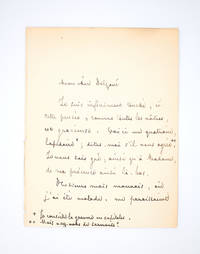
1892759251892. Fine. s. d. 15 avril 1892 12.60 x 16.40 cm 2 pages sur un double feuillet une carte et un calque Autograph letter signed by Stéphane Mallarmé to Alidor Delzant. Two pages written in black ink on a bifolium. Envelope enclosed. Also included is a signed autograph quatrain by Mallarmé on a card the one later inscribed on the mantelpiece: « Ici le feu pour renaître Tantôt durable ou charmant Comme l'amitié du maître Mêle du chêne au sarment. » Alidor Delzant was a lawyer collector and bibliophile. A friend of the Goncourt brothers he devoted a work to them and served as Edmonds secretary and executor. A fine letter in which Mallarmé evokes the composition of a quatrain to adorn Delzants mantelpiece: « Je suis infiniment touché et cette pensée comme toutes les vôtres est gracieuse. Voici un quatrain lapidaire je conseille la gravure en capitales; dites-moi s'il vous agrée. Mais usez-vous de sarments » Also included is the original tracing probably made by Mallarmé himself of the quatrain intended to decorate the lintel of Alidor Delzants library fireplace in his house at Paraÿs. Delzants reply to this letter is known: « Mon cher ami / Ces vers sont très beaux juste ce qui convenait pour glorifier la Cheminée de Paraÿs où les sarments pétillent autour des bûches des chênes. / Je demeure touché et reconnaissant. / Alidor Delzant. » unknown
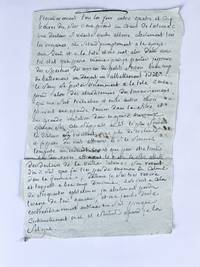
1840640991840. Fine. s. d. circa 1843 13.20 x 21.90 cm 4 feuillets Admirable set of four manuscript fragments of chapter XI of the Voyage d'Espagne which exposes behind the scenes of Gautier's writing which guided by the romantic taste for the picturesque relates his stays in Madrid and Ocaña and his passages by La Guardia and Tembleque . Gautier adopts an astonishing working format revealing the intimate / particular process of writing where flying sheets of different sizes very tight writing and corrections and inks of different colors come together. Originally intended for a publication in the press Gautier's article itself seduced by Spanish exoticism satisfies the search for picturesque then at its peak in France: "" The perpetual carousel of the fans that open close throb and flap like butterflies trying to land; the elbow movements of the women grouping themselves in their mantillas and correcting the inflection of an unsightly fold; the glances launched from one cross to the other to the people of knowledge; the pretty nod of the head and the graceful gesture which accompanies the agur by which the senhoras reply to the horsemen who salute them; the colorful crowd intertwined with Gallegos Pasiegas Valencians Manolas and water vendors "" Gautier establishes links between known references to Spain: Don Quixote and finds picaresque resonances in the adventures he saw: They were men Beyond the simple satisfaction of the public Gautier offers a glimpse of the Spanish character and bon vivant: sobriety and the patience of the Spaniards to endure fatigue is something that is prodigious. They remained Arabs on this point. One can not go further than the oblivion of material life. But these soldiers who lacked bread and shoes had a guitar. unknown
185976839Nohant Nohant-Vic 1859. Fine. Nohant Nohant-Vic 16 août 1859 13.50 x 20.90 cm 4 pages sur un double feuillet Autograph letter signed by George Sand addressed to Ernest Feydeau. Four pages written in blue ink on a double sheet bearing at the head of the first page the sender's blind stamp. This letter was published in the complete correspondence of George Sand established by Georges Lubin. Fine and lengthy letter discussing literature and friendship between writers. Initially a stockbroker and specialist in Antiquity Ernest Feydeau launched himself late into fiction. Anxious to occupy a literary space in which he did not feel justly appreciated he used his connections and maintained a regular epistolary relationship with illustrious correspondents such as Gustave Flaubert Sainte-Beuve and George Sand to whom he sent drafts of his novels and whose opinions he sought. This letter forms Sand's response after having just finished reading Daniel Feydeau's second novel. George Sand then at the height of her literary career describes herself thus: ""I am quite old enough to be your mother for I am 55 years old and I have good hands quite skillful but not beautiful at all. I have earned the right to no longer be coquettish I have been quite reproached for never having been so. I will tell you anything about myself that you wish."" As was her habit much solicited by her peers she delivers a very detailed critique of the text her colleague submits to her: ""I am not against sentences that jar where they need to jar but I am not for harmony being sacrificed to rhythm. Nor am I for the contrary. Understand me well I only blame what is too noticeable what reveals the technique. Do not touch the passages you speak of they are excellent. And in sum I will not insist furiously on the question of form in style seeing that if the qualities of yours should disappear with what sometimes seems to me a flaw I would be in despair at having pointed out the flaw."" Herself very close to Flaubert whom she nicknamed her ""leaden bottom"" Sand seems delighted that the two men know each other: ""I do not have time. But I will have time to receive you when you are free you must come with Flaubert who also has in me an enchanted reader and a wholehearted literary friend. I did not know he was your friend and I am pleased that he is."" The friendship goes so far that Sand soon brings the two writers together placing them on complete equal footing: ""It is no misfortune for you any more than for Flaubert to belong to the race of seers."" A form of solidarity then establishes itself in the face of critical adversity: ""All this is felt better than it can be said and that is why criticism loses its reason three-quarters of the time."" For criticism has had the misfortune of labeling Feydeau as it did with Flaubert a realist: ""People have taken it upon themselves to baptize your manner and his as realism. I do not know why; unless realism is something entirely different from what the first adherents attempted to explain to us. I suspect indeed that there is a way of envisaging the reality of things and beings which is great progress and you bring triumphant proof of it. But the name realism does not suit because art is a multiple infinite interpretation. It is the artist who creates reality within himself his own reality and not that of another. Two painters paint the portrait of the same person. Both create a work that represents the person if they are both masters. And yet the two paintings do not resemble each other. What has become of reality"" This long diatribe - a true manifesto - forms a powerful testimony to the repulsion of George Sand and Flaubert for theorists obsessed with the idea of classifying literature according to a ""system that . blinds"". unknown
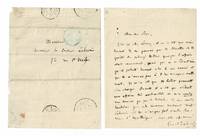
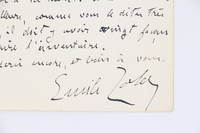
188279111Médan 1882. Fine. Médan 1er décembre 1882 13.60 x 21.40 cm 2 pages sur un double feuillet - enveloppe jointe Autograph letter signed by Emile Zola - apparently unpublished - written in black ink on a double sheet and addressed to Léon Carbonnaux department head at Bon Marché. Folds inherent to mailing. Envelope included. Only two letters from Léon Carbonnaux to Emile Zola are known: they can be consulted in the digitized preparatory file for Au bonheur des dames made available online by the Bibliothèque nationale de France. However we know from this same file which contains a long section entitled ""Notes Carbonnaux"" that this department head at Bon Marché provided Zola with a significant amount of information particularly about employee customs their remuneration and especially inventory techniques. The two men probably met when Emile Zola eager for information about the workings of department stores conducted field research in February and March 1882. Very important unpublished letter shedding new light on the pre-original publication of Au bonheur des dames. In his biography of Emile Zola Henri Mitterrand writes: ""Even before the novel was completed Zola gave an extract to Panurge in November; and on November 23 1882 Gil Blas announced its imminent publication in its columns."" Our letter discussing precisely this alleged pre-publication in Panurge attests that it was simply a joke and thus contradicts Henri Mitterrand: ""But your letter surprises and saddens me somewhat. How could you have been taken in by Panurge's stupid joke Did you not notice that the entire issue is a 'farce' Not one of the articles is authentic they are parodies and very poorly done ones at that."" Indeed reading the said extract cannot fool the assiduous reader of Zola despite the introduction that the journalists wrote: ""After Nana and Pot-Bouille those epics of elegant vice and bourgeois vice M. Emile Zola wanted to create one of honesty: Au bonheur des Dames which will appear shortly is a reassuring painting of innocence and virtue; the greatest success is assured for this new work whose characters move in the setting of a large novelty store; Parisian high commerce will not long await its observer and painter. We thank Emile Zola for having kindly cut out especially for Panurge a few pages from his still unpublished work and we are proud to give the public first an extract from this work of such high morality and such powerful interest."" Panurge no. 4 of October 22 1882 The sentences of this false Zolian text are exaggeratedly long and Panurge took the liberty of endowing the novel with a male main character Denis Mouret an amalgam of Denise the true heroine of the book to appear and Octave Mouret. One can think that it is a text composed from elements of Pot-Bouille the previous volume of Rougon Macquart where Octave - future owner of Bonheur des Dames - exercised the function of clerk before his meteoric social rise: ""For already more than two months he had been attached to the 'silks and furs' department; he arrived in the morning at seven o'clock to return home his day finished only at nine o'clock in the evening when all of Paris buzzed strangely with a feverish animation of pleasure and enjoyment and on his way back he followed gawking the great crowded boulevards where blazed the cafés full of girls and where on the asphalt at theater doors the crowd jostled with here and there in the vague rumor of trampling and pressing the roguish intonation of the cries of program vendors and ticket sellers."" Panurge In his letter of November 30 1882 Léon Carbonnaux - reading the extract from Panurge - had reproached Zola for his errors: ""Nowhere except at the Fabriques de France near Les Halles does one arrive at 7 a.m. It's at the earliest 7:30 but more often 8 a.m. and even then. There is no silk and fur counter at the Louvre. . It is so easy for you to be accurate that errors of this kind especially if t unknown
186075622s. l. Paris 1860. Fine. s. l. Paris s. d. 5 ou 12 janvier 1860 13.60 x 21 cm deux pages sur un feuillet remplié Autograph letter signed by Gustave Flaubert addressed to the archaeologist Charles-Ernest Beulé. Two pages written in black ink on a folded sheet. The recipient of this letter added nine handwritten lines a draft of his future response following Flaubert's letter. This letter has been transcribed and reproduced on the website of the Flaubert Centre at the University of Rouen. The transcriber of this missive notes: ""Are the lines written under the signature by Beulé or by Flaubert himself The handwriting resembles his. Stéphanie Dord-Crouslé suggests that Flaubert may have gone to see Beulé and written these elements under his dictation in response to the questions posed."" This hypothesis seems unlikely to us given that we know Charles-Ernest Beulé's response to this letter itself digitized by the Flaubert Centre and dated February 10 1860. This response does not seem to us to suggest a visit by Flaubert to Beulé. It seems more likely to us that Beulé inscribed under Flaubert's letter a draft of his future response of February 10 1860 which would only be an elegant reformulation of his notes. Handsome and important testimony to the colossal research that Flaubert undertook for the writing of Salammbô. ""Begun in 1857 the novel appeared in 1862 a period when Antiquity was coming back into fashion and when Carthage was 'au goût du jour' ""in vogue"" thanks to the recent excavations by Charles-Etienne Beulé at Byrsa 1859 and in the Punic ports."" Vanessa Padioleau ""Flaubert et Carthage : Salammbô roman polymorphe"" ""Flaubert and Carthage: Salammbô polymorphic novel"" in Revue Flaubert n° 9 2009 It is therefore to one of the specialists on the subject that Flaubert addresses his questions commenting on his recent reading of Ammianus Marcellinus: ""J'ai appris dans ce même Ammien que les Carthaginois ont pris Thèbes en Egypte . Qu'est-ce que cela veut dire Ce passage est je crois peu connu "" ""I learned in this same Ammianus that the Carthaginians took Thebes in Egypt . What does this mean This passage is I believe little known"" Flaubert's task is no small one: at the time nothing or almost nothing was known about the period of the Mercenary Revolt which extended over two years from 240 to 238 BC. He then begins painstaking work basing his research on the texts of the great historians of Antiquity which he reads in Latin in the original. The letter we offer shows his great mastery of it: ""J'ai appris dans ce même Ammien que les Carthaginois ont pris Thèbes en Egypte livre xvii ch. iv. 'Hanc inter exordia pandentis se late Carthaginis improviso excursu duces oppressere Poenorum'"" ""I learned in this same Ammianus that the Carthaginians took Thebes in Egypt book xvii ch. iv. 'At the time when Carthage was beginning its wide expansion the generals of the Phoenicians conquered it by a surprise attack'"". Despite this most thorough research the gate of Carthage would receive only a very brief description in the final version of Salammbô. unknown