Louis, Chevalier de SADEBiblio.com

1 815 résultats
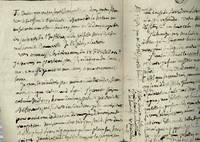
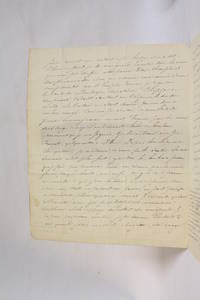
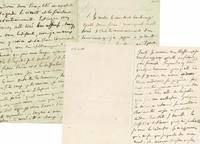
179167693s. l. Londres London Paris Toulon. 1791. Fine. s. l. Londres London Paris Toulon. 1791-1832 12 000 feuillets de divers formats en feuilles Unpublished political scientific and historical archives The complete manuscript unpublished papers of Louis Chevalier de Sade 1753-1832 author of the Lexicon politique and cousin of the famous Marquis. The important geopolitical historical and scientific archives of a learned aristocrat a privileged witness of the end of the Ancien Régime the French Revolution the Consulate Empire and Restoration. A unique fund of research on the implementation of a constitutional monarchy. Exceptional collection of the Chevalier Louis de Sade's personal archives the cousin of the Marquis de Sade representing 12000 handwritten pages including several thousand unpublished and written by his hand. The Chevalier shows a thought system that he describes as «holistic» including historical political and scientific reflections. Louis Chevalier de SADE If we take the French Revolution as the birth of an experiment both secular and political the Chevalier de Sade was without doubt one of its early critics. Not only of the Revolution which had many other detractors but of its political ideology which would go on profoundly to impact the two hundred years that followed. What he calls «positive politics» is «based on reasoning and experience». «The theory did have some attractions for me; I studied it with care I savored its principles. Now I see their value only in terms of the impact of their implementation what we've seen them produce in the peoples of which history has given me knowledge. This is my method; I know that it is all in all the opposite of the methods utilized by the men who have governed us and written our constitutions to this very day without deviation. This continuous divergence between what has been done and what should never have been done increased my confidence in the path to be followed and at the same time fortified my determination to keep to the views I had adopted of judging laws by the historic consequences they entail rather than by the lyrical supposedly conclusive metaphysical arguments with which these innovators continually and still to this day assault us.» The Chevalier de Sade who saw the world in terms of his own time and place could be nothing other than a Royalist. There were practically no examples of democracy in the history known to the Chevalier apart from the Classical democracies of Greece and Rome which had been experiments only in very elitist forms of democracy. These were very well known to this political scientist whose papers contain 7000 pages dedicated to the history of the Classical world. The republic ushered in by the Revolution was more than just a political system it was the realization of a philosophical political ideal. And while most of those opposed to the new regime saw in it above all a threat to their personal situations their religious beliefs or even more simply their habits the writings of the Chevalier de Sade show no such dogmatic influence; or at least he never uses dogma to justify his arguments. Louis de Sade a gentleman without a fortune and without significant ties was conservative through philosophical and historical conviction and not out of interest. It is with this perfect intellectual honesty that he studies the essays memoirs and political or theoretical works of his contemporaries. Running counter to Enlightenment thought the Chevalier's view of society owed very little to philosophy. Though he puts together a serious theoretical history of the development of Man from the condition of «savages» to the forging of various societies he does not posit Man's ideal nature as some of his contemporaries did. Rather the Chevalier examines the gap between nature and the civilized being without passing moral or philosophical judgment as was the fashion at the time. «The political error that damned Europe in the 18th unknown
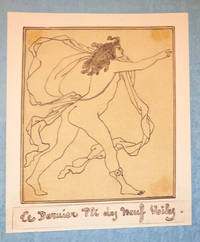
1920759331920. Fine. A priceless poetic testament from Marcel Proust's mentor hidden away and out of sight since the death of the author. s. d. ca 1920 25 x 33 cm en feuilles sous chemises The set of largely unpublished autograph poems by Robert de Montesquiou-Fezensac is brought together by the Count in a collection entitled Le Dernier Pli des neuf voiles whose composition extends from his very first collection Les Chauves-Souris 1892 to his last trilogy Offrandes 1915. Set of 620 autograph leaves. 532 unpublished first draught handwritten on the recto and numbered in pencil preserved in 3 chemises in half red contemporary morocco red morocco labels with gilt author and title; the poems are then placed in the chemises with a handwritten title and a number for publication. According to a note from the author the differences in ink have no meaning mere change of copy. Rare pages from the hand of his secretary Henri Pinard: p. 20 of Huitième voile and p. 29 of Neuvième voile. 23 pages present the printed or typewritten texts of the poems and are enriched with Montesquiou's handwritten corrections. A set of printed proofs are found at the top of the first chemise as well as a pencil tracing after Aubrey Beardsley drawn by the author and accompanied by his handwritten indications. Sublime ode to dandyism to homosexuality and beauty this worldly and poetic promenade by Montesquiou embarks the reader into the decadent fin-de-siècle Paris described in In Search of Lost Time by his friend Marcel Proust. Imbued with his legendary enthusiasm for pictorial decorative theatrical and floral art the collection also delivers hundreds of mournful verses after the disappearance of Montesquiou's lover Gabriel Yturri. Thanks to this collection of poems by Robert de Montesquiou-Fezensac all of which had been lost since 1986 it is now possible to complete the rehabilitation of the aristocratic poet who has long embodied and shaped the Parisian spirit. In May 1920 Montesquiou left handwritten instructions for the posthumous publication of the collection initially announced in two volumes and never produced. On his death a year later the poems were bequeathed to his secretary Henri Pinard who in turn sold them on an unknown date. Auctioned on 24 November 1986 they were mentioned in the LoWire-Littérature colloquium in 1989. This considerable manuscript by Montesquiou forms a veritable home of poetry like his famous aesthetic apartments described by Huysmans. The series of Voiles contain dozens of unpublished poems written in parallel with his previous collections. The author himself indicated the kinship of each voile with a published set of poems announcing here the total completion of his work by the addition of poems which still lay dormant in his papers. The three thick chemises contain rare and curious treasures sometimes drawn on colored sheets often pasted on larger sheets rigorously ordered while awaiting their publication. The poems are written without crossings-out they are fluid with rounded and precious handwriting and stand alongside other first-draught manuscripts: redactions and corrections also bear witness to the work in progress on the new poems; they were applied in the printed proofs of the work present at the top of the manuscript's first chemise. Some poems are taken as they are from collections already published but are slightly modified according to the explanations given by the author. Montesquiou also adds some handwritten notes detailing his intentions. The manuscript contains a poetic anthology of sacred art of extremely rare flowers and of antique furniture adorning his famous Parisian apartments around which so many legends were built Jacques Saint-Cère which fuelled the personalities of Des Esseintes Baron Charlus Dorian Gray and the vain peacock in Edmond Rostand's Chantecler. Moreover Montesquiou was overwhelmed by the features of these famous fictional ghosts of w unknown
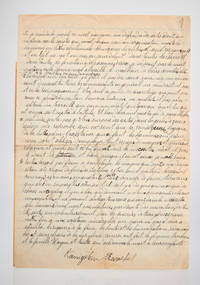
1892734381892. Fine. 1892 20 x 29.50 cm 4 pages sur un double feuillet Exceptional complete autograph manuscript of Ravachols true last testament largely unpublished unknown in this form preceding its rewriting by a third party for publication in the press. A unique testimony to the genuine thought of the anarchist icon. Four-page lined quarto manuscript entirely written in black ink and signed twice Konigstein Ravachol at the foot of each sheet. Pencil corrections within the text possibly in the hand of his lawyer. Some horizontal folds and very minor marginal tears without loss. Written in his prison cell during the second Montbrison trial that led to his death sentence this text hastily penned without punctuation or capital letters and in naïve spelling was meant to be delivered orally by Ravachol during the hearing. Ravachol was dead set on putting in his two cents for the defence not to defend himself but to explain. No luck dammit! Four words in and the judge cut him off. His statement isnt lost by Jove! Émile Pouget in Père Peinard July 310 1892. This self-styled Rocambole of anarchism was not allowed to read his statement aloud but he handed it to his lawyer Maître Lagasse and by June 23 the forbidden text appeared in the conservative newspaper Le Temps. This first publication was so faithful to the original that it preserved the author's eccentric spelling a fidelity that Émile Pouget would ironically criticise in the Père Peinard issue of July 3 1892 one week before Ravachols execution: Le Temps that opportunist bedsheet printed it as is. Like a true Jesuit it even printed it too true. Ravachol had written the thing for himself; he knew how to read it but there wasnt a word of correct spelling seeing as he knew about spelling as much as he knew about cabbage farming. Le Temps printed the thing without changing a line so its practically unreadable . Thats exactly what the bastards wanted dammit! . Im reprinting it below without changing a word just fixing the spelling. That same July 3 issue of Père Peinard included a corrected version orthographically of the statement initially published in Le Temps. This dual publication combined with Ravachols defiant bearing before the guillotine had a powerful effect on public opinion. Until then even anarchist publications had kept a certain distance from this provocative criminal suspected of using the anarchist cause for personal gain. But following his execution the testament was quickly reproduced in other newspapers and Ravachols final cry of revolt soon became a genuine anarchist anthem among libertarians worldwide. However the version circulated in the press the only known version until now the original manuscript having disappeared differs markedly from the manuscript in our possession. Indeed the style was lightly polished several turns of phrase refined and most significantly entire passages were excised including the conclusion paragraph which was fully replaced. Our manuscript with its crossings-out and revisions is likely the original version of this political testament. Written in a single burst in dense handwriting without punctuation or paragraph breaks it includes two lengthy sections expressing concerns for public health that are entirely absent from the published version. The first is a third of a page-long passage about the dangerous ingredients added to bread: no longer needing money to live thered be no fear of bakers adding dangerous ingredients to bread to make it look better or heavier since it wouldnt profit them and theyd have like everyone else and by the same means access to what they needed for their work and existence. Thered be no need to check whether the bread weighs right if the money is counterfeit or if the bill is correct. The second nearly a full page long concerns the silk-dyeing industry in which Ravachol had worked: If one reflects atten unknown
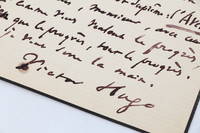
1871833181871. Fine. « So that justice finally be done for women » Mardi 7 novembre 1871 13.30 x 20.80 cm 2 pages sur un feuillet double Autograph letter signed by Victor Hugo to Léon Richer two pages in black ink on a double sheet framed in black. Crosswise folds inherent to envelope inserting. A central tear at the junction of the two sheets. Published in uvres complètes de Victor Hugo Ollendorff 1905. Manuscript housed in a blue half morocco chemise and slipcase marbled paper boards marbled paper slipcase signed Boichot. A magnificent and important letter to Léon Richer one of the first male feminist activists considered by Hubertine Auclert as the ""father of feminism"" and later regarded by Simone de Beauvoir as its ""true founder"". This deeply humanist text is a compendium of Victor Hugo's campaign for the abolition of capital punishment and the female attainment of social equality and civil rights. « Mardi 7 novembre 1871 Monsieur on m'a demandé d'urgence mon intervention pour les condamnés à mort. L'accomplissement de ce devoir a retardé ma réponse à votre excellente lettre. Vous avez raison de compter sur moi pour affirmer l'avenir de la femme. Dès 1849 dans l'Assemblée nationale je faisais éclater de rire la majorité réactionnaire en déclarant que le droit de l'homme avait pour corollaires le droit de la femme et le droit de l'enfant. En 1853 à Jersey dans l'exil j'ai fait la même déclaration sur la tombe d'une proscrite Louise Julien mais cette fois on n'a pas ri on a pleuré. Cet effort pour qu'enfin justice soit rendue à la femme je l'ai renouvelé dans les Misérables je l'ai renouvelé dans le Congrès de Lausanne et je viens de le renouveler encore dans ma lettre au Rappel que vous voulez bien me citer. J'ajoute que tout mon théâtre tend à la dignification de la femme. Mon plaidoyer pour la femme est vous le voyez ancien et persévérant et n'a pas eu de solution de continuité. L'équilibre entre le droit de l'homme et le droit de la femme est une des conditions de la stabilité sociale. Cet équilibre se fera. Vous avez donc bien fait de vous mettre sous la protection de ce mot suprême : l'Avenir. Je suis Monsieur avec ceux qui comme vous veulent le progrès rien que le progrès tout le progrès. Je vous serre la main. Victor Hugo » ""Tuesday november 7 1871 Sir I have been urgently asked to intervene on behalf of those sentenced to death. The fulfillment of this duty has delayed my reply to your excellent letter. You are right to count on me to defend the future of women. As early as 1849 in the National Assembly I made the reactionary majority burst into laughter by declaring the rights of man as natural counterparts to the rights of woman and the rights of children. In 1853 in my Jersey exile I made the same declaration on the grave of an outlaw Louise Julien but this time people didn't laugh they wept. I renewed this effort to finally do justice to women in Les Misérables I renewed it in the Congrès de Lausanne and I've just renewed it again in my letter to Le Rappel which you are kind enough to publish. I would add that every single one of my theatrical works aims to dignify women. As you can see my plea for women is long-standing and persevering and no other has ventured to continue with this endeavor. Balance between men's rights and women's rights is one of the conditions of social stability. This balance will be achieved. I commend you for placing yourself under the protection of this supreme word: the Future. I am Sir with those who like you want progress nothing but progress the whole of progress. I shake your hand. Victor H Although this letter focuses primarily on advocating for women's rights it begins with the death penalty: I have been urgently asked to intervene on behalf of those sentenced to death. The fulfillment of this duty has delayed my reply to your excellent letter. Shortly after the Paris Commune the October 1871 pages of Hugo's diary la hardcover
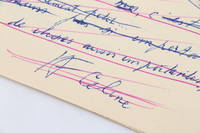
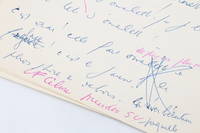
195483743s. l. Meudon 1954. Fine. Céline's Ars Poetica: ""I capture all the emotion on the surface! I cram it into my metro! s. l. Meudon s. d. 1954 10 x 21 cm 34 feuillets Manuscript pages from Conversations with Professor Y' n.p. Meudon n.d. 1954 various sizes from 10x21 cm to 27x21 cm 34 sheets. Autograph manuscript by Louis-Ferdinand Céline 34 sheets of various sizes written in blue and sometimes pink ballpoint pen. Some of the pages are numbered by Céline at top left. The last folio numbered 159 is signed by the writer at the bottom. Two leaves contain previously unpublished passages: the first a few lines long refers to the Professeur. The second leaf numbered 136 features another full-page text on the verso which we did not find in the Professeur Y' or in any of the published works of Céline. Céline refers in this unpublished passage to article 75 of the penal code condemning to the death penalty any French citizen found guilty of intelligence with the enemy. It also mentions a certain ""Me Johann Niels Borggensen"" no doubt a pseudonym for his lawyer Thorvald Mikkelsen: "".supposedly to protect me from police curiosity! holy cow! he was having a ball.when you've got the warrant up your arse crossed out: article 75 anyone can do what they like with you! what a joke! we can do what we like with you.it wouldn't have been Borggensen perhaps someone else would have been worse.give me article 75 and I'll put the whole of France in a Mouse hole for you! and Germany with it! and England such a nag and Europe with it! no bomb needed! H ! Y ! Z ! I'll make you fit the atom into a."" Important set of working manuscripts bearing witness to the writing of Conversations with Professor Y' Céline's true Ars poetica. Since the first part of Féerie pour une autre fois' Fable for Another Time was not as successful as expected Céline wanted to give the release of the second part - Normance - as much publicity as possible and restore his reputation after his years of exile in Germany and Denmark. Instead of writing the usual promotional note prière d'insérer he suggested to publisher Gaston Gallimard this eulogy written in the style of an imaginary interview between himself and Professor Y alias Colonel Réséda a prostatic old man. This zany ""interviouwe"" was published in several parts in the Nouvelle Revue française in 1954 and the finished work through Éditions Gallimard the following year. Céline speaks fervently of his style and his conception of literature and vehemently criticizes the world of letters and public taste. Unlike Céline's other works the genesis of this text crucial to the understanding of his oeuvre is poorly documented and its manuscripts are rare. The Pléiade edition of Celinian novels contains only a few pages of an earlier version very close to the published text. This set of pages covering every passage of the text contains both heavily crossed-out sheets and neatly rewritten notes. It bears witness to the different stages of the writer's work: drafting an initial sheet crossing out and rewriting on the same page then transcribing short passages on separate notes. The last page of the text is extensively crossed out and rewritten resulting in a slightly different version of the published version. The manuscript also contains the famous metaphor of the metro typical of the writer's emotive style compared here to the ""dry language"" of his peers: ""Did you see Have you noticed All caught up in my metro!. what do I leave on the surface. the worst rubbish in cinema!. foreign languages then!. translations!. retranslations of our worst rubbish that they use for their ""parlants"" talking pictures superb foreign languages!. in addition to the psychology! the psychological mumbo jumbo!. all the crap. . Me it's something else! me I'm much more brutal! me I capture all the emotion!. all the emotion on the surface! all at once! I decide! I stick it in the metro! my metro! all t unknown
1797761731797. Fine. An exceedingly rare letter from Restif: « Les événemens du 18 fructidor' m'ont rendu la vie . en affligeant mon cur » 30 fructidor 1797 An V 16 septembre 1897 18.50 x 21.30 cm 3 pages sur un double feuillet Extremely rare autograph letter signed « Restif Labretone » addressed to Citoyenne Fontaine. Three pages written in black ink on a double sheet of laid paper. Remains of a wax seal folds inherent to mailing. This letter was published with some inaccuracies in Lettres inédites de Restif de Labretone by V. Forest and É. Grimaud 1883. The Fontaine couple are merchants from Grenoble and Restif de la Bretonne began corresponding with them on March 15 1797. Important letter testifying to the completion of the publication of Restif's great autobiographical work: Monsieur Nicolas ou les Ressorts du Cur Humain dévoilé. « I will have completed the Cur humain Dévoilé within 15 days I will prepare your package immediately to have it ready. » The first eight volumes of this great autobiographical work printed by Restif himself a typesetter by trade in his residence at 11 rue de la Bûcherie were entrusted to the « dishonest » bookseller Nicolas Bonneville who did not honor his debts to the writer. Besides health issues « I exchange my illnesses and do not cure them » Restif also shares with his correspondent his literary setbacks: « The Author of Nature will preserve a sincere friend for me to compensate for the scoundrels of the Institute and the perfidious Mercier ». Indeed the previous year the author learned with bitterness that he was not admitted to the National Institute and Louis-Sébastien Mercier who had praised him in his Tableau de Paris and supported his candidacy then turned away from him. To this sum of misfortunes financial difficulties are added. Penniless and living on meager state pensions he maintains all his support for the Republic: « By what fatality do I never see the views of the rulers who welcome me; or how do they not see at once that I am attached to the Revolution to the point that I still love it even when it beats me. » Restif profoundly anti-royalist wrote several pamphlets to this effect and had just added to the end of Monsieur Nicolas an apology for the coup d'état of 18 Fructidor Year V. However this date marks the end of the allowance granted to him by Lazare Carnot after his failure at the Institute: « You know the events of 18 Fructidor; I will not speak to you about them. They have given me back my life; but by afflicting both my heart and my gratitude. » But Restif's great sorrow is the loss of his daughter Filette born from his adventure with Louise Allan whose paternity was revealed to him only late: « I am writing to you from bed weeping over my Filette who died 11 months and ten days ago . Filette was my daughter and Louise's whose soul and beauty she had. » Autograph letters signed by Restif de La Bretonne that have survived to this day are extremely rare. unknown
1808689671808. Fine. 26 mars 1808 20 x 24.80 cm 3 pages 1/2 sur un double feuillet Long autograph letter by Stendhal addressed to his sister Pauline written in fine handwriting with black ink. Address of Stendhal's father where his sister resides in Grenoble with the stamp ""n°51 Grande Armée."" Red wax seal bearing Stendhal's coat of arms. Several original folds inherent to postal delivery. A paper loss due to the unsealing of the letter has been skillfully restored. Published in his Correspondance ed. Henri Martineau Paris Le Divan 1933 vol. 3 no. 262 A pp. 26-29. A very beautiful letter filled with romantic passion blending childhood nostalgia with sentimental tales and foreshadowing The Red and the Black. This letter is part of the correspondence between twenty-five years old Henri Beyle and his sister Pauline three years his junior. This epistolary relationship which quickly took the form of a ""journal"" as Pauline's responses were rare. It is deemed a crucial milestone in the intellectual development of the future Stendhal: ""Here are my dreams my dear friend; I am almost ashamed of them; but after all you are the only person in the world to whom I dare confess them."" In this letter which attests to the strong bond between brother and sister Stendhal then in Germany expresses his deep nostalgia: ""I revisited in my memory all the time we spent together: how I did not love you in our childhood; how I once hit you at Claix in the kitchen. I hid in the little book cabinet; my father came back a moment later furious and said to me: 'Wicked child! I would eat you!' Then all the woes inflicted upon us by poor Aunt Séraphie; our walks along those paths surrounded by stagnant water towards Saint-Joseph."" These regrets about the past are accompanied by a typically Stendhalian melancholy: ""Alas! That delightful happiness I once imagined I glimpsed it once at Frascati and a few other times in Milan. Since then it has not returned; I marvel at my inability to feel it. The mere memory of it is more powerful than all the present joys I can procure."" This evocation of the Italy he longs for is intertwined with memories of the women he loved: ""I told you that while in Frascati at a charming fireworks display at the moment of the explosion Adèle leaned on my shoulder for an instant; I cannot express how happy I was. For two years whenever I was overwhelmed with sorrow this image gave me courage and made me forget all my troubles. I had long forgotten it; I tried to recall it today. Against my will I see Adèle as she is; but as I am now there is no longer the slightest joy in this memory."" This lengthy account of Adèle Rebuffet his cousin with whom he had a profound romantic relationship before forming a closer bond with her mother reflects Stendhal's sentimentality. He also mentions another of his great passions Angelina Pietragrua the ideal Italian woman and embodiment of his Milanese memories: ""Madame Pietragrua is different: her memory is linked to that of the Italian language; whenever something pleases me in a role for a woman in a work I involuntarily put it into her mouth."" This ""role for a woman"" that Stendhal refers to echoes the central theme of this letter the work Il Matrimonio segreto by composer Cimarosa: ""Do you sometimes play the Matrimonio Its the passage Cara sposa at the beginning between Carolina and Paolino. . But play the Matrimonio for my sake especially Signor deh permettette and the finale Io rival de mia sorella."" This opera by Cimarosa remained a constant throughout the writer's life and work. In his Memoirs of an Egotist 1832 he explains: ""In Milan in 1820 I wanted to have this written on my tomb . I wanted a marble tablet in the shape of a playing card: ""Errico Beyle - Milanese - Visse scrisse amò - Quest'anima adorava Cimarosa Mozart e Shakspeare - Morì di anni. il . 18."" ""Henri Beyle - Milanese - He lived wrote loved - This soul adored Cimarosa Mozar unknown
1823759401823. Fine. s. d. ca 1823 12 x 18.20 cm Six pages sur deux feuillets rempliés Almost entirely unpublished handwritten letter from the painter Eugène Delacroix to the love of his youth the mysterious Julie now identified as being Madame de Pron by her maiden name Louise du Bois des Cours de La Maisonfort wife of Louis-Jules Baron Rossignol de Pron and daughter of the Marquis de La Maisonfort Minister of France in Tuscany patron of Lamartine and friend of Chateaubriand. 90 lines 6 pages on two folded leaves. A few deletions and two bibliographical annotations in pencil on the upper part of the first page no114. This letter is one of the last to his lover in private ownership all of Delacroix's correspondence to Madame de Pron being kept at the Getty Research Institute Los Angeles. Only nine of the ninety lines of this unpublished letter were transcribed in the Burlington Magazine in September 2009 alongside the long article by Michèle Hanoosh Bertrand and Lorraine Servois whose research finally revealed the identity of the famous recipient. Sublime love letter from twenty-four-year-old Eugène Delacroix addressed to his lover Madame de Pron twelve years his senior who unleashed the liveliest passion in him. This episode of the painter's youth then considered the rising star of Romanticism for a long time remained a mystery in the biography of Delacroix who was careful to preserve the anonymity of his lover thanks to various pseudonyms: Cara the Lady of the Italians and even Julie as in this letter in reference to the famous epistolary novel Julie ou la Nouvelle Héloïse by Rousseau. For obvious reasons Delacroix did not sign his name on any of the letters in correspondence with the lady. A great figure of the legitimate aristocracy the recipient of this feverish letter is Madame de Pron daughter of the Marquis de La Maisonfort Minister of France in Tuscany patron of Lamartine friend of Chateaubriand. Her beauty was immortalized in 1818 by Élisabeth Vigée-Lebrun who painted her portrait in pastel with an oriental hairstyle. Delacroix and Madame de Pron met in April 1822 when the portrait of the latter's son Adrien was commissioned a pupil at the Lycée Impérial now Lycée Louis-le-Grand. Delacroix had been commissioned for the portrait by his close friend Charles Soulier Madame de Pron's lover who despite himself served as an intermediary for Delacroix. In the absence of Soulier who had gone to Italy the painter and the young women established an intense romantic relationship. The portrait commission became a pretext for their tender meetings in his studio on rue de Grès while no trace of the child's painting has been found to this day. Their adventure lasted a little over a year but it was one of the most intense passions of the artist's life. Our letter undoubtedly corresponds to the last throes of their relationship in the month of November 1823. After one of their visits at the end of a hiatus of several months Delacroix writes to her again under the influence of emotion: I come home with a shaken heart what a wonderful evening! . Sometimes I say to myself: why did I see her again In the calm sanctuary where I lived even in the middle of the invisible places that I had formed . I managed to silence my heart. Madame de Pron had indeed decided to bring an end to their intimate relationship see her letter from 10 November 1823: I want sweet friendship . I do not want to torment you Getty Research Institute. Losing all discernment and with blind devotion Delacroix attempts to revive their affair: Make me lie prove to me that your soul is indeed that of the Julie that I once knew since mine has regained its charming emotions and its worries. But the painter runs into Soulier and General de Coëtlosquet also lovers of Madame de Pron. Delacroix had narrowly avoided a final disagreement with Soulier who had almost seen a letter from Madame de Pron in h unknown
195483744Meudon 1954. Fine. ""What is Normance "" Meudon 1954 20 x 27 cm 16 feuillets 9 pour le premier manuscrit 7 pour le second Two unpublished autograph manuscripts signed by Louis-Ferdinand Céline in blue and red ballpoint pen: the first contains 9 pages numbered in the left-hand corner from 1480 to 1488; the second contains 7 pages numbered from 1498 to 1504. Each text is signed by Céline in red ink at the bottom margin with the words ""Meudon 54"" also in his hand ff. 1485 and 1505. There are numerous variants lines and words crossed out modified and repeated. Traces of pinholes in the upper left-hand margin of every sheet as Céline organized his manuscripts in ""bundles"". Normance was published in 1954 as a sequel to 'Fable for Another Time' published two years earlier. Both parts were written during Céline's years of exile and imprisonment in Denmark. Upon his return to France in 1951 Céline began ""polishing"" his writings and published these two monumental texts initially envisaged as a single book. ""Céline while he was working on it thought of this novel as a second Journey to the End of the Night' twenty years later capable to astonish the public as much as the 1932 novel"" Henri Godard. This set of manuscript pages corresponds to two passages from the second half of the novel Romans Pléiade IV p. 371 to 375 significantly different from the published text. This is an earlier version unknown to scholar Henri Godard as evidenced by a note in the Pléiade edition where he explains the difficulties encountered by Céline's secretary Marie Canavaggia when translating the word ""planqaouzeuze"" - appearing here on one of the manuscript leaves. Her transcription ""plaquouseuze"" eventually remained in the published text. Godard further stated he had no knowledge of this part of the manuscript i.e. our manuscript not appearing in the intermediate versions transcribed and published in the Pléiade edition. The first of the manuscripts recounts the ransacking and looting of psychic Armelle's apartment: ""How many decks did Armelle have Her fortune-telling cards were taking the air! . Ah seeress! Something she hadn't guessed was how her trembles would be tarred! They'd rip open her armchairs crush her fine hiding places! ah Pythonisse! ah the quilt now! the inside of the pillows flies! flies away!"" Céline also evokes Madame Toiselle the building's concierge: ""- It's a mess Madame Toiselle. I yell it at her. she was a maniac! . moron! she's looking now! she's looking good! ah I see her consternation.she's there in front of me on all fours. I can see her head! Her hoe! - Omelette head!"" I shout to her Omelette head'! The second focuses on Raymond in the grip of a delirious crisis thinking he's a donkey: ""Raymond Raymond! but it's your wife you're looking for! it's true he was looking for his wife.! well maybe five minutes ago he was looking for his wife! Denise! . now he's looking for himself. . - Hiian! hiiian! he answers me! There's also a comical settling of scores between Mimi and Rodolphe: ""There goes Mimi then there goes Rodolphe! Rodolphe! they're coming! and how they're treating each other! where were they on the threshold the two of them! they're taking advantage of the lull in the bombs! - Pig! Pimp! - Cabotine! coureuse! and they attack their costumes. "" Remarkable manuscripts bearing witness to Céline's tireless pursuit in finding the right word and his willingness to place himself as a direct witness to events both historical and autobiographical. These unpublished manuscript lines are typical of the Celinian style of this ambitious novel: ""The story style and tone of Normance set it apart from the rest. It is nothing more than the long account of a night of bombing in Montmartre told in his own way by Céline who had been deeply impressed by the spectacle of the bombing of the Renault automobile factories in Boulogne-Billancourt which he had witnessed from the windows of his apart unknown
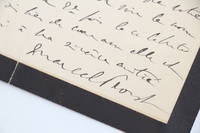
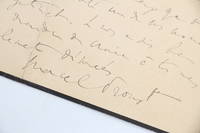
190484876s. l. 1904. Fine. Because I also want success I am extremely material in my wishes for those I love and I wish them every pleasure from the highest to the crudest. s. l. mardi 25 octobre 1904 12.60 x 20.40 cm 12 pages sur 3 bifeuillets Autograph letter signed by Marcel Proust addressed to René Peter. Twelve pages written in black ink on three bifolia framed in black. Tears at the ends along the folds of the bifolia not affecting the text. Published in Kolb IV n°168. A very long letter from Proust full of innuendo to the playwright René Peter. Praising Peter's success Proust confesses to his own vanity as a writer and his literary ambitions. He subtly lets his jealousy for Peter's mistress shine through and declares his absolute devotion to Reynaldo Hahn. This is one of the first letters he sends to his childhood friend after recently reconnecting with him. Proust eternally plagued by ailments remains a recluse and apologizes for missing the rehearsal of Peter's new play Le Chiffon. Peter's three-act comedy with music by Reynaldo Hahn premiered at the Athénée the following month and was a huge success with around sixty performances before the end of the year. The young Proust relies on the glowing opinion of Hahn who had attended the rehearsals and the missive becomes a love letter for the composer and his impeccable judgement: ""Reynaldo told me that your play was delightful and ravishing which is not quite the same thing that he laughed and cried in it as he never laughs or cries in the theater and that the language was exquisite. Of that I was certain. But knowing nothing about you I couldn't know if you had dramatic genius. I am certain of it now because even if I do not know a judge as severe as ridiculously severe as Reynaldo I also do not know one who has more taste giving his enthusiasm very great value in my eyes. In a characteristic tangle of confession and denial Proust barely hides his ambitions and his quest for recognition. He hopes and prays for the same laurels he places on Peter's head: your poor and charming mother who like all those who love and who have lived life bruising all our tenderness has suffered so much is witnessing this great happiness these first rays of glory on your charming forehead which Vauvenargues says softer as the rising sun. I only speak of them in quotations having never known them myself! He will even end up instilling his own literary vocation into the fictional life of the narrator of In Search of Lost Time although the narrator's journey as a man of letters is more marked by disappointments than rays of glory so long awaited by Proust himself. However it culminates in Time Regained with an epiphany: the narrator now knows what to write and above all how to write it. The letter marks the beginnings of the Proust-Peter-Hahn trio whose complicity was such that they formed a special vocabulary of which only they had the secret. The river of words in this letter perfectly illustrates the undeniable link between desire and intellectual admiration: Because I also want success I am extremely material in my wishes for those I love and I wish them every pleasure from the highest to the crudest. Despite these displays of generosity the writer cannot however mask a certain jealousy towards Robert Danceny the fictional co-author of Le Chiffon who was none other than Peter's mistress Mme Dansaërt. Proust elegantly but explicitly refers to her: It makes me happy to think that the charming woman who I am assured is hiding under the male name of your collaborator shares half of your work. I am not talking about your success because whether she worked with you or not she would always have shared your success with her heart having I believe a deep friendship for you. Typical of a Proust transposing his desires through fiction the writer will form various dramatic and morbid scenarios between Peter and this young woman in the following years: I unknown
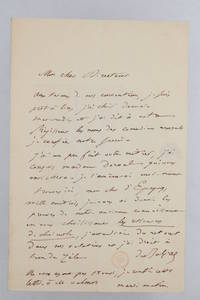
186562589Biponti Deux-Ponts 1865. Fine. Biponti Deux-Ponts Vendredi 12 mai 1865 13.20 x 20.80 cm 1 page sur un feuillet remplié Autograph letter signed by Charles Baudelaire written in ink and addressed to his mother. A few underlinings deletions and authorial corrections. This letter was first published in Charles Baudelaire Dernières lettres inédites à sa mère in 1926. Former collection of Armand Godoy no. 197. A precious letter from Baudelaire's Brussels period during the poet's voluntary exile at the end of his life. « Il est douteux que j'habite quelque part à Paris. Je crois que j'habiterai surtout une voiture dans laquelle je ferai si je peux toutes mes courses en un ou deux jours. » Haunted by Paris the city of vice and creditors he dreads this brief return. His exile in Brussels is in his eyes a sign of failure and ever since arriving in Belgium he has delayed his return to France. Yet weary of the flat country he despises he mocks its inhabitants: « On est lent ici. » The poet like the seventeen-year-old student who once promised his mother he would get back on track now vows: « Me voici en mesure d'accomplir tous mes plans. Je ne sais comment t'exprimer ma reconnaissance ; et je crois que la meilleure manière sera d'exécuter mes promesses. » Literally obsessed with this sacred mother « who haunts his heart and his mind » the « grateful son » sees himself as incapable of fulfilling his poetic destiny without her undivided attention. unknown
1793733941793. Fine. 1er avril 1793 15.60 x 20 cm une page sur un feuillet Unpublished autograph letter signed and dated written in black ink and addressed to a notary. On the verso probably in the hand of a secretary the inscription ""Sade du 1er avril 1793""; below this inscription a short sentence in the Marquis's hand: ""so that I may write to Gaufridy to send him money"". Some transverse folds from the original folding for posting. Lengthy letter addressed to a notary while the Marquis freed on April 2 1790 by the abolition of royal warrants is at liberty and attempting to put his affairs in order. After the Revolution his sons emigrated and he did not follow them. His name nevertheless appears on the list of persons who left France due to the revolutionary troubles: ""I hope that with all this I will manage to have my name erased from that fatal list of émigrés."" Anxious not to be considered a ci-devant Marquis in this period preceding the Terror he insists on the persecution of which he claims to be a victim despite his good will: ""It is an unparalleled atrocity that such a trick should have been played on me who have not left Paris since the revolution and who since that time have not ceased to give the most unequivocal proofs of my patriotism"". In this letter Sade also denounces the complexity of the workings of the French administration after the Revolution: ""I have just sent M. Lions the appropriate certificate of residence and I have attached a petition to the district which he tells me is . essential."" Impecunious he begs his lawyer ""to excite the zeal of those who owe him and to urge them to pay as much money as they collect immediately to M. Gauffridi sic"" and does not hesitate to show himself obliging in order to achieve his ends: ""spare no effort then I beseech you . always preserve for me your care and your friendship . I embrace and greet you with all my heart."" Sade's efforts would prove futile; in December 1793 he was imprisoned at the Madelonnettes before being admitted through the good offices of his friend Mme Quenet to the Coignard de Picpus establishment a nursing home sheltering wealthy suspects. Interesting unpublished letter showing the unfortunate Marquis at bay during one of his rare moments of freedom. unknown
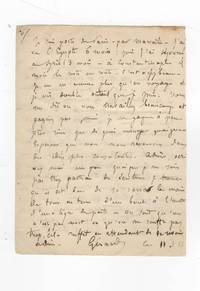
184475148Paris 1844. Fine. Paris 11 février 1844 10.40 x 13.60 cm quatre pages sur deux feuillets Three autograph letters signed by Gérard de Nerval 2 pages signed «Gérard» Théophile Gautier 1 page and a third unsigned letter 1 page penned by a certain «Robert» cf. Nerval's letter Louis Desessart Théophile Gautier's appointed publisher co-published Nervals play Léo Burckart with Barba in 1839. Following financial difficulties he was forced to take refuge «in that sad and charming city of Brussels». The three friends wrote this letter from Paris where they had reunited following Nervals long journey to the East: «I spent six months in Egypt; then three months in Syria four months in Constantinople and the rest en route. Its quite beautiful. I only enjoy myself while traveling and try to live twice as much as I can.» This journey deeply impressed Théophile Gautier who would only travel to Turkey and Egypt years later: «I am in Paris and wish I were in Cairo from where Gérard is returning.» The exoticism of distant lands starkly contrasts with the melancholy and severity of Europe: «How sad Paris is when one returns from sunlit countries.» Nerval And in Paris far from dreams of escape life means toil and melancholy: «We are like sick people who are never comfortable anywhere. I think the good times are gone and the golden hours of the past when we spoke such wise follies will never return. Whats the point of living if we must work and cannot see our friends or write to them or do anything we would like» Gautier The two writers express great compassion for their friends Belgian exile with Brussels appearing as the capital of spleen: «What! Youre still in that sad and charming city of Brussels! . Brussels is even darker poor fellow!» Nerval This joint letter was in fact initiated by «Robert»: «Isnt it true my dear friend that Im quite skilled at making you forget my faults . as a way of making it up to you Im sending you the autographs of two of your . comrades your fondest memories two men of fame who despite all their affection and friendship for you would never have written a word had I not trimmed their quills and handed them paper like sulky children and told them: write at once at once to the exile you love most.» unknown
183386496s. l. Neuchâtel 1833. Fine. Eve's first kiss: 'The gods grant no favours untainted.' s. l. Neuchâtel 29 septembre 1833 13.40 x 21.10 cm une page sur un double feuillet Autograph letter signed by Honoré de Balzac addressed to his friend the writer Charles de Bernard. One page written in black ink on a bifolium. On the verso of the second leaf appears the address of the recipient Charles de Bernard du Grail written in Balzacs hand along with postal stamps and the seal bearing the arms of the Balzac dEntraigues family which the author had appropriated. A few minor holes not affecting the text; fold marks as usual from mailing. Published in his correspondence Paris Calmann Lévy 1876 CXIV pp. 252253. Balzac wrote this letter four days after his very first meeting and first kiss with Madame Hanska in Neuchâtel following many months of epistolary correspondence. « Jai été très heureux ici. Je suis très content de ce que jai vu le pays est délicieux ; mais vous savez que Jupiter a deux tonneaux et que les dieux nont point de faveurs qui soient pures. » ""I have been very happy here. I am most pleased with what I have seen; the country is delightful. But you know that Jupiter has two jars and the gods grant no favours that are untainted."" Two years after receiving the first letter from the Stranger Éveline Rzewuska a lovestruck Balzac left Paris to join her in Switzerland. His brief stop in Besançon ostensibly a convenient detour served as a polite pretext for his departure from the capitalwhere he took the opportunity to visit his correspondent Charles de Bernard. « Il me semble que je vous ai bien peu remercié de la bonne journée que vous mavez donnée ; mais jespère vous prouver que je ne suis point un ingrat. À mercredi donc ; vous devez penser que jaurai bien du plaisir à vous revoir vous qui avez fait que mon voyage à Besançon na pas été inutile et que jy ai trouvé du plaisir ». I fear I thanked you all too little for the delightful day you gave me; but I hope to prove that I am not ungrateful. Until Wednesday then you must know how much I look forward to seeing you again you who ensured that my journey to Besançon was not in vain and even brought me joy. After a day in Besançon and a chaotic journey by mail coach Balzac finally met his beloved though regrettably in the company of her husband Count Hanski. Seizing upon the Counts absence the writer stole a long-awaited kiss with Madame Hanska on an ancient stone bench upon the hill of Crêt. In the rapture of their first encounter he could not help but invoke La Fontaines ominous fable in his letter: « mais vous savez que Jupiter a deux tonneaux et que les dieux nont point de faveurs qui soient pures ». but you know that Jupiter has two jars and the gods offer no favours untainted. His love affair with Madame Hanska would prove far from serene as Gonzague Saint Bris aptly summed it up: eighteen years of love sixteen of waiting two of happiness and six months of marriage. Neuchâtel would remain a powerful emblem of their union recurring in some sixty of their letters. Neuchâtel is like the white lily he wrote to her pure with a penetrating fragrance youth freshness brilliance hope happiness glimpsed. De Bernard who had previously arranged his journey to Switzerland was once again tasked with organising Balzacs return: « Jaurai le plaisir de vous revoir mercredi 2 octobre. Voulez-vous avoir lobligeance de me retenir une place à la malle pour Paris ». I shall have the pleasure of seeing you again on Wednesday 2 October. Would you be so kind as to reserve me a place in the mail coach to Paris The journey separating him once again from his beloved proved wretched: The mail coach was fully booked for six days so my friend from Besançon Charles de Bernard was unable to secure me a place. I was thus obliged to travel on the roof of a diligence in the company of five Swiss from the canton of Vaud unknown
1865767951865. Fine. 30 mai 1865 13.70 x 21.10 cm une page sur un feuillet Autograph letter signed by Charles Baudelaire to Narcisse Ancelle written in black ink on a sheet of blue paper. Folds from mailing three minute pinholes not affecting the text. This letter was transcribed in the Complete Works volume 11 published in 1949 by L. Conard. A moving letter from Brussels addressed to the celebrated family notary who became in 1844 Charles's legal guardian charged with managing his annuity and his exponential debts. A complex relationship developed between the poet and his guardian mingling necessity and mistrust yet nonetheless bearing witness to genuine mutual respect between the two men. This correspondence devoid of the emotional quality of his letters to his mother or the circumlocutions in his exchanges with creditors constitutes one of the most precious biographical sources on the poet. Indeed Baudelaire's financial dependence constrained him to great transparency with his guardian and each of his letters to Ancelle admirably summarizes his wanderings. Thus this letter evokes the terrible mire in which the poet found himself in Belgium and his constantly postponed return to Paris. When he writes Baudelaire is still in Brussels at the Hôtel du Grand Miroir ""28 rue de la Montagne"" but one must not write the hotel's name otherwise letters do not reach him directly where he is dying of boredom illness and resentment toward a country in which he innocently believed he would find glory. This announcement of imminent departure for Paris ""Two or three days after your reply I will leave"" echoes all the similar promises the poet has made for nearly a year to his correspondents. This one will be aborted like all the others for as he confesses to Ancelle a few months earlier Paris fills him with ""a dog's fear."" It is only in August 1865 that he will make a final and brief stay in France before his fatal stroke. His return ""I am eagerly awaited in Paris and in Honfleur"" was nevertheless motivated by a compelling reason: to negotiate with a publisher through Manet's intervention the publication of his collection of reflections on his contemporaries which he had already titled My Heart Laid Bare Mon cur mis à nu and whose manuscript is partly at his mother's house in Honfleur. Another failurethe work would not appear until 1897 thirty years after Baudelaire's death. But it is undoubtedly the reference to the ""two large paintings he wishes to send to Honfleur"" that gives this letter all its significance. Baudelaire evokes his wish to repatriate paintings from his collection that he left with various lenders or restorers of which he had already sent a list to Ancelle a few months earlier. Among these which ones did he want to bring back to his mother His father's portrait the Boilly the Manet a Constantin Guys There is no mention in other letters of this art shipment and of the ""remainder"" to which the paintings were to be joined. This desire to ""send to Honfleur"" his precious belongings nonetheless testifies to the weakened poet's wish to settle permanently in his mother's ""jewel-house"" in Honfleur an island of serenity where Baudelaire dreamed of a peaceful retreat where all would once again be ""order and beauty luxury calm and voluptuousness."" He would indeed return there paralyzed and mute but for a final year of agony after his syphilitic crisis. The Hôtel du Grand Miroir would remain his last true dwelling as noted on Tuesday April 3 1866 in the register of admissions at the Saint-Jean Clinic: ""Name and first names: Baudelaire Charles. Address: France and 28 rue de la Montagne. Profession: man of letters. Illness: apoplexy."" A fine letter to the man who was both Baudelaire's persecutor and protector. He accompanied the poet until his death before becoming executor of the family estate. unknown
185468690Paris 1854. Fine. Paris 25 Juin 1854 11.50 x 18.50 cm une page recto-verso Handwritten letter dated and signed by Charles Baudelaire to Philoxène Boyer concerning the intriguing Léontine B. Paris 25 Juin 1854 11.5 x 18.5 cm one page recto-verso Handwritten two-page letter dated 25 June 1854 and signed by Charles Baudelaire to Philoxène Boyer whom he calls «my dear Lyrique» in which he apologises for having missed a meeting with him he confesses his impecuniosity to him and reports to him on the efforts made by Léontine B. an intriguing person who will end up compromising Philoxène Boyer because of his debts to attend a party to which she is not invited and which holds a certain jealousy: «You surely assume my dear Lyrique that yesterday something serious happened for me to have missed this meeting. Here is what I would have told you: 1 my money has not come; but it will come. / 2 Léontine is obstinate. I am convinced that I have fulfilled my confidence mission very well. I came back three times. When I finally could explain to her carefully that this party was for family secret that Boyer himself was supposed to ignore it she replied: Well it's no longer a secret since I know.» Finally while recognising Léontine as «a very original turn of mind» and although the attitude of this troublesome scheme: «causes you worry and I understand.» Charles Baudelaire pleads for indulgence and leniency: «since she persists so proudly I would urge you to let the event run. It is after all only the homage of a dizzy mind.» unknown
1805669741805. Fine. 10 Floréal 13 30 avril 1805 18.50 x 23.10 cm une feuille Stendhal's autograph letter addressed to his sister Pauline. 28 lines written with a fine writing in black ink. First name ""Pauline"" from the hand of the sender at the bottom of the letter. Inventory number ""36"" in ink from another hand. Two small traces of stamp and stamp a small tear restored in the bottom margin of the page. A few tiny folds inherent in the enveloping of the letter. Rare and beautiful letter of Stendhal addressed to his sister Pauline in which all the sensitivity of the young man and his love for the dramatic art shows more than twenty years before his big romantic successes. This letter comes from the correspondence between Henri Bayle here twenty-two years with his sister Pauline three years younger. This true epistolary liaison which quickly took the form of a ""diary"" - Pauline's answers were rare - is an essential milestone in the constitution of the intellectual journey of the future Stendhal. Our letter of a great lyricism testifies to the strength of the bond uniting the young writer and his sister: ""Let's shake each other my good friend. We will never find anyone who loves Pauline as Henry nor will Henry ever find a more beautiful soul than Pauline. ""The use of the third person and a lover vocabulary erects the young woman to the rank of alter ego a sister-soul and even perfect mistress. The young Henri is then precisely under the yoke of a devouring passion for the actress Melanie Guilbert whom he met during his declamation classes at Dugazon: "" I'm going to be bored perhaps by my dark sadness. I know very well that the seriousness of ardent passions is not pleasant. "" Contrasting with this passionate relationship Pauline symbolizes reason and balance a figure that Henri like a pygmalion can fashion at leisure. In good tutor he advises: ""Learn by heart roles. About declamation I will teach you a thousand things. I'm bringing you a Gil Blas and a Tracy. ""We understand here worship Stendhal devoted to the theater from his earliest years both as a player as a playwright the fund of its archives to the Grenoble Library contains nearly 700 sheets of blanks:"" I am in despair at not being able to wear you Beanies. But wait maybe someday will come . as Ulino says. ""This passion for theater Henry intends to pass it to his sister:"" We will work like hell during the time that I stay in Grenoble. ""In total opposite view with the education of women in his time he put a point of honor that Pauline is an educated person; In several letters moreover we find injunctions from the brother ordering his sister to give up needlework in favor of the reading he recommends. Truly obsessed with theater and convinced that he will become an author of successful comedies he works tirelessly: ""I am told a room where I will not be free and where I can not just declaim. Try to disturb this arrangement. ""Years before writing great novels that make her famous Stendhal already understands that loneliness is for him a source of creation and says:"" A lonely is jealous of his freedom. It is his greatest good as that of all men. "" unknown
184183639s. l. Passy Paris 1841. Fine. s. l. Passy Paris « mardi matin » 28 décembre 1841 13.50 x 21.60 cm une page sur un double feuillet enveloppe jointe Autograph letter signed by Honoré de Balzac to Jean-Baptiste Violet d'Epagny director of the Odéon theater. One page in black ink on a double sheet. Enclosed and pasted on the second page is the envelope of this letter written in Balzac's hand.""My dear director under the terms of our agreements I am ready to read I have chosen tomorrow Wednesday and I have told your stage manager the names of the actors to whom I entrust our play. I've done a bit of your job I've conquered Madame Dorval who will make you rich I'll bring her myself. Find here my dear d'Épagny a thousand regards I have given you proof of our old acquaintance by choosing you for Les Ressources de Quinola I shall expect a return in our relations and I am entitled to a great deal of zeal."" Les Ressources de Quinola is both in the spirit Les Fourberies de Scapin and Les Noces de Figaro. From the 1840s until his death Balzac's ambition was to achieve a reputation comparable to his illustrious predecessors Molière and Beaumarchais. Although this proved to be a hope as vain as it was determined Balzac never doubted failure after failure that his success was imminent. On July 15 1841 d'Épagny was appointed director of the Odéon . as any theater director would have done in his place he spent summer vacations organizing his winter programme. He asked Balzac for a play and Balzac complied choosing Les Ressources de Quinola. . We all know what a fuss was made about Balzac's play and how childishly naive the author was in filling the room with the highest Parisian society and foreign elite in order to make snobs want to join such a brilliant assembly. . Madame Dorval more astute than the author refused the role intended for her as soon as Balzac read . She did well for one never saw a more complete failure"" L'Amateur d'autographes mai 1911 Interesting letter revealing the beginnings of the creation of Les Ressources de Quinola and the author's habit of reading his play for the actors who then voted to accept or reject it. Provenance: Arthur Meyer collection then ""AGR"" stamp on letter and envelope. unknown
195283726Saint-Jean-Cap-Ferrat 1952. Fine. Saint-Jean-Cap-Ferrat août 1952 20.80 x 34 cm 52 pages Autograph manuscript by Jean Cocteau early version of the poetry collection Appogiatures - published in 1953 by Éditions du Rocher in Monaco - comprising 47 leaves of thick paper taken from a large drawing pad and 5 smaller leaves of thin paper written in blue ink and blue ballpoint pen. Numerous deletions and corrections. The leaves are numbered up to 25 including one number 8 bis and most bear a small cross or the mythical Cocteau star. The last leaf containing the poem titled ""Lettre"" is dated in the poet's hand August 15 1952. Also in Cocteau's hand the first leaf bears the final title above which is crossed out the initially envisaged title - Soucoupes volantes - the date 1952 and the place - St Jean Cap Ferrat; it also features a crossed-out dedication: ""À la mémoire de Baudelaire et de Max Jacob qui nous apprirent ces exercices de style."" While the collection clearly shows the influence of Baudelaire's Petits Poèmes en prose and Max Jacob's Le Cornet à dés this tribute was not retained in the published version and was replaced by a dedication to the publisher Henri Parisot. An exceptional ensemble containing 33 of the 51 published poems 11 texts rejected on the advice of publisher Henri Parisot and published in ""En marge d'Appogiatures"" uvres poétiques complètes de la Pléiade pp. 818-831 and 6 unpublished texts. David Gullentops in the edition of Jean Cocteau's uvres poétiques complètes in the Pléiade notes the existence of a second set of manuscripts and typescripts preserved at the Bibliothèque Historique de la Ville de Paris BHVP. He further indicates that he had access to no manuscript of the poem ""Lanterne sourde."" Yet this poem is indeed part of our ensemble which would thus be the first version of the collection envisioned by Cocteau. Jean Cocteau began writing this collection of poems in verse and prose commissioned by his friend the publisher Henri Parisot at the end of July 1952 while staying at Saint-Jean-Cap-Ferrat in Francine Weisweiller's Villa Santo-Sospir. The first version of the collection was completed in mid-August as attested by the two dates on our manuscript ""août 1952"" and ""15 août 1952"" and this entry in Cocteau's diary: ""J'ai terminé la mise au point des courts poèmes en prose pour Parisot. Il y en aura vingt-six à moins que le mécanisme continue ce que je ne souhaite pas car à la longue ces exercices d'écriture illustrés par Baudelaire et Max Jacob fatiguent."" Le Passé défini Tome 1 1951-1952 August 14 1952. Our ensemble would thus be a mixture of the first poems sent to Henri Parisot written with a pen and several added texts written with a ballpoint pen. This hypothesis is supported by the writing of the final title Appogiatures on the title page of our manuscript; Cocteau relates this change again in his diary dated August 29 1952: ""Ai . classé les poèmes pour Parisot sous le titre : Appogiatures."" Our early manuscript version contains significant variants concerning the titles of the poems; thus the poem ""Livre de bord"" was initially titled ""Le Spectacle"" likewise for ""Au poil"" for which Cocteau had previously chosen ""La langue française"" or ""Le tableau noir"" originally titled ""Le lièvre et la tortue."" The order of the poems was also considerably modified for printing: our ensemble shows that Cocteau wished to begin the collection with ""Le voyageur"" which would finally be replaced by ""Seul"" and moved to second position. Also noteworthy in our dossier is the presence of eight poems entirely in verse: these would be removed Appogiatures becoming a collection exclusively in prose. The ensemble heavily deleted and corrected also presents long passages suppressed in the published version for example this very beautiful extract from the poem ""Scène de ménage"" evoking the ""countess"" Francine Weisweiller: ""Et les larmes de la comtesse se disaient : nous sommes la mer. Et la mer se unknown
190886094s. l. 1908. Fine. Proust and the future of pastiche: ""it seems to me that it could perhaps become a more discreet more fragile and more elegant form of literary criticism"" s. l. s. d. 1908 ou 1919 11.60 x 17.80 cm 4 pages sur un feuillet remplié Autograph letter signed by Marcel Proust to his friend Maurice de Fleury a psychiatrist and famed man of letters close to Émile Zola who wrote a collection of short stories as well as various medical works on neurasthenia insomnia epilepsy Chiara Carraro Philip Kolb. Four pages written in black on a bifolium with ""Island Mill"" watermark and framed in black. Usual traces of folds. Published in Kolb VIII no. 32 p. 74-75. Superb letter extolling the merits of literary pastiche by one of the greatest writers of the genre: Marcel Proust. The writing of this letter may coincide with the publication of Proust's series of pastiches on the Lemoine Affair a scam set up by a French engineer of that name who claimed to be able to make genuine diamonds. The articles were printed on the front page of the literary supplement of 'Le Figaro' between 1908 and 1909 or date from its publication in volume under the title 'Pastiches et mélanges' in 1919. The autograph letter is presented in a midnight blue half morocco chemise with marbled paper boards beige suede lined pastedowns and a slipcase edged with the same morocco. Proust warmly thanks his correspondent Maurice de Fleury whom he describes as a ""scholar and writer"" for his favorable reception of his ""little pastiches"": ""Your double merit should make you doubly severe: and you excuse pastiche that inferior genre!"" Votre double mérite devrait vous rendre doublement sévère : et vous excusez le pastiche ce genre inférieur ! acknowledging with irony the still precarious place of this unusual genre although popular during Proust's lifetime. Pastiche was perceived more as a stylistic musing or even a student exercise than a true creation worthy of literary praise. Yet here the writer considers it here a refreshing addition to the strict hierarchy of genres that still prevailed: ""Handled however by your hands more beautiful than mine it seems to me that it could perhaps become a more discreet more fragile and more elegant form of literary criticism. Very proud minds could devote themselves to it and very fine minds like yours very attached to greatness seriousness duty as wise could take pleasure in it and follow these games."" Manié pourtant par vos mains plus belles que les miennes il me semble qu'il pourrait peut-être devenir comme une forme indirecte plus discrète plus frêle et plus élégante de critique littéraire. Des esprits très fiers pourraient s'y adonner et des esprits très fins. comme le vôtre très attraché par la grandeur le sérieux le devoir aussi sage pourrait s'y plaire suivre ces jeux. With these words Proust asserts the interest of 'critical pastiche' which was already well established and acted as an empirical analysis of an author's style. Since his years as a student in Condorcet the writer had regularly indulged in this activity with according to him varying degrees of success: ""I have also sometimes made pastiches of medical literature! these writings are now lost If I could have found them again or started them again but all that is too far away I would have published them if I had known that you read this for fun. I don't need to tell you that considered inimitable you are not among the authors I pastiched. But . others are less perfect and combined some very interesting qualities with small flaws that could be imitated and caricatured."" J'ai été aussi quelques fois à faire des pastiches de littérature médicale ! Si j'avais pu les retrouver ou les recommencer mais tout cela est trop loin je les aurais publiés si j'avais su que vous lisiez cela pour vous amuser. Je n'ai pas besoin de vous dire que jugé inimitable vous n'y figurez pas. Mais . d'autres sont moins parf hardcover
1860640961860. Fine. s. d. circa 1860 20.60 x 27.60 cm un feuillet remplié DUMAS Alexandre Naïs et Chloé. Unpublished handwritten sapphic poem signed by Alexandre Dumas N. d. c. 1860 206 x 276 cm one folded leaf Autograph manuscript poem signed by Alexandre Dumas bearing the title Naïs et Chloé 84 verses in black ink on a blue folded leaf of paper. A few tiny tears without damage to the text invariably produced when a leaf of paper is folded. A very rare manuscript of a long unpublished poem depicting the love of Naïs and Chloé the writing of which is motivated by the admiration and tribute paid by Alexandre Dumas to one of the greatest figures of ancient poetry Sappho. A prolific novelist Dumas rarely tried his hand at poetry; Naïs et Chloé by its length constitutes a hapax in the literary production of this writer. The text remains unpublished to this day and is here enhanced by the elegant calligraphy of its author. The poem is made up of 21 quatrains among which stands a remarkable insertion of the most famous verse by Sappho to the beloved woman the title of which is preserved in the very body of the text. This embedding is part of the verve with which Dumas defends the poetic and evocative force of the writing of Sappho whom he elevates to the rank of the star of the world of Poetry: Il est au sein des mers s'appuyant à l'Asie Entre l'heureuse Smyrne et la sombre Lemnos Une île aux bois fleuris chers à la Poésie A qui Venus donna le doux nom de Lesbos. Quand du chantre divin la voix fut étouffée Que du nom d'Euridice elle eut frappé l'écho Le flot roula tête et la lyre d'Orphée Sur la rive où plus tard devait naître Sapho Sapho naquit la lyre en ses mains fut remise Les sons qu'elle en tira jusqu'à nous sont venus. Translated with conscientious care by the author the poem borrowed from Sappho in which that most famous verse emerges this one I say is equal to the gods is found in several places in Dumas' work particularly in the chapter entitled les vers saphiques of San Felice and in a collection of articles dedicated to the great female figures where she sits alongside Joan of Arc and Margaret of Anjou. For Dumas it is a matter of remaining faithful to the written verses and rendering their sensuality often blurred by previous translators: The translations of these two poets often appear to lack not only ancient color but are inadequate in their lesbian ardor Les étoiles du monde Galerie historique des femmes les plus célèbres de tous les temps et de tous les pays. Above and beyond this translation Dumas is imbued with the lyricism of Sappho without losing his own romantic vein and he paints the sapphic love of Naïs and Chloé in an erotic light: Oh seule palpitante échevelée et nue Une main sur ma gorge et l'autre. Oh ma Naïs Serre moi dans tes bras et sois la bien venue Car à force d'amour. tiens. tiens je te trahis Et l'on n'entendit plus alors dans la nuit sombre Que le bruit des baisers répétés par l'écho Car Nais et Cloé se taisaient et dans l'ombre Clinias s'enfuyait en maudissant Sapho. The poem testifies to the continuous interest that the authors of the late 19th century showed toward sapphism and to the personage of the reader-voyeur here embodied by Cleinias whose most famous occurrence remains Zola's Nana. Exceptional and long autograph sapphic poem by Alexandre Dumas. $ 10 000 unknown
32921This east coast watercolorist and children's book artist illustrated and often also wrote a wide array of children's books from the 1930s into the 1960s -- including "Wilderness Pet" "Wiggly and Giggly the Little Twin Bears" "Whitetail: King of the Forest" "The Three Puppies" "The Small One" "The Nutcracker of Nuremberg" "The Bluebird" "The Night Before Christmas" "The Enchantment of Santa Claus" "The Christ Child" "Pussy Cat Talks to Her Kittens" "Polly Parrot" "Piccolino" "Is There a Santa Claus" as well as some "Dick and Jane Basic Readers." Offered here is the near-complete original illustration art for Smock's 1937 children's book "Jocko" written by Dorothy Winchell and published by Albert Whitman & Co. of Chicago. Represented here is almost the entire book from front cover art through closing "The End" image -- lacking only 3-4 pages front board graphic frontispiece pages 21 and 31. Most are in the form of ca. 10" X 15" heavy stock art boards most with typeset text blocks pagination and other typeset elements stripped in. All are beautifully inked in black and shaded in pale blue. There is a smaller form full-color title page and half-title page and sixth text page these with the text portions entirely hand lettered. Very good. Stripped-in text blocks are usually slightly discolored from the rubber cement with which they were affixed; occasional light soiling and bit of occasional edgewear. Many original tissue overlays are present and these are generally heavily chipped and sometimes partial given their delicate nature though many contain pencilled coloring instructions etc. Four drawings are present in oversize form two 22" X 15" two 15" X 18½". Overall quite attractive and quite displayable. Jocko the monkey is a fictional character seen in 19th century texts such as the 1875 short story "Jocko the Monkey" by Fanny P. Seaverns. The Steiff company issued a monkey stuffed animal named Jocko in the late 19th century and various other Jocko the Monkey products have appeared over the years from cookie jars to posters. There were a series of silent short films about Jocko in the 1920s etc. -- all interesting predecessors to Hans and Margret Rey's "Curious George" which debuted in France in 1939. "Jocko" is the charming tale of "a bright little monkey" named Jocko and his owner an organ grinder named Rollo. Through no fault of his own Jocko gets lost and causes accidents and chaos all about him. He ends up the center of attention at a circus parade. Jocko is asked to join but luckily Rollo finds him at the last moment and they are happily reunited. A delightful collection from the height of this illustrator's fame. It's most unusual to find the nearly complete artwork from an entire book of this period. unknown
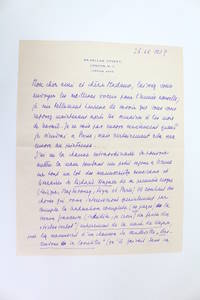
193770612Londres London 1937. Fine. Londres London 26 décembre 1937 17.90 x 22.90 cm une feuille Signed autograph letter to Alfred Cortot and his wife about Richard Wagner's manuscript collection: ""I was lucky enough to be able to acquire the entire lot one day before Bayreuth sent a trusted buyer"". London 26 December 1937 17.9x22.9cm one leaf. Autograph letter signed by Stefan Zweig to Alfred Cortot two pages on one sheet written in violet ink. An outstanding autograph letter in which the avid collector informs his friend Alfred Cortot of his acquisition of unpublished manuscripts of Wagner. Alfred Cortot himself owes his career as a conductor to his early discovery of the German composer. Cortot shared with Zweig his ""almost tyrannical bewitchment suffered with as much intoxication as fervor"" for the composer. Zweig who spoke of his collection as ""more worthy of surviving me than my own works"" The World of Yesterday: Memories of a European 1942 recounts for his friend the details of this incredible discovery of hundreds of forgotten leaflets including Wagner's intimate correspondence handwritten scores and excerpts from opera librettos including The Flying Dutchman The Sublime Fiancée or Bianca and Giuseppe Die Feen Das Liebesverbot The Ban on Love and a lost orchestral version of Rule Britannia. In December 1937 as he fled the Nazi regime and settled in London Zweig became fascinated by the archives of a time when intellectual Europe was living in perfect syncretism. The writer takes a nostalgic look at the manuscripts of Wagner who like him spent his youth travelling through the capitals of Europe: ""I was extraordinarily fortunate to be able to get my hands on a whole lot of Richard Wagner's musical and literary manuscripts from his early period Leipzig Magdeburg Riga and Paris during a short stay in Vienna"". Among these precious manuscripts is the extremely rare orchestral arrangement of the patriotic song Rule Britannia which had been missing for more than sixty years. Sharing his passion for Wagner with his friend the pianist Cortot Zweig announced his discovery with the wonder so familiar to collectors when faced with an exceptional find: "". the manuscript is the only one of its kind in the world that has been preserved. It contains things that will be of special interest to you for example the complete translation 60 pages of the French version unpublished I believe of the text of the ""Liebesverbot"" entirely in Wagner's hand as well as the manuscripts of a vaudeville song ""Descendons la Courtille"" which he performed in his darkest moments . almost thirty pieces of the highest interest and precisely from the rarest period. All this was hidden for 50 years in a private collection and I was lucky enough to be able to acquire the entire lot one day before Bayreuth sent a buyer"". The letter is a fascinating account of Zweig's parallel life which had earned him a reputation as an accomplished collector. His collection also inspired one of his most beautiful short stories The Invisible Collection die Unsichtbare Sammlung and a pioneering essay in the Deutscher Bibliophilen Kalender The Autograph Collection as an Art. His hundreds of historical musical and literary autographs from the Middle Ages to the 20th century were carefully catalogued and collected in the library-museum of his house in Kapuzinerberg: ""In this library a 'place of worship' he also exercises a real activity as an expert in autographs . . The library will attract a number of distinguished scholars sometimes accompanied by their assistants who will not hesitate to return to work there quietly for days or even weeks at a time"" Stefan Zweig le voyageur des mondes Serge Niemetz. With this acquisition Zweig sees the dream of every collector come true. After two years of exile in England Zweig returned to Vienna in time to purchase these exceptional documents from Bayreuth's emissaries who had already built up unknown
40569This noted Montana-born children's book author/illustrator is remembered for "The Runaway Sardine" her first book 1929 and her popular "Kristie" series as well as many other illustrated titles: "To Market! To Market!" 1930 "Till Potatoes Grow on Trees" 1938 "Too Fast for John" 1940 "The Topsy-Turvy Family" 1943 "The Greedy Goat" 1944 "Drusilla" 1963 and others. Offered here is the near-complete original ink-and-watercolor artwork for an early title illustrated by Brock: Louise F. Encking's translation of E.T.A. Hoffmann's classic "The Nutcracker and the Mouse=King" published by Albert Whitman & Co. of Chicago in 1930 when Brock was just starting out and hungry for work. Consists of 25 heavy onion skin leaves each two sheets either stapled or tipped together at top approximately 11½" X 14½" 14 containing a large single black ink line drawings six signed by Brock at lower margin and the remainder mostly containing two small drawings per sheet. All 25 have an overlay sheet on top of the ink drawings each bearing hand colored elements. Below each ink drawing Brock pens a caption which often differs from that which appears in the published book. Very good overall. Minor occasional soiling most about edges and edgewear. Bold and handsome illustrations for almost the entire book some with pencilled editor's notes in the margins including one or two illustrations omitted from the published book. Front cover art is absent present only in the form of an 8" X 10" glossy black-and-white photograph used for production purposes. The simple rear dust jacket art is present on a 12½" X 16½" heavy card stock board as well along with an 8" X 10" glossy black-and-white production photograph of same. A fabulous and quite scarce archive that shows the creative process at work. unknown
31950This most renowned of British naval heroes is almost as famous for his scandalous open affair with one of the most famous and beautiful women in England the married Emma Hamilton despite having lost most of his teeth the use of his right eye and his right arm in various military successes; his nautical victories against the French made him Napoleon's nemesis; killed aboard his ship "Victory" in the battle of Trafalgar. ALS 1p 7" X 8¼" Burnham 1793 February 2. Addressed to "Gentlemen." Near fine. A boldly penned and handsome example of Nelson's scarce right-handed penmanship four years prior to losing his right arm in a July 1797 battle and having to learn to write left handed. Rather cryptic financial content reading in full: "I am glad to hear You did not bring our trust money into the Lands as they had risen so very much. I shall be in Town on tuesday Evening & shall probably see Mr. Creed on Wednesday therefore please to let the money Remain in your hands 'till you hear farther from my Brother or myself. I am Your Very Humble Servant." Page & Creed were Nelson's bankers so the reference to Mr. Creed almost certainly refers to that firm. This choice and scarce letter has been handsomely displayed under a pale green matte with gold filigree alongside a stunning 6½" X 8¼" hand-colored steel engraved portrait of "Horatio Viscount Nelson" engraved by W. Finden and "From the original of Hoppner in / His Majesty's Collection." This early 19th century portrait is in fine condition and bears a large incredibly ornate hand-colored decorative border; it depicts Nelson almost full-length in full military regalia with his empty right sleeve pinned to his chest. This pair is framed under glass in a 1" contemporary walnut frame overall dimensions 21" X 15". A superb presentation -- Nelson in his most desirable that is right-handed form. unknown