Robert de MONTESQUIOUBiblio.com
548 résultats
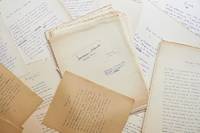
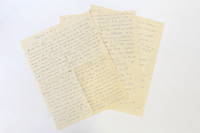
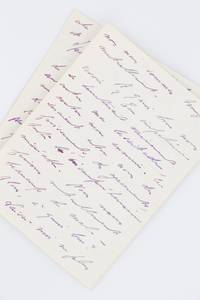
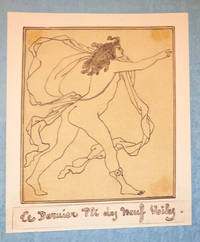
1920759331920. Fine. A priceless poetic testament from Marcel Proust's mentor hidden away and out of sight since the death of the author. s. d. ca 1920 25 x 33 cm en feuilles sous chemises The set of largely unpublished autograph poems by Robert de Montesquiou-Fezensac is brought together by the Count in a collection entitled Le Dernier Pli des neuf voiles whose composition extends from his very first collection Les Chauves-Souris 1892 to his last trilogy Offrandes 1915. Set of 620 autograph leaves. 532 unpublished first draught handwritten on the recto and numbered in pencil preserved in 3 chemises in half red contemporary morocco red morocco labels with gilt author and title; the poems are then placed in the chemises with a handwritten title and a number for publication. According to a note from the author the differences in ink have no meaning mere change of copy. Rare pages from the hand of his secretary Henri Pinard: p. 20 of Huitième voile and p. 29 of Neuvième voile. 23 pages present the printed or typewritten texts of the poems and are enriched with Montesquiou's handwritten corrections. A set of printed proofs are found at the top of the first chemise as well as a pencil tracing after Aubrey Beardsley drawn by the author and accompanied by his handwritten indications. Sublime ode to dandyism to homosexuality and beauty this worldly and poetic promenade by Montesquiou embarks the reader into the decadent fin-de-siècle Paris described in In Search of Lost Time by his friend Marcel Proust. Imbued with his legendary enthusiasm for pictorial decorative theatrical and floral art the collection also delivers hundreds of mournful verses after the disappearance of Montesquiou's lover Gabriel Yturri. Thanks to this collection of poems by Robert de Montesquiou-Fezensac all of which had been lost since 1986 it is now possible to complete the rehabilitation of the aristocratic poet who has long embodied and shaped the Parisian spirit. In May 1920 Montesquiou left handwritten instructions for the posthumous publication of the collection initially announced in two volumes and never produced. On his death a year later the poems were bequeathed to his secretary Henri Pinard who in turn sold them on an unknown date. Auctioned on 24 November 1986 they were mentioned in the LoWire-Littérature colloquium in 1989. This considerable manuscript by Montesquiou forms a veritable home of poetry like his famous aesthetic apartments described by Huysmans. The series of Voiles contain dozens of unpublished poems written in parallel with his previous collections. The author himself indicated the kinship of each voile with a published set of poems announcing here the total completion of his work by the addition of poems which still lay dormant in his papers. The three thick chemises contain rare and curious treasures sometimes drawn on colored sheets often pasted on larger sheets rigorously ordered while awaiting their publication. The poems are written without crossings-out they are fluid with rounded and precious handwriting and stand alongside other first-draught manuscripts: redactions and corrections also bear witness to the work in progress on the new poems; they were applied in the printed proofs of the work present at the top of the manuscript's first chemise. Some poems are taken as they are from collections already published but are slightly modified according to the explanations given by the author. Montesquiou also adds some handwritten notes detailing his intentions. The manuscript contains a poetic anthology of sacred art of extremely rare flowers and of antique furniture adorning his famous Parisian apartments around which so many legends were built Jacques Saint-Cère which fuelled the personalities of Des Esseintes Baron Charlus Dorian Gray and the vain peacock in Edmond Rostand's Chantecler. Moreover Montesquiou was overwhelmed by the features of these famous fictional ghosts of w unknown
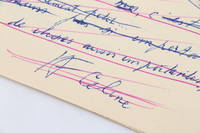
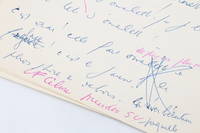
195483743s. l. Meudon 1954. Fine. Céline's Ars Poetica: ""I capture all the emotion on the surface! I cram it into my metro! s. l. Meudon s. d. 1954 10 x 21 cm 34 feuillets Manuscript pages from Conversations with Professor Y' n.p. Meudon n.d. 1954 various sizes from 10x21 cm to 27x21 cm 34 sheets. Autograph manuscript by Louis-Ferdinand Céline 34 sheets of various sizes written in blue and sometimes pink ballpoint pen. Some of the pages are numbered by Céline at top left. The last folio numbered 159 is signed by the writer at the bottom. Two leaves contain previously unpublished passages: the first a few lines long refers to the Professeur. The second leaf numbered 136 features another full-page text on the verso which we did not find in the Professeur Y' or in any of the published works of Céline. Céline refers in this unpublished passage to article 75 of the penal code condemning to the death penalty any French citizen found guilty of intelligence with the enemy. It also mentions a certain ""Me Johann Niels Borggensen"" no doubt a pseudonym for his lawyer Thorvald Mikkelsen: "".supposedly to protect me from police curiosity! holy cow! he was having a ball.when you've got the warrant up your arse crossed out: article 75 anyone can do what they like with you! what a joke! we can do what we like with you.it wouldn't have been Borggensen perhaps someone else would have been worse.give me article 75 and I'll put the whole of France in a Mouse hole for you! and Germany with it! and England such a nag and Europe with it! no bomb needed! H ! Y ! Z ! I'll make you fit the atom into a."" Important set of working manuscripts bearing witness to the writing of Conversations with Professor Y' Céline's true Ars poetica. Since the first part of Féerie pour une autre fois' Fable for Another Time was not as successful as expected Céline wanted to give the release of the second part - Normance - as much publicity as possible and restore his reputation after his years of exile in Germany and Denmark. Instead of writing the usual promotional note prière d'insérer he suggested to publisher Gaston Gallimard this eulogy written in the style of an imaginary interview between himself and Professor Y alias Colonel Réséda a prostatic old man. This zany ""interviouwe"" was published in several parts in the Nouvelle Revue française in 1954 and the finished work through Éditions Gallimard the following year. Céline speaks fervently of his style and his conception of literature and vehemently criticizes the world of letters and public taste. Unlike Céline's other works the genesis of this text crucial to the understanding of his oeuvre is poorly documented and its manuscripts are rare. The Pléiade edition of Celinian novels contains only a few pages of an earlier version very close to the published text. This set of pages covering every passage of the text contains both heavily crossed-out sheets and neatly rewritten notes. It bears witness to the different stages of the writer's work: drafting an initial sheet crossing out and rewriting on the same page then transcribing short passages on separate notes. The last page of the text is extensively crossed out and rewritten resulting in a slightly different version of the published version. The manuscript also contains the famous metaphor of the metro typical of the writer's emotive style compared here to the ""dry language"" of his peers: ""Did you see Have you noticed All caught up in my metro!. what do I leave on the surface. the worst rubbish in cinema!. foreign languages then!. translations!. retranslations of our worst rubbish that they use for their ""parlants"" talking pictures superb foreign languages!. in addition to the psychology! the psychological mumbo jumbo!. all the crap. . Me it's something else! me I'm much more brutal! me I capture all the emotion!. all the emotion on the surface! all at once! I decide! I stick it in the metro! my metro! all t unknown
195483744Meudon 1954. Fine. ""What is Normance "" Meudon 1954 20 x 27 cm 16 feuillets 9 pour le premier manuscrit 7 pour le second Two unpublished autograph manuscripts signed by Louis-Ferdinand Céline in blue and red ballpoint pen: the first contains 9 pages numbered in the left-hand corner from 1480 to 1488; the second contains 7 pages numbered from 1498 to 1504. Each text is signed by Céline in red ink at the bottom margin with the words ""Meudon 54"" also in his hand ff. 1485 and 1505. There are numerous variants lines and words crossed out modified and repeated. Traces of pinholes in the upper left-hand margin of every sheet as Céline organized his manuscripts in ""bundles"". Normance was published in 1954 as a sequel to 'Fable for Another Time' published two years earlier. Both parts were written during Céline's years of exile and imprisonment in Denmark. Upon his return to France in 1951 Céline began ""polishing"" his writings and published these two monumental texts initially envisaged as a single book. ""Céline while he was working on it thought of this novel as a second Journey to the End of the Night' twenty years later capable to astonish the public as much as the 1932 novel"" Henri Godard. This set of manuscript pages corresponds to two passages from the second half of the novel Romans Pléiade IV p. 371 to 375 significantly different from the published text. This is an earlier version unknown to scholar Henri Godard as evidenced by a note in the Pléiade edition where he explains the difficulties encountered by Céline's secretary Marie Canavaggia when translating the word ""planqaouzeuze"" - appearing here on one of the manuscript leaves. Her transcription ""plaquouseuze"" eventually remained in the published text. Godard further stated he had no knowledge of this part of the manuscript i.e. our manuscript not appearing in the intermediate versions transcribed and published in the Pléiade edition. The first of the manuscripts recounts the ransacking and looting of psychic Armelle's apartment: ""How many decks did Armelle have Her fortune-telling cards were taking the air! . Ah seeress! Something she hadn't guessed was how her trembles would be tarred! They'd rip open her armchairs crush her fine hiding places! ah Pythonisse! ah the quilt now! the inside of the pillows flies! flies away!"" Céline also evokes Madame Toiselle the building's concierge: ""- It's a mess Madame Toiselle. I yell it at her. she was a maniac! . moron! she's looking now! she's looking good! ah I see her consternation.she's there in front of me on all fours. I can see her head! Her hoe! - Omelette head!"" I shout to her Omelette head'! The second focuses on Raymond in the grip of a delirious crisis thinking he's a donkey: ""Raymond Raymond! but it's your wife you're looking for! it's true he was looking for his wife.! well maybe five minutes ago he was looking for his wife! Denise! . now he's looking for himself. . - Hiian! hiiian! he answers me! There's also a comical settling of scores between Mimi and Rodolphe: ""There goes Mimi then there goes Rodolphe! Rodolphe! they're coming! and how they're treating each other! where were they on the threshold the two of them! they're taking advantage of the lull in the bombs! - Pig! Pimp! - Cabotine! coureuse! and they attack their costumes. "" Remarkable manuscripts bearing witness to Céline's tireless pursuit in finding the right word and his willingness to place himself as a direct witness to events both historical and autobiographical. These unpublished manuscript lines are typical of the Celinian style of this ambitious novel: ""The story style and tone of Normance set it apart from the rest. It is nothing more than the long account of a night of bombing in Montmartre told in his own way by Céline who had been deeply impressed by the spectacle of the bombing of the Renault automobile factories in Boulogne-Billancourt which he had witnessed from the windows of his apart unknown
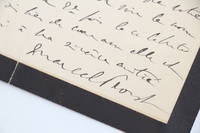
190484876s. l. 1904. Fine. Because I also want success I am extremely material in my wishes for those I love and I wish them every pleasure from the highest to the crudest. s. l. mardi 25 octobre 1904 12.60 x 20.40 cm 12 pages sur 3 bifeuillets Autograph letter signed by Marcel Proust addressed to René Peter. Twelve pages written in black ink on three bifolia framed in black. Tears at the ends along the folds of the bifolia not affecting the text. Published in Kolb IV n°168. A very long letter from Proust full of innuendo to the playwright René Peter. Praising Peter's success Proust confesses to his own vanity as a writer and his literary ambitions. He subtly lets his jealousy for Peter's mistress shine through and declares his absolute devotion to Reynaldo Hahn. This is one of the first letters he sends to his childhood friend after recently reconnecting with him. Proust eternally plagued by ailments remains a recluse and apologizes for missing the rehearsal of Peter's new play Le Chiffon. Peter's three-act comedy with music by Reynaldo Hahn premiered at the Athénée the following month and was a huge success with around sixty performances before the end of the year. The young Proust relies on the glowing opinion of Hahn who had attended the rehearsals and the missive becomes a love letter for the composer and his impeccable judgement: ""Reynaldo told me that your play was delightful and ravishing which is not quite the same thing that he laughed and cried in it as he never laughs or cries in the theater and that the language was exquisite. Of that I was certain. But knowing nothing about you I couldn't know if you had dramatic genius. I am certain of it now because even if I do not know a judge as severe as ridiculously severe as Reynaldo I also do not know one who has more taste giving his enthusiasm very great value in my eyes. In a characteristic tangle of confession and denial Proust barely hides his ambitions and his quest for recognition. He hopes and prays for the same laurels he places on Peter's head: your poor and charming mother who like all those who love and who have lived life bruising all our tenderness has suffered so much is witnessing this great happiness these first rays of glory on your charming forehead which Vauvenargues says softer as the rising sun. I only speak of them in quotations having never known them myself! He will even end up instilling his own literary vocation into the fictional life of the narrator of In Search of Lost Time although the narrator's journey as a man of letters is more marked by disappointments than rays of glory so long awaited by Proust himself. However it culminates in Time Regained with an epiphany: the narrator now knows what to write and above all how to write it. The letter marks the beginnings of the Proust-Peter-Hahn trio whose complicity was such that they formed a special vocabulary of which only they had the secret. The river of words in this letter perfectly illustrates the undeniable link between desire and intellectual admiration: Because I also want success I am extremely material in my wishes for those I love and I wish them every pleasure from the highest to the crudest. Despite these displays of generosity the writer cannot however mask a certain jealousy towards Robert Danceny the fictional co-author of Le Chiffon who was none other than Peter's mistress Mme Dansaërt. Proust elegantly but explicitly refers to her: It makes me happy to think that the charming woman who I am assured is hiding under the male name of your collaborator shares half of your work. I am not talking about your success because whether she worked with you or not she would always have shared your success with her heart having I believe a deep friendship for you. Typical of a Proust transposing his desires through fiction the writer will form various dramatic and morbid scenarios between Peter and this young woman in the following years: I unknown
195283726Saint-Jean-Cap-Ferrat 1952. Fine. Saint-Jean-Cap-Ferrat août 1952 20.80 x 34 cm 52 pages Autograph manuscript by Jean Cocteau early version of the poetry collection Appogiatures - published in 1953 by Éditions du Rocher in Monaco - comprising 47 leaves of thick paper taken from a large drawing pad and 5 smaller leaves of thin paper written in blue ink and blue ballpoint pen. Numerous deletions and corrections. The leaves are numbered up to 25 including one number 8 bis and most bear a small cross or the mythical Cocteau star. The last leaf containing the poem titled ""Lettre"" is dated in the poet's hand August 15 1952. Also in Cocteau's hand the first leaf bears the final title above which is crossed out the initially envisaged title - Soucoupes volantes - the date 1952 and the place - St Jean Cap Ferrat; it also features a crossed-out dedication: ""À la mémoire de Baudelaire et de Max Jacob qui nous apprirent ces exercices de style."" While the collection clearly shows the influence of Baudelaire's Petits Poèmes en prose and Max Jacob's Le Cornet à dés this tribute was not retained in the published version and was replaced by a dedication to the publisher Henri Parisot. An exceptional ensemble containing 33 of the 51 published poems 11 texts rejected on the advice of publisher Henri Parisot and published in ""En marge d'Appogiatures"" uvres poétiques complètes de la Pléiade pp. 818-831 and 6 unpublished texts. David Gullentops in the edition of Jean Cocteau's uvres poétiques complètes in the Pléiade notes the existence of a second set of manuscripts and typescripts preserved at the Bibliothèque Historique de la Ville de Paris BHVP. He further indicates that he had access to no manuscript of the poem ""Lanterne sourde."" Yet this poem is indeed part of our ensemble which would thus be the first version of the collection envisioned by Cocteau. Jean Cocteau began writing this collection of poems in verse and prose commissioned by his friend the publisher Henri Parisot at the end of July 1952 while staying at Saint-Jean-Cap-Ferrat in Francine Weisweiller's Villa Santo-Sospir. The first version of the collection was completed in mid-August as attested by the two dates on our manuscript ""août 1952"" and ""15 août 1952"" and this entry in Cocteau's diary: ""J'ai terminé la mise au point des courts poèmes en prose pour Parisot. Il y en aura vingt-six à moins que le mécanisme continue ce que je ne souhaite pas car à la longue ces exercices d'écriture illustrés par Baudelaire et Max Jacob fatiguent."" Le Passé défini Tome 1 1951-1952 August 14 1952. Our ensemble would thus be a mixture of the first poems sent to Henri Parisot written with a pen and several added texts written with a ballpoint pen. This hypothesis is supported by the writing of the final title Appogiatures on the title page of our manuscript; Cocteau relates this change again in his diary dated August 29 1952: ""Ai . classé les poèmes pour Parisot sous le titre : Appogiatures."" Our early manuscript version contains significant variants concerning the titles of the poems; thus the poem ""Livre de bord"" was initially titled ""Le Spectacle"" likewise for ""Au poil"" for which Cocteau had previously chosen ""La langue française"" or ""Le tableau noir"" originally titled ""Le lièvre et la tortue."" The order of the poems was also considerably modified for printing: our ensemble shows that Cocteau wished to begin the collection with ""Le voyageur"" which would finally be replaced by ""Seul"" and moved to second position. Also noteworthy in our dossier is the presence of eight poems entirely in verse: these would be removed Appogiatures becoming a collection exclusively in prose. The ensemble heavily deleted and corrected also presents long passages suppressed in the published version for example this very beautiful extract from the poem ""Scène de ménage"" evoking the ""countess"" Francine Weisweiller: ""Et les larmes de la comtesse se disaient : nous sommes la mer. Et la mer se unknown
190886094s. l. 1908. Fine. Proust and the future of pastiche: ""it seems to me that it could perhaps become a more discreet more fragile and more elegant form of literary criticism"" s. l. s. d. 1908 ou 1919 11.60 x 17.80 cm 4 pages sur un feuillet remplié Autograph letter signed by Marcel Proust to his friend Maurice de Fleury a psychiatrist and famed man of letters close to Émile Zola who wrote a collection of short stories as well as various medical works on neurasthenia insomnia epilepsy Chiara Carraro Philip Kolb. Four pages written in black on a bifolium with ""Island Mill"" watermark and framed in black. Usual traces of folds. Published in Kolb VIII no. 32 p. 74-75. Superb letter extolling the merits of literary pastiche by one of the greatest writers of the genre: Marcel Proust. The writing of this letter may coincide with the publication of Proust's series of pastiches on the Lemoine Affair a scam set up by a French engineer of that name who claimed to be able to make genuine diamonds. The articles were printed on the front page of the literary supplement of 'Le Figaro' between 1908 and 1909 or date from its publication in volume under the title 'Pastiches et mélanges' in 1919. The autograph letter is presented in a midnight blue half morocco chemise with marbled paper boards beige suede lined pastedowns and a slipcase edged with the same morocco. Proust warmly thanks his correspondent Maurice de Fleury whom he describes as a ""scholar and writer"" for his favorable reception of his ""little pastiches"": ""Your double merit should make you doubly severe: and you excuse pastiche that inferior genre!"" Votre double mérite devrait vous rendre doublement sévère : et vous excusez le pastiche ce genre inférieur ! acknowledging with irony the still precarious place of this unusual genre although popular during Proust's lifetime. Pastiche was perceived more as a stylistic musing or even a student exercise than a true creation worthy of literary praise. Yet here the writer considers it here a refreshing addition to the strict hierarchy of genres that still prevailed: ""Handled however by your hands more beautiful than mine it seems to me that it could perhaps become a more discreet more fragile and more elegant form of literary criticism. Very proud minds could devote themselves to it and very fine minds like yours very attached to greatness seriousness duty as wise could take pleasure in it and follow these games."" Manié pourtant par vos mains plus belles que les miennes il me semble qu'il pourrait peut-être devenir comme une forme indirecte plus discrète plus frêle et plus élégante de critique littéraire. Des esprits très fiers pourraient s'y adonner et des esprits très fins. comme le vôtre très attraché par la grandeur le sérieux le devoir aussi sage pourrait s'y plaire suivre ces jeux. With these words Proust asserts the interest of 'critical pastiche' which was already well established and acted as an empirical analysis of an author's style. Since his years as a student in Condorcet the writer had regularly indulged in this activity with according to him varying degrees of success: ""I have also sometimes made pastiches of medical literature! these writings are now lost If I could have found them again or started them again but all that is too far away I would have published them if I had known that you read this for fun. I don't need to tell you that considered inimitable you are not among the authors I pastiched. But . others are less perfect and combined some very interesting qualities with small flaws that could be imitated and caricatured."" J'ai été aussi quelques fois à faire des pastiches de littérature médicale ! Si j'avais pu les retrouver ou les recommencer mais tout cela est trop loin je les aurais publiés si j'avais su que vous lisiez cela pour vous amuser. Je n'ai pas besoin de vous dire que jugé inimitable vous n'y figurez pas. Mais . d'autres sont moins parf hardcover
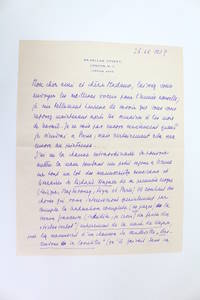
193770612Londres London 1937. Fine. Londres London 26 décembre 1937 17.90 x 22.90 cm une feuille Signed autograph letter to Alfred Cortot and his wife about Richard Wagner's manuscript collection: ""I was lucky enough to be able to acquire the entire lot one day before Bayreuth sent a trusted buyer"". London 26 December 1937 17.9x22.9cm one leaf. Autograph letter signed by Stefan Zweig to Alfred Cortot two pages on one sheet written in violet ink. An outstanding autograph letter in which the avid collector informs his friend Alfred Cortot of his acquisition of unpublished manuscripts of Wagner. Alfred Cortot himself owes his career as a conductor to his early discovery of the German composer. Cortot shared with Zweig his ""almost tyrannical bewitchment suffered with as much intoxication as fervor"" for the composer. Zweig who spoke of his collection as ""more worthy of surviving me than my own works"" The World of Yesterday: Memories of a European 1942 recounts for his friend the details of this incredible discovery of hundreds of forgotten leaflets including Wagner's intimate correspondence handwritten scores and excerpts from opera librettos including The Flying Dutchman The Sublime Fiancée or Bianca and Giuseppe Die Feen Das Liebesverbot The Ban on Love and a lost orchestral version of Rule Britannia. In December 1937 as he fled the Nazi regime and settled in London Zweig became fascinated by the archives of a time when intellectual Europe was living in perfect syncretism. The writer takes a nostalgic look at the manuscripts of Wagner who like him spent his youth travelling through the capitals of Europe: ""I was extraordinarily fortunate to be able to get my hands on a whole lot of Richard Wagner's musical and literary manuscripts from his early period Leipzig Magdeburg Riga and Paris during a short stay in Vienna"". Among these precious manuscripts is the extremely rare orchestral arrangement of the patriotic song Rule Britannia which had been missing for more than sixty years. Sharing his passion for Wagner with his friend the pianist Cortot Zweig announced his discovery with the wonder so familiar to collectors when faced with an exceptional find: "". the manuscript is the only one of its kind in the world that has been preserved. It contains things that will be of special interest to you for example the complete translation 60 pages of the French version unpublished I believe of the text of the ""Liebesverbot"" entirely in Wagner's hand as well as the manuscripts of a vaudeville song ""Descendons la Courtille"" which he performed in his darkest moments . almost thirty pieces of the highest interest and precisely from the rarest period. All this was hidden for 50 years in a private collection and I was lucky enough to be able to acquire the entire lot one day before Bayreuth sent a buyer"". The letter is a fascinating account of Zweig's parallel life which had earned him a reputation as an accomplished collector. His collection also inspired one of his most beautiful short stories The Invisible Collection die Unsichtbare Sammlung and a pioneering essay in the Deutscher Bibliophilen Kalender The Autograph Collection as an Art. His hundreds of historical musical and literary autographs from the Middle Ages to the 20th century were carefully catalogued and collected in the library-museum of his house in Kapuzinerberg: ""In this library a 'place of worship' he also exercises a real activity as an expert in autographs . . The library will attract a number of distinguished scholars sometimes accompanied by their assistants who will not hesitate to return to work there quietly for days or even weeks at a time"" Stefan Zweig le voyageur des mondes Serge Niemetz. With this acquisition Zweig sees the dream of every collector come true. After two years of exile in England Zweig returned to Vienna in time to purchase these exceptional documents from Bayreuth's emissaries who had already built up unknown
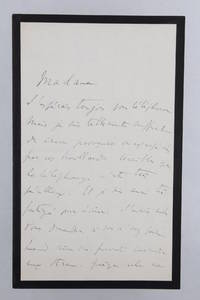
190783638s. l. 1907. Fine. ""New Year's Day is just an occasion for me -- as if occasions were needed! -- to reminisce and weep"" s. l. s. d. ca 1907 12.60 x 20.40 cm 3 pages sur un double feuillet Autograph letter signed to Madame Catusse 126x204cm 3 pages on a double leaf. Autograph letter signed by Marcel Proust probably addressed to Madame Catusse. The recipient and date have been determined by Proust scholar Jean-Yves Tadié. Three pages in black ink on a double leaf edged in black. A fold inherent to the mailing. A sombre and admirable letter steeped in Proustian melancholy. The future author of In Search of Lost Time feels more than ever the loss of his mother during the New Year period. The famously generous Proust also asks his faithful confidante Madame Catusse to buy a gift for the Straus couple whose wife inspired the character of the Comtesse de Guermantes. The end of 1907 apparent date of this letter alluding to the approaching New Year marks the second holiday season spent without Madame Proust who had died two years earlier: ""New Year's Day is only an occasion for me - as if occasions were needed! -- to reminisce and weep"". Proust had also expressed this sentiment in a letter to Anna de Noailles the year before ""New Year's Day had a terrible evocative power over me. It suddenly gave me back the memories of Maman that I had lost the memory of her voice"" February 1906. This fateful moment acted on Proust like a pernicious madeleine at once a sensory reminiscence and an acute awareness of his loss. He would soon begin writing In Search of Lost Time to conjure up this mother figure whose absence would remain unbearable. For the time being Proust is busy writing a series of Pastiches for Le Figaro ""which were in reality only a penultimate detour before writing La Recherche"" George D. Painter. One of these Pastiches dealt with the swindle perpetrated on the president of De Beers in which Proust had invested. Imagining himself already ruined he mentions these unfortunate circumstances in capital letters: ""HAVE I REPORTED MY FINANCIAL DESASTERS TO YOU OVER THE TELEPHONE ."" Overwhelmed by ailments he is also plagued by one of his many asthma attacks ""provoked or exasperated by these terrible fogs"" forcing him into reclusion and even silence: ""telephoning is very dangerous for me. And I'm also very tired when it comes to writing"". The recipient Mme Catusse was a friend of Proust's mother and became an invaluable support to the writer. Proust's prolific correspondence with the woman Ghislain de Diesbach had dubbed the writer's Notre-Dame-des-Corvées represents an inexhaustible resource of insights into his secret life and fears. Proust had called her in a panic during an aphasia attack suffered by his mother shortly before her death. As he became increasingly isolated after moving into 102 boulevard Haussmann the previous year Proust sought her help in many matters including the purchase of numerous gifts: ""I would have liked to ask you if you had by any chance seen anything suitable for the Straus although I always dislike coinciding with New Year's Day"". This sentiment would inspire a passage in The Captive castigating those same ""New Year's Day presents"" given to Madame Verdurin: ""those singular and superfluous objects which still appear to have been just taken from the box in which they were offered and remain for ever what they were at first"" The Captive C.K. Scott Moncrieff's Translation Edited and Annotated by William C. Carter Yale University Press 2023 p. 308. Known for his frenzied displays of prodigality Proust overcomes his aversion to these occasional gifts. The smallest favor to the writer gave rise to extravagant expenses. Lawyer Emile Straus had probably helped the writer sort out his inheritance affairs: ""I FEEL THAT THE NUMEROUS SERVICES PROVIDED TO ME BY MR. STRAUS CANNOT REMAIN WITHOUT THANKS since I believe he would not accept a fee. If you happened to have seen something very unknown
190268100New York and Paris 1902-1950. original elegant full inlaid and onlaid gilt morocco; a.e.g.; green moire silk doublures. Fine. 4to. Among the drawings are a small cartoon by Tony Sarg of a dog chasing a rat; a full page drawing by Edmond Anam-Jean of a lady; a watercolor of a small dog by Maud Earl; and a drawing of penguins by Leland Curtis of the U.S. Antacttic Expedition 1939-40. Many of the musical artists have added brief scores to their autograph sentiments. Contributors include: Marcella Sembrich 1858-1935; coloratura soprano; Edouard de Reszke 1853-1917; Polish bass; Edmond Anam-Jean 1858-1936; French symbolist painter; Clyde Fitch 1865-1909; playwright; Walter Damrosch 1862-1950; German-American conductor and composer; Lillian Nordica 1857-1914; dramatic soprano; T. J. Cobden-Sanderson fine printer; actress Sarah Cowell Lemoyne; William John Locke 1864-1930 British novelist; Olive Fremstad 1871-1951 Swedish-American opera diva; novelist Ian Hay; Kte Douglas Wiggin; Maud Alice Earl; Tony Sarg; Julia Arthur Cheney; Theodore Roosevely; Don Blanding and others. unknown
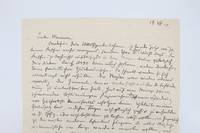
1915822771915. Fine. 19 août 1915 22.20 x 28.60 cm 2 pages sur un feuillet 19 August 1915 222x286cm 2 pages on a leaf. Autograph letter in German signed by the painter Franz Marc to his mother Sophie Marc née Maurice; two pages in black ink. Trace of horizontal and vertical fold. Unpublished letter. Not in the latest edition of his wartime correspondence Briefe aus dem Feld Norderstedt 2019. Lengthy unpublished letter from Franz Marc to his mother during the First World War written a few months before his death in Verdun. In the horror of the conflict the future martyr of German expressionism recalls childhood images and tells horse stories from the front. Stationed on the Alsace front the famed animal painter recounts a hilarious wild boar hunt improvised during a horseback ride reminding him of an illustrated childhood tale: The Three Jovial Hunstmen by Randolph Caldecott 1880. Franz Marc reveals here an inspiration for his famous horses which gave their name to the Blaue Reiter movement created in 1911 with Wassily Kandinsky. The horses in Caldecott's Huntsmen resemble Franz Marc's paintings from 1905-1910. This anecdote is also related to hunting horses sketched on the front and a postcard sketch of the same Jagende Pferde sent to the poet Else Laske-Schüler in September 1915. The letter gives a glimpse of Franz Marc's daily life on the front. By a cruel irony of fate he fought in the native region of his mother Sophie Marc née Maurice born in 1847 in the Alsatian village of Guebwiller. When war broke out in August 1914 he joined the army hoping for a renewal of Europe like many fellow artists and intellectuals. Due to the circumstances of the war the painter wrote his letter in German and not in French as he was accustomed to do in his correspondence with his mother. His mother's influence was decisive in his aesthetic and spiritual approach: Marc's tireless quest for purity inherited from his Calvinist upbringing eventually led him to abstraction already present in his sketches as he wrote this letter. He gives news of a future promotion thanks his mother for sending him food and fills the page with the story of his miraculous hunt: I have one more amusing story to tell: as I was riding out at dawn before breakfast I suddenly noticed a young boar a wild boar beside me in a ditch. I immediately called my fellow riders; he was surrounded I already felt sorry for the poor animal but the pity came too late! Two of them jumped in one grabbed him by the ears the other poked him and the roast for the steward's table was retrieved. A most comical scene ensued: We ordered the youngest soldier to go home with the boar and got him on horseback; but no sooner did the horse feel the boar on his back horses are very afraid of boars than he reared up and threw the rider and the pig into a great arc. Fortunately nothing happened and the embarrassed rider had to walk the boar back then the horse really reared up as soon as he was approached. A real amateur rider! I was thinking of Dad's old English picture book: the jovial huntsman! With this light-hearted anecdote the painter reveals a source of inspiration still unknown to critics and historians. The Three Jovial Huntsmen certainly influenced the young Franz Marc whose own horses painted in the 1910s including the Weidende Pferde I Lenbachhaus Munich are unmistakably marked by Caldecott's British style. In the following years he added to this subject his kaleidoscopic touch and his emblematic blue red and yellow colors charged with spiritual symbolism. Franz Marc also painted blue wild boars in 1913 Museum Ludwig Cologne. The story of this hunt is also completely new since he asked his mother to tell it to his wife Maria to avoid writing a second letter it's long: to tell the same thing twice. This anecdote about hunting and rearing horses can be directly linked to a sketch on a postcard dated the following month entitled jagen unknown
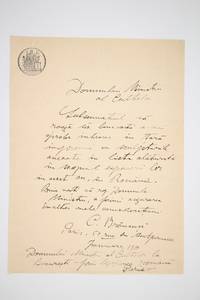
191476382Paris 1914. Fine. Paris janvier 1914 21 x 28.50 cm une page sur un feuillet Handwritten signed letter addressed to the Romanian Ministry of Worship Paris January 1914 21 x 28.5 cm one page on a leaf Very important handwritten letter signed by Constantin Brâncui addressed to the Romanian Ministry of Worship written in black ink on a leaf of white paper. Embossed stamp and a trace of a stamp. Transverse folds from having been sent. In this letter dated January 1914 and addressed to the Ministry of Worship the sculptor requests authorisation to bring some of his sculptures to Romania for the exhibition of the ""Tinerimea Artistica"" company Artistic Youth. Brâncui was then in Paris as evidenced by his address: « 54 rue du Montparnasse ». A list of works was visibly attached to the letter but sadly has disappeared. This letter testifies to the close links maintained between Brâncui and the Romanian artists of the ""Tinerimea Artistica"" who since 1908 organized exhibitions bringing together paintings and sculptures. In March 1914 Brâncui presents six works including La Prière 1907 Le Baiser 1907-08 Mademoiselle Pogany 1913 at the fourteenth exhibition of this important artistic company. He was already a renowned sculptor at that time: the presence of five of his works at the Armory Show in New York 17 February 15 March 1913 where his sculpture Mademoiselle Pogany caused a scandal due it its modernity at the side of Marcel Duchamp's Nu descendant un escalier and allowed him to become one of the major artists of the second decade of the 20th century. unknown
1998007208Amsterdam: Anthos. Signed first edition of rare English language Dutch edition of Irving's novel. The true first edition of Irving's novel preceding the release of the US and UK editions. Author's SIGNED presentation to motorcycle legend Cook Neilson who took the photo of Irving that was used for the dust jacket of the book: "For Stepp and Cook - with my appreciation and affection - John Irving April 1 1998." Together with AUTOGRAPH LETTER SIGNED by Irving on his stationery to Neilson laid in in which Irving says that Neilson's photos will also be used on the UK edition and jokes that another photo to be used for the American and Canadian editions is more flattering because it doesn't show Irving's face. Closes with mention of a nearby school in Vermont. Neilson was a preeminent motorcycle journalist and editor of Cycle Magazine. As a motrocyclist Neilson won the Daytona Superbike race in 1977 on a Ducati. He was inducted into the AMA Motorcycle Hall of Fame and the Ducati North America Hall of Fame in 2006. Published Amsterdam: Anthos 1998. 8vo. Some foxing spots along front edge of page block and verso of dust jacket else near fine in near fine dust jacket. One page typewritten letter on laid paper signed by Irving near fine. . Near Fine. Hard. 1st. 1998. Anthos unknown
1951006892Paris: Aux Editions Eliane Norberg. First edition thus. Signed De Luxe limited edition. Sumptuous full leather Artesian binding by Jacques Blanchet. From an edition of 202 number 72 of 180 printed on Velin d' Arches. Published Paris: Editions Eliane Norberg 1951. Folio 10 1/2" x 13 1/4" x 2 7/8" thick 302pp. illustrated with full page engraved plates and fine textual engravings from copper - all with tissue guards and two leather engravings cover and verso in 6 colors by Robert Fonta. Full dark blue satin morocco over 1/4" thick boards with chamfered corners and leather inner hinges attached to thick duplex flyleaves and gray leather pastedowns. Gilt block paneled titles on spine top edges tinted blue with gilt embossed edge design stamped into the page block. Front cover and verso decorated with unique six-color leather inset engravings by Fonta Signed on the half title by the Bazin: "Hommage amical / de l'auteur / Herve Bazin." Presentation copy to his publisher with a four paragraph typewritten A.L.S. by his wife Jacqueline mounted on free endpaper in which she writes about the color leather engravings and their signification to the situation of Arthur the unstable protagonist of the novel."Cuir chagrin noir dont la couleur evoque le triste bilan d'une vie de desequilibre." A novel of youth rebellion and a man's fractured life caught up in the penal system. The novel is semi-autobiographical based on the author's own experience in mental hospitals from 1937-1940 and was made into the film "Head Against the Wall" in 1959. Binding signed in the leather in gilt by Jacques Blanchet. Encased in a custom matching leather and felted slipcase that echoes the curve of the book. A beautiful exquisite production. Minor rub to a few areas of the spine else fine - binding tight text and plates clean and bright in a very good slipcase with some wear at the corners and edges. . Fine. Full-Leather. 1st. 1951. Aux Editions Eliane Norberg hardcover
194764327Copenhage Copenhagen 1947. Fine. Copenhage Copenhagen 10 avril 1947 22.50 x 28.40 cm 6 pages sur 3 feuillets Very long autograph letter signed ""Dest"" to Doctor Tuset and Henri Mahé dated April 10 unknown
194763242s. l. Copenhague Copenhagen 1947. Fine. s. l. Copenhague Copenhagen 23 avril 1947 22.50 x 28.40 cm 6 pp. in-folio Signed autograph letter of Céline to Henri Mahé and his wife dated April 23 1947 in Copenhagen lines in black ink on three sheets of lined paper. unknown
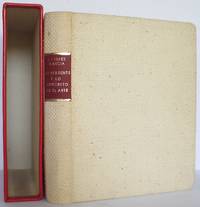
1947009823Montevideo: Asociación de Arte Constructivo / Taller Torres-Garcia. First edition. Author's signed presentation with an original drawing by Torres-Garcia to María Cantú 1914 - 1959 a Mexican painter of the Taller Torres Garcia in Montevideo. 5 volumes finely bound in cloth sewn binding with custom leather slipcase. Published Montevideo: Asociación de Arte Constructivo / Taller Torres-Garcia 1947-1948. 8vo. 7" x 8 1/2" 47; 47; 43; 43 65pp. 'Leccion 1a' to 'Leccion 16a' - 16 lectures on Universal Constructivism illustrated with reproductions on glossy plates. Text in Spanish. Each volume contains leaf of publication information with list of publications by A.A.C. and Taller Torres-Garcia on verso leaf of title page recto printed leaf of explanatory text verso printed followed by text of lecture with final leaf of with 'terminó de imprimir'. Bound in cream buckram with heavy boards with rounded corners burgundy and gilt spine label with titles in gilt. Enclosed in a custom red leather slipcase. Inscribed by Torres-Garcia on first leaf "A Maria Contu con el musajos afecto J. Torres-Garcia" with drawing of a stick figure of a man standing with an oversize heart in his chest the sun forward of his right leg the sea and a fish on his left and a triangle behind his right shoulder. Paper of text block has uniformly age toned else fine in fine slipcase. . Fine. Hard. 1st. 1947. Asociación de Arte Constructivo / Taller Torres-Garcia unknown
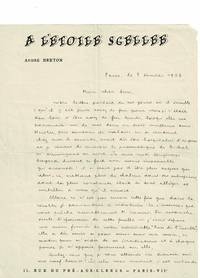
195375729Paris 1953. Fine. Paris 8 janvier 1953 21 x 27 cm 1 pages et quelques lignes sur un feuillet Unpublished handwritten signed letter from André Breton addressed to critic Charles Estienne; one page and a few lines in black ink on a paper from the à l'étoile scellée gallery. Two transverse folds from having been sent a small corner missing in the upper right margin. Very beautiful letter giving an account of the death of one of André Breton's dearest friends and of his quarrel with Albert Camus. Breton tells his friend about the death of the Surrealist Czech artist Jindich Heisler: Your letter spoke of those days where it seemed that there was only just enough fire to live: on Monday there was far from enough fire when it reached me: one of my two or three best friends Heisler taken suddenly unwell on his way to mine on Saturday had to be hospitalised urgently and I had just received the pneumatic from Bichat telling me of his death. The event no less inconceivable than accomplished left me distraught for a long time: there was no-one more exquisite than he putting more warmth into everything he did the most constant of which was to lighten and embellish those whom he loved. The two poets were indeed very close: Heisler participated alongside Breton in the launch of Néon in 1948 and supported him during a period of depression accompanying him with other friends to the Île de Sein. The beginning of 1953 was overshadowed by the death of Jindich Heisler 4 January. Loyal among the faithful he lived entirely for Surrealism according to Breton who pays tribute to his activity as a leader: This is how he was between 1948 and 1950 the soul of Néon and until his last moments the greatest bearer of projects that as if by magic his talent gave him the means to achieve. Henri Béhar André Breton In this letter laden with pain Breton suddenly makes reference to L'Homme révolté by Albert Camus published two years earlier: Come on it is not yet the time in the rebellion that I will succeed in introducing the measure that M. Camus kindly preaches to us. The two writers met in New York at the end of March 1946 when Camus was invited to the United States for a conference tour as a representative of Combat. The two agree on the best way to preserve the testimony of certain men free from ideological distortions. They dream of a kind of pact by which people of their calibre would commit to not join any political party to fight against the death penalty to never claim any credit whatsoever. ibid. With other intellectuals they founded the Rassemblement démocratique révolutionnaire RDR in 1948; but the idyll ended a couple of years later in the autumn of 1951 when Camus published Lautréamont et la banalité an extract from his Homme révolté which was published later. Breton was extremely hurt and responded to him in an article entitled Sucre jaune in Arts: This article . testifies to the part of Camus for the first time for an indefensible moral and intellectual position. . He only wants to see a guilty adolescent in Lautréamont whom he - in his capacity as an adult - must discipline. He goes as far as to find him in the second part of his work: Poésies a deserved punishment. According to Camus Poésies would be but a mass of laborious banalities . It could still be worse if the destitution of these views did not intend to promote the most suspect thesis in the world which is that absolute revolt can generate only the taste for intellectual enslavement. This is a completely gratuitous ultra-defeatist statement which must incur even more contempt than its false demonstration. Thus two years later Breton still holds out against Camus' crime of lese-majesty towards that which Breton constructed as the father of surrealism but even more this allusion to Camus' pacifist philosophy bearing witness to the incompatibility between a thought of moderation and a poetry of revol unknown
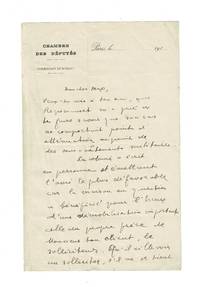
191875931Paris 1918. Fine. Paris s. d. ca 1918 13.30 x 21 cm 2 pages sur un feuillet Unpublished autograph letter signed by Guillaume Apollinaire addressed to Max Jacob. Two pages written in black ink on a sheet with the letterhead of the Chamber of Deputies. Folds inherent to mailing. Unpublished letter concerning the deputy Charles Régismanset then Director at the Ministry of Colonies: ""Veux-tu dire à ton ami que Régismanset m'a prié de te faire savoir que son cas ne comportait point d'atténuation au point de vue des sous-vêtements militaires."" ""La colonie a écrit en personne et émettant l'avis le plus défavorable car la maison en question a bénéficié pour l'heure d'une démobilisation importante."" ""These 'colonies' are hardly distant. He is seconded to Rue Oudinot to the office of Minister Henri Simon who was pleased to be able to assist a poet he had long admired. His duties are rather vague. Assigned to the Press Service he oversees the Bulletin d'Informations coloniales et étrangères occasionally contributing discreetly a task that leaves him sufficient freedom for his own work. His direct superior Charles Régismanset himself a writer calls upon him whenever a 'bushman' passing through might provide information on Bambara customs or Guinean witch doctors."" Pierre-Marcel Adéma Guillaume Apollinaire ""Viens tout de même me voir dirait le père Janvier qui doit pour le moins parler aussi bien que le père de Victor Hugo surtout viens avant janvier et toujours plus haut Excelsior viens j'ai quelque chose d'éditorial à te dire."" unknown
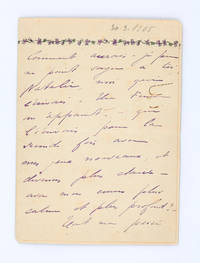
190578968s. l. Paris 1905. Fine. s. l. Paris 30 mars 1905 11.50 x 15.90 cm 6 pages 1/2 sur deux doubles feuillets Autograph letter signed ""Pauline"" by Renée Vivien addressed to Natalie Clifford Barney and written in violet ink on two double sheets edged with violets. Transverse folds inherent to posting. Very fine love letter evoking the only novel by the Violet Muse Une femme m'apparut. ""Comment aurais-je pu ne point songer à toi Natalie moi qui écrivais « Une femme m'apparut » - qui l'écrivais pour la seconde fois avec mes yeux nouveaux et devenus plus clairs - avec mon cur plus calme et plus profond "" ""How could I not have thought of you Natalie I who was writing 'Une femme m'apparut' - who was writing it for the second time with my new eyes which had become clearer - with my heart calmer and deeper"" Published in 1904 this novel - the only one of Renée's literary career - tells the love story of the narrator and ""Vally"" Natalie Clifford Barney from their beginning to their tragic end and the ""apparition"" of the savior Hélène de Zuylen. Reconciled with the Amazon Renée undertakes to rewrite the book which will appear at the beginning of 1906: ""Literary and stylistic improvement No. The concern to justify herself anew but this time in the face of Natalie Barney is beyond doubt. Remorse too: now the apparition that gives the book its title is no longer Eva-Hélène de Zuylen but Lorely-Natalie Barney and this from page 2. When we know that during the summer of 1904 unexpected reunions in Bayreuth came to unite Natalie Barney and Vivien we better understand the meaning of this new version of the novel Renée only returns to her amorous past to deliver us a second version revised and corrected. She thus erases the final choice she had suggested in the first version. Complete palinode confirmed by the very text of the letters that Vivien will write to Natalie Barney in 1904 and especially in 1905."" J.-P. Goujon Tes blessures sont plus douces que leurs caresses This confusion of feelings shows through this letter filled with oxymorons: ""je goûte une tristesse charmante à t'évoquer . quand je songe à toi j'évoque ma plus belle douleur"" ""I taste a charming sadness in evoking you . when I think of you I evoke my most beautiful pain"" The sadness - mixed with unconditional love - is here pushed to its paroxysm: ""Ne te laisse pas attrister par ma lettre grise de ce soir. Il y a des heures ternes - ce sont peut-être les meilleures - Dans tous les cas ce sont les plus vraies . Et ceux qui sont comme tu le dis « ingrats et joyeux » sont fort à plaindre."" ""Do not let yourself be saddened by my grey letter this evening. There are dull hours - these are perhaps the best - In any case these are the truest . And those who are as you say 'ungrateful and joyful' are much to be pitied."" Vivien effaces herself completely in favor of her beloved even proposing to live in her place: ""Va - si tu le peux - là où je voudrais être - à Mytilène. Je verrais l'île merveilleuse à travers tes prunelles - tu me ferais respirer tous ses parfums - A dire vrai le courage m'a manqué pour y aller. Je n'avais plus la force ni le désir de partir ainsi."" ""Go - if you can - where I would like to be - to Mytilene. I would see the marvelous island through your eyes - you would make me breathe all its perfumes - To tell the truth I lacked the courage to go there. I no longer had the strength nor the desire to leave thus."" ""Ne peux-tu toi aller à Mytilène et me rapporter des roses de là-bas "" ""Cannot you go to Mytilene and bring me roses from there"" Yet it is together that the two lovers will soon undertake the journey to Lesbos; it will be the last of their story. It was at the end of 1899 and through Violette Shillito that Renée Vivien - then Pauline Tarn - made the acquaintance of Natalie Clifford Barney ""cette Américaine plus souple qu'une écharpe dont l'étincelant visage brille de cheveux d'or de prunelles bleu de mer d unknown
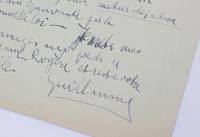
191383938s. l. Paris 1913. Fine. ""I will come to see you to speak to you about naturalization I am appalled by the new law"" s. l. Paris s. d. ca. juin 1913 15.70 x 24.50 cm une page sur un feuillet Unpublished autograph letter signed by Guillaume Apollinaire addressed to Jean Royère one page written in black ink on a sheet. Transverse folds inherent to posting. Very fine letter of thanks from poet to poet. ""I thank you for the admirable article you devoted to me. You have felt my soul like no one else."" Jean Royère had indeed written a laudatory article upon the publication of Alcools in the June 20 1913 issue of La Phalange: ""Here gathered in an 18mo of barely two hundred pages is almost the entire poetic work of Apollinaire. Fifteen years of poetry rest in this small volume. I therefore do not open it without almost a preconceived admiration. In poetry abundance means sterility and one only writes three volumes in a year through inability to devote one's life to a book. Apollinaire evidently will leave only one book of verse like Baudelaire and Mallarmé like Rimbaud: this is a considerable chance of immortality for the true poet is one who has this too rare gift of condensation."" "". I will come to see you in the coming days to thank you first and also to speak to you about naturalization I am appalled by the new law."" The poet here alludes to the Three Year Law dubbed the Barthou Law increasing the duration of military service from two to three years in view of preparing the French army for a possible war with Germany. If Apollinaire's biography prefers to focus on the publication of his works in this year 1913 the letters his mother addresses to her son show that the latter moves heaven and earth to avoid military service and be naturalized as quickly as possible: ""For your papers an Italian colonel attached to the ministry of war who was witness for your act of recognition had written to me once to give me the steps to follow so that you would be exempted from military service in Italy and for your French naturalization. I am going to write to him moreover to ask him to see to the Town Hall."" letter from Angelika Kostrowicka of July 12 1913. War would come soon and on August 3 1914 the day after mobilization the stateless poet would file a request for voluntary enlistment accompanied by a naturalization request. The latter would only be granted to him in 1916. An interesting letter written at the dawn of the Great War bearing witness to Guillaume Apollinaire's two passions: poetry and France. unknown
190479022Paris 1904. Fine. Paris s. d. septembre 1904 12.40 x 16.80 cm 8 pages sur 2 doubles feuillets Autograph letter signed ""Pauline"" from Renée Vivien addressed to Natalie Clifford Barney and written in purple ink on two double sheets with violet letterhead and address of 23 avenue du Bois de Boulogne. Transverse folds inherent to posting. A very beautiful and lengthy breakup letter addressed to the Amazon after her impromptu summer 1904 visit to Bayreuth to attempt to win Renée back: "". Les heures passées à Bayreuth étaient de la douceur : et c'est pourquoi je suis revenue."" ""The hours spent in Bayreuth were sweet: and that is why I returned."" The lexical field of death is omnipresent in this missive as if to better emphasize the definitive character of her decision: ""Pourquoi t'acharner à vouloir ranimer vainement les choses mortes Natalie Tu ne l'as point compris : ce que je cherchais auprès de toi c'était le souvenir et rien d'autre. On ne revit point l'autrefois. Tu dois le sentir comme moi-même. . Je souriais à mon passé. Il est doux parce qu'il est mort. Et toi tu veux galvaniser ce cadavre et le rendre odieux."" ""Why persist in trying to vainly revive dead things Natalie You have not understood: what I sought with you was memory and nothing else. One cannot relive the past. You must feel it as I do myself. . I smiled at my past. It is sweet because it is dead. And you you want to galvanize this corpse and make it odious."" The Muse of violets here reveals her suffering and disappointment pleading with Natalie twice: ""Laisse-moi ne plus revenir."" ""Let me not return again."" A veritable funeral oration for extinguished love this letter is very illuminating as to each one's way of loving: ""Nous nous sommes mal comprises. Je voulais un peu de rêve : tu m'offres la réalité."" ""We have misunderstood each other. I wanted a little dream: you offer me reality."" For this is what separates Renée - the dreamy and quasi-platonic poetess - and Natalie - the carnal and fickle lover: ""Ne sens-tu donc pas ne comprends-tu donc pas que je n'ai plus aucun désir d'amour Je suis lasse infiniment ; je ne voulais qu'un peu de douceur. Et tu m'offres la vie et les frissons que sais-je tout dont je ne me soucie point. Les joies charnelles Mais je les possède mon amie me les donne ma chair est satisfaite et au-delà. Je ne cherche point cela : je ne désire point cela. Ces choses m'excèdent venant de toi. J'espérais que assouvie de ton côté tu ne me demanderais que ce que je te demande : un peu de rêve lassé ; un peu de compréhension un peu de regret. Mais nous nous sommes trompées mutuellement. . Cherche un amour de chair chez une autre ."" ""Do you not feel do you not understand that I no longer have any desire for love I am infinitely weary; I wanted only a little sweetness. And you offer me life and thrills what do I know everything I care nothing about. Carnal joys But I possess them my friend gives them to me my flesh is satisfied and beyond. I do not seek that: I do not desire that. These things excess me coming from you. I hoped that satiated on your side you would ask of me only what I ask of you: a little weary dream; a little understanding a little regret. But we have deceived each other mutually. . Seek carnal love with another ."" It was at the end of 1899 and through the intermediary of Violette Shillito that Renée Vivien - then Pauline Tarn - made the acquaintance of Natalie Clifford Barney ""cette Américaine plus souple qu'une écharpe dont l'étincelant visage brille de cheveux d'or de prunelles bleu de mer de dents implacables"" ""this American more supple than a scarf whose sparkling face shines with golden hair sea-blue pupils implacable teeth"" Colette Claudine à Paris. Natalie who had just lived a summer idyll with the scandalous Liane de Pougy who had initiated her into sapphism paid only discrete attention to this new acquaintance. Renée however was totally capt unknown
190478907s. l. Paris 1904. Fine. s. l. Paris s. d. ca. 1904 11.50 x 15.90 cm 4 pages sur un double feuillet Autograph letter from Renée Vivien addressed to Natalie Clifford Barney and written in black ink on a double sheet bordered with a violet trim. Transverse fold inherent to mailing. A beautiful love letter marking the reconciliation of the Muse of Violets and the Amazon after a two-year separation: ""Your letter was cruelly sweet to me I wept reading it and something within me rejoiced despite everything to think that between us the bond was so powerful and subtle that only death could entirely untie it if death is definitive."" Weary and very jealous of Natalie's infidelities Renée had made the radical decision to leave her. The Amazon had then by every means attempted to win her back sending emissaries as well as numerous letters: ""My tears have flowed over all the letters you have sent me since the silence that had settled between us."" Renée seems this time to have broken her promise never to see Natalie again and addresses this beautiful declaration to her full of hope for the future: ""Forget you! But my lips which are the soul of my soul have kept your reflection and your imprint. . Something in me has been broken since then from having loved too blindly. But if it is true that there remain within us unknown tenderness and ignored sweetness that we can still lavish upon each other in a better future let us not hesitate to discover them in the depths of our souls. I would like to take you in my arms my Little One like a sick child and rock you and console you and heal you and see the smiles of yesteryear bloom again on your lips. You must no longer suffer for me my Blonde Sweetness I love you I will heal you."" These reunions would not last however: torn between Baroness Hélène de Zuylen and Natalie Renée would embark on a series of travels; in turn to Holland Germany Switzerland and Venice she would confide her hesitations to Kérimé Turkhan-Pacha her epistolary companion from the Bosphorus whom she would meet in the summer of 1905 during her last journey with Natalie Clifford Barney to Mytilene. A moving letter from Renée Vivien addressed to the great love of her life. It was at the end of 1899 and through Violette Shillito that Renée Vivien - then Pauline Tarn - made the acquaintance of Natalie Clifford Barney ""cette Américaine plus souple qu'une écharpe dont l'étincelant visage brille de cheveux d'or de prunelles bleu de mer de dents implacables"" ""this American more supple than a scarf whose sparkling face shines with golden hair sea-blue eyes implacable teeth"" Colette Claudine à Paris. Natalie who had just experienced a summer idyll with the scandalous Liane de Pougy who had initiated her into sapphism paid only discreet attention to this new acquaintance. Renée on the other hand was completely captivated by the young American and would relate this love at first sight in her autobiographical novel Une Femme m'apparut: « J'évoquai l'heure déjà lointaine où je la vis pour la première fois et le frisson qui me parcourut lorsque mes yeux rencontrèrent ses yeux d'acier mortel ses yeux aigus et bleus comme une lame. J'eus l'obscur prescience que cette femme m'intimait l'ordre du destin que son visage était le visage redouté de mon avenir. Je sentis près d'elle les vertiges lumineux qui montent de l'abîme et l'appel de l'eau très profonde. Le charme du péril émanait d'elle et m'attirait inexorablement. Je n'essayai point de la fuir car j'aurais échappé plus aisément à la mort. » ""I evoked the already distant hour when I saw her for the first time and the shiver that ran through me when my eyes met her mortal steel eyes her sharp blue eyes like a blade. I had the obscure prescience that this woman was giving me fate's order that her face was the dreaded face of my future. I felt near her the luminous vertigo that rises from the abyss and the call of very deep water. The charm of peril emanat unknown
190278981s. l. Paris 1902. Fine. s. l. Paris Le 1er avril 1902 11.50 x 15.90 cm 7 pages 1/2 sur deux doubles feuillets Handwritten signed letter addressed to Natalie Clifford Barney: I told you by the raw voice of the telegraph Natalie the time has not come for us to see each other again. Paris 1st April 1902 11.5 x 15.9 cm 7 pages 1/2 on two double leavesHandwritten letter signed Pauline from Renée Vivien addressed to Natalie Clifford Barney and written in black ink on two double leaves edged with violettes. Transverse folds from having been sent. Interesting letter mentioning Brumes de fjords and Freddy Manners-Sutton. Tu te trompes en croyant retrouver dans Brumes de fjords un reflet de femme ou l'influence d'une pensée de poète norvégien. Je les ai faites d'un souvenir très lointain de ce pays mystique et de quelques rêves lourds de nostalgies. You are mistaken when you think that you find a reflection of a woman or the influence of a Norwegian poet's thinking in Brumes de fjords. I wrote them as a very distant memory of this mystical country and of some dreams heavy with nostalgia. Brumes de fjords is the first collection of prose poetry by Renée Vivien to be published in June 1902. Natalie and Renée were then separated but this letter shows that the Muse aux violettes continued to send her texts to the Amazone despite the physical and sentimental distance that separated them. Car j'ai dans ma vie une tendresse que je crois sincère quoi qu'il me soit difficile aujourd'hui de croire à la sincérité même lorsqu'elle me montre ses larmes. Since I have a tenderness in my life which I believe to be sincere - though it is difficult for me today to believe in sincerity even when it shows me its tears. This letter was indeed sent to Natalie Clifford Barney while she was in the United States: Je serais venue si tu avais eu besoin de moi. Toi-même tu m'as télégraphiée que ma présence était inutile. lorsque ton temps était pris par un flirt Freddy Manners-Sutton qui sait et qu'importe Il est trop tard maintenant. Je ne viens pas t'amuser ni remplacer une distraction absente. Si tu viens à Paris cet hiver je te verrai une ou deux fois comme on revoit le visage lointain de son passé sans colère sans haine mais aussi sans amour. I would have come if you needed me. You yourself telegraphed me that my presence was useless. when your time was taken by a flirt Freddy Manners-Sutton Who knows And what does it matter It's too late now. I don't come to amuse you or replace an absent distraction. If you come to Paris this winter I will see you once or twice - as you see the distant face of your past - without anger without hatred but also without love. Here Renée gives free reign to her jealousy mentioning Freddy Manners-Sutton Natalie's friend: En réalité Vivien ne pouvait supporter Manners-Sutton. Dans Une femme m'apparut elle l'appellera tout simplement Le Prostitué et dira de lui : Il est banal comme l'adultère. Cette antipathie se transformera en une haine féroce lorsqu'un peu plus tard Vivien apprendra que cet homme se faisait passer pour le fiancé de Natalie Barney. Sacrilège suprême. ! Mais Vivien ne savait pas ou bien voulait ignorer que cette rumeur était en fait propagée par Natalie Barney elle-même afin de donner le change à ses parents. Non pensait-elle ce personnage au-dessous de toute insulte veut tout simplement capter la fortune de Natalie ! In reality Vivien could not bear Manners-Sutton. In Une femme m'apparut she will very simply call him Le Prostitué and will say of him: He is common like adultery. This antipathy will turn into a fierce hatred when a little later Vivien learns that this man pretends to be Natalie Barney's fiancé. Supreme sacrilege.! But Vivien did not know - or even wanted to ignore - that this rumour was actually spread by Natalie Barney herself in order to pull the wool over her parent's eyes. No she thought this below any insult character simply wan unknown
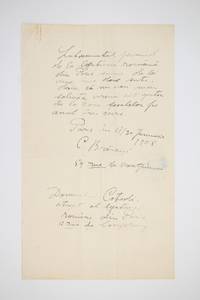
190876381Paris 1908. Fine. Paris 17/30 janvier 1908 21 x 35 cm une page sur un feuillet Handwritten signed declaration to Mr Costadi attached to the Romanian legation in Paris Paris 17/30 January 1908 21 x 35 cm one page on a leaf Handwritten declaration dated and signed by Constantin Brâncui to Mr Costadi attached to the Romanian legation in Paris written in black ink on a leaf of white paper. Embossed stamp and a trace of a stamp. Some transverse folds. The declaration is signed with his full name that he will retain from then on: C. Brâncui and dated 17/30 January 1908 the two dates reflect the coexistence of the Gregorian and the Julian calendar in Romanian principalities in the early 20th century. In this declaration written on 30 January 1908 Brâncui addresses the Romanian legation in Paris represented by Mr Costadi. He hereby confirms receipt of the sum 1200 lei and specifies that he will no longer request assistance from the Maison des écoles section of the future Ministry of Education and Culture for the current year. This grant is the last he will be awarded by a Romanian establishment. unknown
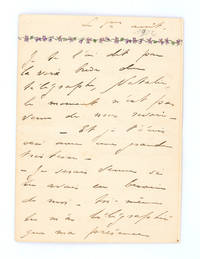
190679014Villa Clos fleuri Nice Nice 1906. Fine. Villa Clos fleuri Nice Nice 3 mars 1906 12.40 x 16.80 cm 3 pages sur un double feuillet Autograph letter signed ""Pauline"" by Renée Vivien addressed to Natalie Clifford Barney and written in violet ink on a double sheet with violet letterhead the Parisian address on the letterhead crossed out. Transverse folds inherent to mailing. Fine letter evoking Renée Vivien's execration for Nice: ""Ici un soleil insolent d'ignobles bâtisses des gens Je regrette Mytilène . Mon Dieu entre Nice et Paris il n'y a pas de différence bien marquée quelques oranges de plus ici des palmiers d'opéra comique - une illusion de chaleur c'est tout."" ""Here an insolent sun ignoble buildings people I miss Mytilene . My God between Nice and Paris there is no marked difference a few more oranges here comic opera palm trees an illusion of warmth that's all."" The evocation of Mytilene where the two lovers had traveled the previous summer continues in this missive: ""Encore une lettre de ce vieux filou de Paradellis Je l'ai envoyé promener Il est capable de faire main basse sur tout ce qu'il y a dans la maison "" ""Another letter from that old rogue Paradellis I sent him packing He's capable of making off with everything in the house "" It was Passagisti Paradellis who rented a villa on site with a two-year lease to Renée and Natalie. ""The villa had been tastefully furnished. Collections of rare porcelain mother-of-pearl inlaid furniture a dining room with high-backed armchairs."" J.-P. Goujon Tes blessures sont plus douces que leurs caresses In this letter the Violet Muse also gives the key to one of the characters in Une femme m'apparut whose revised version had just appeared: ""Dis à Madame Mardrus pas de ma part de la tienne ! que Doriane c'est elle telle qu'elle s'est révélée à moi un jour dans l'ardeur et dans la tristesse."" ""Tell Madame Mardrus not from me from you! that Doriane is her as she revealed herself to me one day in ardor and in sadness."" The work whose rewriting had nevertheless tried the poetess is here devalued by the latter: ""En somme je n'aime pas ce volume ou plutôt il m'est indifférent ce qui est plus triste encore "" ""In sum I don't like this volume or rather it is indifferent to me which is even sadder "" It was at the end of 1899 and through the intermediary of Violette Shillito that Renée Vivien - then Pauline Tarn - made the acquaintance of Natalie Clifford Barney ""cette Américaine plus souple qu'une écharpe dont l'étincelant visage brille de cheveux d'or de prunelles bleu de mer de dents implacables"" Colette Claudine à Paris. Natalie who had just lived through a summer idyll with the scandalous Liane de Pougy who had initiated her into sapphism paid only discreet attention to this new acquaintance. Renée on the other hand was completely captivated by the young American and would relate this love at first sight in her autobiographical novel Une Femme m'apparut: ""J'évoquai l'heure déjà lointaine où je la vis pour la première fois et le frisson qui me parcourut lorsque mes yeux rencontrèrent ses yeux d'acier mortel ses yeux aigus et bleus comme une lame. J'eus l'obscur prescience que cette femme m'intimait l'ordre du destin que son visage était le visage redouté de mon avenir. Je sentis près d'elle les vertiges lumineux qui montent de l'abîme et l'appel de l'eau très profonde. Le charme du péril émanait d'elle et m'attirait inexorablement. Je n'essayai point de la fuir car j'aurais échappé plus aisément à la mort."" ""Winter 1899-1900. Beginning of the idyll. One evening Vivien is invited by her new friend to Mme Barney's studio Natalie's mother 153 avenue Victor-Hugo at the corner of rue de Longchamp. Natalie ventures to read verses of her composition. When Vivien tells her she loves these verses she replies that it is better to love the poet. A response quite worthy of the Amazon."" J.-P. Goujon op. cit. Two ye unknown