66 341 résultats
1¾ SS. 8vo. An einen namentlich nicht genannten Verleger: "Mehrseitig aufgefordert habe ich eine Messe für Männerstimmen componiert und der Vollständigkeit wegen dazu 2 Gradualien und 2 Offertorien nebst Te deum hinzugefügt, mit besonderer Berücksichtigung praktischer [????] Ausführbarkeit. Hiermit beehre ich mich Ihnen diese Compositionen zum Verlage anzubieten, und nachdem derlei Tonstücke noch selten sind, es fast in jedem Dorfe Männergesang von mir gibt, so wäre damit ein gutes Geschäft zu setzen, - mein Name ist wohlbekannt und ich würde hier und in Mähren für genügende Zeitungsnotizen sorgen […]". - Der Sohn von Josef Dominik Škroup und Bruder von František Škroup war seit 1838 Chormeister an der Kreuzherrenkirche in Prag, später Zweiter Kapellmeister am Ständetheater. 1845 wurde er Chordirektor am Veitsdom, 1846 Lehrer am Theologischen Seminar (vgl. MGG XII, 760).
1 S. 8vo. Mit alt montiertem Portrait (Zeitungsausschnitt) und alt auf Trägerpapier montiert. Bekannt als Kammermusiker und Violinsolist, mußte Otakar Ševcík seine umfangreiche Konzerttätigkeit einer Augenkrankheit wegen unterbrechen und lehrte statt dessen 17 Jahre lang an der zaristischen Musikschule in Charkiw und anschließend 14 Jahre lang am Prager Konservatorium; später lehrte er an der Wiener Musikakademie und - nach Gründung der Tschechoslowakei - erneut am Prager Konservatorium. "Sevcíks pädagogische Werke für Violine, die von einfachsten Anfängen bis zu vollkommener Virtuosität führen und alle Probleme der Violintechnik in ausführlichen Übungen bearbeitet, sind weltberühmt" (MGG XII, 594). "Die fast unabsehbare Reihe seiner Schüler verbreitete seinen Ruhm in aller Welt, u. a. Jan Kubelík, Jaroslav Kocian, Erika Morini, Szymon Goldberg, Pavel Kochanski, Wolfgang Schneiderhan, Efrem Zimbalist, Sascha Culbertson, Vladimir Reznikov, Mary Hall, Petr Rybár, Michael Zacharewitsch. Zu seinen Schülern gehörten auch die späteren Dirigenten Václav Talich und Frantisek Stupka, der Komponist Roberto Pick Mangiagalli und die Kinder berühmter Geiger, Alfred Wilhelmj, Alma Rosé und Henrietta Wieniawska, ein Beweis, wie hoch seine Methode von großen Violinmeistern geschätzt wurde. Für seinen besten Schüler hielt Sevcík selbst Jaroslav Kocian, den er auch für seinen Nachfolger auf der Violin-Meisterschule in Prag empfahl" (ebd., 593f.).
4 SS. auf gefalt. Doppelblatt. 8vo. Bittet einen Professor um mehr Material für seine Forschung: "[...] Ich erlaube mir hiemit an die K. K. Akademie die vorläufige Anzeige von einer Arbeit zu richten, dir mir nicht ohne Interesse zu sein scheint, und zu der allerdings nur mehr Mittel zu wünschen wären, als mir hier zu Gebote stehen, namentlich in Bezug auf die Analyse der gebildeten Gase - etwas, woran in keinem der 5 Göttinger Laboratorien auch nur zu denken ist. [...] Aus demselben Grunde - weil ich nie sicher bin halten zu können, was ich wissenschaftlich vorhabe und verspreche - entschließe ich mich nur ungerne zu der Bitte oder vielmehr Anfrage, ob es nicht möglich wäre, für meine Vanadarbeit noch etwas Material zu erhalten. Ich habe im Ganzen noch 30 Gramm Säure, wobei ich bereichs einen großen Teil an Wöhler abgeliefert habe, und habe nun noch Bromvanad [...]". - Der älteste Sohn des berühmten Sprachforschers Pawel Josef Safárik. in den Jahren 1858 und 1859 machte Adalbert praktische Studien in der Chemie unter Wöhler in Göttingen. - Anstreichungen mit Buntstift.
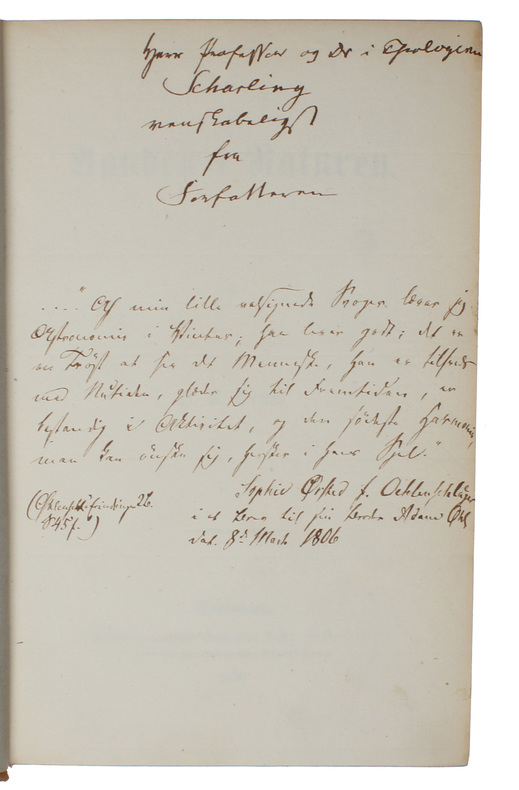
185034812Kjøbenhavn (Copenhagen), Andr. Fred. Høst, 1850. 8vo. Et nydeligt samt. hldrbd. m. samt. tidstypisk rig rygforgyldn. En smule slitage v. false og kapitæler, en anelse svag i forreste indre fals, ellers et nydeligt ekspl., kun indimellem brunplettet. X, 190 XII, 206, (2, -avertissement) pp. 8vo. Nice cont. hcalf w. richly gilt back. A bit of waer to hinges and capitals, and inner front hinge a bit weak, otherwise a very nice and good copy w. only occational brownspotting. X, 190" XII, 206, (2, -advertisement-leaf) pp.
Kjøbenhavn (Copenhagen), Andr. Fred. Høst, 1850. 8vo. Et nydeligt samt. hldrbd. m. samt. tidstypisk rig rygforgyldn. En smule slitage v. false og kapitæler, en anelse svag i forreste indre fals, ellers et nydeligt ekspl., kun indimellem brunplettet. X, 190 XII, 206, (2, -avertissement) pp. 8vo. Nice cont. hcalf w. richly gilt back. A bit of waer to hinges and capitals, and inner front hinge a bit weak, otherwise a very nice and good copy w. only occational brownspotting. X, 190 " XII, 206, (2, -advertisement-leaf) pp.
Very Good Turkish Original three hand-drawn autograph caricatures signed by Turkish cartoonist Özcan Yalti. (21x15 cm). Dated November 17, 1977. Each includes four types. Özcan Yalti was born in 1933, Istanbul. He was graduated from St. Joseph High School followed by the Faculty of Architecture of Istanbul Technical University in 1962. He began to draw caricatures in 1963. His meeting with Turhan Selçuk paved the way for his caricatures to be published in Turkish newspapers. He drew for Yeni-Dergi, Cumhuriyet, Pardon and Akbaba periodicals and journals. He worked as an architect for the Ministry of Public Works in Ankara. (Source: 50 yilin Türk mizah ve karikatürü, BALCIOGLU-ÖNGÖREN).
1 S. 4to. An einen Kollegen über die Übersiedlung ins Haus seines Sohnes: "Nachdem ich beschlossen hatte, meine Vorlesungen gänzl. zu schließen, lag es nahe, Abschied zu nehmen beim Ministerium, weil Freizügigkeit verlangt ward. Mein Sohn hatte mich aufgefordert, ganz zu ihm zu ziehen & ich bin dem gefolgt mit meiner Tochter. Mein Sohn hat hier eine Villa, die er Herbst & Winter mit Familie bewohnt, wir Beide bleiben das Jahr hindurch. Es ist ein liebliches Stückchen Bergstraße & die Lage ist anmutig, das Haus bescheiden, aber fein. Diese Woche wird scharf am Einzug gearbeitet. Die politische Lage forderte Eile, so daß ich nur daher wenig Abschied nehmen konnte, u. das Aufräumen im Hause war so mühevoll. Gern hätte ich Sie noch gesehen [...]".
Very Good Turkish Original typewritten letter signed (TLS) by Ömer Asim Aksoy sent to 'Hisar' periodicals. 30,5x22,5 cm. Dated September, 1, 1969 from Ankara. 'Türk Dil Kurumu' [i.e. Turkish Language Society] letterhead. 1 p. It includes ten lines. Signed as 'Genel yazman' [i.e. General manager]. He says that he's happy to present his book titled 'Özlestirme durdurulamaz' [i.e. Purification of Turkish language cannot be stopped] and about 'Language Celebration Day' on September 26.
Very Good Turkish Original typewritten letter signed (TLS) by Ömer Asim Aksoy sent to 'Türkiye Defteri' periodicals. Oblong: (15x23 cm). Dated 24.1.1974 from Ankara. 'Türk Dil Kurumu' [i.e. Turkish Language Society] letterhead. 1 p. It includes four lines. Signed as 'Genel yazman' [i.e. General manager]. He refused to write an article for 'Türkiye Defteri' periodical and its Kemal Tahir special issue in his letter because of that he has not sufficiently studied on Kemal Tahir who was very famous and important Turkish author.
Very Good Turkish, Ottoman (1500-1928) Original autograph documents signed 'Subasi Ömer (Abdehû)'. Five documents related to 'Ösür' which was a kind of Ottoman tax. Various sizes: 12x9 cm; 17x12 cm. In Ottoman script. 5 separate pages in total. Written in riq'a on special papers with 'ahar'. Signed and sealed by Subasi Ömer. All documents written between the years of 1818-1832 as 'roumi' dates (1234-1248 r.) and start with 'huve' traditionally. Sûbasi was the city guard during the early Ottoman era. During the reign of Sultan Mehmed the Conqueror, 'subasi's began to lose its former effectiveness, but its field of activity was further simplified and expanded. It is claimed that Byzantine institutions had an effect on this according to the historians. (Türkiye Diyanet Vakfi Islam Ansiklopedisi). 'Öshür (Ösür)' [i. e. Tithe] refers to the 'zakat' collected from land products in fiqh (Islamic law). This documents include the subject of ösür (tithe) worth. Written in and for a case 'Kanlicak' kariyesi of Üsküdar (Scutari). They reflect the Ottoman state and tax organization in the early 19th century. Subasi Ömer served probably between the years of 1814-1832 in that area. Some contemporary markings on documents.
ORD-36724e édition. Paris. Le Normant. Barba. 1811. Reliés à la suite: Conaxa ou les Gendres dupés, comédie représentée dans le Collège de la Compagnie de Jésus, pour la distribution des Prix fondée par MM. les nobles Bourgeois de la ville de Rennes. Paris. Michaud. 1812. Puis: La Stéphanéide ou Conaxa, les deux gendres et le Journal de Paris suivis d'un fragment de Lettre à M. Etienne,...par A. J. B. BOUVET. Paris. Dentu. 1812. Puis: Critique raisonnée de la comédie intitulée Les deux gendres, précédée d'un Examen de la Préface supprimée de cette pièce, et de Réflexions sur l'Avis des frères Michaud, éditeurs de Conaxa... Dentu. 1812. In-8 (135 x 220mm) bradel cartonnage rouge, pièce de titre bleue (reliure de l'époque), VIII, 124 pages, 2ff.b., XXVI, (4), 86 pages, 2ff., 35 pp., 2ff., 19pp., et 2ff., VI, 90 pages. On y a joint une lettre manuscrite de 2 pages, signée de l'auteur, faisant état de l'accusation de plagiat dont il fut l'objet après la découverte du manuscrit de Conoxa. Reliure frottée, travail de vers dans la marge inférieure des 40 premières pages, auréoles d'humidité marginales en fin de volume. Exemplaire en état moyen, mais précieux en ce qu'il témoigne de la vive controverse autour de cette comédie qui connut un grand succès et de son auteur devenu célèbre et élu 2 fois à la Comédie Française.
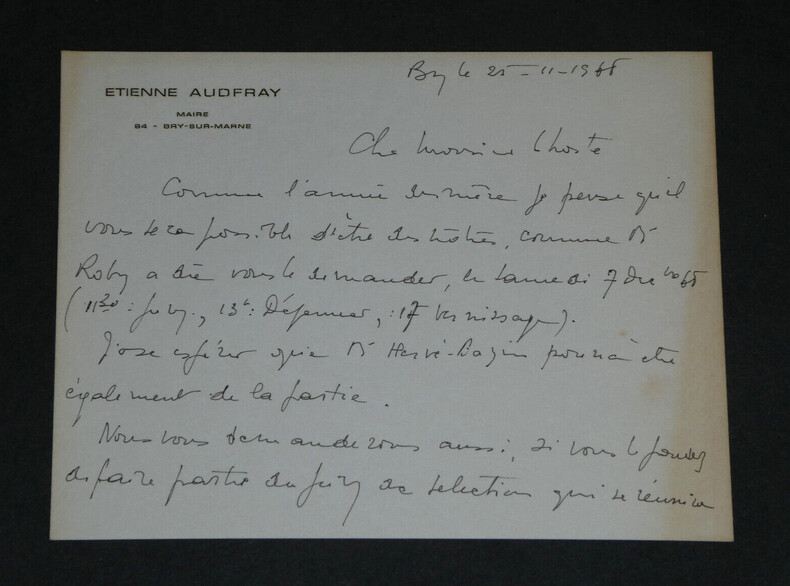
1968boz_004623Étienne AUDFRAY. Carte autographe signée à Pierre LHOSTE, 1968 Carte autographe signée de Étienne Audfray, adressée à Pierre Lhoste, datée du 25 novembre 1968, sur papier à entête à son nom, "Maire 94 - Bry-sur-Marne". Dimensions : 13,5 x 10,5 cm Nombre de pages : 2 pages
1845boz_006307Étienne Arnal - Lettre autographe signée au dramaturge Mélesville - 1845 Lettre autographe signée d'Étienne Arnal, célèbre acteur comique français, datée du 27 novembre 1845. Rédigée à l'encre brune sur feuillet de papier vélin avec monogramme « EA » embossé en tête. Dans cette lettre adressée à l'auteur dramatique Mélesville, Étienne Arnal l'invite à passer à son domicile afin de lui faire part d'une observation qu'il juge importante concernant l'une de ses pièces de théâtre. Dimensions : 10,3 x 12,5 cm. État : Très bon état général. Traces d'anciens onglets de montage et d'annotations au crayon au verso du feuillet. Voir photos et description pour plus de détails. Nombre de pages : 1 page.
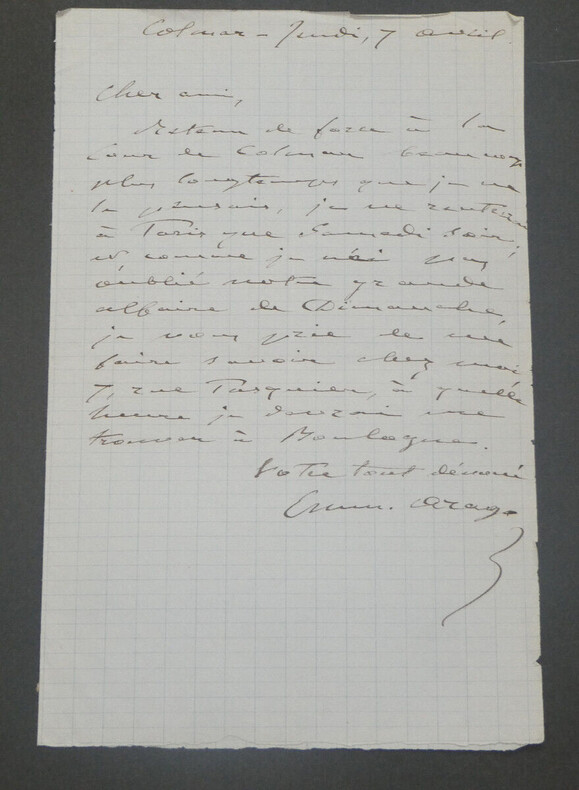
boz_002439Étienne ARAGO. Lettre autographe signée en date du 7 avril Dramaturge Dimensions : 20,9 x 13,3 cm État : Voir photos pour plus de détails. Nombre de pages : 1 page Étienne ARAGO Étienne Vincent Arago est un dramaturge et homme politique français né à Perpignan le 9 février 1802 et mort à Paris 6ᵉ le 6 mars 1892. Républicain engagé, exilé, il fut maire de Paris en 1870.
1837boz_003518Étienne ARAGO. Lettre autographe signée en date du 24 mai 1837. Dimensions : 20,9 x 13,7 cm Nombre de pages : 1 page Étienne ARAGO Étienne Vincent Arago est un dramaturge et homme politique français né à Perpignan le 9 février 1802 et mort à Paris 6ᵉ le 6 mars 1892. Républicain engagé, exilé, il fut maire de Paris en 1870.
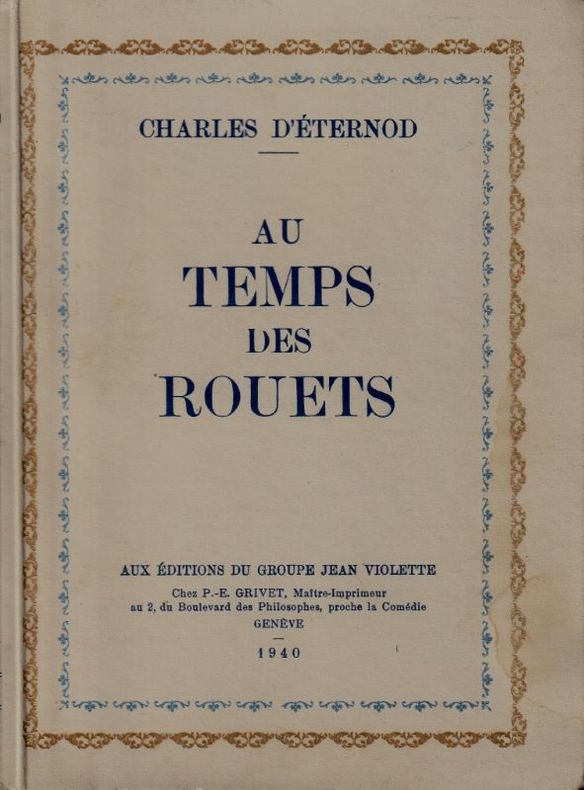
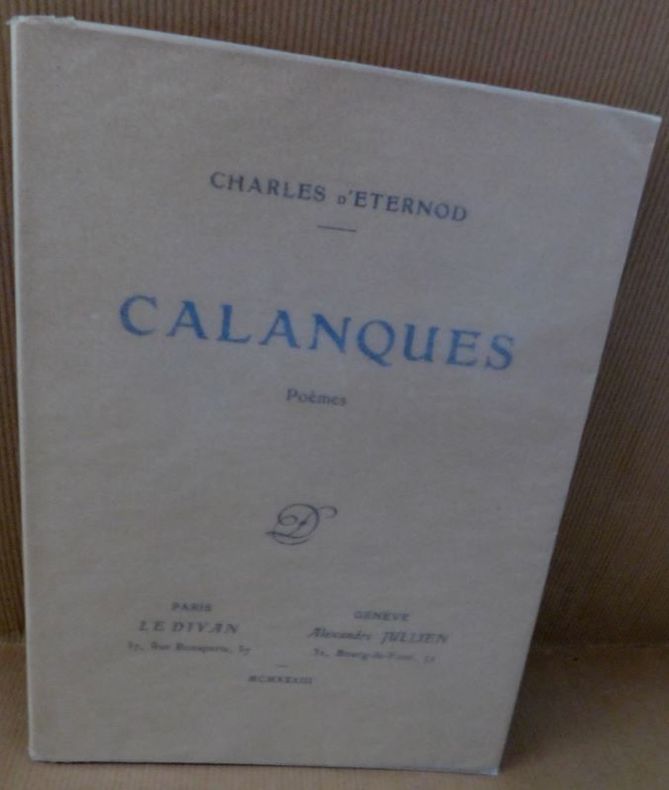
17329Aux Editions du Groupe Jean Violette. 1940. Exemplaire dauteur sur vélin, broché. Envoi autographe signé de Charles dEternod. Bon état.
17319Genève, A. Jullien & Paris, Le Divan. 1933. In-8 broché. 54 pages. E.O. 1/500 sur alfa. [20 Arches / 500 alfa]. Envoi autographe signé de Charles dEternod à Arthur Bretschi. Bon état.
17321. Genève, A. Jullien & Paris, Le Divan. 1933. In-8 broché. 54 pages. E.O. 1/500 sur alfa. [20 Arches / 500 alfa]. Envoi autographe signé de Charles dEternod à Madame Aimée Hauser
1928boz_002646La Maréchale Hubert LYAUTEY. Lettre autographe signée. Dimensions : 13.5 x 21 cm. 2 pages. Etat : Très bon état de conservation.
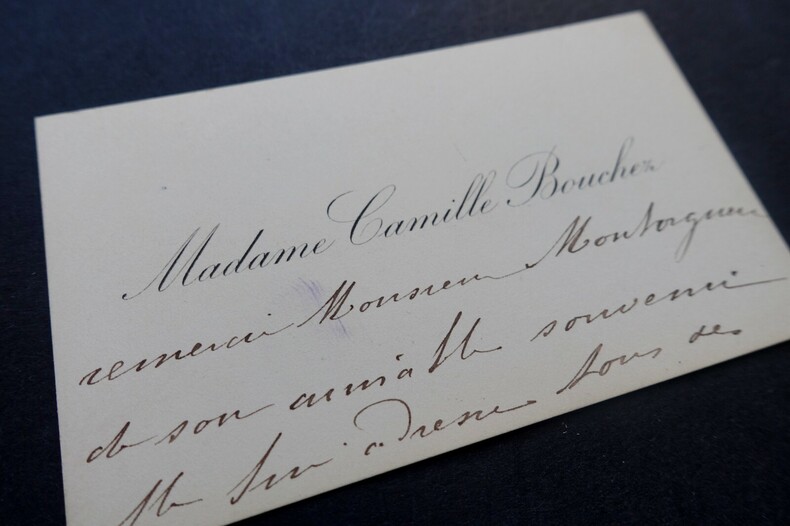
1904boz_005468Madame Camille BOUCHEZ. Carte de visite simple, signée. Carte de visite nominative au nom de Madame l'épouse de Camille Bouchez. Inscription manuscrite en guise de remerciements à Monsieur Montorgueil. Dimensions : 10 x 6 cm. Etat : Bon état de conservation . Camille Bouchez est un avocat et magistrat français, adepte et défenseur du boulangisme. Il démissionna après avoir été amené comme procureur général quand le gouvernement décida de faire comparaître le général Boulanger en Haute-Cour. Il travaillait avec le Ministère de l'Intérieur. Envoi soigné dans un emballage rigide et étanche. Satisfait ou remboursé. Si vous n'êtes pas entièrement satisfait, je reprends la marchandise avec retour à ma charge pour l'Europe et à la charge de l'acheteur pour le reste du monde. N’hésitez pas à visiter ma boutique et affiner vos recherches en fonction des catégories qui vous intéressent. Ma boutique L'Art Délivré. Lettres autographes, vieux papiers, livres anciens, photographies, gravures, timbres… Nous expertisons et/ou rachetons dans toute la France vos lettres, collections de lettres et livres anciens. Merci de votre visite. Jérôme KAYSER.
Various formats. Altogether 16 ff. Including 7 autograph documents on large Folio sheets signed, partly with initials, and partly in the third person within the text, varying between "Mlle la ch're D'Eon," "La ch're D'Eon," and "D.". Ledger pages or receipts, listing prices paid or owed for firewood, lumber, food, clothing and other items, documenting the daily life of an 18th century crossdresser. - Éon de Beaumont was a French transsexual political adventurer, secret agent of Louis XV in Russia (1755), then minister to England. The term "eonism" denoting the tendency to adopt the costume and manners of the opposite sex, is derived from his name. Despite d'Éon's wearing a dragoon's uniform all the time, there were rumors that he was actually a woman, and a betting pool was started on the London Stock Exchange about his true sex. D'Éon finally claimed to be physically not a man, but a woman, and demanded recognition by the government as such. King Louis XVI and his court complied, but demanded that d'Éon dress appropriately and wear women's clothing. D'Éon agreed, especially when the king granted him funds for a new wardrobe. Overall, Charles d’Éon spent his first 49 years as a man, and his last 33 years as a woman. Upon death, a council of physicians discovered that d'Éon's body was anatomically male.
¾ p. Large 8vo. Receipt for household expenses for "Mad.lle la Ch.re D’Éon". - Éon de Beaumont was a French transsexual political adventurer, secret agent of Louis XV in Russia (1755), then minister to England. The term "eonism" denoting the tendency to adopt the costume and manners of the opposite sex, is derived from his name. Despite d'Éon's wearing a dragoon's uniform all the time, there were rumors that he was actually a woman, and a betting pool was started on the London Stock Exchange about his true sex. D'Éon finally claimed to be physically not a man, but a woman, and demanded recognition by the government as such. King Louis XVI and his court complied, but demanded that d'Éon dress appropriately and wear women's clothing. D'Éon agreed, especially when the king granted him funds for a new wardrobe. Overall, Charles d’Éon spent his first 49 years as a man, and his last 33 years as a woman. Upon death, a council of physicians discovered that d'Éon's body was anatomically male.
¾ p. Small 4to. Receipt for household expenses for "M.lle la Ch.re D’Éon", "pour quatre feuillettes de vin rouge ordinaire". - Éon de Beaumont was a French transsexual political adventurer, secret agent of Louis XV in Russia (1755), then minister to England. The term "eonism" denoting the tendency to adopt the costume and manners of the opposite sex, is derived from his name. Despite d'Éon's wearing a dragoon's uniform all the time, there were rumors that he was actually a woman, and a betting pool was started on the London Stock Exchange about his true sex. D'Éon finally claimed to be physically not a man, but a woman, and demanded recognition by the government as such. King Louis XVI and his court complied, but demanded that d'Éon dress appropriately and wear women's clothing. D'Éon agreed, especially when the king granted him funds for a new wardrobe. Overall, Charles d’Éon spent his first 49 years as a man, and his last 33 years as a woman. Upon death, a council of physicians discovered that d'Éon's body was anatomically male.
¾ S. Large 8vo. Receipt for household expenses for "Mlle. D’Éon", here "pour poisson". - Éon de Beaumont was a French transsexual political adventurer, secret agent of Louis XV in Russia (1755), then minister to England. The term "eonism" denoting the tendency to adopt the costume and manners of the opposite sex, is derived from his name. Despite d'Éon's wearing a dragoon's uniform all the time, there were rumors that he was actually a woman, and a betting pool was started on the London Stock Exchange about his true sex. D'Éon finally claimed to be physically not a man, but a woman, and demanded recognition by the government as such. King Louis XVI and his court complied, but demanded that d'Éon dress appropriately and wear women's clothing. D'Éon agreed, especially when the king granted him funds for a new wardrobe. Overall, Charles d’Éon spent his first 49 years as a man, and his last 33 years as a woman. Upon death, a council of physicians discovered that d'Éon's body was anatomically male. - Lower margin with tiny paper defect.
boz_004268Emilie DUBOIS. Lettre autographe signée Actrice française Dimensions : 20 x 13,3 cm État : Voir photos pour plus de détails. Nombre de pages : 1 page Emilie DUBOIS Émilie-Désirée Dubois est une actrice française.