Women in SportsBiblio.com
22 106 résultats
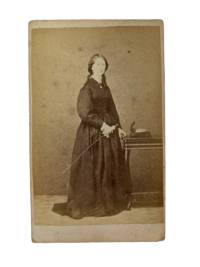
1850205961850. Albumen carte-de-visite depicting a woman dressed in a dark riding habit holding a slender riding crop in her right hand and resting her left on a desk. C.a. 1850s-70s. 2.5" x 4" on cardstock mount. There are no markings on the photograph indicating the woman's identity though her long-sleeved fitted bodice and full skirt are characteristic of American equestrian fashion in the mid-19th century. Riding habits of this period often adapted the tailored silhouette of men's coats paired with practical yet elegant skirts suitable for sidesaddle riding. The riding crop in her hand was both a functional tool for controlling a mount and a fashionable accessory in formal equestrian portraiture. Women's participation in equestrian activities in the 19th century was often associated with skill refinement and social standing with formal portraits like this serving as lasting representations of their horsemanship and style. Overall very good condition. A fine example of mid-19th century equestrian portrait photography. unknown
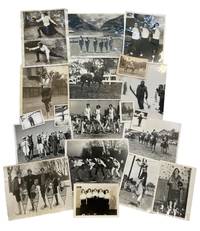
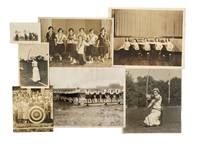
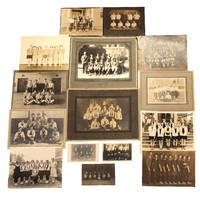
1900158521900. WOMEN IN SPORTS Photographic collection of 18 rare vintage photos celebrating girls and women in sports. Some are identified with names and locations. Locations include New Jersey Canada New York California Massachusetts. Dated approximately 1900-1940. Various sizes; mostly between 8.5" x 11" and 6.5x 8.5" with four smaller photos at 2.25" x 3.5". Black and white silver gelatin photographs. Many pieces show uniformed team photos and action shots documenting girls' increasingly rigorous participation in active sports in the first half of the 20th century. Sports include winter skiing ice skating fencing equestrian and polo bowling swimming track and field rugby. Many of the photos have extended captions on the verso. For example one photo features several Canadian swimmers in uniform in 1930 with the caption: "Swimming champions add to picturesque country at Lake Louise Canada. They are left to right: Agnes Geraghty Olympic swimmer; Catherine Ames Like Lindstrom Metropolitan Distance Champion; Constance Hanf Junior Metropolitan Champion; Eleanor Holm National Champion back stroke 100 and 200 yards; Georgia Colemen National Champion Diver. Miss Coleman is From Los Angeles while the other are members of the Women's Swimming Association New York. Another caption on a photo of several polo players states: "Southern California co-eds to form polo team sorority women at the University of Southern California are preparing to invade one of the few remaining sport sanctuaries of men- polo." Also included is a short of the American Women's Olympic Fencing Team which include: MMarion Lloyd Muriel Guggolz and Dorothy Locke. <br /> <br /> Curated photographic archive celebrating female athletes who overcame stereotypes of women as the "weaker" sex. Because early social constructs regulated physical activity for women few were able to rise up as professional sports competitors until the 20th century. This archive is a testament to these women's historic strides revealing their early physical training their membership in early sport clubs as well as their most daring record-breaking feats. The collection depicts women participating in during the early 20th century. unknown
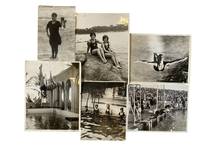
1910218891910. Women in Sports Archive of six photographs documenting women's competitive and recreational swimming 1910s-30s. Includes six silver gelatin press and studio photographs depicting female swimmers and divers dating ca. 1910-1933. Press photos with press annotations and stamps from ACME Newspictures NEA and Culver Service. Locations include Palm Beach Florida and Jones Beach State Park New York. This archive offers a vivid portrayal of women's athleticism in a period when female sports participation was often marginalized with several images highlighting Olympic and championship-level divers and swimmers in action.<br /> <br /> Among the most striking is a 1933 photograph of Clarabel "Clare" Degener University of Michigan senior and 1932 Olympic diving medalist shown in "perfect form" mid-dive during an exhibition at Westchester Country Club Rye New York. The original caption and NEA reference stamp appear on verso. Another photograph dated July 23 1933 shows the start of the second heat in the 880-yard freestyle event during the Women's National Swimming Championships at Jones Beach featuring swimmers launching into the water before a packed audience. A third image captures Helen Meany famed Olympic diving champion in mid-somersault at a Palm Beach facility-also with original press label and NEA date stamp 1930. One early photo dating around 1910 depicts a female swimmer proudly holding a trophy at the shoreline signaling the emergence of women in competitive aquatic sports. Two additional studio portraits show swimmers at leisure: a duo seated lakeside in matching suits and caps and a group of four people standing in the water at a pool identified on verso as the family of international diplomats and military officers including Inga Bryn of Norway and Barine Drake daughter of Col. G.D. Drake.<br /> <br /> Verso stamps and typed captions mostly intact and legible. Overall very good condition. A visually compelling testament to early women's sports history documenting the emergence of female champions in swimming and diving at both recreational and elite levels during a transformative period in gender and athletic culture. unknown
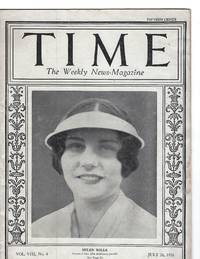
1926164521926. Tennis Champion Helen Willis. Time: the Weekly News-Magazine. July 26 1926. Vol. VIII No. 4. Time Publishing Company. Helen Wills is known as one of the greatest woman tennis players of all time. She won 31 Grand Slam titles during her career 2 Olympic gold medals and was the Wimbledon champion a record-setting 8 times record unbroken until 1990. In 1933 forty years before the "Battle of the Sexes" match in which Billie Jean King beat Bobby Riggs in an exhibition game Helen Wills defeated Phil Neer then the #8 nationally ranked male tennis player in the US. This issue of Time featuring Wills across the cover was the same year as the "Match of the Century" wherein Wills then ranked #2 in the world faced Suzanne Lengdon the #1 ranked French star. Very good condition. unknown
1911171151911. turn of the century Championship Women's Baseball Team Photo Postcard. "The Western Bloomer Girls-Ladies Champion Base Ball Club-Watervliet Mich." Vintage photo-illustrated postcard of the girls baseball team. No date c. 1911. Eleven uniformed girls pose for a team photograph. 3.5 x 5.5 inches. The Western Bloomer Girls were founded in 1911 by Maud Nelson a renowned pitcher in her own right. "Bloomer Girl" baseball teams of women were formed starting in the 1890s taking their name from Amelia Bloomer who designed loose fitting trousers that women wore while playing sports. Bloomer Girls teams rarely played each other but traveled across America challenging local amateur and minor league men's teams. Bloomer Girls were disciplined sportswomen and frequently won games with their solid skills and competitive spirits. Interestingly these "Boomer Girl" teams were integrated when it came to gender; while most of the players were women each roster had at least one male player. In this image two male players pose in the second row. Verso is blank with space for message and address. Light crease to bottom left corner. In very good condition. unknown
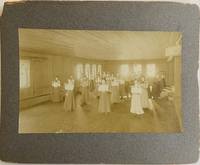
1786219 century vintage albumen photograph featuring four rows of women holding free weights in a gymnasium. Image itself Measuring 8.25" x 5" inches mounted on photographer's board of aprox 10" x 8" inches. Albumen print. Circa 1890's. The women stand in tightly single file rows holding dumbbell weights in both hands at shoulder height ready to raise their arms above their heads. Their faces are composed most of them unsmiling though a few smiles seem to break through making light of the occasion. The women wear long skirts in solid colors with low-heeled boots just visible beneath and shirtwaist blouses some adorned in small bows at the neck or leather bags at the hip. The classroom is long with wooden floors and wooden planked walls and ceiling with pipes and ducts exposed an apparent recreational space or Gymnasium. The portrait documents women's fitness as a novel endeavor. Photographer's board has wearing along the edges and one small ink blot. Photograph is sepia toned and well defined though somewhat overexposed but subjects are clearly visible. Such an early image of weight lifting for women is scarce; in very good condition. unknown
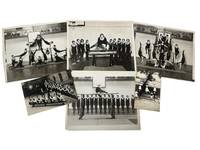
1910175701910. Early Female Gymnasts Photo Archive with six silver gelatin photographs of various sizes circa 1920s. These photos documents early female gymnasts before it was an accepted sports for female athletes. At this point in history gymnastics was still a mostly male sport but starting at the 1928 Olympics women were able to compete in "artistic gymnastics". Includes 4 press photos from New York city Female Gymnasts measuring 10" x 8" inches the set of 4 photographs are from the Savage School of Physical Education in New York City and appears to be taken during the 1920s. These 4 photographs bear press captions and stamps on verso. The women are photographed in a gymnasium in a series of gymnastic formations. Press captions give names and brief descriptions on verso. The archive also includes 2 other smaller images that seem even earlier in time one is a circa 1910 real photo postcard showing girls and their coach performing gymnastics and walking along a beam. All photos are overall in very good condition. unknown
18131Silver gelatin press photo of women's lacrosse team. Los Angeles. C. 1920s. Measures 8 x 10 inches. Photo shows three female players one fielding the ball with her stick the other two rushing to intercept her a male referee caught between them only partially visible. Verso reads "The Hurons of Pasadena fall before the Iroquois of Los Angeles in opening game of ladies La Cross league of California.Referee Eddie Hume is taking an awful chance in this mixup-but he escaped unhurt." Photo by Kadel and Herbert New York. Verso stamped by central press association. Lacrosse was a Native American game first adopted by French Jesuit missionaries. The first women's teams were established in the 1920s elevating the American version of the game from one of brute strength to skill. Small tear to bottom of photo does not affect the image. Good condition. unknown
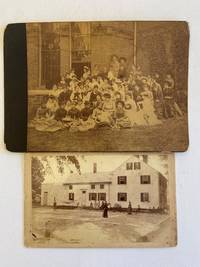
1880178721880. 2 Albumen photos of early recreational tennis game. Circa 1880's. Larger photo measures 6.75" x 8.5" inches on original photographer's board measuring 9.75" x 6.75". Smaller photo measures 7.25" x 4.5" inches on white photographer's board measuring 8" x 5" inches. Photo was taken by Marston photo studio of Bangor Maine. Larger photo shows a large group of young women posed in tiers on a lawn in front of a large brick building. The front row is spread across the grass with others in chairs behind them and the back row sitting on the open windowsill and ledge along the side of the building. The group is entirely female suggesting maybe an early women's college all of them dressed in high-collared dresses long skirts with bustles many in hats and some with parasols. In the front row four women hold tennis rackets as if posing before or after a game. This restless group of young women are pictured in the 1870s or 1880's. The other photo shows a tennis game at play with a man on one side of the net and two women on the other holding rackets on a tennis lawn. The court has been constructed on a lawn with painted boundaries and a net which was customary in 19th century. In the background is a large white wooden house. Lawn tennis came into fashion in the 1870's as an upper-class hobby marking leisure time for players and spectators. Some spotting and Light staining on photos does not effect clarity of images. Overall in very good condition. unknown
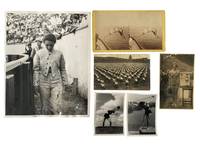
1900224351900. Sports and HobbiesWomen's History Archive of six original photographs depicting women in sports and physical culture ca. 1900s-1950s. A striking group of five silver gelatin photographs and one stereoview documenting early and mid-20th century women's athletics across a range of sports including bullfighting competitive swimming mass calisthenics and weight training. The archive is anchored by a powerful press photograph of Bertha Trujillo a Colombian woman bullfighter shown bloodstained and exhausted yet defiant after leaving the ring as documented by a Hamilton Wright press caption on verso dated May 7 1956. The image captures the rare spectacle of a woman operating within a hypermasculine and violently gendered tradition underlining her transgressive presence in the public arena of the corrida. Trujillo's visibility as a "girl bullfighter" not only subverts gendered codes of spectacle and aggression but also underscores the fraught place of women in national rituals of machismo.<br /> <br /> Also included is an early gelatin silver stereoview of a woman mid-dive from a boat into open water ca. 1900s her long dress captured in graceful suspension. A vintage sepia-toned postcard shows a massive synchronized physical training display by women in uniform skirts likely in a European stadium setting. A third photograph features a smiling young woman swimmer in a tight one-piece suit standing beside a trophy likely ca. 1920s-30s exuding post-competition confidence and the growing visibility of women in elite amateur sport. Two additional gelatin silver prints ca. 1930s-40s show women engaged in solitary strength and flexibility exercises: one throwing a medicine ball under clouded sky the other stretching a resistance band at the edge of a pond. Each of these images gestures toward evolving conceptions of female strength embodiment and public physicality across the 20th century. The photographs collectively trace a visual history of women's contested access to spaces of physical prowess and public acclaim. Minor edge wear and surface rubbing to a few prints. Overall very good condition. A varied archive showcasing women's athleticism in the early 20th century. unknown
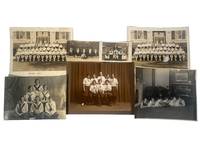
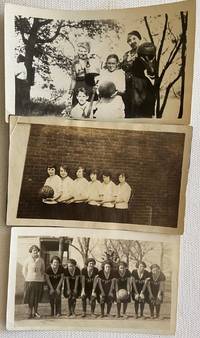
1919185111919. Unidentified photographers photograph archive of women's basketball teams 1919 to 1932 documenting the early development of organized women's athletics in the United States following the introduction of basketball as a women's sport in the 1890s. The material provides primary visual evidence of women's participation in competitive team sports supporting research into gender physical education and the expansion of athletic opportunities for women in the early twentieth century. These images capture institutional and team-based participation during a period when women's athletics remained contested yet increasingly visible.<br /> <br /> Archive of seven silver gelatin photographs depicting formal team portraits ranging from small groups of five players to a large team of approximately thirty-seven individuals. Photographs measure between approximately 3.5 x 5.5 inches and 8.75 x 10.75 inches. Players are shown arranged in rows often with a central figure holding a basketball marked with team initials and year. Uniforms include high-top athletic shoes short skirts and sailor-style tops reflecting standardized early women's basketball attire. Several photographs include handwritten identifications on the verso naming individual players while one larger image on matte paper bears the inscription "Basketball 1931-32" along with a studio stamp indicating production in Boston. The sequence of images demonstrates changes in uniform style and team size over more than a decade while maintaining consistent compositional formats typical of organized team portraiture.<br /> <br /> Seven photographs. Women's basketball introduced by physical educator Senda Berenson shortly after the sport's invention in 1891 became a significant avenue for women's physical activity despite ongoing debates about propriety and health. By the 1920s women's teams were established across schools and regional leagues reflecting broader acceptance of female athletic participation. This archive documents that period of expansion preserving visual records of team organization and identity prior to the formal institutionalization of women's professional basketball later in the twentieth century. Minor edge wear and light foxing to some prints; one duplicate image with tears and surface loss; remaining photographs clear and stable; overall very good condition. A concise visual record of early women's basketball teams and the growth of female athletic participation. unknown
1910178711910. Women in Sports Photo archive of 3 photos of women holding basketballs two with women in early women's sports uniforms. Circa 1910-20s. Small silver gelatin prints. Each measures 4.5" x 2.75" inches. The photos encapsulate the excitement of young women entering the sport. In two of the photos players wear knee-length bloomers as part of their uniform. Women's basketball began in 1892 the year after the invention of the sport. Bloomers were designed in 1896 to preserve the modesty of skirts with the free movement of shorts. One photo shows a team of seven lined up in high school uniforms marked F.H.S their coach standing to one side. Another shows a different group of six girls also in uniforms posing in a line with a ball marked R.H.S. The third photo shows a woman in long dress holding a ball aloft with another woman holding a bucket presumably a stand in for the net and a young girl and boy posing with them the girl holding a basketball. Early photos of Recreational sports for girls are still uncommon. All three photos in good condition. unknown
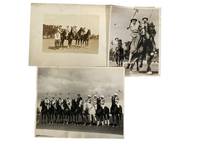
1920219031920. Women in Sports Archive of three photographs documenting women's equestrian sports 1920s-40s. Three original silver gelatin press photos capturing women actively engaged in and preparing for matches-scenes that challenge the male-dominated image of early 20th-century polo. Taken in the United States and Canada these images reflect the increasing public visibility and athletic accomplishments of women showcasing their skill camaraderie and the gradual erosion of gender barriers in elite sporting environments.<br /> <br /> The earliest photograph dated September 26 1928 depicts a historic international match between Canada and the United States-the first known women's international polo game in the U.S. according to the verso text. The players from Alberta are seen poised beside their horses as they await the match's commencement in Rye New York. The image bears the credit "International Newsreel" with annotations indicating it was distributed as a news photo under the slug "Two Teams." The second photograph is captioned "Women Now Play Polo" and is dated March 20 1940. It features prominent players Joan Baker daughter of famed Australian sportsman "Snowy" Baker Mrs. "Willie" Tevis and Yvette Barette at the Riviera Country Club in Santa Monica California. The image highlights how women's polo had begun gaining serious popularity and skill by this time especially in celebrity-adjacent venues like the Riviera. The third undated photograph by Boston-area studio photographer Paul J. Weber embossed stamp: "Paul J. Weber / Dorchester Centre Mass." shows a lineup of women riders mounted and dressed in coordinated attire likely posed before or after a match. Together the photographs capture a pivotal often overlooked chapter in the history of women's sports where gender and athletic prowess intersected in a highly public arena. Verso stamps and original caption slips intact on two press photos with clear studio embossing on the third. Overall very good condition. A compelling archive chronicling the rise of women in polo offering vital documentation of the sport's early gender integration and the public image of athletic women in the early 20th century. unknown
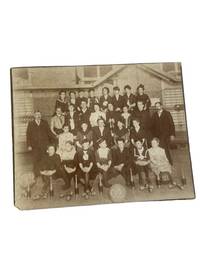
1902182601902. Original Albumen photograph of women in physical education class. 1902. Measures 9.75 x 8 inches. Mounted to photographer's board. Image shows 26 women and girls seated in tiers and posing with various early exercise equipment including dumbbells and large leather balls marked with the year. One man poses wiwth the women in suit and tie and two older men presumably instructors pose alongside the girls one of them extending a hand to touch the shoulder of the girl beside him who looks away. The women's eyes are turned from the camera expressions fixed and unsearchable. They appear to be in a school gymnasium a ladder hung like a track on the wall behind them and racks of free weights beneath it. Women's exercise was first introduced as calisthenics a European import in the 1830s which consisted of light choreographed movements not unlike dance steps. By the late 1800s exercise had been closely linked to women's educational reform. Educational activist Catherine Beecher advocated broadly for physical education as a safeguard for female health and for forming good physical habits in the young. Corner very slightly clipped on one side. Light sunning to image. Overall good condition. unknown
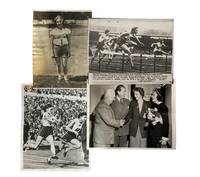
1925218901925. Women in Sports Archive of four photographs documenting women's track and field achievements from 1925 to 1956 highlighting pioneering female athletes in Olympic and exhibition competition. Includes NEA and United Press photo service stamps and typed caption slips on versos. The images span the 1920s to post-WWII era and depict notable moments in women's sports history from athletes representing Australia the Netherlands and beyond. They capture critical milestones in the visibility and legitimization of women in professional athletics especially in Olympic contexts where female participation was still relatively novel and contested.<br /> <br /> Included is a striking 1956 action shot of Australia's Shirley Strickland clearing the final hurdle en route to her gold medal victory in the 80-meter hurdles at the Melbourne Olympics where she set a new Olympic record of 10.7 seconds. The image is identified via an INP Radio Soundphoto caption. A 1952 United Press photo from Helsinki captures the dramatic baton drop in the women's 4x100 relay by Australia's Marjorie Jackson who had earlier taken gold in the 100-meter sprint; the caption dramatically underscores how the error "killed Australia's chances." A third image shows Dutch Olympic legend Fanny Blankers-Koen-winner of four gold medals at the 1948 London Games-greeted with tulips and accolades at New York's Idlewild Airport in May 1955. The accompanying caption notes her role as both a mother and athletic icon foregrounding the persistent framing of female athletes through maternal identity. Lastly a ca. 1925 press photo shows an unnamed track competitor on the field with the reverse stamped August 11 1925 suggesting the early presence of women in organized publicly documented competition during a decade when such participation was still controversial. All images well-preserved with clear annotations on three captioned photos. Overall very good condition. This archive offers an illuminating view into women's evolving presence on the global athletic stage highlighting moments of both triumph and adversity in a narrative of gender progress within competitive sports. unknown
1910219051910. Archive of original photographs documenting women's participation in athletics and organized physical culture during the early twentieth century when women's sports and exercise programs increasingly became accepted within schools colleges camps and recreational organizations. The photographs show women engaged in archery synchronized gymnastics calisthenics and cheer leading during a period when female athletic participation expanded alongside broader debates concerning women's health education public visibility and social independence. The photographs provide visual evidence of the physical culture movement as it shaped women's recreational and educational environments in the United States and abroad preserving both formal athletic training and communal performance activities that contributed to changing expectations surrounding women's physical activity and public presence.<br /> Collection consists of seven original silver gelatin photographs dating approximately from the 1910s through the 1930s. The archive includes several photographs of women participating in organized physical education exercises and athletic activities while dressed in period sporting attire. One image dated July 5 1928 documents uniformed women performing synchronized gymnastic drills during a Sokol Festival dress rehearsal in Prague capturing rows of participants in coordinated motion during a major international physical culture gathering influenced by Central European nationalist and athletic traditions. Another photograph from the 1910s-1920s shows a group of young women posed with medicine balls Indian clubs and batons while wearing sailor-inspired gymnasium uniforms associated with school or collegiate athletic programs. A separate 1930s image depicts a cheerleading squad in matching lettered "S" sweaters posed in formation within a school auditorium. Archery appears prominently throughout the archive. One press photograph portrays Olympic diver and sportswoman Helen Meany Balfe standing with a bow on the grounds of White Sulphur Springs West Virginia as identified by a typed caption on the verso. Another image depicts Stella M. Ives identified in manuscript drawing a bow while dressed in full sporting attire. A vernacular photograph portrays four young women practicing archery in the hills above Troy New York including one identified as Louise Hatch of Troy with a handwritten verso inscription linking the group to Bridgewater Massachusetts. The final photograph shows a large assembly of young women gathered on outdoor steps beside a prominent archery target possibly at a camp or collegiate event emphasizing organized recreation and group participation.<br /> The archive documents the increasing visibility of women's athletic participation during the early twentieth century when organized exercise and sports became associated with women's education health reform and public modernity. Physical culture programs in schools colleges camps and civic organizations promoted athletics as both disciplined recreation and social training while sports such as archery and gymnastics offered women expanded opportunities for public competition and physical expression. Particularly notable is the range of activities represented from regimented calisthenic performance to recreational archery and cheerleading illustrating the broad spectrum of athletic environments available to women before the widespread professionalization of women's sports. Light wear and occasional handling marks consistent with age; photographs remain well-preserved overall in very good condition. A visually engaging archive documenting the growth of women's athletics and physical culture in the early twentieth century. unknown
1918185121918. Women's basketball photograph archive 1918-1929 documents the early institutionalization of women's competitive athletics in the United States recording team organization uniform development and player identification in the decades following the sport's introduction to women's education. Basketball adapted for women in the 1890s under the direction of physical educator Senda Berenson at Smith College expanded into intercollegiate and regional competition by the early twentieth century despite ongoing debate over women's participation in organized sport. These images provide direct visual evidence of that expansion with named players and structured teams indicating the normalization of women's basketball within school and community settings during the interwar period.<br /> <br /> Archive of 15 silver gelatin photographs ranging in size from approximately 3.5 x 5.5 inches to 11 x 13 inches dating between 1918 and 1929. All images are formal team portraits with groups of six to twelve players in some cases accompanied by coaches. Many photographs include handwritten identifications on versos naming players or teams. Several compositions feature a central player holding a basketball marked with team initials and year. The photographs document changes in athletic dress including high top sneakers short skirts sailor style tops and later variations incorporating shorts reflecting evolving standards of movement and athletic practicality. Produced during a period when women's athletics expanded within educational institutions while remaining subject to cultural scrutiny the archive provides material for the study of gender norms physical education and the development of organized sport prior to formal Olympic inclusion of women's basketball in 1976. The progression of uniforms and team structures across the decade offers evidence of shifting expectations regarding women's physical activity and public visibility in competitive environments. Light edge wear and minor foxing to some prints; images remain sharp and fully legible. Overall very good condition. unknown
Z1-F-057-01232Human Kinetics. Used - Good. Ships from UK in 48 hours or less usually same day. Your purchase helps support Sri Lankan Children's Charity 'The Rainbow Centre'. Ex-library so some stamps and wear but in good overall condition. 100% money back guarantee. We are a world class secondhand bookstore based in Hertfordshire United Kingdom and specialize in high quality textbooks across an enormous variety of subjects. We aim to provide a vast range of textbooks rare and collectible books at a great price. Our donations to The Rainbow Centre have helped provide an education and a safe haven to hundreds of children who live in appalling conditions. We provide a 100% money back guarantee and are dedicated to providing our customers with the highest standards of service in the bookselling industry. Human Kinetics unknown
1894315670London: Chapman and Hall 1894. First edition. Folding map and 23 illustrations many full-page from photographs by Colonel Paget. 6 108 pp. 1 vols. 8vo. Publisher's beige cloth gilt.Spine darkened spine ends a bit worn scattered foxing including to map. First edition. Folding map and 23 illustrations many full-page from photographs by Colonel Paget. 6 108 pp. 1 vols. 8vo. Sport and adventure in the Ogaden region hunting lion. as well as crocodile gazelle oryx etc. Czech p. 177 Chapman and Hall unknown books
Hardcover in unclipped dust jacket. Very good condition. Remainder mark on page block foot and closed tear to jacket near spine foot. Pages are sound and clear. TA Used
2000013177Manhattan Beach CA: Waverider Publications 2000. 104pp bw ills. Pictorial card covers. Minor rubbing and slight edge wear. SIGNED BY AUTHOR ON TITLE PAGE. Collection of true stories of the triumphs foibles and happy mishaps of a life of surfing. In additon to this book the author produced 2 surfing films- Always Another Wave & The Search for Gomez. Signed by Author. First Edition. Trade Paperback. Very Good. 8vo. Waverider Publications Paperback
1978023351NY: Vantage Press Inc. 1978 Book. VG. Hardcover. Stated First Edition. Rare nautical novel in very nice condition. Vantage Press, Inc. hardcover
199530226Worcestershire: SELDEC 1995. 2nd. Soft cover. Very Good. 8.3x6.6x1.0in. updated second edition; strip of darkening along bottom edge of front cover bottom finger broken on plastic comb. <br>Selcal is an abbreviated form of the term selective calling used in aeronautical radio communication. This directory lists 8210 aircraft and is arranged in four sections: the first lists selcals in alphabetical order; the second lists aircraft by registration in alphabetical order; the third features aircraft listed by carrier in alphabetical order; the fourth lists the three letter codes by which the carriers are identified. <br>0.89lb 8.3x6.6x1.0in SELDEC paperback
Contiene ilustraciones.Esta obra esrealmenteun manual de este arte marcial cuya maxima principal es No atacar jamas el primero.En las paginas de este libroel lector hallara todo lo referente a este arte marciala sus posturasal movimiento de piesmanospiernasbrazos y demas partes del cuerpoy tambien una relacion de los puntos vitales mas importantes.