22 141 résultats
1978575221978. 8-1/2 x 13-1/2 inches sight. Matted framed and glazed. Signed in pencil by the artist "Robert Seaman 1978" Fine. 8-1/2 x 13-1/2 inches sight. Robert Seaman is a painter teacher and free-lance illustrator whose work in published form has been distributed internationally. His original paintings and drawings are held in private collections throughout the country and he was artist-in-residence at Vermont's Hawk Inn and Mountain Resort and The Legacy Publishing Group. He currently teaches at and is represented by the Sharon Arts Center in Peterborough and the Chaffee Art Center in Rutland VT. He has illustrated for Gray's Sporting Journal Fly Fisherman Magazine Massachusetts Audubon Society's Sanctuary Magazine Lady Bug and Cricket Magazines and a number of books in the hunting and fishing fields-most recently "The History of the Grand Cascapadia River. unknown books
1975575211975. Epreuve d'Artiste. 11-3/4 x 9-1/4 inches sight. Matted framed and glazed. Signed in pencil by the artist "F. Beriue 1975. Epreuve d'Artiste. 11-3/4 x 9-1/4 inches sight. unknown books
194456888New York: Alfred A. Knopf 1944. First edition No. 145 of 275 copies on Rives Liampre All-Rag Paper signed containing an extra color plate. Frontispiece and 4 color plates from paintings by Dr. Edgar Burke 10 photographic plates in black & white. 161 ii pp. 1 vols. 8vo. Original green boards gilt tan cloth spine with lettering piece very fine in slightly worn board slipcase. First edition No. 145 of 275 copies on Rives Liampre All-Rag Paper signed containing an extra color plate. Frontispiece and 4 color plates from paintings by Dr. Edgar Burke 10 photographic plates in black & white. 161 ii pp. 1 vols. 8vo. A beautiful copy of a handsome book signed by author and illustrator on limitation page. Biscotti p. 242; Heller 2:693 Alfred A. Knopf unknown books
194456888New York: Alfred A. Knopf 1944. First edition No. 145 of 275 copies on Rives Liampre All-Rag Paper signed containing an extra color plate. Frontispiece and 4 color plates from paintings by Dr. Edgar Burke 10 photographic plates in black & white. 161 ii pp. 1 vols. 8vo. Original green boards gilt tan cloth spine with lettering piece very fine in slightly worn board slipcase. First edition No. 145 of 275 copies on Rives Liampre All-Rag Paper signed containing an extra color plate. Frontispiece and 4 color plates from paintings by Dr. Edgar Burke 10 photographic plates in black & white. 161 ii pp. 1 vols. 8vo. A beautiful copy of a handsome book signed by author and illustrator on limitation page. Biscotti p. 242; Heller 2:693 Alfred A. Knopf unknown
4to., First Edition, with a frontispiece, and numerous photographs and illustrations throughout; cloth, upper board and backstrip lettered in blue, a very good, bright, clean copy in unclipped dustwrapper.
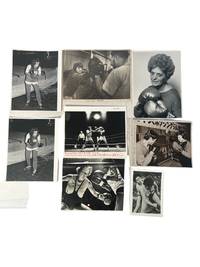
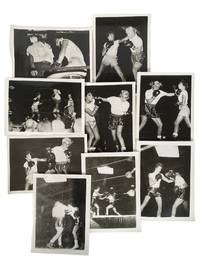
1970201881970. Women's boxing photograph archive 1974 to 1983 documents women as fighters trainers judges and sanctioned competitors during a period when boxing remained one of the most heavily gendered professional sports. The archive provides primary visual evidence of women's participation in combative athletics before women's boxing received Olympic recognition as a medal sport in 2012 and it records several forms of ring authority: women entering the ring as athletes women training male and female boxers and Eva Shain appearing as a pioneering judge. Shain became the first woman to judge a world heavyweight championship bout when she scored the 1977 Muhammad Ali and Earnie Shavers fight at Madison Square Garden placing one image in this group within the broader history of women claiming official authority in professional boxing.<br /> <br /> The archive consists of eight black-and-white silver gelatin photographs of women boxers and women in combat-sport settings circa 1970s to 1980s measuring from approximately 5 x 7 inches to 8 x 10 inches. One press photograph shows a co-ed boxing match between Sheila McGuire and Buddy DiBenedetto in a ring with a referee watching closely behind them. Another press photograph shows Eva Shain at age seventy-one wearing boxing gloves presenting her public identity through the equipment of the sport she judged. A 1983 photograph shows boxing coach Butch Fohndan training a young woman at Palmer Boxing Club in Alaska. A 1974 photograph from Japan shows Masako Takatsuki training a young male boxer; the attached press information identifies Takatsuki as a twenty-seven-year-old cosmetician and the only female boxing trainer-manager then licensed by the Japan Boxing Commission to spar and act as a second. Another action photograph shows an outdoor wrestling match between Gisa Pipa and Aggi Tillman with Tillman holding Pipa from behind. Two photographs show an unidentified woman near a boxing ring in a crouched stance with a direct combative expression suggesting training or promotional posing. The final 1975 photograph shows Sharon Allbery charging toward Zinda Foster at Seattle Center Arena in what contemporary women's boxing history sources identify as the first sanctioned female prizefight in Seattle Washington and the Pacific Northwest.<br /> <br /> The photographs are significant because they show women's boxing as a developing practice rather than a single symbolic breakthrough: fighters in sanctioned and mixed bouts a female judge associated with a heavyweight title fight a Japanese woman trainer-manager local gym instruction and women using combat poses to claim athletic presence. Their strongest research value lies in the way they document the infrastructure around women's boxing including referees licenses gyms press captions arenas and training relationships alongside images of women's physical force. Light handling wear and minor edge wear; press details present on several images; photographs remain crisp with clear ring gym and figure detail; overall very good. Concentrated women's sports photography archive documenting the contested expansion of women's boxing and combat-sport authority in the 1970s and early 1980s. unknown
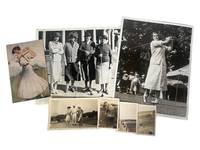
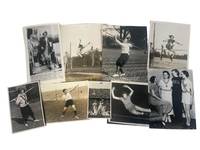
1910200811910. Women's competitive golf archive 1910s to 1930s documents women golfers in practice tournament and club settings during the formative decades of organized women's golf in the United States. The group provides visual evidence of women's athletic participation in a sport long associated with country-club respectability social access and gendered expectations about dress leisure and competition. The U.S. Women's Amateur Championship began in 1895 as one of the USGA's first three championships and the USGA identifies it as marking the beginning of women's competitive golf in the United States; these photographs and postcard show how that competitive culture appeared in everyday and press imagery in the decades that followed. <br /> <br /> The archive consists of seven items dated between the 1910s and 1930s: six silver gelatin photographs and one brightly illustrated postcard measuring from approximately 1.75 x 2.75 inches to 7.25 x 9 inches. The photographs include a 1934 press image of golfer Barbara Stoddard in a swing position; a 1935 lineup from the Annual Women's St. Valentine Golf Tournament identifying Helen Waring Sarah Fownes Wadsworth Myrom W. Marr and W.C. Fownes Jr.; three small circa 1928 photographs of women positioned with clubs on a golf range; and an early 1930s image of two women posed with a man at a country club the women holding several clubs with one woman wearing trousers. The illustrated postcard from the early twentieth century shows a woman swinging a club in an athletic outfit still shaped by long-skirted fashion rather than later sportswear. Across the group recurring details include golf clubs held as markers of athletic identity posed swings tournament lineup conventions country-club settings and changing women's clothing from long skirts to less restrictive dress.<br /> <br /> The archive records women's golf as both competitive sport and social performance making visible the relationship between athletic skill class-coded club culture and evolving public ideas about women's physical capability. Its strongest research value lies in the mix of press photographs vernacular practice images tournament documentation and illustrated popular culture allowing comparison between women as actual competitors and women as stylized sporting subjects. Light handling wear minor edge wear and typical surface wear to photographs and postcard; images remain clear and identifiable; overall very good. Cohesive women's sports archive documenting early twentieth-century women golfers as competitors club participants and subjects of changing athletic representation. unknown
1910201861910. Women's participation in boxing long preceded formal recognition of the sport for female athletes developing through informal exhibitions training clubs and novelty bouts that challenged prevailing gender norms. Although women were largely excluded from organized boxing competitions during the nineteenth and early twentieth centuries scattered photographic evidence demonstrates that women continued to box recreationally and publicly despite social restrictions. This archive of photographs dating from the early twentieth century through the mid twentieth century documents women participating in boxing across a range of informal settings illustrating the gradual emergence of female athletic culture in a sport historically defined as masculine.<br /> <br /> Archive of sixteen black and white photographs including six silver gelatin prints and one real photo postcard measuring approximately 2.5 x 3.5 inches to 3.5 x 5.25 inches dating from the 1910s through the 1950s. The earliest image a real photo postcard dated August 1914 depicts two women wearing corsets and long dresses while sparring with boxing gloves before a mixed group of spectators. The postcard bears a pencil inscription on the verso reading "August 1914 For fun women boxers Francis Edith." Another early photograph shows two women posing with gloved fists raised before a snowy background with the inscription "Grace Miss Vandehei boxing This is Grace's roommate. A fine girl she's here now." Later photographs from the 1920s depict staged boxing encounters between a man and a woman with the female boxer dressed in athletic trousers and high heeled shoes reflecting the novelty and spectacle often associated with early female boxing exhibitions. One image shows the pair squared off with raised fists while another captures the moment of a punch landing against the man's chest. Another photograph shows two women sparring on a ship deck while surrounded by onlookers one boxer wearing a dress and curlers beneath her head covering while raising her gloved fists before a mixed audience of men and women.<br /> <br /> Boxing has historically generated controversy due to its physical intensity and female participation in the sport remained marginal for decades. Women occasionally boxed publicly as early as the eighteenth century yet organized opportunities remained rare. Women's boxing appeared briefly as a demonstration sport at the 1904 Olympic Games in St. Louis and training clubs such as Andrew Newton's Women's Boxing Club in London emerged during the 1920s. Nevertheless women's boxing did not become an official Olympic sport until the 2012 Olympic Games. The photographs in this archive illustrate the persistence of women athletes who trained and competed informally despite these restrictions offering visual evidence of women's athletic experimentation and resilience during a period of shifting gender expectations in sport. Sixteen photographs including silver gelatin prints and a real photo postcard measuring approximately 2.5 x 3.5 inches to 3.5 x 5.25 inches. Photographs clear and well preserved with light handling wear. Overall condition very good. unknown
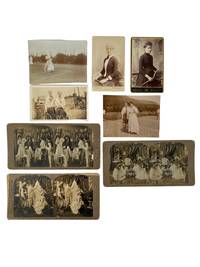
1880206021880. Unidentified photographers female tennis player photograph archive ca. 1880s-1910s documents women's participation in organized sport and recreational culture during the late nineteenth and early twentieth centuries supporting research into gender roles physical activity and educational environments for women in the Victorian and Edwardian periods. The group captures tennis as one of the few socially sanctioned athletic pursuits for women showing both formal portraiture and active play. The inclusion of seminary-based stereoviews alongside studio cartes-de-visite and outdoor scenes establishes a transatlantic visual record of how tennis intersected with women's education leisure and identity formation during a period of restricted physical and social mobility.<br /> <br /> Eight original photographs including five albumen prints and three stereoviews sepia toned ranging from approximately 2.5 x 4 inches to 3 x 4.5 inches. Two cartes-de-visite depict waist-length portraits of women holding tennis rackets dressed in late nineteenth-century attire including fitted bodices and high collars; versos bear photographer imprints for Hellis & Sons of London and George Goodman of Margate. Additional images show women engaged in doubles matches on grass courts including one action-oriented scene with players mid-swing wearing wide-brimmed hats and layered dresses. One photograph shows two young women in matching outfits possibly school uniforms standing in a yard holding rackets. The three stereoviews dated 1905 and issued by C.H. Graves of Philadelphia are captioned "A Masquerade at the Seminary Confidences" "Trying on the Costumes" and "Planning to Scare the Freshies" each depicting groups of young women in a dormitory interior; tennis rackets are visible mounted on the wall in the background linking athletic culture to residential school life. Based on the photographer and setting the images may relate to a women's seminary such as Darlington Seminary in West Chester Pennsylvania.<br /> <br /> Produced during the decades following the introduction of lawn tennis to the United States in 1874 the archive situates women's participation in sport within broader developments in leisure education and shifting norms of female physicality. The imagery documents the persistence of restrictive dress including corseted garments and long skirts even in athletic contexts underscoring the negotiation between mobility and propriety. Minor surface wear consistent with age with strong image clarity and tonal stability across prints. Overall in very good condition. unknown
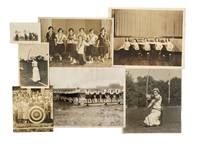
1910219051910. Archive of original photographs documenting women's participation in athletics and organized physical culture during the early twentieth century when women's sports and exercise programs increasingly became accepted within schools colleges camps and recreational organizations. The photographs show women engaged in archery synchronized gymnastics calisthenics and cheer leading during a period when female athletic participation expanded alongside broader debates concerning women's health education public visibility and social independence. The photographs provide visual evidence of the physical culture movement as it shaped women's recreational and educational environments in the United States and abroad preserving both formal athletic training and communal performance activities that contributed to changing expectations surrounding women's physical activity and public presence.<br /> Collection consists of seven original silver gelatin photographs dating approximately from the 1910s through the 1930s. The archive includes several photographs of women participating in organized physical education exercises and athletic activities while dressed in period sporting attire. One image dated July 5 1928 documents uniformed women performing synchronized gymnastic drills during a Sokol Festival dress rehearsal in Prague capturing rows of participants in coordinated motion during a major international physical culture gathering influenced by Central European nationalist and athletic traditions. Another photograph from the 1910s-1920s shows a group of young women posed with medicine balls Indian clubs and batons while wearing sailor-inspired gymnasium uniforms associated with school or collegiate athletic programs. A separate 1930s image depicts a cheerleading squad in matching lettered "S" sweaters posed in formation within a school auditorium. Archery appears prominently throughout the archive. One press photograph portrays Olympic diver and sportswoman Helen Meany Balfe standing with a bow on the grounds of White Sulphur Springs West Virginia as identified by a typed caption on the verso. Another image depicts Stella M. Ives identified in manuscript drawing a bow while dressed in full sporting attire. A vernacular photograph portrays four young women practicing archery in the hills above Troy New York including one identified as Louise Hatch of Troy with a handwritten verso inscription linking the group to Bridgewater Massachusetts. The final photograph shows a large assembly of young women gathered on outdoor steps beside a prominent archery target possibly at a camp or collegiate event emphasizing organized recreation and group participation.<br /> The archive documents the increasing visibility of women's athletic participation during the early twentieth century when organized exercise and sports became associated with women's education health reform and public modernity. Physical culture programs in schools colleges camps and civic organizations promoted athletics as both disciplined recreation and social training while sports such as archery and gymnastics offered women expanded opportunities for public competition and physical expression. Particularly notable is the range of activities represented from regimented calisthenic performance to recreational archery and cheerleading illustrating the broad spectrum of athletic environments available to women before the widespread professionalization of women's sports. Light wear and occasional handling marks consistent with age; photographs remain well-preserved overall in very good condition. A visually engaging archive documenting the growth of women's athletics and physical culture in the early twentieth century. unknown
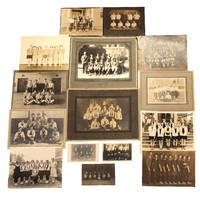
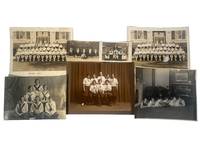
1918185121918. Women's basketball photograph archive 1918-1929 documents the early institutionalization of women's competitive athletics in the United States recording team organization uniform development and player identification in the decades following the sport's introduction to women's education. Basketball adapted for women in the 1890s under the direction of physical educator Senda Berenson at Smith College expanded into intercollegiate and regional competition by the early twentieth century despite ongoing debate over women's participation in organized sport. These images provide direct visual evidence of that expansion with named players and structured teams indicating the normalization of women's basketball within school and community settings during the interwar period.<br /> <br /> Archive of 15 silver gelatin photographs ranging in size from approximately 3.5 x 5.5 inches to 11 x 13 inches dating between 1918 and 1929. All images are formal team portraits with groups of six to twelve players in some cases accompanied by coaches. Many photographs include handwritten identifications on versos naming players or teams. Several compositions feature a central player holding a basketball marked with team initials and year. The photographs document changes in athletic dress including high top sneakers short skirts sailor style tops and later variations incorporating shorts reflecting evolving standards of movement and athletic practicality. Produced during a period when women's athletics expanded within educational institutions while remaining subject to cultural scrutiny the archive provides material for the study of gender norms physical education and the development of organized sport prior to formal Olympic inclusion of women's basketball in 1976. The progression of uniforms and team structures across the decade offers evidence of shifting expectations regarding women's physical activity and public visibility in competitive environments. Light edge wear and minor foxing to some prints; images remain sharp and fully legible. Overall very good condition. unknown
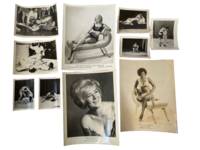
1940206421940. Women's Sports Women's wrestling photograph archive documenting amateur competitions gymnasium training and professional wrestling performers between the 1940s and the 1970s. The images record women participating in a sport historically dominated by men illustrating the gradual emergence of female wrestling as both an amateur athletic activity and a professional entertainment circuit during the mid twentieth century.<br /> <br /> Archive of ten photographs including nine black and white silver gelatin prints and one sepia toned image measuring approximately 3.5 x 4.5 inches to 8 x 10 inches. Several early photographs from the 1940s depict women grappling in an indoor ring during staged matches. Later images show girls wrestling during a gymnasium class setting while classmates watch from the sidelines. Three studio photographs from the 1970s portray professional wrestlers associated with promoter Mary Lillian Ellison known professionally as The Fabulous Moolah.<br /> <br /> Portraits include full length promotional photographs of Joyce Grable of Ozark Alabama Lilly Thomas of Memphis Tennessee and a headshot of Paulla Kaye of Oklahoma City Oklahoma. These performers were active on the professional wrestling circuit during a period when women's wrestling was gaining visibility in regional promotions across the United States. Female wrestling remained controversial throughout much of the twentieth century facing both cultural criticism and sensationalized marketing. Light wear consistent with age. Very good condition. A visual record of women participating in amateur and professional wrestling across several decades of American sports culture. unknown
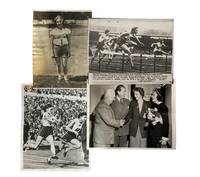
1925218901925. Women in Sports Archive of four photographs documenting women's track and field achievements from 1925 to 1956 highlighting pioneering female athletes in Olympic and exhibition competition. Includes NEA and United Press photo service stamps and typed caption slips on versos. The images span the 1920s to post-WWII era and depict notable moments in women's sports history from athletes representing Australia the Netherlands and beyond. They capture critical milestones in the visibility and legitimization of women in professional athletics especially in Olympic contexts where female participation was still relatively novel and contested.<br /> <br /> Included is a striking 1956 action shot of Australia's Shirley Strickland clearing the final hurdle en route to her gold medal victory in the 80-meter hurdles at the Melbourne Olympics where she set a new Olympic record of 10.7 seconds. The image is identified via an INP Radio Soundphoto caption. A 1952 United Press photo from Helsinki captures the dramatic baton drop in the women's 4x100 relay by Australia's Marjorie Jackson who had earlier taken gold in the 100-meter sprint; the caption dramatically underscores how the error "killed Australia's chances." A third image shows Dutch Olympic legend Fanny Blankers-Koen-winner of four gold medals at the 1948 London Games-greeted with tulips and accolades at New York's Idlewild Airport in May 1955. The accompanying caption notes her role as both a mother and athletic icon foregrounding the persistent framing of female athletes through maternal identity. Lastly a ca. 1925 press photo shows an unnamed track competitor on the field with the reverse stamped August 11 1925 suggesting the early presence of women in organized publicly documented competition during a decade when such participation was still controversial. All images well-preserved with clear annotations on three captioned photos. Overall very good condition. This archive offers an illuminating view into women's evolving presence on the global athletic stage highlighting moments of both triumph and adversity in a narrative of gender progress within competitive sports. unknown
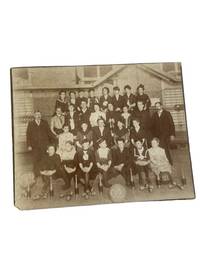
1902182601902. Original Albumen photograph of women in physical education class. 1902. Measures 9.75 x 8 inches. Mounted to photographer's board. Image shows 26 women and girls seated in tiers and posing with various early exercise equipment including dumbbells and large leather balls marked with the year. One man poses wiwth the women in suit and tie and two older men presumably instructors pose alongside the girls one of them extending a hand to touch the shoulder of the girl beside him who looks away. The women's eyes are turned from the camera expressions fixed and unsearchable. They appear to be in a school gymnasium a ladder hung like a track on the wall behind them and racks of free weights beneath it. Women's exercise was first introduced as calisthenics a European import in the 1830s which consisted of light choreographed movements not unlike dance steps. By the late 1800s exercise had been closely linked to women's educational reform. Educational activist Catherine Beecher advocated broadly for physical education as a safeguard for female health and for forming good physical habits in the young. Corner very slightly clipped on one side. Light sunning to image. Overall good condition. unknown
1921185131921. Unidentified photographers photograph archive of women's track and field athletes 1921 to 1949 documenting the expansion of women's participation in international athletics and Olympic competition during the early twentieth century. The material provides primary visual evidence of women competing in events historically excluded from female participation supporting research into gender and sport Olympic history and the institutional acceptance of women's athletic achievement across multiple nations.<br /> <br /> Archive of nine silver gelatin photographs many issued as press images with original article clippings or captions mounted on the verso while others include handwritten identifications of athletes. The photographs depict women actively engaged in track and field events including javelin throwing high jumping and discus. One press photograph shows Fanny Blankers-Koen arriving by airplane captioned as an Olympic champion and mother following her victories at the 1948 Summer Olympics where she won four gold medals. Another image issued as a photographic postcard captures Gisela Mauermayer mid-discussion throw during the 1936 Berlin Olympics with a full stadium and officials visible in the background. Additional photographs include three javelin throwers identified on the verso three high jumpers captured in motion clearing the bar and one press image depicting a coach with members of a women's Olympic track team in uniform accompanied by descriptive captions outlining their roles and achievements. The images emphasize athletic motion competition settings and formal presentation through press distribution.<br /> <br /> Nine photographs ranging in size from approximately 3.75 x 5.5 inches to 8 x 10 inches. These images emerge from a period in which women's track and field gained increasing international recognition following initial exclusion from Olympic competition with early twentieth-century advocacy and independent competitions contributing to eventual inclusion. The presence of Olympic medalists alongside lesser-known competitors situates the archive within a broader landscape of athletic participation and achievement. Minor edge wear and occasional surface markings including ink notation on one image; otherwise photographs remain clear and well-preserved; overall very good condition. A focused visual record of women's athletic advancement and Olympic participation in the early twentieth century. unknown
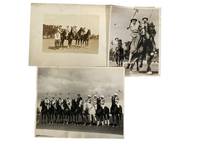
1920219031920. Women in Sports Archive of three photographs documenting women's equestrian sports 1920s-40s. Three original silver gelatin press photos capturing women actively engaged in and preparing for matches-scenes that challenge the male-dominated image of early 20th-century polo. Taken in the United States and Canada these images reflect the increasing public visibility and athletic accomplishments of women showcasing their skill camaraderie and the gradual erosion of gender barriers in elite sporting environments.<br /> <br /> The earliest photograph dated September 26 1928 depicts a historic international match between Canada and the United States-the first known women's international polo game in the U.S. according to the verso text. The players from Alberta are seen poised beside their horses as they await the match's commencement in Rye New York. The image bears the credit "International Newsreel" with annotations indicating it was distributed as a news photo under the slug "Two Teams." The second photograph is captioned "Women Now Play Polo" and is dated March 20 1940. It features prominent players Joan Baker daughter of famed Australian sportsman "Snowy" Baker Mrs. "Willie" Tevis and Yvette Barette at the Riviera Country Club in Santa Monica California. The image highlights how women's polo had begun gaining serious popularity and skill by this time especially in celebrity-adjacent venues like the Riviera. The third undated photograph by Boston-area studio photographer Paul J. Weber embossed stamp: "Paul J. Weber / Dorchester Centre Mass." shows a lineup of women riders mounted and dressed in coordinated attire likely posed before or after a match. Together the photographs capture a pivotal often overlooked chapter in the history of women's sports where gender and athletic prowess intersected in a highly public arena. Verso stamps and original caption slips intact on two press photos with clear studio embossing on the third. Overall very good condition. A compelling archive chronicling the rise of women in polo offering vital documentation of the sport's early gender integration and the public image of athletic women in the early 20th century. unknown
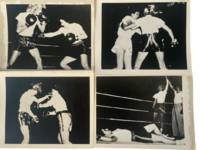
1940206121940. Unidentified photographers female boxing photograph archive late 1940s-1950s documents the emergence of organized women's boxing in the United States supporting research into gender barriers in professional sport postwar athletic culture and the early institutional recognition of female fighters. The photographs capture three central figures in mid-century women's boxing-Barbara Buttrick Phyllis Kugler and Jo-Ann Hagen-whose careers intersected in exhibition bouts and championship contests during a period when women's participation in boxing required legal and promotional negotiation. The material provides visual evidence of competitive matches and ringside moments at a time when women's boxing was only beginning to secure formal licensing in certain jurisdictions.<br /> Nine black-and-white silver gelatin photographs each approximately 5 x 7 inches depicting in-ring action and between-round scenes. Three images show a bout between Hagen and Kugler with both fighters captured mid-exchange in close quarters gloves raised and bodies angled forward in offensive and defensive stances. Five photographs document a match between Kugler and Buttrick likely connected to their 1957 championship contest in San Antonio Texas where the fighters successfully petitioned for a state boxing license for women; scenes include active exchanges as well as ring positioning under overhead lighting. One image shows Buttrick seated in her corner resting between rounds attended by seconds just outside the frame. Across the group the fighters wear standard boxing attire of the period and the ring environment-ropes canvas and audience proximity-appears consistent with mid-century professional venues.<br /> Produced during a period when women's boxing was contested both culturally and legally the archive documents early efforts to legitimize female participation in a sport historically restricted to men. Buttrick's victory in Texas marked a milestone in the recognition of women's championship boxing while Kugler's extensive bout record and Hagen's career-long rivalry with both fighters illustrate the development of a competitive circuit. All three figures were later inducted into the International Women's Boxing Hall of Fame underscoring their role in establishing the sport's foundations. Light surface wear consistent with handling with strong contrast and clear detail throughout. Overall in very good condition. unknown
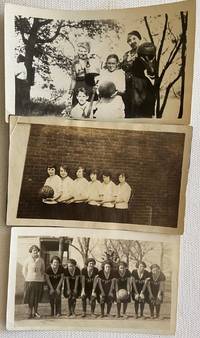
1910178711910. Women in Sports Photo archive of 3 photos of women holding basketballs two with women in early women's sports uniforms. Circa 1910-20s. Small silver gelatin prints. Each measures 4.5" x 2.75" inches. The photos encapsulate the excitement of young women entering the sport. In two of the photos players wear knee-length bloomers as part of their uniform. Women's basketball began in 1892 the year after the invention of the sport. Bloomers were designed in 1896 to preserve the modesty of skirts with the free movement of shorts. One photo shows a team of seven lined up in high school uniforms marked F.H.S their coach standing to one side. Another shows a different group of six girls also in uniforms posing in a line with a ball marked R.H.S. The third photo shows a woman in long dress holding a ball aloft with another woman holding a bucket presumably a stand in for the net and a young girl and boy posing with them the girl holding a basketball. Early photos of Recreational sports for girls are still uncommon. All three photos in good condition. unknown
16662Women Sports Education Women's Athletic Council secretary's handwritten minutes written in many hands concerning school teams and fundraisers for basketball soccer volleyball and other sports from academic years 1938-1947. Original boards. 8.5 x 6.5 in. Title on front cover" Composition Book Property of Women's Athletic Council Secretary's Book" . 90 pages. Includes additional loose papers related to the council. "Each W.A.C. girl who fulfills her obligations in officiating and playing during the year 2 semesters in which she plays in two sports and coaches one or vice versa is given an additional star for her council work. If she does not fulfill this she is dropped from the council."<br/><br/>Handwritten entries spanning almost a decade of council business relating to managing and promoting Sports for Women. "The first meeting of the Women's Athletic council was called to order by Miss Helen Wily on September 27. Nominations were opened for new president. Eva Murdock was formally elected to the office. The question of . a coach for freshman hockey was introduced and Wasdine Freedline was appointed to this position. The president made a request of new business and in response to the request freshmen practice days were set for Tuesdays and Thursdays. Sophomore practice days were set for Wednesdays and Fridays. A motion was properly moved and seconded that the meeting be adjourned. Respectfully submitted Anita Brown Sec."<br/><br/>In addition to coaches and rosters for Varsity Freshman and Sophomore teams in basketball volleyball softball and soccer; the council organized various social functions. "New business. There was a discussion of the possibility of a social function before the term ends but nothing definite was decided." "After debating over several different types of social function It was decided that we have a Weiner Roast down by the river Friday Sept. 20. Ruth Barr and Marylou Gourley were appointed by the president to buy the food." They also oversaw tournaments and games for students. "Plans were discussed for the Speedball Tournament." "An intramural tournament including ping-pong shuffleboard badminton to be healed between the five sororities and a team of non-sorority girls." Some wear and loss to lower portion of spine. In very good condition. unknown books
1919185111919. Unidentified photographers photograph archive of women's basketball teams 1919 to 1932 documenting the early development of organized women's athletics in the United States following the introduction of basketball as a women's sport in the 1890s. The material provides primary visual evidence of women's participation in competitive team sports supporting research into gender physical education and the expansion of athletic opportunities for women in the early twentieth century. These images capture institutional and team-based participation during a period when women's athletics remained contested yet increasingly visible.<br /> <br /> Archive of seven silver gelatin photographs depicting formal team portraits ranging from small groups of five players to a large team of approximately thirty-seven individuals. Photographs measure between approximately 3.5 x 5.5 inches and 8.75 x 10.75 inches. Players are shown arranged in rows often with a central figure holding a basketball marked with team initials and year. Uniforms include high-top athletic shoes short skirts and sailor-style tops reflecting standardized early women's basketball attire. Several photographs include handwritten identifications on the verso naming individual players while one larger image on matte paper bears the inscription "Basketball 1931-32" along with a studio stamp indicating production in Boston. The sequence of images demonstrates changes in uniform style and team size over more than a decade while maintaining consistent compositional formats typical of organized team portraiture.<br /> <br /> Seven photographs. Women's basketball introduced by physical educator Senda Berenson shortly after the sport's invention in 1891 became a significant avenue for women's physical activity despite ongoing debates about propriety and health. By the 1920s women's teams were established across schools and regional leagues reflecting broader acceptance of female athletic participation. This archive documents that period of expansion preserving visual records of team organization and identity prior to the formal institutionalization of women's professional basketball later in the twentieth century. Minor edge wear and light foxing to some prints; one duplicate image with tears and surface loss; remaining photographs clear and stable; overall very good condition. A concise visual record of early women's basketball teams and the growth of female athletic participation. unknown
16662Women Sports Education Women's Athletic Council secretary's handwritten minutes written in many hands concerning school teams and fundraisers for basketball soccer volleyball and other sports from academic years 1938-1947. Original boards. 8.5 x 6.5 in. Title on front cover" Composition Book Property of Women's Athletic Council Secretary's Book" . 90 pages. Includes additional loose papers related to the council. "Each W.A.C. girl who fulfills her obligations in officiating and playing during the year 2 semesters in which she plays in two sports and coaches one or vice versa is given an additional star for her council work. If she does not fulfill this she is dropped from the council."<br /> <br /> Handwritten entries spanning almost a decade of council business relating to managing and promoting Sports for Women. "The first meeting of the Women's Athletic council was called to order by Miss Helen Wily on September 27. Nominations were opened for new president. Eva Murdock was formally elected to the office. The question of . a coach for freshman hockey was introduced and Wasdine Freedline was appointed to this position. The president made a request of new business and in response to the request freshmen practice days were set for Tuesdays and Thursdays. Sophomore practice days were set for Wednesdays and Fridays. A motion was properly moved and seconded that the meeting be adjourned. Respectfully submitted Anita Brown Sec."<br /> <br /> In addition to coaches and rosters for Varsity Freshman and Sophomore teams in basketball volleyball softball and soccer; the council organized various social functions. "New business. There was a discussion of the possibility of a social function before the term ends but nothing definite was decided." "After debating over several different types of social function It was decided that we have a Weiner Roast down by the river Friday Sept. 20. Ruth Barr and Marylou Gourley were appointed by the president to buy the food." They also oversaw tournaments and games for students. "Plans were discussed for the Speedball Tournament." "An intramural tournament including ping-pong shuffleboard badminton to be healed between the five sororities and a team of non-sorority girls." Some wear and loss to lower portion of spine. In very good condition. unknown
Hardcover and jacket, both with a hint of wear along upper edge. One or two light marks on page block; pages are clean, with clear text and images. TS Used
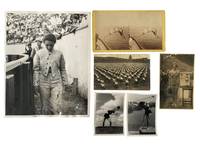
1900224351900. Sports and HobbiesWomen's History Archive of six original photographs depicting women in sports and physical culture ca. 1900s-1950s. A striking group of five silver gelatin photographs and one stereoview documenting early and mid-20th century women's athletics across a range of sports including bullfighting competitive swimming mass calisthenics and weight training. The archive is anchored by a powerful press photograph of Bertha Trujillo a Colombian woman bullfighter shown bloodstained and exhausted yet defiant after leaving the ring as documented by a Hamilton Wright press caption on verso dated May 7 1956. The image captures the rare spectacle of a woman operating within a hypermasculine and violently gendered tradition underlining her transgressive presence in the public arena of the corrida. Trujillo's visibility as a "girl bullfighter" not only subverts gendered codes of spectacle and aggression but also underscores the fraught place of women in national rituals of machismo.<br /> <br /> Also included is an early gelatin silver stereoview of a woman mid-dive from a boat into open water ca. 1900s her long dress captured in graceful suspension. A vintage sepia-toned postcard shows a massive synchronized physical training display by women in uniform skirts likely in a European stadium setting. A third photograph features a smiling young woman swimmer in a tight one-piece suit standing beside a trophy likely ca. 1920s-30s exuding post-competition confidence and the growing visibility of women in elite amateur sport. Two additional gelatin silver prints ca. 1930s-40s show women engaged in solitary strength and flexibility exercises: one throwing a medicine ball under clouded sky the other stretching a resistance band at the edge of a pond. Each of these images gestures toward evolving conceptions of female strength embodiment and public physicality across the 20th century. The photographs collectively trace a visual history of women's contested access to spaces of physical prowess and public acclaim. Minor edge wear and surface rubbing to a few prints. Overall very good condition. A varied archive showcasing women's athleticism in the early 20th century. unknown
Book shows light wear to covers only. Binding is square, text/interior is clean and free of marking of any kind. About 10 pages of b&w illustrations, many photos of Greek, Roman, Spartan sculpture and decorated pottery. 191 pages. The glue in this perfect bound book is over 50 years old and is likely fragile. "A witty pagent of pagan ladies in such diverse roles as wrestler, goddess, cortesan and candidate." -- From the cover
17116Women baseball players. No date c. 1910s. Vintage Real photo postcard that was never sent. Two women in "Ivanhoe" baseball uniforms. 5.5 x 3.5 in. Figures identified on the verso in handwritten blue ink "Goldie & Irma Wade". The history of women playing the game of baseball dates back to the 19th century. In most cases these early women's baseball teams were considered a novelty act. Permanent teams and leagues were rare but they did exist as evidence by this photograph in which 2 serious ball players pose for the camera. In some rare cases women even played on men's teams; perhaps the case for these two who strangely pose without the rest of their teammates. Minor surface damage with a bit lossof emultion to center of image at knee level. Handling dents. In good to very good condition. unknown books