2 277 résultats
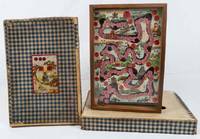
1915218485東京. Tokyo. Circa1915. Very attractive framed glass-topped wooden board depicting the route of the Tōkaidō Railway between Tokyo and Kobe. A metal ball is guided along the printed course with numerous holes into which the ball may fall before reaching the end of the line. The coloured lithographed surface shows key stations and landmarks along the route. 24.4 x 16.4 x 2.7cm presented in its original quite worn cardboard box with title label 25 x 17 x 3.4cm. Original box present though very worn with washi repairs a prior owner's details inside in the lid of the box. The game itself is in excellent bright condition. A charming early 20th-century Japanese tama korogashi ball-rolling or bagatelle-style game combining amusement with geography. These games were popular in the Taishō and early Shōwa eras and represent a forerunner to later mechanical pinball and educational map games. <br> <br>In this hand-held game the player travels from Tokyo to Kobe on the Tokaido Railway line via a small ball which is contained in the box. It is a game of skill with several traps holes which need to be avoided before reaching to the final destination of Kobe. The railway line this game depicts first opened in 1889 between Shinbashi and Kobe and the line was extended to Tokyo Station in 1914. The line which mainly followed the traditional Tokaido Road became the major transportation line in Japan. . unknown
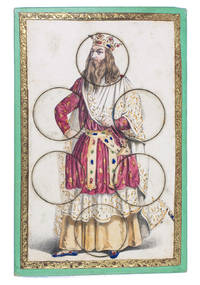
184017799Paris 1840. 19.5 x 13 cm. R. Lacouchin With 3 finely lithographed plates mounted on 3 thick green paperboard cards. The lithographs are framed with a gold-coloured ornamental border. The images on the cards are all beautifully hand coloured and the 3 cards depict respectively a crowned king in ornate robes a beautiful young lady in a green dress and a young man or possibly a court jester in an extravagant yellow and green outfit. Each card has 6 large circular movable pieces to be removed or inserted as the game demands in various circumstances. 3 puzzles. Three beautiful and complete puzzle cards with round movable pieces for example for a game of metamorphosis or lotto. While no rules are present or other specific indications given the cards with their beautiful coloured illustrations are quite intriguing by themselves.The illustration of the young man in the yellow and green outfit is signed "R. Lacouchin". Slightly foxed otherwise in very good condition. unknown
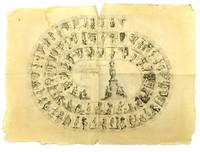
118195Berlin Simon Schropp c. 1790. Engr. broadsheet. Large folio 400x505 mm. Uncut with wide margins 465x635 mm folded. Small tears in foldings and in the outer margins. Stain in upper part. Rare version of this board game with the main title and the individual ones in four languages; French German English and Polish. cf V & A Museum MISC.124-1989.Based on the English version published in 1790 as â€The New Game of Human Life†by John Wallis and Newbury the Berlin publisher Simon Schropp published one version with French text only and this one in four languages. They all go back to Crépy’s â€Le Nouveau Jeu de la Vie Humaine†from ca. 1775.The aim of the game is to reach immortality and the end space nr 84 of the game is the Immortal Man. This version contains no printed rules but the game is so similar to that published by John Wallis that it will be played the same way:The game is played with two dice. Each tile on the playing field has instructions to follow. For instance: â€The Studious Boy at 7 shall receive a Stake and shall proceed to 42 the place of the Oratorâ€. â€The Negliant boy at 11 shall pay a Stake and shall remain two rounds without spinningâ€. â€The Married Man at 34 shall receive two Stakes for his Wife’s Portion and go to be a Good Father at 56â€. â€The Romance Writer at 40 shall pay two Stakes and go back to the Mischievous Boy at 5â€. Etc.â€The Immortal Man who has existed 84 years seems worthy by his Talents and Merit to be a Model for the Close of Life which can end only be Eternity. When we arrive at the No. 84 we shall have gained all we can by this Game but if we exceed this number we must go back as many points as we have proceeded beyond it. The Age of Man is divided in seven periods of twelve years viz. Infance to Youth Manhood Prime of Life Sedate Middle-age Old age Decreptitude and Dotageâ€. Some famous people are depicted. As philosoper nr 62 is Voltaire the poet nr 41 is Alexander Pope and the geographer nr 47 is Captain Cook pointing at a map. The final end space Immortality in the Berlin version shows a monument to Leopold of Brunswick Prince of Brunswick-Wolfenbüttel 1752-85. His charity as a general towards his soldiers made him famous and he drowned while trying to save his soldiers lives in the great flood of the River Oder. unknown
AQ20891s.i. Dorset: s.n. 1798 Single leaf broadside. Uncut but for gutter margin. Old folds and slight marginal creasing soiling to verso else a fine copy completed in manuscript. With three embossed tax stamps totalling 3 Guineas to upper margin. Leading Anglo-Catholic Thomas Weld of Lulworth Castle's 1750-1810 certified permit for the killing of game endorsed by William Burnet Clerk of the Peace for Dorset. The Game Acts of 1784 1785 and 1791 made possession by of an annual game killing certificate for compulsory under pains of a £20 fine for both 'Gentlemen' and Gamekeepers wishing to engage in such activities. Registers of those who had paid Game Duty were kept by local Clerks of the Peace transmitted to the Commissioners of Stamp Duty and in many cases published in local newspapers. Weld is better known for his philanthropic activities - notably with the Society of Jesus - and his famous library at Lulworth Castle which at one point housed both the Lutrell Psalter and the Bedford Hours. . Dimensions 330 x 200 mm. [s.n., 1798] unknown
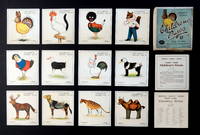
19303220291<p><em>Complete with 12 coloured and numbered cards; 11.5 x 11 cm; 6 double page score cards each with instructions mostly filled in with answers in pencil; and a a 'Key' card containg the corect answers; contained in the original box 11.5 x 13 x 1.8 cm the lid with coloured title label some dust marks minor damp stain affecting two edges.</em></p><p>A party game where the illustrated cards are placed around a room and each of the children given a score card then trying to recognise the four different birds animals and toys combined into a composite picture. Assorted head body legs and tails of rabbits chickens giraffes elephants hens camels etc. are combined together. The toys including a clown doll and 'golliwog' but this is chiefly a semi-educational game as the majority of the Nuzoo creatures are real.</p><p>E. T. W. Dennis and Sons principal productions were postcards - including novelty topographical and latterly saucy types - commercial art greeting cards and tourist guides etc. Party games seem to have been a small offshoot of their business with other titles including Guessit Pintail Pinnet and Jumbles.</p> [Scarborough: E. T. W. Dennis and Sons. Ltd.],
192017556Lyon, Cumin et Masson, Collection Amis du Vieux Lyon, 1920 ; in-12 carré, demi maroquin rouge à petits coins, dos à nerfs surlignés à froid, fleurons et titre dorés, filets dorés sur les plats, tête dorée, premier plat de couverture conservé (reliure moderne) ; (12), 98 pp. , (1) f. d'imprimeur (Audin).
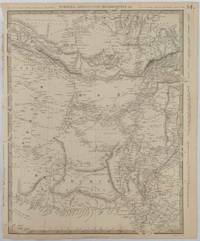
1852224152London.: Society for the Diffusion of Useful Knowledge; Charles Knight. 1852. Engraved map 39 x 30.5 cms; 41 x 34 cms sheet relief throughout shown by hachures publisher's or binder's numeric stamp 94A the margins a little browned and chipped with loss to the two keys at the inner edge marking Indian and Persian distances but the map in very good condition. A highly detailed example of political and military cartography from the height of the Victorian era capturing the Central Asian frontier at the dawn of the "Great Game". <br> <br>The map covers the expanse of Central Asia stretching from the deserts of modern-day Uzbekistan and Turkmenistan down through Afghanistan and Pakistan to the Arabian Sea. It maps out the Emirate of Bukhara in the north and the Desert of Khiva. It explicitly references the "Nomadic Tribes of Turkomans" roaming the steppes. Afghanistan is centred on the map and displays the fractured geography of the Afghan kingdom. It details the treacherous mountain passes of the Hindu Kush alongside the major strategic cities of Kabul Kandahar and Herat. Beloochistan Balochistan & Sinde Sindhanchor the southern third of the sheet it routes down toward the coastline showing the vast desert paths tribal domains and the mouth of the Indus River. . (Society for the Diffusion of Useful Knowledge); Charles Knight unknown
193559984Birmingham & London UK: St. Mary’s Row 40 Pall Mall ca. 1935. Two pieces. 8vo. 37 1 pp. plus 2 pp. publisher’s ads. With numerous photo & text illustrations throughout. Textured green softcovers raised gilt lettering front cover yapp fore-edges slight shelfwear NF copy; 4 pp unpaginated. printed on gold-tinted paper photo & text illustrations self-printed softcovers NF. First edition of these exceedingly scarce Depression-era gun catalogues issued by the W.W. Greener William Wellington firm which had first developed the breach-loader gun as well as inventing the famous cross-bolt and an effective system of choke boring. This Greener Gun catalogue includes Greener’s Presentation Guns which could be chiseled and gold ornamented along with Side Lock Hammerless Ejector Guns miniature models trap models featherweith models and even the Greener Light Model Harpoon Gun. The second piece opens with long endorsement from Yeta III Paramount Chief of Barotseland who would rule from 1916-1945 and was an avid hunter who shot with Greener Rifles and Shot Guns noting here that three-quarters of his hippopotamus trophies had been made with the Greener .375 Double first purchased in 1904. No copies of either in Worldcat. St. Mary’s Row, 40, Pall Mall, paperback
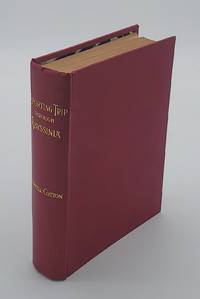
190268475London: Rowland Ward Limited 1902. First edition. Hardcover. Good. 531; 12pp. Large octavo 23 cm Bound in plain red cloth over boards with a gilt stamped title on the spine. Blue and white animal-patterned endpapers. Covers a bit cocked. Text block has dropped. Endpapers cracked along the hinges and hinges going. Text block just starting to crack at p. 177. Bookbinder's small ticket on the rear pastedown. With folding map loose and tucked in with a 10" closed tear along the horizontal center fold. Major Percy Horace Gordon Powell-Cotton 1866-1940 was an explorer big game hunter naturalist and anthropologist and founder of the Quex Museum Birchington the Powell-Cotton Collection. He spent most of his life exploring and traveling throughout the world as well as undertaking multiple overseas collecting expeditions. In total Powell-Cotton undertook 27 expeditions spanning half a century. From the early 1880s he was very much concerned with taking and developing his own photographs.<br /> <br /> Signed by the author's son Christopher on the half title. Rowland Ward, Limited hardcover
8vo., First Edition, with trade advertisement endpapers, some light offsetting from endpapers to title; original green cloth, upper board framed and lettered in gilt, gilt back, gilt top, bevelled boards, uncut, a remarkably well-preserved, bright, crisp copy in wholly unrestored publisher's binding. EXTREMELY SCARCE, ESPECIALLY IN THIS CONDITION.
192753798New York: Frederick A. Stokes Co. 1927. 8vo. xi 3 239 1 pp. Colour-tinted frontisp. 7 colour-tinted plates. Orange cloth silver lettering front cover & spine very minor shelfwear very slight bumping to corners w/ d.j. vivid Art Deco cover art of stalking Tiger silhouette on front cover by Reynolds in black silver and orange slight chipping head of spine minor creasing edgewear still NF/VG- copy. First edition of this anthology of big game stories of the Indian jungle set on the North Eastern frontier near Bhutan. Casserly 1869-1947 joined the 22nd Bombay Infantry in 1892 served in China during the Boxer Rebellion and later with the 120th Rajputana Infantry with about 200 sepoys in a small fort in Cooch Behar. Frederick A. Stokes Co., hardcover
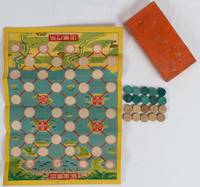
1940216804Japan. Circa 1940. Colour folding game sheet 36.5 x 26cm 10 wooden playing pieces each with embossed images in beige and blue complete original box 15.5 x 7.6 x 2.3cm considerably worn and soiled and corners reinforced the game itself is in very good bright condition. This is a two-player board game where air planes and war ships fight against each other. Fascinatingly the game sheet illustration shows the battle ground is in the Pacific where islands with palm tree are dotted. Consequently the game might be produced at the early stage of the Pacific War. The players attack each other after starting from a naval base and an air base. There are two islands each where they are safely protected from their enemies. The playing pieces are made out of paper with embossed images of war ships and air planes in beige air power and blue sea power colours. . unknown
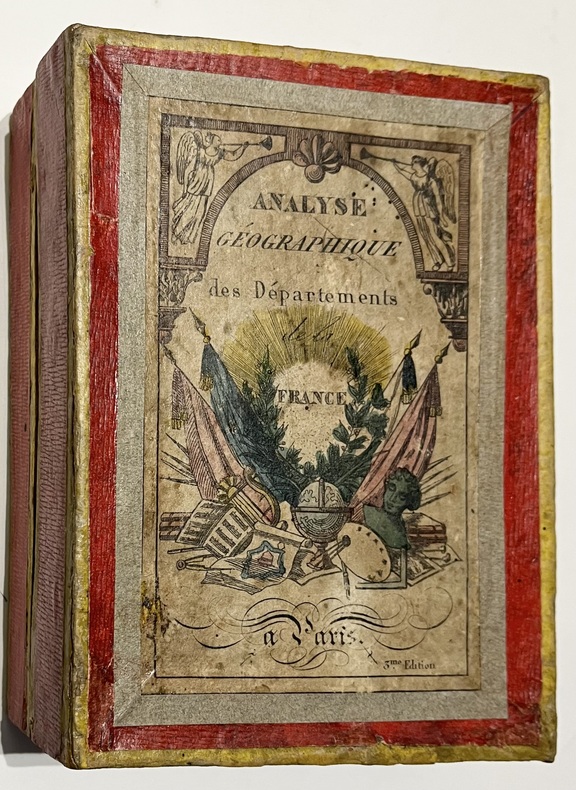
18365579Paris, Bourrut Lemerie, [circa 1836]. 1836 Jeu de 90 cartes (132 x 82 mm). (quelques rousseurs) 1 boite d'origine (160 x 120 mm) en carton recouverte de papier rouge, titre imprimé en couleur sur le couvercle. (défauts d'usage)
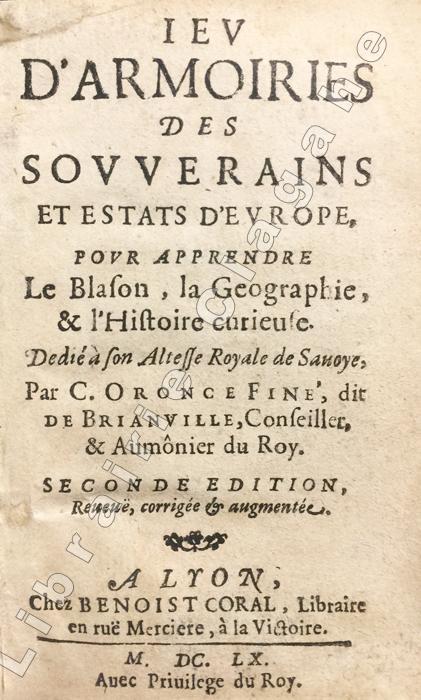
16609246Lyon, Benoist Coral, 1660 ; in-24 ; pleine percaline bleue à décor floral, filets et titre dorés au dos (reliure du XIXe) ; (16) ff. dont titre et 2 planches gravées, 209 pp.
18846396Cambrai: Renaut, 1884. 1884 1 vol in-8° (210 x 140 mm) de : 139 pp. (dont faux titre, titre) ; nombreux schémas et tableaux dans le texte ; cachet de libraire et signature manuscrite de l'auteur et concepteur du jeu au dos de la page de titre. Demi-basane verte d'époque, dos lisse orné et titré, plats recouverts de papier marbré, tranches marbrées. (Reliure frottée).
2007LFA-126742136Revue de 32 pages, format 210 x 270 mm, illustrée, brochée, bon état
201807038Geneve, Collection eldorado - Les humanides associes, 1989 ; in-4, 48 pp., cartonnage de l'éditeur. En bon état - E.O.
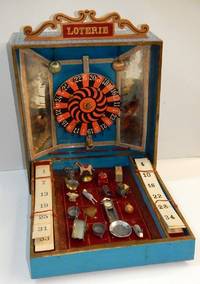
19002210013<p><i>Wooden box 32 x 26 x 8 cm with light blue patterned paper covering; the lid with a label lettered 'Loterie' and a hinged pierced wooden sign with the words 'Loterie' lettered in gilt paper on red; the lined paper interior with a central mounted wheel between mirrored sides and two hanging silk balls; the fall front where the prizes are held with two spaces left and right containing six lottery cards one from another set together with 16 toy prizes as listed below.</i></p><p>Lottery or carnival wheels games became popular at the end of the nineteenth century. Their construction was more complicated than heretofore with the addition of a rotating wheel with pins with a 'clack' mechanism sounding as the wheel is spun. The numbers on the wheel are randomly arranged from 0 through to 25 in white on alternating in black and red ground - clearly based on the 'single zero' form of roulette wheel that became the norm in Europe from the middle of the nineteenth century. The design has a second purpose as the box is hinged so that open it is given the form of a fairground entertainment with an assortment of prizes laid out in a display on squares below the wheel that each have a number too. </p><p>The idea of the game is twofold firstly as the wheel is spun and numbers called out the player who first completes a card of numbers is the winner. In the second game when the numbers 1 to 16 are called out and a player has the number on one of the cards they can then claim one of the small toy prizes. The sixteen twenty assorted of toy prizes include: a handcart wall clock bracelet scales pram wooden top bracelet fairground horse two rabbits a chicken a dish a parcel a metal top metal puzzle pair antimony jardinieres and a heart broach.</p><p>There is no makers name and the design although of a solid construction is nevertheless probably a bespoke production possibly made in order to be sold through fairgrounds and market stalls rather than the more salubrious emporia for children. The interior is lined in turquoise paper with bevelled mirrored silvered card sides and although simple the idea was glittery enough to catch any passing child's attention.</p>
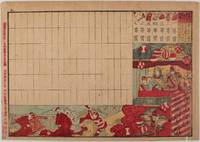
1892215726大野栄吉. Ōno Eikichi. Meiji 25 1892. Colour woodblock print 22.8 x 32.5cm evenly browned few chips in margins but overall very good. This colourful woodblock print serves as a point sheet for a horse racing board game. While the game rules are unclear the print vividly captures an exciting race scene featuring three horses and their jockeys. The race unfolds in a festive atmosphere complete with blossoms and lanterns while the spectators appear to include the Meiji Emperor and Empress along with their entourage. The Emperor is depicted in full military uniform and the Empress is shown in a traditional kimono. The print also displays the prizes for first through seventh place which include a silver cup a trophy a riding cap a scarf a shoe and a whip. Western-style horse racing began in Japan in the mid-19th century following the arrival of Westerners and became a high-class social event during the Meiji period. . 大野栄吉. [Ōno Eikichi]. unknown
191557029Helena MT: Independent Publishing Co. 1915. 8vo. 88 pp. Photo illustrations tables historiated vignettes at upper fore-edges of text pages throughout. Beige-printed softcovers salmon-coloured outline map of Montana on front cover border in burgandy minor chipping head & foot of spine & to couple corners minor dustsoiling still VG- copy. First edition of this exceedingly scarce original and well illustrated report. The Montana Legislature in 1913-1914 codified a number of fish and game laws and established the Game and Fish Commission in order to adjust hunting seasons bag limits license hunters and fishermen who were rapidly decreasing the numbers of game animals and fish as well as try and legislate against water pollution through cyanide and other pollutants introduced by mining interests in the State. Montana had established a number of fish hatcheries to feed many of the small landlocked lakes & ponds which were rapidly being depleted by intrepid sportsmen dynamiting the habitats and harvesting the fish. There are descriptions of hunting bear in Flathead County with a photo of the “Famous Lady Hunter†standing over her trophy; descriptions of deer hunting and remonstrations against poachers especially with those continuing to kill the “Bull Moose†which had been barred by State law. Of additional interest are the photos and detailed description of the Montana State “Fish Car ‘Thymallus’†featuring banks of specially fitted aerated aquariums for transporting hatchery fish for license paying sportsmen followed by tables of the 10s of 1000s of fish released. Also included are statistics on poaching arrests jail sentences and fines. Worldcat locates copies UCLA NOAA Woods Hole Yale holds an edition issued in 1914 for the Northern Pacific Railway with 75 pp.; See: Diann Ericson The Legislative and Political Development of the Montana Department of Fish Wildlife and Parks 1895-1921: A Case of Cultural Heritage 1994. Independent Publishing Co., paperback
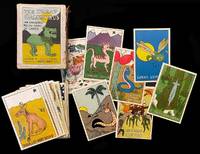
19233210241<i>Complete set of 48 cards 93 x 62 mm including 4 'Privilege Cards' marked with a star; folded sheet of rules; contained in the original purple card slipcase 98 x 76 x 25mm illustrated title label.</i><br /><br />A round game based on nonsense names of creatures probably the name The Great Galumphus derived from invention of the word 'galumph' by Lewis Carroll for Through the Looking Glass of 1872. Certainly all the other named creatures whose images decorate the cards are each in the same nonsense fashion and include the Crowned Cornubian Tasselled Snort Hound Bubbling Water-Hog Pushfoot Polliwog Climbing Chumtrunk Painted Pooh-Pooh Cissling Sand-Snapper Hairless Hunkum Flying Umbratunk Long Eared Scootler Scru-Wuzzium Lunar Lumpkin Putty Faced Popcat and Spotted Sniffle-Grub. This is a memory game where the players have to claim cards from their opponents after they have been turned over with a set of cards needed to become the winner.<br /><br />Jaques as a games maker had been established in 1795 however it was John Jaques II in the mid Victorian era who is credited with inventing such perennials as Happy Families Tiddledywinks Ludo and Snakes and Ladders where the company's fame was most in the ascendent. We have not been able to trace Miss Jessie Veal but wonder if she actually lived in some part of the far flung British Empire the animals and exotic scenery tend strongly to support this idea. Published by J. Jaques & Son Ltd.,
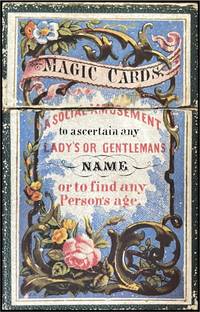
185019999England 1850. 18 cards 89 x 54 mm 9 printed on pink cardstock and 9 on yellow. Housed in original slipcover made of pebbled green paper over boards with chromolithographed label affixed to the front open at top and bottom. Light wear to edges of slipcover otherwise in excellent condition. A charming and unusual magic card game based on mathematical principles that purports to reveal anyone’s name and age. Using the pink cards for women and yellow for men the questioner holds onto the instruction and key cards and gives the player the rest of them which have lists of names and numbers and the letters A E I O U W and Y at the top. The player tells the questioner the letters corresponding to which cards have their name on them and using the key the questioner adds their corresponding numbers to get the player’s name provided it is one of the 127 names listed. The game is played the same way to determine players’ ages. The game actually works! unknown
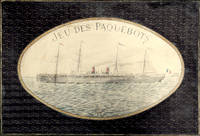
18972210164<p><i>Comprising two coloured map board 66 x 99 cm folding down to 32.5 x 49.5 cm one cloth hinge broken; 14 route cards; a barometer dial 19 x 19 cm with gilt metal spinning arrow some abrading from use; eight painted white metal playing pieces in the form of ships contained in the original small box one piece not original; 16pp booklet of instructions bound in original light green printed wrappers; all contained in the original box 35 x 52 x 5 cm; the hinged lid with a large coloured lithograph title label showing the 'Normandie' leaving port at full steam some minor abrasions but overall in good condition.</i><br /></p><p><i>Jue des Paquebots</i> was something new to games when it was published in 1897 as each player moves their boats on large maps exactly replicating the routes taken by two major French shipping lines. </p><p>The game includes two large folding boards designated 'Carte A' which illustrates the Atlantic shipping lines the other 'Carte B' with the shipping lines leaving Marseilles in the direction of the Black Sea the Indian Ocean and the Pacific. Rather pointedly the instructions state that the two maps include only the French shipping lines of the Messageries Maritimes and the Cie Générale Transatlantique the United Kingdom then the leading maritime nation is neither shown on the maps nor mentioned. </p><p>The players first decide which map they are going use and then select or bid one of the Itinerary cards 8 for map A and 6 for map B. The aim of each player is to complete the journey indicated by their itinerary and then make the return voyage; the first player to complete this double crossing wins. However the number of stopovers is not equal for each different itinerary in play. In order to equalise the chances of winning the players with the fewer ports of call have to repeat their journey a second or even a third time if necessary until the number of ports visited or passed by them in these different routes equates to the number of ports of the busiest route.</p><p>The routes all follow those which the two major French shipping companies plied. These include final destinations at Yokohama Australia New Zealand Zanzibar Odessa Buenos Ayres New York and the Antilles. </p><p>Each player places a ship playing piece at port at the beginning of their route. The first player now spins the Barometer Dial which has outer and inner instructions that allows them to advance out of port when their turn come around again the arrow is again spun and the player can read the inner line of instructions and so advance 1 2 or 3 ports along their route. However there are also stops on the Barometer Dial that include Damage - where you go back to the previous port and pay a token to the bank; Heavy Fog - where you are left stranded until the next round; Collision - this allows another turn of the dial but it the result is 50/50 chance of being sunk and thrown out of the game - you can pay for another ships so all is not lost; Call for Distress - also misses a turn; Shipwreck - something like collision although you can start out again with a new ship and no fine; Rescue - also causes the player to miss a turn; lastly and somewhat topical there is Quarantine - here the player misses a turn and also has a second spin of the arrow to determine if you can go into port or not.</p><p>The lid of the box illustrates the Cie Général Transatlantique liner La Normandie that plied the North Atlantic to New York in the summer and the south Atlantic in the winter - the ship sports a US flag on the foremast and the makers initials on the aft mast. Built in 1886 it was the largest and fastest liner of the company and was originally named 'Ville de New York.' It was also lit by electricity and could carry 1000 passengers and became the model for several sister ships built to the same plan.</p><p>The maker Charles Watilliaux succeeded the games manufacturer Coqueret in 1874 and for the next 35 years became a major publisher and manufacturer of board games and toys until their acquisition by Revenaz & Tabernat. His registered initials were 'W.X.' which is slightly modified for the flag on the box lid as C.W.X.</p> Watilliaux, éditeur.
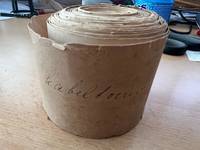
110785Paper roll 6 cm high 7 cm depth 8 cm width. Text in Dutch about infinity and endlessness.NL De begin metafoor Gelijk een kabeltouw dat aan een paal gebonden als men het tot zich trekt geen eind te hebben schijnt ziet op een oneindig lijkende reeks iets dat maar blijft duren zonder oplossing. Een soort lusgedicht. De datum van het rolletje met van na 1866 zijn. Het verwijst immers naar de telegraaf van New York tot aan Londen en die trans-Atlantische telegraafkabel werd in 1866 aangelegd. De spelling pas bij de 19e eeuw voor de spellingshervorming van De Vries en Te Winkel in 1860-1880. Dus het is zo tussen 1866-1880 te dateren.Volledige tekst <strong>spoiler alert voor het einde</strong>!: <em>Gelijk een kabeltouw dat aan een paal gebonden als men het tot zich trekt geen eind te hebben schijnt gelijk de telegraaf van New York tot aan Londen Als men er langs kon zien toch in t verschiet verdwijnt gelijk een groote slang die weg kruipt in de bosschen van blockberg of Mont Blanc als hij tevoorschijn komt zich weer opnieuw vertoont in allerhande bochten zoodat des menschen geest geheel van schrik verstomt gelijk de melkweg die zoover t oog kan dargen zich toont als t vurig pad dat nooit een mensch betreedt en met zijn starrental den mensch schijnt uit te dagen dat men den maatstaf buigt die zijne lengte meet. Gelijk de snelle tijd met groote reuzenschreden voortdurend verder vliegt en altijd maar weer voort Gelijk uit gisteren t heden wordt geboren en dit weer t morgen baart en zich aan niemand stoort Zoo wordt aan dit papier hoelang m ook heeft gewonden Met hoeveel ongeduld men ook naar t einde ziet Gelijk gij hebt gezien wel een begin gevonden Maar toch hoe men ook zoekt het einde heeft men niet. Laat die omstandigheid u echter niet beletten Om met een stalen wil een wil zoo vast en sterk den eens begonnen strijd kloekmoedig voort te zetten Wellicht kroont dan op t laatst het einde nog het werk. Men heeft wel meer gehoord dat na verloop van tijden Een zaak waarna t vernuft vergeeft te zoeken placht Aan welker onderzoek zoovelen t leven wijdden door één omstandigheid werd aan het licht gebracht. Houd daarom goeden moed blijf rustloos voorwaarts streven Bedenk dat m aan dit vers dat door uw vingren zweeft Vier menschenlevens lang heeft achtereen geschreven en twintig emmers inkt daarvoor geledigd heeft. Zoek rustig naar het slot en hebt gij het gevonden zoo laat het niet meer los maar houd het stevig vast en lees dan altijd door het eind komt u niet tegen Daar t als van zelven weer aan deersten regel past nog slechts een woord of wat. Gij hebt dan strijd gewonnen Dan houdt gij glorierijk het einde in de hand Maar toch gaat het weer voort daar waar het is begonnen Want gelijk een kabeltouw dat om een paal gebonden wanneer enz enz enz. </em> unknown
188959410Paris: n.p. 1889. 4to. 10.5 x 10.75 in. Six individual puzzles individually postcard sized approx. 3.5 x 4.75 in. w/ colour chromolithograph image dissected onto nine wooden pieces each 1 small piece has been supplied in facsimile for upper corner of the Cairo street puzzle. All contained w/in the original deep red paper-covered wooden box raised bed w/in the box to hold the puzzles lid w/ decorative gilt title lettering minor shelfwear very minor rubbing still a VG nearly complete artifact. Very scarce original souvenir puzzle game issued for the fourth great Paris World’s Fair celebrating through pomp and events the Centennial of the French Revolution and the storming of the Bastille. The Exposition was intended to pull France out of a ruinous recession and attracted over 61000 exhibitors as well as 32 million visitors many of whom came to view the iconic Eiffel Tower. This puzzle celebrates several of the pavilions at the Exposition including Palais des Beaux-Arts designed by Joseph Brouvard filled with painting and flanking the Eiffel Tower providing visitors; the Palais de Trocadero held over from the famed 1878 Exposition celebrating the renewal of Paris following the Franco-Prussian War; as well as the Ministere de la Guerre which featured an Arms & Armour exhibition as well as displays of knightly tournaments assorted uniforms and cannon. The Maison Egyptienne and Rue au Caire would fuel the Orientalist movement and fascination with the Middle East among artists writers and the industrial arts well into the 20th Century. These boxed puzzle games were quite popular souvenirs as well as educational tools in the Belle Epoque and have become remarkably scarce. No copies in Worldcat. n.p., unknown