2 277 résultats
1979mon0000031013The Pennsylvania State Universit 1979. Paperback. Good. in x in x in. The Pennsylvania State Universit paperback
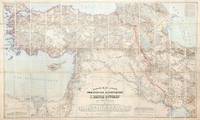
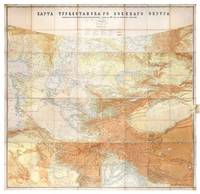
1881149774St Petersburg: Cartographic Institute of the Military-Topographic Department of the General Staff 1881. The cartographic climax of the "great game" Second edition significantly improved from the first edition 1877 to incorporate the latest military intelligence from field surveys. This magisterial work of "great game" cartography was presented at Russia's Tashkent military headquarters to the daring French explorer Stanislas Benoist-Méchin during his epic 1881-3 overland journey from Beijing to Europe. We have traced no other copies. A presentation inscription on the verso of the map reads in French "To Mr Baron Benoist-Méchin from Generals Kouropatkine and Levaschew October 1882 Tashkent." Benoist-Méchin 1854-1923 began travelling the world as a young man and then served as the French cultural attaché in Tokyo 1880-1. In 1881 he decided to return to Europe via the daring route through Central Asia. Leaving Beijing on 15 September with his regular travelling companion Comte Humbert Adrien de Mailly-Chalon 1853-1921 he journeyed through Manchuria and across Russian Siberia. In 1882 having reached Kashgar they received permission to cross Russian Turkestan spending six weeks in Tashkent as the honoured guests of General Mikhail Tchernayev the architect of Russian's expansion across Central Asia General Aleksey Nikolayevich Kuropatkin 1848-1925 and the aforementioned General Levaschov likely the artillery officer Vladimir Levaschov 1834-1898. After reaching Samarkand they travelled in extreme cold through Bukhara and via Khiva to Tehran reaching Moscow in October 1883 where they were accorded a hero's welcome. Their descriptions of this feat of exploration were published in 1885 in the Bulletin de la Société de géographie. This map was made for the use of the Russian military high command in St Petersburg and in the Turkestan Military District which had been established in the 1860s amid the occupation of Tashkent and Bokhara and dates from a period following the Second Anglo-Afghan War and the Battle of Geok Tepe when tensions were at their height. It encompasses almost the entire playing surface of the "great game" extending east-west from Xinjiang and Tibet to the Caspian Sea and Afghanistan and north-south from Siberia to northern India. Unparalleled in terms of accuracy and detail it names every city town and village and the legend has entries for such features as fortifications railways mail and caravan roads and mines. Spot heights are given in feet and deserts are marked with a light red pattern. It is much improved on the first edition which had only 48 panels and did not extend as far south. Chromolithograph map 195 x 200 cm dissected onto 64 sections and mounted on linen as issued laid-down printed slip stating "corrected up to 1881" small folding tab at right edge. Folding away to 28.5 x 28 cm. Housed in green quarter morocco solander box with chemise by the Chelsea Bindery. Map surface generally clean and brighta few stains toning and soiling at edges small repair at top-left edge verso foxed and with couple of areas of linen reinforcement: very good. unknown
1899155664Dehra Dún India & Berlin: Photozincographed at the Office of the Trigonometrical Branch Survey of India & Dietrich Reimer 1899-1904. Remarkable assemblage of three important and superbly detailed maps A rare opportunity to acquire three exceptionally impressive and uncommon maps together forming the finest contemporary cartographic overview of the Great Game's central theatre. Spanning from the Mediterranean to Afghanistan and from the Caspian to Sir Baniyas Island they present a striking synoptic view of the region at a moment of intense strategic interest. All three share the same provenance each bearing the distinguished bookplate of the officers' mess library of the 85th Foot later part of The King's Light Infantry. Likely acquired as a group by an officer attuned to imperial affairs in the run-up to or immediate aftermath of the 1907 Anglo-Russian Convention they reflect the period's effort as Hopkirk notes to resolve regional rivalries and curb Germany's eastward ambitions. The Persia map is a landmark Survey of India production and the most comprehensive rendering of the region then available incorporating the latest British and Russian surveys and reconnoitres. Only 300 copies of this August 1904 issue were printed and institutional locations are limited to the British Library Deutsche Nationalbibliothek and Sächsische Landesbibliothek. The impressive wall map of Afghanistan June 1901 produced under Strahan and Gore and executed at the Frontier Drawing Office under Colonel R. A. Wahab is equally rare with copies recorded only at the British Library Wisconsin and the Bayerische Staatsbibliothek. Its authority rests on extensive British and Russian sources including work by Robertson Trotter Sykes Ney Elias and the Afghan Boundary Commission. These maps exemplify the Survey of India's exacting standards during the era of photozincographic production when officers were required to vet every detail under magnification. Kiepert's map of the Ottoman Empire complements the two Survey of India sheets representing the best contemporary mapping of a region Britain could not itself survey. Kiepert one of the foremost scholarly cartographers of the 19th century travelled widely in Ottoman territories producing clear and remarkably accurate maps that remain valuable records of the period. This map is comparatively well represented institutionally with around 17 holdings recorded in Europe the US and the UK. Persia: scale 1:1013760 six-sheet coloured map divided into four linen-backed quadrants each measuring approx. 976 x 963 mm when assembled measuring 1952 x 1926 mm North West North East South West South East each backed with Nonpareil pattern marbled paper each section dissected into 20; Afghanistan: scale 1:1013760 coloured map dissected into 45 sections linen backed measuring approx. 1035 x 1640 mm; Turkey: scale 1:1500000 coloured map dissected into 65 sections linen backed measuring approx. 1016 x 1700 mm; together with the "Apercu general" measuring 412 x 570 mm showing the administrative division of the same area intended to accompany the map; dissected into 10 sections linen backed. Each map housed in the original dull purple morocco-grain cloth case Stanford's printed label to front. Cases a little worn with some loss of fabric light toning to maps otherwise in excellent condition. Cases a little worn with some loss of fabric occasional light toning to maps otherwise in excellent condition. Kourosh Ahmadi Islands and International Politics in the Persian Gulf: Abu Musa and the Tunbs in Strategic Perspective 2008; Kyle J. Gardner The Frontier Complex: Geopolitics and the Making of the Indo-China Border 1846-1962 2021; Peter Hopkirk The Great Game: On Secret Service in High Asia 1992. hardcover
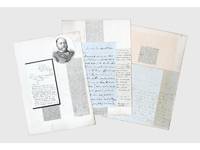
1837156409Kabul and elsewhere: 1837-41 & 1859. Correspondence chess A carefully assembled collection of material connected to players in the "great game" including Colonel Stoddart and Captain Arthur Conolly both famously beheaded at Bukhara Major Henry Rawlinson the political agent at Kandahar and Captain Sir Alexander "Bukhara" Burns. The material mounted on album leaves with accompanying newspaper clippings and other ephemera is tied together by Connolly and Stoddart's dramatic death. Sent on a mission to secure an agreement of friendship between Britain and the Emir of Bukhara in 1838 Stoddart was arrested by the emir on charges of spying and imprisoned. Conolly the intelligence agent credited with coining the term "great game" in an 1840 letter to Rawlinson arrived in Bukhara in late 1841 to negotiate his compatriot's release. Both men were killed in June 1842 and became household names back home. In the first two letters Burns writing about a year before he was killed by a mob in Kabul shares his views with Rawlinson on the latest moves in the "great game". He writes of Stoddart's short-lived release from prison and of the importance of Conolly's current intelligence-gathering in Central Asia. Shah Shuja "is surrounded by a parcel of harpies" and Burns advises caution about the use of British troops to prop up the Shah's rule: "Nothing contributes so much to lower the King's power as the employment of our troops against Afghans & I would avoid it if possible." As for Lord Auckland the governor-general "does not have great faith in the sincerity of Russia in abandoning her Khiva designs but it gives us time." The third letter from Conolly to Rawlinson discusses local news and offers a lighter-hearted window onto the life of a political agent far from home. He has swapped the diplomatic chessboard for the card table: "We miss you very much - especially at whist" the previous night's rubber being "stale and flat but not unprofitable for I won 9 rupees." This letter is mounted with a page of Stoddart's notes on taking navigational bearings which Stoddart gave to Rawlinson before departing for Central Asia in 1837. The final piece touches on the wider appeal of the Stoddart-Conolly story. Writing to the Cornish baronet Sir Hugh Molesworth almost two decades later Dr Joseph Wolff mentions his second expedition to Bokhara mounted to ascertain the fate of the two men and how the profits from the two editions of his best-selling Narrative of a mission to Bokhara 1845 were sufficient to finance a parsonage and schoolhouse in his living. a Sir Alexander Burns to Major Henry Rawlinson 21 December 1840 Kabul. ALS bifolium written across all sides. b Sir Alexander Burns to Major Henry Rawlinson 20 January 1841 Kabul. ALS bifolium written across all sides. c Captain Arthur Conolly to Major Henry Rawlinson 1840 Kabul. ALS bifolium and single sheet written across 5 sides addressed on final side remains of wax seal. d Colonel Stoddart's autograph notes on taking navigational bearings single sheet written one side. Endorsed on verso by Rawlinson "Given to me by Col. Stoddart on his departure for Bokhara in 1837. H. Rawlinson"; later note to the same effect but in a different hand below. e Revd Dr Joseph Wolff to Revd Sir Hugh H. Molesworth 31 August 1859 Taunton Somerset. ALS bifolium written across 3 sides. 4 autograph letters and single sheet of notes totalling 17 sides of manuscript tipped to or mounted on stubs to card album leaves 370 x 265 mm with laid-down material 11 newspaper clippings 2 printed illustrations sheet of manuscript later brief captions in manuscript. Letters and sheet of notes generally well preserved staining and creasing as expected stubs occasionally just touching text but no loss to sense: a very good collection. unknown
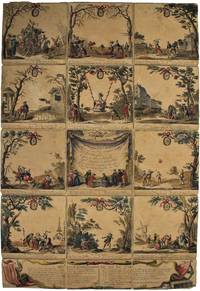
53336Paris: Crépy 1783. Original hand-coloured engraving overall 72 x 48 cm comprising 15 sections the game occupying 12 sections each 16 x 16 cm. plus 3 half-panels at the bottom for the title and rules of the Nouvelle Combinaison each 8 x 16 cm. Contemporary linen backing. Framed with museum quality glass 99% UV filter - less than 2% reflection. Easily removable from frame Joints holding although fragile wear to corners minor loss to inside margin of lower left title panel light browning a few hanging pin holes at margins. Scarce especially when coloured. Without imprint or date as normal. The 12 panels depict 12 traditional games La Main Chaude Le Balon La Crosse etc which follow the 12 months of the year. Rules for advancing around the board underneath each illustration and a second method of playing in the bottom three panels. [Paris: Crépy, 1783]. unknown
1929302295Los Angeles 1929. 100 pp of typed documents and an additional 50 album leaves mounted with approximately 50 photographs various sizes and processes and various documents. Folio. Limp leatherette with title and recipient name stamped in gilt to upper cover. Large black quarter morocco clamshell box gilt. 100 pp of typed documents and an additional 50 album leaves mounted with approximately 50 photographs various sizes and processes and various documents. Folio. "It is proposed that a COMPLETE ZOOLOGICAL GARDENS be opened to the public on a fifty cent admission basis which is to be properly laid out as an attractive Zoological and Botanical Garden with the finest and largest private collection of animals birds and reptiles to be seen anywhere on the continent."<br /> <br /> The advent of the motion picture industry in California had many wide-ranging ramifications on the business world and one was that it created a new market for firms who traditionally supplied animals to circuses and zoos both public and private owned by the likes of William Randolph Hearst. <br /> <br /> This archive is a report by the Investment Auditors of California for the Horne Corporation that was looking to expand by establishing a zoological garden in the environs of Los Angeles. The Horne Corporation was the largest and most successful of its type at the time apparently the only company in the US that could completely outfit a circus with both animals and show equipment. They were to purchase the Los Angeles Zoological Garden and Jungle Studio for $250000 and thereby sought to provide a similarly complete service to the film studios with both animals and suitable locations for film sets.<br /> <br /> The head of the company I.S. Horne for whom this report was compiled commenced trading in animals from Kansas City MO around 1914. The range of animals at the their disposal included big game birds reptiles and many of the documents concern the prospect of importing reindeer from Alaska.<br /> <br /> The material is held in a presentation album and includes the certificate of incorporation in Wilmington Delaware May 13 1929 as well as the by-laws of the corporation minutes of the first meeting the proposal for Los Angeles Zoological Garden and Jungle Studio and a balance sheet. At this stage the company had total assets of $57700 & liabilities of $625388.46; an enumeration of the various animals in inventory including wildebeest sables leopard lynx Rhodesian baboons bushbaby and a large aardvark.<br /> <br /> Of real interest are the plans for the park including artist's impressions which would be furnished with circus attractions "Monkey Island" jungle setting for motion pictures and an acknowledgment that "before the introduction of the motion picture industry the art of showmanship was not quite so highly developed as it is today." In fact one of the first pictures they supplied animals for was - appropriately enough - Trader Horn which was nominated for the 1931 Academy Award for Best Picture. <br /> <br /> On a more practical level there is a "Descriptive Classification of Principal Commercial Wild Animals" which lists 340 different animals in some details. There is also an account of hunting wild animals in East Africa as well as a section on animals that have been trained to hunt by man. Furthermore there is also much correspondence which provides much insight into the game industry its clients and the prospects for its future.<br /> <br /> Horne's venture subsequently became known as the World Jungle Compound in Thousand Oaks California eventually being acquired by 20th Century Fox studios. This archive is a record of a new phase of the entertainment industry. unknown
1929302295Los Angeles 1929. 100 pp of typed documents and an additional 50 album leaves mounted with approximately 50 photographs various sizes and processes and various documents. Folio. Limp leatherette with title and recipient name stamped in gilt to upper cover. Large black quarter morocco clamshell box gilt. 100 pp of typed documents and an additional 50 album leaves mounted with approximately 50 photographs various sizes and processes and various documents. Folio. "It is proposed that a COMPLETE ZOOLOGICAL GARDENS be opened to the public on a fifty cent admission basis which is to be properly laid out as an attractive Zoological and Botanical Garden with the finest and largest private collection of animals birds and reptiles to be seen anywhere on the continent."<br/><br/>The advent of the motion picture industry in California had many wide-ranging ramifications on the business world and one was that it created a new market for firms who traditionally supplied animals to circuses and zoos both public and private owned by the likes of William Randolph Hearst. <br/><br/>This archive is a report by the Investment Auditors of California for the Horne Corporation that was looking to expand by establishing a zoological garden in the environs of Los Angeles. The Horne Corporation was the largest and most successful of its type at the time apparently the only company in the US that could completely outfit a circus with both animals and show equipment. They were to purchase the Los Angeles Zoological Garden and Jungle Studio for $250000 and thereby sought to provide a similarly complete service to the film studios with both animals and suitable locations for film sets.<br/><br/>The head of the company I.S. Horne for whom this report was compiled commenced trading in animals from Kansas City MO around 1914. The range of animals at the their disposal included big game birds reptiles and many of the documents concern the prospect of importing reindeer from Alaska.<br/><br/>The material is held in a presentation album and includes the certificate of incorporation in Wilmington Delaware May 13 1929 as well as the by-laws of the corporation minutes of the first meeting the proposal for Los Angeles Zoological Garden and Jungle Studio and a balance sheet. At this stage the company had total assets of $57700 & liabilities of $625388.46; an enumeration of the various animals in inventory including wildebeest sables leopard lynx Rhodesian baboons bushbaby and a large aardvark.<br/><br/>Of real interest are the plans for the park including artist's impressions which would be furnished with circus attractions "Monkey Island" jungle setting for motion pictures and an acknowledgment that "before the introduction of the motion picture industry the art of showmanship was not quite so highly developed as it is today." In fact one of the first pictures they supplied animals for was - appropriately enough - Trader Horn which was nominated for the 1931 Academy Award for Best Picture. <br/><br/>On a more practical level there is a "Descriptive Classification of Principal Commercial Wild Animals" which lists 340 different animals in some details. There is also an account of hunting wild animals in East Africa as well as a section on animals that have been trained to hunt by man. Furthermore there is also much correspondence which provides much insight into the game industry its clients and the prospects for its future.<br/><br/>Horne's venture subsequently became known as the World Jungle Compound in Thousand Oaks California eventually being acquired by 20th Century Fox studios. This archive is a record of a new phase of the entertainment industry. unknown books
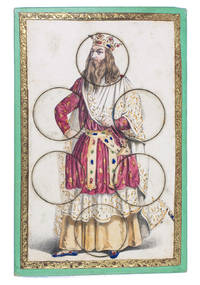
184017799Paris 1840. 19.5 x 13 cm. R. Lacouchin With 3 finely lithographed plates mounted on 3 thick green paperboard cards. The lithographs are framed with a gold-coloured ornamental border. The images on the cards are all beautifully hand coloured and the 3 cards depict respectively a crowned king in ornate robes a beautiful young lady in a green dress and a young man or possibly a court jester in an extravagant yellow and green outfit. Each card has 6 large circular movable pieces to be removed or inserted as the game demands in various circumstances. 3 puzzles. Three beautiful and complete puzzle cards with round movable pieces for example for a game of metamorphosis or lotto. While no rules are present or other specific indications given the cards with their beautiful coloured illustrations are quite intriguing by themselves.The illustration of the young man in the yellow and green outfit is signed "R. Lacouchin". Slightly foxed otherwise in very good condition. unknown
19604455DBKleve, ca. 1960/1980. & 61 Positionen (Mappen) mit über 300 Originalzeichnungen und vielen Druckvorlagen. Dazu ein sich bewegender Schaufenster-Animationselefanten und ein Wummy-Plüschelefanten. + Wichtig: Für unsere Kunden in der EU erfolgt der Versand alle 14 Tage verzollt ab Deutschland / Postbank-Konto in Deutschland vorhanden +
19604455DBKleve, ca. 1960/1980. & 61 Positionen (Mappen) mit über 300 Originalzeichnungen und vielen Druckvorlagen. Dazu ein sich bewegender Schaufenster-Animationselefanten und ein Wummy-Plüschelefanten.
Very Good Turkish, Ottoman (1500-1928) Original manuscript. 16mo. (16 x 10 cm). In Ottoman script. [22] p. This is a very unique and collectible satyric manuscript includes adaptation of classic and modern poems from Turkish / Ottoman literature into poker by an unknown poet (Âsik Menem). Probably Âsik (Minstrel) Menem was a nick name of the poet. Manuscript contains 10 poems of Yunus Emre, Mehmed Emin Bey which adapted into poker by this unknown poet such: "El-Hu!" by Yunus Emre. Its well-known refrains "Allah deyu deyu" are adapted like "Karo çikdi flosa sekli Allah deyu deyu". Poet changed the original verses and refrains like sometimes a loser poker player, sometimes like a winner. It's extremely rare. No copy in Turkey and libraries worldwide.
1915266243London: The London & Counties Press Association Ltd 1915. First edition. one of five hundred sets no. 22 vols. I & IV or 111 vols. II & III. Photogravure frontispiece of King George V in each volume. With 59 colored plates and 5 monochrome plates after G. Lodge A. Thorburn V. R. Balfour-Browne and E. Caldwell; 8 tinted photogravures; 206 black-and-white plates chiefly halftone; most with captioned tissue guards. Numerous illustrations and tables in text. Title pages printed in red and black chapter initials printed in red. 4 vols. Large 4to. Original brown pebbled morocco stamped in gilt t.e.g. rest uncut. Some rubbing to extremities occasional spotting to endsheets light traces of dampstaining in pp. 413-429 and back endpapers of vol. IV. Very good imposing set. First edition. one of five hundred sets no. 22 vols. I & IV or 111 vols. II & III. Photogravure frontispiece of King George V in each volume. With 59 colored plates and 5 monochrome plates after G. Lodge A. Thorburn V. R. Balfour-Browne and E. Caldwell; 8 tinted photogravures; 206 black-and-white plates chiefly halftone; most with captioned tissue guards. Numerous illustrations and tables in text. Title pages printed in red and black chapter initials printed in red. 4 vols. Large 4to. Truly encyclopedic in its scope The Gun at Home and Abroad encompasses all aspects of shooting from stag hunting technique and statistics to tips on burning grouse moors in autumn to accounts of African big game hunts that blend solid observation with colorful anecdote. A lavishly produced and richly informative work documenting the sporting life of a bygone era. Phillips p. 151; Riling 1734; Litchfield p. 74; Chute 482; Czech Asia p. 45 The London & Counties Press Association Ltd unknown books
18760041461876 Paris, J. Rothschild, 1876. Petit in-folio (288 X 362) demi-chagrin vert lierre, dos cinq nerfs, fleuron doré dans les compartiments, auteur et titre dorés, nom de l'éditeur en queue, tranches dorées (reliure de l'époque); (1) f. blanc, (2) ff. de faux-titre et titre imprimé en rouge et noir, frontispice, 140 pages, 45 planches couleurs hors-texte sous serpente, (1) f. blanc. Quelques rares rousseurs, principalement aux serpentes, trois taches sur le cuir du plat supérieur, sans gravité.
Sevilla, Andrea Pescioni, 1582, 28,5 x 20,5 cm., pergamino, 6 h. + 91 folios + 1 h. blanca + (Discurso sobre el Libro de la Montería:) 23 folios (mal numerado 25) + 1 h. con la marca del impresor. Con 35 grabados en madera representado escenas de caza (Nuestro ejemplar tiene en facsímil con una gran precisión un total de 31 folios, incluyendo la portada y el colofón, 13 de la primera parte y los restantes del Discurso, con tan alta calidad, tanto en el papel como en la tinta, que hace muy difícil diferenciar los folios originales de los que no lo son).
OTASG001Comiskey Park Chicago: Major League Baseball 1983 July 5 1983. 4pp. Original printed wrappers printed yellow red and blue. Signed by Roger Maris in blue sharpie to front cover signed by virtually every participating former player on or near their photo. Approximately 100 signatures including: Hank Greenberg Joe and Dom DiMaggio Bob Feller Larry Doby Don Larsen Lefty Gomez Frank Robinson Brooks Robinson Al Kaline Bob Lemon Charlie Gehringer Joe Cronin Bobby Doerr Roger Maris signed twice Earl Weaver Leo Durocher Buck Leonard Ernie Banks Lou Brock Carl Hubbell Willie McCovey Pee Wee Reese Willie Mays Johnny Mize Stan Musial Enos Slaughter Duke Snider Warren Spahn Willie Stargell Bobby Thomson Travis Jackson Ralph Kiner and Joe Torre. Some light wear to the extremities several creases otherwise very good. . First Edition. Original Wraps. Near Fine. Comiskey Park, Chicago: Major League Baseball, 1983 (July 5, 1983). paperback books
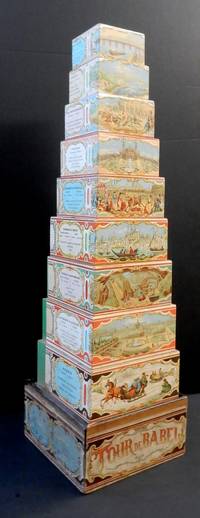
18823220299<i>A nest of nine wooden blocks ranging in size from 78 x78 x 46 mm to 182 x 182 x 60 mm each with a chromolithograph wrap-around illustration depicting European countries with statistical information; contained in the original box with a wrap around title label including four cartouche scenes printed in blue; with a sliding lid replaced.</i><br /><br />Each of the blocks is illustrated with a typical scene from European countries Russia the largest block showing a number of troikas in a winter landscape Germany & Austria with a view of Vienna Sweden and Denmark with mining for iron Turkey & Greece with a view of Istanbul etc. Also included are cartouches with basic information on the population and chief products of each country. <br /><br />The now ubiquitous graduated nested set of blocks for children was quite a late development in toy design with the earliest known patent being applied for in the US in 1881. Watilliaux's Tour of Babel was first marketed as interlocking jigsaw like pieces that could be joined together as hexagons and then stacked to form a tower that was issued at the time of the 1878 Paris Exposition here depicted as the illustration representing France. However when first American nested blocks began to appear Watilliaux evidently adapted the printed design and applied it to his own set of graduated blocks. Unfortunately this reworking did not quite fit the increased surface area of the blocks and a blank section has perforce had to be filled by a section of green glazed paper. It also necessitated the dropping the country of Switzerland and in that case the original pattern was too large to be adapted without their being some lose to the design.<br /><br />No doubt the original design had some educational value although this is somewhat lessened as there is no dexterity needed to correctly interlock the jigsaw pieces and instead only to stack and knock down the Tour de Babel.<br /><br />In 1874 Charles Watelliaux took over the publisher and manufacturer of many board games and toys Bernard Coudert and became a major producer until its sale in 1908 to Revenaz & Tabernat. Watilliaux, Editeur, Lith. J. Marie, Faub St Denis, 61.
05401France: 1900. Les Trois Chats"<br /> A Remarkable Survival of a Passé-Boules Carnival Game<br /> <br /> PASSÉ-BOULES GAME. Les Trois Chats. in the style of Louis Wain. Hand-painted 'Polychrome' Papier Maché late nineteenth century ball throwing 'Carnival' game. French ca. 1900. <br /> <br /> Three side by side polychrome cats in 'Papier Maché the structure reinforced by two wooden boards one as the base and the other at the top. The height is 24 1/2 inches 630 mm.; the width is 23 5/8 inches 600 mm.; and the depth is 5 7/8 inches 150 mm.<br /> <br /> Each of the three felines have gaping open mouths 2 1/2 inches 63 mm. the one on the center wearing an orange and blue hat with the name "Toto" in orange. At the bottom is a receptacle with three compartments which are marked "30" "50" & "20" respectively. <br /> <br /> A remarkable survival of a Passé-Boules Carnival Game.<br /> <br /> Historically passé-boule ball-toss was a very popular fairground game in France from the 19th century onwards and the masks often depict figures to be ridiculed. Any number of people may play. <br /> <br /> The object of the game is to hit the target with small white balls - similar to table tennis balls but slightly smaller. <br /> The three targets are the wide-open mouths of the three cats. Players aim to throw or bounce their ball into the open mouths for a good score.<br /> <br /> Provenance: Purchased in Paris from the family of the original owner whose Grandfather or Grandmother acquired it at the turn of the 19th/20th centuries. France: , 1900 unknown
Together 10 vols., 8vo., and Cased Map, text in gold and black, with colour plates (a number double-page), pedigrees in the text and endpaper charts, pictorial cloth, gilt backs, black tops, a near fine set to date in publishers blocked board slip-cases with interior illustration. Books 1-4 of A Song of Ice and Fire. The set to date [2022] comprises A Game of Thrones (2019); A Clash of Kings (2020); A Storm of Swords (2020); A Feast for Crows (2021); A Dance with Dragons (2022). WINNER OF THE BRAND/SERIES IDENTITY CATEGORY, BRITISH BOOK DESIGN AND PRODUCTION AWARDS, LONDON, 18 JANUIARY 2023. 'Rarely does a set of books encapsulate a story so perfectly, with such attention to detail in every aspect of production (British Book Design and Production Awards judging panel). ALL FIRST PRINTINGS AND NOW SCARCE AS SUCH.
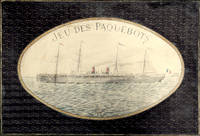
18972210164<p><i>Comprising two coloured map board 66 x 99 cm folding down to 32.5 x 49.5 cm one cloth hinge broken; 14 route cards; a barometer dial 19 x 19 cm with gilt metal spinning arrow some abrading from use; eight painted white metal playing pieces in the form of ships contained in the original small box one piece not original; 16pp booklet of instructions bound in original light green printed wrappers; all contained in the original box 35 x 52 x 5 cm; the hinged lid with a large coloured lithograph title label showing the 'Normandie' leaving port at full steam some minor abrasions but overall in good condition.</i><br /></p><p><i>Jue des Paquebots</i> was something new to games when it was published in 1897 as each player moves their boats on large maps exactly replicating the routes taken by two major French shipping lines. </p><p>The game includes two large folding boards designated 'Carte A' which illustrates the Atlantic shipping lines the other 'Carte B' with the shipping lines leaving Marseilles in the direction of the Black Sea the Indian Ocean and the Pacific. Rather pointedly the instructions state that the two maps include only the French shipping lines of the Messageries Maritimes and the Cie Générale Transatlantique the United Kingdom then the leading maritime nation is neither shown on the maps nor mentioned. </p><p>The players first decide which map they are going use and then select or bid one of the Itinerary cards 8 for map A and 6 for map B. The aim of each player is to complete the journey indicated by their itinerary and then make the return voyage; the first player to complete this double crossing wins. However the number of stopovers is not equal for each different itinerary in play. In order to equalise the chances of winning the players with the fewer ports of call have to repeat their journey a second or even a third time if necessary until the number of ports visited or passed by them in these different routes equates to the number of ports of the busiest route.</p><p>The routes all follow those which the two major French shipping companies plied. These include final destinations at Yokohama Australia New Zealand Zanzibar Odessa Buenos Ayres New York and the Antilles. </p><p>Each player places a ship playing piece at port at the beginning of their route. The first player now spins the Barometer Dial which has outer and inner instructions that allows them to advance out of port when their turn come around again the arrow is again spun and the player can read the inner line of instructions and so advance 1 2 or 3 ports along their route. However there are also stops on the Barometer Dial that include Damage - where you go back to the previous port and pay a token to the bank; Heavy Fog - where you are left stranded until the next round; Collision - this allows another turn of the dial but it the result is 50/50 chance of being sunk and thrown out of the game - you can pay for another ships so all is not lost; Call for Distress - also misses a turn; Shipwreck - something like collision although you can start out again with a new ship and no fine; Rescue - also causes the player to miss a turn; lastly and somewhat topical there is Quarantine - here the player misses a turn and also has a second spin of the arrow to determine if you can go into port or not.</p><p>The lid of the box illustrates the Cie Général Transatlantique liner La Normandie that plied the North Atlantic to New York in the summer and the south Atlantic in the winter - the ship sports a US flag on the foremast and the makers initials on the aft mast. Built in 1886 it was the largest and fastest liner of the company and was originally named 'Ville de New York.' It was also lit by electricity and could carry 1000 passengers and became the model for several sister ships built to the same plan.</p><p>The maker Charles Watilliaux succeeded the games manufacturer Coqueret in 1874 and for the next 35 years became a major publisher and manufacturer of board games and toys until their acquisition by Revenaz & Tabernat. His registered initials were 'W.X.' which is slightly modified for the flag on the box lid as C.W.X.</p> Watilliaux, éditeur.
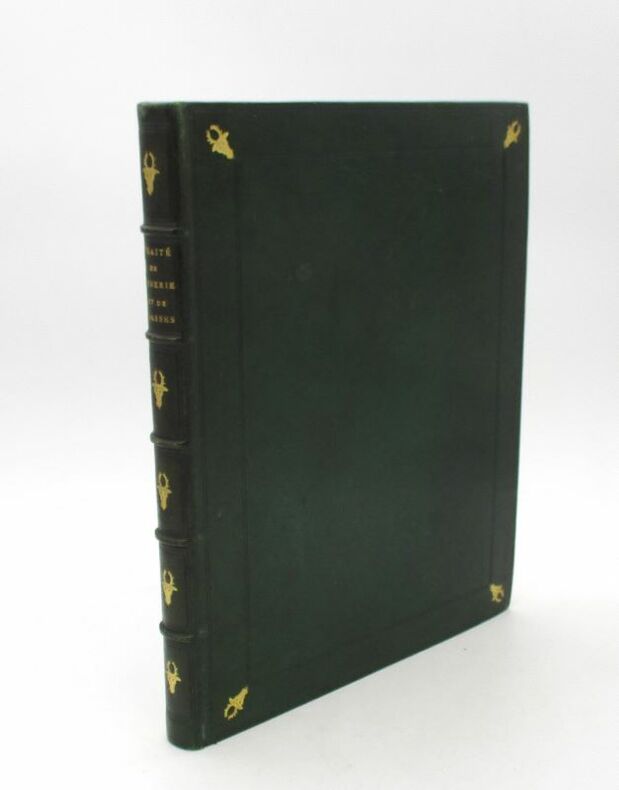
17107Paris, Moutard, 1776. 2 parties en 1 vol. in-4, XII-208 pp. 39 pl., maroquin vert de Petit sccr de Simier, deux doubles filets à froid en encadrement sur les plats cantonnés de tête de cerfs dorées, dos à nerfs orné de caissons à froid ornés de têtes de cerf dorées, dentelle intérieure dorée, tranches dorées (petits frottements et taches)
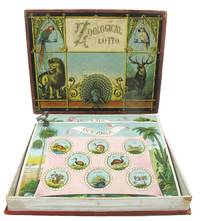
076544N: N 189-. Early English lotto game manufactured in Germany. Comprising: six coloured lithographed oblong card sheets 18.3 cm. x 23.5 cm. each incorporating eight removable pictorial disks representing the native animals of the different continents; contained within the original card box with decorative sides and pictorial title label on lid edges of box slightly rubbed and with a couple of neat repairs to corners the title label lightly soiled; a couple of small closed tears to the card beneath the Jaguar disk; n.d.c.1890s. The disks are all captioned with the name of the animal and feature a question about that animal on the verso which is answered by the brief text printed on the depression into which the disks are set on the card sheets. For example the Oceania sheet contains disks depicting a kangaroo which asks on the reverse: Who are these funny jumping creatures The answer printed below the disk is The kangaroo's with very clever features. This sheet also includes a black swan emu dingo and a Lyer-bird sic- Whose Lyer does not give one sound The lyer-birds in Australia it is found. N unknown
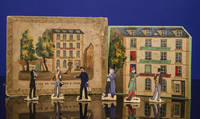
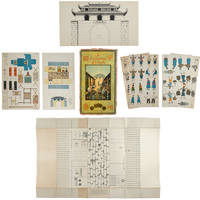
04338Paris: H. Duru 1840. A Remarkable Survival<br /> <br /> FRENCH BOARD GAME. Le Jeu Du Portier The Doorman's Game Par H. Duru. France ca. 1840. <br /> <br /> Original hand colored lithographed board depicting 'The Five Story House" 8 3/4 x 6 3/4 inches; 222 x 172 mm. with the right hand top corner beveled as issued. Six original hand colored lithographed figures each on a wooden base average size 3 1/8 x 1 1/4 inches; 80 x 32 mm. Complete in the original card box with the top showing a hand colored lithograph of "the Five Storey House". The Board and the Figures in near fine condition the box a little soiled on the top and the corners strengthened with cloth tape.<br /> <br /> The Board is lettered from top to bottom: "No. 6 "/ "No. 5 / Locart Fnt Lunetier au 3 mp" / "No. 4 / F. Sonnet M.De Dentelles" / "No.3 Clagmann Et Cie. Banquiers" / "No. 2" / "No. 1 Loge du Portier." The lid of the box is titled "Le Jeu Du Portier Par H. Duru."<br /> <br /> The six figures are titled: Le Portier The Doorman; "2 Proprietaire" Owner; "3 Banquier" Banker; <br /> "4 Marchand" Trader; "5 Fabricant" Maker and "6 Ouvrier" Worker.<br /> <br /> A remarkable survival. We have searched OCLC and can find no records of this game in any libraries and institutions worldwide - not surprising!!!<br /> <br /> H. Duru was an early to mid-nineteenth century Parisian publisher of children's books games toys and movable books. <br /> <br /> According to OCLC their other publications include:<br /> <br /> Nouvelle méthode de lecture progressive ou Lecture apprise en quarante jours <br /> 3 editions published between 1841 and 1851.<br /> Syllabaire universel en action 2 editions published between 1840 and 1857.<br /> Progressive Spelling Book illustrated in French and English published 1810<br /> Les homonymes illustrées published in 1835.<br /> Grammaire illustrée published in 1841.<br /> Quelques mots sur l'organisation du travail published in 1848.<br /> Alphabet chantant no date. Paris: H. Duru, 1840 unknown
04338Paris: H. Duru 1840. A Remarkable Survival<br/><br/>FRENCH BOARD GAME. Le Jeu Du Portier The Doorman's Game Par H. Duru. France ca. 1840. <br/><br/>Original hand colored lithographed board depicting 'The Five Story House" 8 3/4 x 6 3/4 inches; 222 x 172 mm. with the right hand top corner beveled as issued. Six original hand colored lithographed figures each on a wooden base average size 3 1/8 x 1 1/4 inches; 80 x 32 mm. Complete in the original card box with the top showing a hand colored lithograph of "the Five Storey House". The Board and the Figures in near fine condition the box a little soiled on the top and the corners strengthened with cloth tape.<br/><br/>The Board is lettered from top to bottom: "No. 6 "/ "No. 5 / Locart Fnt Lunetier au 3 mp" / "No. 4 / F. Sonnet M.De Dentelles" / "No.3 Clagmann Et Cie. Banquiers" / "No. 2" / "No. 1 Loge du Portier." The lid of the box is titles "Le Jeu Du Portier Par H. Duru."<br/><br/>The six figures are titled: Le Portier The Doorman; "2 Proprietaire" Owner; "3 Banquier" Banker; <br/>"4 Marchand" Trader; "5 Fabricant" Maker and "6 Ouvrier" Worker.<br/><br/>A remarkable survival. We have searched OCLC and can find no records of this game in any libraries and institutions worldwide - not surprising!!!<br/><br/>H. Duru was an early to mid-nineteenth century Parisian publisher of children's books games toys and movable books. <br/><br/>According to OCLC their other publications include:<br/><br/>Nouvelle méthode de lecture progressive ou Lecture apprise en quarante jours <br/>3 editions published between 1841 and 1851.<br/>Syllabaire universel en action 2 editions published between 1840 and 1857.<br/>Progressive Spelling Book illustrated in French and English published 1810<br/>Les homonymes illustrées published in 1835.<br/>Grammaire illustrée published in 1841.<br/>Quelques mots sur l'organisation du travail published in 1848.<br/>Alphabet chantant no date. Paris: H. Duru, 1840 unknown books
192061926Cascade Mountains and Spokane Washington and Montana 1920. Photograph album. Oblong 4to photograph album 7 x 10 inches "Photographs" gilt-stamped on upper board all of the photographs captioned in white ink on the album leaves below the images the captions have been taken from identical notes on the verso of each of the photographs. Almost all of the photographs were taken in the Cascade Mountains in Washington and Oregon; two picturing the elk were taken in Montana and another was taken in northern California. An excellent photograph album built around the hunting trips of Spokane Washington businessman Percy Powell from his teenage years to adulthood; Powell was general manager of the Powell-Sanders Wholesale Grocers in Spokane Washington from the late 1910s. The photos are affixed to the album leaves by two corners one is badly worn several others are a little chipped or creased the images mostly dark and sharp. Contemporary gilt-stamped black photograph album tied. 8879. <br/><br/> unknown books
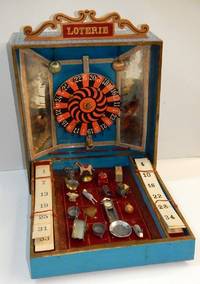
19002210013<p><i>Wooden box 32 x 26 x 8 cm with light blue patterned paper covering; the lid with a label lettered 'Loterie' and a hinged pierced wooden sign with the words 'Loterie' lettered in gilt paper on red; the lined paper interior with a central mounted wheel between mirrored sides and two hanging silk balls; the fall front where the prizes are held with two spaces left and right containing six lottery cards one from another set together with 16 toy prizes as listed below.</i></p><p>Lottery or carnival wheels games became popular at the end of the nineteenth century. Their construction was more complicated than heretofore with the addition of a rotating wheel with pins with a 'clack' mechanism sounding as the wheel is spun. The numbers on the wheel are randomly arranged from 0 through to 25 in white on alternating in black and red ground - clearly based on the 'single zero' form of roulette wheel that became the norm in Europe from the middle of the nineteenth century. The design has a second purpose as the box is hinged so that open it is given the form of a fairground entertainment with an assortment of prizes laid out in a display on squares below the wheel that each have a number too. </p><p>The idea of the game is twofold firstly as the wheel is spun and numbers called out the player who first completes a card of numbers is the winner. In the second game when the numbers 1 to 16 are called out and a player has the number on one of the cards they can then claim one of the small toy prizes. The sixteen twenty assorted of toy prizes include: a handcart wall clock bracelet scales pram wooden top bracelet fairground horse two rabbits a chicken a dish a parcel a metal top metal puzzle pair antimony jardinieres and a heart broach.</p><p>There is no makers name and the design although of a solid construction is nevertheless probably a bespoke production possibly made in order to be sold through fairgrounds and market stalls rather than the more salubrious emporia for children. The interior is lined in turquoise paper with bevelled mirrored silvered card sides and although simple the idea was glittery enough to catch any passing child's attention.</p>