(Game of the Goose)Biblio.com
2 277 résultats
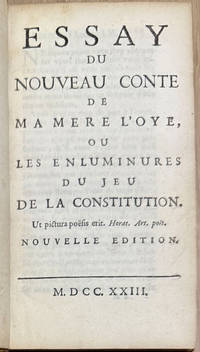
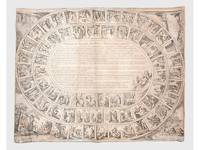
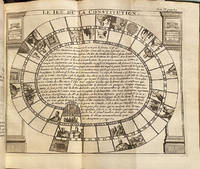
1724BB_88102Game of the Goose<br /><b><i>Poesies sur la Constitution Unigenitus</i></b>. Recueillies par le Chevalier de G. Officier de Regiment de Champagne. Villefranche i.e. Amsterdam: Chez Philalete Belhumeur 1724. Two volumes. Illustrated with duplicate frontispieces title-vignettes and many decorative woodcut head- and tail-pieces. 8vo. i i xxiv 317 pp. – i i 389 pp.; uniform polished tree-calf extra-gilt all edges gilt covers with armorial gilt stamp.<br />First edition thus greatly revised and expanded from an earlier version with essays letters poems reviews and songs with political Constitution religious Pope Clement XI and literary interest. Most important this work includes an essay titled <i>"Essai du Nouveau Conte de Ma Mere L'Oye"</i> NewTales of Mother Goose showing the influence of Perrault's tales barely twenty years after his death AND a handsome folding-out engraved board game titled <i><b>"Le Jeu de la Constitution" </b></i>designed in a race-game format.<br /><p>As a notable compilation of pro-Jansenist writings of an often satirical nature with the aforementioned board game and its five pages of rules on a folding plate. Selections include: "Les 101 propositions de la constitution Unigenitus exprimées en cent et un couplets"; "Ode pindarique sur la destruction du monastère de Port-Royal-des-Champs"; "Adieu d'une dame janséniste qui se refugie en Hollande". Brunet 4: 755. Weller 2: 88. Willaert 2: 9370. For the game see Phillippa Plock & Adrian Seville "Rothschild Collection of Printed Board Games at Waddesdon Manor" in: Of Boards and Men: Board Games Investigated Proceedings of the XIIIth Board Game Studies Colloquium Paris 14-17 April 2010 pp. 101-103: "B3 2669.2.25 Le Jeu de la Constitution - 1721/22 or to give its the full title Le Jeu / De la Constitution / Sur l'air du branle de Mets sic is <b>one of the most controversial games ever devised on the pattern of the game of Goose and perhaps may be regarded as the first polemical variant </b>Girard and Quétel 1982: 58 and 73. It dates from about 1721 but is associated with a book that appeared a year later the Essay Essai du Nouveau Conte de ma Mère l'Oye ou Les Enluminures de la Constitution. This book contains a folding plate of the game in smaller format and with some omission of text. It also contains 18 enluminures in rhymed couplets which explain the game in detail. The claimed author is given in the subtitle: 'Poesies sur la Constitution Unigenitus recuellies par le Chevalier de G. Officier du Regiment de Champagne'. The publisher is given as Philalete Belhumeur "Good Humour" Villefranche. These publication details are of course wholly fictitious as is the claimed author who in reality was the Abbe é Louis de Bonnaire 1680-1752; the book was published in Amsterdam the full-sheet game probably in Paris. De Bonnaire was a supporter of the Jansenist heresy named for Cornelius Jansen 1585-1638: this theology emphasised a particular reading of Augustine's idea of efficacious grace which stressed that only a certain portion of humanity were predestined to be saved. Though the Jansenists were strongly Catholic Jesuits and the papacy were suspicious of their beliefs which seemed to limit free will and the ability to choose to do good or evil. Despite condemnation by Pope Innocent X in 1655 the movement gained strong support in the Church. The Jansenist position as included in 101 of the propositions of Pasquier Quesnel Jansenist theologian b1634 d1719 in his Épitomé des Morales des Évangélistes of 1671 was finally condemned by Pope Clement XI's Unigenitus bull of 1713 but even this condemnation did little to diminish the enthusiasm of adherents. Indeed in 1717 four French Bishops attempted to appeal Unigenitus to a General Council a move that received considerable support from other clergy and the parlements though the majority of clergy stood by the Pope: Clement responded in the next year by excommunicating all those who had called for a General Council. Even so it was not until 1728 that the death of Jansenism was marked by the submission to the Pope's authority of Cardinal Noailles Archbishop of Paris who had originally approved Quesnel's book and was reluctant to support Unigenitus arguing that many of the 101 propositions were in fact orthodox.<br /><br />The point of the game and of De Bonnaire's book is to challenge and mock the authority of the Church and in particular that of the Pope and of his bull. For example the columns on either side are each headed by a cartoon depicting the Pope in council all present being represented by geese wearing mitres. Below the lefthand cartoon is the Latin phrase "Non ego cum Gruibus simul Anseribusque sedebo in Synodis - S. Greg. Nazianz Carm. 10" I shall not sit in Synod with cranes and geese. This refers to a dictum of Gregory of Nazianzus c329-390 Archbishop of Constantinople who compared the rowdy Council of Constantinople 381 AD to the loud cackling of a flock of geese.<br /><br />The 'good' spaces show the Apostles 'equal in number to that of the geese which they replace': there are thirteen including St Paul and they occupy the traditional spaces. The traditional hazards are likewise replaced or given special significance and others are added. The usual entry arch appears as Noah's Ark at space 1 symbolising the Church as it is tossed about on the waters of Unigenitus. The bridge of explanations at the expected space 6 shows bishops falling into the water marking their error in taking the wrong sense of the 101 propositions: it leads to space 12 acceptance where a young woman blindfolded is shown as accepting Unigenitus through ignorance. At space 15 there is the torn robe symbolising schism of the Church. The labyrinth here at space 16 symbolises error into which fall those who subscribe to the condemnation of the 101 propositions. The inn at space 19 is here the cabaret and represents the 'accommodation' accommodement or submission of the Jansenists to the bull. The Tower of Babel at space 24 represents the confusion of language into which the bull has fallen. At space 26 is the first appeal of 1717 represented by a notice on the Vatican door. At space 33 we find the avertissemens or pronouncements of the Archbishop of Soissons Jean-Joseph Languet de Gergy 1677-1753 a notorious anti-Jansenist and vehement defender of Unigenitus. He has an oboe a horn and a trumpet the three instruments symbolising 'his three avertissements and their different tones': a special rule refers to moving forward with the 'small dice' and with 'the other' when going back. Next is the prison at space 40 where the player must wait until a throw of 5 which multiplied by 3 will lead to Louis XV and deliverance. The well space 49 symbolises the body of doctrine in which the truth is hidden. At space 51 are the re-appealing Bishops the second appeal being at space 53. At space 55 is the portrait of Louis XV - enluminere XV in the book makes clear that he was seen as a force for change and re-unifying the Church. The death space at 58 shows the skeleton of Pope Clement XI sitting in an armchair wearing his papal tiara and raising his bony hand to bless an infant at his feet which represents the Unigenitus bull. Cardinal Noailles appears at the penultimate space 62 from which point 'one may only go backward'. The explanatory text in the centre of the game claims that it 'presages the day that the constitution of the Church will no longer be nothing but un Conte de ma Mère l'Oye' - a Mother Goose tale here used as a figure of speech for something unbelievable and ridiculous. The winning space at 63 shows that this result is to be achieved by a General Council in reference to that called for in 1717. De Bonnaire's book was condemned at Arras in 1726. Although his anonymity as author seems to have been effective in protecting him the publishers father and son were thrown into the Bastille. Even today the game has the power to shock by the force of its imagery.</p> Philalete Belhumeur hardcover
2016126133I.B.Tauris. New. 2016. Paperback. 178130047X . FREE UPGRADE to Courier/Priority Shipping Upon Request - IN STOCK AND IMMEDIATELY AVAILABLE FOR SHIPMENT - Flawless copy brand new pristine never opened -- with a bonus offer-- . I.B.Tauris paperback
200676481NMS. New. 2006. Paperback. 1901663035 . FREE UPGRADE to Courier/Priority Shipping Upon Request - IN STOCK AND IMMEDIATELY AVAILABLE FOR SHIPMENT - Flawless copy brand new pristine never opened -- 108 pp. With 138 ills. 125 col. . 20 x 21 cm. -- with a bonus offer-- . NMS paperback
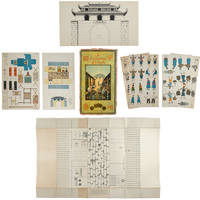
1900159678London.: Church of England Zenana Missionary Society. No date. circa1900. Nine printed sheets each printed with people or items and showing the cut lines. Original chromolithograph card box archivally repaired along seams. Some occasional light foxing on sheets card covers browned and worn in places a few other minor signs of wear but generally very good. 43 x 24cm. Rare. We have found no other copies of this game. The first two sheets show Chinese people in clothes appropriate to their age occupation etc. Those illustrated include The Opium Smoker School-master The General Shopkeeper Native Biblewoman etc. Other sheets show furniture and fittings a coloured illustration of the street a black and white image of the city gate and a much larger sheet 50 x 87.5cm which is an illustration of the street and onto which the other cut-outs when coloured and cut out are placed. . Church of England Zenana Missionary Society. hardcover
Lyon, chez les Fréres Bruyset, 1732. Dos volúmenes en gran folio; 6 hs., 1656 columnas de texto y 100 columnas de índices + 2 hs., 1570 columnas de texto y 85 columnas de índices. Con un total de 255 viñetas grabadas entre el texto, gran parte de ellas referidas a temas de caza, pesca, agricultura, jardinería y ganadería. Encuadernación uniforme en piel , de la época, con lomeras profusamente ornadas. Noël Chomel fue discípulo de Jean-Baptiste de la Quintinie, jardinero de Luis XIV. Párroco rural y ecónomo del Hôtel-Dieu de Lyon, reunió a lo largo de su vida sus experiencias campestres y domésticas, y publicó a los 76 años, en 1709, este monumental diccionario, traducido a numerosos idiomas, hasta el japonés, pero nunca en español.
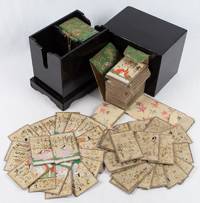
175724No date. Late Edo. Complete set of 200 delicately coloured handpainted cards flecked with gold and silver. Each card 8 × 5.4 cm. Two patterned silk cases one for the text and the other the portraits of the poets with washi paper linings are held within a black wooden lacquer box 16 ×11 ×15 cm. Some light signs of use but overall a very attractive set. This famous and much beloved Japanese card game is based on the classic anthology of 100 poems by 100 different poets. The anthology known as both Ogura Hyakunin Isshu and Hyakunin Isshu brings together waka usually now called tanka poems which were written between the 7th and 13th centuries. It was compiled by the famous 13th century critic and poet Fujiwara no Sadaie more often known as Teika. Hyakunin Isshu showcases all of the most important poets from the late Heian period in Japan. <br> <br>It is difficult to give an appropriate English language parallel to the enormous influence of the Hyakunin Isshu but possibly the closest would be the influence Shakespeare has had in the English speaking world. Many educated Japanese are able to recite many of the poems and this close association with and knowledge of these poems have to a great extent come through this card game. Playing the card game of Hyakunin Isshu is a very popular New Year holiday pastime. The first to win is the person with the largest number of cards collected. To achieve this goal you must be very familiar with the poems so that you can quickly take the card on which is written the last two lines of the poem being read out before your opponent does! A game of great knowledge and speed. . unknown
189578554August 1895 - 1978. original padded leather. The album's spine is perished with light wear at edges; contents sound and fine. 8vo. Illustrated throughout. The first page is an amusing original hand-colored cartoon of a Victorian couple cowering in front of a pig initialled "A.T." Following are 175 pig drawings all signed and most dated and many with a location. Dozens are neatly filled in in black and one is flesh-colored. 117 drawings were made between 1895-1900; 26 from 1900-1910 . hardcover
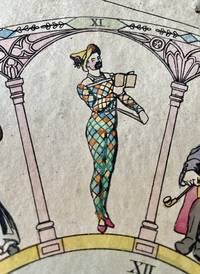
18405201<p>GAME. Arlequin und Columbine oder Arlequins Hochzeit. Nach der bekannten Pantomime gleichen Namens stellen bei diesem Spiele sämtliche Mitspieler Freier um Pantolons Tochter Columbine vor. n.p. n.p. ca 1830. </p><p> VAT in EU & UK</p><p>Lithograph broadside mounted on board 365 x 325 mm hand-coloured; board showing some staining and edges a little frayed; numbered 222 at bottom.</p><p>A well preserved board game played with two dice relating to the marriage of Harlequin and Columbine. Based on the well-known pantomime of the same name in this game all the players introduce suitors for Pantolon's daughter Columbine etc. The central circular field depicts the wedding couple surrounded by a number of acrobats. The surrounding twelve numbered arches show twelve stock male courtship figures all vying for Columbine's attention. The four corners show Commedia dell'arte figures.</p><p>Clockwise from the top the arches are numbered 2 7 5 4 10 2 8 3 6 9 2 11 while the central circle is numbered 12. The numbers thus represent all chances upon double dice with double 1 appearing three times. The rules give pay or take instructions for the various throws. The rules of the game are printed below. One participant is the 'banker' who organises the game and takes the pawns from all participants and arranges for the money to be distributed. The players throw dice andmove along according to their results.</p><p>This board game is number 222 from the fund of an unknown German publisher printed about 1840.</p><p>See Plock Phillippa and Adrian Seville "The Rothschild Collection of printed board games at Waddesdon Manor" in XIIIth Board Game Studies Colloquium Paris 14-17 April 2010; Buijnsters P.J. Papertoys. Speelprenten en papieren speelgoed in Nederland 1640-1920. Waanders Uitgevers-Zwolle 2005.</p> n.p.
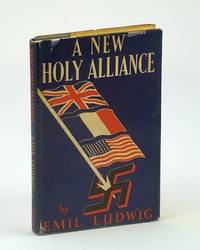
193886240London: Robert Hale 1938. 1st edition. Nice Copy. octavo. dust jacket 123pp. frontis. A warning that the new alliance between Britain France the US & Nazi Germany will end in disaster.Very nice copy in grey boards in a very nice bright dust jacket with minimal chipping at edges. Extremely scarce especially in this condition. PHOTO available Robert Hale hardcover
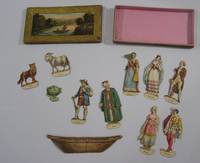
182518320French: n.p. 1825. Very good. 11 engraved cut-out figures or objects including ferryman three couples wolf goat cabbage and boat to be slotted into boat original box with engraved pictorial label colored by hand A rare children's game possibly printed by the Parisian publisher Nepveau. Contained in the box measuring 14cm x 7cm x 1cm is a complete set of figures for the two river crossing puzzles known as the 'Jealous Husbands Problem' and 'Goat Wolf and Cabbage'. The earliest account of these puzzles is in the 9th century manuscript "Propositionnes ad Acuendos Juvenes" Problems to Sharpen the Young attributed to Alcuin. In both puzzles there are only two places in the boat. In the Jealous Husbands Problem no woman can be with another man unless also accompanied by her husband. In Goat Wolf and Cabbage the wolf will eat the goat and the goat will eat the cabbage unless they are guarded by the boatman. <br /> Originally accompanied by counters and an instruction sheet now lost. The box is lightly worn else in very good condition; the figures are in fine condition except the boat which has been repaired and the cabbage which lacks the lower part of its insertion tab and one female figure lacks a hand. Rare. n.p. unknown
1723Debonnaire1723<p>GAME OF THE GOOSE Essay du nouveau conte de ma Mère l'Oye ou les enluminures du jeu de la Constitution by Louis Debonnaire. No imprint 1723. 8vo xiii xviii 176pp; early leather boards with original spine laid down.</p><p>Despite the claim that this is a new edition it is nonetheless an UNCOMMON IMITATION of the traditional "Game of the Goose" a rhymed pastiche as if spoken by Mother Goose written by a Jansenist priest Abbot wherein one must win the formation of a new Council here referred to as a Constitution. It introduced what became a familiar catchphrase "LIBERTY EQUALITY FRATERNITY" condemned in 1725 as anti-Rome. Barber III 880</p> No imprint hardcover
1930857New York: Bibo & Lang Exclusive Distributors 1930 First edition second issue. Quarto 12" x 9" 15 & 1 pages plus covers. Original pictorial stapled paper wraps.<br /><br /><p>Moderately soiled & rubbed wraps beginning to separate about 3 inches brief wear at edges & corners light foxing a Very Good copy of a fragile book. </p><p>The second issue of the first Mickey Mouse book which adds Bobette Bibo's age on the title page revises the lyrics of The Mickey Mouse Song removing "Kill Him" & adds two comic strips. The game board & adjacent perforated sheet with the games pieces so often lacking are present & uncut.<br /></p> Bibo & Lang paperback books
1898247238London: Rowland Ward 1898. First edition. Illustrated with photographs by the author and two folding maps in back pocket. 506 pp. 1 vols. 8vo. Mulberry cloth titled in silver. Lower inner hinge cracked spine ends rubbed. Very good. First edition. Illustrated with photographs by the author and two folding maps in back pocket. 506 pp. 1 vols. 8vo. Presentation Copy. A lively account of the author's adventures during an eight-month shooting trip in Baltistan Ladakh and Kashmir.<br/><br/>Very scarce.<br/><br/>A presentation copy inscribed on the half title: "Robert Frazer from his old schoolfellow the writer February 1898". Czech Asia 58 Rowland Ward unknown books
182518320French: n.p. 1825. Very good. 11 engraved cut-out figures or objects including ferryman three couples wolf goat cabbage and boat to be slotted into boat original box with engraved pictorial label colored by hand A rare children's game possibly printed by the Parisian publisher Nepveau. Contained in the box measuring 14cm x 7cm x 1cm is a complete set of figures for the two river crossing puzzles known as the 'Jealous Husbands Problem' and 'Goat Wolf and Cabbage'. The earliest account of these puzzles is in the 9th century manuscript "Propositionnes ad Acuendos Juvenes" Problems to Sharpen the Young attributed to Alcuin. In both puzzles there are only two places in the boat. In the Jealous Husbands Problem no woman can be with another man unless also accompanied by her husband. In Goat Wolf and Cabbage the wolf will eat the goat and the goat will eat the cabbage unless they are guarded by the boatman. Originally accompanied by counters and an instruction sheet now lost. The box is lightly worn else in very good condition; the figures are in fine condition except the boat which has been repaired and the cabbage which lacks the lower part of its insertion tab and one female figure lacks a hand. Rare. n.p. unknown books
1938734G4576London: Robert Hale Limited 1938. Book. Good. Hardcover. First English Edition. 8vo - over 7¾" - 9¾" tall. 123 pages. Black and white photographic frontisplate of author. First published in German in the same year. Noteworthy for its call for a resurrection of the same two-front military alliance which was marshalled against Germany in the Great War. The following year 'Foreign Affairs Quarterly' published a review of this book endorsing this policy. - Mike King. "In July 1914 Dr. Ludwig expounded the causes and misunderstandings which led up to the Great War. The purpose of the present work is to provide a remedy for the present perilous impasse before it is too late to avert disaster." - from dust jacket. In preparing this work Ludwig confidentially sent the first 83 pages of his manuscript to Edward VIII for his corrections which were later provided by letter. Source available upon request. Bold dust jacket art depicts British/French/US spear piercing a Nazi swastika. Unmarked. Binding tight. Moderate wear to book. Somewhat above-average wear to dust jacket which is now preserved in mylar. Moderate age-toning near endpapers. Moderate foxing to edges and back half of dust jacket. A sound copy of this significant work. Robert Hale Limited Hardcover
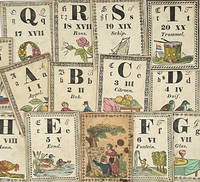
1820103149<p>No place no date but Leiden P.J. Trap c. 1820. Size: c. 6 x 8 cm. 27 cards the first one with two children reading and the other 26 contain the alphabet in various lettering types and the Roman and Arabic numbers. Each card also shows a word beginning with the letter on it and a handcoloured picture of the word. Each card with a decorative typographical border various types. card with publisher's name not present; the first card with browning and staining but all in all a lovely clean set held in a homemade green open box.</p><p>Rare Dutch alphabet cards. The first card was used for the cover of 'Kinderen lazen kinderen lezen'. c.f. Van Veen Kinderen lazen kinderen lezen #17; Buijnsters Papertoys p. 142/143.</p> P.J. Trap
18846396Cambrai: Renaut, 1884. 1884 1 vol in-8° (210 x 140 mm) de : 139 pp. (dont faux titre, titre) ; nombreux schémas et tableaux dans le texte ; cachet de libraire et signature manuscrite de l'auteur et concepteur du jeu au dos de la page de titre. Demi-basane verte d'époque, dos lisse orné et titré, plats recouverts de papier marbré, tranches marbrées. (Reliure frottée).
1998mon0000157544Soft Bank 4/6/1998 12:00:00 AM. jp_oversized_book. Very Good. 0.6299 in x 11.5748 in x 7.8740 in. Very minimal shelfwear near fine. Soft Bank unknown
188959410Paris: n.p. 1889. 4to. 10.5 x 10.75 in. Six individual puzzles individually postcard sized approx. 3.5 x 4.75 in. w/ colour chromolithograph image dissected onto nine wooden pieces each 1 small piece has been supplied in facsimile for upper corner of the Cairo street puzzle. All contained w/in the original deep red paper-covered wooden box raised bed w/in the box to hold the puzzles lid w/ decorative gilt title lettering minor shelfwear very minor rubbing still a VG nearly complete artifact. Very scarce original souvenir puzzle game issued for the fourth great Paris World’s Fair celebrating through pomp and events the Centennial of the French Revolution and the storming of the Bastille. The Exposition was intended to pull France out of a ruinous recession and attracted over 61000 exhibitors as well as 32 million visitors many of whom came to view the iconic Eiffel Tower. This puzzle celebrates several of the pavilions at the Exposition including Palais des Beaux-Arts designed by Joseph Brouvard filled with painting and flanking the Eiffel Tower providing visitors; the Palais de Trocadero held over from the famed 1878 Exposition celebrating the renewal of Paris following the Franco-Prussian War; as well as the Ministere de la Guerre which featured an Arms & Armour exhibition as well as displays of knightly tournaments assorted uniforms and cannon. The Maison Egyptienne and Rue au Caire would fuel the Orientalist movement and fascination with the Middle East among artists writers and the industrial arts well into the 20th Century. These boxed puzzle games were quite popular souvenirs as well as educational tools in the Belle Epoque and have become remarkably scarce. No copies in Worldcat. n.p., unknown
191260725London: Rowland Ward 1912. Price list. Four different examples of this publication from Rowland Ward two with the title above one from 1904 with the caption title "Stuffed Animals: Museum Specimens All Mounted in Standing Positions" and one from 1912 with the caption title "Price List of Mounted Specimens for Museums". 4to. The lists vary from three to ten pages rectos only two include a full page illustration of a stuffed elephant one torn three include a Rowland Ward decorated cover sheet. Animals from Africa predominate but there are also specimens from India Asia Europe North and South America and Australia; prices seem to top out at $500 for an African elephant typically an entry would include common name of the animal its genus and species its sex country of origin and price. Apparently none of these lists are located on OCLC. Folded for mailing one with a receipt stamp two with ink docketing. Very good lot of scarce Rowland Ward ephemera. Brad-bound in an upper corner. #7966. <br/><br/> Rowland Ward unknown books
189020151France 1890. 48 playing cards on thick stock. 86 x 56 mm. Wood engraved designed with stencil color versos alike with wood engraved grid fields. Excellent condition. A fine deck of cards for the game of Aluette a trick-taking game commonly played in France. Made up of four suits—batons coins swords and cups—the deck is dealt to players clockwise and played in “tricksâ€; the highest card wins and the player who threw it take the rest of the pile. <br /> Although it is a French game Aluette uses Spanish suits indicating that the game may be older than the creation of French playing cards. It is also called “La Vache†in some circles because one of the cups cards features a cow. B.P. Grimaud was the primary producer of Aluette decks but not that offered here. However the basic imagery on the cards closely follows Grimaud’s of the mid-late 19th century. unknown
1821141642Paris: chez Basset 1821. Rare printed board game retracing the history of Genesis in 63 squares arranged in a spiral. The game begins from the Garden of Eden and ends with the death of Joseph. Each box in the game is illustrated with an engraved biblical scene. The corner illustrations depict the creation of the world the ark of Noah and Lot and his daughters. The rules are in the centre of the image. Large single sheet 455 x 575 mm. Printed to one side only. The printer's details have been trimmed off this example. Central vertical and horizontal creases from prior folding. Paper age toned some wear repair and damp staining - minimal damage still a good copy. unknown
118195Berlin Simon Schropp c. 1790. Engr. broadsheet. Large folio 400x505 mm. Uncut with wide margins 465x635 mm folded. Small tears in foldings and in the outer margins. Stain in upper part. Rare version of this board game with the main title and the individual ones in four languages; French German English and Polish. cf V & A Museum MISC.124-1989.Based on the English version published in 1790 as â€The New Game of Human Life†by John Wallis and Newbury the Berlin publisher Simon Schropp published one version with French text only and this one in four languages. They all go back to Crépy’s â€Le Nouveau Jeu de la Vie Humaine†from ca. 1775.The aim of the game is to reach immortality and the end space nr 84 of the game is the Immortal Man. This version contains no printed rules but the game is so similar to that published by John Wallis that it will be played the same way:The game is played with two dice. Each tile on the playing field has instructions to follow. For instance: â€The Studious Boy at 7 shall receive a Stake and shall proceed to 42 the place of the Oratorâ€. â€The Negliant boy at 11 shall pay a Stake and shall remain two rounds without spinningâ€. â€The Married Man at 34 shall receive two Stakes for his Wife’s Portion and go to be a Good Father at 56â€. â€The Romance Writer at 40 shall pay two Stakes and go back to the Mischievous Boy at 5â€. Etc.â€The Immortal Man who has existed 84 years seems worthy by his Talents and Merit to be a Model for the Close of Life which can end only be Eternity. When we arrive at the No. 84 we shall have gained all we can by this Game but if we exceed this number we must go back as many points as we have proceeded beyond it. The Age of Man is divided in seven periods of twelve years viz. Infance to Youth Manhood Prime of Life Sedate Middle-age Old age Decreptitude and Dotageâ€. Some famous people are depicted. As philosoper nr 62 is Voltaire the poet nr 41 is Alexander Pope and the geographer nr 47 is Captain Cook pointing at a map. The final end space Immortality in the Berlin version shows a monument to Leopold of Brunswick Prince of Brunswick-Wolfenbüttel 1752-85. His charity as a general towards his soldiers made him famous and he drowned while trying to save his soldiers lives in the great flood of the River Oder. unknown
1906BIGGAMEH002055Privately printed by Marchant Singer & Co London. 1906. First edition. Royal octavo. pp xvi 415. 112 illustrations mostly from photographs by Mrs McMillan but also a number of full-page reproductions of drawings by the author. Large folding colour map in pocket at rear. Original red cloth gilt. Accounts of four hunting trips by Mr and Mrs McMillan in which the author participated. The McMillans originally from St Louis Missouri had relocated to London and also owned a farm in Kenya.Gift inscription from 1923 on front free endpaper. Front inner hinge starting to split. Endpapers a bit tanned and spotted. Very good indeed. Scarce. Privately printed by Marchant Singer & Co, London. hardcover
Folio, First Edition, with portrait frontispiece (of Bewick; original guard present), 16 fine coloured plates (all original guards present), 18 plates in autotype (all original guards present) and 30 wood-engraved illustrations (by the author and George Lodge) in the text, neat contemporary signature on front paste-down; original red straight-grained half morocco, red coarse-grain cloth sides blocked and lettered in gilt, gilt back, gilt top, blue-grey endpapers, uncut, joints and corners very faintly rubbed else a near fine, crisp copy. Lovely copy of Millais' well-known monograph on the four primary species: Capercaillie, Blackgame, Grouse and Ptarmigan. A number of the text-illustrations are by George Lodge. Freeman 2583; Jackson p.25; Mullens & Swann, p.405; Tate p.247.