4 134 résultats
1959M177081959 Chez l ' auteur , 1959 , in4° broché , jaquette illustrée . Illustrations noir et sépia de l'auteur . Couverture légèrement défraichie restaurée . Edition à tirage limité numérotée . Envoi de l' auteur . Un dessin original en dernière page .
8vo. 64 pp. Original printed wrappers. Caesar Vimercati describes his experiences on board of "La Guerriera" during the year 1840 and provides descriptions of Constantinople, Alexandria, Beirut, Saida, Acre, etc. Austrian warships had their first military encounters during the Oriental Crisis of 1840 as a part of a British-led fleet which ousted the Viceroy of Egypt, Muhammad Ali, from Ottoman Syria. Archduke Friedrich took part in the campaign personally and was awarded the Military Order of Maria Theresa for his exceptional leadership: "Es ist allgemein bekannt, daß um diese Zeit, und zwar genau am 15. Juli zu London eine Uebereinkunft zwischen den Repräsentanten der vier Großmächte England, Rußland, Preußen und Oesterreich geschlossen worden war, welche die Bezwingung der maßlosen Eroberungssucht Mehemed Ali's zum Zwecke hatte […] ". - Wrappers slightly dust-soiled, brownstaining to paper throughout, otherwise a good copy. OCLC 797734900. Not in Kalemkiar or in Kat. der k. k. Kriegsbibliothek.
8vo. 160 pp. Illustrated. Original pale blue wrappers titled in navy. First edition of "The Campaign for the Liberation of Israel": a rare publication on the First Arab-Israeli war by Israeli geographer Zev Vilnay (1900-88). Better known for his lectures on outdoor hiking and touring in Israel, Vilnay also served as a military topographer in Haganah and later the Israel Defense forces. His work, written in Hebrew, is profusely illustrated with maps showing transportation corridors, troop movements, and military and civilian installations. Vilnay's maps depict battles in and around Jerusalem, Haifa, Tel Aviv, the Upper and Eastern Galilee, and many more, discussing strategy and the use of infrastructure and landscape in waging war. An interesting geographer's view of Israeli military action during the 1948 Arab-Israeli War. - Light wear to spine. OCLC 19195703.
8vo. (6), 647 pp. Modern half calf with giltstamped spine. First edition. - The Jesuit Jacques Villotte (1656-1743) was sent to China. Leaving Marseilles in 1688, he arrived in Isfahan in October 1689. His various attempts to penetrate China were unsuccessful, and he settled in Isfahan, where he remained for twelve years. He was not recalled to France until 1712. At Isfahan, he taught plainchant to the Persians and translated several works in Armenian. - Some staining. OCLC locates no copy in the U.S.; however, one copy in Princeton (the Atabey copy). Atabey 1294. De Backer/Sommervogel VIII, 789 (quoting a slightly different title, possibly in error).
4to. XIV, 346 pp. With end-paper maps. Blue cloth with gilt embossed titles to spine. First edition. An account of sailing with the Arabs in their dhows, in the Red Sea, around the coasts of Arabia and to Zanzibar and Tanganyika; pearling in the Arabian Gulf; and the life of the shipmasters, the mariners and merchants of Kuwait. With particular attention to Basra, Kuwait, Bahrain, and Muscat. Numerous black and white photographs by the author, the master mariner and adventurer Allan Villiers (1903-82). - A fine copy. Macro, Bibliography of the Arabian Peninsula, 2250.
8°, CARTONATO EDITORIALE CON LOGO OVALE APPLICATO AL PIATTO ANTERIORE E TITOLO AL DORSO, SOVR. COLOR ARGENTO CON FOTO A COLORI, RISGUARDI CON FOTO B.N., PG. 128 (4), 78 FOTO B.N. N.T. E DIVERSE A COLORI N.T. NON NUMERATE, EDITO DAL CIRCOLO GOLF IN OCCASIONE DEL 60° ANNO DI FONDAZIONE, BUONO\OTTIMO STATO. (C)
4to (199 x 243 mm). XXXII, 462, (2) pp. Contemporary auburn calf (covers sympathetically restored). Marbled endpapers. First (and only) edition of this early grammar of Ottoman Turkish, the fourth book known to have been printed at the French embassy press at Constantinople established by Choiseul-Gouffier in 1787. The Arabic types were supplied from Basel. The oriental scholar Viguier (1745-1821), who was apostolic prefect and resident at Constantinople from 1783 to 1802, was the first to distinguish in Turkish the exclusive use of either guttural or palatal vowels within a single word. His grammar is printed with the Turkish transliterated, although some sentences are printed in Ottoman script together with their transliteration. - The books printed at the embassy press were "mostly military or scientific and included Turkish translations of Fitte-Clave's 'Elémens de castramentation' and Truguet's 'Tactique navale'. Choiseul-Gouffier was keen to see printing re-established in Turkey, and there may well have been some degree of co-operation between his press and the refounding under Abdul Hamid I of the Turkish press (first established by Ibrahim Müteferrika), which led to the printing of Vauban's work on mines, the 'Fenn-i Lagim'. The press was mostly used for the production of materials used by the embassy" (Atabey). The subscribers included mostly merchants resident in Turkey, although some names from Smyrna and Saloniki are also to be found, as are various missionaries, the English ambassador Ainslie, Count Ludolf, ambassador of the King of the Two Sicilies, and Pierre Guys, author of "Voyage littéraire de la Grèce". - Light browning as common; upper corner of the final errata leaf torn away without loss and professionally remargined. Rebound to style retaining the original, beautifully gilt-stamped spine with sympathetic full calf covers and marbled endpapers. Atabey 1290. Blackmer 1732. Brill, Turcica, 13. Chahine 5025. Aboussouan 936. Vater/Jülg 416. Cf. H. Omont, "Documents sur l'imprimerie à Constantinople", in Revue des Bibliothèques, Paris, July-September 1895.
No marks or inscriptions. A lovely clean very tight copy with bright unmarked boards and no bumping to corners. Dust jacket not price clipped or marked or torn or creased. 224pp.
Folio (368 x 255 mm). Etched and engraved title and 31 etched plates (numbered 1-30 and one unnumbered). Contemporary French red morocco gilt, arms of Louis-François-Armand de Vignerot du Plessis, duc de Richelieu et de Fronsac on covers (Olivier 407, fer 15), within gilt border of Richelieu’s repeated motif of two crossed batons intertwined with an ornamental “R”, repeated with coronet within arabesques at the corners, spine gilt in compartments with same motif. First edition; a large-paper copy with Richelieu's arms. Vien's charming series of etchings depicts the costumes worn by members of the French Academy in Rome for a "Turkish masquerade" held during the Carnival celebrations of 1748. This masque is an outstanding example of the influence the orient exerted on western style during the late-Baroque era, showcasing the degree to which cultural transfer was possible and even a matter of enthusiastic adoption by the west but little more than half a century after the siege of Vienna. The elaborate masquerades at the French Academy constituted an important fixture in the Roman calendar. As director of the Academy, Vien organised the masque of 1748, the fabulous costumes of which are presented here, designed, drawn and etched by Vien himself. The costumes in the present suite are "a curious mixture of authentic Turkish habits and European invention" (Blackmer), showing the stock figures of the Turkish court liberally enhanced with elements of Vien's own concoction. The fantastical nature of the creations is a far cry from the sober neo-classical style with which Vien is commonly associated (his pupils included some of the foremost artists of the period, notably Jacques-Louis David). Vien's original drawings and oil paintings for the Mascarade are held by the Musée du Petit Palais; they were exhibited in Berlin in 1989. - Some marginal dampstaining and foxing, binding rebacked retaining most of original spine, corners repaired. This copy commanded $26,000 at Christie's New York in 1997. - Provenance: from the library of Louis-François-Armand de Vignerot du Plessis, duc de Richelieu et de Fronsac (1696-1788), a close friend of Louis XV of France, though critical of Madame de Pompadour. He is supposedly the model for the character of Valmont in Choderlos de Laclos' "Les Liaisons dangereuses". Atabey 1288. Lipperheide Sm 10. Colas 3005 (suggesting the plates are un-numbered). Hiler 879. Le Blanc II, 122, 8-39. Cohen/R. 1014f. Brunet V, 1211. Cf. Blackmer 1730. Cf. Gay 3644. Graesse VI/2, 311 (Paris, Bassan et Poignan).
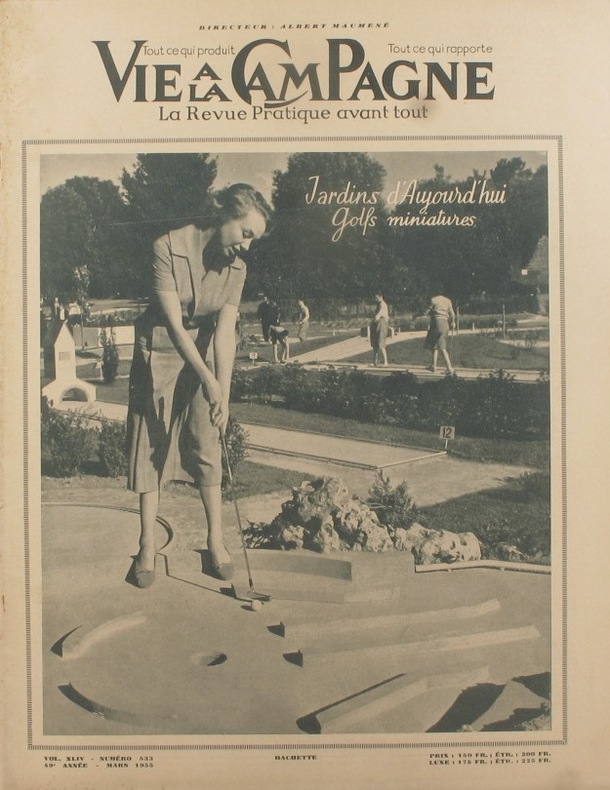
1955118668Couverture souple. Revue brochée.
8vo. (16), 216 pp. With a folding map in the lower cover. Original printed cloth. First edition of this study of the traditional historical region of Al-Hasa near Dammam in eastern Saudi Arabia, created a World Heritage site in 2018. The anthropologist and surveyor Federico S. Vidal, an Aramco employee, would develop his work into a 3-volume Harvard Ph.D. thesis in 1964. - Handwritten ownership of Hazel D. Blair to front free endpaper. An excellent copy of this scarce work.
8vo. (16), 344 pp. Modern marbled calf with gilt title to spine. First German edition. "Il La Croze era bibliotecario del re di Prussia. Il primo libro di quest' istoria narra le origini e il progresso del monofisismo, il secondo contiene la relazione di Etiopia del patriarca Bermudez, il terzo racconta il progresso e la decadenza della influenza portoghese in Etiopia" (Fumagalli). - Some brownstaining throughout. Fromm 26499. Mulsow, Drei Ringe, p. 150. Cf. Cioranescu 35510. Fumagalli 2268. Gay 2691 (1739 first French ed.). Not in Kainbacher or Paulitschke.
Large 8vo. 228 pp. (misnumbered "328"). With lithogr. frontispiece and 15 lithogr. plates, all in beautiful contemporary colour, raised in gum Arabic, with tissue guards. Contemporary half calf with gilt spine. First edition; republished in Brussels in 1844. The artist Goupil-Fesquet (1817-78) accompanied Vernet to Egypt and Syria, where is is known to have taken the first dagerreotypes in the area - only two months after the discovery of photography was announced in 1839. This work is an account of that famous journey which became a landmark in the history of photography in the Near East. In addition to his description of the famous tour, Goupil discusses the oriental decorative arts. - Strong foxing throughout. Blackmer 718. Weber I, 309. Not in Ibrahim-Hilmy.
Matted, framed and glazed (frame dimensions 570 x 505 mm). Pretty lithograph by the famous horse painter Carle Vernet (1758-1836), showing an Arabian horse getting prepared for the ride. - In very good condition.
Aquatint print (image size: 485 x 390 mm, not including title and imprint; paper size: 55 x 45 cm), engraved by Jean Pierre Jazet after Vernet. Striking aquatint of a Mamluk leader by the acclaimed French artist Carle Vernet (1758-1836), best known for his depiction of horses and war scenes. The Mamluk leader is depicted in traditional garb with a scimitar dangling from a robe in his hand, on a horse, with a fighting scene in the background in front of a Middle Eastern town. The engraver, Jean Pierre Jazet (1788-1871), must have been a skilled artist himself. - A lithographed copy, retaining some of the original splendour, was published in Vienna by Joseph Trentsensky a few years later. - A fine copy in a crisp impression. Dayot, Carle Vernet (1925), no. 102. Nagler XXII, p. 440. Cf. Mennessier de la Lance II, p. 617.
With a lithographed portrait of the author, 5 lithographed facsimiles of the author's autograph manuscripts and 4 of the letterpress pages printed in gold. Extra-illustrated with 3 lithographed and 4 engraved Royal Folio illustration plates (including 2 portraits of the Ottoman Sultan Abdulmejid I). With: (2) Vernay, Charles. Poésies Turques et Persanes (cent quarante et une pièces) ... Paris, Albert Franck (below frame: lithographed by [Mathieu] Masson), "1858-1859" [= AH 1275]. With a letterpress wrapper-title in French, printed in gold, a lithographed Turkish and Persian wrapper-title (dated "1275" and "1858") and text in Turkish and Persian, lithographed from the autograph manuscript in Arabic script, all printed in gold, and a lithographed portrait of the author (the same as in ad 1). (3) Vernay, Charles. Nouvelles poésies Persanes et Turques ... Paris, Albert Frank, July 1860 (colophon: lithographed by [Mathieu] Masson, r. de Valois 48, Paris). A large 4to bifolium, with a lithographic facsimile of a 4-page autograph manuscript in Arabic script, printed on blue paper. (4-18) Vernay, Charles. [Miscellaneous publications in various formats, some letterpress, others lithographed facsimiles of the author's autograph manuscripts in French, Turkish and Persian, and including a 1-leaf autograph manuscript in Persian]. Paris, Firmin Didot frères and others, 1851-1858. 18 publications in 1 volume. Royal Folio (49.5 × 34.5 cm) with a few items in smaller formats. Contemporary diced, richly gold-tooled calf, each board with a double frame of rolls and stamps, a crescent moon and star inside each corner of the inner frame, blind-tooled turn-ins, green silk brocade endleaves. Unrecorded royal folio issues of two major editions of oriental poetry, bound together and with extensive supplementary material added, probably for presentation to the Ottoman Sultan Abdulmejid I: the first and only edition of the collected oriental poetry (195 pieces) of the French child prodigy orientalist, linguist and poet Charles Vernay; and the earlier lithographic edition of his 141 Turkish and Persian poems. In the former work, the Turkish and Persian poems are rendered both in the Arabic script and in French translation. It also includes a few poems in Italian and German. Even the 8vo issues of these two editions are very rare. The present Royal folio issues of the two main works were clearly never offered for sale. - Charles Vernay (1842-1866?) began publishing his writing at age nine and most of the present publications note the age at which he wrote them, ranging from 9 to 16. When Vernay was in Istanbul in 1861, he wrote a new dedication for the 1860 Poésies nationales et religieuses, addressed to the Ottoman Sultan Abdulmejid I, though Vernay had it printed in Paris. It explicitly notes that he is presenting a copy of "mon volume de Poésies Françaises, Italiennes, Turques et Persanes" to the Sultan. This suggests that the present copy of the two works together, with that dedication and many other additions, is the copy he planned to present. Since the dedication is dated 14 March 1861 and the supplementary Dixième chant mystique (also printed by Lainé and Havard) 20 April 1861 (only 2 months before Sultan's death), it is possible the Sultan died before Vernay had an opportunity to present the book to him. In addition to the extensive additional material inserted in the Poésies nationales et religieuses, and the supplement to the Poésies Turques et Persanes, the present copy has about 15 miscellaneous publications by Vernay bound between the two main works, some letterpress, some lithographic facsimiles of his autograph manuscripts in French, Turkish and Persian, and including a 1-page autograph manuscript in Persian. Some occasional foxing and an occasional marginal tear. The ink in the 5 lithographic facsimiles of very large Arabic script has eaten a few holes in the paper, and it and a few other lithographed leaves have offset onto the facing pages. But the book remains in good condition. The binding is worn at the hinges, shows some superficial damage on the front board near the fore-edge, and the first free endleaves at front and back have been creased and at the front its silk has been torn and repaired, but the binding also remains good and with the tooling clear. Ad 1: cf. Hage Chahine 4995 (8vo issue); WorldCat (7 copies of the 8vo issue); ad 2: cf. Browne, Hand-list ... Turkish (Gibb coll., Cambridge UL), (1906), 169; Hage Chahine 4994 (8vo issue); WorldCat (4 or 5 copies of the 8vo issue); ad 3: not found recorded; none of the 3 in Aboussouan coll.; Atabey; Blackmer; Diba, Persian bibliography; Lambrecht; Coll. Lazard; for Charles Vernay and his poetry, see also: Syed Tanvir Wasti, "On Charles Vernay and his 'Divan'", Middle Eastern studies LI (2015), pp. 789-803.
Small 8vo. (2), 30 pp. Lithographed and illustrated throughout. Original yellow printed wrappers. Lithographed in Arabic throughout (save for the French wrapper-title): a rare official manual of the legal system of weights and measures used in French Algeria, intended for Arab-French schools. The booklet was drawn up by the school principal Eugène Vayssettes and translated by an Arab known only as Antoine, after an earlier effort by the military interpreter Ahmed ben Lefgoun had been condemned by the board as too complicated and linguistically obscure. The illustrations show various receptacles and measuring units. - In excellent condition. OCLC 493647389.
Hand-coloured engraved map (560 x 490 mm). Matted. Robert de Vaugondy’s spectacular 1753 map of the Ottoman Empire. Vaugondy maps the empire at its height, with territory spanning from the Black Sea to the southernmost extension of Arabia and west, inclusive of Persia, as far as the Mogol Empire of India. Includes the modern day nations of Turkey, Egypt, Saudi Arabia, Oman, Yemen, the United Arab Emirates, Iran, Iraq, Kuwait, Israel, Palestine, Jordan, Syria, Lebanon, Armenia, Azerbaijan, Georgia, and parts of Afghanistan, Pakistan, India, Uzbekistan, and Greece. Vaugondy employs all of the latest geographical information of the time incorporating both French and transliterations Arabic place names. This map offers splendid detail throughout inclusive of undersea shoals and reefs in the Red Sea and Persian Gulf, mountain ranges, lakes, rivers, and historical sites. A highly decorative title cartouche showing an Ottoman prince appears in the lower left quadrant. Five distance scales are in the lower right. Drawn by Robert de Vaugondy in 1753 and published in the 1757 issue of his Atlas Universal. Al-Qasimi 168. Al Ankary 353. McMinn 49. Not in Tibbetts.
199653231996 éditions Covedi Pau 1996 - In folio format 36cmX26 cm non paginé - préface Pierre Tucoo-Chala - très nombreuses reproductions d aquarelles dans le texte - bon état
4to. 2 vols. bound in one. 14 pp. (index), 210 pp., (1 blank), 7 pp. (index), 190 pp. Original full calf with later paper label; later marbled paper on the spine. An important first-hand account of relations between the Porte and central Europe as well as the wider political events during the second half of the 18th century. Written by the Baghdad-born diplomat Ahmed Vasif Effendi and also known as "Vasif Tarihi" ("Vasif's History"), it forms one of the most important works of Ottoman political history for the period between 1754 and 1774, when the author actively participated in the world of diplomacy in the Ottoman Empire, on the Balkans, in Russia and in Vienna. Vasif was known for his quick temper and was later described by the German orientalist Franz Babinger as "vain, stingy, jealous, and excessively vicious" (cf. p. 336). His text was left unfinished after a dispute with the Istanbul-based press of Rasid Efendi, which Vasif himself had helped establish, and it was completed by Sadullah Enveri (d. 1794), who himself had participated in the military events described. - At the time one of the few available printed historico-political accounts of contemporary Middle Eastern relations with the West during the age of Enlightenment, the book proved extremely popular throughout Europe and is today found in many European libraries. This is the third and last edition, the second printed at Bulaq, by the first official and governmental printing press in Egypt, after first being published in Istanbul in 1219 (1803/04). - Bulaqor Al-Amiriya Press, the first official and governmental printing press established in Egypt, was founded in 1820 by the viceroy of Egypt, Muhammad Ali. As early as in 1815 the first delegation was sent from Egypt to Milan to learn printing. After the building for the press was finished in the autumn of 1820, it took another two years to transport the machines and train the employees, and the first book, an Arabic-Italian dictionary, was published in 1822. Viceroy Muhammad Ali started several reform programmes with a view to create a modern Egyptian society after the European model, and the press was part of this modernisation. He is remembered for establishing modern Egypt as an independent country. - Printed on thick paper. Interior clean with sporadic old staining; old pencil and ink annotations to endpapers. Binding shows larger scratches and loss of material, but still in the original Bulaq covers. Provenance: 19th century bookseller's label of Benjamin Duprat, Paris, on front pastedown; later owned by the Iraqi architect Mohamed Makiya (2015). Özege V, 22519. OCLC 949617481, 777193206, 320228577, 780208235, 165361809, 26779362 and 600848792 (some examples on microfilm). Ethan L. Menchinger, The First of the Modern Ottomans: The Intellectual History of Ahmed Vasif (2017). Franz Babinger, Die Geschichtsschreiber der Osmanen und ihre Werke (1927), pp. 335-337.
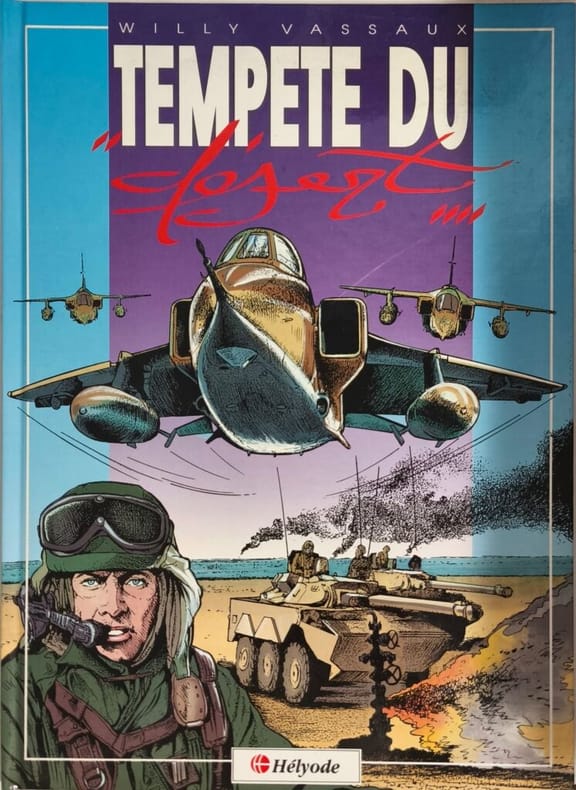
19915566Helyode 1991 47 pages in4. 1991. cartonnage editeur. 47 pages. Cette bande dessinée documentaire relate l'invasion du Koweït par l'Irak de Saddam Hussein le 2 août 1990 événement déclencheur de la guerre du Golfe qui a bouleversé la géopolitique du Moyen-Orient
4to. LXXXV, (1 blank), 121, (3) pp. With 5 maps, the facsimile text of the title-page and colophon of Varthema's original 1510 book, 1 plate, and a small blue illustration (similar to the blind-tooled image on the front board) on the title-page. Text set in Monotype Baskerville. Half white and half blue cloth with gold lettering on spine and a blind-tooled image (probably of Varthema) on the front board. Ludovico di Varthema (ca. 1468-1517) was one of the first Europeans to visit the cities of Mecca and Medina and to travel as far east as India and the East Indies. He probably came from Bologna or possibly from Rome and might have been a soldier in the Papal forces, but not much is known about his early life. Due to Varthema's writing and later publishing his travel account, much more is known about his later years: in 1802 he sailed from Venice via Cairo in Egypt to Damascus in Syria, where he embarked upon his first remarkable journey. He joined a pilgrimage to Mecca and Medina, being one of the first Europeans to enter these holy cities, and then continued south through the Arabian Peninsula to Yemen. From Aden in Yemen he sailed to several cities on the coast of Somalia before sailing along the coast of Oman to Ormuz and subsequently travelling inland across Persia to India. Varthema supposedly travelled across large parts of the East Indies, but since his descriptions of this part of his journey lose some of its accuracy, scholars doubt whether he made the journey himself. Nonetheless, the itinerary shows that the journey that far to the East was not impossible or unheard of at the beginning of the 16th century. - Varthema's Itinerary was first published in Rome in 1510, and numerous editions have been published since. Almost immediately after its first publication the work was translated into Latin (1511), and numerous translations into other languages followed. In 1863 the Hakluyt Society published the principal English translation of the original Italian work, by John Winter Jones. In the present edition, prepared by Norman Mosley Penzer, an extensive analysis of Varthema and his travels by Richard Carnac Temple has been added to Jones's translation. Temple (1850-1931) was an Indian-born British administrator and an anthropological writer. He was a member of several learned societies and institutes, including the Royal Asiatic Society, the Royal Anthropological Institute, and the Hakluyt Society. Penzer (1892-1960) was a British scholar specialising in Oriental studies and a fellow of the Royal Geographical Society. - Binding slightly soiled, edges foxed and untrimmed. With a pink reading ribbon and a small blue label on the back pastedown: "Vancouver Bookshop 909 Robson Street Vancouver, B.C.". Printed on Japon vellum, one of 975 copies but unnumbered. Howgego I, V15. cf. Blackmer 338; Gay, Afrique et Arabie, 140; Macro 2239.
4to. 226 pp. (A8, B-C4, D8, E-F4, G8, H-J4, K8, L-M4, N8, O-P4, Q8, R-S4, T6, V4, X7, without the final blank). With title woodcut and 47 woodcuts in the text (including 1 full-page illustration). - (Bound after) II: Giovio, Paolo. Libellus de legatione Basilii Magni principis Moschoviae ad Clementem VII. Pontificem Max. in qua situs regionis antiquis incognitus, religio gentis, mores, & causae legationis fidelissime referuntur. Basel, [J. Froben], 1527. 39, (1) pp. With woodcut printer's device to t. p. - (Bound after) III: Fabri (of Leutkirch), Johann. Ad serenissimum principem Ferdinandum Archiducem Austriae, Moscovitarum iuxta mare glaciale religio. Basel, J. Bebel, 1526. 18 ff. - (Bound after) IV: Ricoldo (da Monte di Croce). Contra sectam Mahumeticam libellus. (Georgius de Hungaria). De vita & moribus Turcorum. Carben, Victor de. Libellus de vita et moribus Iudaeorum (ed. J. Lefèvre). Paris, H. Estienne, 1511. 86 ff. With large woodcut in the text and several woodcut initials. - (Bound after) V: Ficinus, Marsilio. De religione Christiana & fidei pietate opusculum. Xenocrates de morte, eodem interprete. Strasbourg, J. Knobloch, 1507. 90 ff. With woodcut printer's device on final page. - (Bound after) VI: Haythonus (Hatto). Liber historiarum partium orientis, sive passagium terrae sanctae scriptus anno Redemptoris nostri M.CCC. Hagenau, J. Setzer, 1529. 71 ff. With woodcut title border and device on final page. Contemp. wooden boards with wide blindstamped leather spine and 2 brass clasps. The first illustrated edition (in its second issue) of one of the most famous early travel reports and the first Western encounter with the Arab world. Of the utmost rarity; not a single copy could be traced on the market for the past sixty years; not a single copy in the USA (cf. OCLC). - The "Itinerario" contains the first printed eyewitness account of any place in today's United Arab Emirates: on his return journey from Mecca (which he was the first Westerner to describe), Varthema visited Ras al-Khaimah ("Giulfar") and portrayed the city as "most excellent and abounding in everything", with "a good seaport", and whose inhabitants are "all Muslims". While Montalboddo's famous anthology of discoveries, printed in 1507, contained the first printed reference to the Arabian Gulf region, it was Varthema's work, published only three years later, that offered the first actual report from the region by a Western traveller who had visited the coast. - All early editions of Varthema’s “Itinerario” are exceedingly rare (even the 2013 Hajj exhibition at the MIA, Doha, only featured the 1654 reprint; cf. below). This - the first illustrated one - is certainly the rarest of them all: international auction records list not a single copy. The 1510 editio princeps was offered for US$ 1 million at the New York Antiquarian Book Fair in April 2011. - Varthema, a gentleman adventurer and soldier from Bologna, left Venice at the end of 1502. In 1503 he reached Alexandria and ascended the Nile to Cairo, continuing to Beirut, Tripoli, Aleppo and Damascus, where, adopting Islam and taking the name of Yunas, he joined a Mameluke escort of a Hajj caravan and began the pilgrimage to Mecca. Varthema was amazed by what he observed: "Truly I never saw so many people collected in one spot as during the twenty days I remained there", he begins, and arriving at the Great Mosque, continues, "it would not be possible to describe the sweetness and the fragrances which are smelt within this temple." Thanks to his knowledge of Arabic and Islam, Varthema was able to appreciate the local culture of the places he visited. Impressed and fascinated, he describes not only rites and rituals, but also social, geographical, and day-to-day details. "I determined, personally, and with my own eyes", he declares in the prefatory dedication, "to ascertain the situation of places, the qualities of peoples [...] of Egypt, Syria, Arabia Deserta and Felix, Persia, India, and Ethiopia, remembering well that the testimony of one eye-witness is worth more than ten hear-says." His good fortune did not continue unabated, however: after embarking at Jeddah and sailing to Aden, he was denounced as a Christian spy and imprisoned. He secured his release and proceeded on an extensive tour of southwest Arabia. Stopping in Sanaa and Zebid as well as a number of smaller cities, he describes the people, the markets and trade, the kind of fruits and animals that are plentiful in the vicinity, and any historical or cultural information deemed noteworthy. Returning to Aden, and after a brief stop in Ethiopia, he set sail for India. In addition to visiting Persia, Varthema explored the coasts of Malabar and Coromandel, including a very documented stay at Calicut at the beginning of 1505. He also purports to have made extensive travels around the Malay peninsula and the Moluccas. Returning to Calicut in August 1505, he took employment with the Portuguese at Cochin and, in 1508, made his way back to Europe via the Cape of Good Hope. - First published in 1510, Varthema's account became an immediate bestseller. In addition to his fascinating account of Egypt, Syria, the Arabian Peninsula, and the holy Muslim cities, "Varthema brought into European literature an appreciation of the areas east of India [...] which it had previously not received from the sea-travelers and which confirmed by firsthand observations many of the statements made earlier by Marco Polo and the writers of antiquity" (Lach, I. i. 166). "Varthema was a real traveller. His reports on the social and political conditions of the various lands he visited are reliable as being gathered from personal contact with places and peoples. His account of the overland trade is of great value in that we are made to see it before it had begun to give way to the all-seas route. He even heard of a southern continent and of a region of intense cold and very short days, being the first European probably after Marco Polo to bring back the rumor of Terra Australis" (Cox I, 260). - Bound with this work are five other 16th century imprints: II: Giovio's report on Russia is based on conversations with the Russian envoy Dimitry at the court of Pope Clement VII in Rome. - III: "The second printed book on Russia" (NUC), intelligence on Russia gathered by the later bishop of Vienna in Tübingen in 1525 from the envoy of the Grand Prince Ivan Vasilievitch. - IV: "Very rare anti-Muslim and anti-Semitic volume, of which this is the first edition to include the third tract by Victor de Carben" (Schreiber). Contains the report by Georgius de Hungaria, who was captured in 1438 during the siege of Mühlbach and was sold into Turkish slavery. Also includes the anti-Muslim treatise of Ricoldo (1242-1320) and the anti-Semitic pamphlet of Victor de Carben (1422-1515), a converted Rabbi from Cologne. - V: Fine Strasbourg humanist edition of two works by the great Neo-Platonist Marsilio Ficino (1433-99), including his 1474 apology of Christianity against Islam and Judaism. - VI: First Latin edition, edited by Menrad Molther, with his dedication to Georg von Morsum. The Armenian prince Haytho reached Poitiers in 1306 and there dictated his history of the Middle East since the first appearance of the Mongols. - Spine slightly rubbed; some browning, annotations and occasional worming. Ms. index of all works contained on front pastedown. Removed from the Donaueschingen court library with their stamps on first and final page. I: VD 16, ZV 15157. BM-STC 66. IA 113.543 (includes copies in BSB Munich and Wolfenbüttel). Benzing (Strasbourg) 100. Schmidt (Knobloch) 132. Ritter (IV) 932 & 2000. Muller 132, 170. Kristeller 383. Paulitschke 296. Ibrahim-Hilmy II, 305. Röhricht 574. Cf. exhibition cat. “Hajj - The Journey Through Art” (Doha, 2013), p. 90 (1655 Dutch ed. only). Macro, Bibliography of the Arabian Peninsula, 2239 (other editions only). - II: BM-STC 360. VD 16, G 2081. Adelung I, 188 ("1537" in error). - III: BM-STC 294. VD 16, F 189. Adelung I, 185. - IV: BM-STC 317. Moreau 197. Renouard 9, 1. Göllner 48. Apponyi 78. Schreiber 11. - V: BM-STC 302. Adams F 416. VD 16, F 939. Ritter 838. The same, Catalogue, 978. Schmidt (Knobloch) 33. Muller 117, 29. - VI: BM-STC 403. VD 16, H 870. Adelung I, 119 (imprecise). Röhricht 176 (p. 66). Ritter 1090. The same, Catalogue, 1171. Burg 200. Benzing (Hagenau) 84, 107.
4to. 226 pp., final blank f. With title woodcut and 47 woodcuts in the text (including 1 full-page illustration). Blindstamped dark blue morocco by Riviere & Son with giltstamped spine title. All edges gilt. Marbled endpapers. The first illustrated edition (in its second issue) of one of the most famous early travel reports and the first western encounter with the Arab world. Of the utmost rarity; not a single copy could be traced on the market for the past sixty years; not a single copy in the USA (cf. OCLC). Lodovico de Varthema’s “Itinerario” contains the first printed eyewitness account of any place in today's United Arab Emirates: on his return journey from Mecca (which he was the first Westerner to describe), Varthema visited Ras al-Khaimah ("Giulfar") and portrayed the city as "most excellent and abounding in everything", with "a good seaport", and whose inhabitants are "all Muslims". While Montalboddo's famous anthology of discoveries, printed in 1507, contained the first printed reference to the Arabian Gulf region, it was Varthema's work, published only three years later, that offered the first actual report from the region by a Western traveller who had visited the coast. All early editions of Varthema’s “Itinerario” are exceedingly rare (even the 2013 Hajj exhibition at the MIA, Doha, only featured the 1654 reprint; cf. below). This - the first illustrated one - is certainly the rarest of them all: international auction records list not a single copy. The 1510 editio princeps was offered for US$ 1 million at the New York Antiquarian Book Fair in April 2011. - Varthema, a gentleman adventurer and soldier from Bologna, left Venice at the end of 1502. In 1503 he reached Alexandria and ascended the Nile to Cairo, continuing to Beirut, Tripoli, Aleppo and Damascus, where, adopting Islam and taking the name of Yunas, he joined a Mameluke escort of a Hajj caravan and began the pilgrimage to Mecca. Varthema was amazed by what he observed: "Truly I never saw so many people collected in one spot as during the twenty days I remained there", he begins, and arriving at the Great Mosque, continues, "it would not be possible to describe the sweetness and the fragrances which are smelt within this temple." Thanks to his knowledge of Arabic and Islam, Varthema was able to appreciate the local culture of the places he visited. Impressed and fascinated, he describes not only rites and rituals, but also social, geographical, and day-to-day details. "I determined, personally, and with my own eyes", he declares in the prefatory dedication, "to ascertain the situation of places, the qualities of peoples [...] of Egypt, Syria, Arabia Deserta and Felix, Persia, India, and Ethiopia, remembering well that the testimony of one eye-witness is worth more than ten hear-says." His good fortune did not continue unabated, however: after embarking at Jeddah and sailing to Aden, he was denounced as a Christian spy and imprisoned. He secured his release and proceeded on an extensive tour of southwest Arabia. Stopping in Sanaa and Zebid as well as a number of smaller cities, he describes the people, the markets and trade, the kind of fruits and animals that are plentiful in the vicinity, and any historical or cultural information deemed noteworthy. Returning to Aden, and after a brief stop in Ethiopia, he set sail for India. In addition to visiting Persia, Varthema explored the coasts of Malabar and Coromandel, including a very documented stay at Calicut at the beginning of 1505. He also purports to have made extensive travels around the Malay peninsula and the Moluccas. Returning to Calicut in August 1505, he took employment with the Portuguese at Cochin and, in 1508, made his way back to Europe via the Cape of Good Hope. - First published in 1510, Varthema's account became an immediate bestseller. In addition to his fascinating account of Egypt, Syria, the Arabian Peninsula, and the holy Muslim cities, "Varthema brought into European literature an appreciation of the areas east of India [...] which it had previously not received from the sea-travelers and which confirmed by firsthand observations many of the statements made earlier by Marco Polo and the writers of antiquity" (Lach, I. i. 166). "Varthema was a real traveller. His reports on the social and political conditions of the various lands he visited are reliable as being gathered from personal contact with places and peoples. His account of the overland trade is of great value in that we are made to see it before it had begun to give way to the all-seas route. He even heard of a southern continent and of a region of intense cold and very short days, being the first European probably after Marco Polo to bring back the rumor of Terra Australis" (Cox I, 260). - A few contemporary underlinings and marginalie. Some slight browning and staining as usual; stamp of the Dukes of Saxe-Meiningen on the reverse of the title. VD 16, ZV 15157. BM-STC 66. IA 113.543 (includes copies in BSB Munich and Wolfenbüttel). Benzing (Strasbourg) 100. Schmidt (Knobloch) 132. Ritter (IV) 932 & 2000. Muller 132, 170. Kristeller 383. Paulitschke 296. Ibrahim-Hilmy II, 305. Röhricht 574. Cf. exhibition cat. “Hajj - The Journey Through Art” (Doha, 2013), p. 90 (1655 Dutch ed. only). Macro, Bibliography of the Arabian Peninsula, 2239 (other editions only).
4to. 220 unnumbered pp. Title-page and title woodcut printed in red and black; full-page woodcut on reverse of title-page and 44 woodcuts in the text by Jörg Breu the elder. Bound with eight contemporary pamphlets. Contemporary blindstamped leather over wooden boards. All edges red. Remains of two clasps. Sixth or seventh, still early German edition of Ludovico di Varthema's famous travels to Arabia, Persia, and India: the highly important and adventurous narrative containing the first printed eyewitness account of any place in today's United Arab Emirates. On his return journey from Mecca (which he was the first Westerner to describe), Varthema visited Ras al-Khaimah ("Giulfar") and portrayed the city as "most excellent and abounding in everything", with "a good seaport", and whose inhabitants are "all Muslims". While Montalboddo's famous anthology of discoveries, printed in 1507, contained the first printed reference to the Arabian Gulf region, it was Varthema's work, published only three years later, that offered the first actual report from the region by a Western traveller who had visited the coast. All early editions of Varthema’s account are exceedingly rare (even the 2013 Hajj exhibition at the MIA, Doha, only featured the 1655 reprint; cf. below). - Varthema, a gentleman adventurer and soldier from Bologna, left Venice at the end of 1502. In 1503 he reached Alexandria and ascended the Nile to Cairo, continuing to Beirut, Tripoli, Aleppo and Damascus, where, adopting Islam and taking the name of Yunas, he joined a Mameluke escort of a Hajj caravan and began the pilgrimage to Mecca. Varthema was amazed by what he observed: "Truly I never saw so many people collected in one spot as during the twenty days I remained there", he begins, and arriving at the Great Mosque, continues, "it would not be possible to describe the sweetness and the fragrances which are smelt within this temple." Thanks to his knowledge of Arabic and Islam, Varthema was able to appreciate the local culture of the places he visited. Impressed and fascinated, he describes not only rites and rituals, but also social, geographical, and day-to-day details. "I determined, personally, and with my own eyes", he declares in the prefatory dedication, "to ascertain the situation of places, the qualities of peoples [...] of Egypt, Syria, Arabia Deserta and Felix, Persia, India, and Ethiopia, remembering well that the testimony of one eye-witness is worth more than ten hear-says." His good fortune did not continue unabated, however: after embarking at Jidda and sailing to Aden, he was denounced as a Christian spy and imprisoned. He secured his release and proceeded on an extensive tour of southwest Arabia. Stopping in Sanaa and Zebid as well as a number of smaller cities, he describes the people, the markets and trade, the kind of fruits and animals that are plentiful in the vicinity, and any historical or cultural information he deems noteworthy. Returning to Aden, and after a brief stop in Ethiopia, he set sail for India. In addition to visiting Persia, Varthema explored the coasts of Malabar and Coromandel, including a stay at Calicut at the beginning of 1505. He also purports to have made extensive travels around the Malay peninsula and the Moluccas. Returning to Calicut in August 1505, he took employment with the Portuguese at Cochin and, in 1508, made his way back to Europe via the Cape of Good Hope. - First published in 1510, Varthema's account became an immediate bestseller. In addition to his fascinating account of Egypt, Syria, the Arabian Peninsula, and the holy Muslim cities, "Varthema brought into European literature an appreciation of the areas east of India [...] which it had previously not received from the sea-travelers and which confirmed by firsthand observations many of the statements made earlier by Marco Polo and the writers of antiquity" (Lach, I. i. 166). "Varthema was a real traveller. His reports on the social and political conditions of the various lands he visited are reliable as being gathered from personal contact with places and peoples. His account of the overland trade is of great value in that we are made to see it before it had begun to give way to the all-seas route. He even heard of a southern continent and of a region of intense cold and very short days, being the first European probably after Marco Polo to bring back the rumor of Terra Australis" (Cox I, 260). - Bound at the end of the volume are eight rare contemporary pamphlets, including two concerned with the Ottoman wars, two others so rare that they are bibliographically unrecorded (a full list with references is available upon request). Binding is mildly rubbed and bumped; interior shows slight browning and fingerstaining with occasional edge damage. Pastedown has ownership and bookplate of the Bildhausen Cistercians, dissolved in 1803. VD 16, ZV 15159 (BSB copy lost). IA 113.553 (s. v. "Barthema", citing 212 pp. only: no more than six copies, all in Germany). Goedeke I, 379, 17, 7. Cf. Röhricht no. 574, p. 164; Cordier Indosinica I, 103; Röttinger 115 (all for Gülfferich's 1549 ed.). Cf. exhibition cat. "Hajj - The Journey Through Art" (Doha 2013), p. 90 (1655 Dutch ed. only). Blackmer 1719. Gay 140 (a 1556 Frankfurt ed). Cox I, 260. Macro 2239 (other eds.). Carter, Sea of Pearls, p. 68 (1520 ed.). Boies Penrose, p. 28-32. Not in Atabey, BM, or Adams.