4 134 résultats
8vo (154 x 208 mm). Arabic manuscript on paper. 267 ff. (final 6 leaves are supplied in a 19th century hand). Naskh script in black and red, with many numerical charts and calculations in text and margins. Rebacked contemporary red morocco, ruled and stamped in blind. Commentary on a work by the Egyptian mathematician Ahmad ibn Muhammad ibn al-Ha'im (ca. 1352-1412), the "Murshidat al-talib ila asna al-matalib fi ilm al-hisab" ("A student's guide to the summit of learning on the science of mathematics"). Al-Ha'im is famous for his contributions to mathematics, especially in the field of early algebra. The author of the commentary, Baha al-Din Muhammad al-Shinshawri (d. 1590), finished this work in 1587. The present copy was completed by the scribes Abd al-Rahman bin Wali Allah and Shihab al-Din al-Wiqay al-Shinway al-Shafi' on Friday, the 18th of Rabi' al-Thani 1023 AH at Cairo's Al-Azhar Mosque in Ottoman Egypt. - The text incorporates several small mathematical charts as well as marginal calculations, which provide a key insight into the development of mathematical notation and visual organization in the early 17th century. - Covers rebacked and spine replaced, along with final six leaves which were probably completed in Western Asia in the 19th century. Several small waqf stamps. A few paper repairs and marginal wormholes, otherwise well-preserved. Cf. GAL II, 125.
Oblong 8vo (170 x 110 mm). 67, (5) pp., illustrated throughout. Original brown printed wrappers decorated with the Haganah symbol and the Israeli flag, interior flaps illustrated with coloured maps. A rare Haganah publication on the first year of Israeli statehood printed in English, Yiddish, and Hebrew. The book is made up of 62 patriotic half-tone plates illustrated from photographs of war, politics, and parades, with a few additional images of ships of settlers. Each illustration is captioned in three languages, and most are dated. - The publication was intended for an audience of Israeli soldiers on the occasion of Rosh Hashana, with two introductory remarks addressed "To the Soldiers of the Nation" and "To the Soldiers of Israel", authored by Brigadier Chief of General Staff Yaakov Dory (1899-1973) and Chairman of the Central Soldiers Welfare Committee Joseph Baratz (1890-1968), respectively. Dory was the first Chief of Staff for the IDF, and Baratz was elected to the first Knesset; both had been involved with Haganah since the early days of the Zionist movement. The maps on the interior flaps of each wrapper, printed in colour, are titled "Palestine Partition Map according to U.N. Decision of 29th November 1947" and "Israel Occupied Area at the beginning of the second truce, 18th July, 1948". - Light wear, otherwise in good condition. OCLC 39498227.
2005181957Fotos, die Geschichte machten. Vorwort von Peter Alliss. Text von Liz Kahn. aus dem Englischen von Birgit Herbst. Köln, Egmont, 2005. 4to. Durchgehend mit meist farbigen fotografischen Abbildungen. 352 S. Or.-Pp. mit Schutzumschlag. [5 Warenabbildungen]
895 x 945 mm. Polyconic projection, constant ratio linear horizontal scale 1:4,000,000. Blue-line print. Framed. The only known example: a highly detailed map of the Arabian Peninsula, published by the "Arabian American Oil Co." in March 1942, two years before the company was formally so renamed, and the first effort to produce a large-scale map of the entire Peninsula that satisfied modern technical needs. Clearly produced in a very limited edition for internal use at the crucial, transitional moment in Arabian oil exploration, this is the earliest known map to use the name that still survives in "Saudi Aramco", issued at a time when the company was still officially Standard Oil of California. - The legend identifies railways, primary and secondary roads as well as "explorers' routes", oil pipelines, intermittent streams, airports, towns, "Arab wells", oases, "sand areas", "sabkhas", and "marsh". The Maidan-i-Naftun and Naft Safid oilfields in Iran (and the pipelines that link them to the A.I.O.C. Refinery at Abadan) are illustrated, as are the Kirkuk oilfield and the pipelines running from there to Haifa and Tripoli. Dammam and Dhahran, the sites of the first commercial oil wells in Saudi Arabia, also feature on the map. Aside from that, however, there is no illustrated oil development in the Middle East: the map effectively illustrates the blank slate that was Arabian oil exploration in the early 1940s. On the coast of what was then Trucial Oman, Sharjah, Dubai (with airfield) and Abu Dhabi are identified; the areas to the southwest of Abu Dhabi City are labelled "Sabkha es Salmiyah" and "Taff". Shows adjoining areas from the Bosporus to Somaliland and the USSR. - The "compiler and tracer" (cartographer and draughtsman) is identified as the Aramco engineer G. S. Sheets; separate fields to indicate "checked by" and "revisions" remain blank. Sheets had joined Aramco's predecessor, the California Arabian Standard Oil Company, in 1939 and immediately began work in Dhahran as a geological draftsman in the Production (Exploration) department. Upon his return to the U.S. he prepared several geological maps including the present one and acted as liaison with the Army Map Service. In 1942 he became attached as a civilian to the U.S. Army Corps of Engineers, Army Map Service, but he returned to Arabia in 1944 and in 1955 became staff assistant to the director of Concession Affairs. - In excellent state of preservation. Extremely rare: OCLC locates only two examples, both of which appear to be photocopies (Library of Congress and American University of Beirut). While the large 1963 map of Arabia that succeeded this, also produced by Aramco geologists, has occasionally appeared in the trade, no other original of this early map could be traced in libraries or in auction or trade records. A unique survival. OCLC 1048657705.
Large 4to. (20), 424, (22) pp. With 20 (4 folding) engr. plates and 12 (8 folding) engr. maps. Later marbled half vellum with ms. title to spine. First German edition, translated by J. H. Merck. "Has been praised by Dibdin and others. It is especially esteemed for its botanical and zoological plates, in addition to the information Shaw imparts on the antiquities, geology and geography of the areas he visited" (Navari, Blackmer). "Cet ouvrage est estimé tant pour ses observations relatives à l'histoire naturelle, que pour son exactitude. L'auteur visita pendant douze ans l'Afrique septentrionale" (Gay). "During the period of his chaplaincy to the English factory at Algiers from 1720 to 1733, Shaw travelled in Egypt, Palestine, Cyprus and through much of North Africa. His work is valuable for its accurate descriptions of antiquities, geography and the natural history specimens he observed" (Aboussouan). Shaw (1694-1751) was professor of Greek at Oxford. The maps show parts of Arabia, the Mediterranean, and the environs of Algiers and Tunis. - Binding somewhat rubbed; some browning throughout due to paper; a large tear to one plate repaired. 1840 ownership "A. Lutz" to flyleaf; armorial bookplate "S. G. Koenig, V.D.M." to pastedown. Later in the Ottoman collection of the Swiss industrialist Herry W. Schaefer. Howgego I, S92. Weber II, 501. Gay 391. Röhricht 1352. Tobler 124. Nissen, ZBI 3840. Chatzipanagioti-S. 1028. Cf. Blackmer 1533-1535. Aboussouan 842. Graesse V, 362.
199136993n.p.: Ailsa Inc. Fine. 1991. Hardcover. 0940889366 . A reprint of the 1934 Windward House edition. Fine in green cloth. No dust jacket as issued. . Ailsa, Inc. hardcover books
199120850n.p.: Ailsa Inc. Fine. 1991. Hardcover. 0940889366 . A reprint of the 1934 Windward House edition. Fine in green cloth. No dust jacket as issued. . Ailsa, Inc. hardcover books
90 pages. Fiction: The Fugitives; He Loves Me; Take Care When You Say Hello; The Long Denial (part 3 of 4); When the Lilacs Bloomed; Mr. Digney Has a Dream. Articles: The Deadliest War - Germ Warfare; Judy Holliday - star of 'Born Yesterday'; Senator Wayne Morse of Oregon criticizes abuse of power in Congress; How to Run a Prize Fight - the Louis-Conn brawl; Scranton Buys its Own Jobs; Lessons in cooking fish on the beach in the Nassau, Bahamas manner; George Vogel is staff Organist at the Freeport Bank of Freeport, Long Island; Miracle Bark of the California Redwood; and more. Ads include: Color GE Radio ad featuring Frank Sinatra; Great color photo ad for International trucks featuresWillers Truck Service of Sioux Falls, SD, plus the Herman Oil Transport Company of Fremont, NB; Lucky Strike cigarette ad; Borden's ad featuring Elsie the Cow; Martin Aircraft; Nice color-photo ad for Oldsmobile and its new Hydra-matic transmission; Bendix Aviation; Hickok belts; Little Lulu is featured prominently in a Keenex ad; Santa Fe Railroad; Union Pacific Railroad; Douglas DC-4 aircraft; Piper aircraft; Mercury cars; Acushnet golf balls; Very attractive ad for Jantzen swim suits and sun clothes; Blatz Beer - sailing scene; Chesterfield cigarette ad on back cover features bride. Average wear. Unmarked. A sound vintage copy. Book
Folio. 1 page. On uncut wove paper, bearing the Schoellers-Parole blind embossed seal, margins uncut. The original autograph contribution of Shah Wali to the Committee of the World League for Peace (Ligue Mondiale pour la Paix), a remarkable organization formed in 1925 with close ties to the League of Nations. The Committee itself was composed of such notaries as Queen Elizabeth of Belgium, King Carol II of Romania, John D Rockefeller, Marie Curie, and Albert Einstein, who personally gathered the present manuscripts over the course of seven years (1925-32). Among the public figures who contributed to the project were dignitaries from the newly-created League of Nations' member states. The inscription is in Arabic with a typset translation below: "War is a terrible catastrophe, which all peoples of all epochs have always abhorred. [Signed] Prince Shah Wali, Minister of Afghanistan in Paris". - Shah Wali, the brother of Mohammad Nader (ruler of Afghanistan 1929-33), was posted in Europe as a foreign minister from 1929 until 1945. Pax Mundi. Livre d'or de la paix. Enquete universelle de la Ligue mondiale pour la paix sous le haut patronage de son comite d'honneur avec l'approbation de la Societe des nations, du Bureau international du travail et de la Cour permanente de justice internationale. Geneve, Societe paxunis, 1932.
4to (164 x 244 mm). Persian manuscript on polished but unsophisticated laid paper. 352 leaves (misnumbered 347, numerous errors in pagination, but complete). 21 lines of black and occasional red Nast'aliq within blue and double red rules; a pretty gilt, red and lapislazuli 'unwan headpiece on the first page. Some marginal glosses throughout, likewise in black and red ink. 19th century Western-style codex binding with leather spine and cloth edges, using the original red morocco covers. An amplified Persian adaptation of the Arabic medical treatise "Sharh al-asbab" (completed in 1424) by the Persian physician Burhan addin Nafis ibn 'Iwaz al-Kirmani (d. ca. 1449), itself a commentary on Najib addin al-Samarqandi's (d. 619/1222) "Kitab al-asbab wa'l-'alamat". This medical compendium, later translated into Urdu and Sindhi, covers the symptoms and treatment of diseases specific to particular parts as well as general diseases. - The Indian medical writer Mohammad Akbar Arzani composed several works in Persian which circulated also through various Urdu translations and thus gained considerable diffusion among later physicians. "According to his own statement in the 'Tibb-i akbari', he had been a recluse in a convent (zawia), later on he studied the religious doctrines and finally dedicated himself to the study of medicine. He probably took part in the Mughal military campaign in the Deccan under Awrangzeb" (Encyclopedia Iranica, online). - Inherently brittle and fragile throughout with numerous edge tears, chips, marginal worming and other minor flaws, several paper breaks due to ink corrosion along the rules. One quire loosened, two leaves have old repairs with adhesive tape. Foliation erratic; leaf 196 (recte: 206) transposed before 194, but complete. Cf. GAL I, 491 & S I, 895 (for Nafis ibn 'Iwaz al-Kirmani's commentary).
4to (178 x 240 mm). Arabic manuscript on paper. (136) pp. Calligraphic text with cursive writing in red ink, black and gold in a frame of double red rules, 15-23 lines, frontispiece on double page, 4 banners. Contemporary blindstamped red morocco binding with fore-edge flap. Arabic manuscript on the virtue of prayer upon the Prophet Muhammad. The very neat cursive calligraphy is finely executed in three inks: black, red and gold (the latter having taken on an olive green hue). The manuscript begins with the last three suras of the Qur'an, followed by the Asma ul-Husna, an introduction, and a prayer. A superb frontispiece on a double page (pp. 5-6) is executed in black ink on a red background within polychrome frames. The one on the right-hand side, decorated with five outward-facing arches in the margins, gives the names of Allah, of the Prophet, and of his four caliphs; the panel on the left indicates the name of the manuscript and its author, "Abi Abdallah Hashim ibn Abdulaziz al-Mohammadi al-Shafei". The titles of each of the six chapters are written in red ink or gold, followed by the "Bismillah" in larger calligraphy. The first colophon, at the end of the first chapter, is calligraphed in red ink in a banner; the other three colophons, arranged within triangular tiers, announce the end of each chapter and repeat the name of the author. The text ends with the "Qasida" to the glory of the Prophet. The analysis of the document and the use of the term "Shafei" suggest that its author was an imam trained in the Shafiist school of jurisprudence, one of four schools (madhhab) of jurisprudence within Sunni Islam, based on the teaching of Imam Al-Shafi'i (767-820) and his followers. This "madhhab" is widespread in Yemen and around the Horn of Africa (Djibouti, Eritrea, Ethiopia, and Somalia), as well as in Kurdistan and Egypt. Binding and paper suggest a date in the second half of the 18th century.
8vo. 2 parts in 1 volume. Arabic manuscript on paper. 144 ff., 1 leaf of index. Text in black naskh with important words and phrases in red, occasional marginal notes. 19th century three quarter red boards with red morocco spine, ruled and lettered in gilt. An uncommon epitome of a 13th century medical treatise by 'Abd al-Wahhab ibn Ahmad Sha'rani (1492/3-1565), known primarily for his mystical writings. While Al-Sha'rani famously founded an Egyptian order of Sufism, Sa'rawiyyah, which remained active until the 19th century and wrote extensively on religious law and Sufism; his interest in medicine is less well known. This book, which discusses a treatise by the physician Al-Suwaydi (1204-92), is unique among his works as a scientific text, and is important in forming an idea of Al-Sha'rani as a man of numerous intellectual interests, equally able to debate religious law and explain medical recipes and procedures. Indee, these were not interests at odds with each other: magical and occult remedies are prominent throughout the text. Al-Sha'rani retains some of Al-Suwaydi's stylistic choices as well, most noticeably the organization of the medical recipes by body part to be treated: the work starts with ailments of the head and proceeds down the body to end with the feet. - This specimen was copied on Sunday, the 11th of Safar 1108 AH by the scribe Muhammad Muhyi al-Din Abi al-Anas al-Shafi'i al-Miliji al-Ash'ari al-Sha'rani. Two of the ownership entries are dated 1251 and 1322 H, and annotations and notes at the end with an added index in Maghribi script suggest that it was last owned by a physician in Morocco or elsewhere in North Africa. - Boards somewhat worn, a few minor stains and wormholes. Index has been reinforced. An interesting medical work from a Sufi theologian. GAL II, 335f.
4to (225 x 264 mm). X, 42 pp. With 4 lithogr. folding plates. (And:) Beitraege [...] Zweites, Drittes, Viertes, Fünftes Heft. Systema Astronomiae Aegyptiacae Quadripartitum. Ibid., 1833. XXX, 445, (10) pp. (series titles and separate half-title for no. 2). With hand-coloured frontispiece and 10 large folding plates, lithographed throughout. Contemporary polished red morocco, spine, leading edges, inner dentelle and covers richly gilt and blind-tooled in the Romantic style. Glazed green endpapers; all edges goffered and gilt. Bound by the Leipzig master Anton Stumme with his label on the first flyleaf. A fine morocco volume comprising the first five of Seyffarth’s monographic "Contributions" to Egyptology (apparently all published at the time of binding; two more were to follow by 1840). While the first fascicle contains the earliest catalogue raisonnée of the substantial Berlin collection of papyri, fascicles 2-5 (published with continuous pagination) constitute a bold investigation into early Egyptian astronomy and its all-pervading cosmological cult. This section includes a hand-coloured frontispiece of astronomical animal forms and ten large folding plates, all lithographed, showing important pieces of archeological evidence: the Navicula astronomica (Paris), Zodiacus Tentyriticus (Paris), Zodiacus Taurinensis (Turin), Sarcophagus Sethi (London), Sarcophagus Ramsis (Paris), Monolithus Amosis (Paris), Mensa Isiaca (Rome), and a Papyrus funeralis formerly in the d'Hermand collection. The final part is an astronomical lexicon, a typographical masterpiece that fits more than 1300 lithographed hieroglyphs precisely into their letterpress explanations. - Seyffarth, an opponent of Champollion's, emigrated to the U.S. in 1855. His thousands of transcriptions and sketches are preserved in the Brooklyn Museum as the "Bibliotheca Aegyptiaca Manuscripta". - A luxury copy printed entirely on wove paper and bound in elaborate morocco with finely goffered edges (unusual for a secular binding of the time) by the Leipzig master Anton Wilhelm August Stumme (1804-67), who also worked for Robert Schumann. Minor wear to binding, occasional foxing as typical for wove paper. Coloured frontispiece browned evenly; largely insignificant gutter tears to four folding plates. A crisp, unused copy in a magnificent binding. Ibrahim-Hilmy II, 229f.
4to. 160 unnumbered pp. Title page printed in red and black. With a large title woodcut in red and black and 3 woodcuts in the text (1 page-sized cut, 2 repeats). Modern vellum bound to style, stored in custom cloth-lined slipcase. Scarce account of a 1556/59 journey to the Holy Land by the Silesian nobleman Melchior von Seydlitz. First published in 1580, the work begins with the events of the trip from Venice via the Greek islands to Cyprus, where the pilgrims stayed from July 4 through 14, 1556. An entire chapter is devoted to the description of the island, its geography, agriculture, salt works, etc. Substantive chapters are dedicated to Jerusalem, Damascus, and Constantinople. Also mentions Mecca, "16 days from Jerusalem". "Seylitz's party was taken captive in Palestine; the 'honourable warrior' Hand von Ehrenberg visited them in Ramleh" (cf. Tobler). The fine title woodcut shows the travellers' capture; the full-page illustrations depicts te Holy Sepulchre in Jerusalem. - Several contemporary underlinings and marginalia in red ink. Small, faint erased stamp to reverse of title. A fine copy. VD 16, ZV 14388. Röhricht 710. Yerasimos p. 245. Cf. Tobler 76.
8vo. 99, (1) pp. Red half morocco with blindstamped cloth boards and giltstamped spine title in Ottoman Turkish. First and only edition in the Ottoman world. Sidi Ali Reis was an Ottoman admiral sent by Suleiman the Magnificent to counter Portuguese piracy and attacks on Muslim pilgrim ships in the Indian Ocean, Arabian Sea, Red Sea and Arabian Gulf. He was shipwrecked in India and travelled to the Muslim states of South Asia, Afghanistan, central Asia, Iran, and the Middle East before returning to the Ottoman Empire. His travels are recounted in his present "Mirat ül-Memalik" ("The Mirror of Countries"), first published in 1557, one of the earliest travel books of Turkish literature and written in the now extinct Chagatai language. Rare: OCLC lists 3 copies only internationally (Leiden, Bamberg, Munich). OCLC 632504491, 65818716.
Large 8vo. VIII, 844 pp. Original buff buckram, leather labels to spine. "The law of Transjordan is Turkish law as it existed on the 23rd of September, 1918, except in so far as it has been superseded or modified since that date. To indicate the extent to which it has been so superseded and modified is the purpose of this volume […]" (from the Compiler's Preface). - Seton was President of the District Court, Jaffa from 1920 to 1926, after which he took on the post of Judicial Adviser Transjordan, in which role he produced this digest. He was subsequently President of the District Court in Haifa, 1931-35, before moving on to become Puisne Judge, Jamaica. This was his sole publication. - This copy is unmarked as such, but is from the Library of Glubb Pasha, and is the Arab Legion Head Quarters copy, with ink stamp to the front pastedown and inscription, "Not to be taken from the Head Quarters of the Arab Legion" in Peake Pasha's hand, signed by him. - Endpapers lightly foxed, otherwise very good in the original buckram, labels a little rubbed and lifting at the corners.
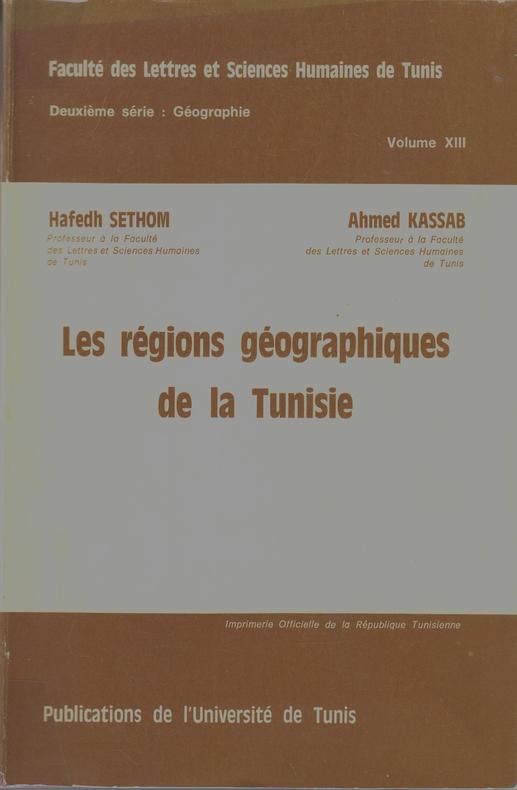
1981SPN-314Tunis : Publications de l'Université de Tunis, 1981. Broché 24x16, 460 pages illustrées de plans, cartes et photos en noir,
8vo (164 x 244 mm). (2), XVIII, (2), 476 pp. (Includes, bound after the preliminaries:) Notice hydrographique No. 4 (1900). 14 pp., 1 blank f. Notice hydrographique No. 8 (1900). 15 pp., 1 blank p. Contemporary gilt half calf over marbled boards. Marbled endpapers. The French essential standard sailing directions for the Red Sea and Gulf of Aden as well as the entire south coast of the Arabian Peninsula. Comprises directions for the navigation of the Suez Canal, the Gulf of Suez, and the central track for steam vessels through the Red Sea, Straits of Bab-al-Mandab, and Gulf of Aden; also, descriptions of the Gulf of 'Aqaba, the shores of the Red Sea, the inner channels, the Gulf of Aden, and the south-eastern coast of Arabia to Ras al Hadd, the coast of Africa from Ras Si Ane to Capo Guardafui, including the Gulf of Tadjoura, thence to Ras Hafun, Abd-al-Kuri, the Brothers, and Socotra. - Largely based on the relevant British counterpart, the "Red Sea and Gulf of Aden Pilot"; the section on the Gulf of Tadjoura is entirely by the lieutenants of the French hydrographic ships Guillou and R. de Carfort. The book had appeared only once previously, in 1885, and the present copy includes not only the Supplements I and II published in 1900, but also extensive publisher's corrections that were issued to slips of paper and are here bound into the volume in their respective place. The flags and signals are partly printed in red and yellow. A rare and early edition in excellent condition. OCLC 460171378.
8vo. XXXVII, 394 pp. (Bound with) II: The same. Étude orientale ou trois odes de Hafiz et une élégie de Saadi poetes persans. Paris & Geneva, Duprat & Cherbuliez, 1852. 32 pp. Contemp. red half calf. I: Early anthology of 44 Ottoman writers. An excellent translation, dedicated to the King of Prussia. Contains a wealth of information for the oriental scholar, especially by virtue of the learned introduction and the copious appendix with biographical notes on all poets here presented. - With the author's three-line autograph inscription to Ferdinand Perrier on the endpaper; Perrier's drystamp on title page. - Bound with the first French edition of these three odes of Hafez, also profusely annotated. - Somewhat browned; occasional insignificant foxing. Saba 826. Nawabi VII, p. 990.
8vo. (33)-47 pp. Original wrappers. Offprint from the Journal of the Royal Asiatic Society, April 1951. Part 1 only, recounting the "Land Dispute". Part 2 (pp. 156-169, "Dispute over the Runaway Wife") would appear in the October issue. - An excellent copy. OCLC 77797713.
8vo. (6), 276, (2) pp. Early 20th century half leather with green buckram covers. First edition of Sen's English-Farsi dictionary, following a Farsi-English volume published in 1829. In 1841 Sen would produce a new edition, adding the pronunciation of the Persian words in transliteration. - Lightly browned throughout due to paper; a few edges reinforced. Old ownership "D. H. Crawley" (?) on title-page, and later ownership, dated 1957, of the linguist, National Socialist politician, and translator Martin Löpelmann (1891-1981). A good copy of a rare work. OCLC 85263053. Cf. Vater/Jülg 280.
8vo. VI, (2), 164 pp. Original printed wrappers. Scholarly work on Abu 'Ubaid's collection of proverbs (matal) known as "Kitab al-Amtal", assembled in the 8th/9th century A.D., and other, similar anthologies of Arabic adages. - A very good copy.
8vo. 2 vols. in one. (38), 373, (51) pp. (6), 338, (36) pp. With engr. t. p. (wants the table). Contemp. auburn morocco, richly gilt. All edges gilt. Third edition, the second edited by Andreas Beyer (first published in London in 1617). Selden (1584-1654) "first won fame in Europe as an orientalist by his treatise 'De Diis Syris', the first of his oriental studies [...] use was also made of it by Vossius in his great treatise on idiolatry" (DNB). - Elaborately bound gilt binding; insignificantly rubbed with minute restoration to upper spine-end. VD 17, 23:320175K. DNB 1161. Graesse VI/1, 343. Cf. STC S 1861.
1953844M19Kuala Lumpur: Selangor Golf Club 1953. First edition. Cloth. Very Good Indeed. 9" by 6". Not Stated. An illustrated history of the Selangor Golf Club in celebration of its Diamond Jubilee. The first edition of this work in the publisher's original moire binding with yellow and red silk ribbon markers. A history of the Selangor Golf Club in Kuala Lumpur Malaysia in celebration of the club's Diamond Jubilee in 1953. Established in 1893 the Selangor Golf Club is one of the oldest golf clubs in Asia. This volume explores the development of the golf course and notable members illustrated with many plates. In the publisher's original moire binding. Externally smart with some silverfish damage to the spine and a little to the boards. Internally firmly bound. Pages are very bright and clean. Ribbon markers are in excellent condition. Very Good Indeed Selangor Golf Club hardcover
72 pages. Features: Nice cover illustration of boy celebrating summer vacation; Sisman's Scampers shoe ad inside front cover; Editorials deal with these topics - Partial Relief, A Doctor, Not a Nurse, Maintaining the Tradition, The Cooperatives, Farewell Toscanini, and Not Conquest but Murder; Trollop (short story); This Peace (short story); A Modern Odyssey - photo-illustrated article by Edgar N. Brown describes sea travel; Rough 'Un (short story); The Black Ace (short story); The Smooth Silence (short story); The Dilemma of Debt; Scotland Yard Versus Crime - photo-illustrated article on the system employed by this world famous organization to track down criminals, law breakers and lesser offenders; Golf Duds & Meteors - photo-illustrated golf article with photos of Charles A. Whitcome, Albert "Scotty" Campbell, Lex Robson, Tony Manero, Willie Lamb, and Tommy Armour; It's In the Bag - interesting article on the history of purses; Half-page Canadian Pacific ad features Banff; Palmolive ad features photo of Montreal stylist and designer Doris Preston; Nostalgic half-page ad for McClary Stoves; Vintage half-page photo ad for Eddy's Sterilized White Swan toilet paper shows fellow in bathing suit at the beach; Movie news with photos of Clark Gable, Francis Lederer, Ida Lupino, William Powell, Jean Chadburn, Alison Skipworth, Warren William, Conrad Veidt, Renee Ray, and more; Lux soap ad features photo of Joan Bennett; Photo of Dick Powell in Quaker Puffed Wheat ad; Pond's ad features photos of Miss Barbara Hebbard and Lady Daphne Straight; Unusual half-page ad for Blue-Jay Corn Plaster, by Bauer & Black Scientific; Nice half-page Canadian Pacific photo-ad features the Empress of Britain; Business News includes mention of the recent Alberta default; Cooking article; Lovely one-page colour Kraft ad features their cheese products; Nice one-page Heinz ad features their vinegar and Olive Oil; Vintage half-page Rice Krispies ad; Beauty article; Why Baby Cries; One-page Carnation Milk ad features five large photos of each of the individual Dionne Quints; World Sayings; Colour ads inside back cover for Lifebuoy and Rinso; Rare colour back cover ad for Red Indian oil and Marathon Blue gasoline features illustration of native elders in feathered headgear, painted by Winold Reiss; and more. Covers loose but present. Average wear and soiling. A worthy copy of this nice vintage issue. Book