4 134 résultats
8vo. XIV, 280 pp. With a portrait of King 'Abdul-'Aziz Ibn Sa'ud as the frontispiece, 1 map of Arabia in 1950, and 16 double-sided plates. Black cloth. First edition of this biography of Saudi Arabian King HRH Abdul-Aziz bin Abdul Rahman al Sa'ud by his adviser Harry St John Bridger Philby. Ibn Sa'ud was the founder of modern Saudi Arabia, when after a conquest spanning 30 years he united most of the Arabian Peninsula under his rule. He reigned from 1932 until his death in 1953, but had previously (since 1902) ruled parts of what was to become Saudi Arabia as Emir, Sultan, King of Nejd, and King of Hejaz. The present work is not a complete and final biography: at the time of writing and publication the king was still alive, and Philby states in the preface that "it is rather a pageant of his [Ibn Sa'ud's] achievement, set forth in a series of tableaux illustrating characteristic phases of his career". The descriptions of these phases contain not only information relating to the king, but also inform the reader about the country as a whole and are enlivened by accounts and other small details of court life and Islamic customs, including a pilgrimage to Mecca. The work is illustrated with numerous images of the king and his family, and important landmarks in Saudi Arabia. - Binding shows slight signs of wear, spine is slightly discoloured, slight foxing to edges, very slight browning throughout, several newspaper clippings in a small paper pocket on the lower pastedown. Overall in good condition. Howgego IV, P 31. Cf. (other ed.) Shapero, The Islamic World (2003), 395; Sotheby's, Burrell sale, lot 623.
8vo. 115-124 pp. Contemporary blue cloth with giltstamped title to upper cover: "Philby - Yaman". First edition. A brief investigation of Joseph Halévy's journey through the Jawf region of Yemen, comparing the account given by Hayyim Habshush, recently published, with Halévy's own. - St John Philby (1885-1960), also known by his Arabian name "Sheikh Abdullah", was an Arabist, explorer, writer, and British colonial office intelligence officer. Educated at Trinity College, Cambridge, he studied oriental languages and was a friend and classmate of Jawaharlal Nehru, later prime Minister of India. Philby settled in Jeddah and became famous as an international writer and explorer. He personally mapped on camelback what is now the Saudi-Yemeni border on the Rub' al Khali; in 1932, while searching for the lost city of Ubar, he was the first Westerner to visit and describe the Wabar craters. At this time, Philby also became Ibn Saud's chief adviser in dealing with the British Empire and Western powers. He converted to Islam in 1930. The personal contacts between the United States and Saudi Arabia were largely channeled through the person of Philby. - Very slight browning, a few minor stains to the first page. Macro 1782. Smith, The Yemens, 84.
Colour-printed map (30 x 44 cm). Map showing Philby’s route. Inset of Central Arabia. Not in Ankary; Al-Qasimi.
Colour-printed map (56 x 36 cm). Not in Al Ankary; Al-Qasimi.
8vo. XXIV, 433, (1) pp. With 3 folding maps an 47 illustrations on 32 plates. Publisher's original giltstamped green cloth. First edition. St. John Philby (1885-1960), also known by his Arabian name "Sheikh Abdullah", was an Arabist, explorer, writer, and British colonial office intelligence officer. Educated at Trinity College, Cambridge, he studied oriental languages and was a friend and classmate of Jawaharlal Nehru, later prime Minister of India. Philby settled in Jeddah and became famous as an international writer and explorer. He personally mapped on camelback what is now the Saudi-Yemeni border on the Rub' al Khali; in 1932, while searching for the lost city of Ubar, he was the first Westerner to visit and describe the Wabar craters. At this time, Philby also became Ibn Saud's chief adviser in dealing with the British Empire and Western powers. He converted to Islam in 1930. The personal contacts between the United States and Saudi Arabia were largely channeled through the person of Philby. - An excellent copy, with very insignificant foxing to first and last few pages. Macro 1781. Ghani 302.
8vo. 21, (1), 107-132 pp. With 1 large folding, coloured map, 1 smaller, uncoloured folding map, and numerous photographs on 7 plates. Later half cloth over marbled paper boards with giltstamped title to spine. First edition. Important account of travels in southern Arabia performed in 1936, particularly in the Hadhramaut, by the Arabist, explorer, writer, and British colonial office intelligence officer St. John Philby (1885-1960), also known by his Arabian name "Sheikh Abdullah". It describes the longest of Philby's journeys, ostensibly to map the new frontier with Yemen, containing excellent photographs taken for the first time in that area by a European. Until the 1930s the highlands of the south-western corner of Arabia were among the world's few remaining lands not fully explored or charted. - Educated at Trinity College, Cambridge, Philby studied oriental languages and was a friend and classmate of Jawaharlal Nehru, later prime Minister of India. Philby settled in Jeddah and became famous as an international writer and explorer. He personally mapped on camelback what is now the Saudi-Yemeni border on the Rub' al Khali; in 1932, while searching for the lost city of Ubar, he was the first Westerner to visit and describe the Wabar craters. At this time, Philby also became Ibn Saud's chief adviser in dealing with the British Empire and Western powers. He converted to Islam in 1930. The personal contacts between the United States and Saudi Arabia were largely channeled through the person of Philby. - Clear tape on the first page, covering part of the title of the journal without affecting the page or legibility of the text; very slight foxing on the large coloured map (mainly on the back). In very good condition. Macro 1788.
4to. 141 pp., final blank page. With 8 coloured plates and numerous photographs (some in colour) in the text. Contemporary full cloth with giltstamped spine-title and illustrated dust jacket. First edition. Lavishly illustrated posthumous edition of an unpublished manuscript "by the great Arabian traveller, scholar and writer, H. St John Philby [...] charting his explorations into the bewildering thickets of the story [of the Queen of Sheba]" (publisher's blurb). With an introduction by the British military officer, Arabist, explorer, historian and diplomat Gerald de Gaury (1897-1984). - Dutch newspaper clipping about the analysis of an Ethiopian DNA sample supposedly going back to the legendary Queen of Sheba is loosely inserted. - In mint condition. OCLC 640352386.
Oblong folio. 440 pp. Illustrated with tipped-in reproductions in colour of paintings by various artists, including paintings by Anthony M. Alonso and from the collection of the National Museum of Racing, Inc. Original calf-backed pictorial cloth, giltstamped spine. In original cloth drop-back box with colour illustration mounted on lid. Limited edition. The original publisher was unable to complete the full 100 copies; only four are reported in OCLC. Illustrated with paintings from the National Museum of Racing. A large tome on race horses in North America, including the history and evolution of the sport and stories of the famous racers and racetracks. "Extremely detailed, especially the pedigrees, racing records and index. I've come to rely on it daily as a valued reference" (John Prather, review in Bloodstock Advisory). "Everyone in the thoroughbred industry should have a copy. The colour plates alone are enough to justify buying it" (Dr. William Reed, review in Mare's Haven). - In excellent condition. OCLC 41093209.
4to. (32) pp. With many woodcut type specimens. Disbound. Only edition; one of several variant issues. - A congratulatory publication by the prolific Saxon oriental scholar August Pfeiffer (1640-98) who was said to know seventy languages. The present rare work is dedicated to the Duke of Saxony Johann Georg II on the occasion of his 15th anniversary as Elector. It contains 15 celebratory poems in the world's principal languages German, Latin, Greek, Hebrew (with Latin literal translation), Chaldaic (with Latin transliteration and literal translation), in the Jerusalem dialect, in Syriac (with Latin literal translation), Samaritan, Arabic, Ethiopian, Farsi, Ottoman Turkish, Coptic, Armenian, and Chinese (all with Latin transliteration and literal translation). The end is brought up by a "fusa vacui" (or stopgap), namely verse 3 of Psalm 113 in no fewer than 35 different languages (Hebrew, Chaldaic, Syriac, Arabic, Ethiopian, Samaritan, Farsi, Ottoman Turkish, Armenian, Coptic, Iberian, Greej, Latin, Italian, Sardinian, Spanish, Portuguese, French, German, Saxon, Dutch, Danish, Norwegian, Swedish, English, Scots, Irish Gaelic, Hungarian, Polish, Czech, Serbo-Croatian, Chinese, Nahuatl, Inuit, and Quechua. - Browned throughout due to paper; binding loosened; old ownership to title-page and page numbers throughout, but trimmed rather closely. This copy was bound from a defective set of sheets: several leaves (3 and 4 in each gathering) show a hole through the middle of the page, resulting in loss of text to several poems (mainly affecting Chaldaic, Arabic, Turkish, and Coptic). VD 17, 12:161548X. Not in Jöcher or J./Adelung.
Small folio (238 x 298 mm). (4), XXVII, (1), 470, (2) pp. Later 19th century marbled half calf with giltstamped title to gilt spine. Marbled endpapers. First edition. - Since 1815 Peyron (1785-1870) taught oriental languages at the University of Turin. He was a specialist in the Coptic language, the latest stage of Egyptian and spoken in Egypt until at least the 17th century. His research in this field gained him an international renown that was consolidated by his Coptic dictionary, the earliest of its kind. It remained unsurpassed until Wilhelm Spiegelberg's "Koptisches Handwörterbuch" in 1921. - From the library of the Ducs de Luynes at the Château de Dampierre: their bookplate reproducing the arms of Charles Marie d'Albert de Luynes (1783-1839), 7th Duc de Luynes, on pastedown. An excellent copy. Ibrahim-Hilmy II, 113. Gay 2337. Zaunmüller 228. Vater/Jülg 209. Brunet IV, 584. Graesse V, 247. OCLC 2786885.
4to. With 13 numbered lithographed plates (the first used as frontispiece), including 3 fully and 1 partially coloured by a contemporary hand, of which 2 highlighted in gold. Contemporary half calf, restored and rebacked with parts of the original backstrip laid down, with new tooling and title-label on spine, cloth sides, later endpapers. First edition of "the historic cornerstone of the study [of mummification] in English. For the time at which it appeared, the work was a monumental undertaking. Based on scholarly research and practical experience, Pettigrew's work was a summation of almost all that was known concerning Egyptian funerary practices. He compiled all the ancient sources and commented on them, as well as discussing many examples of mummified remains investigated by or known to him. The work is illustrated by [...] Georges Cruikshank (better known for his satirical drawings) that are the product of careful observation" (Peck). - With the bookplate of the British lawyer and politician Bernard John Seymour Coleridge, 2nd Baron Coleridge (1851-1927). Some foxing on the title-page and some spots and marginal waterstains on the plates, touching the last three illustrations, otherwise in good condition. Binding rebacked and restored. Brunet IV, 581. Gay 1565. W. H. Peck, "Mummies of ancient Egypt" in: Mummies, disease and ancient cultures (1998), p. 15.
8vo. 8 pp. With woodcut device on title page. Wrappers. An appeal, written in verse, to all religious orders and Christian laymen to take arms against the Ottomans. Apparently an early product of the Turkish-Venetian War of 1714-18, in which the new Grand Vizier Silahdar Damat Ali Pasha re-conquered Morea (the Peloponnesus) from the Venetians, who had held the peninsula since 1699. A different version (kept at the Biblioteca Civica Bertoliana in Vicenza), published by Giovanni Berno "in Venetia, Bassano, & in Verona", is dated 1715; this date of publication is also supported by the mention of Pope Clement XI (1700-21). However, the Marciana in Venice keeps an earlier publication of the same work produced for the Venetian Alessandro Cortesi, bearing the date 1663. Yet another, undated version in the Biblioteca Universitaria di Padova bears the imprint "In Venezia, per Domenico Lovisa à Rialto". No other copy with Remondini's imprint is known. - Some browning and waterstaining; old pagination in manuscript and stamped (apparently removed from an old collection).
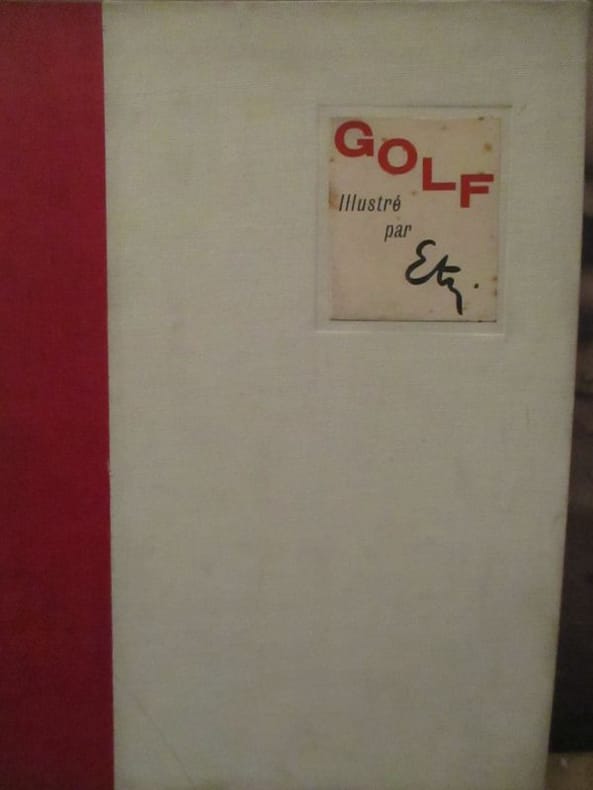
193071801930 Chez l auteur Etienne Petitjean 1930 In4 cartonnage éditeur vignette de titre collée, format 34cmX25cm cartonnage éditeur édition originale non paginée - 24 dessins humoristiques à pleine page
4to. (4), LV, (3), 1-312, 10, 312-316 pp. With lithogr. frontispiece and 27 plates. Marbled half calf with 5 raised bands and gilt label to giltstamped spine. First edition; very rare. Peters' work was published on the same day in English in London, in French in Paris, and in German in Frankfurt (cf. Mennessier de la Lance II, p. 306). In addition to treating the principles of riding, the work discusses horse grooming and the use of weapons on horseback. - Untrimmed copy, slightly browned, otherwise in excellent condition. Huth 127. OCLC 18787323. Cf. Mennessier de la Lance II, 305 (22 plates only, French ed.).
Small 8vo. VI, (2), 125, (3), 92 pp. Later 19th century leather with giltstamped title to spine, both boards and spine with gilt armorial lion crest of the Ducs de Luynes. Leading edges, inner dentelle gilt; marbled endpapers. First edition of Petermann's manual of Arabic in a French master binding for the Duc de Luynes. Issued as part IV of the author's "Porta Linguarum Orientalium" for private study, this also contains a selection of Arabic reading pieces. - Some foxing throughout, otherwise beautifully preserved. From the library of the Ducs de Luynes at the Château de Dampierre. Vater/Jülg 27. OCLC 27870350.
XI, (1), 143, (1) SS. Bedr. Originalbroschur. 8vo. Der erste von insgesamt acht Bänden des Katalogs der orientalischen Handschriften der Herzoglichen Bibliothek Gotha und der einzige Band, der die persischen Werke verzeichnet. Den Katalog, der zwischen 1859 und 1893 erschien, verfasste der Bibliothekar und Orientalist Pertsch (1832-99), Beamter und ab 1879 Oberbibliothekar zu Gotha. Auf den Katalog der persischen Handschriften folgte jener der türkischen in einem Band, der arabischen in fünf Bänden und abschließend ein Band der übrigen orientalischen Handschriften. - Gering stockfleckig. Unbeschnittenes, unaufgeschnittenes Exemplar. Nicht bei Besterman.
17118Vintage Optical Lantern images of the Persian Gulf circa late 19 cent Glass size is about 3.25" x 3.25" . Vintage Image of the Persian gulf and The Sheik of Mohammerah Palace at Shah-et-Arab. A boat is docked in calm water along the bridge while a spray of palm leaves waves at the edge of a palace. The handwritten label reads "Sheik of Mohammerah Palace. Shah-et-Arab." The Shatt al-Arab also known as Arvand Rud River is a river formed by the confluence of the Euphrates and the Tigris. Mohammerah is city and port presently known as Khorramshahr a city in southwestern Iran. It lies on the right bank of the KÄrÅ«n River where it enters the Shatt al-Arab. The city occupies the site of the old Ê¿AbbÄsid port of Mohammerah but it was already in existence at the time of Alexander the Great. Since In 1847 it was ruled by a sheik known as the Emir of Mohammerah who was chief of the local Banu Ka'b tribe and built a large Palace known as Qasr al-Failiyah in Mohammera with very large arches that can be seen on the image. Very few historical artifacts exist from the times of Shaikh Khaz'al bin JÄbir bin MirdÄw al-Ka'bÄ« 1861-1936. After oil was discovered by the Anglo-Iranian Oil Company BP today in Khuzestan in 1908 Britain at first strengthened its ties to Shaikh Khaz'al. But after W.W.I The British stopped supporting him and in 1924 Mohammerah came under the control of the central government of Iran and was renamed Khorramshahr by Rez Shah of Iran. The cheikh was taken to Tehran and stayed in house arrest until his death in 1936. Out of all the sheikdoms around the gulf Abu Dhabi Dubai Sharjah Ajman Umm Al Quwain and Fujairah he is the only Emir to have lost his sheikdom. The southern end of the river constitutes the border between Iraq and Iran and discharges into the Gulf and has been the cause of multiple wars due to its huge oil reserves including the Iran-Iraq war. Scarce and in very good condition. unknown books
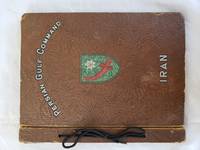
17136WWII Iran Photo album of US Military in Persian Gulf Command. 38 original silver gelatin print photographs most of sinking ships c. 1943-1945. Images of US Army soldiers as part of the Persian Gulf Command a WWII initiative to secure allied Soviet supply lines through Iran. Original textured brown boards. 13 x 10 in. "Persian Gulf Command / Iran" printed on front cover along with PGC insignia of 7-pointed white star and red scimitar blade on a green shield. Photographs of various size from 1.25 x 2" to 2.5 x 4". During World War II the U.S. Army's Persian Gulf Command maintained a supply line through Iran for the benefit of Soviet allies. One photograph of a soldier even shows Russian Cyrillic text for "American" ÐМЕРИКÐÐСКИЙ painted on the door of his Jeep. 23 photographs show badly damaged and sinking ships. Most photographs do not have captions but one is labeled "Abadan Iran" a city in the south of Iran; and another image of a pool is labeled "Iran". 1 image is of 3 Iranian local men . Other photos show soldiers resting in their barracks relaxing off-duty around a pool or sights from their travels. One photograph of soldiers in the 1940s was developed in 1967 others are period. In very good condition. unknown books
1988126725RMC Edition 1988 In-8 broché 22,5 cm sur 13,7. 293 pages. Bon état d’occasion.
352pp. 30 cm. Hardcover Very good condition good
303p., illus. 30 cm. Hardcover Very good condition good
No marks or inscriptions. No creasing to covers or to spine. A very clean very tight copy with bright unmarked orange cloth boards, minor bumping to spine ends and no bumping to corners. 146pp. How the pros played the shots and how you can play them, with studies of twenty-four of the top professional golfers at specific events.
199124306New York NY U.S.A.: Harry N. Abrams Incorporated 1991. Cloth. Fine/Very Fine. Folio - over 12" - 15" tall. Klemme Mike. Photographs by Mike Klemme painting illustrations by Elizabeth Peper. Very large very heavy book light blue cloth color photographs inside covers and adjacent end papers 304 heavy photo paper pages. DJ has beautiful color photograph of arched bridge and nearby green on front golfer and crowd on back. DJ and book both Very Fine. <br/> <br/> Harry N. Abrams , Incorporated hardcover
200011GW22-791-094Artisan. Good in Good dust jacket. 2000. Hardcover. 1579651623 . This book is in very good condition; no remainder marks. Dustjacket does have some shelfwear scratching edge wear a few small corner tears. Inside pages are clean. ; 448 pages . Artisan hardcover
68-4885San Mateo CA: Peninsula Golf and Country Club. 1993. 4to. Green Cloth Oblong. 92 pp. Very Good. B&W plates. Provenance: Everett Mathews attorney from Millbrae CA. San Mateo, CA: Peninsula Golf and Country Club., [1993]. hardcover