Roberts, James.MareMagnum

4 135 résultats
8vo (223 x 148 mm). 40 engraved plates, some with vignette at foot, engraved index leaf. Modern olive green morocco gilt by Eighton, covers with triple gilt fillet, spine in six compartments, gilt lettered direct in second, others richly gilt, raised bands, top edge gilt. Fine series of plates, each depicting a famous horse with his rider or stable-hand, and recording its pedigree, qualities and racing record, together with the owner's name. The final plate shows the most famous of all, the Godolphin Arabian (here called the "Bay Arabian, the property of the Right Hon.ble the Earl of Godolphin"), foaled in Yemen around 1724: "This extraordinary horse became a private stallion soon after his arrival in this kingdom, and got a greater number of fine horses of just temper with superior speed than any Arab ever did. He was the Sire of Lath, Dismal, Cade, Bajazet, Babraham, Phenix, Dormouse, Regulus, Skewball, Sultan, Blanck, Slugg, Noble, Tarquin, Blossom, the Godolphin Gelding, Shepherdess, Amelia, and many others besides stallions and brood mares, all in the highest esteem; he died at Hogmagogg Hills, Dec. 1753, in the 29th year of his age". - Among the other horses are Lath, the Godolphin Arabian's offspring by Roxana; Basto (son of the Byerly Turk); Old Scar, whose ancestry included the Oglethorpe Arabian and Darcy's Yellow Turk, etc. The horses pictured all ran between 1708 and 1755. The first edition was published in about 1760. Rare, only two copies recorded in ABPC/AE Online. ESTC records two issues, one published and sold by Henry Roberts, the other printed for R. and R. Baldwin (as here): just one location is given for the first issue (Winterthur), and one for the second (BL). Huth records the work under a variant title, and also notes an 1820 edition. - Plate 12 shorter at margins, some spotting and browning, heavier at margins. A most handsome copy. Huth 38.
8vo. Letterpress title page and 40 engr. plates by James and Henry Roberts, engr. index leaf, and publisher's 4-page catalogue (with woodcut image of cocks fighting). Stitched in wrappers. Fine series of plates, each depicting a famous horse with his rider or stable-hand, and recording its pedigree, qualities and racing record, together with the owner's name. The final plate shows the most famous of all, the Godolphin Arabian (here called the "Bay Arabian, the property of the Right Hon.ble the Earl of Godolphin"), foaled in Yemen around 1724: "This extraordinary horse became a private stallion soon after his arrival in this kingdom, and got a greater number of fine horses of just temper with superior speed than any Arab ever did. He was the Sire of Lath, Dismal, Cade, Bajazet, Babraham, Phenix, Dormouse, Regulus, Skewball, Sultan, Blanck, Slugg, Noble, Tarquin, Blossom, the Godolphin Gelding, Shepherdess, Amelia, and many others besides stallions and brood mares, all in the highest esteem; he dies at Hogmagogg Hills, Dec. 1753, in the 29th year of his age". - Among the other horses are Lath, the Godolphin Arabian's offspring by Roxana; Basto (son of the Byerly Turk); Old Scar, whose ancestry included the Oglethorpe Arabian and Darcy's Yellow Turk, etc. The horses pictured all ran between 1708 and 1755. The first edition was published in about 1760, and this Barker edition some forty years later. This copy has no watermarks, but the books listed in J. Barker's catalogue of publications were mostly published in the 1790s. - Spine rubbed and bumped; slight wear to edges and corners. An excellent copy with two small tears imperceptibly restored. Of the utmost rarity: the only copy recorded at auction during the last decades is the Gloucester copy (Christie's, Jan. 27, 2006, lot 592). Huth, p. 38. Cf. Podeschi 54.
8vo. 36 ff., printed on rectos only. Original printed wrappers with oval portrait of the author in Arabic costume. Stapled. First edition, very rare. Extraordinary guide to the Kingdom of Hejaz, "the most frequented pilgrim country in the world" (f. 36). It comprises accounts of Jeddah and Mecca and includes a chapter on King Abd al-Aziz ibn Saud (1875-1953), "undoubtedly the strongest and ablest ruler Arabia has produced for many many years" (f. 29). - Describing the journey from Egypt across the Red Sea, the booklet discusses the travel documents required to enter Hejaz, as well as the enormous economic benefit of the pilgrimage to the Kingdom, and gives a report of the crossing from Suez to Jeddah including stops at El Tor, "the most attractive and beautiful of the Red Sea towns" (f. 11), Wedja and Yambo. It includes a description of the Mount Sinai monastery as well as the wrecked pilgrim ship "Asia", which caught fire in the Jeddah port in 1929. On the one hand deeming Jeddah "a place for work and no play" (p. 24), the guide laments the prohibition of alcohol, cigarettes and gramophones, as well as the lack of hotels, cafés, restaurants, cinemas, and fresh water, and criticises the general state of many houses in the city. On the other hand, the booklet admires the low crime rate of Hejaz as well as recent improvements in public transportation. An uncommonly frank account of a Westerner's stay in Hejaz, not hesitating to speak out on the hardships of pilgrimage. - Covers loosened; somewhat soiled. A few pages slightly wrinkled. Contemporary ownership inscribed to title-page in blue ballpoint. Not a single copy traceable in libraries worldwide.
8vo. 1 p. on bifolium. To his son-in-law Henry Bicknell, making arrangements to meet: "I have unfortunately accepted an invitation to dine with Lord Tenterden on Wednesday, had it been an other I would have endeavoured to get off - as it is I have done as you desired an pop'd Marochetti into the fire. With the exception of that and Saturday I am disengaged the rest of the week [...]". - In a postscript, he adds that "Turner called on Monday to say he would dine with you tomorrow having mistaken the day - he is to dine with your Governor [Henry Bicknell's father, the art collector Elhanan Bicknell] on Saturday". - Roberts enjoyed a close and warm relationship with his daughter and her husband, no doubt a compensation for his own unhappy marriage.
Large 8vo (300 x 220 mm). 6 vols. bound as 3. With 250 numbered plates (image size 120 x 170 to 150 x 220 mm), including a tinted lithographed portrait of the artist, 6 tinted lithographed title-pages, 2 stone-engraved maps and 239 tinted and double-tinted lithographed and 2 chromolithographed views. Contemporary, richly gold-tooled reddish-brown morocco, side-stitched and oversewn, then sewn on 5 recessed cords, with a hollow back, 5 false bands on the spine, gold-tooled turn-ins, combed and curled marbled endpapers, headbands in red and yellow, gilt and gauffered edges. With thin paper guard leaves facing each plate. Second edition, with reduced illustrations but with more of them double-tinted or chromolithographed, of one of the most splendid and historically important visual records of the Middle East, after drawings by David Roberts (1796-1864) from the sketches he made from life during his travels through what is now Egypt, Israel, Jordan, Saudi Arabia, Syria and Lebanon in 1838 and 1839. In Egypt he ventured up the Nile as far as the Nubian temples at Abu Simbel, near the present border with Sudan and travelled by camel through the Sinai to the extraordinary carved-rock buildings of Petra. These had been unknown to Europeans until Burckhardt discovered them in 1812 and 1813, so Roberts's views are among the earliest and are in many ways better than the few predecessors. In Lebanon he ventured as far as Baalbek, which had seen few European visitors before Egypt annexed it in 1832. Other sites he visited and drew include Cairo, Suez, Gaza, Jerusalem and Beirut. He was one of the first Europeans allowed to make drawings of the interior of mosques, so even in well-known cities these too opened a new world to European eyes. His views also provide a very detailed visual record of many sites that were afterward destroyed or disturbed. He drew them during the infancy of photography, before it reached the Middle East and long before it reached maturity there. His views of the modern cities also preserve records of both their architecture and their daily life and he shows spectacular landscapes in the mountains, around the Dead Sea and along the Nile and the Jordan. Roberts, born to a poor (Welsh?) family in Edinburgh, was apprenticed as a house painter, moved to London and worked his way up to paint sets for the Drury Lane Theatre and others. Thanks to patrons who appreciated his talents and hard work he was able to make the expensive and dangerous voyage through the Middle East. George Croly (in volumes 1-3) and William Brockedon (in volumes 4-6) provided explanatory and historical notes on the sites shown in Roberts's views. - Roberts's views were originally published in two separate works, issued in parts in the years 1842 to 1849 and often found together. One centred on the Holy Land, though also including views in other parts of the Middle East, while the other was devoted to Egypt and Nubia. The views in the former were made with only a single tint block and even the latter used fewer tint blocks than the present second edition and only one chromolithograph. The present edition, with sometimes very intricate double tints and two chromolithographs (with black and three tint blocks) is a masterpiece of tinted lithography. Since the lithographers used photographic reductions of the lithographic views of the first edition as an aid to their work, the book also pioneered the use of photography in graphic reproduction. The lithographed title-pages are dated 1855 except for those of vol. 3 (from the simultaneous New York issue, undated) and 6 (1856) but volumes 2-6 include plates dated 1856. The dates of the plates in all six volumes range from 16 April 1855 to 15 December 1856. - The title-page of volume 3 was intended for the simultaneous New York issue, but appears to have always been part of the present copy. In very good condition, with occasional light foxing, mostly on the backs of the plates, and with a faint marginal water stain in the lower outside corner of many plates in volumes 3 and 4, not approaching the printed image. The inside front hinge of the second volume as bound has separated from the book block and the bindings show some wear at the hinges and extremities, but they are otherwise also very good. 250 mostly tinted and double-tinted lithographs providing stunning early views of the Middle East, including Petra, Abu Simbel and the interiors of several mosques. Abbey, Travel 388 (lacking vols. 5-6). Blackmer 1432 (note). Gay 25. Hiler 205. Cf. Hamilton, Europe and the Arab world 66 (1842-49 ed.); Lipperheide, Lc 12 & Ma 27 (1842-49 ed.); Tooley 401f. (1842-49 ed.); not in Colas.
Small 8vo. (8), 252 [but 254], (2) pp. (includes final leaf of ads). Contemporary calf, rebacked. First edition of this extraordinary account of an Englishman’s capture by Barbary pirates and subsequent adventures as a slave in Algeria. The narrative is framed as an authentic journal of a deceased traveller, prepared for the press by a friend of the departed. Through this mechanism the reader is taken into a proto-novelistic fantasy, albeit one that must have been informed by genuine experience of Eastern travel. As a slave under numerous masters the author tricks his way variously into employment as the cook to the King of Algiers, is then demoted to Keeper of the King’s Bath and secretly fathers a daughter with one of the King’s wives. After an unsuccessful stint as a gardener’s assistant he journeys in the service of an officer, collecting tribute money with the Algerian army and offers his services as an advisor to the Ottoman governor of Tlemcen. He recounts observations on the various peoples encountered and their customs and peculiarities, marvelling at flying serpents, lions and ostriches and skirmishing with an army of Arabs. Against a backdrop of mosques, minarets and palaces, the narrative is peppered with anecdotes of meetings with Barbary pirates, European renegados, and dalliances with alluring women of the Maghreb. - The author takes particular relish in recounting the details of his sexual adventures: "the women in this country keep much at home, but their minds and affections are more wandering abroad, because they are so recluse; whereas if they had as much liberty as in other countries they would not be so furiously debauch’d: their husbands keep strict guard over them, that when they can escape their eyes, they give the reins to their passion, and labour to satisfy themselves more abundantly; stolen waters are sweet: the more they are forbidden and hindered from variety, the more pleasure and satisfaction they fancy in it [...] had my design been to make conquests in the Empire of Love, I think none could have been more happy [...] this good opinion of my ability spread & increased wonderfully in the town [...]". A separate appended section offers directions for navigating the Barbary coast. The work is of value both as a travel narrative and as a proto-novel reflecting the European fascination with the Orient. This is one of four journeys undertaken by Englishmen in the Ottoman Mediterranean analysed recently by Gerald Maclean in his 2004 study "The rise of Oriental travel: English visitors to the Ottoman Empire, 1580-1720". - Provenance: small stamp of Bibliothèque Generale, Rabat, to title, first leaf of dedication, and first leaf of text. Small ownership stamp of Alexander Gardyne, 1883, to verso of title. Manuscript bookplate of Henry White, Lichfield, 1820, to pastedown. A very good copy. Playfair, Morocco, 244. Playfair, Algeria, 155. Pforzheimer, 846. Wing S152. Not in Blackmer or Atabey.
1975004075Washington, American Enterprise Institute, 1975. -- Broschiert -- 8°
West Chester, Schiffer, 1992, 4to (cm. 28 x 21,5) brossura con copertina illustrata a colori, pp. 160 completamente illustrato a colori. Ottimo.
61097, picture Publishing, 2023 hardcover, formaat 340mm x 260 mm, gebonden, 420 pagina's full colour, rijk geïllustreerd. ISBN 9789492576637.
8vo. 32 pp. in paper cover, illustrated title page. Numerous illustrations in the text Shortened Italian version of this account of a journey made from Port Said, down the Red Sea to Mascate, and then along the Arabian Gulf ending in Baghdad (Obock, Mascate, Bouchire, Bassorah. Paris 1883). No. 61 of the famous "Biblioteca illustrata dei viaggi intorno al mondo per terra e per mare" series, published 1899-1904. - Some wear, but altogether well preserved. OCLC 799578383.
12mo. (4), 292 pp. With woodcut vignette on title page, 13 plates and a folding map. Original printed wrappers. First edition of this account of a journey made from Port Said, down the Red Sea to Mascate, and then along the Arabian Gulf ending in Baghdad. - Some foxing. OCLC 254176761.
Imperial folio (405 x 474 mm). 2 vols. (10), 12, (2) pp. With 10 colour illustrations in the the text and 100 full-page coloured illustrations mounted on plates. Sumptuous dark brown contemporary full calf, gilt, covers lined in silk, with silk endpapers. First edition of this monumental publication on Islamic pottery, no. 107 of 200 copies printed. All ceramics pictured within the two volumes are described in detail with place and date of origin as well as the current owner (mostly French noble or institutional collections). Includes a bibliography on the subject and list of plates. - Union Club bookplate. Contemporary bindings somewhat rubbed; hinges professionally repaired, otherwise a fine copy, clean throughout. Rare. Not in Arntzen/Rainwater.
1888226791888 A. Picard et Kaan, Maurice Dreyfous, Paris 1888] IN8 percaline rouge,plat orné un peu passé,240 pp, collection Picard, Biliothèque coloniale et de voyages. Frontispice, 2 cartes et 23 gravures in-texte ; toutes tranches dorées, triples filets dorés au dos. Coiffes et coins légèrement frottés, intérieur très frais
8vo. XII, 400 pp. Contemporary full blue calf, the spine elaborately gilt, blue silk page-marker, all edges gilt. Neat contemporary ownership inscription to front free-endpaper. Second edition. "The author, a Christian Arab from Lebanon, gives a very interesting account of life among the native Christian population. The work consists of a mixture of autobiographical anecdotes, travels and information on Syria and Lebanon. There is also an amusing chapter on how a young Syrian sees England, plus a very interesting account of silk-worn culture" (Blackmer, 1427). - Minor wear to extremities of spine, corners slightly bumped, otherwise very good. Cf. Blackmer 1427 (first edition).
8vo. X, (2), 364 pp. With a pictorial map as frontispiece, 31 photographic plates and a full-page map in text. Original publisher's black cloth, with title in gold on spine. First edition, British issue, of a travelogue by the distinguished Lebanese Arab-American writer Ameen Rihani (1876-1940). Divided into five parts, it describes his time with King Husein in the Hijaz, the Idrisi in Asir, Aal Sabah, the sheiks of Kuwait, Aal Kalifah, the sheiks of Bahrein, and Aden and the protectorates. It is one of the most important sources for the historical background of the Idrisid Emirate of Asir. - Rihani, who moved to New York when he was twelve, is considered the founding father of Arab-American literature. His early English writings mark the beginning of a school of literature that is Arab in its concern, culture and characteristic, English in language, and American in spirit and platform. - A few occasional spots, but otherwise in very good condition.
8vo (125 x 182 mm). (8), 80 pp. Contemporary full red morocco with gilt dentelle borders along both covers. Ottoman Turkish treatise on equestrian anatomy: a translation of the "Traité des articulations du Cheval" (Paris 1827) by the French veterinary surgeon Félix Rigot (1803-47), translated by Muhammad 'Abd al-Fattahh al-Misri and edited by Mustafa Hasan Kassab. - Old ticket inscribed in French "Arabe - Chirurgie" pasted to inside of lower cover. A very good, clean copy. OCLC 56713283.
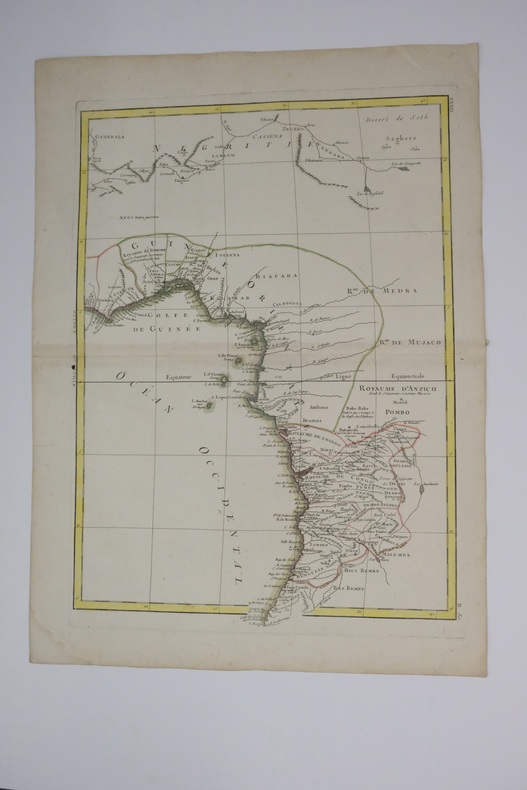
1770carte180b12Français : Un bel exemple de la carte décorative de l'Afrique de l'Ouest de Rigobert Bonne datant de 1770. Couvre de la Gold Coast (Ghana moderne), au sud autour du golfe du Bénin (Biafara) jusqu'au Gabon, au Congo et à l'Angola. Comprend les pays modernes du Ghana, du Togo, du Bénin, du Nigeria, du Cameroun, de la Guinée équatoriale, du Gabon, du Congo et de l'Angola. Comme la plupart des cartes de l’Afrique, cette carte montre d’excellents détails le long de la côte et uniquement des spéculations à l’intérieur. Donner la preuve d’importantes activités cartographiques belges à travers le Congo. Nomme de nombreux royaumes africains, dont Anzico, Mujaco, Bembe, Lubolo, Pemba, Dembi, Calbongo, Bake-Bake, Bénin et d'autres. Tentatives de cartographier le fleuve Niger quant à ses écoulements dans le désert de Seth ou Saghara, mais la plupart de cette cartographie est au mieux spéculative. Dessiné par R. Bonne en 1770 pour émission sous la planche no. B 30 dans le numéro de 1776 de Jean Lattre de l'Atlas Moderne English: A beautiful example of Rigobert Bonne's 1770 decorative map of West Africa. Covers from the Gold Coast (modern day Ghana), south around the Bight of Benin (Biafara) to Gabon, Congo and Angola. Includes the modern day countries of Ghana, Togo, Benin, Nigeria, Cameroon, Equatorial Guinea, Gabon, Congo and Angola. As with most maps of Africa, this map shows excellent detail along the coast and only speculation in the interior. Give evidence of significant Belgian mapping activities throughout the Congo. Names numerous African Kingdoms including Anzico, Mujaco, Bembe, Lubolo, Pemba, Dembi, Calbongo, Bake-Bake, Benin and others. Attempts to map the Niger River as to flows into the Desert de Seth or Saghara, but most of this cartography is speculative at best. Drawn by R. Bonne in 1770 for issue as plate no. B 30 in Jean Lattre's 1776 issue of the Atlas Moderne .
Folio (302 x 402 mm). (6), 56 pp. With 60 chromolithographed plates. Contemporary half cloth. Second edition of this plate set first published in 1876-78, including several much-sought depictions of falcons. "As these birds of prey are rendered with the utmost attention to detail, the description of their exterior may be confined to that which is not evident from the images or whatever is of particular noteworthiness" (cf. preface). - Binding rubbed and stained; lower hinge beginning to split. Nissen, IVB 782. OCLC 302340448. Cf. Harting 127.
Engraving. 285 x 357 mm. Matted. An Arabian horse led by a bedouin, engraved by the young Martin Elias Ridinger after a drawing by his famous father.
Oblong folio (450 x 336 mm). Letterpress title page (with extensive description on the reverse) and 4 engraved plates. Contemporary blank wrappers, stored in custom-made cardboard portfolio with giltstamped cover label. First edition. A fine series of four elaborately decorated Turkish horses, based on drawings prepared in Constantinople and sent to Ridinger by Baron Gudenus. As stated in the letter from Constantinople, dated 7 March 1741 and printed on the reverse of the title page, the Ottoman dignitaries could be distinguished by the various kinds of luxurious cloths, jewels, and finery they applied to their stables. The officials would vie with each other for the most splendid equestrian adornments, often showering their animals with gold and silver, diamonds, silk, and delicate embroideries. At a state reception in 1740, the Sultan was reported to have shown a parade of 30 horses, each covered in a different kind of precious stone. Such a horse laden with ornament, led into the seraglio by a Janissary, is pictured in plate I: four ostrich feathers adorn the head (a distinction afforded only to the Sultan's personal stable), while the chest bears a splendid rosette belt. Plate II shows a rising "Divani", such as is ridden by the Grand Vizier when dressed in state, with silver chains jingling from its halter and an embroidered blanket under the saddle. Plate III shows another Divani (titled "du coté gauche", but a rare variant imprint from front right), with different bridle and blanket; an elaborately tooled gilt thong is strapped across the chest. The final plate IV shows the "cheval de main d'un Pacha" besides a large kiosk, with a long blanket, rich silver and gemstone decoration and two leopard skins. - Some fingerstaining in the margins, but well preserved. Thienemann 594-597.
8 engravings, 255 x 180 mm each. Attractive series of horses (and mules) used in Arabia, Germany, England, Spain, Tartary, Turkey, and Hungary. - Captions and four-line descriptions in German and French.
Small 4to (140 x 187 mm). 68 ff. (but title is fragmentary, preserving the letterpress only, laid down to old paper). Near-contemporary full leather binding, spine rebacked. All edges red. Rare edition of this famous and scare refutation of the Qur'an. The Dominican Ricoldus (ca. 1243-1320) was sent to the orient as a missionary in 1288. He visited the Holy Land and travelled to Baghdad via Cilicia, Erzurum, and Tabriz. During his stay in Baghdad, Ricoldus studied the Qur'an and other works of Islamic theology, for controversial purposes, arguing with Nestorian Christians. He is said even to have begun a translation of the Qur'an about 1290, but it is not known whether this work was completed. - Ricoldus returned to his native Florence around the year 1300 to compose or edit several works about the Middle East. While many of his writings praise the Muslims' social behaviour, hospitality and sense of honour, his best-known work, the "Contra legem Sarracenorum", is a notorious refutation of the Islamic doctrines. Largely a compilation from William of Tripolis, Marcus of Toledo and the "Contrarietas alpholica", and probably an early effort written in preparation of Ricoldus's mission, it contends that the Qur'an's self-contradictory passages, confused arrangement and want of miracles prove that Islam cannot be a true revealed religion. Despite Ricoldo's hostility towards Islam his work shows specific knowledge of the Qur'an and overcomes one important prejudicial error common to other medieval criticisms of Islam: the perception that Muhammad introduced a christological heresy. The work was widely received; a Greek translation was prepared as early as 1385 by Demetrius Kydones, which was re-translated into Latin by Bartolomeo Piceno as "Improbatio" or "Confutatio Alcorani". A Spanish version appeared at Toledo in 1502, and Luther translated parts into German in 1530 (his "Verlegung des Alcoran" appeared in 1542). It influenced Pope Pius II, John of Segovia and Nicolaus Cusanus (cf. LMA VII, 808). - Binding worn but professionally repaired; spine rebacked. Some fingerstaining and browning with occasional slight worming to gutter. Trimmed rather closely with printed marginalia cropped in places, title fragment torn out and mounted, preserving some old handwritten annotations. Provenance: Mehmed V (1844-1918), Sultan of the Ottoman Empire from 1909, with his his Arabic bookplate on the pastedown. VD 16, R 2328. BNHCat R 296. This edition not in Panzer.
19977080784Zürich: Museum Rietberg 1997. 319 Seiten. Mit zahlreichen farbigen Abbildungen. 4° (30,5 - 25 cm). Farbig illustrierter Orig.-Pappband. [Hardcover / fest gebunden].
2010B3A210320016Hazeltine National Golf Club. 50th Anniversary Committee 2012-01-01. Hardcover. Very Good. A nice copy. Text in mint/unmarked condition. Cover has minor wear. Binding is tight. Your Satisfaction Guaranteed. We ship daily. Hazeltine National Golf Club. 50th Anniversary Committee, hardcover
Folio (275 x 407 mm). 2 vols. (4), XLVIII, (16) pp. 2144 (but: 2136: skipping 441-448) cols. (4) pp., XX cols., (6) pp., 2286 cols. 19th century English calf. First edition of the first Persian-Arabic-English dictionary, edited by the orientalist Sir John Richardson (1740/41-1795). The first volume includes a dissertation on the languages, literature and manners of Eastern nations. ''An excellent work. As the first vol. or Persian, Arabic and English part was published separately, many more copies were sold than of the second or English, Persian, and Arabic. A few broken sets of the first volume being left, the booksellers were led to reprint several deficient sheets, and so with the copies left on hand of the second vol. they made up some perfect sets. But these are easily known from the original'' (Clarke), as they are printed in London in 1800. - "On 12 November 1767 [Richardson] was proposed for the Society of Antiquaries of London as of Furnival's Inn. In London he pursued both the law and the study of Arabic and Persian. In his oriental interests Richardson was much influenced by another young man, William Jones, who was already coming to be regarded as a prodigy of learning in Asian languages. With the growth of British territorial power in India the potential market for a Persian dictionary had aroused the interest of London publishers and by 1770 Jones and Richardson were working on a new version of Franciscus Meninski's 'Thesaurus linguarum orientalium', first published in 1680-87. Progress was very slow, and Jones withdrew to concentrate on his legal career, leaving the field to Richardson. Thanks to his 'ingenuity and perseverance' (memorial of A. Hamilton and G. Nicol to East India Company, 6 Feb 1776, BL OIOC, E/1/60, no. 26), an abridged version of the original project eventually appeared in two volumes in 1777 and 1780 as A Dictionary, Persian, Arabic and English. Fundamentally revised by others, notably by Charles Wilkins in 1806 and 1810, the dictionary was to have a long life, but although the company took 150 sets, there were few other subscribers and Richardson got little reward for the huge effort he had expended on it" (Marshall). - Bindings rubbed and worn, inner hinges partly split, endpapers renewed. Some staining and marginal repairs to interior; larger tears to 5 leaves, staining to both titles, ownership inscriptions partly inked out; both titles showing central repaired clipping as well as marginal strenghtening and collector's stamp. A large part of both volumes shows worming to gutter; a few leaves with repairs. Zaunmüller 189. Vater/Jülg 25. Graesse VI, 113. Cf. Brunet IV, 1285 (later ed. only, 1806-1810). Clarke, John. (1806). The Bibliographical Miscellany - Supplement, vol. 1 (London, 1806) pp. 273-274; for Richardson: Marshall, "Richardson, John [styled Sir John Richardson, ninth baronet] (1740/41-1795), orientalist", in: ODNB (online ed.).