4 134 résultats
4to. (73), (1 blank) ff. With woodcut allegorical and architectural title-page with putti and mythological women holding drapes hanging from an arch and the Royal Portuguese coat of arms at the foot, 40 woodcut (geometrical and optical) figures in text, Rodericus's large full-page emblematic woodcut printer's device (a dragon with the motto "Salus vitae" on a banderole) and many woodcut initials. Bound in a period-style Italian calf binding, gold-tooled spine, blind-tooled frames on front and back boards and gold-tooled centerpieces on the front and back board with "Petri Nonii" on the front board and "MDXLII" on the back board. First edition of two of the most important and rarest scientific works on twilight and optics. The first is written by the greatest Portuguese mathematician Pedro Nunez (1492-1577), who served as cosmographer royal to the court of João III. His "De crepusculis" discusses new solutions for problems concerning twilight (such as the shortest twilight period) and the refraction of light, and announces his new instrument for measuring exceedingly small angles, now called a “nonius”. - The second work, also entitled "De crepusculis", was written (according to the title-page) by the greatest Islamic physicist Ibn Al-Haytham (965-1039), from living in the Arabian Peninsula, whose seminal work on optics broke with ancient Greek theories. In fact, the work is now attributed to the great Andalusian father of spherical trigonometry, the 11th-century mathematician and astronomer Abu ‘Abd Allah Muhammad ibn Mu’adh, who was described by Averroës as "advanced and high-ranking" (Sabra, p. 85), but about whom very little is known. His work discusses the density of the atmosphere and establishes a relationship between atmospheric pressure and altitude. It also notes that twilight only ceases or begins when the sun reaches 19 degrees below the horizon. It was translated from Arabic into Latin by Gerard de Cremona (1114-87), who brought Arabic science to the West. This work is one of the artifacts through which Islamic civilisation made significant and crucial contributions to scientific knowledge in the pre-modern age during their golden age of Arabic science, although the Latin translations in this field only provide "a dim reflection of the true splendour of achievements" (Gerli, p. 804). - With an owner's inscription at the head of the title-page and a handwritten impressum on the title-page in the same hand, three faint library stamps (two of a library in Douai) and with marks of an erased bookplate on the front pastedown. Binding very slightly worn around the spine, some small stains on the endpapers, but otherwise a beautiful copy in very good condition. Adams N 375. DSB X, 160f. Honeyman 2353. Houzeau/Lancaster 1188 & 2473. King Manuel 48. Palau 196.748. Poggendorff II, 305. Sabra, "The authorship of the Liber de crepusculis", in: Isis 58.1 (1967), pp. 77-85. Stilwell 781 & 863. Cf. Carmody, Arabic Astronomical and Astrological Sciences in Latin Translation; Gerli, Medieval Iberia (2003), p. 804. Not in Vagnetti.
4to. (2), 143, (1) pp. With 6 hand-coloured engraved plates (1 folding, 5 full-page) by D. Sluyter after H. van Oort. Contemporary stiff grey wrappers. Rare separate issue of Numan's detailed and beautifully illustrated study of the larvae of the equine botfly (family Oestridae), an internal parasite of horses. Alexander Numan (1780-1852) discusses the different species of botfly found in the stomachs of horses, the way the eggs are transferred to the intestines, their growth and development, the effect on the health of the host animal, and the various ways they may be removed. The essay appeared both in the Nieuwe Verhandelingen der eerste klasse van het Koninklijk-Nederlandse Instituut van Wetenschappen, and in the present, much rarer separate issue, where only the plates refer to the journal. - Numan completed his medical studies at Groningen in 1804. He wrote a prize-winning essay on the Keil dysentery epidemic of 1810, which appeared in 1812. In the same year he was asked to translate a veterinary manual and later to write his own, which went through five editions from 1819 to 1856. When the first Dutch veterinary school opened at Utrecht in 1821, no suitable professor could be found in the practice, and the position went to Numan. He went on to write many excellent articles, the best known of which discusses cow pox (1831). - Wrappers slightly damaged at spine, but still very good. A fine copy of a rare and well-illustrated essay by a pioneering veterinary researcher. KVK (1 copy). NCC (4 copies). Not in Garrison/M., Landwehr Coloured Plates, Nissen ZBI.
12 sheets joined and mounted on cloth; total dimensions 1190 x 1300 mm. Engraved map in original outline colour. In the original marbled paper box with manuscript title on cartouche and a 19th century bookseller’s label. A large map coving from the Balkans to the Ukraine, the Caspian Sea, Western Persia, Arabia and the Nile. Unusually, the map uses stipple engraving to give texture to the open areas, especially in Arabia. It is also an uncommonly international publication, published in France by the engraver, with the assistance of publishers in other countries: James Wyld and John Cary in London; Artaria & Fontaine in Mannheim; Villardi in Milan; Bouffa & Fils in Amsterdam; and Brunin in Glasgow (a publisher not listed in Tooley’s Dictionary). - Minor defects to the box, slight browning, otherwise in fine condition. OCLC 1061136095.
19512463Prentice-hall Malicorne sur Sarthe, 72, Pays de la Loire, France 1951 Book condition, Etat : Bon hardcover In-8 1 vol. - 126 pages
1st edition. Hardback in a protected dust jacket. VG/VG. Inscriptions on the inside front endpaper. ISBN 0862541263. Review. 19089. eng
Partially engraved sea chart, 1 sheet of 6 sheets only. 940 x 675 mm. Updated 1852 edition of Norie's very rare and monumental sea chart of the Indian Ocean, one of the 19th century's greatest works of maritime cartography. The present sheet embraces the southern coasts of the Arabian Peninsula, including the coasts of Oman, Yemen, and much of the Red Sea coast of Saudi Arabia, up as far as Yanbu, including the Jeddah-Mecca area. In Africa the chart includes the coasts of Eritrea, Djibouti, Somalia, Kenya, and Tanzania, while the Seychelles appear within the Indian Ocean itself. The quality of the hydrography and engraving is exquisite. The antecedent chart of the present work was first issued by William Heather in 1799 but was re-engraved and dramatically updated in 1833 by Heather's successor J. W. Norie. The present edition was issued by Norie's successor firm, Norie & Wilson, featuring the latest updates. - Pronounced staining and crackling with minor loss to middle of left blank margin, some light staining in other areas, some short tears emanating from the margins; some offsetting in lower part of chart. Altogether well preserved. Cf. OCLC 498106078 (1833 edition).
8vo. (4), 168 pp. Contemporary blue wrappers with original printed cover label. Second edition; rare: not in Copac or OCLC. The first edition appeared in 1817. Also includes the coasts of Syria, Egypt, and North Africa (Tripoli, Tunis, Algiers). John William Norie (1772-1843) was one of the most important hydrographic publishers of his time. - Some dog-earing, but still a good copy. OCLC 851876144.
Large folio (295 x 479 mm). 2 vols. (12), XXXIV, 124 pp. (4), VIII, 155, (1) pp. With engraved frontispiece, engraved portrait, 19 engraved vignettes, 10 engraved initials, and 162 engravings on 161 plates. Modern half cloth. First English edition of one "of the earliest modern studies of Egypt" (Howgego). - "The first map of the Nile between Cairo and Derr based on autopsy, indicating all locales on the river banks" (cf. Henze). The engravings show views, landscapes, ruins, antiquities, plans, and maps. Plates numbered I through CLIX; plates XVI, XXII and XVII are followed by an unnumbered plate; illustrations CXL/CXLI and CXLII/CXLIII are printed from a single plate; no. CVIII is printed from two separate plates and is not joined to form a single illustration (thus counted as two plates). - Some edge repairs near beginning and end; several plates trimmed closely. All plates stamped "Birmingham Library". Endpapers show traces of a removed bookplate, as well as a later bookplate (apparently "Fritz Machac") in hieroglyphs. Howgego I, N38. Weber II, 520. Ibrahim-Hilmy II, 74. Cox I, 382. Brunet IV, 101. Graesse IV, 687. OCLC 5716565. Cf. Gay 2169. Henze III, 622. Paulitschke 746. Blackmer 1212 (2 volumes in one).
Small folio (238 x 303 mm). (2), 638, (2) pp. Modern half calf with red and green gilt spine labels, bound in 19th century style. First printed edition of the celebrated Islamic biography of Alexander the Great (356-323 BC) by the Persian poet Nizami, completed ca. 599/1202. Published under the auspices of Sir Gilbert Elliot-Murray-Kynynmound, the First Earl of Minto (1751-1814), and printed in Persian throughout but for the English title. - "The Alexander of the Persian romances is much more colorful than his Western counterpart [...] Nizami celebrates him first as a king and conqueror, then as a sage and a prophet. In 'Iskandarnamah', in addition to being a zealous Moslem, Alexander becomes an ardent lover with numerous wives and concubines" (Southgate, "Portraits of Alexander in Persian Alexander-Romances of the Islamic Era"). - Islamic myths about Alexander the Great are thought to have derived in part from Qur'anic references to the "Dhu'l-Qarnayn" ("He of the Two Horns") as well as from the Greek sources in translation. "The principal episodes of the legend of Alexander, as known to the Muslim tradition, are elaborated in the [Eskander-nama]: the birth of Alexander, his succession to the Macedonian throne, his war against the Negroes who had invaded Egypt, the war with the Persians, ending with the defeat and death of Dara and Alexander's marriage to Dara's daughter, his pilgrimage to Mecca. Nezami then dwells at some length on Alexander's stay in the Caucasus and his visit to Queen Nushaba of Barda'a and her court of Amazons; this lady takes over the role of Candace in earlier versions of the Alexander saga. Alexander then goes to India and China. During his absence the Rus (i.e., the Russian Vikings) invade the Caucasus and capture Barda'a (as they in fact did some two centuries before Nezami's time) and take Nushaba prisoner. Alexander's wars with the Rus, which are depicted at considerable length, end with his victory and his magnanimous treatment of the defeated army. The [Eskander-nama] concludes with the account of Alexander's unsuccessful search for the water of immortal life" (Encylopaedia Iranica, Vol. VIII, pp. 612-614). Along the way Alexander's conquests of much of Central Asia and the pre-Islamic world are described: Dara (Syria), Ajam (near Kuwait), Kayan (Afghanistan), the Arabian Peninsula, Khorasan (Northern Iran), and so on. - Ca. 20 pages with wormholes affecting some text, wide margins. Some browning throughout. Discarded and sold from the Library of Haverford College, Pennsylvania, with their drystamp to the title-page. Later in the Alexander the Great Collection of Julio Berzunza (1896-1952), Professor of Languages at the University of New Hampshire. Graesse IV, 680. Brunet IV, 83; Ebert 14833 ("1811" in error). Nawabi 414. OCLC 41609907.
8vo (130 x 218 mm). Arabic manuscript on paper. (375) pp., 19 lines per extensum. Written in neat black naskh, emphases picked out in red; catchwords. With numerous tables and diagrams, one in red and black. Contemporary brown leather binding with stamped ornaments. A 16th century commentary (sharh), profusely illustrated with diagrams, on Naziraddin al-Tusi's "at-Tadhkira an-Nasiriya", a general outline of astronomy, originally written in Persian. Composed by the Persian Sunni scholar Nizamaddin ibn Muhamad an-Nisapuri (d. 1328/29), who was known as a mathematician, astronomer, jurist, Qur'an exegete, and poet. His teacher Qutb al-Din al-Shirazi had himself been a student of al-Tusi's. An-Nisapuri wrote the present commentary in 711 H (1311 CE). - Binding rather rubbed. Marginal notes throughout; colophon with partial date "14 Jumada II". Scattered minor wormholes, but overall in good condition. GAL I, 511, VI, 40 b.
68 pages. Features: Lots of footbal and baseball coverage; Bill Veeck's views on the Pittsburgh drug trials; Photo of Tony Fernandez spraying champagne on Manny Lee as Blue Jays win pennant; Photo of Buffalo Bills' Justin Cross playing golf with one arm (as the other is broken); Phil Niekro's 300th win - article with photo; Harry Neale is new Detroit Red Wings' coach - photo; Article on Glen Sather; Big Heads Biggest Foe for Edmonto Oilers - article with photo of Gretzky with Paul Coffey; and more. Average wear. Unmarked. A sound copy. Book
2 parts in one volume. Engraved title page, letterpress title in red and black, 2 armorial engraved plates, 2 ff. of dedication, 208 pp. 258, (10) pp. With 111 engravings in the text, 1 folding engraved map, and 35 double-page-sited engraved plates. Full calf, spine and covers stamped in blind, spine label. Folio. Second Dutch edition (previously published in 1665) of this description of the 1655-57 embassy of Peter de Goyer and Jacob de Keyzer, with a general account on China in part 2. The plates show views (including Batavia, Canton, Macao, Nanjing, and Beijing), plans, costumes, flora and fauna etc. - "The Dutch, being at the height of their power, having supplanted the Portuguese, desired to gain access to China and a portion of the Chinese trade. After much opposition the Government succeeded in sending merchants to try the pulse of the Chinese at Canton. Upon their report it was determined to despatch ambassadors from Batavia to the Court of Peking to solicit liberty to trade. This is the embassy written up by Nieuhoff, who was steward to the ambassadors" (Cox). - The selection of plates varies from copy to copy. The present one contains two engraved armorial plates not called for in the list of plates, but not the portrait (not mentioned there either) and also lacks the plate "Paolinxi". - Hardly browned of soiled; insignificant edge flaws at beginning and end. Map wrinkled, waterstained and with repaired edge tears. Cat. Nederl. Hist. Scheepvart Mus. 499. Cordier, BS 2345. Graesse IV, 675. Tiele 800. Cf. Boucher de la Richarderie V, 297; Cox I, 325; Henze III, 612.
199523953London, Harper Collins, 1995. 132 SS., 3 Bll. Verlagswerbung. (19 x 14,5 cm), gelber original Pappband im illustr. original Schutzumschlag.
4to. (6), XLI, (1), 408, (14) pp., 1 blank leaf. Engraved title-page. With 24 numbered plates (7 of which folding), a folding map of Yemen (coloured in outline), and a folding table. - (Bound with) II: Michaelis, Johann David. Vragen aan een gezelschap van geleerde mannen [...]. Ibid., 1774. XLVI, 270, (2) pp. Contemporary half calf over marbled boards with giltstamped spine and spine labels. First Dutch translation of an important and famous account of the Danish royal expedition to the Middle East, Egypt, Persia and India (1761-67), the first scientific expedition to this area. Niebuhr's account is here bound with the Dutch translation of Michaëlis's work, containing a review of the first. "The expedition had been proposed by the Hebrew scholar Johann David Michäelis of Göttingen for the purpose of illustrating certain passages of the Old Testament, and initially envisaged only a single traveller, possible an Arabic scholar. However, the idea rapidly blossomed into a fully-fledged scientfiic expedi - tion. The team eventually assembled, for which there was no appointed leader, included Niebuhr as surveyor, along with Friedrich Christian von Haven, Peter Forskall, Christian Carl Kramer, Georg Baurenfeind, and a Swedish ex-soldier named Berggren'' (Howgego). Carsten Niebuhr (1733-1815) was the sole survivor, and his work represents an important contribution to the study of the Middle East. His map of Yemen, the first exact map of the area ever, remained the standard for the next 200 years. The plates include views of the mosques of Mecca and Medina, and 6 maps including the map of Yemen and of the Gulf of Suez. Furthermore it contains Arabic specimens from the Qur'an, with vowel points and decorations hand coloured. Niebuhr's "accounts are probably the best and most authentic of their day" (Cox). - Handwritten ownership on title-page cancelled, causing some ink spots to neighbouring pages. Extremities somewhat rubbed. A tear in the large map of Yemen repaired with tape; slight foxing to some plates along the fold lines. A good copy of this standard work. Howgego I, N24. Tiele, Bibl. 795f. Gay 3589. Cf. Atabey 873f. Cox I, 237f. Hamilton, Europe and the Arab world 48.
Large 4to. 2 vols in one. (6), 56, 252 pp. (4), 315, (5) pp. (pages 153-216 of part 2 transposed after p. 88). With 1 folding genealogical table and 25 engraved plates (6 folding), including maps, plans, costumes, views, and 2 showing Arabic text with vowel points, as well as 2 engraved headpieces. Contemporary full calf with giltstamped red spine label. Marbled endpapers. All edges sprinkled red. Third French edition (first published in German in Copenhagen, 1772). "Édition revue par de Guignes" (Gay). "Niebuhr (1713-1815) participated as astronomer and naturalist to the royal Danish expedition to Arabia in 1763-1767. Together with the naturalist Forskal, the philologist Van Haven and two others, he travelled up the Nile to Suez and Mount Sinai, and from there to Jeddah and Mocha. By the end of their stay in Mocha, all the memebers of the expedition but Niebuhr had died, and Niebuhr travelled on alone to India, returning via Persia, Syria, Cyprus, and Constantinople. The only surviving member of the hazardous expedition, he returned to an indifferent reception in Copenhagen [...] Niebuhr's comprehensive description, particularly of the Yemen region, was the best and most authentic of the day. Many subsequent travellers have acknowledged their debt to him, and only on a few minor points have they shown him to be in error. He was scientifically and philosophically minded, cautious and steady, and hardly the man to masquerade in Mekkah or wander with the Bedouins, but few contributed more solidly to the study of Arabia" (Atabey). - Extremeties a little bumped, hinges repaired. Occasional light browning or staining, more pronounced near beginning. Contemporary handwritten "Avis au Lecteur" bound before title-page, alerting the reader to the transposed quires in part 2. - Rare. Gay 3589. Howgego I, N24 (p. 752). Brunet IV, 74 (note). Cf. Atabey 873. Macro 1699. Not in Blackmer.
Large 4to (205 x 262 mm). 2 volumes. (6), 56, 252 pp. (4), 315, (5) pp. With 1 folding genealogical table and 25 engraved plates (many folding), including maps, plans, costumes, and views, 2 showing Arabic text with vowel points, as well as 2 engraved headpieces. Contemporary full marbled calf with giltstamped spines and red spine labels. Blue coloured endpapers. All edges red. Third French edition (first published in German in Copenhagen, 1772). "Édition revue par de Guignes" (Gay). "Niebuhr (1713-1815) participated as astronomer and naturalist to the royal Danish expedition to Arabia in 1763-1767. Together with the naturalist Forskal, the philologist Van Haven and two others, he travelled up the Nile to Suez and Mount Sinai, and from there to Jeddah and Mocha. By the end of their stay in Mocha, all the memebers of the expedition but Niebuhr had died, and Niebuhr travelled on alone to India, returning via Persia, Syria, Cyprus, and Constantinople. The only surviving member of the hazardous expedition, he returned to an indifferent reception in Copenhagen [...] Niebuhr's comprehensive description, particularly of the Yemen region, was the best and most authentic of the day. Many subsequent travellers have acknowledged their debt to him, and only on a few minor points have they shown him to be in error. He was scientifically and philosophically minded, cautious and steady, and hardly the man to masquerade in Mekkah or wander with the Bedouins, but few contributed more solidly to the study of Arabia" (Atabey). - Noticeable worming to gutter, sometimes touching text but loss to legibility (more extensive in vol. I), much of which professionally repaired. A few handwritten pencil annotations in the margin. Bindings professionally restored. Gay 3589. Howgego I, N24 (p. 752). Brunet IV, 74 (note). Cf. Atabey 873. Macro 1699. Not in Blackmer.
4to. XLII, 372 pp. With engraved title (in counted prelims.), 25 engraved plates (8 folding, including large engraved map of the Yemen, in partial colour) and a folding table. Contemporary half calf with giltstamped red morocco label over marbled green boards. Marbled endpapers. Second French edition, translated from the German ("Beschreibung von Arabien") by F. L. Mourier. Includes Niebuhr's famous map of the Yemen and Arabic specimens from the Qur'an, with added hand colouring to indicate vowel sounds. "L'on voit [...] sur la IV et V planche, une feuille copiée d'un Korân, qui est écrit sur du parchemin et conservé comme un grand thresor dans la collection de livres faites par l'Académie Dsjamea el ashar à Kahira, parce qu'on croit, que le Calife Omar l'a écrit de sa propre main. Mais quand Omar ne l'auroit pas écrit, cette feuille est toujours très ancienne et par là-même remarquable" (Chauvin). - This is the famous account of the Royal Danish Expedition (1761-67) to the Middle East, Egypt, Persia and India, the first scientific expedition to this area. Niebuhr's "work on Arabia was the first European attempt at a complete account of Arabia, its people and their way of life. He amassed a vast quantity of factual information which he relates in a simple unrhetorical fashion, distinguishing clearly between things observed personally and things learned from others. The expedition, which lasted six years, was sponsored by the Danish king, and included the brilliant Swedish scientist, Peter Forsskal, who died while in Yemen" (Cat. Sotheby‘s, 13 Oct 98, lot 1010). Of the five scientists, Carsten Niebuhr (1733-1815) was the sole survivor, and his work represents an important contribution to the study of the Middle East. His map of the Yemen, the first exact map of the area ever, remained the standard for the next 200 years. "Niebuhr's comprehensive description [...] was the best and most authentic of the day. Many subsequent travellers have acknowledged their debt to him, and only on a few minor points have they shown him to be in error. He was scientifically and philosophically minded, cautious and steady, and hardly the man to masquerade in Mekkah or wander with the Bedouins, but few contributed more solidly to the study of Arabia" (Atabey). - Binding a little rubbed, spine professionally repaired. A good, wide-margined copy in a contemporary binding from the library of the French historian, archaeologist, numismatist, and orientalist Victor Langlois (1829-69) with his cancelled ownership handwritten to the flyleaf. Chauvin X, p. 57, no. 128; XII, p. 288, no. 1206. Howgego I, N24 (p. 752). Weber II, 548. Gay 3589. Nyon 21017. Grenoble 25621. Cf. Macro, Bibliography of the Arabian Peninsula, 1699. Carter, Robert A. Sea of Pearls, p. 116. Carter, Robert A. Sea of Pearls, p. 116.
4to. 2 vols. XVI, (6), 505, (1) pp. With 72 plates and folding map. (16), 479, (1) pp. With 52 plates and maps. Contemporary vellum with title to spine. First edition. - Niebuhr's "work on Arabia was the first European attempt at a complete account of Arabia, its people and their way of life. He amassed a vast quantity of factual information which he relates in a simple unrhetorical fashion, distinguishing clearly between things observed personally and things learned from others. The expedition, which lasted six years, was sponsored by the Danish king, and included the brilliant Swedish scientist, Peter Forsskal, who died while in Yemen" (Cat. Sotheby‘s, 13 Oct 98, lot 1010). Of the five scientists, Carsten Niebuhr (1733-1815) was the sole survivor, and his work represents an important contribution to the study of the Middle East. His map of the Yemen, the first exact map of the area ever, remained the standard for the next 200 years. - An unsophisticated, exceptionally fine copy. Macro 1700. Gay 3589. Howgego I, N24 (p. 752).
4to (285 x 233 mm). 2 vols. VIII, (6), 484, (2) pp. (16), 455, (1) pp. With engraved vignette by N. van der Meer to each title-page, 94 plates (30 folding, 64 full-page), and 31 maps and plans (7 folding, 24 full-page, of which the folding map of Yemen handcoloured in outline), engraved by C. Philips, Th. and C. H. de Koning, C. J. de Huyser, C. F. Fritsch, O. de Vries and others. 19th-century half calf. Untrimmed. First Dutch translation of this important and famous account of the Royal Danish Expedition (1761-67) to the Middle East, Egypt, Persia and India, the first scientific expedition to this area. The original German edition was published in Copenhagen in 1744-1778 under the title "Reisebeschreibung nach Arabien und anderen umliegenden Ländern". - ''In volume II, p. 317 he [Niebuhr] begins his description of the journey from Beit el Fakih in the coffee mountains. This is accompanied by three engravings'' (Hünersdorff). There are some 40 other references to coffee in this work, including the journey from Sana'a to Mocha. The plates, the same as used for the first German language edition, include many views of cities, antiquities and statues, natives in traditional dress, hieroglyphs, Arabic script, musical instruments, a reception with the Iman of Sana'a (Yemen), and views of the mosque in Meshed Ali. The 31 maps and plans are of Constantinople, the Nile, Jeddah in the province of Mecca, Bombay, the palace of Persepolis, Muscat, the Arabian ("Persian") Gulf, Baghdad, Mosul, etc. Niebuhr's map of Yemen, the first exact map of the area ever, remained the standard for the next 200 years. - "The expedition had been proposed by the Hebrew scholar Johann David Michäelis of Göttingen for the purpose of illustrating certain passages of the Old Testament, and initially envisaged only a single traveller, possible an Arabic scholar. However, the idea rapidly blossomed into a fully-fledged scientific expedition. The team eventually assembled, for which there was no appointed leader, included Niebuhr as surveyor, along with Friedrich Christian von Haven, Peter Forskall, Christian Carl Kramer, Georg Baurenfeind, and a Swedish ex-soldier named Berggren" (Howgego). Carsten Niebuhr (1733-1815) was the sole survivor, and his work represents an important contribution to the study of the Middle East. - Bindings used. Large-margined copy of this famous account of the Middle East, Egypt, Persia, and India in fine condition. Howgego I, N24. Hünersdorff, Coffee, p. 1081. Van Hulthem 15024. Nyon 21018. Tiele, Bibl. 796. Cf. Atabey 873-874. Cox I, pp. 237-238. Gay, Bibl. de l'Afrique et Arabe 3589. Macro, Bibliography of the Arabian Peninsula, 1700. Carter, Robert A. Sea of Pearls, p. 116. Not in Atabey or Blackmer.
2 vols. VIII, (6), 484, (2) pp. (16), 456 pp. (6), XXXXI, (1), 408, (14) pp. With 2 engraved title-pages, each with an engraved vignette (that for volume 2 from the plate of the 1774 "Beschryving" with the lettering revised; that for volume 1 copied from it and unsigned), 125 engraved plates numbered I-LXXII, [LXXIII] (vol. 1) & I-LII (vol. 2) (38 folding), showing topographic views, watermills, people, Egyptian and Persian antiquities, Egyptian, Persian, cuneiform and other inscriptions, etc. by C. F. Fritsch, C. J. de Huyser, Th. Koning, G. H. Koning, C. Philips, O. de Vries, Baurenfeind and others. The unnumbered folding map of Yemen ("Tabula Itineraria", plate size 48.5 x 41.5 cm), with the trade routes coloured by hand, covers a smaller area at a larger scale than that in the Beschryving. - (Bound with) II: Niebuhr, Carsten. Beschrying van Arabie, uit eigene waarnemingen en in 't land zelf verzamelde narigten opgesteld. Amsterdam, Steven Jacobus Baalde; Utrecht, Johannes van Schoonhoven & Co. (colophon: printed by Johan Joseph Besseling), 1774. With engraved title-page showing an engraved vignette by N. van der Meer (2 female figures with a globe and other instruments) and 25 engraved plates numbered I-XXIV, (XXV), including 7 folding showing 1 view of military exercises, 2 Kufic inscriptions (coloured by hand) and 4 maps. The unnumbered map of Yemen (plate size 58.5 x 39 cm) is coloured by hand in outline. The full-page plates include maps, topographic views, costumes, coins, Arabic inscriptions, etc. All by C. J. de Huyser, N. van der Meer, Th. Koning and C. Philips. 2 works in 3 volumes. 4to. Contemporary half tree calf, sides covered with paste paper; rebacked, with original gold-tooled backstrip laid down. One of the very rare large paper copies of the first and only editions of the Dutch translation by Jacob van Ekers of Niebuhr's famous account of a voyage to Arabia and surrounding countries (ad 1) and his description of Arabia, Egypt and the Middle East (ad 2). Both works were originally written by the Danish traveller and surveyor Carsten Niebuhr (1733-1815) and published in German, in Copenhagen in 1772 under the titles, "Beschreibung von Arabien" and "Reisebeschreibung nach Arabien und anderen umliegenden Ländern". Both works were also translated in French and English. - In 1760 Niebuhr was invited to join a scientific expedition to Egypt. Other members of the expedition were Friedrich Christian von Haven (a Danish linguist and orientalist), Christian Carl Kramer (a Danish physician and zoologist), Georg Baurenfeind (an artist from southern Germany), Berggren (a Swedish ex-soldier) and Pehr Forrskal (a Swedish botanist). In January 1761, the expedition sailed from Copenhagen, Denmark to Alexandria, Egypt. The members of the expedition spent a year in Egypt, visiting Suez and Mount Sinai. They left Suez in October 1762 and sailed to Yemen. In May 1763 they reached Mocha where Von Haven and Forrskal died from malaria. In August 1763 Baurenfeind and Berggren died, followed by Kramer in February 1764. Niebuhr was the only one left to continue the expedition. In 1764, he explored India, sailing from Bombay to Muscat, as well as Shiraz, Babylon, Baghdad, Mosul, and Aleppo. He spent some time in Persepolis in 1765 where he has made very detailed drawings and maps, which were used for more than a hundred years. In 1766, he explored Palestine before finally returning to Copenhagen on 20 November 1767, after a journey of seven years. When he returned to Copenhagen the Swedish government warmly welcomed him and paid the costs of engraving the plates to illustrate his accounts of the voyage. Both works are lavishly illustrated, having together 2 large maps of Yemen and 148 beautifully engraved maps, plans and views of all the regions Niebuhr visited. - The present set has both works printed on the same large watermarked paper (Strasbourg bend above VDL) and is only slightly trimmed, measuring 296 x 242 mm with the tranchefiles still visible (regular copies are printed on unwatermarked paper measuring 275 x 217 mm). Not even Tiele mentions the existence of copies on large paper. - Binding slightly rubbed on the sides and rebacked as noted; otherwise good. With a few occasional spots, the half-titles slightly thumbed and a few mm of minor browning in the upper margins; a very good large paper copy, only slightly trimmed. Howgego, to 1800, N24. Tiele, Bibl. 795f. Cf. Atabey 873f. Cox I, 237f. Gay 3589. Hamilton, Europe and the Arab world 48.
4to. 2 vols. VIII, (6), 409, (1) pp. VI, (10), 389, (1) pp. With 2 engraved titles (in counted prelims.), 124 engraved plates (many folding), and folding map of Yemen (in partial colour). Contemp. full calf with gilt cover borders and giltstamped labels in red and green to fully gilt spine. Marbled endpapers. All edges red. First French edition, translated from the German ("Reisebeschreibung nach Arabien und anderen umliegenden Ländern", 1774) by F. L. Mourier. Title pages are dated 1776-80; colophones dated 1775-79. The famous account of the Royal Danish Expedition (1761-67) to the Middle East, Egypt, Persia and India, the first scientific expedition to this area. Niebuhr's "work on Arabia was the first European attempt at a complete account of Arabia, its people and their way of life. He amassed a vast quantity of factual information which he relates in a simple unrhetorical fashion, distinguishing clearly between things observed personally and things learned from others. The expedition, which lasted six years, was sponsored by the Danish king, and included the brilliant Swedish scientist, Peter Forsskal, who died while in Yemen" (Cat. Sotheby‘s, 13 Oct 98, lot 1010). Of the five scientists, Carsten Niebuhr (1733-1815) was the sole survivor, and his work represents an important contribution to the study of the Middle East. His map of the Yemen, the first exact map of the area ever, remained the standard for the next 200 years. - Old stamps erased from title pages (leaving insignificant waterstain), otherwise a perfect set in immaculate original French bindings. Howgego I, N24 (p. 752). Weber II, 549. Ibrahim-Hilmy II, 66. Gay 3589. Van Hulthem 15024. Nyon 21018. Cf. Macro, Bibliography of the Arabian Peninsula, 1700. Carter, Robert A. Sea of Pearls, p. 116. Not in Atabey or Blackmer.
Folio (29 x 22 cm). 63, (10) ff. Manuscript in Dutch, written in ink on paper, with two loosely inserted supplements (2 bifolia), with a calligraphic title-page (in script lettering with an interior white line giving an incised effect) and 39 pages of (mostly) ink and grey ink wash drawings of inscriptions, musical instruments, buildings, etc., including 3 pages of Kufic inscriptions in black ink with vowel points in red and decorations in red, yellow and green, and a few other written inscriptions showing the styles of script, plus a small drawing of an inscription and a few written examples in the text. Contemporary half canvas, sides covered with printed pattern paper (a matrix of 4-petalled rosettes on a background of horizontal and vertical lines, and dots, in red, blue and yellow, sewn on 3 vellum tapes and tacketted to the canvas spine through a vellum liner. A Dutch illustrated manuscript devoted to the Arabian Peninsula and neighbouring regions, compiled in 1785 by (and the illustrations drawn by) Johan Louis Gerlagh (1735-98), a director of the Dutch West India Company and East India Company (WIC and VOC). He takes a special interest in the various and styles of script, including Egyptian hieroglyphs and at least six styles of Arabic script (kufic, naskh, ta'liq, thuluth, ruq'ah and maghribi), but he also discusses and illustrates bas-reliefs, buildings (including the Great Mosques at Mecca and Medina), musical instruments, footware, a scarab, etc., and provides tables of data concerning tides, compass corrections and temperatures, and accounts of the Islamic calendar, precious stones, weights and measures and coins. The title describes the manuscript as notes from Carsten Niebuhr's "Reize naar Arabië en andere omliggende landen", a Dutch translation (Amsterdam & Utrecht 1776-78) of the German "Reisebeschreibung nach Arabien" (Copenhagen 1774-78), but Gerlagh apparently treats Niebuhr's complementary "Beschryving van Arabie" (1774, first published in German in 1772) as an additional volume of the Reize. All the illustrations and most of the text are copied from these two publications. Gerlagh does make use of other sources, however, quoting from Bernhard von Breidenbach's "Peregrinatio in Terra Sanctum" (1486); Heinrich Buenting's "Itinerarium scripturae" (1581); Fredrik Hasselquist's "Travels in the Levant" (1766); J. F. Martinet's "Historie der waereld" (1780-87), and Joseph de la Porte's "Nieuwe reisiger, beschryving van de oude en nieuwe weereldt" (1766-91). - Gerlagh came from a patrician family that had ties with the WIC by at least 1720 (including a director by 1730) and the VOC by at least 1735. He himself was a director of both by 1764. Although he is recorded moving from Tholen to Oosterhout (northeast of Breda) in 1779, this may have been a second residence, for he had already set up in Hoeven (west of Breda) where he served as "schout" (head of the municipality) from 1771 to 1794, his wife died there in 1786 and he died there in 1798, so he probably produced the present manuscript there. His amateur drawings and sketchbooks, most of them in Museum Gouda, have been exhibited. - The manuscript collates: [A]14 (- A9) [B]10 (B1 + [chi]2; - B7, 9, 10) [C]2 [D]4 [E]2 [F]4 [G]6 (± G1, 2, 3, 6) [H]4 [I]2 [K]-[N]4 2[chi]1 [O]-[P]4 [Q]2 = 73 ff., with E2 and H4 blank except for the leaf numbers (ff. 30 & 34). The main paper stock (including the endpapers at the front and probably also at the back) is watermarked: crowned GR in laurel branches, in a circle = Dutch garden (with "Pro Patria" above toward the centre of the sheet) above "H K P" (the main mark can appear in the left or right half sheet). We have not found or identified the initials HKP. After the last numbered leaf (2[chi]) a new part of the text begins with a different paper stock to the end of the manuscript (quires O-Q), similar but with no initials below the Dutch garden, in the general style of Heawood 3700 (1747) and Voorn, Noord-Holland 140 (1790). The cancel leaf G6± may come from the same stock, while the cancel leaves G1±, G2± and G3± show a different stock or stocks: G3± with a lion with 7 arrows, lance and freedom hat (pedestal with "VRYHEYT") in a crowned ring (double lines inside and out) containing (in mirror image) "Pro patria eiusque libertate"), in the general style of Heawood 3148 (1745) and Voorn, Noord-Holland 104-111 (1713-49); and G1± and G2± with the countermark "J[an] H[onig] & zoon", that form shown with a different main mark in Voorn, Noord-Holland 133 (1741). The firm name in the present form, with the present "zoon" (son), is recorded from 1735 to at least 1764 (probably at least 1768), changing to "zonen" (sons) probably by 1774 and certainly by 1793. So the paper used for these three cancel leaves may be several years older than the manuscript itself. - The manuscript is internally in good condition, with most deckles preserved. Binding worn but professionally restored. A good example of the fascination of leading figures in the VOC and WIC with the Arabian Peninsula and vicinity and with Islamic culture. For Niebuhr and his accounts of Arabia: Hamilton, Europe and the Arab world 48; Howgego, to 1800, N24; for Gerlagh: Katalogus ... tekenwerk-schilderwerk van Johann Louis Gerlagh (1987); A. Romeijn, De stadsregering van Tholen (1577-1795) (2001), pp. 229f.
12mo. 2 vols. XX, 339, (1) pp. XII, 359, (1) pp. With 8 engraved plates and one engraved folding map of the Arabian Gulf. Contemporary half calf over marbled boards with giltstamped spine and spine-title. All edges sprinkled red. Second edition in English of Niebuhr's excellent account of his travels in the Middle East, Egypt, Persia, India and Arabia, the first scientific expedition to this area, subsidised by the Danish king. Of the five scientists, Carsten Niebuhr (1733-1815) was the sole survivor, and his work represents an important contribution to the study of the Middle East. The maps Niebuhr drew in the course of the expedition were remarkably detailed and accurate. Indeed, his map of Yemen was the first exact map of the area ever, remaining the standard for the next 200 years. The volumes include authentic descriptions of life and customs in Yemen, Oman and elsewhere, with detailed descriptions of Mecca and Medina, Sana'a and Mocha as well as several references to coffee and coffeehouses. The first volume was adapted from Niebuhr's "Reisebeschreibung nach Arabien" (1774) and the second from his "Beschreibung von Arabien" (1772). Previously published in Edinburgh in 1792. - Corners and hinges professionally repaired. With near-contemporary manuscript presentation note to flyleaves: "presented to the Glenbervie Sunday School Library by G. M". Later pencil ownership of the Scottish dentist and naturalist E. G. H. Lightfoot, dated Aberdeen 1953. Some additional pencil notes to pastedown and flyleaf of volume I, including brief biographical notes on Niebuhr in Lightfoot's handwriting. ESTC T176314. Howgego, to 1800, N24. Hünersdorff, p. 1081. OCLC 5416838. Cf. Weber II, 550. Macro 1700. Atabey 873-874 (other eds).
8vo. 71, (1) pp. With a map frontispiece and four black and white plates. Original printed wrappers. First edition. An Arabic translation of Carsten Niebuhr's description of Baghdad, originally published in his "Reisebeschreibung nach Arabien und andern umliegenden Ländern" (Copenhagen, 1774-78), a remarkable travel account famed for its groundbreaking description of Yemen in the mid-18th century. - Niebuhr, by then the sole survivor of a party of five, visited Baghdad on his return journey to Europe after spending nearly a year in the Arabian Peninsula. He arrived back in Copenhagen in November 1767, where he presented his report and the workings of his departed co-travellers - a mass of writings, plans and sketches which proved to be of the most remarkable and lasting worth. - Two small stains to upper wrapper, edges a little worn, a few gatherings roughly opened, otherwise very good. A few pages unopened. Ink translator's presentation inscription to title-page. Extremely rare; not in OCLC.
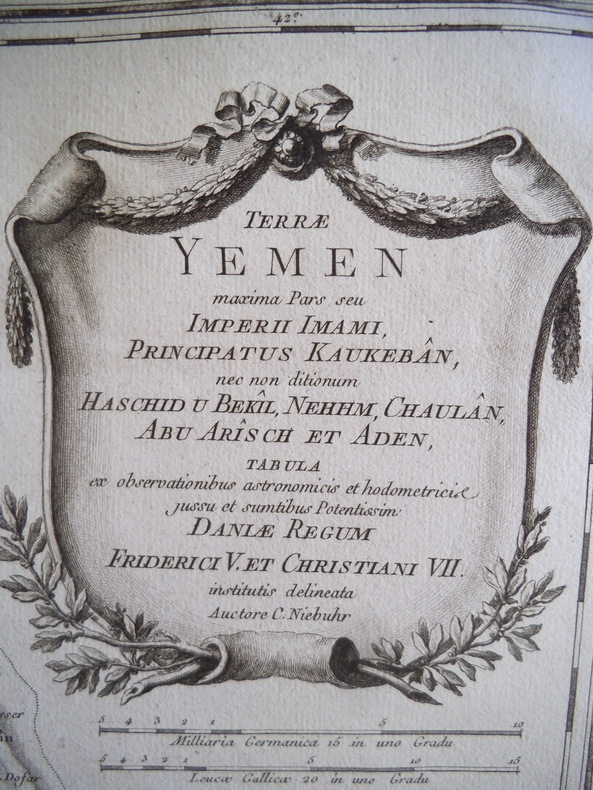
14503CARSTEN NIEBUHR Terrae YEMEN maxima Pars Seu Imperii Imani Principatus Kaukebân nec non dilionum Haschid U Bkîl, Nehhm Chaulân Abu Arîs Ch et Aden. Tabua ex pbservtionibus astronomicis et hodometricise jussu et sumtibus Potentisissim Danlae Regum. Friderici V et Christaini VII Autore C NIEBUHR Carte 520x 670 mm avec marges, 380x580mm à la cuvette. Gravure sur cuivre d’après CARSTEN NIEBUHR, vers 1771. Né à Altendorf , ingénieur, mathématicien, et astronome allemand, membre d’une expédition Danoise de la péninsule du Sinaï au Yemen 1761 1767 dont il fut le seul survivant.