4 134 résultats
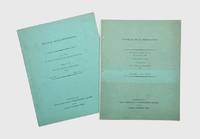
1958174959Oxford: Distributed for the Royal institute of International Affairs by Oxford University Press 1958-59. Revised edition of Western Powers updated from the 1958 briefing including a length section on the "British position in the Arabian Peninsula and the Persian Gulf" framing six decades of British foreign policy within the context of Lord Curzon's 1899 analysis of the Gulf. "This memorandum had its origin in the need to put together for immediate use during the summer of 1958 documents and statements relating to the latest of the recurring crises in the Middle East". It outlines treaty commitments to different Gulf states and provides a documentary chronology of Britain's diplomatic relationships. The memorandum on Libya discusses topics such as defence population agriculture and fisheries transportation and budgets and finance. Two works quarto. Mimeographed typescript in both vols. Original green wrappers wire-stitched as issued front covers lettered in black. Pencilled price on front wrapper of Libya. Light sunning contents clean: near-fine copies. unknown
194p. Illustrations by the author. Tall 8vo. Original full cloth binding. Original dust jacket. An enjoyable description of the Portuguese Man-of-War and their exotic relatives. NH 1
8vo., First Edition, with numerous photographs and diagrams throughout; pictorial wrappers, wire-stitched as issued, a fine copy. The supplementary folding map of the course is laid in. SCARCE.
4to (19.5 x 15.5 cm). (4), "139" [= 135], (5) pp. With a woodcut ship on the title-page (with a griffin on the sail) and about 60 woodcut illustrations in the text (mostly about 55 x 80 mm) plus about 10 repeats, each with a thick-thin border. Set in textura types with incidental roman and italic. Gold-tooled, red goatskin morocco by Robert Riviere in London (ca. 1875/80), with 5 (false?) bands on the spine, each board with a double frame of double and triple fillets and 2 different sets of 4 corner pieces, author and title in gold in 2nd and 3rd of 6 spine compartments, the others with gold-tooled decorations and the date and place of publication at the foot, gold-tooled turn-ins, gold fillets on board edges, straight-combed endpapers, gilt edges, stamped on the back of the free marbled endleaf in sans-serif capitals: "Bound by Riviere". A rare 17th-century English edition, with about 60 different woodcut illustrations, of a classic and partly fictional 14th-century account of travels presented as voyages of Sir John Mandeville through Turkey, Egypt, Ethiopia, Syria, Persia, Arabia, India and the East Indies. According to the story he set off on his travels in 1322 from Saint Albans in England, returned in 1343, wrote the present account in 1364 and died in 1371. It was originally written in French and is thought to have been compiled from various sources by Jehan d'Outremeuse (1338-1400) of Liege. A 1371 manuscript survives and it first appeared in print under the title Itinerarius in Dutch (ca. 1477), French (1480), German (1480) and other languages, and in English in Richard Pynson's edition of ca. 1497/98. It includes many well-known stories and illustrations of monstrous people and animals in exotic lands: a man with only one enormous foot that he can use as a parasol, a dog-headed man, a man with his face in his chest, a girl who turns into a dragon, griffins, nine-metre giants, ants that gather gold, diamonds that mate and give birth to baby diamonds and much more that spoke to the imagination (though the ox-headed man is presented as an idol that was worshipped, rather than a fantastic beast). The book also includes genuine descriptions of the regions covered and gave many Europeans their first notions of the Near East, Middle East, India and East Indies. It shows carrier pigeons, an elephant and other recognizable or plausible scenes. It also incorporates and illustrates some biblical stories. The part on Arabia includes an account of the birth of Mohammed. Most of the present woodcuts are loosely and indirectly based on those in the 1481 Augsburg edition, partly in mirror image. The book went through dozens of editions in English and other languages. It reached more or less the present form with the 1650 London edition, which may have used the same woodblocks (we have not had an opportunity to compare them). The imprint of the present edition names four London publishers, and one of them (Conyers) also advertises his edition of William Lithgow's Nineteen years travels (1692) at the foot of the last page. The book was registered for these four publishers in the term catalogue for Trinity 1696, issued in June. The printing was probably shared between two different anonymous printers: exactly half way through the book, between quires I and K, the running heads, the textura type used for the main text and the roman drop capitals opening the chapters change. The 1684 edition by four London publishers (none named in the present edition) not only uses the same woodblocks but is also typographically almost identical to the first half of the present edition and no doubt came from the same printer. The drop capitals differ, but those in the present edition have not been recorded before 1688. Samuel Roycroft and James Orme both used them, and Roycroft used at least several of the other types in the first half. The book is printed on coarse laid paper with no watermark. Halliwell, in his 1869 edition of Mandeville, noted the present edition for its woodcuts and reproduced at least many of them from the Grenville copy now at the British Library. Only 5 other copies are known, all in U.S. libraries. Robert Riviere (1808-82) established his famous bindery in Bath and moved it to London in 1840, gaining a reputation as one of England's best binders for the quality of his materials and workmanship. He signed his bindings "Bound by Riviere" from 1860 to 1880 (thereafter Riviere & son). - With an early owner's inscription faded on the title-page and 2 armorial bookplates on the paste-down: Sir Edward Sullivan (1822-85), Lord Chancellor of Ireland, and Allan Heywood Bright (1862-1941) in Liverpool, a member of Parliament, along with a loosely inserted signed autograph letter (ca. 1900) from Bright's brother Hugh Bright (1867-1935) in Leeds, giving him the book and noting that he bought it at Young's "some years ago". With 8 leaves with their margins extended at the fore-edge and foot ( N2-O4, Q1, probably sophisticated from another copy of the same edition), sometimes shaving a catchword or quire signature, the title-page and last page somewhat worn and dirty, but further in good condition, with a few minor marginal chips and tears restored or repaired and 3 leaves with minor water stains in one corner. The spine is slightly faded but the binding is still very good. A rare edition of Mandeville's voyages, illustrated with about 60 woodblocks cut ca. 1650. Arber, Term catalogues II, p. 593, item 8; ESTC R217088 (5 copies); J. O. Halliwell (ed.), Voiage and travaile of Sir John Maundevile (1866), p. xvi (item 2, from the Grenville library); Wing M417 (same 5 copies); for the story in general: Cambridge History of English Literature (1976), pp. 78-87.
1993146456Kibdib, HHL Publsihing. (1993). 248 pages. With a lot of photos in colour. Green original hardcover binding and an Illustrated original dustjacket in very good condition. 31x24 cm
8vo. XVI, (8), 384, (8) pp. Title page printed in red and black. Contemporary calf with giltstamped cover fillets, rebacked to style with giltstamped red label, leading edges gilt. All edges sprinkled in red. Rare, reliable 18th-century English edition of the classic (though partly fictional) 14th-century account presented as voyages of Sir John Mandeville through Turkey, Egypt, Ethiopia, Syria, Persia, Arabia, India and the East Indies, published from a 15th-century manuscript in the Cottonian Library (MS Titus C XVI). "This is the completest edition up to date" (Cox). According to the story he set off on his travels in 1322 from Saint Albans in England, returned in 1343, wrote the present account in 1364 and died in 1371. It was originally written in French and is thought to have been compiled from various sources by Jehan d'Outremeuse (1338-1400) or Jean de Bourgoigne (d. 1372) of Liege. It includes many well-known stories and illustrations of monstrous people and animals in exotic lands. The book also includes genuine descriptions of the regions covered and gave many Europeans their first notions of the Near East, Middle East, India and East Indies. The part on Arabia includes an account of the birth of Muhammad (p. 169). - Occasional slight browning, but well-preserved. Provenance: Sold as a duplicate by the Bodleian Library (with the Radcliffe Infirmary's armorial bookplate and cancellation stamp); later in the collection of H. C. Gleave (his bookplate). Ibrahim-Hilmy II, 12. Cox I, 319. Cf. Henze III, 363 (1883 reprint of this edition). Gay 2128.
3 vols. Large folio (70 x 55 cm). With 150 striking coloured plates, all lithographed on stone, printed and coloured by J. T. Bowen of Philadelphia, after drawings by John James and John Woodhouse Audubon, and the backgrounds after Victor Audubon. Each volume also with a title-page and a list of contents. Late 19th century black morocco, with gold-tooled spine, red cloth sides and marbled endpapers. First edition of the extraordinary coloured plates of quadrupeds by the world-famous French-American naturalist and painter John James Audubon (1785-1851), whose "Birds of America" was purchased at a Christie's auction for $11.5 million in March 2000, setting a world record for the most expensive book ever sold (surpassed only by the 1640 "Psalm Bay Book", sold for $14.2 million in November 2013). The plates in the present work are considered the finest animal prints ever published in America. Unlike the "Birds", it was produced entirely in the United States, making it the "largest successful color plate book project of 19th-century America" (Reese). - After the publication of his highly acclaimed "Birds of America", Audubon settled on the Hudson River and began working on the present series to document the animal life of North America. The plates were first published in 30 parts of 5 plates each, and three separately published accompanying text volumes, written by John Bachman, appeared between 1846 and 1854. A second edition was published in 1856, but "the first edition is by far the best" (Sabin). - Title-pages show some small scuff marks, a few plates with minor, unobtrusively repaired tears along the edges. Binding skillfully restored. A complete set, with most plates in fine condition. Nissen, ZBI 162. Buchanan, pp. 147-154. Reese 36. Sabin 2367. Cf. Howgego II, A19 (p. 15, 1846-54).
Folio 256p., illus. Hardcover Very good condition good
Oversize, 192p., illus. Hardcover Very good condition good
Coloured. Two sheets conjoined, total 610 x 1010 mm. Restoration to binding folds and tears. Moll's large-format map of the Turkish Empire based on De l'Isle, also covering the whole of the Mediterranean, first published in 1714. The caravan route from Basra to Mecca is also given. Includes inset prospects of Constantinople, Smyrna and Jerusalem, and three views of the Holy Sepulchre. A note engraved in the area of the Arabian desert south of today's United Arab Emirates contains a pointed editorial critique of Ottoman rule in Arabia: "The Turks oppress the Arabians with Tribute, and Govern 'em with great Cruelty, which has made them several times attempt to throw off their Yoke, but in Vain: Those of Arabia Felix are kept in Awe by the Turkish Gallies on the Red Sea; and those of the other Arabia's not being able to subsist in their barren Countries have spread themselves into the mountanous parts of Syria and the Desarts of Barbary, Barca &c. where they live by Rapine in the Neighboring Countries, and plundering Travellers." - Well preserved; an excellent, appealingly coloured specimen. Tibbets 202. Al-Qasimi (2nd ed.) p. 151.
8vo. (4), XVIII, 231, (1) pp. With engraved portrait frontispiece. Contemporary marbled half calf with giltstamped spine title. Tenth edition of this "often reprinted" (DNB) treatise, first published in 1697. Its scholarship depended in particular on Pococke. "Prideaux's literary reputation rests on his ‘Life of Mahomet’ (1697) [... of which] the story has been told that the bookseller to whom he offered the manuscript said he ‘could wish there were a little more humour in it.’ No sign of humour was ever shown by Prideaux, except in his proposal (26 Nov. 1715) for a hospital in each university, to be called ‘Drone Hall,’ for useless fellows and students. The ‘Life of Mahomet’ was in fact pointed as a polemical tract against the deists. [...] Some of its errors were noted by Sale in the discourse and notes to his translation of the ‘Koran,’ 1734" (ibid.). - From the library of the British philosopher of religion, David Arthur Pailin (b. 1936), with his bookplate and notes laid in. Previously in the collection of Charles William Tupper (b. 1898), grandson of the Canadian physician and sometime Prime Minister Sir Charles Tupper (1821-1915), one of the Canadian Fathers of Confederation, with his engr. armorial bookplate. Cf. DNB 46, 353. Chauvin XI, 656-660 (earlier editions). Gay 3623 (1st. ed.).
8vo. XII, (2), 286 pp. Contemporary calf. All edges sprinkled in red. 6th edition of this "often reprinted" (DNB) treatise, first published in 1697. Its scholarship depended in particular on Pococke. "Prideaux's literary reputation rests on his ‘Life of Mahomet’ (1697) [... of which] the story has been told that the bookseller to whom he offered the manuscript said he ‘could wish there were a little more humour in it.’ No sign of humour was ever shown by Prideaux, except in his proposal (26 Nov. 1715) for a hospital in each university, to be called ‘Drone Hall,’ for useless fellows and students. The ‘Life of Mahomet’ was in fact pointed as a polemical tract against the deists. [...] Some of its errors were noted by Sale in the discourse and notes to his translation of the ‘Koran,’ 1734" (ibid.). From the library of the British philosopher of religion, David Arthur Pailin (b. 1936), with his bookplate and notes laid in. Chauvin XI, 658. Cf. DNB 46, 353. Gay 3623 (1st. ed.).
8vo. XIII, (3), 200 pp. Contemporary blindstamped calf (spine rebacked; giltstamped red spine label). 7th edition of this "often reprinted" (DNB) treatise, first published in 1697. Its scholarship depended in particular on Pococke. "Prideaux's literary reputation rests on his ‘Life of Mahomet’ (1697) [... of which] the story has been told that the bookseller to whom he offered the manuscript said he ‘could wish there were a little more humour in it.’ No sign of humour was ever shown by Prideaux, except in his proposal (26 Nov. 1715) for a hospital in each university, to be called ‘Drone Hall,’ for useless fellows and students. The ‘Life of Mahomet’ was in fact pointed as a polemical tract against the deists. [...] Some of its errors were noted by Sale in the discourse and notes to his translation of the ‘Koran,’ 1734" (ibid.). From the library of the British philosopher of religion, David Arthur Pailin (b. 1936), with his bookplate. Chauvin XI, 658. Cf. Gay 3623 (1st. ed.).
4to. (4), 264, (16) pp. With engraved map of Ethiopia, including part of the Red Sea and the source of the Blue Nile. Modern calf, gold-tooled spine, with red morocco title-label, and the sides blind-tooled in a panel design. Rare first English edition of Tellez's influential historical account of Ethiopia and Arabia. It is a digest of the accounts of all the Jesuit travellers to Ethiopia and Arabia, including Paez, De Montserrat, Almeida, Lobo and Mendes. It includes an account of the travels of the Jesuit missionaries Pédro Paez and Antonio de Montserrate, who were captured off the Kuria Muria islands on a mission from Goa to Ethiopia in 1590 and subsequently taken to Yemen, where they were held captive until 1596. After being sent to San'a by way of Melkis and the Wadi Hadramaut, then after three years taken to Al Mukha (Mocha), where they were forced to serve as galley slaves, they were finally ransomed in 1596 and returned to India. Paez discovered the source of the Blue Nile and is said to have been the first European to have tasted coffee in Al Mukha. - The work further includes a detailed description of Aden (Yemen) as well as of the Ethiopia-Adal War (1529-43), during which Ahmad ibn Ibrahim al-Ghazi led several expeditions against the Ethiopian emperor until most of Ethiopia came under the power of the Muslim Sultanate of Adal. The present English edition is based Almeida's "Historia geral de Ethiopia a alta" (1660), edited by Tellez. - With early owner's inscription ("W. G. Patchell") on title-page. Quires 2D and 2E transposed; a couple of millimetres shaved off the outer border of the map; a faint waterstain throughout; some leaves foxed and some occasional spots. A good copy. ESTC T133244. Paulitschke 1137. Cf. de Backer/Sommervogel VII, 1908-1910. Howgego, to 1800, A65 (Almeida).
Folio (ca. 260 x 320 mm). 2 vols. (instead of 9). (6), X, (2), 114, (4) pp. (2), 115-227, (5) pp. Contemporary unsophisticated wrappers with handwritten titles to upper covers. The first two parts of this chronicle by Paul Zaim of Aleppo (1627-69), an Ottoman Syrian Orthodox archdeacon. Son of Patriarch Macarios III Zaim, Paul accompanied his father in his travels throughout Constantinople, Wallachia, Moldavia, Ukraine and Russia, as an attempt to raise funds and support for their church. Paul's account of his visits, originally written in Arabic, is important as a source on Wallachia, as it documents the main events of Constantin Serban's rule and the Ottoman expedition of 1657. - Published for the Oriental Translation Fund of Great-Britain and Ireland, by R. Bentley, this copy with special half-titles printed for the subscriber Sir Archibald Kennedy, 1st Marquess of Ailsa (1770-1846), then styled the 12th Earl of Cassilis. Seven additional parts would appear by 1836. - Dedication-leaf waterstained. Bindings chipped, occasional light flaws to the wide margins. Old library stamp of the Community of the Resurrection. Untrimmed copy. OCLC 14123266.
4to. (22), CXXI, (7), 320, (1) pp., final blank page. With lithographed folding map of the itinerary and a map of the Bengal Gulf. Publisher's original blue full cloth with giltstamped ship "Victoria" and blindstamped border to cover, as well as giltstamped spine-title. First Hakluyt edition and the principal English translation of "the first recorded visit by a Christian to Mecca" (Blackmer), containing the first printed eyewitness account of any place in today's United Arab Emirates, first published in Italian in 1510. - On his return journey from Mecca, Varthema visited Ras al-Khaimah ("Giulfar") and portrayed the city as "most excellent and abounding in everything", with "a good seaport", and whose inhabitants are "all Muslims". While Montalboddo's famous anthology of discoveries, printed in 1507, contained the first printed reference to the Arabian Gulf region, it was Varthema's work, published only three years later, that offered the first actual report from the region by a Western traveller who had visited the coast. - A gentleman adventurer and soldier from Bologna, the author left Venice at the end of 1502. In 1503 he reached Alexandria and ascended the Nile to Cairo, continuing to Beirut, Tripoli, Aleppo and Damascus, where, adopting Islam and taking the name of Yunas, he joined a Mameluke escort of a Hajj caravan and began the pilgrimage to Mecca. Thanks to his knowledge of Arabic and Islam, Varthema was able to appreciate the local culture of the places he visited. Impressed and fascinated, he described not only rites and rituals, but also social, geographical, and day-to-day details. After embarking at Jeddah and sailing to Aden, he was denounced as a Christian spy and imprisoned. He secured his release and proceeded on an extensive tour of southwest Arabia. Stopping in Sanaa and Zebid as well as a number of smaller cities, he describes the people, the markets and trade, the kind of fruits and animals that are plentiful in the vicinity, and any historical or cultural information deemed noteworthy. Returning to Aden, and after a brief stop in Ethiopia, he set sail for India. - From the collection of Col. Samuel Barrett Miles with his stamp of ownership to flyleaf. His widow sold the book to the Bath Public Reference Library in 1920 (their bookplate and shelfmark to pastedown, their blindstamped ownership to several pp., including the folding map). Old shelfmark label to spine. - Heads of spine and corners somewhat rubbed, slightly scuffed. Occasional light spotting; tear to right margin of folding map; pp. 39-42 loosened. A good copy. Howgego I, V15. Macro 2240. Cf. Blackmer 338. Gay 140.
Large 4to (32 x 26). "XVIII" [= XX], (2), 243, (1) pp. With various passages including the original Arabic text. Also with a subscription leaf for the Marquess of Lansdowne ("this copy was printed for the most noble the Marquess of Lansdowne"), printed in black and blue, with wood-engraved illustration, in a cast floral border printed in red. Later half calf. Top edge gilt. First edition of the first substantial English translation of the travel account of Abu Abdullah Mohammed ibn Batuta (1304-68/69), known in the West as the Arabian Marco Polo, with extensive footnotes. "While on a pilgrimage to Mecca he made a decision to extend his travels throughout the whole of the Islamic world. Possibly the most remarkable of the Arab travellers, he is estimated to have covered 75,000 miles in forty years" (Howgego). His journeys included trips to North Africa, the Horn of Africa, West Africa and Eastern Europe in the West, and to the Middle East, South Asia, Central Asia, Southeast Asia and China. - The account, known as the Rihla, is esteemed for its lively descriptions of his travels, giving notable information on the history, geography and botany of the countries and cities Ibn Batuta visited. He describes, for example, the city of Aden as follows: "From this place I went to the city of Aden, which is situated on the sea-shore. This is a large city, but without either seed, water, or tree. They have, however, reservoirs, in which they collect the rain-water for drinking. Some rich merchants reside here: and vessels from India occasionally arrive here. The inhabitants are modest and religious" (p. 55). - Endpapers, half-title and subscription leaf foxed, some spots on the title-page, otherwise a very good copy, only slightly trimmed leaving generous margins. Binding very good as well. Howgego, to 1800, B47.
Large 4to (32 x 26 cm). "XVIII" [= XX], (2), 243, (1) pp. With various passages including the original Arabic text. Modern half morocco. First edition of the first substantial English translation of the travel account of Abu Abdullah Mohammed ibn Batuta (1304-68/69), known in the West as the Arabian Marco Polo, with extensive footnotes. "While on a pilgrimage to Mecca he made a decision to extend his travels throughout the whole of the Islamic world. Possibly the most remarkable of the Arab travellers, he is estimated to have covered 75,000 miles in forty years" (Howgego). His journeys included trips to North Africa, the Horn of Africa, West Africa and Eastern Europe in the West, and to the Middle East, South Asia, Central Asia, Southeast Asia and China. - The account known as the Rihla, is esteemed for its lively descriptions of his travels, giving notable information on the history, geography and botany of the countries and cities Ibn Batuta visited. He describes, for example, the city of Aden as follows: "From this place I went to the city of Aden, which is situated on the sea-shore. This is a large city, but without either seed, water, or tree. They have, however, reservoirs, in which they collect the rain-water for drinking. Some rich merchants reside here: and vessels from India occasionally arrive here. The inhabitants are modest and religious" (p. 55). - A very good copy, binding very good as well. Howgego, to 1800, B47.
3 volumes. 8vo in 4s. XXXII, 618; XII, 643, (1); XII, 763, (1) pp. With a different lithographed title-page to each volume and hundreds of wood engraved illustrations in text. 19th-century red morocco (signed on flyleaf: Jefferies & Sons, Bristol), richly gold-tooled spines, boards, board edges and turn-ins, gilt edges. Attractively bound set of the first accurate English translation of the of Alf Laylah wa Laylah, commonly known in English as the "Arabian Nights". The British orientalist Edward William Lane (1801-76) lived in Egypt for several years and had integrated well with the Arabic population. - It looks like by the time of publication of the third volume, the run of the first was sold out and the publisher had turned to a new printer for the third and a second edition of the first volume to complete the set. The second edition of the first volume is a line for line reprint, but omits the final printer's imprint and the occasionally included translator's advertisement. - With the bookplate of the American collector Henry T. Cox, whose library was auctioned in 1899, and the library stamps of the American businessman Henry T. Sloane (1845-1937). A very good set. Scheherazade's Web: The 1001 Nights & Comparative Literature, J. Ross 24 (1839-1841).
8vo. XII, 400 pp. Contemporary full blue calf, the spine elaborately gilt, blue silk page-marker, all edges gilt. Neat contemporary ownership inscription to front free-endpaper. Second edition. "The author, a Christian Arab from Lebanon, gives a very interesting account of life among the native Christian population. The work consists of a mixture of autobiographical anecdotes, travels and information on Syria and Lebanon. There is also an amusing chapter on how a young Syrian sees England, plus a very interesting account of silk-worn culture" (Blackmer, 1427). - Minor wear to extremities of spine, corners slightly bumped, otherwise very good. Cf. Blackmer 1427 (first edition).
382 pages. Bibliography. Extensive footnotes. Black and white illustrations. "Previously ignored, the war between the 'people of the land' and the colonial government remains of utmost significance in today's world of unsettled First Nations' land claims. After the war of 1863 aboriginal land continued to be alienated, and Native jurisdiction eroded, throughout British Columbia - leaving an inequity which remains unresolved almost a century and a half later." - from back cover. Clean, bright and unmarked with very light wear. A high quality copy. May shock readers who think of area history in terms of only fishing, logging and mining. Book
30 pages. Features: Nice cover photo portrait of The Countess of Roseberry; Way of the War - story and photos of notable personalities; Myself at the Pictures, by James Agate; Four photos from Kipling's Jungle Book, filmed by Korda, Korda & Korda; The Theatre - Horace Horsnell; The Arts Theatre Club presents Jean Forbes-Robertson in "Twelfth Night" - please note that one of the four photos has been clipped out and is not included - this seven by four inch clipping removed a portion of the Social Roundabout on the next page; See "Big Top" at His Majesty's - The show with the Charles B. Cochran Touch - 7 photos; D.B. Wyndham Lewis article; Photos of Stage Star and Stable Owner Mr. Vic Oliver; Nice one-page cartoon illustration of the I.T.W. by Wing-Commander E.G. Oakley-Beuttler; July 4th centerfold photos at Eton; The John Clements and the Robert MacDermots - photos; The Marchioness of Londonderry and her Youngest Daughter - photo portraits; Sabretache - several interesting photos with text; Elizabeth Bowen - With Silent Friends; Photos of seven newlywed couples and two newly engaged young women; Full-page ad for The Nuffield Organization shows two military officers with map; Nice fashion photos on pages 378-379; Back cover colour ad for The North British Rubber Company shows golf clubs conversing over drinks. Center page loose but present. Average wear. Six-inch opening from top of cover-fold partway into front cover. Bit of writing on back cover. A sound copy. Magazine
8vo. VIII, (4), 523, (1) pp. With folding map and 16 printed plates. Contemp. red smoothed goatskin morocco binding, elaborately giltstamped for the Royal Asiatic Society with their monogram and motto on covers and (slightly faded) spine. All edges gilt. First and only edition. The fine illustrations show the approach to Mecca, Damascus, Gibraltar from the East, a nook in Algiers, the Tomb of the Khalifs in Cairo, the Gate of Blood in Toledo, a mosque in Cordova, the Alhambra in Granada, a reproduced double-page from the Qur'an, the mosque at Mecca, Medina, pilgrims' dress, Meccan chiefs with camel and attendant, etc. - This copy awarded in 1912 to the later journalist, political theoretician and British Communist Rajani Palme Dutt (1896-1974) as school prize for Essays by William Henry Denham Rouse, headmaster at Perse Grammar School, Cambridge. - Dutt's father, Upendra Dutt, was an Indian surgeon; his mother Anna Palme Dutt was Swedish and related to the future Prime Minister of Sweden, Olof Palme. Dutt was educated at The Perse School, Cambridge and Balliol College, Oxford, where he obtained a first class degree in classics after having been suspended for a time due to his status as a conscientious objector in World War I. Dutt married an Estonian, Salme Murrik, in 1922. His wife had come to Great Britain in 1920 as a representative of the Communist International. That same year, he joined the newly formed Communist Party of Great Britain (CPGB) and remained one of its most conservative members all his life. In 1921 Dutt founded a monthly magazine called 'Labour Monthly', a publication which he edited until his death. - Spine slightly rubbed; front hinge repaired; a nicely preserved presentation copy in a fine RAS binding.
74 catalogued items, comprising 88 volumes of printed books. In Arabic, English, French, German, Italian, Latin, Swedish, and Syriac. A highly important ensemble of books on early Islamic medicine and science, assembled by one of the most renowned medical research institutes of its age, comprising not only rare historical and bibliographical studies, but also many first printed editions of crucial scientific texts in Arabic, frequently in the form of doctoral theses that remain almost impossible to find in libraries. Several titles, such as Steinschneider's "Introduction to the Arabic Literature of the Jews" (published in no more than 20 copies, "for private circulation" only), have not been seen on the market in decades, making the present offering a unique opportunity to acquire some of the most elusive relevant literature published in the late 19th and early 20th century. - Established in 1906, the Karl Sudhoff Institute in Leipzig was the first institute for the study of the history of medicine established worldwide. Its founder Karl Sudhoff (1853-1938) is regarded as one of the 20th century's foremost historians of medicine. A practicing physician for most of his life, Sudhoff published more than four hundred articles as well as many monographs, edited standard works and editions of original manuscripts. He was personally involved in building the institute's library and thus in assembling the present collection. - The 88 volumes offered here include numerous relevant issues of scholarly journals as well as journal articles. They often unite within a single volume several items published separately but forming a clear thematic unit, sometimes bringing together between two covers material that appeared at various times and in several places but was intended by the author to be considered as a whole. Deaccessioned from the Department of the History of Medicine of the University of Leipzig, most books bear the usual shelfmarks and stamps, but are otherwise in fine condition. - Catalogue available upon request.
191523767London: L. H. Lefèvre & Son 1915. First Edition: "A Limited number of artist's proofs signed by Sadler and Dobie.were printed on rice paper. Golf print in black and white by James Dobie after W. Dendy Sadler. 1 vols. 14 x 18 1/2 inches. About fine with full margins. First Edition: "A Limited number of artist's proofs signed by Sadler and Dobie.were printed on rice paper." Golf print in black and white by James Dobie after W. Dendy Sadler. 1 vols. 14 x 18 1/2 inches. This scene shows the negotiation of the stymie a rule on the putting green which is no longer in force. One of the special copies signed in pencil below the image by both W. Dendy Sadler and James Dobie. L. H. Lefèvre & Son unknown books


