Tarbuck, JimmyAntiquariat.de
Tarbuck on golf
198304804London, Willow, 1983. PP, OU, 120S, gutes Exemplar

Buchhandlung und Antiquariat Lutz Heimhalt · DE - Hamburg11,90 €
4 134 résultats
8vo. (2), 6, 591, (1), 31, (1) pp. Contemporary red half morocco over marbled boards with giltstamped spine title. Rare Beirut-printed edition of this 13th century world chronicle by the great Syrian theologian Bar-Hebraeus (Abulfaragus, 1226-86), first edited by Edward Pococke in 1663. Bar-Hebraeus focuses on the Middle East and the reigning Muslim dynasties as well as on the East and West Syrian Christian churches, covering extensively the rise and spread of Islam and relations between the Christian and Islamic worlds. His account of the destruction of the Alexandrian Library, placing it at the time of the Islamic conquest of the city in 642 and claiming that the books were used as fuel for the ovens in the bath houses (!), contradicts most sources, which place the destruction much earlier. Even for the early periods, Bar Hebraeus makes use of sources that have since been lost, but his most original contribution remains what was in his day recent history. - Bar-Hebraeus, born in what is now Turkey, became Bishop of Gubos in the Syriac Orthodox Church in 1246 and worked in Aleppo from 1252. He wrote the present work in ancient Syriac but translated it into Arabic himself. As Pococke's 1663 publication (with a Latin translation) was the classic edition of the Early Modern period, the present edition is the received modern one. - Binding somewhat rubbed at extremeties. Light browning and brownstaining throughout, but in all a good, tight copy. OCLC 31907278.
8vo. (12), 200 ff. Title with architectural woodcut border. 17th century vellum with ms. title to spine. An early merchants' guide to the measurements of the Mediterranean and Near East, this pocketbook for sixteenth-century Italian traders is one of the foremost sources for the study of the metrologies of Venice and her trading partners in the early sixteenth century. It enabled conversion between Venetian currency, weights and measures and units of other Italian city-states, European neighbours and more exotic locations in the Levant, North Africa, the Near and Middle East, including Constantinople, Aleppo, Tripoli, Damascus, Cyprus, Corfu, Rhodes, and Crete. Pasi's manual is invaluable as a record of the panoply of commodities traded in the Mediterranean at the beginning of the sixteenth century, including pearls, silks, wool, saffron, chestnuts, figs, galangal, vegetable oils, gold and silver. On fols. 3, 11, and 12, Pasi recorded the tariffs on pearls in Damascus, Aleppo, Cairo, Alexandria, Constantinople and Venice. It is very likely that the famous merchant Balbi carried a copy of this classic with him on his travels. First printed in Venice in 1503, and again in 1521, this 1540 edition appears to be the third and was followed by another in 1557. -- Some brownstaining to preliminary matter; a few contemporary ink marginalia slightly trimmed in the course of the 17th-century rebinding. On the whole an excellent clean copy. Very rare: the only copy of any edition to surface at auction within the last thirty years appears to be the Honeyman copy of the 1503 edition. Kress 51. Adams P 374. Smith, Rara Arithmetica, 79. Cf. Goldsmiths' 7 (1503 edition). R. A. Donkin, Beyond price. Pearls and pearl fishing: origins to the age of discoveries (Philadelphia, 1998), p. 138.
4to. 231, (1) pp. With a few woodcuts in the text. Contemp. full calf, leading edges and spine sumptuously gilt. All edges red. First edition; very rare. The best known, and most controversial, of Schickard's works: a treatise, with a lengthy introduction, about various Persian ruling dynasties, especially the Sasanians - editing a total of six out of seventeen genealogical charts found on a 45-foot Turkish manuscript scroll. The genealogies aimed to legitimise the Ottoman dynasty by tracing it back to Adam. Schickard (1592-1635) was one of the most learned men of his age, astronomer, professor of Hebrew, mathematician and orientalist. The scroll was brought to Germany by Veit Marchtaler of Ulm, who found it in a mosque during the sack of Fillek (Fülek) in Hungary. Marchtaler wished that the manuscript might not be simply forgotten, consulted in vain with various dragomans (whose versions he did not trust), and finally came across Schickard, who, though he had no Turkish or Persian, knew Arabic and immediately grasped the significance of the scroll. His detailed commentary quotes from various Hebrew and Arabic writings, including several extracts from the Qur'an: sura 21 (p. 60), 38 (p. 53 & 61), 27 (p. 77), 2 (p. 97), and 4 & 5 (p. 97-100). The translation is offered as a gift to the Emperor Ferdinand II until such time as the "autographum ipsum" be lodged in the imperial library. "Schickard was also the designer of Arabic type, which he engraved himself as copper matrices; they were cast by Theodoricus Werlin, and served to illustrate his 'Tarich'" (Smitskamp). - Browned throughout due to paper (as common); trimmed rather closely; final 2 leaves cropped at outer margin with loss of letters. One of three variants, this one without the 20-page appendix (corresponding with the copy in the Bodleian Library, Oxford). Provenance: "Nathan Wright of Englefield", Berkshire (cropped signature at head of title), probably Sir Nathan Wright (1654-1721), lawyer, appointed Lord Keeper in 1700 (cf. ODNB). Later in the collection of the Earls of Macclesfield (North Library at Shirburn Castle; 1860 bookplate, shelfmark 57.B.1). VD 17, 14:646680U. Wilson 203. ADB XX, 300. Smitskamp, PO 132e (note). OCLC 13604133.
198304804London, Willow, 1983. PP, OU, 120S, gutes Exemplar
Hand-drawn military map and organizational flowchart, 1.37 x 1.45 m. Coloured ink and watercolour on paper. Accompanied by 9 original photos. Unique hand-drawn chart of Bahrain's naval force as it was projected in the early and mid-1970s, including two large maps: firstly, of the island's location in the Gulf showing the Navy's planned 200-mile range as well as strategic points throughout the Gulf, and secondly, a smaller scale map showing the defensive coastal artillery firing range and radar ranges reaching out to the north and east of Qal'at al-Bahrain, Galali, and East Sitra bases around Manamah. An inset flowchart shows in detail the organization of Bahrain's Navy, to be headed by the Commander of Naval Forces, presiding over the branches of Supplies and Exercises (Engineers, Supplies, Medical Office), of Operations, Planning, and Signals (all commanded by the Chief of Staff), as well as the Naval Armed Forces proper (Fleet, Special Forces, and Coastal Artillery). The extensive annotation describes the maritime theatre of war around Bahrain, identifies vital targets (Port Sulayman, oil terminal, national airport, oil wells and storage tanks, refinery) and crucial points to be observed, and sketches the projected scope of the navy: initially a small fleet of armoured motor vessels with radar-guided automatic ordnance, later to be upgraded with surface-to-surface rocket launchers with a tactical range of ca. 180 nautical miles. The planning stage is to encompass some 2 to 3 months, followed by a development stage of about 3 years and an implementation phase of another year. - The chart is accompanied by a set of nine original mid-1970s photographs of members of the Egyptian General Staff who assumedly were closely involved in advising the government of Bahrain on the structure and implementation of their new Naval Forces, which became fully operational in 1979. - A fine survival, undocumented and at the time undoubtedly a closely guarded military secret.
4to. (6), 40 pp., final blank leaf. With numerous black-and-white photographic illustrations and a map of the Tapline. Original printed wrappers. Stapled. Illustrated history of the Trans-Arabian Pipeline - the "greatest of all long range engineering projects". The account celebrates the Tapline's completion in 1950, describing the arduous construction, with rare photographs of the work involved, including pictures of the Sidon terminal and the Badanah pump station as well as portraits of the executive management personnel of the Tapline company. - Wrappers slightly creased; margins a little rubbed. OCLC 6162918.
Large 4to (216 x 280 mm). (6), 40 pp., final blank leaf. Illustrated throughout, staple-bound in original illustrated wrappers. A celebratory magazine describing the thought put into, the hardships endured, the challenges faced, the difficulties overcome and the political points proved in the construction of what was then the world's largest oil pipeline system. The so-called "Tapline" connected Aramco's oil fields and refineries on the east coast of Saudi Arabia with the Mediterranean port of Sidon, in Lebanon. Aramco completed its Tapline in 1950 with an initial capacity of 320,000 bpd. At the same time, however, King Ibn Saud threatened to nationalize his country's oil production, prompting Aramco to offer a 50/50 split of all profits and to shift its headquarters from New York to Dhahran. - In good condition.
Large folio (680 x 500 mm). 43 plates (36 of which are in colour), 2 double-page coloured maps. XXVI, (2) pp. Original wrappers. German text in wrappers and loose plates in original grey cloth portfolio with giltstamped titles. First edition of "the first great book on turkoman rugs" (Arntzen/Rainwater). The magnificent plates in full colour are printed on special paper, each sheet bearing the label of the St. Petersburg "Manufacture des Papiers de l'État". - Title page of the text volume shows a closed tear, otherwise fine. Cf. Arntzen/Rainwater P618 (the 1973 reprint only).
0267616856.Ghardcover. Good. Access codes and supplements are not guaranteed with used items. May be an ex-library book. hardcover
0265736331.Ghardcover. Good. Access codes and supplements are not guaranteed with used items. May be an ex-library book. hardcover
0365026743.Ghardcover. Good. Access codes and supplements are not guaranteed with used items. May be an ex-library book. hardcover
033124229X.Ghardcover. Good. Access codes and supplements are not guaranteed with used items. May be an ex-library book. hardcover
0484613928.Ghardcover. Good. Access codes and supplements are not guaranteed with used items. May be an ex-library book. hardcover
0484701703.Ghardcover. Good. Access codes and supplements are not guaranteed with used items. May be an ex-library book. hardcover
0656348933.Ghardcover. Good. Access codes and supplements are not guaranteed with used items. May be an ex-library book. hardcover
0666925739.Ghardcover. Good. Access codes and supplements are not guaranteed with used items. May be an ex-library book. hardcover
0364000953.Ghardcover. Good. Access codes and supplements are not guaranteed with used items. May be an ex-library book. hardcover
0366569473.Ghardcover. Good. Access codes and supplements are not guaranteed with used items. May be an ex-library book. hardcover
0259921440.Gpaperback. Good. Access codes and supplements are not guaranteed with used items. May be an ex-library book. paperback
0243257201.Gpaperback. Good. Access codes and supplements are not guaranteed with used items. May be an ex-library book. paperback
4to. English manuscript on paper. (4), 306 pp. With mounted engraved frontispiece in original hand colour and 21 mounted engraved plates, 13 of which in original hand colour. Contemporary half calf over patterned boards with giltstamped spine and spine-title. Marbled endpapers. All edges red. Intriguing manuscript comprising five Arabian tales allegedly recounted by officers at a Spahi camp in Algeria in the context of an imminent raid against the Haschemu tribe loyal to Emir Abdelkader in 1842, commanded by the French general Louis Juchault de Lamoricière (1806-65). The compiler, who gives his initals as "E. H. S. de R." on the title-page, states that he transcribed the tales from another book, but gives no clear indication whether or not the account is purely fictitious. He does, however, criticize the "cruel system of warfare which the French have hitherto employed in Africa" (p. 1). - Prefaced to the tales is an introduction describing the events leading up to the frame narrative, involving the rescue of a Douair chieftain by a member of the Spahi regiment, and the officers spending the evening together at the campfire. Five of them are prompted to tell stories, some autobiographical, which the editor has titled "The Unfortunate", "The Dervish of Anatolia", "The Renegade", "The Arab's Faith", "Love and Hate", and "The Fugitive of Armenya". The last tale is followed by an account of the fate of the two Douair and Spahi officers, who became close friends after the latter saved the life of the former. - The hand-coloured engravings which illustrate the volume depict characters and scenes from the tales; the frontispiece shows a lavishly decorated room in a palace with an Arab leader smoking a long pipe, surrounded by servants and followers. Continuously paginated, but with additional pagination for each tale. The additional heading "First series" on the title-page suggests that the present manuscript was conceived as part of a larger set. - Extremities slightly rubbed; interior very clean. A very well preserved volume providing an unusual look at French rule in Algeria during its early years.
570 x 425 mm. Colour lithograph, signed "Ibrahim K.". Mounted on styrofoam board. Bilingual safety poster in Arabic and English. - Traces of folds.
4to (154 x 230 mm). Arabic manuscript on polished oriental paper. (45) pp., 11 lines, per extensum. Black ink with red emphases. With numerous red ink diagrams in the margins. Later full black cloth. An Arabic manuscript of the "Optics" by Euclid, a work on the geometry of vision. According to Euclid, the eye sees objects that are within its visual cone. The visual cone is made up of straight lines, or visual rays, extending outward from the eye. These visual rays are discrete, but we perceive a continuous image because our eyes, and thus our visual rays, move very quickly. - Incomplete, comprising only the first 23 ff. Paper browned; occasional light brownstaining; a paper flaw to the final leaf has been remargined.
A clean, unmarked book with a tight binding. Many full-page photographs of rock weathering; glossary. Full gray cloth boards in weathered rock textured pattern.
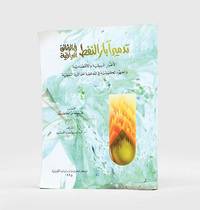
1995182920Kuwait: Markaz al-buhuth wa-al-dirasat al-Kuwaytiyah 1995. First edition of this well-illustrated study on the environmental impact of the destruction of oil wells in Kuwait based on government documents issued by the Iraqi government during the Gulf War. The work presents this damage substantiated by copious data as a main goal of the Iraqi war strategy of delayed sabotage. An appendix lists names of Iraqi officers accused of being "environmental criminals" as they took part in the identification of targets and methods and the execution of the plan - phases which are carefully described in the first part. The second part discusses subsequent damages to the economy public health and the environment including air and water pollution and their impact on living organisms. The third part describes the strategies employed to limit the damage such as the efforts of firefighters in extinguishing burning oil wells. Quarto. With facsimiles of documents colour illustrations and maps. Text in Arabic. Original pictorial wrappers wire-stitched as issued. Pencilled Arabic word at head of last verso. Extremities a trifle rubbed or creased contents clean: a very good copy. unknown