4 134 résultats
19279045<p>Printed for Royal St. George's by Pain & Sons Sandwich and Deal Kent. England. 1927. 4pp score chart showing the names of he players in the 1st heat played on April 15th 1927 plus those players with a bye to the second heat played on the same day. The spaces to write in the competitors that moved through the heat stages have not been filled in. The whole opened sheet measures 16.6 x 13.2 inches and folds down to a slim 3.3 x 8.3 inches to allow for fitting into a pocket. Creases on the folds as expected but overall in very good condition.</p> Printed for Royal St. George's by Pain & Sons, Sandwich and Deal, Kent. England. 1927
19852090502113706395Not Available 1985. Soft Cover. Fine. The book is in fine condition. Not Available paperback
19862090502113709194Not Available 1986. Soft Cover. Fine. The book is in fine condition. Not Available paperback
189624979Berlin, Pitcairn-Knowles, Simon & Co. Januar-Juni 1896. Halbledereinband der Zeit mit goldgepr. Deckeltitel (Rücken an den Gelenken angebrochen und mit Brandspur. 3 Bl., 418 S. Mit zahlreichen photographischen Abbildungen. 2°. Papierbedingt gebräunt. Bis auf die Einbandbeschädigung gut erhaltenes Exemplar.
Mark Mulvoy Sport illustrated. Golf. , Harper and Row 0, Guida illustrata sul golf Mediocre (Poor) . <br> <br> <br> <br>
Folio (ca. 274 x 400 mm). 11, (1) pp. In Ottoman script. With several black and white photographic illustrations. A copy of the Turkish sports magazine "Sports World", published weekly in Istanbul between 1919 and 1929. The photographs show various competing national teams, including the Turkish football team, as well as a bare-chested athlete bearing numerous medals. Includes a section on the 1928 Olympic Winter Games held in St Moritz, with a photograph of the ice hockey match at which Canada scored the gold medal against Switzerland. An advertisement depicts a runner dressed in white, with the Olympic flag in the background, surrounded by portraits of six athletes on the cover. - Browned and waterstained throughout.
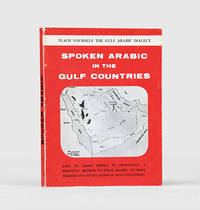
1971171721al-Khobar: The International Publications Industries 1971. Keep the following in mind and everything will be easy Fourth printing of this institutionally rare phrasebook which adopts "a short cut method simple and easy enough for a businessman to teach himself the spoken Arabic while relaxing in the Aircraft or in his Hotel room. Many of the oil industry people in Arabia owe their local friendship to this book". Arranged by topic the book has sections on greetings shopping food and drink and other practicalities such as taking one's car to a mechanic. The unnamed author places a premium on language as a key to understanding local culture: "you will find the Gulf Arabs intensely loyal to their friends as well as to their families. Most of them are blessed with a keen sense of humor. For these and other reasons such as their hospitality and courtesy you will enjoy getting acquainted with them". Further sections discuss the etiquette of being a guest at a traditional wedding and how to behave if invited to a private house as a guest. WorldCat lists only four copies in institutions Oxford National Library of Wales National Library of Israel Bilkent University. Small octavo 115 x 117 mm. Wire stitched in the original printed wrappers spine lettered in black. Minor wear to wrappers contents lightly toned not affecting text. A very good copy. unknown
163 pages. The fictional little community of Spinner's Inlet, in the idyllic Gulf Islands along the west coast, is home to some unique and engaging characters. "Delightful." - Jack Webster. Average wear. Contents clean and unmarked. Book
Folio (244 x 341 mm). (12) pp. With 2 engravings (one in the text, one on the title). - (Bound after) II: (Schiepati, Giuseppe / Assemani, Simone). Descrizione di alcune monete cufiche del Museo di Stefano de Mainoni. Milan, Paolo Emilio Giusti, 1820. 136 pp. With 3 engraved plates. - (And) III: Reinaud, [Joseph Toussaint]. Lettre à M. le baron Silvestre de Sacy sur la collection des monuments orientaux de [...] comte de Blacas. Paris, Firmin Didot, 1820. 16 pp. Original pink printed wrappers. 8vo. All three within contemporary green boards with giltstamped red spine label. Collection of three rare studies falling within "the rarely-entered territory of Muslim archaeology" (cf. Fück, p. 153), comprising the two final works of Simone Assemani and the first publication of Joseph Toussaint Reinaud. - In 1818, the orientalist Assemani, well known as an authority on Kufic coins through his "Museo Cufico Naniano" (1787) and, more recently, his treatise "Sopra le Monete Arabe effigiate" (1809), published his "Spiegazione", a discussion of two rare Cufic coins in Stefano de Majnoni's collection. Subsequently, Majnoni called on Assemani to identify several additional coins and in 1820 requested him to check a catalogue of his collection compiled by Giuseppe Schiepati. When Schiepati published the second work here included, "Descrizione di alcune monete cufiche", it was found to contain many unacknowledged contributions by Assemani, as well as extracts from his "Museo Cufico Naniano". Also, Schiepati’s historical comments relied on, and indeed summarized, C. O. Castiglioni’s "Monete Cufiche dell’ I. R. Museo di Milano" (1819). A controversy arose, in the course of which Schiepati was accused of plagiarism - a matter exacerbated by the fact that Assemani had died in early 1821, at the age of 69. - The third work in the volume is a slim octavo brochure, composed by Reinaud as a letter to his teacher Silvestre de Sacy reporting on the Islamic collection of the French antiquarian and diplomat Pierre de Blacas (1771-1839). Eight years later Reinaud would publish his famous, lavishly produced two-volume catalogue "Description des monumens musulmans du cabinet de M. le duc de Blacas", which made his name. - Occasional insignificant browning; Reinaud's work untrimmed, the folio works printed on large paper retaining very wide margins. From the library of Jean-Baptiste Alexandre Billard de Saint-Laumer (1814-92) with his collection drystamp to title page of "Descrizione"; the three plates interleaved with smaller sheets bearing numbered annotations, likely in his hand. I: Leitzmann 5. Achat 11216. OCLC 84477158. - II: Leitzmann 124. Brunet V, 199. Graesse VI, 301; I, 240. OCLC 52651290. - III: Leitzmann 114. OCLC 229903535.
Large 8vo. XVI, 143, (1), 70 pp. With 1 engr. plate of music. Contemp. full calf with giltstamped cover borders, attractively gilt spine and green gilt spine label. Second, posthumous edition, first published in Cambridge in 1796. Poets include Lebid ben Rabiat Alamary, Hassan Alasady, Abd Almalec Alharithy, Abu Saher Alhedily, Hatem Tai, Jaafer ben Alba, Alfadhel ibn Alabas, Meskin Aldaramy, Nabegat Beni Jaid, Imam Shafay Mohammed ben Idris, Ibrahim ben Adham, Isaac Almousely, Abu Mohammed, Abd Alsalam ben Ragban, Ibn Alalaf Alnaharwany, etc. The Arabic text follows the English translation (with separate page count). J. D. Carlyle (1759-1804) was professor of Arabic in the University of Cambridge. He was appointed chaplain by Lord Elgin to the embassy at Constantinople in 1799, and pursued his researches in Eastern literature in a tour through Asia Minor, Palestine, Greece and Italy, collecting in his travels several valuable Greek and Syriac manuscripts. - Occasional browning to text; covers sunned in places. A handsome copy from the library of John Pulteney with his engr. armorial bookplate to front pastedown. BMC 4:1258.1197. Gay 3436. Graesse II, 49. OCLC 2770074.
Single sheet of wove paper folded once to form two leaves (243 x 195 mm). Arabic calligraphy and English inscription on polished oriental paper, window-mounted vertically on first leaf, text in Hutton's hand written vertically on first leaf and continued horizontally on second. A specimen of Arabic calligraphy by an Egyptian Turk named Ali Effendi, inscribed in English in Effendi's hand "To Mrs Catherine Hutton", with the note "Madam when I am Ali Bey I shall be glad to see you in Egypt. I am yours [sic] sincere friend Ali Effendi". Catherine Hutton's accompanying notes, dated 1826 and 1829, state that Effendi "is a young, handsome, clever Egyptian-Turk, who had been sent to England by his beloved 'Grand Pasha' to learn our language, manners &c, and transport them to Cairo. His proficiency in writing English is seen in the following autograph, the English part of which he wrote for me". Hutton further notes that Effendi "was fond of the theatre, and spoke with rapture of the beautiful actresses. He looked upon English horsemanship with the utmost contempt. Stooping forward, and hanging down his head, he said 'Your men ride like this'. Then, rising to his accustomed height, he added, 'I throw my jereed on full gallop, and stop the moment when I should touch the wall'. Ali Effendi drank wine like an infidel". Hutton mentions three of Ali Effendi's companions: Mohamed Effendi, "who is studying naval architecture", Selim Aga, "who is studying mathematics and military engineering", and Omar Effendi, "who is qualifying himself for diplomacy". That all four men spent some years in England is confirmed by The Nautical Magazine for 1832, which adds that they were aged between 22 and 25 years of age and that they arrived in 1826. From an early age the novelist Catherine Hutton (1756-1846) was a keen letter-writer. "The Coltman family of Leicester and Mrs Andre of Enfield, Middlesex, were lifelong correspondents. She also wrote to her cousin the mathematician Charles Hutton (1737-1823), Sarah Harriet Burney (Fanny Burney's half-sister), the radical author Sir Richard Phillips, Eliza Cook, and, latterly, Edward Bulwer Lytton, and Charles Dickens. Her letters are full of anecdotes and shrewd observations on her acquaintances and are seasoned with a self-deprecating wit, their direct address and dry cheerfulness recalling the epistolary style of Jane Austen. Hutton delighted in Austen's novels, and believed that 'her character is either something like mine, or what I would wish mine to be'. In an account of her occupations written in July 1844, Catherine Hutton described some of the other activities which absorbed her: needlework, including 'patchwork beyond all calculation'; pastry and confectionery; collecting prints of costumes in eight large volumes; and collecting more than 2000 autographs. Bridget Hill rightly concludes that her life 'illustrates the particular problems of the educated, intelligent, single daughter of the middle class' in late 18th- and early 19th-century Britain' (Oxford DNB). - In very good condition.
Large 4to. XV, (1), 573, (3) pp. Title-page with engraved illustration, aquatint frontispiece (author's portrait) by W. N. Gardiner after S. Harding and 1 full-page plate, drawn and etched by J. Storer. Set in roman and Arabic types, with incidental Greek and Hebrew. Contemporary boards, spine with printed label. Untrimmed, leaving all deckles intact. Second edition of Pococke's elaborate "Specimen historiae Arabum", first published in 1650. Based on Bar Hebraeus's "Mukhtasar fî'l-Duwal", it includes detailed essays on Arabic science, literature, religion, and history. The main text set in Richardson's long-bodied English Arabic, with the notes in Caslon's Arabic types. - Slightly browned, otherwise in very good condition and wholly untrimmed. From the library of the Ducs de Luynes at the Château de Dampierre: their bookplate reproducing the arms of Charles Marie d'Albert de Luynes (1783-1839), 7th Duc de Luynes. Schnurrer 140. OCLC 643939358. Cf. Fück 88 (1650 ed.). Graesse V, 373 (1648 ed.).
Large 4to (235 x 272 mm). (8), 164 pp. Contemporary paper wrappers. Inaugural dissertation by the orientalist Martin Hoogvliet (b. 1814), containing an extract edition and translation of this important history of Muslim Spain, entitled "Al-mo'ajeb fi talkhíss akhbári-l-maghreb" ("The Promoter of Admiration, or a compendious History of the West"), written by the Moroccan historian Al-Marrakishi (b. 1185). Based on the ms. in the library of Leyden (No. 546). Treats the Aftasid dynasty and the work of Abdul Majid ibn 'Abdun Al-Yaburi (from today's Évora in Portugal). - Untrimmed, uncut copy. OCLC 187471341.
Large 4to (220 x 261 mm). (4), VIII, 264, (2) pp. Contemporary half calf with giltstamped red spine label and sparsely gilt spine. Edges lightly sprinkled in red. Only edition. - Pioneering specimen of a catalogue of oriental manuscripts in the Leiden library, with extensive extracts in Arabic, produced by H. A. Hamaker (1789-1835). "Ce spécimen ne contient que douze articles" (Brunet). "The descriptions of a mere twelve items on 238 pages illustrate the diligence with which the author attends to each and every title. Indeed, the final MS, the 'Qamus al-Muhit' of Firuzabadi, is discussed on no fewer than 60 pages. Each author is provided with extensive biographical excerpts with Latin translations, to which are added extremely detailed discussions of scholarly literature. Had Hamaker kept up this method for all the oriental MSS in Leiden, estimated at a number of some ten thousand, he should have wanted about 25,000 pages, not to mention hundreds of pages of indices. It is thus questionable whether Hamaker intended more with his 'Specimen' than to provide an example of an ideality which was to promote his planned catalogue [...]. And yet, had he been able to realize this ideal with the help of other scholars, this would have given to the world a source-based work of reference which would have preserved its value to this day, not superseded either by Brockelmann's 'Geschichte der arabischen Litteratur' nor by Sezgin's 'Geschichte des arabischen Schrifttums'" (cf. B. Liebrenz, Arabische, persische und türkische Handschriften in Leipzig [Leipzig 2008], p. 73). - Some creases to paper; binding rubbed and chafed in places. A good copy from the library of the Dutch theologian Christiaan Jacobus van der Vlis (1813-42) with his handwritten ownership on the front pastedown. Besterman 4352. Brunet III, 26f. & VI, 31385. Cf. Fück 181 (for Hamaker).
4to. (12), 66, 41, (1) pp. Title-page printed in red and black. With a coin engraving in the text. 19th c. wrappers. Only edition thus: the 30th and the 48th sura (Ar-Rum and Al-Fath) in the original Arabic and with Latin parallel translation. An early and scholarly specimen of Qur'an translation in the West, with extensive commentary. The Arabic text is rendered in Hebrew letters, as Arabic types were unavailable to the printer. M. F. Beck (1649-1701) had studied history and oriental literature at Jena. In 1677 he settled in Ausgburg as a preacher, but kept his focus on the oriental languages. His linguistic proficiency ultimately earned him a pension from the King of Prussia (cf. ADB II, 218). - Some browning; title insignificantly dust- and waterstained, but altogether well preserved. VD 17, 12:128711C. Schnurrer 374. OCLC 13610797.
4to. 36 pp. Contemporary papered spine. First edition of this rare and early dissertation on the reception of Greek philosophy in the Arab world. Composed as an "academic specimen" by the young Nuremberg-born classicist Christopher Fabricius under the direction of the Altdorf professor Johann Nagel (1710-88), one of Germany's foremost oriental scholars of his age, this treatise is one of the first to investigate the crucial transmission process of ancient Greek "philosophia" into the Aristotelian and Neo-Platonically infused "falsafa" of mediaeval Islamic culture. The author points out that it was through Muslim travellers to India and China that even the cultures of the farther East were introduced to Western philosophy. - The study's principal Arabic sources are Abu al-Faraj and Jirjis ibn al-'Amid Makin. As the printer of Altdorf University, Meyer, lacked Arabic type, the quotations are set in Hebrew. Reprinted in 1753 in C. E. von Windheim's "Fragmenta Historiae Philosophicae". - A waterstain to the title-page, otherwise in good condition. Meusel X, 5.
Folio (365 x 545 mm). 14 (instead of 15) maps (lacking no. 11). Contemporary black half-leather binding over brown cloth. Kiepert's map of the western part of Asia Minor: the personal copy of Paul Gaudin, the archaeologist and engineer in charge of the completion of the Hejaz railway. - In the margins, the numbers of the adjacent maps are written in blue pencil. On maps VIII and IX the route of the railway line as well as the names and numbers of the stations between Alasehir/Philadelphia and Karahissâr/Afiûn were added by Gaudin in red ink. - Binding rubbed. Interior in good general condition despite some minor soiling, tears and pinholes. Also included are maps of Turkey, drawn on tracing paper, showing the route of the Smyrna-Panderma and Smyrna-Afion/Karahissar railway lines. - Provenance: from the library of the archaeologist, collector and railway engineer Paul Gaudin (1858-1921), in charge of the completion of the Hejaz railway in the first decade of the 20th century and later a major donor to the Louvre Museum. OCLC 32646128.
19792090202118203378Not Available 1979. Soft Cover. Fine. The book is in fine condition. Not Available paperback
20001329162PN. New. 2000. Soft Cover. Date is original print. This is a reprint edition . PN paperback
Hand-coloured steel engraving. 158 x 96 mm. Matted. Plate from "The Naturalist’s Library Vol. IX Part I. Birds of Prey" by William Jardine published in 1838.
46890215-nnew. unknown
0265607906.Ghardcover. Good. Access codes and supplements are not guaranteed with used items. May be an ex-library book. hardcover
1330268369.Gpaperback. Good. Access codes and supplements are not guaranteed with used items. May be an ex-library book. paperback
0484690035.Ghardcover. Good. Access codes and supplements are not guaranteed with used items. May be an ex-library book. hardcover
1333673809.Gpaperback. Good. Access codes and supplements are not guaranteed with used items. May be an ex-library book. paperback