981 résultats
Second edition, 12mo, xxxv, [1, blank], 133, [11, index]pp., with half-title, engraved frontispiece and nine additional full-page engravings showing two boxers fighting (perhaps Dan Mendoza and Richard Humphries), demonstrating the various boxing techniques taught in the text, some light off-setting, a few pages have been trimmed up to the text, especially at the fore-edge, but with no loss, early paper endpapers, nicely bound in full calf, hand sewn headbands, hand tooled edges, hand lettered spine. The author of this guide indicates he seeks to appeal specifically to the gentleman wanting to protect himself from 'the insolence so peculiar to the manners of the lower order of people in this country.' But he has special advice for professional practitioners of the pugilistic art, with hints for preparing for a scheduled fight which include taking 'a pint of best red wine mulled, with a tablespoonful of brandy' on the morning itself. This manual was written at an important juncture in the sport, and focuses on two practitioners who impelled boxing forward greatly - Daniel Mendoza and Richard "The Gentleman Boxer" Humphries, who famously fought three bare-knuckle bouts between 1788 and 1790 (the third of which was the first time spectators were charged an entry-payment to a sporting event). Before Mendoza, boxers generally stood still and merely swapped punches. Mendoza's 'scientific style' consisted of more than simply battering opponents into submission and included much defensive movement. He developed an entirely new style of boxing, incorporating such defensive strategies as what he called 'side-stepping,' moving around, ducking, blocking, and generally avoiding punches. At the time, this was revolutionary, and Mendoza was able to overcome much heavier opponents as a result of this new style. Though he stood only five feet seven inches and weighed only 160 pounds, Mendoza was England's sixteenth Heavyweight Champion from 1792 to 1795, and is the only middleweight to ever win the Heavyweight Championship of the World. Mendoza helped transform the popular English stereotype of a Jew from a weak, defenceless person into someone deserving of respect. He is said to have been the first Jew to talk to the King, George III. Mendoza was second for Tom Molineaux, a freed Virginia slave, in his fights. In 1789 - the year this book was issued in London - he opened his own boxing academy there. Hartley, 1578; Extremely rare, ESTC locates a single copy of the first edition at Yale which is tentatively dated 1784, and two copies of this second edition (British Library and Yale).
1820220416London: S. Fores Piccadilly 1820. 6 vols. Folio 16 x 10-1/4 inches sight. Frame: 23-1/2 x 18-1/2 inches. Framed and glazed some wear to frames. Prints slightly faded. 6 vols. Folio 16 x 10-1/4 inches sight. Frame: 23-1/2 x 18-1/2 inches. S. Fores, Piccadilly unknown
1820220416London: S. Fores Piccadilly 1820. 6 vols. Folio 16 x 10-1/4 inches sight. Frame: 23-1/2 x 18-1/2 inches. Framed and glazed some wear to frames. Prints slightly faded. 6 vols. Folio 16 x 10-1/4 inches sight. Frame: 23-1/2 x 18-1/2 inches. S. Fores, Piccadilly unknown books
194182212Norwalk Conn.:: Boxing Writer's Association; Nat Fleischer; The O'Brien Suburban Press 1941. 1941 Edition. publisher's blue gilt-lettered cloth. The cloth of the spine extending onto a portion of the front panel is discolored from water damage. The binding structure and contents are unaffected. 8vo. This book belonged to a boxing trainer named "Ray" Arcel and contains more than fifty signatures and inscription including champions Joe Louis Ray Robinson Jim Braddock Tony Canzoneri and Gus Lesnevich. Other signatures are those of ring announcers and writers restauranteur Toots Shor; boxing commissioner John J. Phelan; cartoonist Ham Fisher with a pencil drawing of Joe Palooka; Joe DiMaggio; and J. Edgar Hoover. Boxing Writer's Association; Nat Fleischer; The O'Brien Suburban Press], hardcover
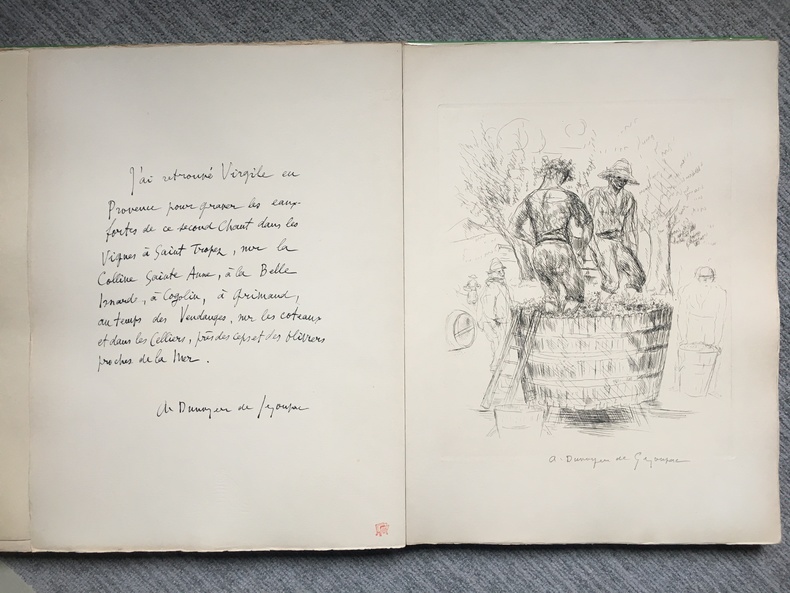
19441791Paris, aux dépens de l'artiste, l'Imprimerie Nationale 1944 (1947). 2 volumes grand in-folio (46 x 34 cm) en feuilles, sous chemises et étui de l'éditeur. Texte en latin et en français traduit par Michel de Marolles. 119 EAUX-FORTES ORIGINALES DE André DUNOYER DE SEGONZAC. Tirage unique à 225 ex. numérotés sur papier vélin d'Arches. 1 des 220 exemplaires avec l'état définitif (n° 176) sur vélin filigrané. Tirage des eaux-fortes par Jacques Frélaut chez Roger Lacourière. Typographie choisie par Ambroise Vollard, impression du texte sur les presses de l'Imprimerie Nationale. Le chef-d'œuvre gravé de l'artiste.
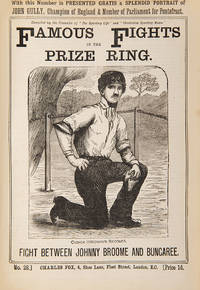
106190London Charles Fox c. 1888. . 36 issues bound in one volume; 4to 257 x 198 mm; 36 full-page graphic pictorial covers scattered foxing some toning to leaves a few short closed edge tears 3 sections of news article on boxing pasted to rear blank flyleaves; contemporary half brown leather pebbled cloth boards gilt lettering to spine a few minor spots to covers some material loss to foot of spine light rubbing to extremities overall a very good copy; 288pp.<br /> Publisher's complete grouping of 36 issues of this very obscure bare-knuckle boxing history. <br /><br />This weekly was originally issued in serialised format beginning in about 1877. Each issue consists of 8 pages with a pictorial cover showing known boxers. All of the historical champion bare-knuckle boxers and major fights are included. This grouping of 36 issues all published was apparently bound together by the publisher after all the parts were issued. The compiler Charles Fox was also the promoter of 'The Sporting Life' and 'Illustrated Sporting News'. <br /><br />While separate issues are occasionally offered bound copies of all 36 issues are especially hard to come by OCLC locates only two sets of this complete grouping; only one auction listing recorded in the last 50 years 1997.<br /> London, Charles Fox, [c. 1888]. hardcover