LEDET, MichelLivre Rare Book

234 résultats
20061251762006 Editions LELA Presse - 2006 - Fort in-4, cartonnage illustré - 581 pages - Nombreuses illustrations en couleurs et en N&B, in et hors texte, dans l'ouvrage
Softcover in-8° , 152 pp., broché. Bel exemplaire. [WE-3]
1952EYL-254Monaco, Editions du Rocher, 1952. In 12 de 251 p., 1 f. Demi maroquin vert sombre à bandes, dos à nerfs orné de filets dorés et à froid, et deux petits fleurons dorés, tête dorée, couvertures conservées. Bel exemplaire.
200611078Augsburg, Weltbild, 2006. PP, OU, 192S, gutes Exemplar
2006215715Augsburg: Weltbild, 2006. 192 S., zahlr. Ill., Kt., 31 cm. Opp., gebundene Ausgabe, SU.
198318591CBEbersberg/Obb., Edition 8 1/2, 1983. 4°, 125 S mit zahlreichen s/w- und Farbabbildungen, farbig illustr. original Kartonage (Paperback), Erstausgabe kleiner Besitzervermerk auf Vorsatzseite, sonst schönes, sauberes Exemplar
In 4, br. ed. ill. col. pp. 179, ill. in n. e col. n.t.; Catalogo esposizione "Samurai" realizzata per iniziativa del Credit Comunal de Belgique, Bruxelles, 21 septembre -18 novembre 1984. Lievi tracce d'uso alla cop. interno in buono stato.Luogo di pubblicazione BruxellesEditore Passage 44Anno pubblicazione 1984Materia/Argomento Arte, Giappone, Samurai, Cataloghi mostre
12477, Brussel, Gemeentekrediet, 1984., softcover, originele geillustreerde uitgeversomslag in kleur, 21x29,5cm, 181pp, geillustreerd in kleur en z/w,
470 pages. Index. "A superb piece of scholarship, admirable for its integrity and painstaking research. Provides the fresh air of reason in a national debate too often marked by acrimony and prejudice." - Tom Clancy. Light wear. Usual library markings. Nice clean copy with minor lean to spine. Book
178 pages including bibliography and colour plates. A series of picaresque adventures set against the backdrop of a Japan still closed off from the rest of the world. "...Opens a wonderful window into the real-life conditions of a down-at-the-heels lower-middle level samurai." - Susan Matisoff. Average wear. Moderate lean to spine. Decent copy with usual library markings. Book
19632090202118205095Kadokawashoten 1963. Soft Cover. Fine. The book is in fine condition. Kadokawashoten paperback
19772081502112100155Not Available 1977. Soft Cover. Fine. The book is in fine condition. Not Available paperback
199742011ABKöln, Kunsthandel Klefisch, 1997. 8°, 102 Textseiten und 32 Tafelseiten mit wenigen Farb- und zahlr. s/w-Abb., beschrieben und oftmals abgebildet sind 662 Positionen, illustr. original Kartonage, schönes, textsauberes Exemplar
197742007ABKöln, Kunsthandel Klefisch, 1977. 8°, 141 S. mit zahlr. s/w-Abb. und Illustr., beschrieben und oftmals abgebildet sind insg. 1.248 Positionen, illustr. original Kartonage, der helle Einband etwas berieben, sonst aber ein schönes, textsauberes Exemplar
198442006ABKöln, Kunsthandel Klefisch, 1984. 8°, 88 S. mit zahlr. s/w-Abb. und Illustr., beschrieben und oftmals abgebildet sind 353 Positionen, illustr. original Kartonage, schönes, textsauberes Exemplar
198542005ABKöln, Kunsthandel Klefisch, 1985. 39 S. mit zahlr. s/w-Abb. und Illustr., abgebildet und beschrieben sind 86 Positionen, illustr. original Kartonage (geheftet), der Rückendeckel minimal berieben, sonst ein schönes, textsauberes Exemplar
199242009ABKöln, Kunsthandel Klefisch, 1992. 8°, 99 Textseiten und 55 Tafelseiten mit zahlr. Farb- und s/w-Abb., beschrieben und oftmals abgebildet sind 622 Positionen, illustr. original Kartonage, schönes, textsauberes Exemplar
199342010ABKöln, Kunsthandel Klefisch, 1993. 8°, 84 Textseiten und 22 Tafelseiten mit wenigen Farb- und zahlr. s/w-Abb., beschrieben und oftmals abgebildet sind 729 Positionen, illustr. original Kartonage, schönes, textsauberes Exemplar
br. Lo zen, il ramo del buddhismo che sottolinea maggiormente la disciplina meditativa, fu anche la filosofia di vita scelta dai samurai, la classe militare giapponese che assunse il potere nel 1600, mantenendo pieno controllo del paese fino alla restaurazione (1867). In che modo una filosofia serena e contemplativa poté rispondere alle esigenze del samurai aiutandolo a perfezionare le capacità marziali e schermando la sua mente dalla naturale paura della morte? L'autore esamina in dettaglio la disciplina e l'esperienza zen, soffusa di elementi taoisti, e la sua diffusione in Giappone, dapprima come scuola minore e poi come religione appropriata al guerriero. Quindi passa ad analizzare la figura del guerriero giapponese, il bushi, spiegandone in dettaglio condizione sociale, costumi, principi morali e loro evoluzione nel corso della storia giapponese. Un'attenzione particolare è dedicata agli stili di combattimento e alle armi, soprattutto la spada, 'anima del samurai'. Riallacciandosi alla storia moderna, King prende in esame l'eredità dei samurai e il risorgere dei loro valori durante l'espansione del Giappone in Asia e la seconda guerra mondiale. Gli stessi valori sono alla base della struttura stessa della società giapponese odierna, e ben evidenti negli ambienti di lavoro, nella scuola e nella famiglia.
19762092902137302662Nichido Gallery 1976. Soft Cover. Fine. The book is in fine condition. Nichido Gallery paperback
20122082702114910584Kanagawa Prefectural Museum of History 2012. Soft Cover. Fine. Number of pages: 303 pages Size: 30cm Kanagawa Prefectural Museum of History paperback
19322090502126903495Nobara-sha 1932. Soft Cover. Fine. Size: paperback Nobara-sha paperback
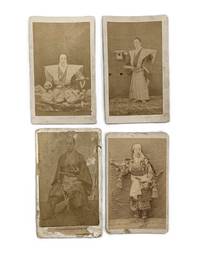
1860231401860. Meiji JapanSamuraiKabuki Theatre Samurai identity in the late 19th century photo archive documenting kabuki depictions of warrior masculinity in Japan during the early Meiji period made after the abolition of the samurai class when images of warriors continued to shape popular understandings of military tradition and masculinity in Japan. These four photographs preserve samurai imagery as presented in popular theatre at a time when Japan's military identity was changing under rapid political transformation. The archive is especially strong for showing how kabuki performance sustained martial ideals in visual form after the social foundations of hereditary warrior status had been dismantled.<br /> Photo archive of 4 albumen carte-de-visite photographs approximately 2.5 x 3.5 inches Japan circa 1860s-1880s. The images show male sitters posed in studio interiors against plain backdrops and atop patterned floor coverings each dressed as a samurai or warrior character. One figure stands in full armor with a sword at his side and a striped staff or bow-like prop in hand his costume built from lamellar armor tassels shin guards and layered protective dress that stress the ceremonial weight of warrior costume. A second sitter tentatively identified as kabuki actor Jitsukawa Enjaku appears seated frontally in voluminous robes with sharply extended shoulder forms flanked by swords and posed on a textile-covered platform in a deliberately formal composition. A third stands holding a small prop structure in one hand with a sword tucked at the waist while a fourth in a more lightly defined but heavily worn image sits in traditional dress with topknot hairstyle and blades visible at the sash. Across the group the repeated use of swords stylized posture and exaggerated makeup grounds the archive in theatrical samurai iconography rather than ordinary portraiture.<br /> These photographs belong to the decades in which photography popular prints and theater recoded samurai visuals as a national historical image rather than a living class identity. Kabuki played a central role in that process preserving warrior narratives and masculine ideals for mass audiences while early commercial photography made those images widely distributable and accessible. For institutions building Japanese photography theater or military history holdings the archive offers direct evidence of how samurai identity was presented popularized and circulated in the first generation of Japanese photography. Heavy fading staining edge wear and mount losses to several cards most notably one with substantial abrasion and corner loss; overall fair to good condition. A group exemplifying the presentation of samurai imagery in popular theatre and photography in Meiji Japan. unknown
2002110449Dreamland éditeur, coll. « CinéPulp », n° 2 2002 In-8 broché 21 cm sur 15,5. 135 pages. Bon état d’occasion.
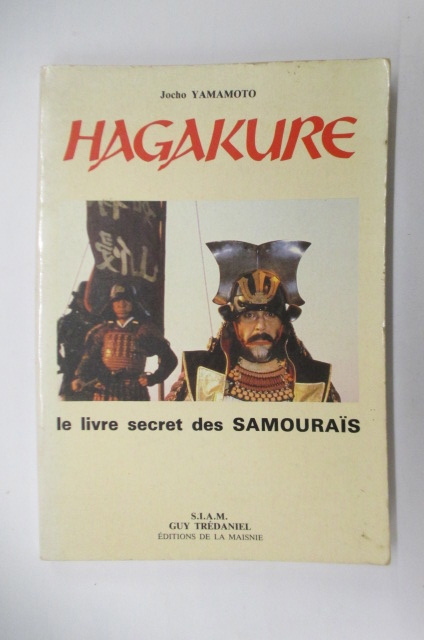
SCH629C961984 / 101 pages. Broché. Editions Trédaniel.