67 résultats
19162080202102705284Foreign sugar industry 1916. Soft Cover. Fine. Page size: 267 pages Size: A5 size Foreign sugar industry paperback
20032080202102500812Shinkosho Co. Ltd. Campus 2003. Soft Cover. Fine. The book is in fine condition. Shinkosho Co., Ltd. Campus paperback
19912110502151102797Not Available 1991. Soft Cover. Fine. Number of books: 1 Not Available paperback
18812082402113510423Rairakudo 1881. Soft Cover. Fine. Volume: 1 Rairakudo paperback
18822111902160200608Hiro-rei-sha 1882. Soft Cover. Fine. Number of pages: 114 pages Size: 18.5cmx12.5cm Number of books: 1 Hiro-rei-sha paperback
19462091502135410244Shinsei-sha 1946. Soft Cover. Fine. Number of books: 1 Shinsei-sha paperback
19962091502135405582Chinese Medicine Publishing House 1996. Soft Cover. Fine. Number of books: 1 Chinese Medicine Publishing House paperback
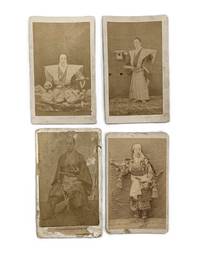
1860231401860. Meiji JapanSamuraiKabuki Theatre Samurai identity in the late 19th century photo archive documenting kabuki depictions of warrior masculinity in Japan during the early Meiji period made after the abolition of the samurai class when images of warriors continued to shape popular understandings of military tradition and masculinity in Japan. These four photographs preserve samurai imagery as presented in popular theatre at a time when Japan's military identity was changing under rapid political transformation. The archive is especially strong for showing how kabuki performance sustained martial ideals in visual form after the social foundations of hereditary warrior status had been dismantled.<br /> Photo archive of 4 albumen carte-de-visite photographs approximately 2.5 x 3.5 inches Japan circa 1860s-1880s. The images show male sitters posed in studio interiors against plain backdrops and atop patterned floor coverings each dressed as a samurai or warrior character. One figure stands in full armor with a sword at his side and a striped staff or bow-like prop in hand his costume built from lamellar armor tassels shin guards and layered protective dress that stress the ceremonial weight of warrior costume. A second sitter tentatively identified as kabuki actor Jitsukawa Enjaku appears seated frontally in voluminous robes with sharply extended shoulder forms flanked by swords and posed on a textile-covered platform in a deliberately formal composition. A third stands holding a small prop structure in one hand with a sword tucked at the waist while a fourth in a more lightly defined but heavily worn image sits in traditional dress with topknot hairstyle and blades visible at the sash. Across the group the repeated use of swords stylized posture and exaggerated makeup grounds the archive in theatrical samurai iconography rather than ordinary portraiture.<br /> These photographs belong to the decades in which photography popular prints and theater recoded samurai visuals as a national historical image rather than a living class identity. Kabuki played a central role in that process preserving warrior narratives and masculine ideals for mass audiences while early commercial photography made those images widely distributable and accessible. For institutions building Japanese photography theater or military history holdings the archive offers direct evidence of how samurai identity was presented popularized and circulated in the first generation of Japanese photography. Heavy fading staining edge wear and mount losses to several cards most notably one with substantial abrasion and corner loss; overall fair to good condition. A group exemplifying the presentation of samurai imagery in popular theatre and photography in Meiji Japan. unknown
19712090502113717998Not Available 1971. Soft Cover. Fine. The book is in fine condition. Not Available paperback
2080202103705079Kashiwashobo N.A. Soft Cover. Fine. Page size: 128p Size: 22cm A5 Kashiwashobo paperback
20062090502113717829Not Available 2006. Soft Cover. Fine. The book is in fine condition. Not Available paperback
19422110502150412071Kijokai Tokyo City 1942. Soft Cover. Fine. Volume: 1 Kijokai (Tokyo City) paperback
1800305220Nara 1800. 152 woodcut illustrations some double-page across several bifolia on mulberry paper. Folio 380 x260 mm. With a small stain on the opening pages thicker paper covers slightly soiled the upper cover with a few worm holes not affecting illustrations. upper cover title label not present. Stitched. Ownership chop of Sato Takekicho. 152 woodcut illustrations some double-page across several bifolia on mulberry paper. Folio 380 x260 mm. Woodcut book of the samurai armor at the Kasaga Shrine Nara Prefecture <br /> <br /> "A fine illustrated text on an important collection of ancient samurai armor. The Kasaga shrine in Nara was the shrine of the Fujiwara family first built in 768 and rebuilt several times over the centuries and is now one of the more important in Japan and a Unesco World Heritage Site. The family armor which came to be placed in the Shrine includes pieces dating from the 12th century such as a special helmet with a sparrow motif said to have been dedicated by Minamoto no Yokishitsune dating form the Kamakura period 1185. The shrine is famous for its bronze lanterns. unknown
20122082702114910584Kanagawa Prefectural Museum of History 2012. Soft Cover. Fine. Number of pages: 303 pages Size: 30cm Kanagawa Prefectural Museum of History paperback
19632090202118205095Kadokawashoten 1963. Soft Cover. Fine. The book is in fine condition. Kadokawashoten paperback
19292110502150414177Japan Broadcasting Corporation Tokai Branch Nagoya City 1929. Soft Cover. Fine. Volume: 1 Japan Broadcasting Corporation Tokai Branch (Nagoya City) paperback
TE-57WM-2XXEFine. Fine book & jacket. unknown
19712092902137306776Japan Arts and Crafts Company 1971. Soft Cover. Fine. The book is in fine condition. Japan Arts and Crafts Company paperback
19642090202118201918Japan Arts and Crafts Company 1964. Soft Cover. Fine. The book is in fine condition. Japan Arts and Crafts Company paperback
19642090202118202476Japan Arts and Crafts Company 1964. Soft Cover. Fine. The book is in fine condition. Japan Arts and Crafts Company paperback
19932080302106807940Kashiwashobo 1993. Soft Cover. Fine. Size: A5 version 279 pages Number of books: 1 Kashiwashobo paperback
19342091502135415490Dai bun kanshoten 1934. Soft Cover. Fine. Number of books: 1 Dai bun kanshoten paperback
18852090502128300123Not Available 1885. Soft Cover. Fine. The book is in fine condition. Not Available paperback
1840122137Japan: c.1840s. A samurai's armour was a map of his spiritual power A colourful and intricately painted explanation of the complex steps samurai followed to don their famous warrior armour and required undergarments. The sequential illustrations show the fitting of a loincloth shirt and cord belt. The figure puts on trousers slippers leggings sandals greaves and thigh guards followed by the external armoured vest belt and shoulder guards. A couple of paintings show the warrior jumping and moving to test the fit of the armour and the security of the knots. Finally he straps on his swords and secures his mask helmet and arm guards completing a fearsome appearance. This manuscript was brushed on the cusp of the major changes in the status of the samurai. After the Meiji Restoration imperial decrees began to curtail their privileges and elite social standing - changes which transformed works like the present example into valuable historical documents. Quarto 267 x 197 mm ff. 15. With 30 original colour illustrations. Contemporary brown wrappers early 20th-century green thread yotsume toji stitching manuscript title label on front cover. Red ownership seal of the artist Hitomi Yuuichi Gyokuransai d.1968 on first leaf. Losses at foot of spine stitching split but still sturdy worming to wrappers and contents illustrations generally unaffected inner rear cover with old paper repair: a good example attractively illustrated. Antony Cummins & Yoshie Minami eds Samurai Arms Armour & the Tactics of Warfare: the Collected Scrolls of Natori-Ryu 2018. hardcover
19362080502106511289Toyama bo 1936. Soft Cover. Fine. Volume: 1 Toyama bo paperback