[Women's Liberation] [Andre Citroen]Biblio.com
652 résultats
77190Paris Citroën 1915-1916. In two volumes. Oblong folio 31.5 x 43.7 cm. 71 original photographs 22.0 x 28.5-35.5 cm mounted on grey cardboard with printed captions 60; 11. Uniform full mottled calf. Boards with double gilt-rolled ornamental borders and gilt title. = A very rare set both volumes dealing with the Parisian factory founded by André-Gustave Citroën 1878-1935 renowned for its technologically advanced cars but also for its contributions to the French war industry during WWI and in particular the contributions women made as factory workers in the mass production of artillery shells. The first volume is entirely devoted to this subject showing the female munitions-workers at work. André Citroën played an essential part in French women's emancipation: once the women had left their traditional singular role as homemakers replacing the men who fought in the trenches there was no looking back and after the war their participation in the country's workforce became permanent. "World War I radically changed women's role in society as they stepped into the boots of men gone to fight for their countries. In cities across Europe women took on traditionally 'male' jobs - waiting on tables delivering the mail teaching in boys' schools or handling cash as bank clerks. 'Women rapidly became indispensable not only in the nursing and welfare services but in offices and factories and agriculture changing the whole balance of society in the process' says historian Michael Howard. As soon as war broke out in 1914 France's prime minister Rene Viviani called on women to 'replace in the workplace those who are on the battlefield'. . From 1915 onwards Europe's industry - devoted to the war effort - relied massively on the female workforce as did that of the United States from 1917. 'Without women victory will tarry' warned Britain's soon-to-be prime minister David Lloyd George in 1915. Some 400000 women were toiling in France's war factories by 1918 - a quarter of the workforce - handling some 2500 shells per exhausting 11-hour shifts" AFP. The second volume records the building and operational start of the factory itself. It shows the evolution of the works starting with a photo of the still-vacant lot save for gardens and sheds followed chronologically by views of all building developments including one with the famous Eiffel Tower in the distance. Groundwork started in March 1915 and by the 28 September the largely female workforce had already become fully active. The final photo shows the official ceremonial opening of the factory on 24 June 1916 revealing decorations given by General Gilinski on behalf of the Russian emperor. "As soon as war was declared in August 1914 André Citroën was mobilized as a lieutenant then as captain in the 2nd Grenoble Artillery Regiment. On the eastern front he was able to witness France's lack of artillery and ammunition to counter the German forces. Following the death of his brother Bernard on the front André Citroën was determined not only to do his duty but also to repel the enemy as far as possible. In January 1915 he proposed to General Louis Baquet director of artillery at the Ministry of War which was sorely lacking in ammunition to apply Fordism in a factory built in three months and capable of producing 5000 to 10000 artillery shells of Type 75 per day. Thanks to his savings those of his right-hand man Georges-Marie Haardt and especially financing from a rich diamond dealer of Armenian origin Atanik Eknayan who had already saved his fragile Mors 12 car business Citroën erected a huge ultramodern factory on 15 hectares of vacant land and vegetable gardens on the Quai de Javel. With some 13000 workers the factory produced 23 million shells at a rate of 10000 per day an unprecedented rate at the time. 'You have to produce quickly well and economically to put the products manufactured within the reach of the greatest possible number of consumers he said. The pace the factories imposed on workers was tiring and as a result André Citroën was sometimes considered a despot. Nevertheless he was one of the first manufacturers concerned about the well-being of his workers and avoided imposing repetitive tasks. André Citroën's ammunition business quickly gained a reputation and became a model of organization efficiency and social responsibility. Major personalities both civil and military visited the factory. Between 1917 and 1918 the government also charged Citroën with reorganizing supplies for the armaments industry the military postal services and with the distribution of bread ration tickets in the Paris region. When the war was over André Citroën decided to convert his factory on the Quai de Javel into a car manufacturing plan" taken from French Wikipedia. Boards a bit rubbed; a skilful repair to one joint one photograph with a brown spot in the top left corner; otherwise in an excellent state. hardcover
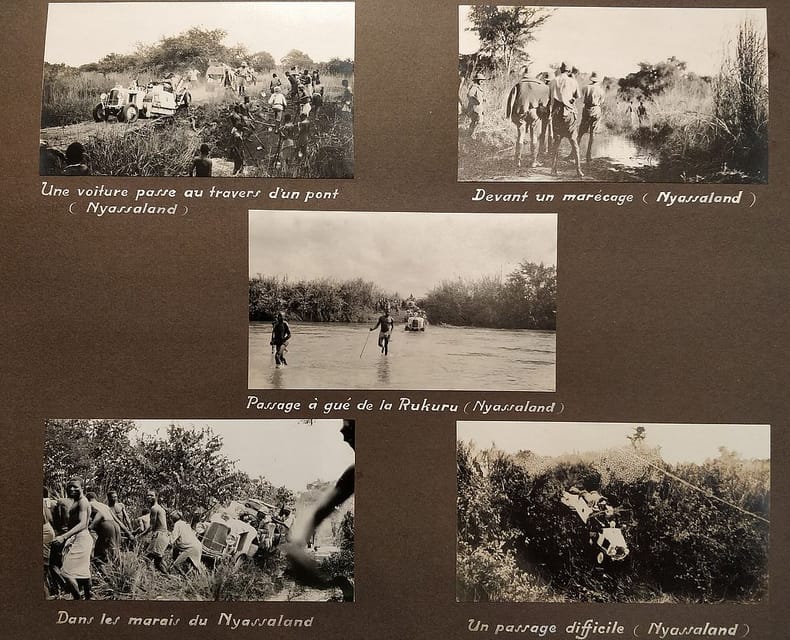
020222Exceptionnel album contenant 311 photographies, épreuves sur papier baryté (tirage argentique). Cet ensemble de photographies est présenté dans deux volumes à l'italienne (345*460mm). Le premier volume contient 205 photos et le second 106 photos, réparties sur 71 pages. La majorité des photos sont au format environ 80*138mm, de nombreuses photos sont plus grandes, environ 118*165mm. Les photos sont globalement en très bon état, quelques-unes sont jaunies. Le corps du premier volume est détaché de la reliure (ouvrage très lourd, difficile à manipuler). L'album commence par une page de titre, les photos des 18 membres de l'expédition, puis les photos de l'expédition à proprement parler. Toutes les photos sont légendées vraisemblablement par Specht, avec néanmoins quelques erreurs (Specht indique rapidement Nyassaland alors que l'expédition est encore en Tanzanie par exemple). Notons que dans les membres de l'expédition, on trouve Baba, interprète, boy et cuisinier, personnage souvent absent. Un détail particulièrement cocasse : on ne voit pas Léon Poirier parmi les membres de l'expédition, et on ne le voit d'ailleurs que très peu dans l'album. Specht était pourtant son assistant. Il ne nomme d'ailleurs que très rarement les personnages de l'expédition dans l'album, y compris quand il est présent sur les photos. Les photographies montrent toute la Croisière Noire depuis le départ jusqu'à l'arrivée et suivent en particulier le trajet du groupe Haardt dont faisait partie Specht (mis en évidence sur la carte ci-contre). Il s'agit donc du trajet qui, arrivé à Tabora (Tanzanie), continue vers le Malawi en longeant le lac Nyassa et arrive au Mozambique portugais. Cet album est un témoignage quasi-unique de la Croisière Noire et est l'unique album-souvenir connu à ce jour. En effet, Georges-Marie Haardt possédait un tirage de quasiment toutes les photos, le tout réparti dans 11 volumes. Cet ensemble était donc plutôt une archive et non un album souvenir et les manques sont les quelques erreurs quasi-inévitables sur un tel nombre de photographies. Il a été acquis auprès de la famille par le musée du quai Branly en 1967. On retrouve en ligne une partie des photographies numérisées . Audouin-Dubreuil possédait 189 photographies, dans des tirages similaires aux nôtres (dimensions comprises), qui avaient souvent été contrecollées mais sans faire partie d'un album. L'ensemble fut d'ailleurs divisé en 4 lots lors de la vente en 2010 . Elles semblaient reprendre des épisodes de la totalité de l'expédition. Specht a donc fait sa propre sélection. Cet exceptionnel ensemble, impossible à détailler précisément, est à découvrir. La quasi-totalité des photographies sont bien choisies : belles vues animées, beaux portraits, peu de paysages, beaucoup de photographies montrant des anecdotes comme les passages difficiles, notamment la partie au Nyassaland qui était considérée comme impossible par les anglais et aussi la vie courante et des personnages de l'expédition. On voit un peu tous les membres de l'expédition et beaucoup les autochenilles. Notons que le début se concentre plus sur les populations et les évènements liés au passage de la croisière. La seconde partie en revanche se concentre principalement sur les autochenilles, avant une série de photos à Madagascar. Quelques photos à la fin concernent le retour et le passage par Zanzibar et le canal de Suez. Une telle réunion de photographies originales de la Croisière Noire, couvrant toute l'expédition, est quasi-unique voire unique puisqu'on ne connait aucun équivalent sur le marché et que le seul album similaire est celui de Haardt, conservé au musée du Quai Branly et qui constitue une archive et non un album-souvenir. Une seule photographie de cet album n'est pas dans le fonds Haardt (oubli vraisemblable). Une liste détaillée des photos avec son numéro et la référence dans le fonds Haardt sera remise à l'acheteur. Plus de renseignements sur demande.